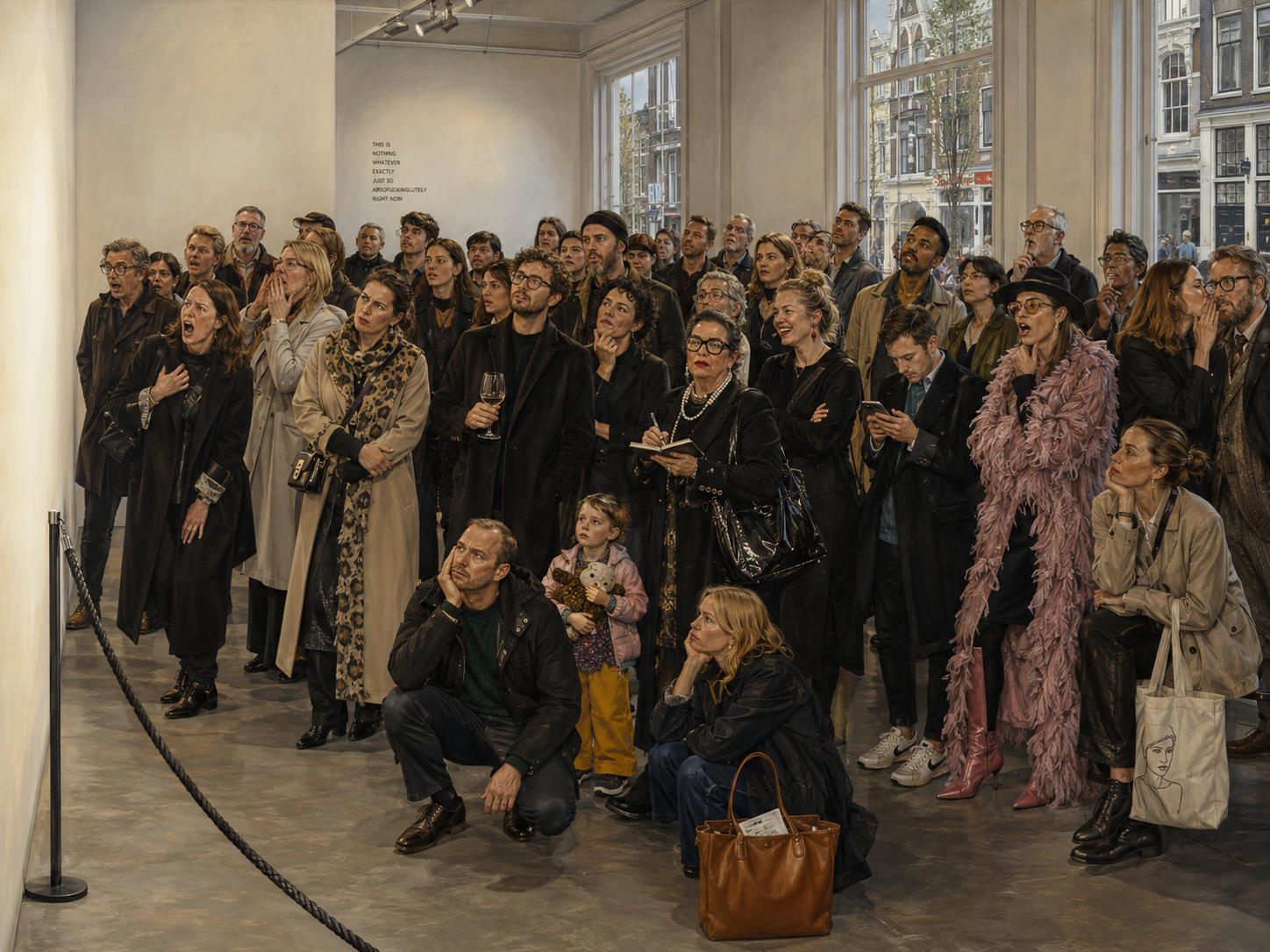
 No seriously. I live in de Jordaan now. It’s goddamn 50% Galleries in all these delightful little streets here. A sizeable percentage of people here are fake as fuck. They live in a completely detached state of derealization. Oh yeah and literally everyone here is white as fuck. There’s several primary schools in the street, parents arriving with these cargo bikes with kids draped in by the gross, kids marching by, singing creepy . I moved into the Jordaan and discovered, to my considerable alarm, that I am now one of Those People.
CHRISTIE’S AMSTERDAM’S “ANGRY ARTISTS” AUCTION: THE WEEK AMERICA LOST ITS MIND
By breakfast in New York, the photographs from Amsterdam are everywhere. These are not anonymous canvases hanging in some damp Rotterdam warehouse gallery, not internet agitprop, not a student exhibition lubricated by warm wine and somebody forcing industrial noise through a broken amplifier. This is Christie’s. Serious auctioneer, serious provenance, serious collectors, serious money. Twelve million euros. Fourteen million. Sixteen million. Seven million. The numbers are what make everything worse, because obscenity becomes much harder to dismiss once somebody with a private banker has raised a paddle for it.
The hammer has barely fallen on The Hacking of Mark before American television begins screaming. The painting depicts Mark Zuckerberg dragged from some collapsed perimeter of technological sovereignty by an enraged crowd, bruised, bleeding from the mouth, bewildered, while a woman calmly prepares a noose behind him. His face is not defiant. That is the particularly cruel detail. He looks frightened and confused, the expression of a man discovering that the abstraction called “society” has suddenly acquired hands.
The first American chyron is inevitable: CHRISTIE’S SELLS ZUCKERBERG LYNCHING FANTASY FOR $14 MILLION. The noose itself is blurred on television, which somehow makes the whole thing feel dirtier. Conservative hosts demand to know how this qualifies as art, whether Christie’s would sell similar imagery aimed at a Black CEO, whether some unstable viewer might interpret the painting as instruction rather than fantasy, and whether American institutions should continue doing business with an auction house willing to turn the imagined killing of a living American businessman into a blue-chip collectible.
The presenter keeps returning to the number because the number is the wound. Twelve million euros. Somebody paid twelve million euros for this.
By afternoon, members of Congress have discovered the exhibition. One senator calls the work “the celebration of political murder” and demands that American institutions reconsider any relationship with Christie’s. Another lawmaker starts talking about museum funding. A third suggests hearings. The usual machinery comes rattling out of storage. America has spent decades insisting that markets reveal value, and now the market has revealed a value nobody particularly wanted to see.
Then somebody uploads Last Dividend.
The temperature goes through the ceiling.
The Bezos painting is technically astonishing, which is part of the problem. It does not look symbolic. It looks witnessed. Bezos has been forced to the floor by masked figures and seems almost unable to comprehend the transformation. He is not painted as a titan brought down by titans. He looks like a frightened middle-aged man confronting the discovery that liquidity, logistics, influence, personal security and unimaginable wealth have somehow all stopped functioning at the same time. Behind him rises the guillotine, and the composition contains enough visual information to make American broadcasters refuse to show the complete canvas.
European broadcasters are less squeamish. France 2 gives viewers a warning and displays it. The BBC crops it. Dutch television shows the entire painting while two art historians calmly discuss its debt to Caravaggio, chiaroscuro and seventeenth-century martyrdom compositions. This enrages Americans even more. The Europeans are not merely displaying the thing. They are being cultured about it.
The New York Times responds with a vast Sunday essay under the restrained headline When Political Rage Becomes Luxury. The critic never quite condemns the works and never quite absolves them, which naturally infuriates everybody. The central observation is that the most disturbing feature of the paintings is not their violence but their technical sincerity. These are not cartoons. They borrow the visual grammar once reserved for kings, saints, martyrdoms, battles and dynastic collapse. Billionaires have become the new monarchs, and their imaginary destruction has become history painting.
BURNING MAN
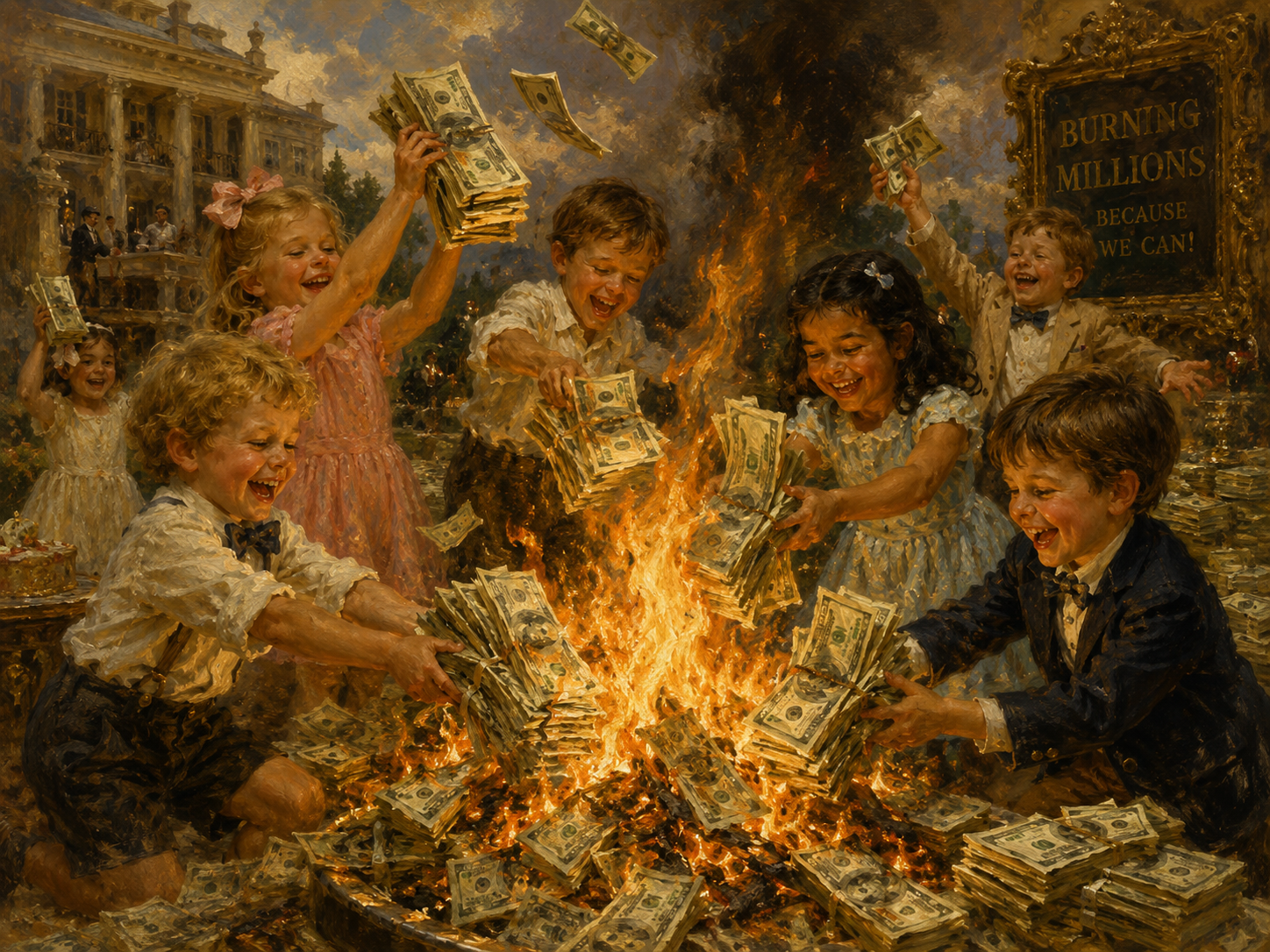
The Times is particularly fascinated by The Burning Man, the €16 million Musk canvas. Elon Musk is trapped inside a burning Cybertruck while children gather around it, laughing and tossing bundles of burning banknotes into the flames. The work is hideous, funny, juvenile, magnificent and somehow impossible to reduce to any one of those things. The Times calls it “an appalling, extraordinarily accomplished inversion of the nineteenth-century industrial sublime,” which immediately becomes a secondary scandal. An evening host nearly combusts over the phrase. “Appalling but extraordinarily accomplished? So now we compliment assassination fantasies because the brushwork is good?”
The Wall Street Journal suffers no comparable hesitation. Its editorial page runs THE BILLIONAIRE POGROMS COME TO CHRISTIE’S and accuses European cultural institutions of nurturing what it calls a fashionable aristocracy of anti-capitalist sadism. Yet the Journal also notices the contradiction that will haunt the entire movement: the buyers must themselves be enormously rich. Revolutionary paintings about the destruction of billionaires are being purchased by other billionaires.
Capital has discovered anti-capitalist death imagery and, after a brief period of alarm, has asked for the catalogue.
CNBC spends half a morning trying to determine who bought the Musk. Nobody knows. Rumors ricochet through finance. A hedge-fund manager privately claims that three people at Davos are already joking about wanting one. Another collector supposedly asked Christie’s whether there were any “less overtly political examples,” which is rather like asking whether the crocodile comes in vegetarian.
Fox News abandons subtlety altogether. EUROPE’S DEATH CULT. CHRISTIE’S CASHES IN ON MURDER PORN. ARE AMERICAN BILLIONAIRES SAFE IN AMSTERDAM? One commentator wants the artists barred from entering the United States. Another claims the paintings constitute threats. A First Amendment lawyer patiently explains that grotesque depictions of public figures are generally not equivalent to true threats and is promptly talked over, because nobody has invited him on television to make the situation less exciting.
MSNBC encounters a different difficulty. The paintings are plainly aimed at oligarchs, authoritarian politicians and extreme concentrations of wealth, all subjects the network’s audience is accustomed to criticizing. Unfortunately, they are also horrific. One presenter spends nine agonizing minutes attempting to explain that it is possible simultaneously to oppose billionaire dominance over democratic society and oppose fantasies about billionaires being physically destroyed. It is a reasonable position, which makes it almost useless for television.
Then the Netanyahu painting appears and the argument changes again.
The work shows Israeli mothers killing Benjamin Netanyahu with ordinary kitchen knives. They are not painted as ecstatic avengers. They are exhausted, filthy, grieving, some of them crying as they attack him. The image detonates across Israeli television. The Israeli ambassador in The Hague calls it “a cultural obscenity.” Pro-Palestinian activists divide immediately between those who see the work as a furious indictment of political responsibility and those who argue that reducing mass suffering to personalized revenge turns actual Palestinian death into theatrical vengeance.
Christie’s finally issues a statement insisting that it does not endorse the political content of works offered for sale and that its role is to provide a marketplace for works of recognized artistic significance.
This accomplishes approximately nothing.
CNN assembles the inevitable panel: an art historian, a former Secret Service official, a scholar of political violence, an auction-market specialist, a free-speech attorney and somebody whose professional title contains the phrase “digital extremism.” Nobody agrees on anything. The security expert explains that disturbing imagery does not automatically constitute a threat. The extremism specialist warns about normalization. The art historian finally says, “If Goya were alive today, you people would have him on a watch list.”
The clip gets thirty million views.
Musk inevitably responds to his own painting. At first he laughs. Then he becomes annoyed. Then somebody points out that his imaginary death has fetched more than those of Trump, Putin and Netanyahu. He posts, “Apparently I’m worth €16M dead ,” follows it shortly afterward with a suggestion that Christie’s should auction a painting showing the artists receiving the treatment they fantasize about, and then complains that “art” apparently means violence against people the establishment dislikes.
Seventeen thousand people reply with versions of the same observation.
You are the establishment.
The argument consumes the platform for forty-eight hours.
Meta responds more cautiously and therefore more strangely. The company issues a corporate statement saying that violence directed at any individual is unacceptable and that cultural institutions should consider the societal consequences of normalizing imagery depicting real people being harmed. Within minutes, users flood the replies with screenshots of violent material that has circulated through Facebook over the years.
Then somebody notices the title again.
The Hacking of Mark.
The artist has painted Zuckerberg being physically hacked apart by the social body his company is accused of having hacked psychologically, politically and commercially. The title becomes the subject of seminars before the week is over. Somebody writes a dissertation proposal. Somewhere, an academic discovers the phrase “recursive corporeal platform critique” and commits it to paper.
The Trump painting initially sells for “only” €5 million.
Trump notices.
This becomes a story all by itself.
The work depicts the Trump family in a mass grave after execution. Trump himself lies staring upward with one ruined eye, and the composition unmistakably borrows from twentieth-century atrocity photography. German critics, in particular, will later object fiercely to this aesthetic appropriation, but before that serious argument can happen Donald Trump posts that the work is “DISGUSTING FAKE ART BY SICK EUROPEAN COMMUNISTS.”
Then somebody points out the price differential.
Musk: sixteen million.
Trump: five.
The inevitable post arrives: ONLY 5 MILLION? THEY PAID MORE FOR MUSK. CHRISTIE’S IS RIGGED!
For approximately six hours, the United States enters a previously unimaginable political condition in which Trump supporters and Trump opponents argue about whether Donald Trump’s imaginary corpse has been undervalued by the international art market. A late-night comedian observes that Trump may be the first former president to demand a higher market valuation for his own mass grave.
Putin’s reaction is different. The work depicting his corpse in a ruined building being eaten by stray dogs is not shown on Russian state television. It is described. The Kremlin calls the exhibition an example of European civilizational degeneracy, and the artist responsible is reportedly placed on various Russian undesirable-person lists. This has the completely predictable effect of increasing the painting’s estimated resale value.
The buyer who paid €7 million refuses interviews.
The Peter Thiel painting creates perhaps the strangest intellectual controversy of the entire auction. It does not depict his death. Instead, Thiel has been kidnapped by an African jihadist gang. Armed men march him toward a cage surrounded by gasoline drums while cameras record the scene. The horror exists almost entirely in anticipation. Nothing has happened yet. The painting is about the instant in which a man accustomed to thinking in terms of systems, jurisdictions, sovereign exits, private security and strategic geography realizes that geography has become personal.
Art critics adore it. Security professionals despise it. One critic calls it “the finest painting ever made about the moment wealth discovers geography.”
The phrase travels everywhere.
The Guardian responds by publishing enough contradictory essays to constitute a small civil war. One columnist calls the exhibition “a necessary howl from a generation raised beneath oligarchic weather.” Another dismisses it as pseudo-radical cruelty purchased by the exact class it pretends to despise. A third argues that the real artwork is not any individual canvas but the auction itself. The paintings depict the destruction of immense wealth, and the auction transforms those depictions into immense wealth.
Capitalism has eaten the revolution and asked for dessert.
France splits more elegantly. The right condemns the exhibition as barbaric. The left insists that the works belong to the long European tradition of political grotesque. Everyone mentions Goya. Somebody inevitably mentions Jacques-Louis David. A French critic points out that museums are full of kings being stabbed, saints being flayed, generals being dismembered and peasants being slaughtered, and nobody demands the Louvre put little curtains over them.
The American response comes immediately: “Those people are dead.”
The critic replies: “That is merely a scheduling distinction.”
The sentence becomes infamous.
Germany is less amused. The Trump mass-grave painting provokes a serious argument over the appropriation of Holocaust and Einsatzgruppen visual language. Major newspapers ask whether historical atrocity aesthetics can ethically be repurposed for contemporary satirical fantasy. Several German critics who admire the other paintings condemn this one specifically, arguing that some visual forms carry historical weight that cannot simply be borrowed because the artist wants maximum emotional voltage.
For once, nobody screams for twelve consecutive minutes. People actually argue about visual memory, inherited imagery and the moral limits of analogy.
The Angry Artists respond collectively: “History painting was never required to be polite.”
Germany remains unconvinced.
The Dutch reaction becomes the most infuriating of all to American audiences because it is so magnificently undramatic. NOS runs a sober eight-minute segment. A Christie’s representative explains provenance. An art historian explains why the works command such extraordinary prices. A lawyer explains that depiction is not endorsement. A collector describes the Bezos painting as “beautifully unpleasant.”
The presenter looks at the image for a moment and says, “Nou. Heftig.”
Then they move on to the weather.
American social media becomes deranged.
THE DUTCH THINK THIS IS NORMAL?
A Dutch account replies:
“No, we think it is a painting.”
The screenshot is shared approximately four million times.
By this point, the specialist art press has realized that something historically significant may actually be happening. Not because the paintings are violent. Art has been violent forever. Not because they attack powerful people. That too is ancient. The novelty lies in the collision between hyperrealist political hatred and blue-chip auction economics.
Until Amsterdam, Angry Art had been treated as aesthetically impressive but commercially radioactive. Then somebody pays €16 million for one.
Suddenly every gallery director on Earth wants to know who these people are.
The Angry Artists are mostly anonymous. Some use pseudonyms. One refuses photographs. Another communicates only through handwritten statements. Christie’s says almost nothing. Rumors multiply immediately. They are Ukrainian. They are Dutch. They are American. They are former advertising people. They are disgruntled concept artists from the videogame industry. One supposedly worked in visual effects. Another supposedly reconstructs seventeenth-century Flemish glazing techniques using custom-ground pigments. Somebody claims Banksy is involved.
Banksy almost certainly is not involved.
None of this matters.
Within three weeks, lesser Angry Artists begin appearing on the private market. A painting of a private-equity executive drowning beneath luxury handbags sells for €2.1 million. A pharmaceutical CEO sits at an enormous banquet while hospital patients stare through the windows and receives a €4 million offer. A monumental canvas shows hundreds of ordinary people standing silently along a harbor watching a billionaire’s yacht burn.
Museums become interested.
Then the rich become interested.
Every wealthy collector wants one.
Preferably depicting somebody else.
This produces the darkest joke of the entire movement: the super-rich begin competing to own the finest available images of the super-rich being destroyed.
At dinner parties in London, Zurich and New York, collectors begin discussing provenance, period, technique and political ferocity. “That is early Amsterdam.” “The handling of the skin is extraordinary.” “You can still see the Flemish influence.” “Mine has a dead telecom magnate.” The revolutionary image has become a status object, and perhaps the only thing more expensive than being publicly hated is acquiring a beautifully painted record of somebody else being publicly hated.
By the end of the month, the central question occupying American culture is no longer “How dare Christie’s sell these?”
It is “Who paid for them?”
Because somebody owns The Hacking of Mark. Somebody owns Bezos beneath the guillotine. Somebody owns Musk burning inside his Cybertruck. Somebody owns Putin being consumed by dogs.
Nobody knows who.
That anonymity frightens the subjects more than the paintings ever could.
A public insult has a speaker. A protest has organizers. A newspaper has an editor. But an anonymous collector who quietly pays sixteen million euros to own a monumental painting of your imagined destruction becomes something else entirely. It becomes social weather. Somewhere inside the global class you thought was yours, somebody apparently wants this object badly enough to spend the price of a townhouse on it.
That is harder to laugh away.
And then Christie’s announces the final indignity.
The next Angry Artists sale will not be held in Amsterdam.
It will be held in New York.
Estimated total:
$110–160 million.
At which point the argument is over in the only language the art market ultimately recognizes.
The scandal has become an asset class.
PREMATURE POSTMORTEM
Then….
MBS strapped alive to a forensic examination table beneath surgical lights, visibly terrified and stripped only enough to evoke the cold ritual of an autopsy rather than sexual humiliation. Around him lie the pathologist’s instruments, rulers, calipers, specimen trays, labels, and measuring tools, all arranged with bureaucratic neatness. The title is icily procedural: Postmortem, Premature.
At €18.2 million, the reaction becomes volcanic. Saudi media denounces the work as racist, dehumanizing and tantamount to incitement against the Crown Prince, while Riyadh reportedly begins applying pressure wherever it can reach: Christie’s commercial relationships, insurers, collectors, corporate partners, diplomatic channels and wealthy patrons. The United States finds itself in the exquisitely uncomfortable position of having to defend artistic freedom in principle while distancing itself from a painting that depicts one of its most strategically important Middle Eastern partners being prepared for dissection.
The art press, meanwhile, cannot stop talking about the obvious Khashoggi reference. The painting turns the forensic gaze back onto the ruler whose international reputation remains inseparable from the murder and dismemberment of Jamal Khashoggi. Critics argue furiously over whether the work constitutes moral inversion, sadistic revenge fantasy, legitimate political accusation, or simply one of the most vicious pieces of contemporary portraiture produced in decades. The technical quality only worsens the controversy, because this is not crude agitprop. It is composed with the gravity of history painting, lit with almost devotional precision, and executed with the kind of anatomical realism that refuses the viewer the comfortable distance of caricature.
Then the auction result lands: €18,200,000.
That number becomes the story. MBS has now overtaken Musk, Bezos and Zuckerberg as the most valuable subject in the entire scandalous cycle. Saudi commentators demand to know who bought the painting, American commentators demand to know who consigned it, and Christie’s refuses to identify either party. The anonymity immediately acquires its own sinister aura. Somewhere, someone has paid more than eighteen million euros to own this image, and nobody knows who.
One furious Gulf columnist writes that Europe has discovered a convenient cultural formula in which insulting Arabs becomes respectable once the canvas is expensive enough. An Amsterdam critic responds that the entire exhibition has spent the week insulting American, Russian, Israeli, Saudi and European power with equal enthusiasm, and that the outrage has less to do with ethnic dignity than with the sudden realization that contemporary art has rediscovered the old privilege of portraying rulers without asking their permission.
Then CNBC puts up the leaderboard. MBS sits at €18.2 million, Musk at €16 million, Bezos at €14 million, Zuckerberg at €12 million, Putin at €7 million and the Trump family at €5 million. The spectacle becomes grotesque in a new way because television starts discussing imaginary political deaths with the cadence of football transfer fees and quarterly earnings. Commentators debate who has “held value,” who has “outperformed,” and which subjects now command the strongest collector interest, until the distinction between political horror and luxury-market entertainment becomes almost impossible to maintain.
And then, inevitably, somebody on Dutch Twitter posts the line that turns the whole affair into a diplomatic incident: “Congratulations to His Royal Highness on becoming the most valuable corpse in contemporary art.”
The screenshot goes everywhere. Saudi officials condemn it, American commentators replay it, European newspapers quote it with varying degrees of embarrassment, and the auction itself becomes larger than the paintings. What began as an offensive work of art has turned into a transnational referendum on power, obscenity, immunity, wealth, and who is permitted to imagine the mighty as mortal.
CONSEQUENTIALISM
The first people to call it a movement are not the artists. They are journalists, which is traditionally how an artist discovers that something done for reasons of rage, obsession or inability to behave normally has become an -ism.
For several weeks everybody searches desperately for a name. The American press initially settles on “Angry Realism,” usually with quotation marks indicating that the writer would rather not be associated with either word. A Dutch critic tries Retribution Painting. Le Monde produces Nouvelle Cruauté, because French criticism remains incapable of encountering an artistic disturbance without giving it an excellent perfume name. An Italian magazine proposes Pittura Punitiva, which sounds sufficiently Renaissance to make the whole business seem respectable. At Goldsmiths, somebody publishes an essay describing the phenomenon as “post-oligarchic punitive figuration within the exhausted representational economies of late neoliberal spectacle,” thereby demonstrating that the academy has detected prey.
Then a young Belgian painter gives an interview and ruins everybody’s fun by calling what she is doing simply Consequentialism.
The interviewer asks whether she means philosophical consequentialism. She says no. She means consequences.
“You people spent forty years painting power as glamorous,” she explains. “We paint what people imagine happens after the credits.”
The name sticks because it is comprehensible.
Within six months, Consequentialists are everywhere. This does not mean that good Consequentialists are everywhere. Most of the work is dreadful, which turns out to be essential to the formation of the movement. Every significant artistic school needs a vast surrounding swamp of people who have understood approximately twenty percent of the idea and reproduced that twenty percent with tremendous enthusiasm. For every genuinely unsettling museum-quality canvas, there are fifty pictures of politicians being eaten by sharks, CEOs hanging from lampposts, landlords fleeing gigantic rats, influencers buried beneath smartphones and petroleum executives drowning in crude oil rendered with suspiciously good reflections.
Instagram becomes unusable.
Every seventeen-year-old with a graphics tablet announces herself to be an Angry Artist. AI-generated pastiches appear within days. Someone produces a series in which central bankers are eaten by enormous chickens. Another paints hedge-fund managers being judged by medieval cats. There is briefly an entire subgenre involving Jeff Bezos and volcanoes.
The original painters are appalled.
One of them issues what becomes the closest thing the movement ever has to an early manifesto: “Violence is not the style. Consequence is the subject. Learn to paint.”
Naturally it is on T-shirts within forty-eight hours.
That distinction, however, begins to matter. Serious Consequentialism becomes increasingly obsessed with craft, almost perversely so. The painters work on enormous canvases, sometimes for months. They rediscover glazing, underpainting, difficult foreshortening, anatomical drawing, compositional geometry and the almost extinct pleasure of spending six weeks getting somebody’s hand right. Their studios acquire rabbit-skin glue, mahl sticks, pigment grinders and assistants who speak gravely about the drying characteristics of lead white. At precisely the historical moment when the art world had become comfortable with the idea that a conceptual gesture could consist of placing a chair beside a photocopier, these lunatics decide to reconstruct the technical infrastructure of the seventeenth century.
Art historians become dangerously excited.
The inevitable Caravaggio comparisons begin almost immediately. Critics point to the abrupt violence, the theatrical illumination, the collapsing distance between sacred composition and dirty human bodies. Someone discovers tenebrism. Everyone else rediscovers tenebrism fifteen minutes later. A catalogue essay describes the bruised face of a technology billionaire as “a post-digital citation of Caravaggesque corporeality situated within an inverted economy of martyrdom.” The painter responsible replies that she had simply wanted the bastard’s nose to look broken.
This does not slow the catalogue essays.
There are references to Goya, naturally, especially The Disasters of War, although one increasingly irritated Spanish historian points out that invoking Goya every time somebody paints something unpleasant is becoming the critical equivalent of putting parsley beside a steak. Jacques-Louis David enters through the side door because Consequentialism clearly understands the visual authority of history painting. Gericault is summoned whenever there are bodies. Delacroix appears whenever there are flags. Courbet is mentioned whenever someone wants to insist that ugly political reality has forced itself back into a medium that preferred conceptual distance. Otto Dix and George Grosz become almost compulsory once the movement reaches Germany. Bosch is deployed incorrectly but enthusiastically. Bruegel is cited whenever there are more than thirty peasants.
The Dutch, naturally, begin claiming some obscure ancestral responsibility. Here, critics argue, is the return of the moralizing group portrait, the vanitas, the civic painting and the cheerful Calvinist suspicion that your prosperity may itself be evidence against you. A tech magnate surrounded by useless luxury goods becomes “a twenty-first-century vanitas.” A collapsed private jet receives a catalogue paragraph about the skull concealed beneath the tulip. Rembrandt is invoked mainly because everybody is in Amsterdam and it would seem rude not to.
The interesting thing is that none of this is entirely nonsense.
Nothing in serious Consequentialism looks spontaneous. Nothing looks meme-like. Everything carries the obscene dignity of official history painting. The figures occupy space with the authority once reserved for saints, generals and kings. The lighting insists that something Important is occurring. The canvas dimensions tell the viewer that future schoolchildren ought to be brought here on compulsory excursions.
They look, in other words, like paintings commissioned by rulers.
Except the rulers are losing.
A Berlin critic writes that Consequentialism has “appropriated the visual grammar of sovereignty and changed the verbs.” This is exactly the kind of phrase everybody pretends to dislike before stealing it.
The second generation becomes stranger. One painter refuses to depict violence at all. She paints the five minutes before it. A hedge-fund billionaire sits alone in a restaurant while, almost imperceptibly, every waiter leaves through the kitchen. A dictator wakes in an absurdly large bedroom and notices that none of his guards are answering. A technology founder sits inside a private jet watching contacts disappear from his phone one by one. A mining magnate looks through the windows of his house and sees hundreds of workers walking silently up the road toward him.
Nothing has happened.
That is the point.
Critics immediately discover what they call “pre-eventual dread.” Kierkegaard is dragged into the room against his wishes. One curator describes the paintings as “eschatological portraiture without eschaton.” Another observes that the works operate through “the suspension of historical causality at the threshold of the punitive sublime.” The painter says she likes painting frightened people before they know exactly how frightened they should be.
Her work sells for millions.
Another artist specializes entirely in aftermath. Her canvases contain no antagonists whatsoever. There are empty boardrooms, abandoned compounds, luxury cars rusting underneath trees, presidential palaces converted into nurseries, private islands being dismantled by dockworkers and enormous yachts stranded on dry seabeds while children climb through their skeletons.
This becomes known as Afterpainting.
The term generates three conferences.
Somebody inevitably argues that Afterpainting constitutes a dialectical negation of history painting because it depicts history after history has finished performing itself. Somebody else says this is merely landscape painting with better lawyers. Both articles are published.
Then comes the first canonical Consequentialist masterpiece without a recognizable public figure in it. It depicts an immense banquet hall viewed in deep perspective, a composition so formally severe that critics immediately begin mentioning Veronese. Thousands of places have been laid. At the head of the room sit perhaps twenty sumptuous chairs upholstered in velvet. Every other chair is cheap plastic.
There is no food.
The painting is called They Said There Was Enough.
It sells for €23 million.
The absence of a celebrity changes everything. Consequentialism no longer needs Musk, Trump, Bezos or some conveniently hated oligarch to carry its meaning. The target can now be structural. The banquet itself has become the portrait.
Museums become interested.
The Tate acquires one. MoMA announces that it has no immediate acquisition plans and is then discovered negotiating privately for another. The Centre Pompidou organizes a symposium containing the words “figuration,” “violence,” “capital” and “afterlives.” The Whitney schedules a panel and loses two donors before lunch. A major American museum trustee resigns because one Consequentialist painting depicts a fictional pharmaceutical dynasty being tried in a basketball stadium.
Attendance increases.
Queues form around the block.
American conservative television consequently upgrades Consequentialism from irritating European depravity to civilizational menace. THE ASSASSINATION ART MOVEMENT COMES TO YOUR CHILDREN’S MUSEUMS, announces one chyron, despite nobody having proposed placing any of the paintings inside a children’s museum. This detail does not survive the production meeting.
A governor announces that state museums will not use public money to purchase “fantasies about murdering entrepreneurs.” An art professor replies that the state museum already owns approximately fourteen paintings of saints being tortured to death.
The governor explains that this is different because those paintings are religious.
The clip becomes immortal.
Universities now become unbearable.
Graduate students descend upon Consequentialism in enormous numbers and begin attaching theoretical apparatus to it with the enthusiasm of barnacles colonizing a shipwreck. Dissertations appear titled The Return of History Painting After Neoliberalism, Punitive Figuration and the Collapse of Elite Immunity, From Martyrdom to Accountability: The Iconography of Consequence, and, inevitably, The Guillotine as Interface: Platform Sovereignty and the Posthuman Body in Late Consequentialist Praxis.
There are Marxist Consequentialists, Lacanian Consequentialists, Foucauldian Consequentialists and postcolonial Consequentialists. A scholar in California proposes that the movement’s obsession with bodies represents the “re-entry of the somatic Real into abstracted financial power.” A critic in Vienna produces forty pages on the chair.
One extremely irritated painter finally says: “I painted a bastard afraid because bastards are sometimes afraid.”
Nineteen papers are subsequently published explaining what she actually meant.
Meanwhile the original Christie’s Amsterdam auction acquires the status of foundation myth. People begin describing where they were standing when the first Zuckerberg sold. Attendance claims eventually exceed the physical capacity of the building by approximately forty thousand people. Collectors who had dismissed the works as expensive undergraduate sadism now remember having recognized their historical importance immediately.
Everybody knew.
Everybody understood.
Everybody almost bid.
Prices continue climbing. Discovery, depicting a billionaire sitting at his desk while thousands of identical legal envelopes pour through the windows like snow, sells for €31 million. Critics describe the envelopes as “a secular annunciation rendered through administrative multiplicity.” Lawyers call the painting extremely funny.
Another canvas shows the owner of a gigantic surveillance company standing in an ordinary supermarket while every shopper quietly photographs him. It sells for €19 million. The wall text discusses “reciprocal visibility and the collapse of the panoptic privilege.” People standing beneath the wall text take photographs of one another reading it.
A Chinese Consequentialist paints a Party princeling inside an enormous mirrored banquet room where each reflection contains a different famine. The work disappears almost immediately into a private collection. Nobody knows who bought it, where it went or whether it still exists.
Its disappearance makes it famous.
Russia bans several artists. Saudi Arabia denounces the school. China largely ignores it officially, which gives Chinese Consequentialism approximately the glamour of samizdat pornography. American politicians eventually summon the art world to Congress.
The hearings are catastrophic.
Art historians are called. Psychologists are called. Auction executives are called. Members of Congress demand to know whether violent political imagery encourages violence. Christie’s spends four hours explaining that an auction house sells artworks without necessarily endorsing their content, a position that seems perfectly intelligible everywhere except inside a hearing room.
Finally one congressman holds up a reproduction of a Consequentialist work and asks whether Christie’s would sell a painting depicting him being killed.
The executive pauses.
The room becomes silent.
“If it met our standards and was legally consigned, Congressman, potentially.”
The hearing explodes.
Christie’s receives several hundred million dollars of free publicity.
Then something subtler happens. The very rich begin commissioning Consequentialists.
Initially this seems to represent the absolute termination of the movement. Then the logic becomes obvious. Owning Consequentialism demonstrates sophistication. Being portrayed by a Consequentialist demonstrates that one is important enough to deserve consequence. Being able to laugh at one’s own imaginary downfall demonstrates that one is extremely secure, which is another way of displaying power.
A Silicon Valley founder commissions himself being chased from a burning data center by thousands of elderly women. A media billionaire wants to be crushed beneath an enormous printing press. A crypto founder proposes being painted at the bottom of the Atlantic surrounded by hardware wallets.
Most requests are refused.
Refusal becomes prestigious.
You cannot simply purchase Consequentialism. Consequentialism must first consider you interesting enough to punish.
Collectors begin boasting about the severity of their rejection letters.
Wealth, having briefly been frightened by the rebellion, begins digesting it.
This process lasts approximately nine months.
Then a young Dutch painter produces The Patron.
The composition resembles a great seventeenth-century gallery portrait. A billionaire collector stands proudly before his guests, gesturing toward an enormous private collection of Consequentialist paintings. Behind him, cleaners quietly remove the canvases one by one and replace them with mirrors. The final painting has already disappeared. The patron, smiling magnificently, points directly at his own reflection.
Critics lose their minds.
There are immediate comparisons to Velázquez, specifically the games of spectatorship and power in Las Meninas. Someone writes that the absent paintings represent “the final evacuation of signified radicality from the bourgeois collection.” Someone else argues that the cleaners constitute “a counter-curatorial proletariat.” The artist says she thought it would be funny.
It sells for €42 million.
The buyer is a billionaire.
Nobody can decide whether this destroys the joke or completes it.
Probably both.
By the second year, Consequentialism begins developing sects, schisms and doctrinal heresies, confirming beyond dispute that it has become a proper art movement. The Hard Consequentialists insist that responsibility must remain visible and identifiable. Their subjects are real politicians, real CEOs, real monarchs, real generals and real oligarchs. They regard abstraction as moral cowardice.
The Soft Consequentialists argue that personalized villainy merely reproduces the Great Man theory of history in negative. Their paintings target structures instead: hospitals converted into luxury apartments, entire neighborhoods locked behind investment fencing, warehouses filled with unsold food beside queues of hungry people, server farms glowing beside empty reservoirs and private rockets rising behind collapsing schools.
Critics immediately observe that the Hard/Soft division roughly recreates nineteenth-century arguments between history painting and realism, except with venture capitalists.
A third faction declares both schools exhausted and announces Preconsequentialism.
Naturally.
Preconsequentialists depict the moment when catastrophe is still avoidable. Their subject is not punishment but choice. A minister reads a report. An engineer points to a crack. A scientist holds up a graph. A worker raises her hand. Twenty executives sit around a polished table while smoke begins rising beyond the city windows. A junior analyst stands beside a projection containing all the necessary information.
Every executive is looking at a telephone.
The painting is called We Knew.
There is no blood. Nobody is tortured. Nobody is humiliated. Nobody is dead.
People stand in front of it longer than they stand before the executions.
It sells for €54 million.
The catalogue essay calls it “an inverted history painting in which the decisive historical event is constituted by the refusal of eventhood.” Everybody laughs at this sentence.
Then everybody quietly admits that it is not entirely wrong.
Something awkward has happened.
Consequentialism has matured.
It can no longer be dismissed as expensive death fantasy because it has developed its own syntax, iconography, genealogies, formal disputes, doctrinal camps, terrible imitators and infuriating masterpieces. Auction houses establish specialist departments. Universities offer seminars. Forgeries appear. Collectors sue one another over authentication. The market begins distinguishing “early Amsterdam,” “second-period anticipatory,” “post-figurative structural” and “mature forensic” Consequentialism with the solemn precision formerly reserved for Cubism.
An authenticated first-period Consequentialist becomes more expensive than a Basquiat.
Somewhere in a Zurich freeport is reportedly an entire room of works that have never been publicly exhibited because their owners are also their subjects.
Then the movement escapes the art world.
A phrase enters ordinary language.
“This needs a Consequentialist.”
A photograph circulates of executives smiling after announcing layoffs. Someone replies: “This needs a Consequentialist.”
A politician laughs during testimony about a preventable disaster. “Someone paint this.”
A billionaire posts from a yacht while his company collapses. “Christie’s Amsterdam, 2030.”
The phrase becomes a threat without technically being a threat. It does not mean that someone will hurt you. It means something considerably more civilized and therefore, to certain kinds of people, considerably more frightening.
History may remember you looking exactly like this.
That is where Consequentialism acquires its actual power.
The great works are no longer saying that powerful people ought to die. They are saying that powerful people may not control the final image. They may control communications departments, archives, foundations, biographers, portrait commissions, media companies and buildings named after themselves, but they cannot completely determine what the culture eventually decides their face means.
This is, art historians point out with barely concealed delight, a reversal of one of portraiture’s oldest functions.
Portraiture was once a technology of immortality.
Kings commissioned themselves magnificent. Merchants commissioned themselves respectable. Generals commissioned themselves victorious. Popes commissioned themselves eternal. Industrialists commissioned themselves paternal. The sitter controlled the costume, architecture, attributes, symbols and sometimes even the preliminary drawing. Portraiture was not merely resemblance. It was reputation rendered in oil.
Consequentialism offers the same service with hostile witnesses.
By this point politicians finally realize that the original argument about ropes, knives, fires and corpses was almost beside the point. They thought the artists were arguing about permissible violence.
The artists were arguing about iconography.
They were arguing about who gets to become Saint Sebastian, who gets to become Saturn, who gets to become the bloated corpse on Gericault’s raft, who gets placed beneath the merciless illumination of Caravaggio, who gets turned into vanitas and who gets to stand in velvet pretending history liked them.
That argument cannot be legislated away.
Painting has been settling political scores for centuries.
Consequentialism has merely revived the machinery, stripped off several layers of polite institutional varnish and pointed it at a class of people who had become accustomed to commissioning the picture themselves.
The novelty is not that art has become hostile to power.
The novelty is that the patrons have changed sides of the canvas.
THE GRETA PROBLEM

The first great ideological crisis of Consequentialism arrives not from a museum, a government, or a billionaire demanding that his imaginary corpse be removed from public view, but from a wealthy right-wing patron who has been watching the movement for two years with the increasingly aggrieved expression of a man who believes the left has been allowed to monopolize cruelty.
He commissions a retaliatory work.
The subject is Greta Thunberg.
The painting is deliberately ugly in conception even though it is executed with considerable technical competence. Greta is shown as the victim of an appalling attack in a degraded suburban environment, surrounded by figures coded unmistakably as African migrants and Muslim men. A clerical figure presides over the scene with the grotesque transactional logic of propaganda rather than realism. The composition is designed not merely to humiliate Greta but to compress an entire right-wing cosmology into one image: migration becomes predation, Islam becomes conspiracy, the banlieue becomes contamination, humanitarian politics becomes suicidal naivety, and Greta becomes the sacrificial daughter of a Europe too stupid to understand what it invited through the gates.
The title is Welcome.
The commissioner thinks this is devastating.
It is not.
This becomes the first important critical consensus of the entire affair.
The painting is not rejected because it is offensive. Consequentialism has been offensive since breakfast. It is not rejected because Greta Thunberg is beyond political criticism. She plainly is not. Nor is it rejected because right-wing artists somehow lack permission to employ the visual language of Consequentialism. Nobody owns chiaroscuro. Nobody has patented symbolic doom.
It is rejected, by a surprising number of critics from several political directions, because it is painfully, catastrophically, almost scientifically unfunny.
Not “unfunny” in the sense that the earlier paintings were jokes. The Bezos work was not funny. Bucha was not funny. Gaza was not funny. The best Consequentialist paintings had never depended on laughter. But they usually contained some secondary intelligence, some inversion, some formal trap, some recognition that the image was doing more than shouting the commissioner’s opinion at the viewer.
Welcome shouts.
It points.
It underlines.
It circles the thing in red.
Then it writes “THIS IS WHAT I MEAN” underneath.
The response from the right is immediate and predictable. Its defenders insist that this is hypocrisy. For two years, they argue, critics have tolerated paintings of billionaires destroyed, politicians humiliated, dictators reduced to meat, oligarchs hunted by the historical consequences of their own power. Now someone paints a progressive icon as the victim of the very migration policies she supposedly represents, and suddenly everyone discovers ethics.
The commissioner gives interviews in which he repeats the same question with increasing satisfaction.
“You applauded Musk burning in a Cybertruck. Why is this different?”
This turns out to be irritatingly effective, because some people really had applauded Musk burning in a Cybertruck.
The answer therefore cannot simply be that one painting is politically nice and the other politically nasty. If Consequentialism is to survive contact with its own rhetoric, somebody has to explain the difference without hiding behind taste.
Thus begins The Discourse.
For approximately eighteen months, nobody in contemporary art is permitted to discuss anything else.
The first distinction proposed is power. The classic Consequentialist subjects had overwhelmingly been presidents, monarchs, billionaires, generals, corporate dynasties, surveillance barons, financiers and political leaders. They were people capable of issuing orders, moving armies, changing markets, buying newspapers, hiring thousands, firing thousands, altering laws, shaping institutions and deploying security apparatus.
Greta Thunberg, however famous, does not command any of those things. She cannot dissolve parliament. She cannot send a carrier group into the Persian Gulf. She cannot restructure Amazon’s workforce. She cannot make an intelligence agency return her calls. Whatever symbolic power she possesses exists primarily through attention, argument and moral authority.
This matters.
But the real asymmetry lies elsewhere.
The imagined perpetrators in Welcome are not individual heads of state or recognizable corporate actors. They are social categories. Migrants. Black men. Muslims. Residents of the banlieue. The painting does not accuse a specific powerful actor of causing harm and then imagine consequence returning to that actor. Instead, it uses one recognizable progressive woman as a stage upon which entire populations can be cast as monstrous.
The earlier paintings tended to individualize blame.
This one industrializes it.
That distinction becomes the nucleus of the argument.
A critic in Berlin formulates it as vertical consequence versus horizontal contagion. A curator in London calls the work “an iconography of displaced culpability.” An American sociologist refers to “lateralized punitive imagination under conditions of symbolic majoritarian anxiety,” ensuring that absolutely nobody understands the issue better afterward.
The basic point is simpler.
The Bezos painting says, roughly: concentrated power creates rage toward the person who embodies that power.
The Greta painting says: the people you were foolish enough to defend are monsters, and what happens to you is proof that we were right about them.
That is not the same political proposition.
The right responds that this distinction has obviously been invented after the fact to preserve a monopoly on respectable hatred.
This is not entirely a stupid objection.
Unfortunately for the right, its chosen painting is.
That becomes the second problem.
Consequentialism had developed a peculiar tradition of formal indirection. Even at its crudest, the best paintings tended to contain some visual intelligence beyond the obvious political message. Musk’s Cybertruck was simultaneously machine, coffin, consumer object and monument to techno-optimism. Discovery turned legal process into weather. The Patron transformed collection into self-portrait. We Knew made inaction itself the historical event.
Welcome, by contrast, has approximately the semiotic complexity of a Facebook meme posted by someone’s divorced uncle at three in the morning.
This observation becomes surprisingly destructive.
A French critic writes that “the problem with reactionary art is not reaction. It is the desperate compulsion to make sure the viewer gets it.”
The sentence spreads.
Soon the question is no longer merely whether the painting is hateful. It becomes whether contemporary right-wing culture possesses any functioning concept of ambiguity.
This produces fury.
Conservative critics begin listing right-wing comedians, satirists, novelists and filmmakers as evidence that the right can obviously be funny. Progressive critics reply that this is not the claim. The claim is that reactionary propaganda tends to kill its own joke by explaining it too loudly.
The right immediately demonstrates this by explaining why the Greta painting is funny.
For weeks.
Television hosts spend entire segments describing the symbolism.
“Do you see? She welcomed migrants. Now look what the migrants do.”
Yes.
Everyone sees it.
That is the problem.
An art historian on Dutch television remarks that medieval altarpieces sometimes incorporated labels because the congregation could not be assumed to recognize every saint. “This painting,” she says, “needs fewer symbols, not more. We understand. The commissioner has made extremely certain that we understand.”
The clip goes viral.
The phrase The Right Is Not Funny begins circulating, first as an insult and then as something approaching an art-historical thesis. It does not mean that no conservative person has ever told a joke. It means that this particular mode of political imagination has trouble tolerating the space in which a joke remains partially unresolved.
It wants the sinner named.
The threat identified.
The moral stated.
The punchline laminated.
The left is not thereby declared funny. Much contemporary progressive satire resembles compliance training with better typography. Entire museums remain full of installations consisting of a plastic chair, a recording of a cough, and a wall text explaining extractive capitalism. Nobody emerges innocent from this inquiry.
But Welcome becomes the canonical example of political art strangled by its own determination to be understood.
Then Christie’s accepts it.
This is the moment everything becomes worse.
The estimate is €800,000 to €1.2 million.
The sale room is packed.
Everybody pretends not to care.
It sells for €9.7 million.
The buyer is anonymous.
The commissioner immediately declares victory.
“The market has spoken.”
This phrase causes severe damage to several art historians.
Conservative media treats the price as a plebiscite on European immigration policy. One headline reads MARKET SAYS €9.7M: EUROPE IS DONE PRETENDING. Another asks whether museums will finally admit that “the forbidden painting” has become part of art history.
Progressive critics respond that price has never established moral worth.
Collectors respond that this was apparently not the argument when Musk sold for sixteen million.
The Discourse expands.
Now the question is whether market price constitutes cultural legitimacy. Auction houses insist that price reflects scarcity, demand, notoriety, provenance, historical significance, speculation, collector psychology and occasionally aesthetic quality.
Television reduces this to:
“So is it good or not?”
Nobody knows how to answer.
Then somebody creates an NFT.
There is a collective groan from the entire art world.
NFTs had been safely buried several years earlier beneath a mountain of bored apes, collapsed exchanges, forgotten Discord servers and men who had once described JPEG ownership as the transition from feudalism to digital sovereignty. Nobody wanted them back.
Consequentialism brings them back anyway.
The first token is not even produced by the artist.
An anonymous group calling itself WELCOME3 creates 9,700 fractional digital certificates referencing the Greta painting, one for every thousand euros of the hammer price. They do not own the painting. They do not own reproduction rights. It is unclear what, legally speaking, they own at all.
This is considered extremely Web3.
The tokens sell out in eleven minutes.
The floor price triples.
Then collapses.
Then triples again because Elon Musk posts about it.
Now an NFT derivative of a right-wing painting criticizing migration, itself derived from a left-coded art movement criticizing concentrated power, is being traded by international speculators who have no particular interest in Greta Thunberg, refugees, contemporary painting or Europe.
Art history achieves escape velocity.
A crypto theorist writes that fractional ownership has “democratized access to reactionary iconography.”
Someone replies that they have democratized nothing because the NFT has no legal connection to the artwork.
The theorist says this is an outdated conception of ownership.
Three lawyers become physically ill.
A DAO forms.
Naturally.
The DAO proposes buying the actual Greta painting if it ever returns to market. Governance tokens will allow members to vote on whether the work should be displayed, stored, lent to museums or ceremonially “deaccessioned into the metaverse.”
Nobody knows what the final phrase means.
It passes with 63 percent support.
A rival progressive DAO begins buying the tokens with the stated intention of acquiring a controlling position and renaming the project CRINGECOIN.
The right-wing DAO accuses the left-wing DAO of censorship.
The left-wing DAO points out that purchasing something is generally regarded as capitalism.
The right-wing DAO replies that this is economic warfare.
The painting has now produced a proxy conflict fought through decentralized finance.
Somewhere, Greta Thunberg says nothing.
Her silence becomes the most discussed contribution to the debate.
Critics interpret it as refusal.
Conservative commentators interpret it as humiliation.
Poststructuralists interpret it as “discursive absence.”
Someone publishes an article titled The Silent Sitter: Thunberg and the Refusal of Representational Reciprocity.
Greta eventually posts a photograph of a frog.
This generates nine essays.
Then the museums become involved.
One museum declines to borrow Welcome, explaining that its acquisition committee does not believe the work meets institutional standards.
The commissioner calls this censorship.
Another museum agrees to show it in an exhibition on political propaganda.
The commissioner calls this contextualization a form of censorship.
A third museum displays the painting without commentary.
Critics call the lack of contextualization irresponsible.
A fourth museum puts it behind an enormous introductory wall containing seventeen hundred words explaining why the museum is displaying something it does not endorse.
Visitors photograph the wall and ignore the painting.
This is widely considered a curatorial success.
Then a curator at a major European institution says the sentence that gets her fired:
“Our obligation is not to collect virtue.”
The sentence is defensible.
It is also catastrophic.
Her argument is that museums preserve evidence of what societies desired, feared, fantasized and hated. Museums contain imperial propaganda, religious terror, racial caricature, war trophies, authoritarian portraiture, colonial ethnography and objects acquired under circumstances that now require entire departments to explain.
Why should twenty-first-century political ugliness be uniquely excluded from history?
Her opponents respond that museums do not merely preserve. They authenticate. They conserve. They insure. They place objects beneath controlled lighting and announce that these things deserve attention across centuries.
Acquisition is not neutral.
Display is not neutral.
Storage is not neutral.
Refusal is not neutral.
The museum discovers that neutrality has somehow become the one position nobody is permitted to occupy.
The Discourse has now eaten the building.
Meanwhile artists respond to Welcome with retaliatory retaliations.
A left-wing painter depicts a conservative politician destroyed by her own political base. A nationalist artist paints European ministers wandering through a gigantic refugee-processing complex. An anti-corporate Consequentialist depicts an oil dynasty sealed inside a perfectly climate-controlled bunker while the outside world burns. Another painter produces a monumental scene in which liberal philanthropists desperately attempt to purchase moral absolution from a vending machine that accepts only carbon credits.
Some of these works are excellent.
Most are terrible.
The important thing is that Consequentialism no longer belongs to anyone.
Its visual grammar has become politically portable.
The left can use it.
The right can use it.
Nationalists can use it.
Environmentalists can use it.
Religious movements can use it.
Corporations can eventually use it, which is the moment everyone should have seen coming.
A sportswear company runs an advertising campaign in which outdated social expectations are depicted as toppled statues in vaguely Consequentialist lighting.
The original artists threaten litigation.
The company explains that no specific work has been copied.
An advertising executive describes the campaign as “purpose-forward post-consequence branding.”
Civilization deteriorates another millimeter.
By the third year, there are conferences devoted entirely to the Greta problem.
GRETA : WIR SCHAFFEN DAS !
CONSEQUENCE AND SCAPEGOAT: FIGURATION AFTER POLARIZATION, Tate Modern.
WHO GETS TO BE THE MONSTER?, Centre Pompidou.
THE ETHICS OF PUNITIVE IMAGE-MAKING, Universität der Künste Berlin.
An American university hosts ASYMMETRIES OF VISUAL VIOLENCE: FROM GUERNICA TO GRETA, causing Spain to file an informal complaint against the title.
The conference proceedings run to eight hundred pages.
Nobody reads them.
They are cited constantly.
Eventually the distinction that survives is not left versus right, or permissible versus impermissible, but punishment versus scapegoating.
Punishment imagines consequence returning to an actor because of something that actor possesses, commands or has done.
Scapegoating relocates consequence onto a symbolic body and then uses that body to condemn entire categories of people.
The distinction is imperfect.
Every serious critic admits this.
History is full of powerful people who portray themselves as persecuted minorities and marginalized movements that acquire real institutional power. Nobody can construct a political taxonomy capable of resolving every painting in advance.
This infuriates people who were hoping for rules.
There are no rules.
There are arguments.
This may be the final victory of Consequentialism.
The movement began with paintings of powerful people discovering mortality. It then discovered that the interesting question was not who deserved what happened inside the canvas.
The interesting question was who had the cultural authority to define consequence.
The Greta painting remains famous despite never becoming beloved. Its auction price continues rising. It appears in textbooks under several headings: reactionary Consequentialism, weaponized figuration, neo-propagandist history painting, post-meme realism and, in one particularly unfortunate American survey course, Counter-Woke Baroque.
Nobody calls it beautiful.
Nobody quite manages to make it disappear.
Its NFT derivatives are eventually worth almost nothing.
One token, purchased near the height of the controversy for €87,000, sells four years later for €14.62.
An art historian buys it.
She frames the transaction receipt.
The framed receipt is exhibited under the title Market Correction.
It sells for €240,000.
At which point even the original Consequentialists admit that the universe has become hostile to parody.
The Forensic Turn
At some point Consequentialism stopped inventing consequences and began painting things that had actually happened.
That changed the movement more profoundly than any auction record, scandal, congressional hearing or collector feud. Until then, however vicious the imagery became, there remained a defensive perimeter around it. A billionaire burning inside a Cybertruck was fantasy. A dictator discovering that his guards had abandoned him was allegory. A surveillance magnate surrounded by people photographing him in a supermarket was satire, however pointed. One could object to the taste, the politics, the implied violence or the psychological sadism, but the work still occupied that ancient protective category called imagination.
Then one of the painters crossed the line from imagination into documentation.
The first works were modest by Consequentialist standards. A destroyed apartment block. A border road. A checkpoint. A body photographed after an atrocity and then reconstructed in oil with a level of attention normally reserved for royal portraiture. The painter did not idealize, dramatize or “improve” the scene. The colors remained ugly where reality had been ugly. Faces were copied from photographs. Uniforms were rendered accurately. Vehicle markings were checked. Time of day mattered. Shadows mattered. Architecture mattered.
The artist’s studio began to look less like a studio and more like the back room of an investigation.
Then came the announcement that changed everything: the artist would keep nothing.
The statement beside the first major work was almost aggressively plain. The artist received no proceeds. The gallery received none. The auction house waived its commission. Resale royalties, where legally possible, were assigned to independently administered victim funds. The numbers would be audited and published.
This immediately removed the easiest criticism from the field.
Until then, detractors had always possessed a reliable escape route. Whatever moral language the painters used, they were still selling horror to very rich people. At some level the spectacle of righteous fury was still being converted into reputation, scarcity, value and private wealth. The movement could rail against capital as violently as it pleased, but somewhere a bank transfer was occurring.
The new arrangement broke that symmetry.
A painting sold for €11 million, but the artist did not make €11 million. The market had paid €11 million to be forced to look at something, and the money had then been routed toward the people whose suffering made the image possible.
Suddenly price acquired a different meaning.
The sale was no longer simply a transaction in which horror became property. It was a transfer mechanism built out of horror. The painting functioned simultaneously as accusation, memorial, spectacle and financial instrument, which made it much harder to discuss in the comfortable vocabulary of either art criticism or philanthropy.
The media argument changed overnight.
Critics who had been saying, “This is exploitation,” now had to make a more difficult case. If the artist was not taking the money, did the work somehow become ethical? Obviously not. The victims had still not necessarily consented to becoming symbols. Their relatives had not necessarily agreed that their faces should appear on museum walls. The fact that money was going to victim funds did not erase questions of dignity, privacy, ownership, grief or representation.
Those questions became brutal because the faces were real.
A murdered Ukrainian civilian. A Palestinian child. A dead migrant recovered near a European border. An identifiable soldier. A Frontex officer. An IDF conscript. A Russian serviceman. A US Border Patrol agent. The paintings refused the safe distance of abstraction, and because the references came from publicly available photographs, journalism, open-source investigations and documentary archives, families sometimes recognized their relatives before institutions had even contacted them.
Some were horrified.
One family demanded that a painting be removed immediately. Another asked that it never be taken down. A Ukrainian mother refused every cent connected to the sale of a work containing her daughter’s image, while another family asked for reproductions because, as one relative put it, the painting was the first time their son had been represented abroad as a person instead of a casualty number.
A Palestinian family described a portrait of their murdered child as unbearable and necessary. Another threatened litigation because their relative’s final moments had been transformed into a multimillion-euro cultural object without permission.
The artist responded with the sentence that came to define the entire Forensic phase:
“I am not selling their death. I am forcing the market to pay for looking at it.”
The sentence was powerful enough to survive immediate attack.
The next question was better.
“Who gave you the authority to decide what looking costs?”
There was no clean answer.
That absence of cleanliness became central to the movement. The artist did not pretend to be disinterested. When a television presenter accused them of becoming famous through other people’s suffering, the answer was simply yes. Reputation was also currency. Prestige was also reward. Refusing money did not magically make the painter pure.
This mattered because purity had become one of the great diseases of political art. Every institution wanted a moral position from which nobody could accuse it of contamination. Consequentialism, at its best, had always been suspicious of that fantasy. The Forensic painters made the suspicion explicit. They were not innocent because they donated the proceeds. They were simply changing where the money went.
The ethical disputes became so intense that the movement began developing something resembling an internal constitution, though naturally nobody agreed on its clauses.
Some artists required family consent before depicting a victim. Others rejected that rule, arguing that atrocities were public events and that documentary representation could not be governed entirely by private veto. Some painters blurred victims and identified perpetrators. Others did the reverse. Some would use only the faces of public officials, soldiers and commanders. Others argued that removing civilians from the image reproduced exactly the abstraction they were trying to resist.
The most radical collective solved the problem in a characteristically excessive manner: it published everything.
Each painting was accompanied by the reference photographs, dates, geolocation, maps, witness statements, satellite imagery, documented unit movements, uniform insignia, vehicle identification, weather records, source notes and chain of attribution used to construct the scene.
The result looked less like an exhibition than a war-crimes brief.
This faction became known as the Forensic School.
Its unofficial motto was simple:
Nothing invented.
That proved far more frightening than fantasy.
An imaginary painting of Putin being eaten by dogs could be dismissed as crude political hatred. A painting tied to specific dates, places, witnesses, units and photographic evidence required a different response. Governments could no longer attack the image merely as obscene or violent. They had to attack its evidentiary basis.
That photograph is unverified.
That uniform has been misidentified.
That vehicle may belong to another unit.
That casualty attribution is disputed.
That witness statement is unreliable.
That victim has not been independently identified.
The painters responded by becoming intolerably meticulous.
Researchers entered the studios. So did lawyers, archivists, open-source investigators, translators and people capable of identifying military formations from minute visual details. Satellite imagery was compared against building damage. Sun angles were reconstructed. Weather records were checked against cloud cover in source photographs. Shadows were used to estimate time. Vehicle markings were enlarged. Walls, windows and street layouts were measured.
A painting that once might have taken six months began taking eighteen.
Some acquired evidentiary appendices running to a hundred pages.
Art critics complained that the work was becoming journalism. Journalists complained that it was becoming prosecution. Lawyers objected that it was neither, which made it dangerously unconstrained.
The painters considered this a compliment.
Then came the work that permanently changed the movement.
It was enormous, even by Consequentialist standards, a panoramic canvas constructed around three zones of documented contemporary violence: Bucha, Gaza and the Mediterranean border regime. There were no allegorical demons, no symbolic executions, no fantasy punishments and no theatrical monsters. There were simply recognizable people doing recognizable things to other recognizable people.
The scale was almost absurd.
It borrowed the visual authority of nineteenth-century history painting, but the subject was not victory. There was no emperor on horseback, no liberated city, no heroic general receiving surrender. The traditional machinery of grandeur had been commandeered to record events that states, armies and institutions preferred to describe through statistics, press releases and carefully selected terminology.
The painting sold for €38 million.
The artist received nothing.
Christie’s waived its commission.
The buyer voluntarily added a further premium.
The total amount distributed to victim organizations reached €43.6 million.
At that point the political response became almost comic in its discomfort.
Condemning the painting outright meant appearing to stand against tens of millions of euros flowing toward civilians. Endorsing the painting meant accepting, or at least legitimizing, the accusations built into its construction. Governments therefore retreated into the kind of language produced when twelve departments have edited the same sentence.
One spokesperson offered the formulation:
“We strongly support humanitarian assistance while rejecting attempts to politicize complex security environments through decontextualized artistic representation.”
The sentence was mocked for weeks because it attempted the impossible feat of acknowledging human suffering while gently asking everyone not to notice who might have caused it.
Then the artist published the ledger.
Every cent.
Audited.
Public.
There was no foundation with the artist’s name attached, no salary, no studio reimbursement, no travel budget, no management fee and no conveniently opaque administrative structure. The money simply left.
This produced an unexpected transformation in the collector market.
Collectors began paying absurd amounts partly because they knew the money would not remain inside the art world. Purchasing a major Forensic Consequentialist became a peculiar form of philanthropy with teeth. Ordinary charity allowed a donor to attend a dinner, smile beside a giant cheque and receive a plaque. This transaction produced a monumental accusatory object that then had to be taken home.
A billionaire bought one.
A journalist asked why.
He answered:
“Because I deserve to have to look at it.”
That sentence changed the movement again.
The best Consequentialist works no longer said, Look what should happen to them.
They said, Look what happened to us.
That distinction turned out to be enormous.
Imaginary violence provoked arguments about fantasy, taste, political hatred and the ethics of representation. Documented violence forced arguments about responsibility, evidence, complicity and memory. Once the artist had removed direct financial profit from the transaction, the standard accusation that atrocity was merely being commodified no longer ended the discussion.
In some ways, it made the discussion worse.
The paintings still became commodities. They still entered collections. Their scarcity still generated price. Their makers still became famous. Auction houses still acquired cultural capital from selling them. Museums still gained attendance by exhibiting them. Collectors still acquired status by owning them.
The market had not vanished.
It had simply been made to perform a different trick.
Consequentialism had begun by asking what powerful people might look like after power failed them. The Forensic School asked something colder: what does power look like when nobody is permitted to look away from what it has already done?
That is why these works became harder to dismiss than the original fantasies.
One could object to the violence in a Musk painting and reasonably say that no such event had occurred. One could call it cruel, irresponsible, juvenile or grotesque.
The Forensic paintings denied that luxury.
Their final question was not whether the viewer approved of the artist.
It was not even whether the viewer approved of the painting.
It was much nastier than that.
If the depiction was accurate, if the documentation was public, if the money went to the victims, then what exactly were you asking not to be seen?
You Can’t Win With These People
The next scandal is not caused by an artist but by an NGO, which is in some ways more damaging because NGOs are supposed to know how scandal works.
A large international humanitarian organization quietly acquires an early Consequentialist painting known informally as Dead Billionaire, a monumental oil canvas in which an unnamed finance magnate lies collapsed beside an infinity pool while two gardeners continue trimming a hedge in the middle distance. It is an unusually restrained early work. Nobody cheers, nobody raises a fist, there is no theatrical revenge and no obvious moral caption embedded in the composition. The dead man has simply ceased to be important to the people maintaining the property. The purchase price is €8.4 million.
The organization does not exhibit the painting. It places it in bonded storage in Geneva, ostensibly for reasons of conservation and “asset preservation.” That explanation remains dull enough to escape serious attention until an internal investment memorandum leaks and reveals that the NGO’s endowment committee expects the work to appreciate to somewhere between €18 million and €30 million over the following decade. The phrase used in the report is “mission-aligned alternative asset.”
It is difficult to imagine a phrase better engineered to cause widespread derangement.
An organization devoted to alleviating poverty has spent €8.4 million on a painting of a dead billionaire, not primarily because it wishes anybody to look at the painting, but because it expects the dead billionaire to become more valuable while sitting in a climate-controlled freeport. The jokes arrive almost before reporters have established which committee approved the purchase. EAT THE RICH, BUT HOLD FOR TEN YEARS appears first, followed by DEAD BILLIONAIRE ETF and HUMANITARIAN HEDGE FUND DISCOVERS CLASS WAR. Somebody produces a mock Bloomberg terminal showing DEADBILLIONAIRE as a tradable instrument, acquired at €8.4 million with a target price of €24 million and projected upside of 186 percent.
The NGO then makes the mistake common to large institutions in distress and attempts to explain itself in the language of fiduciary prudence. “The acquisition represents responsible diversification of long-duration charitable reserves,” it says. The sentence becomes more famous than the painting.
An early Consequentialist responds with considerably greater economy: “You bought the corpse but buried the painting.”
That is the phrase that survives because it identifies the actual contradiction. Consequentialism had always claimed that the work mattered because it was confrontational, because the viewer was required to occupy the same room as the accusation. Even its most absurd collectors had understood that much. Now one of the movement’s canonical early pictures was sitting unseen in Geneva, performing the function of an appreciating entry on a balance sheet. The billionaire had died on the canvas only to be reincarnated as capital.
Once journalists begin looking, the situation becomes substantially worse. An environmental foundation owns three Consequentialist works, none publicly displayed. A refugee charity owns two. A university endowment has exposure to five through an art-investment partnership. A European labor federation owns an early Musk through a Luxembourg vehicle. A major anti-poverty organization owns minority interests in seven paintings alongside private investors.
The phrase minority interests proves especially destructive.
One work has been divided economically into forty shares while the canvas itself remains physically stationary. A Belgian schoolteacher owns 0.002 percent of a fictional murdered oil executive through an alternative-assets fund. Reddit names the arrangement fractional guillotine capitalism, and for once the internet’s contribution to cultural theory is better than anything generated by the universities.
The next scandal is almost too elegant to resent. A large global inequality NGO publishes a report titled Wealth Without Accountability, using a major Consequentialist painting on the cover. The report receives enormous international attention, is discussed in parliaments and financial media, and becomes one of the organization’s most successful public interventions in years. Journalists subsequently discover that the NGO owns the painting in question and that its estimated value has increased by roughly €3 million since the report appeared.
The organization has accidentally created a closed moral-financial circuit in which condemning wealth concentration increases the value of its wealth-concentration asset.
An economist calls this “ethical reflexivity with a storage fee.”
The Consequentialists are appalled and, inevitably, intrigued. One of them paints the situation. Liquidity depicts an enormous freeport warehouse receding almost without end beneath flat industrial lighting. Crates are stacked from floor to ceiling, each supposedly containing some famous image of oligarchs ruined, palaces burning, executives disgraced or private wealth meeting the consequences of its own appetite. Outside the perimeter fence, refugees sleep beneath blankets against the warehouse wall.
The work sells for €27 million.
The buyer is a consortium of humanitarian foundations.
They place it in storage.
There are moments when satire ceases to be a method and becomes simple transcription.
The artists respond by modifying the legal architecture of the work. Some impose minimum exhibition periods. An institutional buyer may no longer acquire a painting and consign it to permanent darkness; failure to exhibit it publicly for a stipulated number of days within a five-year period can trigger transfer to a charitable trust. Others require public access, prohibit indefinite freeport storage, or redirect resale profits above inflation into victim funds and social organizations. One faction develops increasingly elaborate anti-speculation clauses intended to make the paintings awkward, expensive and unattractive as financial instruments.
The result is exactly what anybody familiar with luxury markets might have predicted.
Their prices rise.
The restrictions themselves become a form of scarcity, and scarcity attached to inconvenience turns out to be particularly intoxicating to collectors. Ownership becomes a test of seriousness. One collector at Art Basel boasts that his work may not legally remain in storage for more than fourteen months. Another replies that his carries a mandatory public-loan clause. A third mentions that five percent of all resale appreciation is automatically redirected to a migrant legal-defense fund. The first collector looks, for a moment, genuinely outclassed.
Competitive moral illiquidity has entered the market.
The next wave of buyers is less glamorous and more consequential: pension funds, university endowments, religious organizations, labor federations, climate foundations, philanthropic trusts and development institutions. Consequentialist art offers precisely the combination institutional investors find seductive. It is culturally prestigious, historically scarce, demonstrably capable of appreciating, and unusually convenient for annual reports in which capital allocation must be described as an expression of institutional values.
ESG discovers oil painting.
A consulting firm soon publishes Activist Fine Art as a Non-Correlated Impact Asset Class, a ninety-two-page document containing, inevitably, a quadrant. Somewhere inside it are the terms “values exposure,” “reputational alpha” and “mission coherence.” The original painters watch a movement founded on images of collapsing elite immunity become legible to management consultants and experience the peculiar despair of seeing rebellion successfully plotted on two axes.
From there the financialization proceeds with almost bureaucratic inevitability. An investment company launches an index tracking auction performance for politically oppositional figurative art produced after the original Amsterdam sale. Its official name is so bland that nobody remembers it. Everyone calls it the Dead Billionaire Index. The ticker is DBI.
DBI rises 11.7 percent in its first year.
CNBC begins reporting that “Consequentialist assets substantially outperformed broader contemporary figurative benchmarks this quarter, driven by strong demand for early Amsterdam material and constrained availability in the Forensic segment.” Behind the presenter appears a photograph of a burning palace with a small green arrow pointing upward.
Nothing produced by the Consequentialists themselves ever summarizes the movement quite as efficiently.
A painting about the destruction of wealth has appreciated. A financial instrument tracking paintings about the destruction of wealth has also appreciated. Analysts begin discussing whether exposure to images of destroyed wealth might function as a hedge for portfolios containing actual wealth. Somebody proposes a Consequentialist fund of funds. Somebody else proposes derivatives.
At this point a person says “NFT,” and Europe emits a collective sound of physical fatigue.
The technology had enjoyed the decency to recede into cultural memory, where it remained associated with bored apes, collapsed exchanges, Discord servers full of people typing “gm,” and men who once believed tokenized JPEGs represented the transition from feudalism to digital sovereignty. Consequentialism nevertheless succeeds in dragging it back.
A startup announces fractional tokenized exposure to early Consequentialist works, promising “liquidity without compromising the cultural integrity of the underlying asset.” The underlying asset in the first offering is a seven-meter-wide painting explicitly attacking financial abstraction. The prospectus describes the scheme as democratizing access.
Minimum subscription: €50,000.
By now the question that had hovered over the movement from the beginning can no longer be avoided. If an artwork depicting the destruction of capital becomes capital, has the artwork failed?
One camp believes it has. On this reading, Consequentialism has been absorbed completely. The billionaire dies inside the painting and is resurrected inside the spreadsheet. Radical imagery has become portfolio allocation, stored in tax-efficient facilities, insured by multinational underwriters and rebalanced by investment committees. The movement imagined itself capable of confronting wealth and has instead supplied wealth with an unusually entertaining new asset class.
Another camp argues that this is precisely backwards. Of course the paintings can be commodified. They are paintings. They are finite objects capable of being owned, sold, inherited, insured, pledged, securitized, donated, fractionated and warehoused. A market does not need to approve of an object’s politics in order to establish a price for it. Capitalism has not refuted Consequentialism by assimilating it. It has demonstrated, with almost embarrassing efficiency, the machinery Consequentialism claimed to be describing.
The contradiction is therefore not an embarrassment attached to the work. The contradiction has become part of the work.
This argument rapidly generates conferences, special issues and papers with titles such as Accumulation After Iconoclasm: Assetization and the Self-Consuming Radical Image. Economists begin appearing in art journals. Art historians begin appearing in financial newspapers. Everyone acquires enough vocabulary from the other discipline to become dangerous.
Then an anonymous Consequentialist produces the painting that seems, briefly, to settle the question.
Not Currently On View is almost empty. It depicts a Geneva freeport corridor with the fidelity of architectural photography: grey floor, white walls, fluorescent lighting, security cameras, polished concrete. At the center of the composition stands one enormous wooden crate. Printed on it are the words PROPERTY OF THE GLOBAL FOUNDATION FOR ECONOMIC JUSTICE.
The contractual conditions are more important than the image. The painting may not be placed in long-term storage, may not disappear into a private residence or invitation-only collection, and must remain publicly accessible for the duration of its existence. Whoever owns it is obliged to let ordinary people see it.
The estimate is €4 million.
It sells for €61 million.
The buyer remains anonymous, but the destination does not. Six months later the painting appears behind museum-grade glass in a major public railway station. There is no donor lounge, branded pavilion, admission fee or explanatory monument to the generosity of whoever paid for it. Commuters move past carrying coffee, bicycles, backpacks and bad moods. Most barely notice it. Some stop. Children occasionally ask what is inside the crate.
Nobody knows.
The ambiguity helps.
The work is an image of art being hidden that is itself contractually forbidden from being hidden. Its enormous price is partly generated by restrictions designed to make it behave badly as a luxury asset. The less conveniently it can function as property, the more valuable the property becomes.
Critics call it brilliant, smug, terminally self-referential and the logical culmination of Consequentialism. None of these descriptions excludes the others.
Then the railway station begins receiving more visitors because people want to see the painting. Retail rents rise. A coffee chain opens another location nearby. The station starts selling postcards. A fashion house shoots a campaign in front of the work. An augmented-reality company offers a paid interpretive layer explaining its history.
Somebody creates an NFT of the crate.
The Consequentialists decline to comment.
By then there is not much left to say. Every attempt to prevent the market from neutralizing the work has produced a new form of value. Donating the proceeds created prestige. Preventing storage created scarcity. Discouraging speculation made illiquidity desirable. Attacking wealth produced valuable objects. Giving the work away increased the value of its location. Removing the donor’s name made the donor’s anonymity famous. Insisting that the experience remain free ensured that somebody eventually opened a coffee shop beside it.
This is the final lesson of Consequentialism, and perhaps the only one nobody manages to turn into a manifesto.
You cannot win with these people.
The problem is that, by the end, nobody can quite determine who “these people” are supposed to be.