 Premise
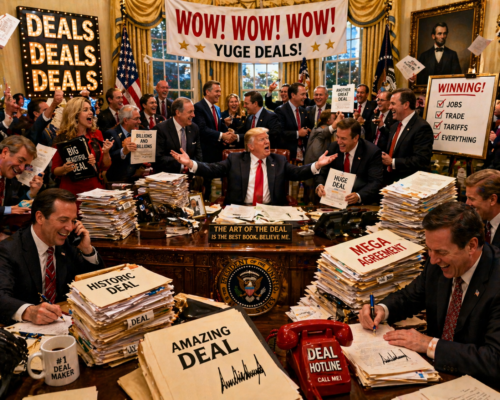
In our story we inhabit an imaginary quantum reality unlike our own, a sort of messy endless series of minor, manageable white house trump related blunders – and not the arguably civilization ending stuff we are witnessing right now. In this reality, the presidency has settled into a long-running sitcom rhythm: nothing ever truly collapses, nothing ever truly resolves, and each episode begins with a new, self-contained crisis that somehow resets by the closing credits. So, in other words, we live in some kind of endless Friends episode where Trump has been President for an indeterminate number of seasons and audience laughter tracks. And in this episode we concoct a premise to prove a certain argumentative logic. Trump, permanently in-season, announces that he is once again doing what he does best—making a deal so extraordinary that it will redefine how nations interact, a deal so clean and symmetrical that even the word “reciprocity” seems inadequate. Oh yeah he does that. He wrote the book and frankly it’s a better book than the bible. Or so people keep tell him. The deal we are envisioning is that he locks himself up in the white house with some European losers, as he calls them inadvertently/accidentially during a press conference, then praised lavishly in the same breath, and he negotated the most amazing (frantic hand gestures, pinched fingers) deal ever. Ok I now have to stop myself before I squeeze out yet another absolutely grotesque flight of fancy of these very annoying quotes. In this deal where the premise is simple and irresistible: total mutual access to each other’s healthcare markets, no artificial barriers, no unfair advantages, just pure, competitive excellence meeting pure, competitive excellence.
The agreement, when unveiled, is framed as a triumph of American strength and confidence. U.S. healthcare providers, insurers, and pharmaceutical companies are now free to expand into Europe under equal conditions, while European counterparts are granted the same freedom to operate in the United States, subject only to their own regulatory frameworks and dispute mechanisms. It is presented as a bold experiment in fairness, a demonstration that American systems, unshackled, will dominate any open field. The fine print, dense but unremarkable to anyone not actively looking for asymmetry, quietly affirms that both sides may operate according to their native pricing models, legal standards, and institutional norms. Within hours, the announcement is followed by a stream of triumphant late-night messages declaring total victory, historic brilliance, and a future in which everyone wins, especially America.
However here is what happens.
There is a particular kind of mistake that only powerful systems make. It is not the small error of miscalculation or the ordinary bureaucratic stumble. It is the grand, theatrical misread of reality that comes from believing your own mythology so completely that you stop recognizing other systems as real.
In that sense, the scenario is not really about a deal, or even about Trump specifically. He is just the most efficient narrative vessel for it, because he embodies that specific genre of confidence: loud, absolute, unexamined, and profoundly incurious about how anything actually works beyond the surface. The absurdity is not that he makes a bad deal. The absurdity is that he makes a deal he does not understand with people who understand it perfectly, and then celebrates it as a victory while the consequences quietly unfold in a domain far from his everyday existence.
So the deal is signed behind closed doors. Reciprocity, openness, access. It sounds clean, symmetrical, modern. America gets to sell its healthcare excellence into Europe under American Rukes, Europe gets to participate in the vast and lucrative American market. Flags, handshakes, cameras, the ritual choreography of mutual benefit. On paper, nothing looks wrong. That is the elegance of it. There is no trick clause that glows ominously in the margins. There is no hidden dagger. There is only a structural asymmetry so obvious to one side that it becomes invisible to the other. The Americans think they are exporting superiority. The Europeans understand they are importing a comparison.
Because the moment the agreement becomes real, it stops being about access and starts being about exposure. American healthcare entities are, in theory, free to operate in Europe. In practice, they collide almost immediately with a regulatory, pricing, and cultural environment that does not reward the behaviors they have evolved around. They cannot inflate prices and negotiate them back down through labyrinthine rebate structures. They cannot rely on opaque billing systems that obscure the actual cost of care. They cannot stretch administrative overhead into a parallel industry of its own. They are not prevented from operating, but they are stripped of the environment that made their business models viable in the first place. It is not exclusion. It is incompatibility.
On the other side, European entities enter the United States carrying something far more disruptive than cheap drugs. They carry an entirely different logic. It is not ideological in presentation. It does not announce itself as reform. It simply behaves differently. Prices are set in ways that appear almost naïve to American observers. Billing is direct, legible, unadorned. Insurance functions as insurance rather than as a strategic obstacle course. Administrative overhead exists, but it does not metastasize. There is no grand unveiling. There is just the quiet, almost boring demonstration that things can be done another way. At first, the reaction is dismissal. It has to be. The existing system cannot immediately accept the possibility that its own complexity is not the inevitable result of sophistication but the accumulation of incentives that were never corrected. So the language emerges quickly. The newcomers are unrealistic, subsidized, culturally incompatible, not scalable. There are concerns about standards, about safety, about hidden distortions. The discourse fills with technical objections that sound serious but carry a faint undertone of panic. Because underneath all of it is a simple and deeply uncomfortable observation: the Europeans are not doing anything miraculous. They are just not doing the same things.
The pharmacy counter becomes the first real point of fracture. It always does. Abstract debates about systems and policy can be sustained indefinitely, but a price tag is immediate. A person stands in front of a counter, receives a number, and experiences a moment of dissonance. Not shock, not outrage, but confusion. The number does not align with expectation. It is not dramatically cheap in the sense of being suspicious. It is simply lower, in a way that feels matter-of-fact rather than exceptional. That moment repeats. It spreads. It becomes anecdote, then pattern, then quiet awareness.
What makes this narratively powerful is that nothing needs to be argued. No one needs to win a debate. The comparison exists in lived experience. A system that relied heavily on abstraction and complexity suddenly finds itself competing against one that presents itself through simplicity. And simplicity is dangerous, because it removes the need for explanation. If something costs less and works just as well, the burden of justification shifts entirely onto the more expensive system. It must explain itself, not through theory, but through necessity. 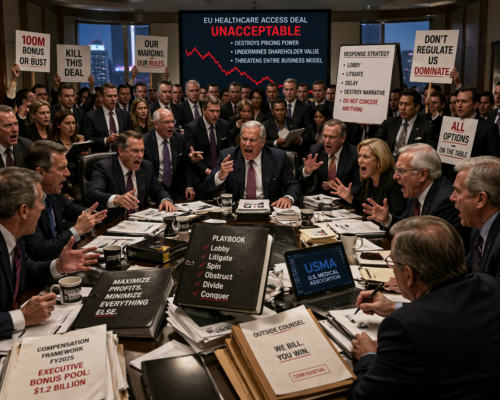 The insurance layer amplifies this effect. American insurance has, over time, evolved into a structure that balances risk, cost management, negotiation, and denial in ways that are internally coherent but externally opaque. European-style insurers, operating under different constraints, do not replicate that structure. They process claims differently. They price risk differently. They interact with providers differently. Again, there is no dramatic confrontation. There is only a gradual realization that the system people assumed was inevitable is in fact contingent.
This is where the narrative tension sharpens. Because the American system is not passive. It does not simply observe and adapt. It resists. It frames the newcomers as distortions, as anomalies, as threats to stability. The language of fairness emerges, but it is a peculiar fairness that assumes the existing system’s characteristics as the baseline. When those characteristics are challenged, the challenge itself is framed as unfair. It is not that the newcomers are breaking rules. It is that they are not playing by the same unspoken assumptions.
Meanwhile, the political layer continues to operate on its own script. The deal remains a victory in rhetoric. It is described in terms of access, opportunity, leadership. There is no incentive to reinterpret it publicly, because doing so would require acknowledging that the premise was flawed. And so the narrative splits. At the top, the story is one of triumph. At the ground level, the story is one of quiet disruption.
The legal reciprocity clause adds a subtle but important dimension. The idea that disputes can be handled across jurisdictions sounds balanced, but it introduces a new variable into a system accustomed to operating within its own legal culture. It is not that one system is inherently better than the other. It is that they are different in ways that affect how disputes are resolved, how quickly they move, how outcomes are framed. This difference does not need to be exploited aggressively to be felt. It simply needs to exist.
Over time, the cumulative effect becomes harder to ignore. Not because of any single dramatic failure, but because of the steady erosion of assumptions. The belief that high cost correlates with high quality becomes less stable. The belief that complexity is necessary becomes less convincing. The belief that alternatives are impractical becomes less credible. None of these beliefs collapse overnight. They shift, gradually, under the weight of repeated contradiction.
What makes the scenario resonate is that it does not rely on malicious intent. No one needs to be outmaneuvered in a conspiratorial sense. The outcome emerges from the interaction of systems that were never designed to coexist on equal terms. The absurdity lies in the initial confidence that they could be opened to each other without consequence. The irony lies in the fact that the most disruptive element is not aggressive competition, but the simple presence of a different way of doing things.
The phrase “heathen medical savages” in this context becomes inverted. It is not a description of the newcomers, but a reflection of how the existing system might perceive them. They do not conform to the expected behaviors. They do not engage in the same rituals of pricing and negotiation. They appear unsophisticated precisely because they are not performing the complexity that has become normalized. And yet, their outcomes challenge the assumption that sophistication requires that complexity.
In the end, the rage that emerges is not just economic. It is existential. It is the discomfort of a system confronted with evidence that its defining features are not universal, not necessary, and not particularly efficient. It is the realization that the moat was not a natural formation, but a constructed barrier that can, under the right conditions, be bypassed.
And somewhere in the background, the original deal remains, framed and celebrated, its language unchanged. Because the narrative of success is easier to maintain than the acknowledgment of miscalculation. The system continues to insist that everything is working as intended, even as the evidence accumulates that something fundamental has shifted.
The most telling moment is not a policy debate or a court case. It is a small, almost trivial interaction. A person receives a bill, reads it, and understands it. There is no confusion, no hidden layers, no need for interpretation. It is what it appears to be. That moment, repeated enough times, does more to destabilize the existing order than any argument ever could.
Because in the end, the most dangerous thing for a complex, self-justifying system is not opposition. It is comparison.