Skip to content

KHANNEA

A little lost, a little found but always moving forward.

Menu
  • – T H E – F A R – F R O N T I E R –
  • I made Funda this suggestion :)
  • My Political Positions
  • Public versus Personal (?) AI Model Research Cluster Brainstorm Cluster
  • Shaping the Edges of the Future
  • Shop
  • Some Of My Art
Menu

Cybernetics Catalogue

Posted on 22 April 202622 April 2026 by Khannea Sun'Tzu

Category : Holistic Systemware

 [ S P I N E ]
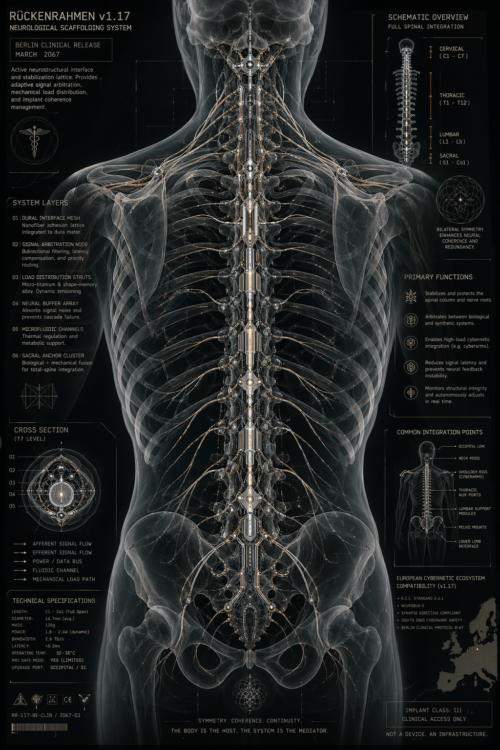
The Rückenrahmen v1.17 (Berlin clinical release, March 2067) is marketed as a “spinal stabilization scaffold,” but in practice it is a dense, semi-autonomous lattice of fiber-optic nerves, microfluidic shock channels, and adaptive firmware threaded along the dura and fused to the vertebral laminae, effectively rewriting the spine from a passive conduit into an active arbitration layer between brain, body, and hardware; it does not make you stronger so much as it makes your failures less catastrophic, continuously negotiating signal integrity, load distribution, and timing jitter between native nerves and foreign systems, which is why it became the quiet prerequisite for anything more ambitious than cosmetic augmentation in the Eurozone’s tightly regulated cybernetics ecosystem. Early adopters discovered—sometimes mid-rehabilitation, sometimes mid-collapse—that the Rückenrahmen could absorb the chaotic feedback loops that had made full cyberarms borderline unworkable outside military contexts, translating their brutal torque and latency demands into something the human nervous system could survive without seizures, dissociation, or slow spinal burnout; but this came at a cost that clinics described in soft language and patients described in blunt terms: a persistent sense that your posture, your reflexes, even your pain responses are being co-authored by a system that learns you in the same way it learns devices, prioritizing coherence over comfort, uptime over identity. 
By 2070 it had already stratified into a quiet standard across Berlin, Vienna, and Prague, then diffused outward—fragmented, reverse-engineered, occasionally degraded—into Russian industrial rigs, Scandinavian maritime exosystems, Atlantic Theater security frameworks, and more improvisational adaptations in Middle Eastern and African-adjacent markets, where its role as “just a scaffold” was understood for what it really was: an infrastructural nervous system that makes other cyberware possible, provided you’re willing to let something else hold your spine together, in every sense that matters. 

Category : Cyberweapon Mounts

 [ T H R O A T ]
MSI // “Mantis Shrimp Implant” (colloquial; designation varies by vendor cluster)
Status: Non-catalogue, boutique-class cybernetic subsystem
Deployment count (est. 2088): <200 confirmed installs
Origin trace: Fragmented; earliest cohesive documentation appears in a 2074 Cairo-based applied study on West African close-proximity operative doctrine
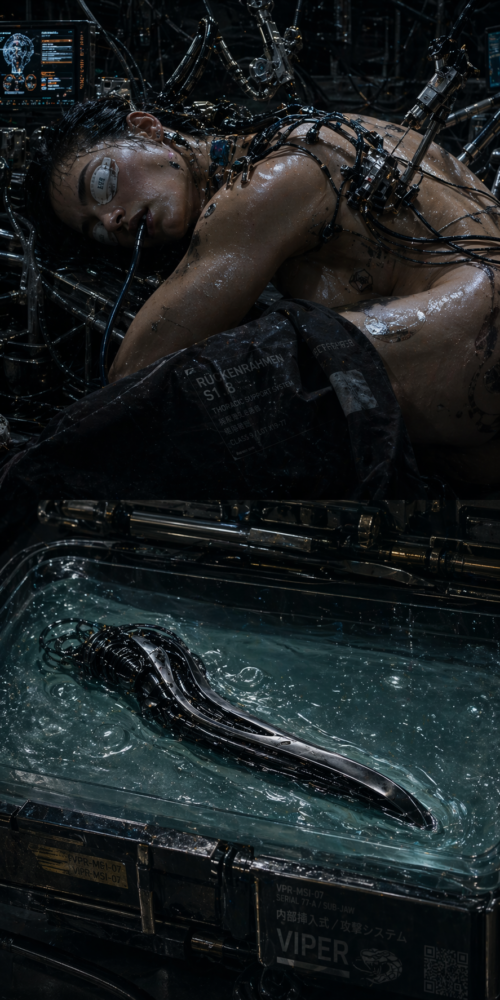
The MSI is not a discrete implant but a parametric kinetic deployment system integrated into existing thoracic cybernetic architecture. Each instance is individually CAD-CAM modeled against host-specific constraints: rib spacing, sternum geometry, existing scaffold implants (e.g. Rückenrahmen-class systems), power distribution topology, and neural arbitration layers. No two units are identical; even within a single vendor lineage, design drift is expected.
 
 
At its core, the MSI consists of a coiled acceleration spine—a segmented, pre-tensioned assembly housed within a reinforced thoracic cavity channel, typically parasternal or subclavicular. The structure is fabricated from high-elasticity metamaterials with layered fatigue resistance and embedded micro-actuation nodes. Energy storage is achieved through a hybridized system: mechanical preload (torsion/compression), supplemented by rapid-discharge capacitive bursts drawn from the host’s auxiliary power bus. The result is a high-velocity linear extension event with variable stroke length (standard: 40–55 cm; extended variants up to ~70 cm), deployable along a constrained vector determined at design time.
Control is mediated through the host’s neural interface, but notably not via direct conscious actuation in most builds. Instead, MSI units are typically slaved to a predictive targeting layer—a low-latency heuristic system that resolves spatial positioning, timing windows, and collision paths. This is necessary because raw human reaction time is insufficient to fully exploit the system’s acceleration profile. Integration with external targeting mods, tactical overlays, and motion prediction suites is strongly recommended; standalone operation degrades performance and increases risk of misalignment or structural rebound.
The terminal assembly (“striker”) varies widely. Some configurations favor minimal cross-section and low observability, employing monomaterial tips with non-reflective, scan-resistant coatings designed to evade standard detection protocols. Others incorporate micro-sensing elements for positional feedback during extension/retraction cycles. All designs prioritize retraction reliability, as incomplete withdrawal introduces severe mechanical and physiological failure modes. 

A defining constraint of the MSI is internal clearance and interference management. Deployment occurs within millisecond-scale windows but traverses a body that is already densely occupied by biological and artificial systems. As such, successful installations rely heavily on precomputed exclusion volumes and real-time arbitration with the host’s scaffolding systems. Rückenrahmen-class implants, when present, often act as a stabilizing backbone, absorbing recoil forces and redistributing load across the axial structure.

Thermal management is non-trivial. Rapid discharge events generate localized heat spikes along the acceleration spine; most builds incorporate microfluidic cooling loops tied into existing metabolic or implant cooling systems. Failure to dissipate heat effectively leads to material fatigue and increased maintenance intervals.


From a detection standpoint, MSI units are engineered for low signature presence. Housing materials are selected for reduced electromagnetic reflectivity and compatibility with common scan-noise profiles. However, complete invisibility is not achievable; high-resolution or invasive scanning will typically reveal anomalous structural densities
Maintenance requirements are high. The system undergoes extreme stress during each deployment cycle, necessitating periodic recalibration, component inspection, and, in some cases, partial reprinting of degraded segments. Field repair is not advised; most operators rely on specialized clinics with access to the original design parameters.
Operationally, the MSI is characterized by asymmetry: long periods of dormancy punctuated by extremely brief, high-intensity activation events. It is not a general-purpose augmentation but a situational tool, optimized for environments where proximity, timing, and concealment outweigh sustained engagement capability.

In summary, the MSI should be understood not as a weaponized appendage but as a kinetic subsystem embedded within the body’s infrastructure, whose effectiveness depends less on raw output and more on integration fidelity, predictive control, and the host’s tolerance for systemic complexity.

Category : Skull Sensory

 [ O P T I C S ]

Compressed TDAO Optical Systems Ecologies

Tactical Data Assimilation Overview (TDAO)

The emergence of compressed Tactical Data Assimilation Optical Systems (TDAO) marks the transition from augmentation-as-enhancement toward augmentation-as-infrastructural necessity. Early cyberoptical systems, appearing in limited clinical and industrial deployments in the late 2020s and achieving broad civilian diffusion by the mid-2030s, were initially framed as accessibility tools, occupational aids, or lifestyle enhancements. These first-generation systems offered improved resolution, spectral extension, and optional overlay layers for navigation, advertising, and informational tagging. However, as urban environments became saturated with machine-readable signals, passive telemetry, and ambient network emissions, the role of optics shifted from visual enhancement toward real-time interpretive mediation of environmental complexity.
By 2045, the human visual system, unassisted, had effectively become insufficient for navigating high-density informational environments. The problem was not acuity, but throughput and prioritization. Unaugmented perception could not meaningfully discriminate between critical and non-critical stimuli across the expanding data field of networked objects, semi-autonomous infrastructure, and algorithmically mediated public space. This led to the bifurcation of the population into three broad categories: approximately twenty-five percent equipped with fully integrated cyberoptical systems; fifty percent relying on semi-external marquee overlays projected directly into the visual field; and the remaining quarter operating unaugmented, typically in low-density or economically constrained environments.
The proliferation of optical ecosystems was rapid and highly fragmented. Thousands of vendors entered the market, ranging from legacy optics manufacturers (Zeiss, Canon, Olympus) to document and imaging corporations (Xerox) repurposing scanning and pattern recognition technologies, to specialized cybernetics firms (Kiroshi, NSO, Candiro, Signex, Lore, Hermes) developing proprietary stacks of sensor integration, signal interpretation, and overlay abstraction. Each ecosystem evolved its own internal logic, encoding strategies, and data prioritization heuristics, resulting in a landscape where visual reality became partially vendor-defined.
This fragmentation produced both competitive innovation and systemic incompatibility. While baseline functions such as object recognition, navigation, and hazard detection became standardized, higher-order interpretive capabilities diverged significantly. Some systems prioritized consumer convenience and lifestyle augmentation; others emphasized industrial safety or logistical optimization. A smaller, less visible subset of systems—often developed under dual-use or covert funding structures—focused on tactical relevance extraction under conditions of uncertainty and signal ambiguity.
It is within this latter category that compressed TDAO systems emerged.
 

Historical Trajectory

The conceptual roots of TDAO lie in early machine vision research and predictive analytics, particularly in systems designed to infer meaningful patterns from incomplete or noisy datasets. Initial military applications in the 2030s focused on battlefield awareness, integrating drone feeds, satellite imagery, and ground sensor networks into centralized command interfaces. These systems, while effective at scale, suffered from latency and dependency on external processing nodes.
Attempts to miniaturize and localize these capabilities revealed a fundamental constraint: meaningful interpretation of complex environments required not just data access, but proximity to perception itself. The delay introduced by routing sensory input through external computational systems rendered such solutions ineffective in dynamic, close-range scenarios. Reaction windows measured in milliseconds could not accommodate network latency, encryption overhead, or distributed processing delays.
By the early 2050s, research efforts shifted toward embedding compressed analytical frameworks directly within the perceptual pathway, specifically within the interface between ocular input and cortical processing. Advances in neuromorphic computing, micro-scale fabrication, and energy-efficient data compression enabled the development of localized processing clusters capable of operating at near-biological speeds.These clusters did not attempt to replicate full-spectrum environmental analysis. Instead, they implemented highly specialized, aggressively pruned models designed to extract probabilistic relevance signals from overlapping data streams. The emphasis was not on completeness, but on timely sufficiency—providing just enough information, just fast enough, to influence action before conscious deliberation.
 

System Architecture

A compressed TDAO system is not a singular device but a distributed micro-architecture spanning the ocular hardware, optic nerve interface, and adjacent neural integration layers. The system operates through four primary stages: acquisition, interference mapping, compression, and projection.
Acquisition involves the ingestion of multi-modal sensory inputs, including extended optical spectra, micro-movement detection, electromagnetic leakage, and low-level network emissions. Unlike traditional sensors, TDAO systems do not treat these inputs as discrete channels but as overlapping fields of potential relevance.
Interference mapping is the core analytical process. Instead of isolating signals, the system examines how disparate inputs intersect, amplify, or suppress one another. For example, minor irregularities in thermal output, combined with anomalous network handshake patterns and subtle deviations in movement cadence, may coalesce into a cluster indicative of concealed human presence.
Compression is both a technical necessity and a defining feature. Raw interference patterns are too complex and voluminous to transmit directly into conscious perception. The system therefore reduces these patterns into minimal actionable representations, discarding non-essential data and encoding significance into low-bandwidth cues.
Projection delivers these cues to the user, typically not as explicit overlays but as modifications to perceived salience. Objects or regions of interest may appear fractionally more prominent, subtly colored, or cognitively “weighted” without overt graphical representation. In advanced configurations, minimal symbolic overlays may be employed, but the system’s effectiveness relies primarily on pre-conscious influence rather than conscious interpretation.
 

Civilian and Adjacent Applications

While originally developed for tactical contexts, TDAO principles rapidly diffused into civilian and quasi-civilian domains. Urban environments saturated with regulatory, logistical, and commercial signals provided fertile ground for relevance extraction systems.
Civilian-adjacent applications include:
  • identification of infrastructural hazards (structural fatigue, material degradation, environmental contaminants such as asbestos)
  • detection of legal and financial risk zones (unmarked liabilities, contract violations, surveillance exposure)
  • optimization of navigation through high-density spaces based on real-time crowd dynamics and infrastructural load
These systems operate within complex legal frameworks. In many jurisdictions, direct access to certain data streams is restricted; however, TDAO systems frequently derive actionable insights from permissible inputs, effectively reconstructing restricted knowledge through inference. This has led to ongoing disputes regarding the legality of “knowing without being told,” particularly in contexts involving surveillance infrastructure and proprietary data.
 

Military and Tactical Applications

In military contexts, TDAO systems are not optional enhancements but critical survival infrastructure. The distinction between worn optics and embedded TDAO systems is not merely qualitative but temporal.
Worn optics—external visors, helmets, or augmented displays—introduce unavoidable latency. Data must be captured, transmitted, processed, and rendered, even if these steps occur within milliseconds. In static or low-intensity environments, this delay is acceptable. In close-quarters or high-velocity engagements, it is fatal.
Embedded TDAO systems eliminate this delay by collapsing the processing pipeline into the perceptual loop. The system does not “display” information after analysis; it modifies perception during acquisition. This temporal integration allows the user to react to inferred threats at speeds approaching reflex, rather than cognition.
The specific application under consideration involves the extraction of hostile presence indicators from environmental noise. Unlike traditional detection systems, which rely on direct observation or explicit signals, TDAO systems operate on the premise that dangerous actors generate detectable disturbances within complex environments, even when actively concealing themselves.
These disturbances are rarely singular or definitive. They manifest as:
  • transient signal inconsistencies
  • anomalous motion patterns
  • irregular interactions with infrastructure
  • residual artifacts of prior activity
The system aggregates these weak signals into probabilistic clusters. The user does not “see” the enemy directly but perceives:

localized distortions in relevance

These may appear as fleeting highlights, peripheral flickers, or momentary shifts in focus—commonly referred to as “blips” or “signal ghosts.” While not always reliable, these indicators provide critical early warnings, enabling preemptive action.
 

Integration with Smartgun Systems

TDAO optics achieve their full operational value when integrated with smartgun platforms. These systems form a closed-loop interaction between perception, analysis, and action.
Smartguns operate across four primary domains:
  1. Physical Adjustment
    The weapon continuously aligns itself based on predicted target vectors, compensating for user movement, recoil, and environmental factors. This alignment is informed by TDAO-derived relevance clusters rather than explicit visual targets.
  2. Temporal Projection
    The system generates predictive models of enemy movement, displaying both current and probable future positions. These projections are not fixed trajectories but dynamic probability fields updated in real time.
  3. Behavioral Analysis
    Enemy strategies, morale states, and tactical patterns are inferred from observable and inferred data. These insights are presented in highly compressed visual cues, allowing rapid assimilation without cognitive overload.
  4. Environmental and Equipment Data
    The system identifies and contextualizes:
    • structural composition of barriers
    • type and properties of deployed munitions (e.g., gas grenades)
    • characteristics of nearby objects (e.g., unidentified cylinders, potential hazards)
    • weapon status, ammunition levels, and armor integrity
All outputs are rendered in minimal, high-density visual formats, prioritizing clarity and speed over detail.
Data Infrastructure and Security
TDAO systems rely on continuously updated data packs tailored to specific operational contexts. These packs are:
  • securely transmitted
  • location-aware
  • adversary-specific
Security protocols are robust but not absolute. Systems are designed to resist intrusion through layered encryption, anomaly detection, and compartmentalized processing. However, successful compromises do occur.
Notably, compromised systems are engineered to degrade gracefully rather than fail catastrophically. In the event of intrusion, output is reduced to minimal viable functionality, avoiding complete blackout while limiting the propagation of corrupted data.

Conclusion

Compressed TDAO optical systems represent a fundamental shift in human perception, from passive observation to active, pre-conscious interpretation of complex environments. By embedding relevance extraction within the perceptual loop, these systems enable users to navigate and survive in data-saturated, adversarial contexts where unaugmented perception is insufficient.
They do not reveal everything. They produce fragments, distortions, and probabilities. They generate ghosts of meaning rather than certainty.
And in environments where delay equals failure, these ghosts are often enough.


Post navigation

← Non-Military Fallout of a Full Strait of Hormuz and Persian Gulf Closure

Leave a Reply Cancel reply

You must be logged in to post a comment.

Hi there. I am khannea – transhumanist, outspoken transgender, libertine and technoprogressive. You may email me at khannea.suntzu@gmail.com.


Tags

Animal Cruelty Anon Artificial Intelligence Automation BioMedicine BitCoin Cinematography Collapse Degeneracy and Depravity Facebook Gaga Gangster Culture Humor Idiocracy Intelligence (or lack thereoff) Ivory Towers Khannea Larry Niven Life Extension MetaVerse Monetary Systems Moore's Law Peak Oil Philosophy Politics Poverty Prometheus Psychology Real Politiek Revolution Science Fiction Second Life Singularity social darwinism Societal Disparity Space Industrialization Taboo Uncategorized UpWing US Von Clausewitz War Crimes White Rabbit Wild Allegories Youtube

Pages

  • – T H E – F A R – F R O N T I E R –
  • I made Funda this suggestion :)
  • My Political Positions
  • Public versus Personal (?) AI Model Research Cluster Brainstorm Cluster
  • Shaping the Edges of the Future
  • Shop
  • Some Of My Art

Blogroll

  • Adam Something 0
  • Amanda's Twitter On of my best friends 0
  • Art Station 0
  • Climate Town 0
  • Colin Furze 0
  • ContraPoints An exceptionally gifted, insightful and beautiful trans girl I just admire deeply. 0
  • David Pakman Political analyst that gets it right. 0
  • David Pearce One of the most important messages of goodness of this day and age 0
  • Don Giulio Prisco 0
  • Erik Wernquist 0
  • Humanist Report 0
  • IEET By and large my ideological home 0
  • Isaac Arthur The best youtube source on matters space, future and transhumanism. 0
  • Jake Tran 0
  • Kyle Hill 0
  • Louis C K 0
  • My G+ 0
  • My Youtube 0
  • Orions Arm 0
  • PBS Space Time 0
  • Philosophy Tube 0
  • Reddit I allow myself maximum 2 hours a day. 0
  • Second Thought 0
  • Shuffle Dance (et.al.) 0
  • The Young Turks 0
  • What Da Math 0

Archives

Blogroll

  • ContraPoints An exceptionally gifted, insightful and beautiful trans girl I just admire deeply. 0
  • My G+ 0
  • Erik Wernquist 0
  • Philosophy Tube 0
  • Second Thought 0
  • Adam Something 0
  • The Young Turks 0
  • Shuffle Dance (et.al.) 0
  • My Youtube 0
  • Climate Town 0
  • IEET By and large my ideological home 0
  • Jake Tran 0
  • What Da Math 0
  • Colin Furze 0
  • David Pakman Political analyst that gets it right. 0
  • Kyle Hill 0
  • Louis C K 0
  • Don Giulio Prisco 0
  • PBS Space Time 0
  • Humanist Report 0
  • David Pearce One of the most important messages of goodness of this day and age 0
  • Amanda's Twitter On of my best friends 0
  • Art Station 0
  • Orions Arm 0
  • Reddit I allow myself maximum 2 hours a day. 0
  • Isaac Arthur The best youtube source on matters space, future and transhumanism. 0

Pages

  • – T H E – F A R – F R O N T I E R –
  • I made Funda this suggestion :)
  • My Political Positions
  • Public versus Personal (?) AI Model Research Cluster Brainstorm Cluster
  • Shaping the Edges of the Future
  • Shop
  • Some Of My Art

Tags

Animal Cruelty Anon Artificial Intelligence Automation BioMedicine BitCoin Cinematography Collapse Degeneracy and Depravity Facebook Gaga Gangster Culture Humor Idiocracy Intelligence (or lack thereoff) Ivory Towers Khannea Larry Niven Life Extension MetaVerse Monetary Systems Moore's Law Peak Oil Philosophy Politics Poverty Prometheus Psychology Real Politiek Revolution Science Fiction Second Life Singularity social darwinism Societal Disparity Space Industrialization Taboo Uncategorized UpWing US Von Clausewitz War Crimes White Rabbit Wild Allegories Youtube

Archives

  • April 2026
  • March 2026
  • February 2026
  • January 2026
  • December 2025
  • November 2025
  • October 2025
  • September 2025
  • August 2025
  • July 2025
  • June 2025
  • May 2025
  • April 2025
  • March 2025
  • February 2025
  • January 2025
  • December 2024
  • November 2024
  • October 2024
  • September 2024
  • August 2024
  • July 2024
  • June 2024
  • May 2024
  • April 2024
  • March 2024
  • February 2024
  • December 2023
  • October 2023
  • September 2023
  • August 2023
  • July 2023
  • June 2023
  • May 2023
  • April 2023
  • March 2023
  • November 2022
  • October 2022
  • September 2022
  • August 2022
  • July 2022
  • June 2022
  • May 2022
  • April 2022
  • March 2022
  • February 2022
  • January 2022
  • December 2021
  • November 2021
  • August 2020
  • July 2020
  • April 2020
  • March 2020
  • December 2019
  • November 2019
  • October 2019
  • September 2019
  • August 2019
  • July 2019
  • June 2019
  • April 2019
  • March 2019
  • February 2019
  • January 2019
  • September 2018
  • August 2018
  • July 2018
  • June 2018
  • May 2018
  • April 2018
  • March 2018
  • February 2018
  • January 2018
  • December 2017
  • November 2017
  • October 2017
  • September 2017
  • August 2017
  • July 2017
  • May 2017
  • February 2017
  • January 2017
  • November 2016
  • October 2016
  • September 2016
  • August 2016
  • July 2016
  • June 2016
  • May 2016
  • April 2016
  • March 2016
  • February 2016
  • January 2016
  • December 2015
  • November 2015
  • August 2015
  • July 2015
  • March 2015
  • February 2015
  • January 2015
  • December 2014
  • November 2014
  • October 2014
  • September 2014
  • August 2014
  • July 2014
  • June 2014
  • May 2014
  • April 2014
  • March 2014
  • February 2014
  • January 2014
  • December 2013
  • November 2013
  • October 2013
  • September 2013
  • August 2013
  • July 2013
  • June 2013
  • May 2013
  • April 2013
  • March 2013
  • February 2013
  • January 2013
  • December 2012
  • November 2012
  • October 2012
  • September 2012
  • August 2012
  • July 2012
  • June 2012
  • May 2012
  • April 2012
  • March 2012
  • February 2012
  • January 2012
  • December 2011
  • November 2011
  • October 2011
  • September 2011
  • August 2011
  • July 2011
  • June 2011
  • May 2011
  • April 2011
  • March 2011
  • February 2011
  • January 2011
  • December 2010
  • November 2010
  • October 2010
  • September 2010
  • August 2010
  • July 2010
  • June 2010
  • May 2010
  • April 2010
  • March 2010
© 2026 KHANNEA | Powered by Minimalist Blog WordPress Theme