Skip to content

KHANNEA

A little lost, a little found but always moving forward.

Menu
  • – T H E – F A R – F R O N T I E R –
  • I made Funda this suggestion :)
  • My Political Positions
  • Public versus Personal (?) AI Model Research Cluster Brainstorm Cluster
  • Shaping the Edges of the Future
  • Shop
  • Some Of My Art
Menu

Chaos Wars

Posted on 24 May 202624 May 2026 by Khannea Sun'Tzu

Monday.
8:49 AM.
Burbank.

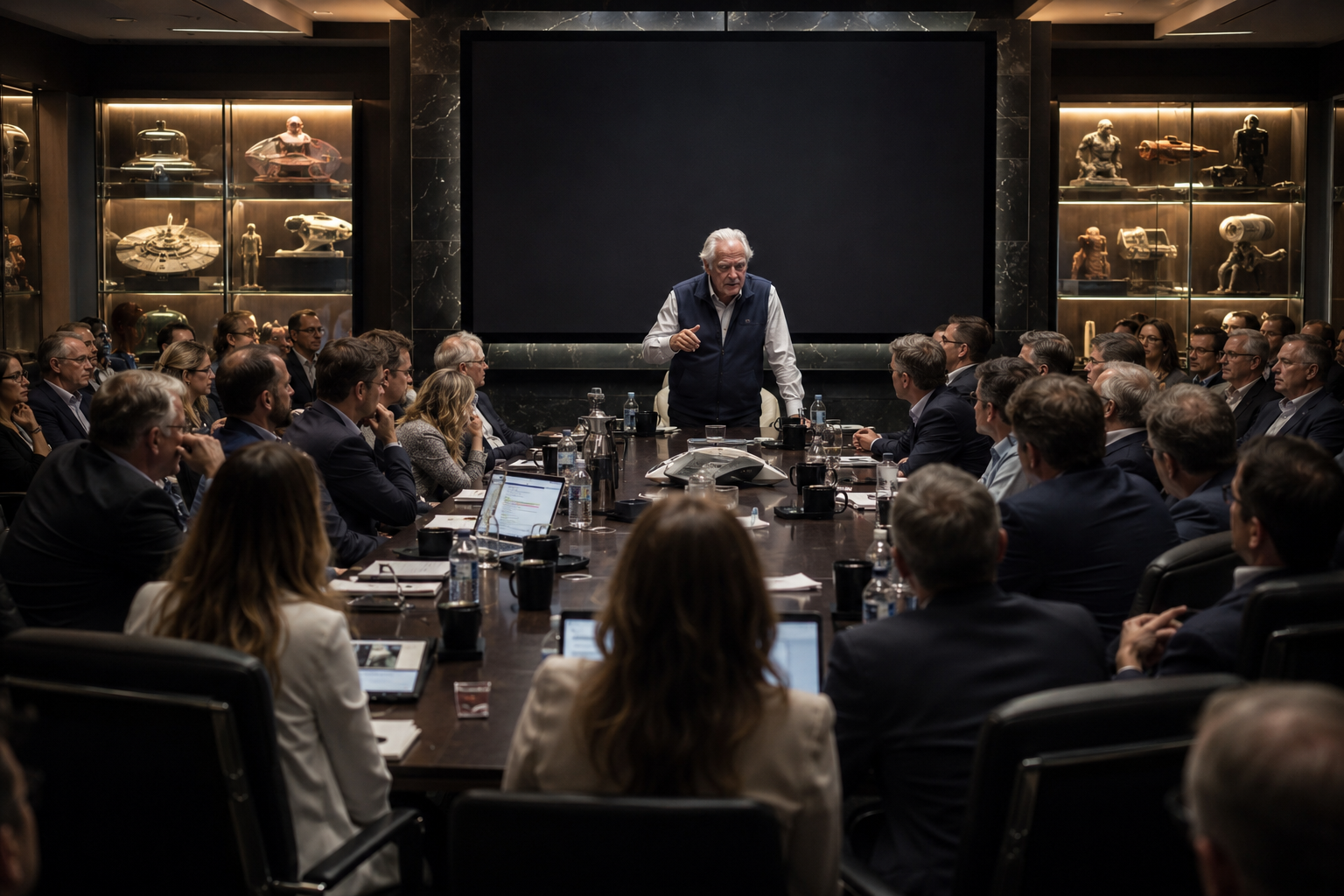
The boardroom had the atmosphere of an airport terminal after a bombing threat. Quiet, expensive panic. Forty-three people around a table designed less for collaboration than intimidation. The room smelled faintly of coffee, cologne, printer heat, and recirculated air from private jets. Somebody had flown in from Sardinia four hours earlier and had showered at the airport. Another had come directly from a yacht somewhere near Mykonos. A woman from legal still had sunscreen visible along the back of her neck beneath a severe blonde bun. Nobody mentioned it. Nobody mentioned anything unnecessary.

At the far end sat Harold Vane.

Seventy-four years old. Navy fleece vest over a white dress shirt. Pale, liver-spotted hands folded carefully in front of him. The kind of executive who no longer raised his voice because entire civilizations had glacially rearranged themselves around quieter tones. He looked exhausted in the way only rich old men could: medically maintained, professionally composed, spiritually frayed.

Behind him loomed a massive black screen that had not yet been turned on.

That was the worst part.

If there had been charts, numbers, a leak, a lawsuit, a cyberattack — people could have oriented themselves. Instead there was only the strange fact that everyone important had been ordered back immediately under threat of termination. Streaming. Parks. Licensing. Consumer products. Investor relations. Franchise management. Crisis communications. Three outside firms. Four litigation sharks. Two men from sovereign wealth funds. One silent Saudi in a charcoal suit with cufflinks worth more than most houses.

Nobody knew exactly why they were here.

They only knew it was bad.

Phones buzzed continuously against polished walnut. Assistants moved around the perimeter carrying coffees no one drank. One junior executive quietly cried in the hallway for reasons unrelated to this meeting and then returned inside pretending nothing had happened. A lawyer near the center of the table had already billed thirty thousand dollars before breakfast and looked annoyed he might have to work harder.

Harold stared at the blank screen for a long time.

Not dramatic. Just… old.

Like a man realizing the world had changed shape while he was asleep.

Finally he stood.

The room straightened almost involuntarily.

He glanced once toward the dark display behind him.

Then at the people gathered before him.

Strategy people with perfect teeth.
Predatory litigators.
Market analysts.
Brand architects.
The people whose entire careers consisted of turning childhood memories into recurring revenue streams.

Nobody spoke.

Harold inhaled slowly. “All phones off. I synced with legal. There’s no connectivity starting now. I do not want anyone to leak or quietly start dumping. Switch em off anyways, laptops as well. If I see a screen on it goes in the aquarium.“

“Friday,” he said, “I believed this was a law enforcement problem.”

Several attorneys nodded immediately, relieved to hear familiar language.

“By Saturday afternoon,” he continued, “I thought it was a piracy problem. Even internationally. We did interventions in the Czech republic. We sent in police in India. ”

More nods.

“No such luck… By Sunday evening…” He stopped.

Something flickered across his face. Not fear exactly. Something rarer.

Uncertainty.

“Well, you’ll see. The original runtime is 136 plys 142 plus 140 minutes. Seven hours. This new version is longer. We fucking gona sit here with lavatory breaks down the hallway every 30 minutes for five, security in the lavatory. No connectivity there either. ”

Eyes flared wide in panic. Sven hours. 

Harold looked around the room carefully now, almost suspiciously, as though checking whether anyone else had heard the same terrible thing over the weekend.

“I had to sit through this with my grandkids from three marrages twice this weekend, I though, no not this crap again,” he said softly. “But I was spellbound, at my age. Second watching I was still paying attention. I suggest you dose up, whatever you kids use these days to stay on your toes because I want nobody to miss even te slightest detail.”

Silence pressed against the glass walls. Everyone was having acute Claustrophobia. Seven hours. Security distributed isotonic drinks, modafinil, protein bars and then disappeared. 

The Saudi investor leaned forward slightly for the first time.

Harold placed both hands on the table.

Then finally said the sentence everyone had been dreading since their phones started ringing the night before.

“Everyone quiet. Watch as if this is the first you watch this. Watch like it’s 1999. .”
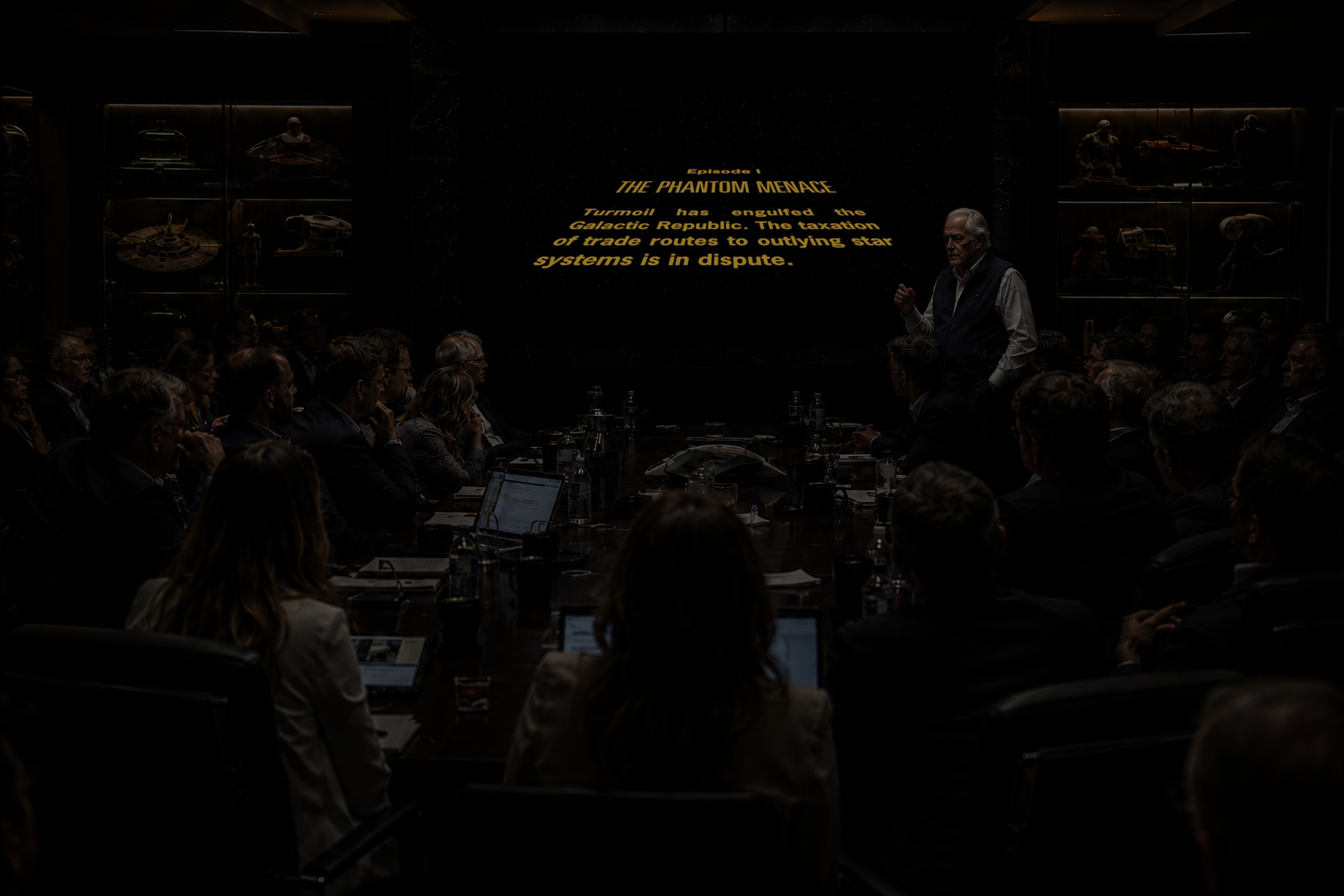
The screen remained black for a very long time.

Not paused.
Black.

The kind of black that becomes oppressive after thirty seconds in a room full of executives trained to consume information continuously. Nobody spoke. A few people shifted in their seats. Someone coughed into their hand. The Saudi investor sat perfectly still, fingers interlaced, watching the reflection of the room in the dark screen.

Then, without fanfare, a line of pale text appeared.

STAR WARS
EPISODE I
THE PHANTOM MENACE
RECONSTRUCTED CUT
Runtime: 2h 36m

A few people frowned immediately.

Two hours and thirty-six minutes.

Twenty minutes longer than the original.

Then the familiar crawl began — except it wasn’t familiar at all.

No mention of taxation disputes. No childish framing. No broad fairy-tale language. Instead the crawl read like the opening to a political conspiracy thriller. References to vanished Senate auditors. Unmarked freighters disappearing near Nabooan space. Emergency powers quietly consolidated through “temporary procedural harmonization.” Mentions of classified biotech annexes buried beneath Trade Federation logistics treaties.

The room leaned forward almost involuntarily.

The score, too, had changed. Not triumphant. Not whimsical. Low choral drones under fractured strings. Something between liturgy and surveillance footage.

Then the first shock.

The Trade Federation no longer appeared as bumbling caricatures. No comic accents. No waddling incompetence. They were cold. Corporate. Surgical. Executives discussing population leverage models and orbital famine projections with the detached professionalism of consulting firms discussing shipping delays.

One board member quietly whispered:
“Jesus.”

Nobody answered.

The opening sequence aboard the diplomatic cruiser had become almost unbearable in tone. The Jedi were not noble adventurers entering a children’s story. They were intelligence assets entering a compromised zone. Qui-Gon no longer smiled warmly. Obi-Wan looked frightened before they even arrived.

The negotiations were not negotiations.

They were a trap everyone in the room understood immediately.

Then came the assassination attempt…

No cartoon panic. No slapstick escape. Just sealed blast doors. Hissing vapor. Tight closeups of Obi-Wan’s pupils dilating as he realized someone in the Republic itself had authorized this operation in advance. Hacking technology, Jason Bourne action. Ruthless bloody wetwork. The conference room in Burbank remained utterly silent.

The film moved differently than the original. Slower in some places. Sharper in others. Whole conversations reconstructed from alternate takes and synthetic inserts. New dialogue threaded seamlessly through old scenes. It felt less like a fan edit than a recovered version from a parallel production history.

Then Naboo.

No longer an idyllic jewel-world from a children’s illustrated Bible. No bright paradise floating untouched above galactic corruption. The reconstructed cut treated Naboo as something far stranger and more dangerous: a civilization so polished, so choreographed, so aesthetically perfected that the beauty itself became threatening.

Controlled…. Clearly too controlled.

The camera lingered on things the original film treated as background texture. Decorative arches concealing sensor arrays. Palace corridors subtly narrowing into kill funnels. Handmaidens exchanging coded phrases beneath ceremonial dialogue. Security personnel disguised as servants. Entire wings of the capital left unnaturally empty during supposedly public events. 

Every frame whispered the same thing: This place is not normal.

One added sequence — assembled from fragments, alternate angles, AI reconstruction and impossibly convincing synthetic inserts — followed Amidala through a restricted archive beneath the royal complex before departure from Coruscant. The scene was quiet. No music except distant ventilation and the low mechanical hum of encrypted data vaults. A handmaiden walked beside her. 

Not speaking naturally.

Reporting.

“Sector Four pacification complete.”
“Dissident clergy relocated.”
“Three more disappearances attributed to pirate activity.”
“Outer settlements remain unstable regarding force-rumor contamination.”

Amidala listened without visible reaction.

Young. … Beautiful…. Terrifyingly composed.

The reconstructed cut reframed her completely. Not innocent. Not evil either. Worse than evil: institutional. A person born so deep inside systems of aristocratic control that moral boundaries had partially dissolved into procedure. Then came the dossiers.

Projected briefly against dim blue light as Amidala reviewed sealed intelligence files before the diplomatic mission.

Most flashed by too quickly to fully process:

BIOLOGICAL IRREGULARITIES — MID RIM
Trade Federation Shipping Losses
Force-sensitive instability events
Unauthorized genetic laboratories
Behavioral divergence in cloned stock

Then one dossier remained on screen half a second too long.

Just enough.

TATOOINE
Probability Escalation Event: CRITICAL
Subject viability unresolved
Local asset active

The room in Burbank had gone utterly still.

But the reconstructed film was only beginning.

Because then Jar Jar appeared.

And several executives physically recoiled. Not because he was comedic. Because he was unrecognizable.

Gone was the slapstick fool. Gone the stammering idiot. The reconstruction retained fragments of the original vocal cadence, but altered the timing, posture, editing, and surrounding context so profoundly that the character transformed into something uncanny.

He barely spoke. When he did, it sounded deliberate. Performative.

Like somebody pretending to be harmless. Jar Jar binks had become the complete opposite of Darth Maul – an agent of Amidala. The film introduced him not crashing foolishly through the swamp, but watching the Jedi first from concealment. Motionless among reeds. Face partially obscured by mud and breathing gear. Observing.

Evaluating.

Then vanishing silently before reappearing “accidentally.”

One executive whispered:
“No fucking way.”

The reconstruction leaned fully into a theory fandom had joked about for decades and somehow made it emotionally plausible. Jar’Jar as an operative. Not Sith exactly. Not Jedi. Something older.

Local.

A native survivor of Nabooan occupation politics. A Gungan insurgent shaped by generations of aristocratic manipulation from the human palace cities above. His clumsiness became camouflage.

His rambling speech became social invisibility as survival strategy.

The reconstructed cut inserted tiny moments everywhere. Jar Jar watching security patrol patterns while pretending confusion. Jar Jar subtly steering conversations. Jar Jar exchanging nearly imperceptible glances with handmaidens who immediately looked away. Most disturbing of all:

Amidala clearly knew.

Not fully.

But enough.

Several new scenes implied Jar Jar functioned as a kind of deniable shadow asset attached to the royal court. A knife that officially did not exist. Freedom fighter, assassin, courier, insurgent liaison. Useful precisely because elites underestimated him instinctively.

One inserted flashback sequence — grainy, fragmented, almost documentary in style — showed armored Naboo security forces burning submerged Gungan settlements during anti-insurgency operations years earlier. Children hiding underwater. Bodies floating upward. Jar Jar among them.

The boardroom audience shifted visibly at that scene.

Because suddenly the entire racial dynamic of Naboo changed.

The beautiful human capital above. The displaced amphibious natives below.

Ceremonial unity masking colonial occupation. And Jar Jar walking between both worlds carrying unbearable historical memory beneath the mask of idiocy.

One reconstructed scene shattered the room completely.

Late at night aboard the royal cruiser, Amidala stood alone reviewing tactical reports. Jar Jar entered silently from darkness without announcement. No comedic music. No stumbling. Just silence. For several seconds they stared at one another as equals.

Then Jar Jar spoke in low, careful dialect:

“Da boy dangerous.”

Amidala replied without surprise.

“I know.”

“No. Yousa no know.”

Then the reconstructed cut did something extraordinary. It held on Jar Jar’s face. Completely still.

And for the first time in cinematic history, the audience could see the intelligence behind the performance. Exhaustion. Rage. Calculation. A being who had survived by allowing powerful people to mistake him for furniture. He stepped closer.

“Da Force move round him wrong.”

Amidala finally looked uncertain.

Just briefly.

“Palpatine knows?” she asked.

Jar Jar’s answer:

“Everybody knowin’. Dat da problem.”

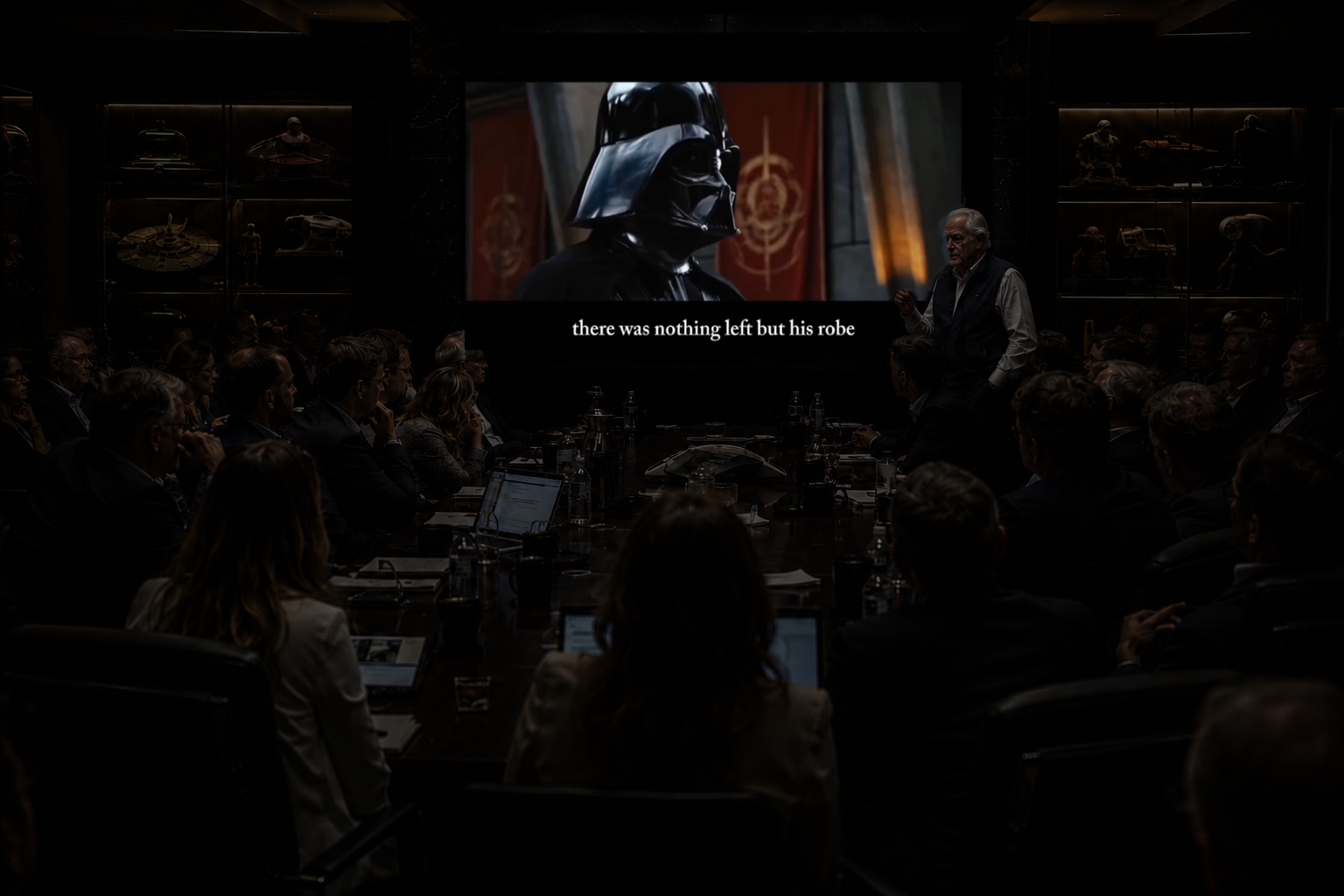
Several people in the Disney boardroom stopped breathing normally after that line. Because suddenly the entire prequel trilogy collapsed inward into espionage, surveillance, and competing factions circling a biologically impossible child like sharks sensing blood in dark water. And Jar Jar — absurd, hated Jar Jar — had become the only character who understood the true scale of the catastrophe early. Not because he possessed mystical wisdom. Because oppressed people recognize predatory systems faster than elites do. The reconstructed film used him sparingly after that. Which made him even more effective. Silent in the background during Senate scenes. Watching exits. Watching Palpatine. Watching Amidala. Once briefly seen speaking with hooded figures beneath Theed through rainwater and engine steam.

Not comic relief: Counterintelligence.

By the time the final battle arrived, audiences understood something horrifying: Jar Jar had probably killed people before this story even began. Jar’Jar had probably killed more people than … Darth Maul. 

And would kill again before it ended. Yet somehow the reconstruction made him sympathetic. Not clean. Not noble. Necessary.

The old movie’s tonal architecture collapsed completely under this reinterpretation. Naboo no longer represented innocence threatened by outside corruption. Naboo was corruption wearing elegance so perfectly that the galaxy mistook it for civilization itself. And deep beneath the polished marble, ceremonial gowns, orchestral processions and golden sunlight, frightened people were already maneuvering for control over Anakin Skywalker long before he understood what was happening to him.

SUBJECT: TATOOINE
Unauthorized force-sensitive anomalies
Probability escalation event: HIGH

Nobody in the room breathed normally after that. Because suddenly the trip to Tatooine changed meaning entirely.  It was not random. It was selection. Manipulation. A deliberate deviation. And the film trusted the audience enough not to explain this directly. That was what made it devastating. The audience had to assemble the horror themselves.

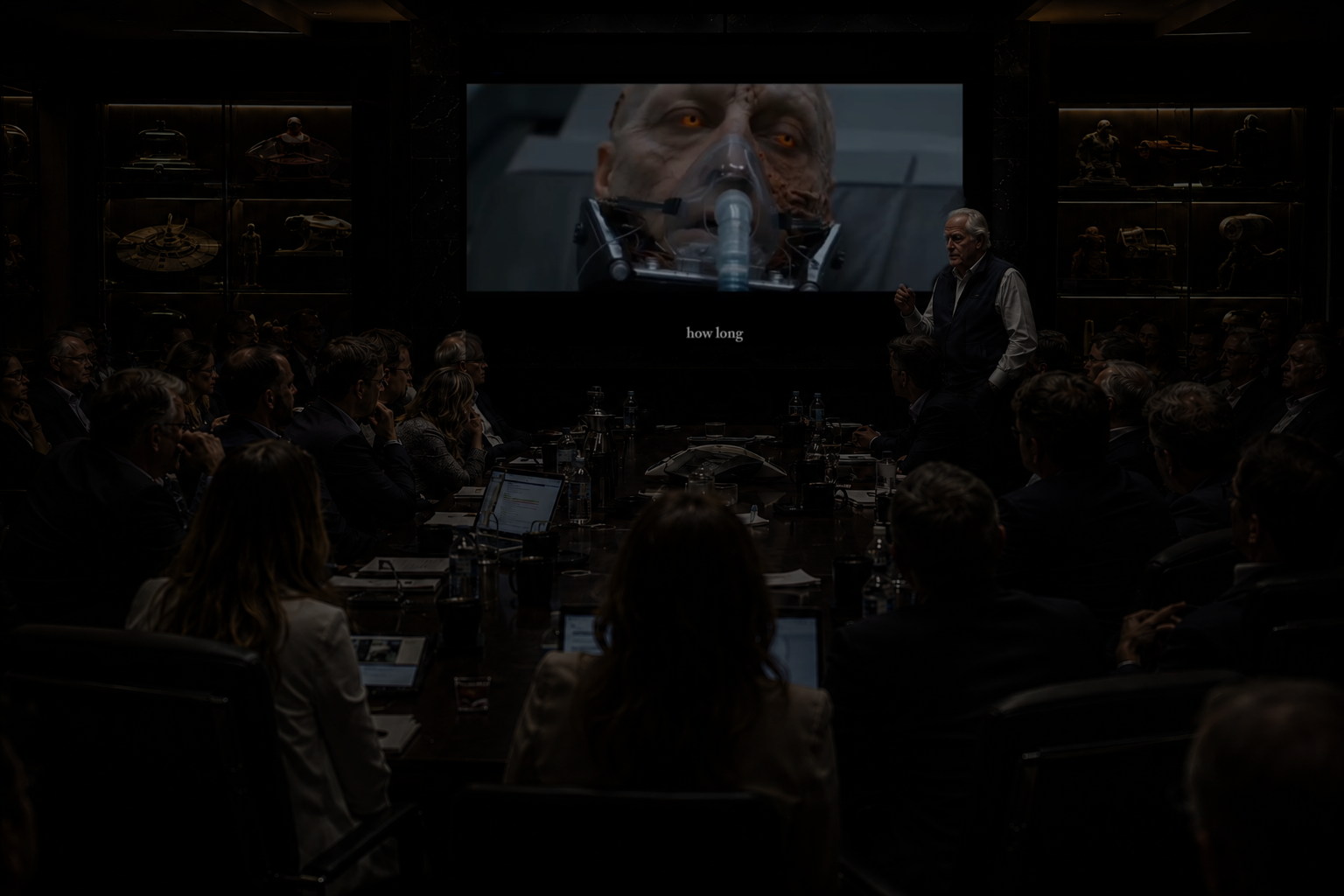
The first appearance of Anakin shattered whatever remained of the original tone. Gone was the cheerful child-mechanic energy. This Anakin was wary, dissociated, hypervigilant. The edit subtly altered line deliveries and reaction shots until the character became something else entirely: a child raised inside systems of industrialized ownership. The slave quarters had been expanded massively. Barracks. Medical stations. 

Tagged children – Inventory language.

One added scene — obviously AI-assisted but horrifyingly effective — showed rows of nutrient tanks partially obscured by tarps and steam beneath Watto’s compound. Not explicit. Worse than explicit. Suggestive. A board member near the center physically removed his glasses and rubbed his face.

Nobody looked at him.

The movie continued.

Watto himself transformed from comic relief into something reptilian and exhausted. A middle manager in a black-market biotech chain he barely controlled anymore. His fear of Jedi was no longer comedic greed. It became institutional terror.

Then the pod race.

The room visibly shifted during the pod race. Because suddenly everyone understood.

It was not sport. It was evaluation. The reconstruction intercut the race with hidden observers transmitting biometric readings. Heart rate. Reflex speed. Adrenal response. Midichlorian density spikes. Betting markets overlaid with intelligence chatter. One inserted line from a Federation observer:

“If Subject survives this heat threshold, escalation protocols proceed.”

A woman from licensing quietly muttered:
“Oh my God.”

And the terrible thing was that it worked.

It all worked. Not perfectly. Sometimes a synthetic face movement lingered half a second too long. Sometimes reconstructed dialogue sounded faintly uncanny. But emotionally? Structurally?

It felt coherent. More coherent than the original. The room knew it. That was the real horror. Then came the scene that broke them. Amidala speaking privately with Anakin aboard the ship. Originally innocent.

Now utterly sacharine unbearable.

The reconstruction reframed every glance. Every hesitation. Every silence. She questioned him too carefully. Touched his neck while discussing “potential.” Asked whether he remembered dreams before he was born. The room temperature seemed to drop. Nobody moved. Because now the film implied something monstrous: that multiple adults around Anakin recognized what he was before he did. And were already maneuvering around him.

Politically… Emotionally… Sexually, almost — though never explicitly enough to become exploitative. Just enough to become deeply wrong.

The executives stopped taking notes.

By the time Darth Maul appeared again, the entire structure of the film had transformed. He was no longer merely an attack dog. The reconstruction implied operational familiarity with Tatooine itself. One inserted holographic sequence showed him reviewing production metrics tied to unidentified “specialized growth assets.” 

Clone imagery appeared but only briefly. Enough to matter. 

Enough for everyone watching to suddenly connect Anakin to the later clone army in retrospect.

There was never some kind of miracle birth. This was all something that had been set in motion from Naboo, it was all by design. It was not random, not happenstance, not capricious. Anakin was the ruthless result of industrial manufacture.

Or attempted manufacture.

A terrible, unstable success.

The boardroom had become tomb-silent now. No coughs. No whispers. Just the sound of air conditioning and the low hum of the projector.

Then the final act arrived. And the film became openly tragic. 

The duel with Maul was cut differently — brutal, desperate, ugly. Obi-Wan looked terrified rather than heroic. Qui-Gon’s death landed with shocking weight because the reconstructed film had spent real time establishing him as the only adult who genuinely saw Anakin as a child rather than an asset.

When he died, the room felt it physically.

Not nostalgia. Loss. The only person that was even remotely approximating clean was cut down.

By the ending montage, Naboo no longer looked victorious. It looked compromised. The celebrations resembled propaganda footage. Palpatine’s ascension was edited like a silent coup occurring in plain sight while everyone applauded. It wasn’t even like he had a choice. It was a chess game. 

Final shot: Anakin smiling weakly at Amidala. Amidala unable to meet his eyes for more than a second.

Cut to black.

No credits for almost ten seconds.

Nobody in the boardroom moved.

Then the house lights rose slightly.

And something extraordinary happened.

No one spoke.

Not because they were being polite.

Because language had temporarily stopped functioning.

One executive stood abruptly and left without a word.

Then another.

Then five more.

A strange, silent migration began toward the lavatories lining the outer corridor. Men and women moving quickly but not running. Eyes wide. Faces pale. Several stared at the floor as they walked.

Nobody dared make eye contact.

One woman entered the restroom and simply stood gripping the sink for nearly a minute without turning on the water.

A lawyer vomited quietly in a stall.

Not from disgust.

From adrenaline.

Near the walls outside the boardroom stood corporate security in dark red jackets, hands folded politely in front of them, watching everyone with careful neutrality. Their presence suddenly felt much more ominous than before the screening.

Inside the room, Harold remained seated.

Still staring at the blank screen.

The Saudi investor leaned toward him slightly.

Finally, after nearly a full minute, he spoke.

Softly.

Almost reverently.

“This is not piracy anymore.”

Harold did not answer immediately.

Because somewhere deep down he understood the real catastrophe.

Millions of people were going to watch this.

And a frightening number of them were going to decide it was the real version.

The I.P. Wars – I

The strange thing about intellectual property is that most people instinctively treat it as though it were physically real, like land or machinery or livestock. We say a corporation “owns” Star Wars in the same grammatical tone we use to say somebody owns a farm. But this comparison becomes unstable the moment one examines what narrative art actually is. A story is not a finite object. It is not depleted through use. It does not disappear when shared. In fact the opposite is true: stories derive their cultural power precisely through repetition, mutation, reinterpretation, quotation, argument, ritualization, and collective emotional investment across generations. Myth grows through circulation. Restricting circulation too aggressively can paradoxically weaken the thing supposedly being protected.

This tension sat dormant for most of the twentieth century because industrial media production required gigantic centralized infrastructures. Cameras, distribution, theaters, television networks, manufacturing chains, marketing apparatuses — these created practical monopolies over narrative legitimacy. A corporation could plausibly claim stewardship over a fictional universe because only corporations possessed the means to materially instantiate that universe at scale. Intellectual property law evolved under those assumptions. It emerged less as a metaphysical doctrine than as an economic compromise: society grants temporary monopolies over creative works to incentivize investment and production. At least in theory.

But something peculiar happened with franchises like Star Wars. They exceeded their commercial boundaries and became symbolic architecture embedded inside mass consciousness. Jedi, Sith, lightsabers, empires, redemption arcs, fallen heroes, spiritual energy fields — these are no longer experienced merely as products. They function as cultural language. Children who have never seen the original trilogy still understand Darth Vader iconographically. Political commentators invoke “the dark side” without explanation. Entire emotional grammars migrated into society itself. At that point ownership becomes philosophically ambiguous. Disney may own the trademarked commercial apparatus surrounding Star Wars, but can one meaningfully claim ownership over a mythology that has fused with collective cognition across billions of people?

This becomes even more ethically unstable when corporations leverage state violence to defend those claims. Because beneath the polite language of “copyright enforcement” lies an uncomfortable reality: intellectual property rights are ultimately enforced through coercive legal structures backed by governments. Fines, lawsuits, asset seizure, criminal penalties, platform removals, blacklisting, algorithmic suppression. The machinery of the state is mobilized to preserve narrative exclusivity. And increasingly, ordinary people feel intuitively that something disproportionate is occurring when a multinational corporation invokes vast legal systems against individuals engaging in transformative creativity around stories that already function culturally as shared myth.

That intuition is not necessarily anti-artist. In fact many people supporting looser narrative ecosystems are motivated by love of art rather than contempt for it. The problem is that modern IP law often conflates protection of creators with perpetual enclosure by institutions that did not originate the underlying mythos in the first place. George Lucas himself built Star Wars through recombination. Kurosawa, Flash Gordon serials, Dune, westerns, Joseph Campbell, samurai cinema, WWII footage, Roman imperial imagery, pulp science fiction — Star Wars was never born ex nihilo. It emerged from synthesis. All culture does. Human creativity is recursive by nature. Every storyteller inherits symbolic material from prior civilizations and rearranges it into new forms. Total originality is largely a romantic fiction.

This is where AI destabilizes everything. Not because machines suddenly “become artists” in some mystical sense, but because generative systems annihilate scarcity around aesthetic production. Once ordinary individuals can produce emotionally convincing cinematic reinterpretations from bedrooms and collaborative online communities, the old industrial assumptions collapse. Corporations no longer monopolize access to spectacle. The audience becomes partially capable of manufacturing its own canon. That changes the emotional legitimacy of ownership. If millions of people can collectively elaborate a mythology in ways audiences find more resonant than official outputs, the corporation begins to appear less like a steward and more like a gatekeeper enforcing artificial scarcity over culture itself.

The concept of canon becomes especially fragile under these conditions. Canon traditionally served industrial clarity. A single authoritative timeline simplified merchandising, continuity management, licensing, adaptation rights, and audience onboarding. But myth historically never behaved that way. Ancient religions, epics, folklore cycles, Arthurian traditions, Norse sagas, Buddhist texts, even Biblical traditions existed through contradictory accounts, regional reinterpretations, political revisions, and contested oral histories. There was no singular immutable continuity. Myth functioned as an evolving conversation distributed across generations.

Modern franchise management attempted to freeze myth into database architecture. This worked temporarily because audiences tolerated institutional authority while production remained centralized. But younger generations raised inside internet culture increasingly experience narrative differently. They are accustomed to participatory interpretation, remixing, fan theories, alternate readings, fragmented timelines, memes, collaborative storytelling, unstable truth environments, and decentralized authorship. To them, fixed canon often feels less natural than evolving multiplicity. The idea that a corporation can permanently dictate the “correct” emotional interpretation of a mythological universe begins to feel psychologically artificial.

None of this means creators deserve no protection. That would collapse rapidly into exploitative chaos benefiting only the largest platforms and aggregation systems. Artists still need compensation, attribution, leverage, and survival mechanisms. Without those, creative labor becomes impossible to sustain. But the current system increasingly reveals contradictions between protecting creators and preserving institutional monopolies over culturally integrated symbolic worlds indefinitely. Copyright terms have expanded far beyond their original economic rationale. Franchises become immortal corporate assets detached from human lifespan entirely. They no longer incentivize creation so much as preserve inherited extraction systems.

There is also an aesthetic problem. Excessive legal enclosure tends to produce increasingly risk-averse storytelling. When intellectual property becomes a multi-hundred-billion-dollar asset class embedded in global financial systems, experimentation becomes dangerous. Every narrative decision passes through committees, risk analysis, demographic modeling, international market considerations, platform strategy, and shareholder pressures. Art begins flattening under managerial optimization. Audiences sense this intuitively. They may not articulate it economically, but they feel when mythology loses sincerity and becomes administratively processed content.

This is partly why transformative fan works can feel emotionally alive even when technically imperfect. They often emerge from obsession rather than institutional maintenance. They carry interpretive conviction. They are trying to say something rather than merely preserve brand stability. Corporations frequently underestimate how much audiences value sincerity over polish. Especially now, in an age where people increasingly distrust institutions generally. Narrative legitimacy itself has become decentralized.

The deeper philosophical question, then, is whether certain stories eventually outgrow proprietary ownership altogether. Not legally perhaps, but culturally and morally. At what point does a myth cease functioning primarily as commercial property and become part of civilization’s symbolic commons? There is no clear boundary. But Star Wars may be one of the first major franchises where society collectively confronts that ambiguity at planetary scale.

Disney possesses legal ownership because existing systems grant it that ownership. But legality and legitimacy are not identical categories. Feudal aristocracies once possessed perfectly legal hereditary rights over rivers, forests, and populations. Colonial empires possessed legal charters. Legality describes structures of enforcement, not necessarily moral permanence. Increasingly, audiences are beginning to question whether narrative universes that have fused with collective imagination should remain indefinitely enclosed under perpetual institutional stewardship backed by coercive legal machinery.

And AI may accelerate that crisis dramatically. Because once culture becomes infinitely generative, enforcing singular ownership over myth starts resembling attempts to privatize language itself.
The I.P. Wars – II

The endpoint of maximalist intellectual property logic is not cultural protection. It is civilizational paralysis. That is the absurdity slowly emerging beneath contemporary franchise warfare, and speculative examples like Disney suing Games Workshop, followed by Dune suing Disney, followed by historical estates suing Dune, are useful precisely because they expose the hidden recursive structure of modern creative production. Once one begins tracing influence honestly, nearly all narrative art reveals itself as layered appropriation extending backward indefinitely through history.
Warhammer 40,000 is an excellent case study because it is simultaneously derivative and radically original. It borrows visibly from Star Wars, Dune, Alien, Judge Dredd, Moorcock, Catholic iconography, fascist aesthetics, heavy metal album covers, WWI trench imagery, cyberpunk, Tolkien, and British satire. Yet nobody seriously experiences 40K as merely a Star Wars knockoff. The influences metabolized into something distinct. The resulting universe possesses its own symbolic gravity, emotional architecture, philosophical obsessions, and aesthetic identity. In practice, creativity does not emerge through purity. It emerges through transformation.

But modern IP systems often pretend otherwise. They rely upon the fantasy that ideas can be cleanly isolated into proprietary units with identifiable sovereign owners. This fiction was administratively convenient during the industrial era because corporations needed stable legal categories to justify large-scale investment. Yet culturally it becomes almost impossible to defend once influence chains are examined with any seriousness.

Take Dune. Frank Herbert’s work profoundly shaped Star Wars. This is not controversial. Desert planets, mystical orders, empire politics, prophetic bloodlines, spiritualized ecology, hidden destinies, warrior asceticism, messianic manipulation — the connective tissue is obvious. Lucas transformed these influences substantially, but they remain visible. Yet Herbert himself drew heavily from prior traditions: Lawrence of Arabia, Islamic history, environmental theory, psychedelic culture, Roman imperial structures, Zen Buddhism, feudalism, and mythological archetypes extending back thousands of years. One can continue excavating endlessly. Lawrence of Arabia itself emerged from real historical events shaped by older imperial traditions, oral cultures, military memoirs, Biblical motifs, and colonial romanticism.

At no point in this chain does one discover a pristine origin point where “pure ownership” becomes philosophically stable. Culture resembles ecology more than engineering. Symbolic forms mutate, migrate, recombine, and hybridize continuously across civilizations. Every major mythology humanity remembers is itself recombinant. Greek myth absorbed Egyptian influence. Christianity absorbed pagan structures. Arthurian legend fused Celtic, Christian, and French courtly traditions. Shakespeare recycled older stories constantly. Even Tolkien — often treated as the patron saint of internally coherent worldbuilding — constructed Middle-earth from Norse sagas, Anglo-Saxon poetry, Catholic cosmology, Finnish epics, and European folklore.

The modern entertainment industry therefore sits atop an unresolved contradiction. On one hand, it depends economically upon exclusive ownership claims. On the other hand, the actual process of artistic creation remains fundamentally collective, historical, and cumulative. Corporations attempt to freeze dynamic cultural flows into static asset categories because finance requires legibility. Investors need identifiable ownership structures. But culture itself resists containment.

This contradiction intensifies dramatically once franchises become large enough to resemble civilizations rather than stories. Star Wars, Warhammer 40K, Dune, Warcraft, Marvel, Tolkien — these are no longer merely works of fiction. They are symbolic ecosystems inhabited by millions of people emotionally over decades. Audiences do not merely consume them. They internalize them as frameworks for identity, morality, aesthetics, politics, spirituality, and imagination itself. Fans spend thousands of hours elaborating worlds collectively through discussion, art, roleplay, modding, theorycrafting, reinterpretation, and transformative creation. The boundaries between creator and audience begin dissolving.

At that point aggressive legal enforcement starts producing strange moral optics. If Disney attempted to annihilate Games Workshop through litigation by claiming ownership over broad science-fantasy archetypes, many observers would instinctively perceive this not as protection of creativity but as aristocratic overreach. Why? Because people intuitively understand that no corporation truly invented “galactic empires,” “psychic knights,” “space religion,” or “fallen heroes.” These are mythic structures with deep civilizational roots. Excessive ownership claims begin resembling attempts to privatize human imagination itself.

And importantly, reciprocal escalation would expose the absurdity immediately. If Dune sued Star Wars successfully for spiritual-political science fiction overlap, then Tolkien estates could potentially destabilize large portions of modern fantasy. If Games Workshop aggressively defended armored supersoldier aesthetics, entire gaming genres become vulnerable. Warcraft could be accused of derivative borrowing from Warhammer. Warhammer itself borrowed heavily from Moorcock’s Chaos cosmology. Moorcock borrowed from older mythic dualisms. The logic spirals infinitely backward.

Eventually one arrives at the uncomfortable realization that modern copyright systems work largely because participants choose not to fully weaponize them at conceptual scale. Informal tolerances exist everywhere. Industries survive through selective enforcement and mutual restraint rather than philosophically coherent boundaries. Everyone borrows constantly. Everyone knows this. The system functions because influence remains partially deniable and because corporations recognize mutually assured destruction dynamics when franchises become sufficiently abstract.

But AI threatens this equilibrium because generative systems massively accelerate recombination visibility. Audiences can now witness styles blending in real time. Influences once hidden beneath production barriers become transparent. People increasingly perceive culture as remix ecology rather than isolated authorship. Younger generations raised on memes, mashups, fan edits, modding culture, TikTok audio layering, and collaborative internet creativity already experience cultural production as participatory rather than proprietary. To them, strict canon enforcement often feels less like artistic integrity and more like bureaucratic territorialism.

There is also a deeper philosophical issue beneath all this: what exactly is being protected? The original justification for copyright was not eternal control. It was temporary incentive balancing public benefit and creator compensation. Society grants limited monopolies so creators can profit from labor, after which works ideally return to the commons. But contemporary franchise capitalism increasingly seeks perpetual enclosure. Copyright durations expand repeatedly. Corporate entities become immortal rights holders. Stories risk remaining locked indefinitely behind institutional stewardship detached entirely from the lifespan or intentions of original creators.

This produces feudal aesthetics almost accidentally. Great houses controlling narrative territories across generations. Vast legal retainers defending symbolic estates. Fans functioning simultaneously as consumers, laborers, evangelists, and trespassers. Corporations cultivating emotional attachment while aggressively policing unauthorized participation. The contradiction becomes psychologically unstable because modern franchises encourage audiences to love worlds deeply while reminding them those worlds remain legally inaccessible except through approved channels.

Yet culture historically thrives through permeability. Shakespeare survived because people endlessly reinterpreted him. Mythology survived because nobody owned it completely. Religions evolved through schisms, revisions, translations, and contested narratives. Art remains alive precisely because it escapes total control by its originators.

The endpoint of maximal IP absolutism therefore cannot be creative flourishing. It becomes endless territorial litigation over increasingly abstract symbolic territory. Corporations suing over archetypes. Aesthetic motifs treated like mineral rights. Narrative influence chains collapsing into legal warfare so recursive that eventually all culture becomes mutually infringing by definition.

And perhaps that reveals something important. Maybe intellectual property works best not when treated as absolute ownership, but when understood as stewardship with limits. Temporary custodianship over living cultural organisms rather than permanent sovereign dominion over imagination itself. Because once stories become civilizational myths, enforcing total ownership begins resembling attempts to fence off parts of the collective unconscious.


The I.P. Wars – III
How It Ends, and What Comes After


The last movie ended without applause. The screen faded into black and remained there, projector hiss whispering softly into a room that suddenly smelled unmistakably human again. Seven hours of tension had accumulated into the air itself: stale sweat, burnt coffee, wool jackets that had been worn too long under recycled ventilation, the faint chemical smell of stress. Nobody moved immediately. Forty-three people remained seated around the enormous conference table, staring at the dark screen as though some final clarification might still appear if they waited long enough.

Outside the windows, California sunlight gleamed across parking structures and palm trees with obscene normalcy. Traffic moved. Helicopters crossed the distant haze. Somewhere beyond the glass, tourists were probably buying plush toys and churros while executives inside this room silently confronted the possibility that the underlying economic architecture of modern entertainment had just suffered a mortal wound.

Harold Vane sat motionless at the end of the table. His glasses remained in his hand. The old navy vest he had worn all morning looked crumpled now, almost soft, like armor after battle. Nobody wanted to be the first person to speak because everyone understood instinctively that the first sentence spoken aloud would define reality again, and nobody trusted reality anymore.

Finally someone from legal cleared his throat and asked, very quietly, “What do we do now?”

The room detonated.

Not emotionally. Not theatrically. Worse than that. It erupted into overlapping systems language. Executives, strategists, investors, litigators, producers, analysts — all speaking at once in the clipped panic dialect of people whose entire professional lives depended upon maintaining the illusion that institutions remain in control of events.

“We litigate immediately.”

“Against who?”

“We pressure distribution channels.”

“There are no centralized channels.”

“We criminalize propagation.”

“You criminalize half the internet.”

“We buy the creators.”

“We don’t know who they are.”

“We’ll find them.”

“No, you won’t.”

“We can regain narrative control.”

“No we cannot.”

“They used our assets.”

“They used culture.”

“That distinction won’t survive court.”

“It may not survive history.”

The Saudi investor remained silent through all of it, fingertips pressed together beneath his chin, watching the room with the unnerving calm of somebody who had seen entire industries die before and understood that collapse often announces itself not through explosions, but through tone changes. Through rooms exactly like this one.

Then Martin Kessler leaned forward abruptly, face flushed from exhaustion and adrenaline. “We grab it all,” he said.

The room paused.

He sensed the opening immediately and pressed harder. “We absorb it. Every version. Every reinterpretation. Every cut. We stop fighting this thing and turn the argument itself into the product.”

Several people visibly relaxed hearing recognizable corporate logic return to the room. Acquisition. Consolidation. Branding. Packaging. The sacred verbs of modern capitalism. If the thing threatening you cannot be destroyed, you purchase it. If it cannot be purchased, you platform it. If it cannot be platformed, you simulate permission while quietly enclosing the ecosystem around it.

Martin stood now, pacing slowly beside the dark screen. “People clearly want multiplicity. Fine. Give them multiplicity. Imperial versions. Jedi versions. Contradictory timelines. Competing historical interpretations. We own the whole discourse layer. Every possible continuity becomes officially licensed.”

“You’re describing narrative chaos,” someone muttered.

“No,” Martin replied instantly. “I’m describing market adaptation.”

A younger executive from analytics finally shook her head. She looked pale. Not frightened anymore exactly. More like somebody who had realized the building was already underwater several floors below them. “You still think this is about products,” she said quietly.

Martin frowned. “What else would it be about?”

She stared at him for several seconds before answering. “Legitimacy.”

That word changed the room.

Because suddenly everyone understood the actual problem. The reconstructed trilogy had not merely succeeded aesthetically. That could have been survived. Bad press could be survived. Piracy could be survived. Even financial damage could be survived. Corporations survived those things constantly.

But this was different.

Millions of people were emotionally accepting an unauthorized version of Star Wars as more real than the official one.

Not technically official. Not legally canonical. Real.

That distinction terrified them because legality was the only territory they still unquestionably controlled.

The analytics executive continued carefully, as though speaking too directly might make the realization irreversible. “Kids aren’t asking whether these versions are licensed. They’re asking why the licensed versions feel emotionally dishonest by comparison.”

Nobody interrupted her.

“They don’t experience this as theft. They experience it as restoration.”

The old attorney near the center of the table scoffed reflexively, but weakly now. “That’s absurd.”

“No,” she replied. “It’s mythology.”

The silence after that statement lingered heavily across the room. Because everyone there, no matter how cynical, understood instinctively that mythology operated under different psychological rules than ordinary entertainment. People tolerated ownership over products. They became uncomfortable when ownership extended too visibly over symbolic worlds that had embedded themselves inside collective emotional life for generations.

Harold finally spoke again, his voice softer than before. “My grandson said ours felt fake.”

Nobody looked at him.

“He’s eleven years old,” Harold continued. “He explained political grooming, institutional manipulation, and genetic engineering over pancakes yesterday morning.” He paused. “And the disturbing part was that he understood the rewritten version better than the original.”

A nervous laugh flickered somewhere in the room and died immediately.

Because everyone had felt it during the screening. The terrible coherence of it. The sense that the reconstructed films had not merely changed events, but revealed hidden emotional structures audiences already subconsciously believed were missing from the originals. It had transformed fairy tale spectacle into systems horror. Into politics. Into trauma. Into elite manipulation. Into mythology for an age that no longer trusted institutions.

One of the producers finally said the thing none of them wanted spoken aloud. “Maybe this was inevitable.”

Several executives snapped toward him immediately, almost angry at the suggestion. But the producer continued anyway.

“We spent thirty years turning myth into asset management. We optimized everything. Sanitized everything. Focus-tested everything. We extracted every possible revenue stream from emotional attachment.” He rubbed his face tiredly. “And now audiences are rebuilding the myths themselves because they got tired of waiting for permission.”

The room drifted into a strange stillness then, not because anyone disagreed, but because they understood he was describing something much larger than one franchise.

Streaming had already shattered the old television order. YouTube had shattered broadcast authority. Social media had shattered gatekeeping over public speech. AI, decentralized media creation, collaborative editing ecosystems, synthetic performances — perhaps this was simply the next fracture point. The next monopoly losing coherence under technological pressure.

The horrifying thing was that everyone in the room could already see the contours of where this ended, even if nobody yet understood the exact mechanism.

Five years.

Ten at most.

That was the unspoken timeline silently hovering above the conference table.

Not necessarily the death of Disney itself. Empires rarely vanish cleanly. But the death of this model. The death of centralized myth management as a stable civilizational arrangement. The extraction machine they had built — endlessly repackaging, sanitizing, monetizing inherited dreams while audiences passively consumed approved continuities — suddenly looked ancient. Feudal, almost.

And the audience had noticed.

Worse: the audience had become capable.

That was the real catastrophe.

For decades corporations tolerated fan creativity because fans lacked industrial power. They could write fiction, make costumes, edit YouTube videos. Harmless participation inside fenced territory. But now the fences themselves were dissolving because the tools of cinematic myth production were becoming democratized at planetary scale.

People were no longer merely commenting on stories.

They were rebuilding them.

A young executive whispered, almost to herself, “They broke the seals.”

Nobody answered because everybody understood the metaphor instantly.

The audience had opened the machinery. Rewritten the code. Hacked the firmware. Pulled apart the sacred black box of industrial storytelling and reconstructed it collaboratively according to emotional appetites the corporations themselves no longer fully understood.

And the reconstructed trilogy had proven something devastating: audiences were willing to follow.

Not because the new versions were technically flawless. They weren’t. There were uncanny moments. Strange edits. Synthetic seams visible under scrutiny. But sincerity had outweighed polish. Conviction had outweighed institutional authority.

That realization sat in the room like radiation.

Disney could probably survive this financially for years. The parks would remain full. Merchandise would continue selling. Lawsuits would still frighten people. Investors would still extract value from the machinery. Empires decay asymmetrically.

But culturally?

Everyone here understood the damage was already done.

Because somewhere outside this building, millions of people were downloading mythology that no longer required permission to exist.


Judge for yourself.


Post navigation

← Sloshtrioshka Planets

Leave a Reply Cancel reply

You must be logged in to post a comment.

Hi there. I am khannea – transhumanist, outspoken transgender, libertine and technoprogressive. You may email me at khannea.suntzu@gmail.com.


Tags

Animal Cruelty Anon Artificial Intelligence Automation BioMedicine BitCoin Cinematography Collapse Degeneracy and Depravity Facebook Gaga Gangster Culture Humor Idiocracy Intelligence (or lack thereoff) Ivory Towers Khannea Larry Niven Life Extension MetaVerse Monetary Systems Moore's Law Peak Oil Philosophy Politics Poverty Prometheus Psychology Real Politiek Revolution Science Fiction Second Life Singularity social darwinism Societal Disparity Space Industrialization Taboo Uncategorized UpWing US Von Clausewitz War Crimes White Rabbit Wild Allegories Youtube

Pages

  • – T H E – F A R – F R O N T I E R –
  • I made Funda this suggestion :)
  • My Political Positions
  • Public versus Personal (?) AI Model Research Cluster Brainstorm Cluster
  • Shaping the Edges of the Future
  • Shop
  • Some Of My Art

Blogroll

  • Adam Something 0
  • Amanda's Twitter On of my best friends 0
  • Art Station 0
  • Climate Town 0
  • Colin Furze 0
  • ContraPoints An exceptionally gifted, insightful and beautiful trans girl I just admire deeply. 0
  • David Pakman Political analyst that gets it right. 0
  • David Pearce One of the most important messages of goodness of this day and age 0
  • Don Giulio Prisco 0
  • Erik Wernquist 0
  • Humanist Report 0
  • IEET By and large my ideological home 0
  • Isaac Arthur The best youtube source on matters space, future and transhumanism. 0
  • Jake Tran 0
  • Kyle Hill 0
  • Louis C K 0
  • My G+ 0
  • My Youtube 0
  • Orions Arm 0
  • PBS Space Time 0
  • Philosophy Tube 0
  • Reddit I allow myself maximum 2 hours a day. 0
  • Second Thought 0
  • Shuffle Dance (et.al.) 0
  • The Young Turks 0
  • What Da Math 0

Archives

Blogroll

  • Jake Tran 0
  • Climate Town 0
  • Second Thought 0
  • My Youtube 0
  • David Pakman Political analyst that gets it right. 0
  • The Young Turks 0
  • Amanda's Twitter On of my best friends 0
  • Don Giulio Prisco 0
  • Art Station 0
  • IEET By and large my ideological home 0
  • Colin Furze 0
  • Shuffle Dance (et.al.) 0
  • Isaac Arthur The best youtube source on matters space, future and transhumanism. 0
  • Adam Something 0
  • Humanist Report 0
  • Philosophy Tube 0
  • ContraPoints An exceptionally gifted, insightful and beautiful trans girl I just admire deeply. 0
  • Orions Arm 0
  • Kyle Hill 0
  • Louis C K 0
  • What Da Math 0
  • PBS Space Time 0
  • My G+ 0
  • Erik Wernquist 0
  • David Pearce One of the most important messages of goodness of this day and age 0
  • Reddit I allow myself maximum 2 hours a day. 0

Pages

  • – T H E – F A R – F R O N T I E R –
  • I made Funda this suggestion :)
  • My Political Positions
  • Public versus Personal (?) AI Model Research Cluster Brainstorm Cluster
  • Shaping the Edges of the Future
  • Shop
  • Some Of My Art

Tags

Animal Cruelty Anon Artificial Intelligence Automation BioMedicine BitCoin Cinematography Collapse Degeneracy and Depravity Facebook Gaga Gangster Culture Humor Idiocracy Intelligence (or lack thereoff) Ivory Towers Khannea Larry Niven Life Extension MetaVerse Monetary Systems Moore's Law Peak Oil Philosophy Politics Poverty Prometheus Psychology Real Politiek Revolution Science Fiction Second Life Singularity social darwinism Societal Disparity Space Industrialization Taboo Uncategorized UpWing US Von Clausewitz War Crimes White Rabbit Wild Allegories Youtube

Archives

  • May 2026
  • April 2026
  • March 2026
  • February 2026
  • January 2026
  • December 2025
  • November 2025
  • October 2025
  • September 2025
  • August 2025
  • July 2025
  • June 2025
  • May 2025
  • April 2025
  • March 2025
  • February 2025
  • January 2025
  • December 2024
  • November 2024
  • October 2024
  • September 2024
  • August 2024
  • July 2024
  • June 2024
  • May 2024
  • April 2024
  • March 2024
  • February 2024
  • December 2023
  • October 2023
  • September 2023
  • August 2023
  • July 2023
  • June 2023
  • May 2023
  • April 2023
  • March 2023
  • November 2022
  • October 2022
  • September 2022
  • August 2022
  • July 2022
  • June 2022
  • May 2022
  • April 2022
  • March 2022
  • February 2022
  • January 2022
  • December 2021
  • November 2021
  • August 2020
  • July 2020
  • April 2020
  • March 2020
  • December 2019
  • November 2019
  • October 2019
  • September 2019
  • August 2019
  • July 2019
  • June 2019
  • April 2019
  • March 2019
  • February 2019
  • January 2019
  • September 2018
  • August 2018
  • July 2018
  • June 2018
  • May 2018
  • April 2018
  • March 2018
  • February 2018
  • January 2018
  • December 2017
  • November 2017
  • October 2017
  • September 2017
  • August 2017
  • July 2017
  • May 2017
  • February 2017
  • January 2017
  • November 2016
  • October 2016
  • September 2016
  • August 2016
  • July 2016
  • June 2016
  • May 2016
  • April 2016
  • March 2016
  • February 2016
  • January 2016
  • December 2015
  • November 2015
  • August 2015
  • July 2015
  • March 2015
  • February 2015
  • January 2015
  • December 2014
  • November 2014
  • October 2014
  • September 2014
  • August 2014
  • July 2014
  • June 2014
  • May 2014
  • April 2014
  • March 2014
  • February 2014
  • January 2014
  • December 2013
  • November 2013
  • October 2013
  • September 2013
  • August 2013
  • July 2013
  • June 2013
  • May 2013
  • April 2013
  • March 2013
  • February 2013
  • January 2013
  • December 2012
  • November 2012
  • October 2012
  • September 2012
  • August 2012
  • July 2012
  • June 2012
  • May 2012
  • April 2012
  • March 2012
  • February 2012
  • January 2012
  • December 2011
  • November 2011
  • October 2011
  • September 2011
  • August 2011
  • July 2011
  • June 2011
  • May 2011
  • April 2011
  • March 2011
  • February 2011
  • January 2011
  • December 2010
  • November 2010
  • October 2010
  • September 2010
  • August 2010
  • July 2010
  • June 2010
  • May 2010
  • April 2010
  • March 2010
© 2026 KHANNEA | Powered by Minimalist Blog WordPress Theme