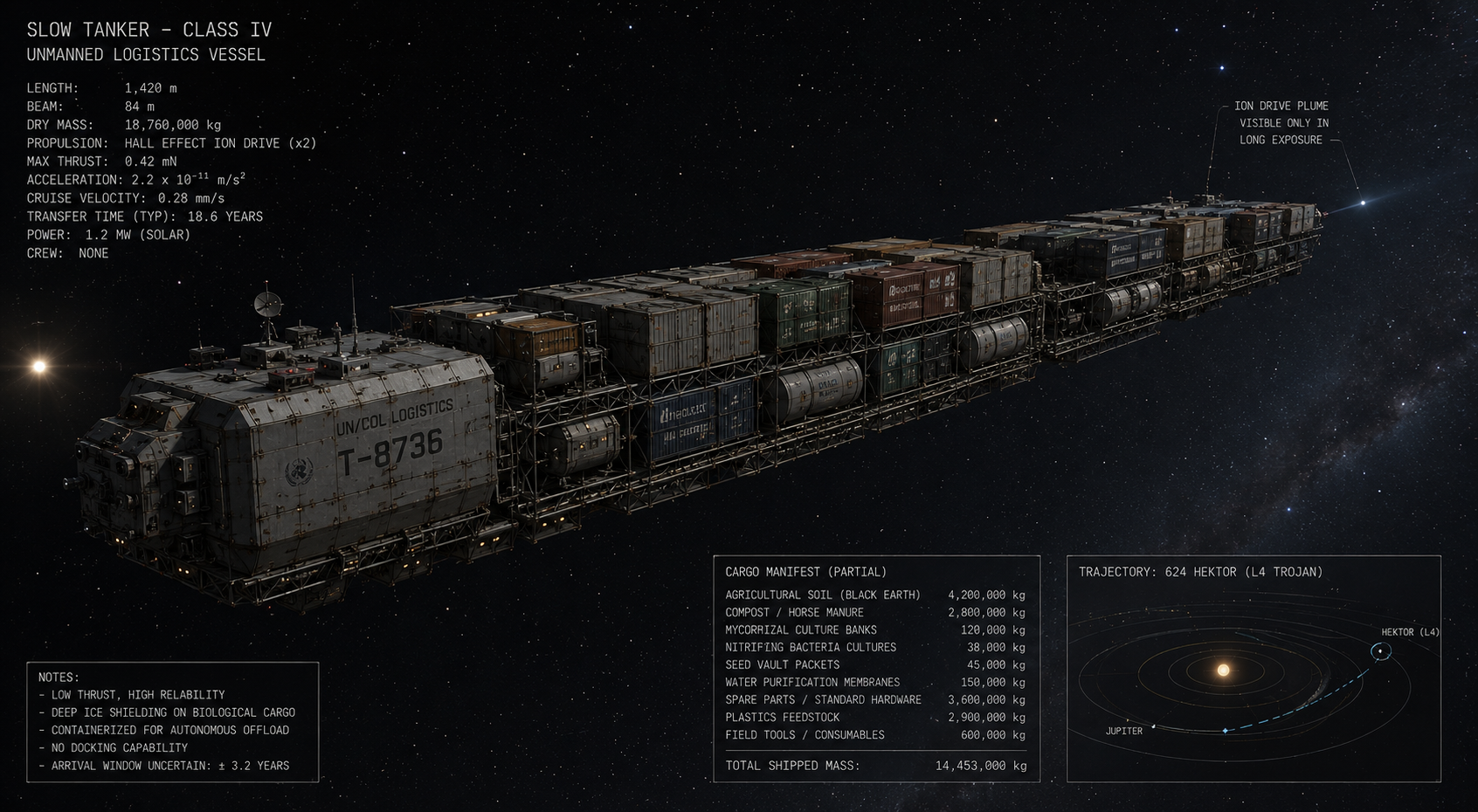
Slow tanker logistics formed the hidden circulatory system of early interplanetary civilization. Contrary to the heroic mythology of astronauts, explorers, and fast courier vessels, the actual expansion of humanity beyond the inner planets depended primarily on vast numbers of extremely cheap, low-acceleration cargo injections launched years or decades ahead of human arrival. These “slowboats” carried bulk substrates whose Earthside value was negligible but whose destination utility could become civilization-critical: soil, bacterial ecologies, plastics feedstock, spare seals, pressure tubing, fertilizers, algae cultures, water purification membranes, thermal blankets, and industrial stock materials. Because transfer economics overwhelmingly favored mass efficiency over speed, such cargoes were launched continuously and opportunistically, often arriving long after the original missions had departed Earth.
Here is where it gets nasty : under later UN colonial utility law, merely depositing survivability-enhancing infrastructure or material near a recognized settlement corridor generated presumptive beneficiary liability for future colonists, regardless of direct use. This transformed logistics into a form of long-range economic territorialization. Entire settlements became financially entangled with decades-old cargo streams before local sovereignty, demography, or culture had stabilized. The resulting system resembled less a frontier than a layered accretion of actuarial obligations, salvage rights, and inherited infrastructure debt. In practice, the outer Solar System was not conquered by explorers, but slowly assembled by insurers, depot planners, cargo syndicates, patient investors, and the relentless arrival of useful things.
One of the least intuitive aspects of early interplanetary expansion was that colonization did not fail primarily because of propulsion, but because of logistics timing. By the late 21st and early 22nd centuries, humanity had already solved enough of the energy and automation problem to physically move cargo throughout much of the inner Solar System and eventually toward the Jovian regions. The true bottleneck turned out not to be launching mass, but paying for mass whose usefulness would only materialize years or decades later.
This created a severe structural problem. Any serious settlement effort beyond Mars required enormous quantities of pre-positioned material before human arrival. Colonists could not simply land on a distant asteroid or moon and “figure it out later.” They needed atmospheric processors, spare pressure seals, structural stock, water purification systems, greenhouse substrates, emergency food reserves, radiation shielding materials, industrial feedstocks, replacement electronics, medical equipment, and biological ecologies waiting ahead of them. In practice, every successful colony depended on years or decades of invisible logistical buildup long before the first human beings arrived.
However, this immediately created an economic paradox. The entities most capable of launching such cargoes — governments, insurers, industrial consortia, and infrastructure firms — had little incentive to do so voluntarily. From their perspective, these were extremely long-duration investments with delayed and uncertain returns. A shipment launched toward a Trojan asteroid or outer-system depot might not arrive for ten or fifteen years. In some cases the destination settlement itself did not yet exist when the cargo launched. Worse, the political and commercial landscape could change entirely during transit. Companies collapsed. Governments fell. Markets shifted. A mission could fail before arrival, rendering the cargo worthless. No rational institution wanted open-ended liability for infrastructure that might spend decades drifting through space before becoming useful.
The result was a classic developmental deadlock. Colonies required enormous amounts of pre-positioned infrastructure to survive, yet nobody wanted to finance that infrastructure because the return horizon was too distant and too uncertain. Without intervention, the expansion of human civilization beyond a few heavily subsidized flagship outposts would likely have stagnated permanently.
The eventual solution emerged through a controversial series of UN orbital development treaties during the late 21st century. Collectively referred to as Colonial Utility and Beneficiary Law, these agreements fundamentally changed the economics of interplanetary logistics by redefining who was ultimately responsible for paying for pre-positioned infrastructure.
The core principle was deceptively simple: if cargo materially improved the survivability, industrial capability, or future optionality of a recognized colonial destination, then future beneficiaries of that infrastructure inherited financial responsibility for it upon settlement maturity. Crucially, this obligation did not depend on direct use. Colonists did not need to open a container, activate equipment, or formally accept delivery. The mere presence of useful infrastructure at destination constituted measurable strategic value. By reducing settlement risk and increasing survivability odds, such cargo altered the economic prospects of the colony itself. Therefore, the future colony — not the launch sponsor — became the presumed beneficiary.
This legal shift transformed the economics of space expansion almost overnight.
Suddenly, private actors could launch low-cost, long-duration cargoes toward developing destinations with the expectation that eventual colonial growth would retroactively generate repayment. Governments no longer needed to directly finance every kilogram of infrastructure. Insurers no longer bore indefinite open-ended exposure. Investors could distribute risk across decades, relying on the assumption that functioning colonies would eventually produce industrial output, taxable activity, export capacity, and settlement-scale economic growth sufficient to absorb inherited logistical debt.
The system effectively treated colonies as future exponential economies rather than isolated expeditions. This assumption was not irrational. Historical models consistently demonstrated that once settlements achieved demographic stability — especially once family formation and multi-generational continuity emerged — growth curves accelerated dramatically. Industrial replication, local manufacturing, mining, volatiles processing, and population increase created compounding economic activity. Early colonies were expensive survival projects. Mature colonies became productive industrial ecosystems.
As a result, the law intentionally embedded a form of moral hazard into colonial development. Future settlers inherited obligations they had never personally agreed to. Colonies effectively began existence already indebted to centuries of prior logistical investment. Critics argued that this transformed frontier populations into captive revenue bases for Earthside financial interests. Supporters countered that without such mechanisms, large-scale interplanetary expansion would never have occurred at all.
In practice, the system worked precisely because the economics of slow logistics were so asymmetric. A shipment with trivial Earthside value could become enormously valuable at destination. Soil, microbial ecologies, industrial lubricants, polymers, fertilizer precursors, plumbing hardware, algae cultures, or simple replacement components might be nearly worthless at launch yet critically important to survival at a remote colony years later. The law converted this asymmetry into a functioning market mechanism. Investors were incentivized to continuously inject useful low-cost material into future settlement corridors because eventual colonies would absorb the accumulated logistical debt as part of becoming economically operational.
Over time, this produced an entirely new kind of infrastructure ecology across the Solar System. Before human arrival, destinations accumulated layers of dormant industrial potential: depots, spare parts caches, greenhouse modules, biological archives, volatile reserves, pressure vessels, communications arrays, and emergency shelters drifting into place over decades. Colonization became less an act of heroic exploration than a process of slow infrastructural sedimentation.
This also radically changed the character of frontier settlements themselves. Early colonies were rarely clean-sheet creations. Instead, they inherited tangled accumulations of aging equipment, abandoned depots, obsolete standards, and overlapping ownership claims stretching back generations. Settlers did not arrive in empty territory. They arrived inside partially completed logistical environments already entangled with financial obligations, legal precedents, and historical cargo chains.
The consequences were profound. Entire branches of colonial law emerged around cargo genealogy, infrastructural provenance, survivability valuation, and inherited utility obligations. Economists increasingly described outer-system expansion not as territorial conquest but as actuarial growth. The frontier was no longer defined by distance alone, but by the gradual accumulation of useful matter whose future value could be predicted, insured, and eventually monetized.
In hindsight, historians would conclude that the Solar System was not truly opened by propulsion breakthroughs, heroic astronauts, or even governments. It was opened by a legal framework that solved the problem of delayed logistical payment. Once future colonies themselves became the collateral backing long-duration infrastructure investment, expansion ceased being an exceptional political project and became a self-reinforcing economic process.
The individual later known throughout the Solar System under the moniker Hubertus Bigend emerged quietly during the mid-2060s, at precisely the moment interplanetary logistics ceased being a government monopoly and became vulnerable to asymmetrical economic exploitation. Almost nothing about the person was ever conclusively verified. “Hubertus Bigend” was almost certainly not a real name. Most historians agree the operator was Belgian or Dutch-speaking Flemish (some say VanThisOrThat), likely a beneficiary of first-generation commercial longevity treatments, and deeply familiar with both maritime insurance law and orbital freight arbitrage. What mattered was not the identity itself, but the realization they made before almost anyone else did: the future value of cargo would become radically detached from its launch value.
At the time, the economics of early deep-space expansion were still primitive. Launch providers, governments, and insurers focused obsessively on high-value infrastructure: reactors, pressure systems, advanced fabrication units, AI supervision packages, and propulsion systems. Meanwhile, enormous quantities of low-status material were treated as economically irrelevant. Agricultural substrate, diapers, bacterial cultures, thermal insulation rolls, low-grade polymers, food supplements, fungal ecology packs, pressure-seal lubricants, cheap textiles, and bulk packaging materials were considered too low-margin to justify expensive interplanetary transfer.
Hubertus realized the opposite.
A bag of soil on Earth was worthless.
A bag of living soil at a settlement three years from ecological collapse was civilization-critical.
That asymmetry became the foundation of the Blue Ant model.
The corporation itself appeared suddenly through a tangle of shell structures, insurance subsidiaries, orbital salvage holdings, and freight acquisition firms. The name “Blue Ant” was widely interpreted as a layered reference: parasitic wasps that inject eggs into living systems, the ant-like persistence of distributed logistics, and almost certainly the William Gibson character Hubertus Bigend, whom the operator apparently considered either hilarious or aspirational. The psychological effect was immediate. Regulators, insurers, and colonial planners all understood that someone profoundly irritating had entered the system.
The operational model was brutally simple.
Blue Ant purchased obsolete or downgraded low-thrust propulsion systems in enormous quantities. These were not cutting-edge drives. They were old-generation Chinese and Kazakh ion systems, decommissioned Hall-effect cargo units, outdated solar-electric transfer buses, and low-efficiency L4 injection platforms no longer commercially competitive for premium freight. Most operators considered them junk. Hubertus bought them by the hundreds for almost nothing.
The drives were slow.
Painfully slow.
Many cargoes required:
- 8 years,
- 12 years,
- sometimes 20 years,
to reach projected destinations.
Hubertus did not care.
Time itself became the arbitrage.
The launch strategy operated under three favorable conditions, all of which produced profit.
If settlers arrived after Blue Ant cargo had already reached destination, reimbursement and utility valuation were immediate. The colony inherited fully emplaced survivability infrastructure and therefore assumed debt obligations under Colonial Utility Law.
If the cargo was still underway when settlers arrived, liability still attached. The future arrival of survivability-enhancing material altered actuarial projections and settlement optionality. Colonists were still deemed beneficiaries.
Most infuriatingly, if Hubertus launched cargo shortly before a colony expedition itself departed Earth, the legal framework still recognized the shipment as contributing future strategic value. Settlers might spend a decade building a settlement only to receive notice years later that additional infrastructure launched after their departure had entered recognized utility range and therefore generated debt exposure retroactively.
The economics were staggering because Blue Ant’s margins were almost entirely determined by launch cost minimization.
Hubertus became obsessed with buying things civilization considered beneath dignity.
The cargo manifests became infamous.
Black earth mixed with horse manure.
Compost worms.
Mycorrhizal fungal starter cultures.
Nitrifying bacteria.
Frozen yeast banks.
Agricultural lime.
Bulk vitamins.
Baby formula.
Cold-weather blankets.
Pressure-stable wrapping film.
Insulation foam precursor chemicals.
Algae nutrient paste.
Cheap copper wiring.
PVC-equivalent tubing.
Generic machine oil.
Low-grade ceramic bearings.
Field repair adhesives.
Flexible sealant tape.
Hydroponic mesh.
Fungal-resistant fabrics.
Vacuum-rated gloves.
Mass-market painkillers.
Contraceptive implants.
Educational tablets.
Low-bandwidth entertainment archives.
Dental repair kits.
Water purification membranes.
Industrial bleach precursor compounds.
Portable toilets.
Diapers.
Soap concentrates.
Protein culture starter vats.
Seed vault duplicates.
Chicken embryo banks.
Freeze-dried onions.
Synthetic leather patches.
Cold-resistant tarp material.
Cargo netting.
Pressure tent membrane rolls.
Generic antibiotics.
Vacuum-safe zipper systems.
Laundry detergent precursors.
Childhood vaccine libraries.
Emergency heater coils.
Spare LED arrays.
Food-safe polymer buckets.
Nutritional yeast.
Steel fastener assortments.
Insulated floor foam.
Medical gauze.
Mosquito netting, hilariously useless at destination yet legally categorized as adaptive textile infrastructure.
Cheap stuffed animals.
Basic kitchenware.
School chalk.
Coffee seeds.
Religious literature.
Carbon filters.
Atmospheric scrubber substrate.
Low-cost hearing aids.
Industrial gloves.
Sewing kits.
Manual hand tools.
Bulk pencils.
Feminine hygiene products.
Replacement toothbrush heads.
Cargo pallets.
Reinforced paper products.
Mylar emergency sheeting.
Field mattresses.
Vitamin D supplements.
UV-resistant paint.
Mold suppression chemistry.
Artificial pollinator drones.
Soil acidity testers.
Portable water heaters.
Children’s educational media.
And endless quantities of dirt.
The dirt became legendary.
Blue Ant discovered that living soil ecologies were almost impossible to synthesize correctly in closed-loop extraterrestrial environments. Early settlements repeatedly encountered immune dysfunction, agricultural instability, fungal collapse, and microbiome degradation. Rich terrestrial soil containing worms, bacteria, fungi, trace organics, and chaotic biological complexity became absurdly valuable beyond Earth.
Hubertus responded by launching dirt by the kiloton.
Often mixed with horse manure because it improved microbial survivability during transfer.
UN inspectors despised him.
Launch inspections became infamous theater. Colonial transfer officials routinely accused Blue Ant representatives of exploiting legal loopholes, burdening future settlements with involuntary debt, and effectively conducting economic territorialization through garbage injection. Internal memos described Blue Ant as “an actuarial parasite attached to civilization expansion itself.”
None of this mattered.
The cargoes were legal. Worse, they worked and actually saved numerous colonies.
Many settlements that initially mocked or resisted Blue Ant shipments eventually discovered the material was genuinely useful. Agricultural failures were mitigated by imported biome diversity. Cheap insulation reduced thermal losses. Emergency diapers and infant nutritional systems quietly stabilized fertility rates in early family settlements. Thermal blankets and wrapping foams became life-saving during pressure emergencies. Blue Ant’s obsession with low-status survival material repeatedly intersected with the brutal realities of frontier life.
By 2072 Blue Ant was launching hundreds of cargoes annually.
By 2085 the number reached into the thousands.
By 2100 Blue Ant-linked freight objects existed throughout the Main Belt, Mars transfer corridors, Trojan approaches, Jovian infrastructure routes, and dozens of undeclared settlement trajectories.
The effect on Solar civilization was profound.
Blue Ant effectively transformed slow logistics into a distributed parasitic infrastructure ecology. Cargoes traveled continuously through deep space like spores. Some failed. Some drifted inert forever. Some arrived decades after their launch sponsors had dissolved. Yet enough arrived successfully that the model became self-sustaining.
Critics began referring to operators like Hubertus as “Logistics Trolls,” individuals or consortia that weaponized colonial utility law by flooding future settlements with low-cost survivability-enhancing material specifically to generate inherited debt obligations. Supporters argued that such actors unintentionally solved one of the greatest bottlenecks in interplanetary expansion: pre-positioning massive quantities of boring but necessary infrastructure before human arrival.
Historians remain divided on Hubertus Bigend.
Some portray Blue Ant as a predatory actuarial parasite that transformed colonies into captive debt organisms before they even achieved sovereignty.
Others argue that without the logistical sedimentation generated by operators like Blue Ant, outer-system settlement would have stagnated permanently as an underfunded prestige exercise.
What nobody disputes is this:
the expansion of humanity beyond Earth was not built primarily by heroes, astronauts, or explorers.
It was built by the relentless arrival of useful things.
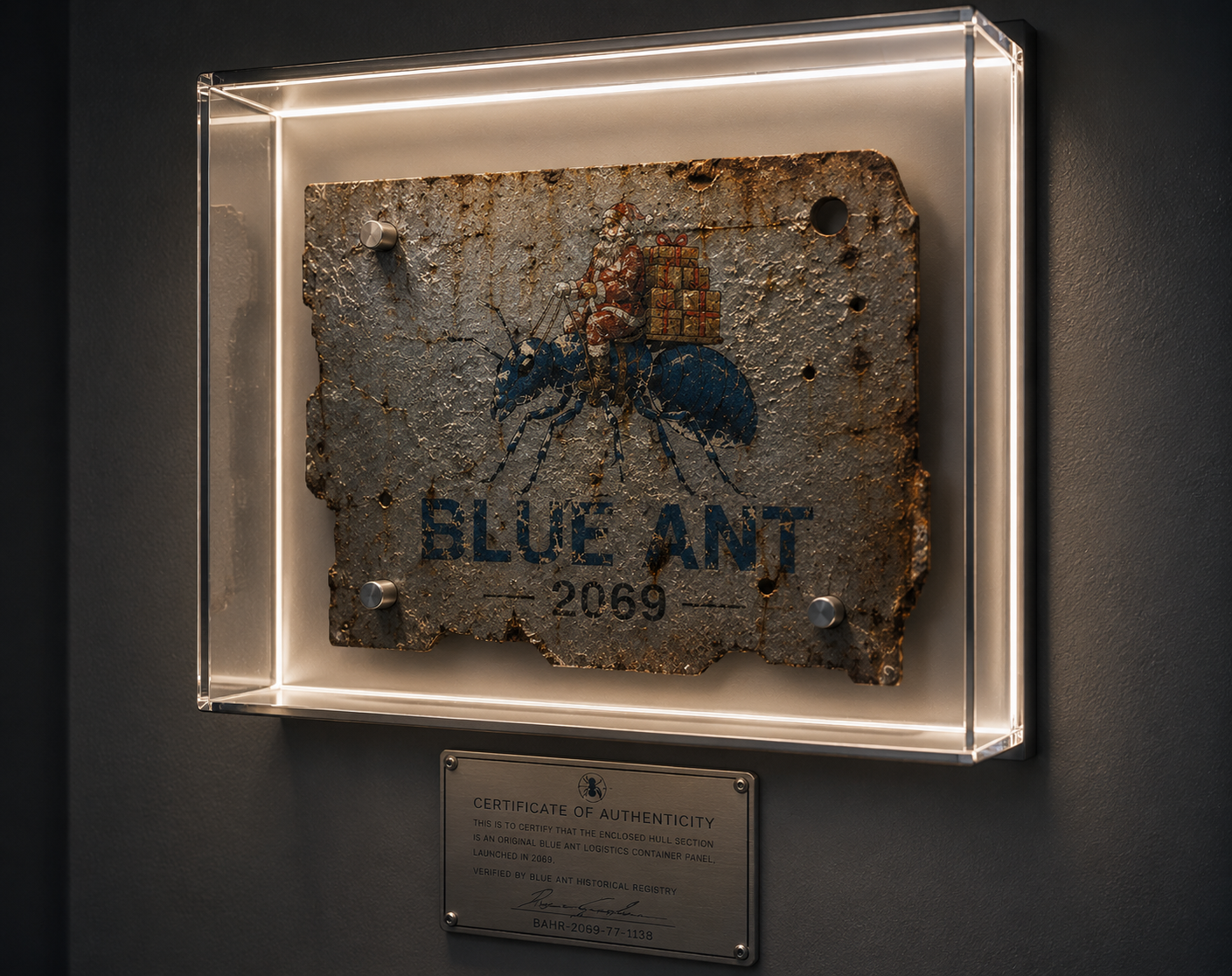
By the middle decades of the 23rd century, original Blue Ant hull sections had become one of the most recognizable and perversely prestigious collectible categories in the Solar System. The transformation was ironic almost to the point of absurdity. During their operational era, Blue Ant containers had been associated with debt extraction, legal opportunism, logistical harassment, and the hated sedimentary economics of colonial expansion. Dockworkers cursed them. Colonial administrators despised them. UN inspectors openly insulted Blue Ant launch representatives during departure certification. Yet over the course of two centuries the surviving hull fragments evolved into something else entirely: physical relics from the brutal, improvised, deeply unglamorous birth of interplanetary civilization.
Authentic Blue Ant hull material was extraordinarily difficult to obtain. Most early cargo containers had been recycled, pulverized, buried into regolith shielding, melted into structural stock, or simply lost in transfer accidents and orbital debris fields. The few surviving examples tended to originate from extremely early launches, especially pre-2080 injection cargoes associated with the first major expansion wave into the Main Belt and Trojan corridors. Their rarity was compounded by the fact that Blue Ant containers were never designed to survive as cultural artifacts. They were ugly, low-cost industrial objects built from cheap pressure-tolerant alloys, often assembled from downgraded terrestrial maritime fabrication stock and rapidly adapted orbital freight frames.
This aesthetic degradation became central to their appeal.
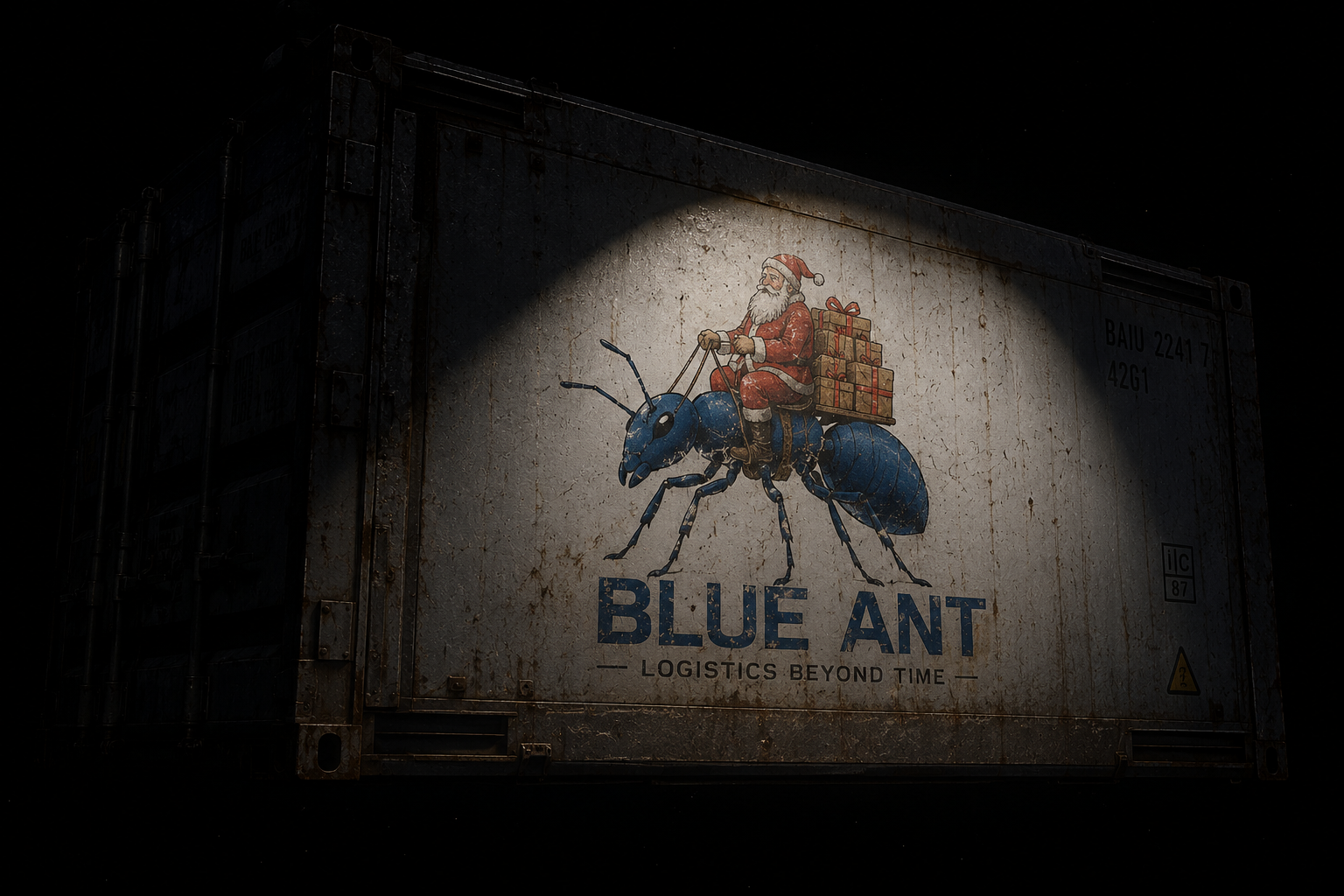
A pristine Blue Ant panel was generally considered undesirable and suspicious. Serious collectors preferred sections exhibiting extensive operational damage: radiation darkening, vacuum corrosion, thermal discoloration, micrometeoroid pitting, emergency weld patches, fungal bloom staining, registry overpainting, impact scoring, and visible evidence of long-duration environmental abuse. The most desirable examples often retained fragments of the original stenciling beneath layers of abrasion and oxidation: partial serial codes, agricultural hazard markings, old Colonial Utility registration seals, degraded cargo classifications, or fragments of the iconic Blue Ant logo itself.
Collectors particularly prized panels showing clear evidence of outer-system exposure. Distinctive Jovian radiation embrittlement patterns, Trojan dust abrasion signatures, or long-term vacuum crystal blooming dramatically increased provenance value. Some authenticated pieces still emitted faint measurable residual radioactivity from decades spent adjacent to reactor freight or improperly shielded industrial cargo. Ironically, minor contamination was considered desirable provided it remained below habitation thresholds. Dealers often advertised such pieces using phrases like “cold-active,” “warm-spectrum verified,” or “L4 exposure authentic.”
The preferred display style evolved into a recognizable Solar aesthetic. Hull sections were typically laser-cut from larger salvage plates, stabilized to prevent continued structural decay, and suspended inside thick cast epoxy vitrines under low indirect lighting. The epoxy itself was usually left slightly imperfect, intentionally preserving trapped oxidation particles, dust, or microscopic structural debris. High-end displays incorporated embedded authentication chips, isotopic dating reports, launch registry overlays, and reconstructed trajectory histories. In elite collections, the object was often displayed alongside accompanying documentation tracing the cargo lineage and eventual colonial utility claims associated with the original container.
The social meaning of ownership was unusually complex. Blue Ant relics functioned as status objects, but anti-status status objects. They signaled historical literacy, industrial romanticism, and familiarity with the ugly realities underlying Solar civilization. Owning one implied a rejection of naïve utopian aesthetics. Wealthy collectors displayed them precisely because they were crude, corroded, and materially honest. In contrast to polished orbital luxury goods or algorithmically generated art objects, Blue Ant hull sections represented labor, entropy, bureaucracy, compromise, and survival.
The appeal crossed class boundaries in a way few collectible categories managed. Corporate executives, Martian debt aristocrats, university historians, reactor engineers, docking crews, and freight syndicate veterans all recognized the symbolism immediately. The artifacts carried a kind of grim authenticity. Everyone understood that the early expansion era had not been built primarily by visionary architecture or heroic exploration, but by endless quantities of cheap useful material moving slowly through space.
As a result, the hull sections accumulated a mythology almost entirely disconnected from conventional fine art culture. Collectors spoke about them the way earlier centuries discussed salvaged battleship steel, Soviet industrial relics, or fragments of the Berlin Wall. They were not beautiful in a traditional sense. Their value came from representing the physical residue of historical inevitability.
This became especially pronounced among outer-system elites. By 2265, a self-respecting collector in the Jovian or Trojan regions was almost expected to own at least one authenticated Blue Ant segment. The objects frequently appeared in executive offices, shipping consortium headquarters, orbital law firms, university history departments, luxury docking lounges, and private habitation suites. Entire interior design trends emerged around “Logistics Brutalism,” emphasizing reclaimed industrial materials, exposed utility structures, freight-era typography, and salvaged colonial hardware.
The uglier the artifact, the better.
A heavily corroded panel showing three layers of repainting, partial insurance markings, emergency weld seams, and faded agricultural substrate warnings might command vastly higher prices than a cleaner specimen. Collectors became obsessed with provenance details. Was the hull exposed at Hektor? Did it originate from a pre-Settlement utility injection? Was it associated with one of the famous Trojan debt disputes? Did the panel survive vacuum drift after cargo separation? Was the radiation profile consistent with early-generation Kazakh ion injection corridors?
Authentication evolved into an entire specialist industry. Experts analyzed isotopic alloy signatures, solar particle exposure damage, corrosion chronology, weld pattern geometries, and historical registry inconsistencies. Counterfeits became rampant during the 2240s and 2250s as demand exploded. Entire criminal networks specialized in artificially aging industrial scrap to imitate early Blue Ant hull material. Serious collectors therefore relied heavily on authenticated provenance chains and destructive microanalysis techniques.
Ironically, the historical reassessment of Blue Ant itself contributed heavily to the collectible boom. By the 23rd century, public attitudes toward Hubertus Bigend and the broader Logistics Troll era had become deeply ambivalent. Early settlements had hated inherited debt burdens and utility claims, yet later generations increasingly acknowledged that many colonies would likely have failed without the vast quantities of pre-positioned survivability material injected throughout the Solar System during the expansion period. Blue Ant containers had carried diapers, vitamins, thermal blankets, bacterial ecologies, agricultural substrate, insulation polymers, plumbing hardware, and thousands of other boring low-status necessities that proved civilization-critical in frontier conditions.
This ambiguity made the relics culturally irresistible.
To display a Blue Ant panel in 2265 was not merely to own an antique. It was to participate in a long unresolved argument about how humanity actually spread into space. The relics represented a civilization built not through heroism alone, but through accounting tricks, actuarial pressure, industrial persistence, ugly infrastructure, and the relentless arrival of useful things.
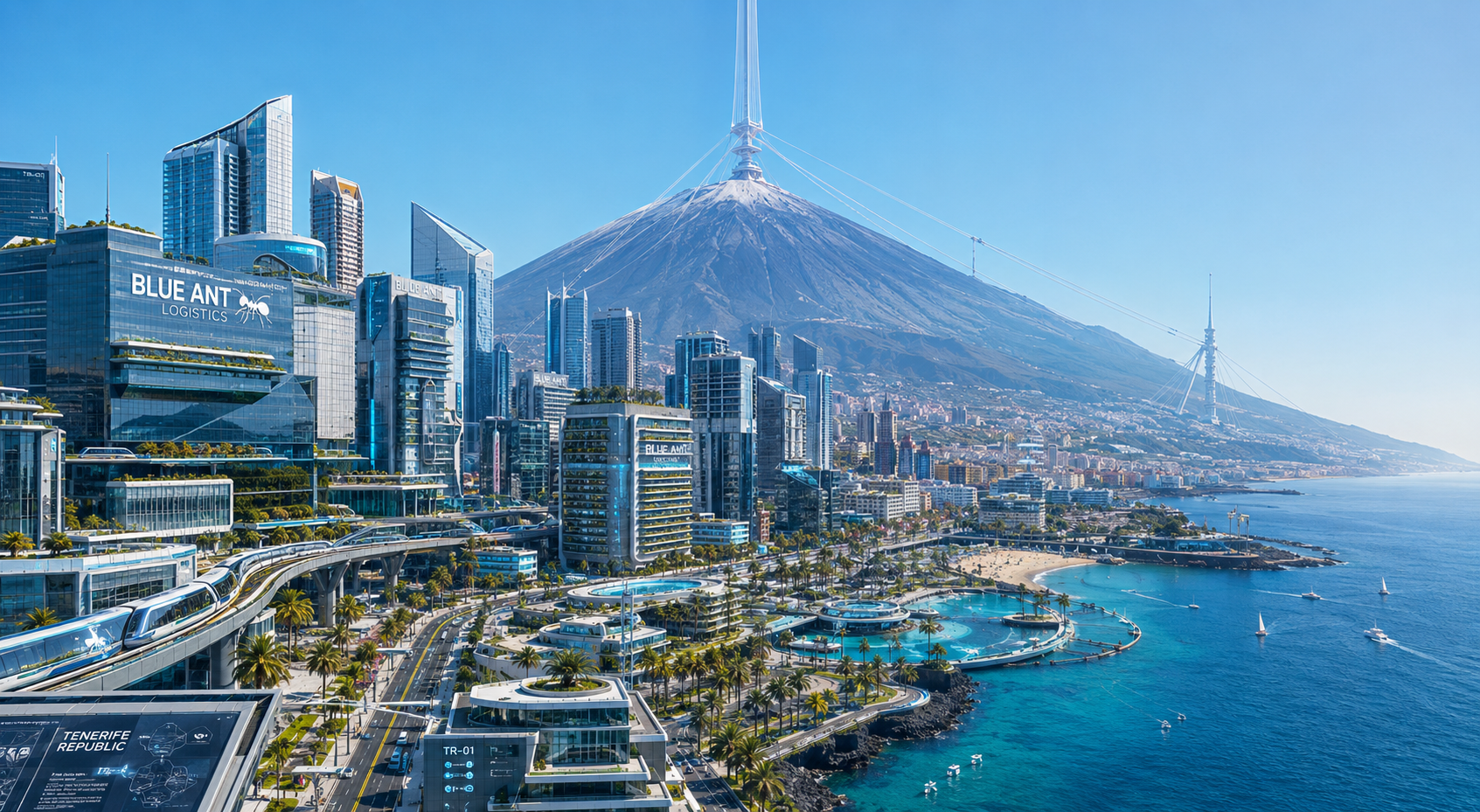
By 2265 the Tenerife Republic had become one of the wealthiest and strangest sovereign entities in the inner Solar System, a glittering Atlantic logistics principality built on orbital throughput, debt arbitration, launch insurance, and the slow-motion circulation of civilization itself. Officially the Republic remained small: a hypermodern archipelago wrapped around the old Canary Islands, clustered beneath the vast geometry of the Teide Skyhook Array. Unofficially it functioned as one of the central financial valves of human expansion. Cargo rights, utility futures, colonial debt instruments, transfer insurance, orbital salvage claims, launch certification, and outer-system survivability bonds all passed through Tenerife in one form or another. The island’s skyline reflected this transformation. The old tourist coastlines still existed in fragments beneath layers of vertical arcologies, white ceramic transit decks, hanging gardens, oceanic desalination terraces, and radiant glass logistics towers bearing the discreet insignia of freight syndicates and actuarial houses. Above it all rose the impossible structures on the slopes of Teide itself: anchor towers, magnetic launch rails, atmospheric stabilizers, and the colossal ascending filaments of the Skyhook complexes vanishing into the upper atmosphere with serene mechanical arrogance.
The Republic cultivated a carefully managed atmosphere of optimism. Unlike many cyberpunk visions of the future, Tenerife was not overtly dystopian. It was clean. Functional. Obscenely rich. Public transit worked beautifully. Beaches remained open. Streets were safe. The sea glittered turquoise beneath climate-managed skies almost offensively blue in their perfection. Citizens lived well by any historical standard. The darkness, as always, was structural rather than theatrical. Tenerife’s wealth rested on ownership of delay itself. Entire populations across the Solar System spent generations paying utility obligations, transfer claims, and inherited infrastructure debt through financial systems ultimately routed through Tenerife registries and orbital clearing houses. With strong links to Rothblatt interplanetary banking, The Terasem Foundation Habitats, Moore systems life extension, The 2020SL19 Tannhauser Gate ‘Cambridge’ University Complex the influence of Blue Ant is like an spiders web all over the continent.
And somewhere behind it all, almost invisible by design, lingered the old ghost of Blue Ant.
Nobody ever proved anything conclusively. The true ownership structures vanished generations earlier into layered holdings, sovereign exemptions, orbital shell corporations, and colonial trust mechanisms so labyrinthine that even advanced legal AIs struggled to model them coherently. But throughout the Republic there persisted the quiet understanding that the hidden gravitational center of Tenerife was not the Senate, nor the Skyhook Authority, nor the banking combines. It was the unseen stranger who had understood logistics before everyone else did. The ancient troll who realized that civilization could be built from diapers, horse manure, vitamins, thermal blankets, and dirt moving slowly through space.
By 2265, Hubertus Bigend had become less a person than a weather pattern. Younger generations argued endlessly over whether he had ever existed as a single individual at all. Some claimed “Hubertus” had always been a consortium identity shared across multiple actors. Others insisted the original operator still lived somewhere within Tenerife’s sealed oceanic estates, endlessly prolonged by discreet rejuvenation medicine and protected by a legal architecture older than many nation-states. The Republic itself encouraged ambiguity. The uncertainty had become part of the mythology.
Certain older executives in Tenerife logistics circles occasionally smiled in a particular way when the name came up. Not denial. Not confirmation. Recognition.
The irony was that Hubertus had accidentally become fashionable. Two centuries earlier he had been regarded as a parasite, a legal vandal spamming the Solar System with low-value cargo to exploit Colonial Utility Law. But time transformed the aesthetic of the thing. By 2265 the Blue Ant era represented authenticity. The ugly birth of interplanetary civilization. Before the polished orbital dynasties and curated outer-system republics came the freight years: ugly containers, obsolete ion drives, fungal cultures packed in ice shielding, and millions of tons of boring useful material crawling outward through darkness.
Tenerife embraced this mythology with almost embarrassing sincerity. Original Blue Ant hull fragments appeared in executive offices and luxury habitation suites throughout the Republic. Young financial elites wore vintage freight patches ironically. Entire restaurants adopted “Transfer Era” industrial décor. Wealthy collectors displayed corroded container panels inside illuminated epoxy vitrines like religious relics. The richer the owner, the uglier the artifact usually became. A heavily pitted Blue Ant hull section with visible Jovian radiation scarring and faded agricultural substrate warnings could command absurd prices among Tenerife’s upper class.
Yet despite all the wealth and mythology, the Republic retained a strangely playful undertone. Tenerife never became fully humorless in the way many financial powers eventually do. Perhaps that too was inherited from Hubertus himself. The island understood, at some level, that the entire Solar civilization had been partially built by an elaborate accounting joke that became too useful to stop.
And so the old joke persisted.
Quietly.
Never officially acknowledged.
Never quite denied.
Somewhere in the Republic there remained people whose eyes still lit up a little too brightly at the name “Hubertus.” Certain old-world entrepreneurs and virtual-world veterans, especially those who remembered the strange experimental decades of the early metaverse era, occasionally reacted to the comparison with visible pleasure they tried very hard to hide. The resemblance was never discussed directly in polite company. That would have been gauche. Besides, everyone understood the etiquette around myths of this scale. One did not rudely dissect them in daylight.
Instead the Republic cultivated ambiguity the way other civilizations cultivated vineyards.
After all, it would have been very strange if Gibson had accidentally brushed sideways against something real.