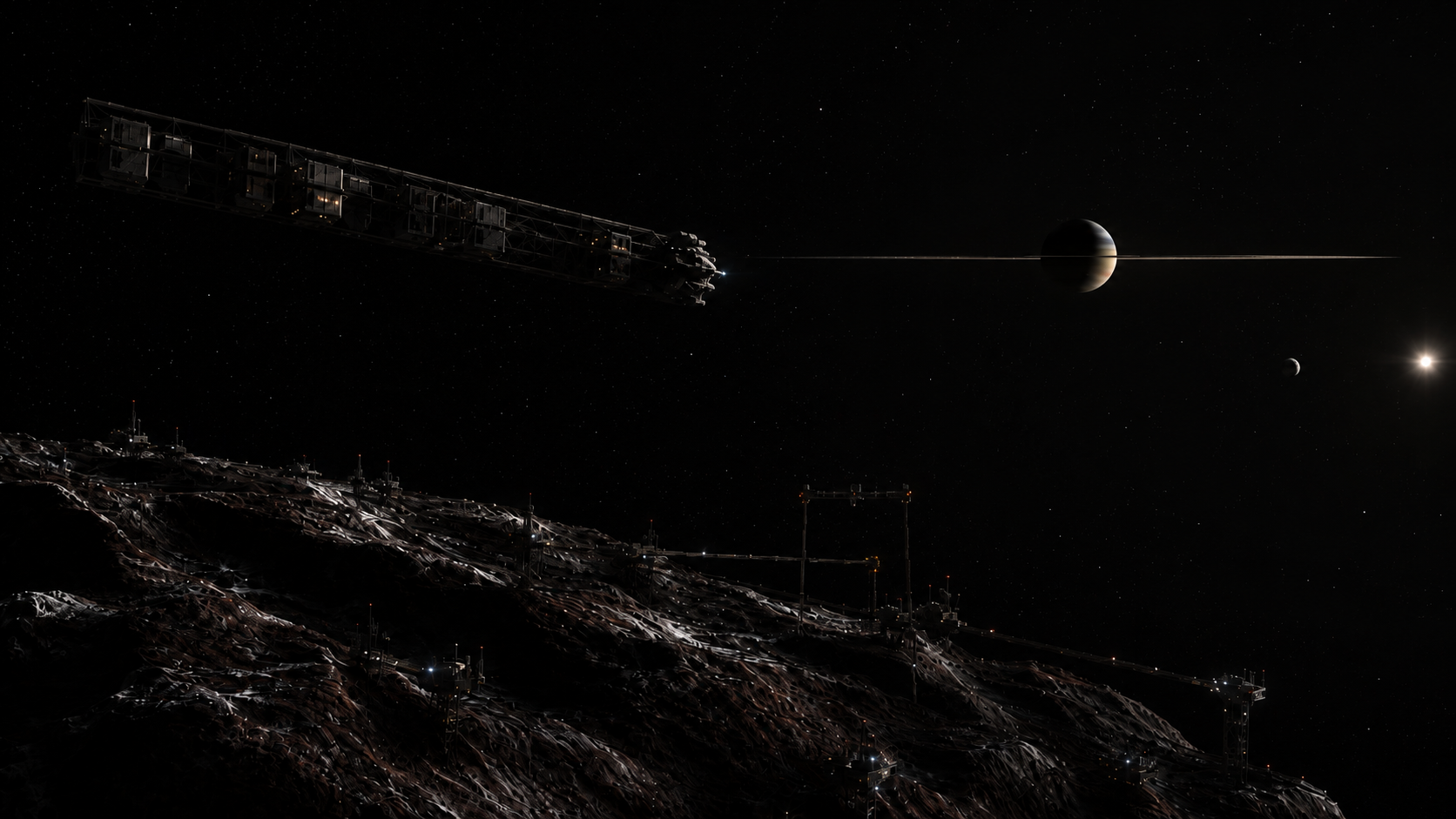
Water, Heat, Claims and Transportation Beyond Saturn
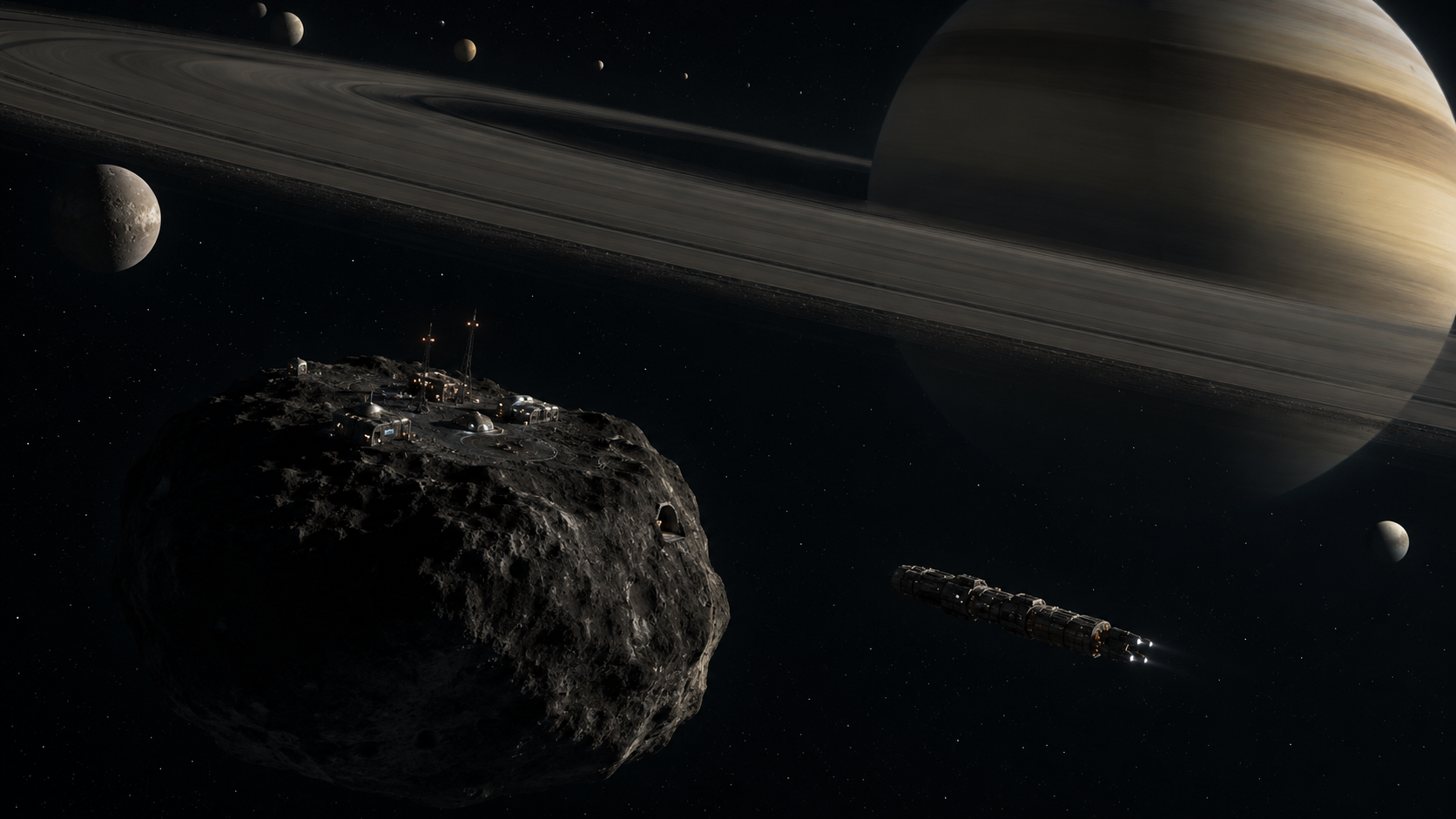
My most sincere apologies for the resort analogue retro guernsback asteroid colony (likely with artificial gravity ™ and viewing ports ™ and Niven style synthehol serving ten forward bar ™ and the approaching suspiciously Iteron-like blazing engine freighter. We Can Not Escape Out Demons No Matter How Hard We Try.
Beyond Saturn, the familiar hierarchy of materials begins to invert.
On Earth, water is precious, continuously circulated and politically sensitive. Stone, iron, aluminium and concrete are the anonymous bulk of civilization. In the outer Solar System, water may be the anonymous bulk. Entire moons, rings, cometary bodies and minor objects contain it in quantities so large that a settlement could excavate buildings, radiation shields, roads and reservoirs while scarcely altering the local inventory.
Water becomes dirt.
Rock becomes ore.
Metal becomes treasure.
Heat becomes the means by which treasure is reached.
This does not mean that the outer Solar System lacks heavier construction materials. It means that they are unevenly distributed, frequently buried, chemically inconvenient and separated by astronomical distances. The difficulty is not simply finding matter. It is finding the correct matter in a form, location and orbit that can be economically converted into machinery.
A civilization beyond Saturn would therefore be built not around individual self-sufficient colonies, but around prospecting networks, power infrastructure, industrial claims and transportation systems capable of treating water as expendable reaction mass.
Water as the Universal Bulk Material
At the temperatures prevailing around Saturn and beyond, water ice behaves less like the contents of a drinking glass and more like a geological material. NASA describes water ice on Titan as effectively playing the role of basalt, while Rhea’s surface is largely water ice with the general texture of pig iron. Titan also possesses methane and ethane rivers, lakes and seas, giving it access to immense quantities of carbon-bearing chemical feedstock. Outer-system settlement would become intensely cavalier about water, much as the Earth became cavalier about mud.
Water could be used as excavation support, radiation shielding, ballast, thermal storage, pressure-buffering mass and the bulk component of external structures. It could be frozen into blocks, sprayed into moulds, reinforced with fibres, mixed with dust or enclosed within tension structures. Habitats might be surrounded by exvacated blocks of pure water ice, not because the inhabitants are extravagantly wealthy, but because local water is cheaper than transporting a few tonnes of precision steel.
The pressure vessel inside such a structure would still require carefully manufactured components. Warm living spaces cannot simply be hollowed into naked ice and expected to remain dimensionally stable. Ice creeps under load, sublimates into vacuum and behaves badly around heat sources. The warm pressure shell would therefore sit inside a colder mass of structural ice, separated by insulation, vapour barriers and service cavities.
The result would resemble neither an igloo nor an Earth building. It would be a small, expensive, mechanically sophisticated machine surrounded by a huge quantity of cheap frozen mass.
Water would also replace materials that Earth engineers instinctively regard as permanent. A damaged wall could be melted down and recast. Or water blocks might be wrapped with plastic analogue insulation materials. Radiation shielding could be pumped from one side of a vessel to another. Temporary landing pads, impact barriers and construction berms could be laid down by spraying water into vacuum and allowing it to freeze.
A community might possess a million tonnes of construction material and only a few thousand tonnes of carefully controlled metals, ceramics, carbon composites and electrical conductors.
Heat Is the Scarce Construction Material
Calling heat “scarce” requires one qualification. The truly scarce commodity is controlled, high-grade energy: electricity or heat at a temperature useful for excavation, refining and propulsion.
The outer Solar System is cold, but cold surroundings do not perform industrial work. A dark ice field cannot melt itself, separate its own minerals or refine nickel from silicate. The fact that the environment sits near cryogenic temperatures merely means that uncontrolled equipment freezes very effectively.
A deposit buried beneath kilometres of ice may contain extraordinary quantities of rock and metal, yet remain economically worthless until someone can deliver enough energy to reach it.
This creates a basic equation of outer-system development:
Accessible material equals geological concentration multiplied by available power, divided by excavation depth and transportation cost.
Energy x distance x time
A mediocre rocky fragment exposed at the surface may be worth more than the vast rocky interior of a major moon. Iapetus and Rhea are each thought to contain approximately one-quarter rock by mass, despite their ice-dominated surfaces. Whereas for instance Tethys is mostly water ice and substantially less valuable along the same metric. That represents an astonishing inventory, but “contains rock” is not the same thing as “contains conveniently mineable ore.” deeply into a large icy moon may require melting, fracturing, pumping, stabilising and refreezing immense volumes of material. Every kilogram excavated absorbs energy. Every warm shaft tries to close, deform or flood. Every underground machine must operate inside a hostile cryogenic pressure system.
The cheapest mines would therefore not necessarily descend towards the centre of large worlds. Prospectors would first search impact ejecta, exposed cliff faces, deep fractures, differentiated collision fragments and small bodies whose volatile coatings are thin.
Haumea provides an instructive extreme. NASA describes it as probably consisting largely of rock with a coating of ice. A body with that architecture is less an ice world containing inaccessible minerals than an enormous rocky resource wearing a frozen overcoat. overy of such bodies changes the map of the outer Solar System. The deep is not uniformly made of snow. It contains rocky worlds, mixed bodies, collisional families and presumably innumerable smaller fragments whose compositions remain unknown.
The primary frontier industry is therefore not mining.
It is prospecting.
Prospecting Creates the Civilization
Outer-system colonization would be preceded by decades or centuries of spectroscopy, gravitational measurement, radar sounding, seismic investigation and robotic sampling. Apparent size alone would be nearly meaningless. A small dense object could be more important than a moon thousands of times larger.
The critical questions would be practical.
- How much non-volatile material does the body contain?
- Is that material mixed through the ice or concentrated into a core?
- Has an impact exposed deeper layers?
- Does the body contain metallic iron, sulfides or merely hydrated silicate?
- What is its spin rate?
- Can automated machinery remain anchored?
- How much sunlight, reactor power or beamed energy reaches the site?
- What is the body’s orbital inclination?
- How expensive is it to transport material from there to existing settlements?
This is where diversification becomes existential.
The useful answer is: Phoebe, Dione, Enceladus, Titan, Rhea and Iapetus are the principal heavy-element prospects; Titan, Enceladus, Tethys, Mimas and Hyperion are the strongest volatile reservoirs.
But “high in ores” needs handling with tongs. We have identified bulk rock fractions and some surface minerals, not economically concentrated copper seams or cheerful little nickel deposits. But – In 2026, these are all not yet certainties.
No serious polity would trust its civilization to one magnificent body. It would maintain a portfolio: water claims, rocky claims, carbon and nitrogen sources, reactor-fuel inventories, transport depots and orbital manufacturing sites. A settlement that possesses limitless water but no source of machine metals is not independent. A mining camp with rich ore but no reliable source of power is merely camping on treasure.
The viable unit of civilization is therefore not a colony, It is a supply network.
Titan might provide nitrogen, hydrocarbons, organic chemistry and bulk water ice. A rocky Saturnian moon or captured irregular object might provide silicates and common metals. A distant Kuiper Belt fragment might supply rarer minerals (if only it wouldn’t be half a century away). Orbital refineries would separate materials without repeatedly lifting them from substantial gravity wells.
Each community would be locally incomplete but regionally survivable.
Claim Culture in a World of Unequal Matter
Claims in the outer Solar System would not resemble terrestrial land ownership. Surface area would often be the least important part of the asset.
A claim would describe access to a resource system.
It might include the right to extract material from a particular geological layer, maintain equipment within a defined orbital volume, operate a mass driver along an approved trajectory, use a communications frequency, establish radiator fields, anchor transportation cables or exclude hazardous plume activity near an installation.
The valuable boundary would not simply be drawn across a map. It would extend through depth, orbit, time and velocity.
One organization might possess the right to harvest exposed rock from an impact basin. Another might operate the power reactor supplying the excavation. A third might own the refinery in orbit. A fourth might possess scheduled access to the only safe mass-driver corridor. None would meaningfully “own the moon” in the traditional sense, yet together they could control nearly all useful activity there.
Current international space law already begins from an awkward position: the Outer Space Treaty rejects national appropriation of celestial territory. A mature settlement culture would therefore be more likely to recognise operational rights, installations, extraction licences and time-limited industrial claims than simple planetary sovereignty. respected claim would be a proved claim. Its holder would have supplied samples, composition data, orbital surveys and a credible development plan. Speculation alone might provide a temporary priority period, but not perpetual ownership. Otherwise, the first sufficiently wealthy organization could file claims on half the Kuiper Belt and leave everyone else to enjoy the wonders of digital feudalism.
Claims would probably expire when they were not worked (within an appreciable amount of time?). Development requirements would prevent strategic hoarding. Survey data might be deposited in public registries, while the prospector retained priority access or a royalty. The culture would reward discovery without allowing a single corporation to claim every moving pixel detected by a telescope.
Claim jumping would remain possible, but it would rarely involve planting a flag. A rival might contest the survey accuracy, intercept transport contracts, establish a cheaper refinery or demonstrate that the claimed material is part of a wider collision family. The decisive battle could occur in a scientific review, an insurance office or an orbital traffic authority.
The deepest political conflicts would concern heat and access.
A community might tolerate generous use of local water while jealously rationing reactor output. Residents could be permitted to excavate ice almost freely but charged heavily for furnace time, deep drilling, electrolysis or high-temperature refining.
Water rights become commonplace.
Power rights become sovereignty.
The Steamy Wet Transportation Culture
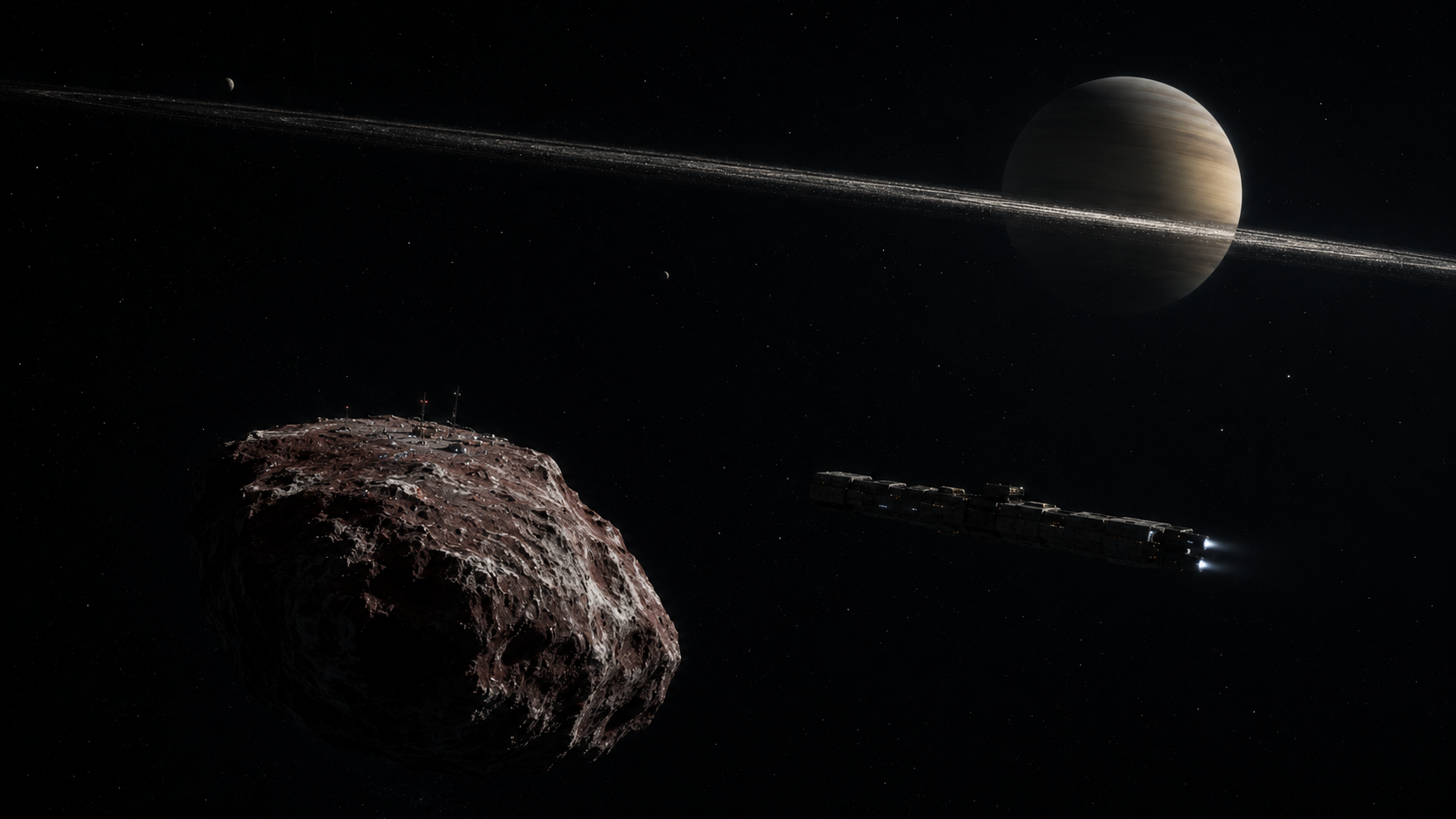
ahh better but still not perfect…
Abundant water would also produce a transportation culture almost unimaginable from Earth.
Ships would carry water not only for life support but as shielding, ballast, coolant, energy storage medium and reaction mass. A water tank would not necessarily be a precious reserve guarded until an emergency. It might be the cheapest and most disposable part of the vessel.
Some craft would depart deliberately “wet,” carrying enormous quantities of water because their propulsion systems were designed to trade propellant efficiency for simplicity, thrust or thermal survival.
At the lowest technological level, water can simply be heated and expelled through a nozzle. This is commonly described as steam propulsion or a water resistojet. It is not a Victorian piston engine installed in a spacecraft, although some future mechanic will inevitably decorate one with brass pipes to irritate historians. It is essentially a boiler, heating chamber and rocket nozzle.
Such an engine has relatively modest exhaust velocity and therefore consumes large quantities of water. Around Earth, hauling that water into orbit makes the concept unattractive for major transport. In the outer system, where water may already be available in orbit or on low-gravity bodies, wasting tonnes of it may be perfectly rational.
A steam tug could be mechanically simple, tolerant of impure propellant and capable of generating useful thrust. It would be poorly suited to extreme interplanetary velocity changes, but excellent for local work: shifting ore bags, moving construction assemblies, controlling spin, descending to small bodies or travelling between nearby depots.
The next rung is electrolysis. Electricity splits water into hydrogen and oxygen, which can later be burned in a chemical rocket. NASA and ESA have both developed or studied propulsion systems using this approach. It provides higher thrust than typical electric propulsion, though at lower propellant efficiency, and permits water to be stored safely before conversion. Up the ladder, water can supply electric or plasma propulsion. The water is vaporised, dissociated into hydrogen and oxygen, ionised and accelerated electrically or magnetically. At that point it is no longer meaningful to imagine intact microscopic droplets being thrown from the ship. The engine is handling a hot mixture of atoms, ions and electrons.
ESA has investigated water-electrolysis products in Hall-effect thrusters, including additional radio-frequency heating to improve ionisation. The technical attraction is clear: a single benign stored material could support both chemical and electric propulsion modes. same vessel might possess several relationships with its water supply.
- It could vent cold vapour for precise attitude control.
- It could heat water into steam for local manoeuvres.
- It could electrolyse water and burn hydrogen and oxygen for short, forceful acceleration.
- It could feed ionised products into an electric thruster for long, efficient interplanetary burns.
The water is the same. The power system and engine determine what kind of transportation it becomes.
The Price of Ionising Water
Ionising water to extreme energies does not make propulsion free. It merely changes which resource is being consumed most aggressively.
The kinetic energy placed into each kilogram of exhaust rises with the square of exhaust velocity. Ignoring losses, accelerating one kilogram of reaction mass to 10 kilometres per second requires about 50 megajoules. At 50 kilometres per second, it requires approximately 1.25 gigajoules. At 100 kilometres per second, it requires about 5 gigajoules.
Real engines require more because they are not perfectly efficient.
This produces a fundamental division between vessels.
A wet vessel carries abundant reaction mass and throws it away at comparatively low velocity. It needs less power for a given amount of thrust but consumes water rapidly.
A hot vessel accelerates less material to much greater velocity. It uses reaction mass efficiently but requires enormous electrical or thermal power.
For local movement among water-rich bodies, wet vessels may dominate. For long voyages, high exhaust velocity becomes increasingly valuable because carrying and accelerating the additional propellant itself becomes burdensome.
The deciding commodity is again heat and power.
A ship with a large reactor can ionise and accelerate water aggressively. A ship with limited power can still move, but must either accelerate very slowly or consume far more reaction mass through lower-performance propulsion.
Transportation tariffs would therefore be quoted not only by mass and distance but by energy regime.
“Cheap passage” might mean a slow wet trajectory using enormous quantities of water.
“Fast passage” might mean buying access to megawatts or gigawatts of reactor output.
The water itself could be nearly free while the act of giving it velocity costs a fortune.
Open-Cycle Cooling and Deliberate Waste
The most transformative consequence of abundant water may not be propulsion directly. It may be cooling.
Spacecraft cannot lose heat through air or seawater. They must radiate it away or eject hot material. Radiators become large, fragile and increasingly burdensome as reactor output rises.
A water-rich civilization can cheat.
During a high-power burn, water can be circulated through engines, reactors and electrical systems, allowed to absorb heat and then expelled. This open-cycle cooling sacrifices mass in exchange for compactness and temporary power density.
A vessel might begin a burn surrounded by thick water shielding. During acceleration, that shielding is progressively pumped through cooling channels and discharged through propulsion systems. The ship becomes lighter as it gains velocity. Its radiation protection, coolant inventory and reaction mass are all parts of the same consumable architecture. This ship would blaze in infrared.
This would be considered appallingly wasteful near Earth.
Beyond Saturn it might be standard practice.
Such vessels could operate engines at powers that their permanent radiator systems could not continuously support. They would sprint between depots, arrive nearly dry and refill from local ice.
The limitation is not the quantity of water in the Solar System. It is whether water is available at the correct point in the transportation chain. This creates enormous demand for depots, tankers, automated ice cutters and standardised transfer systems.
A transport route would resemble a maritime coaling network, except that the ships might consume thousands of tonnes of water to move cargo worth only a few tonnes of refined metal.
The Politics of the Water Wake
Throwing enormous quantities of water into space would produce its own culture and regulation.
Exhaust plumes can erode surfaces, contaminate instruments and deposit frost on cold equipment. Near busy habitats, uncontrolled steam propulsion would be treated less like harmless exhaust and more like operating a sandblaster in an airport terminal. It’s much like dumping garbage from cruise ships – and at high velocities it might become akin to creating kessler syndrome like effects; coagulated ice particles become bullets.
Exhaust disposal would eventually become the outer system’s equivalent of dumping refuse and sewage from cruise ships. Each individual vessel could plausibly argue that the amount released was negligible compared with the immensity of space. Around a busy port, refinery or water depot, that argument would become steadily less credible.
Water vapour and plasma would disperse, but not necessarily before striking nearby structures, depositing frost on cold surfaces, contaminating instruments or altering the optical and thermal properties of radiators. Expelled droplets could freeze into grains. More seriously, powerful exhaust striking loose regolith, accumulated frost or abandoned equipment could accelerate solid material into independent trajectories.
At low velocities this would be pollution. At higher velocities it would become an orbital-debris problem.
A grain of ice is harmless while resting in a storage tank. At several kilometres per second it is ammunition. It can puncture radiator membranes, craze windows, damage optics and chip protective surfaces. If an impact breaks machinery or habitat cladding into additional fragments, the result begins to resemble a local Kessler cascade: not merely waste occupying space, but waste generating further waste through collisions.
The danger would be greatest around heavily travelled moons, depots and orbital transfer nodes, where many vessels repeatedly use similar approach corridors. An irregular moon might possess almost no meaningful atmosphere and very little gravity, allowing plume-driven debris to escape the surface and enter long-lived Saturn-centred trajectories. What began as careless harbour practice could gradually pollute an entire family of useful orbits.
Ports would consequently impose exhaust corridors, minimum ignition distances and strict restrictions on open-cycle cooling near inhabited infrastructure. Arriving ships might be required to coast through the inner traffic zone, use low-contamination manoeuvring systems or connect to tugs stationed beyond the settlement. Large burns would be directed away from orbital planes used by habitats, radiators and cargo depots.
Water itself might remain almost free. The right to discard accelerated water would not be.
Vessels could be charged according to the mass, velocity, phase and direction of their exhaust. Operators might post environmental bonds against later cleanup, tracking or collision damage. Dumping a thousand tonnes of warm vapour into empty interplanetary space would be unremarkable. Releasing ten tonnes of ice grains across a populated transfer orbit could be treated as criminal negligence.
Thus an outer-system transportation culture extravagant with water would nevertheless become highly disciplined about where that water was thrown. The shared void would cease to be regarded as infinitely empty once enough people depended upon crossing it safely.
Ports would establish plume corridors, departure headings and exclusion periods. Ships might be required to retain exhaust until they had cleared sensitive infrastructure. Water crystals and vapour clouds could interfere with optical systems or create transient debris hazards.
A vessel’s wake might also reveal its recent activity. A wet ship conducting a large burn could leave a detectable expanding cloud of water products. Smugglers would therefore favour more efficient, hotter engines not merely for speed, but because wasting less reaction mass leaves less evidence.
This returns directly to the smuggler-burn problem. The fastest craft are constrained not simply by fuel capacity, but by their ability to generate power, cool machinery and conceal the thermal consequences of doing so.
The deep Solar System is dark, but a high-power ship is not subtle.
Civilization as an Industrial Archipelago
Outer-system civilization would not spread as a continuous frontier. It would appear as an archipelago of industrial sites separated by enormous distances.
- One body supplies water.
- Another supplies carbon chemistry.
- Another contains exposed silicates.
- A rare dense fragment supplies nickel, iron or sulfur.
- A large orbital station performs refining.
- A reactor complex sells energy.
- A transportation cooperative connects the chain.
The most valuable place may not be the richest mine. It may be the modest body whose orbit repeatedly brings it near several trade routes. A poor deposit in a useful orbit can outperform a fabulous deposit that requires ruinous inclination changes or years of travel.
This is the same principle that governs ports, canals and mountain passes on Earth. Geography remains decisive, but geography now includes velocity.
Claims, settlement and political power would accumulate around the intersection of composition, orbit and energy. A polity controlling all three could dominate an entire region without possessing much conventional territory.
Its wealth would not be measured in square kilometres.
It would be measured in tonnes of proved reserves, megawatts of accessible power, kilograms of refined specialist elements and metres per second of affordable transport.
Relative Scarcity, Not Absolute Poverty
The outer Solar System is not empty of construction materials. Nor is it composed entirely of useless ice. It contains rocky moons, mixed bodies, metal-bearing fragments and large objects whose internal compositions may be more favourable than their frozen surfaces suggest.
The difficulty is relative scarcity.
Water, carbon, nitrogen and simple volatiles may be abundant enough to waste. Common rock and metals will be available, but only after systematic prospecting and energy-intensive processing. Certain elements needed for electronics, catalysts, high-temperature alloys and nuclear technology may remain scarce enough to justify interplanetary trade.
This creates a civilization that is extravagant with bulk mass and fanatically conservative with complex components.
A settlement may demolish an ice structure by melting it into the street while carefully recovering every gram of copper, tungsten and semiconductor material inside it.
A ship may throw a lake’s worth of water into space and still delay departure for want of a replacement bearing.
The central fact of life beyond Saturn is therefore not that material is scarce.
It is that the correct atoms are rarely located beside the energy required to use them.
Civilization emerges by connecting the two.