 By the late 2030s, the phrase “European decline” had acquired the exhausted quality of an old joke repeated too many times. The continent had spent half a century being described—mostly by Americans and occasionally by its own elites—as slow, decadent, bureaucratic, overregulated, militarily dependent, demographically doomed, psychologically post-historical. Europe itself had almost begun to believe it.
 Housing was infrastructure. Energy was infrastructure. Food security was infrastructure. Semiconductor fabrication was infrastructure. Water tables, shipping lanes, fertility rates, flood plains, rail corridors, data integrity, industrial redundancy, public health capacity, even social cohesion itself—these were all understood not as isolated political questions, but as interdependent systems requiring active stewardship across generations.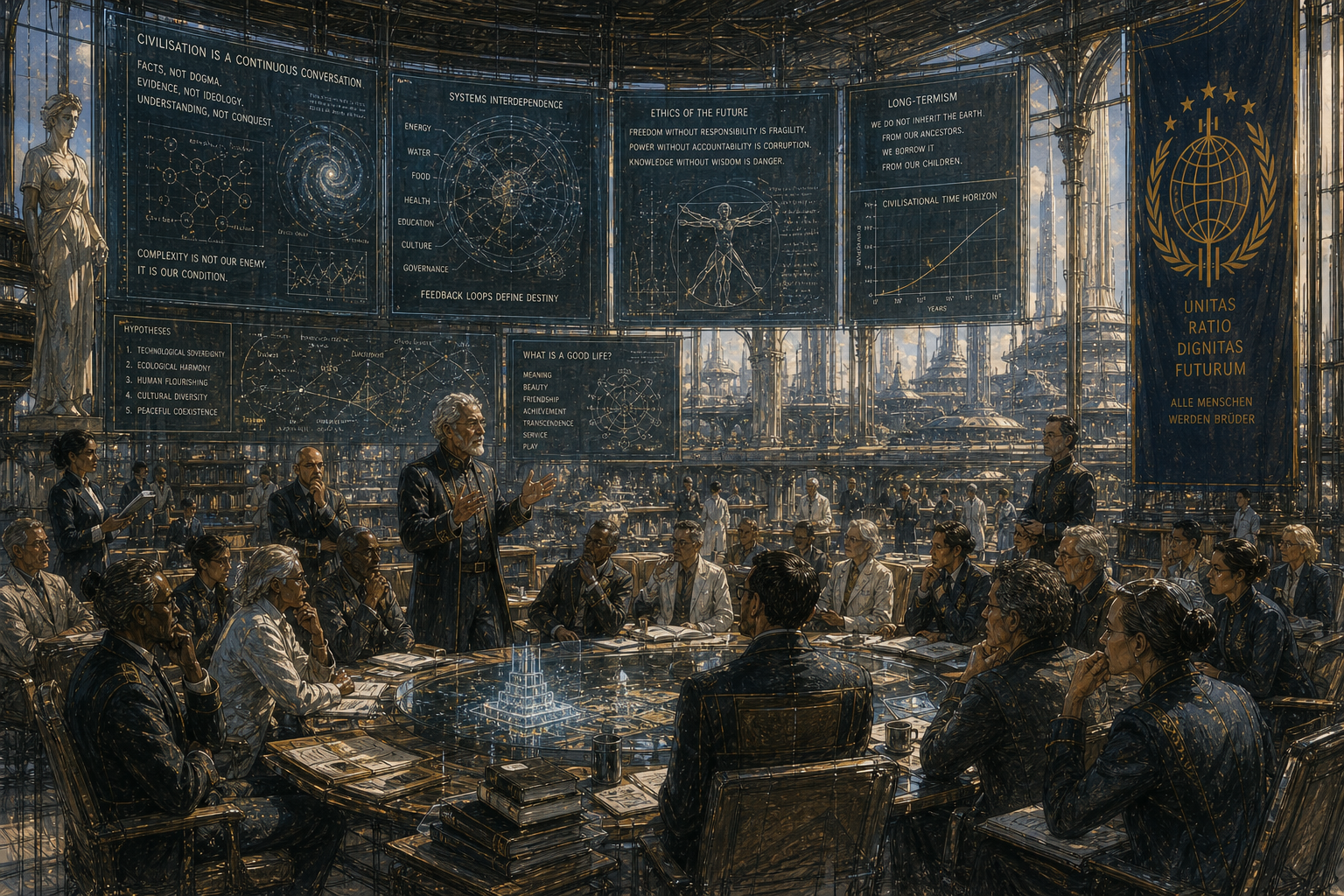
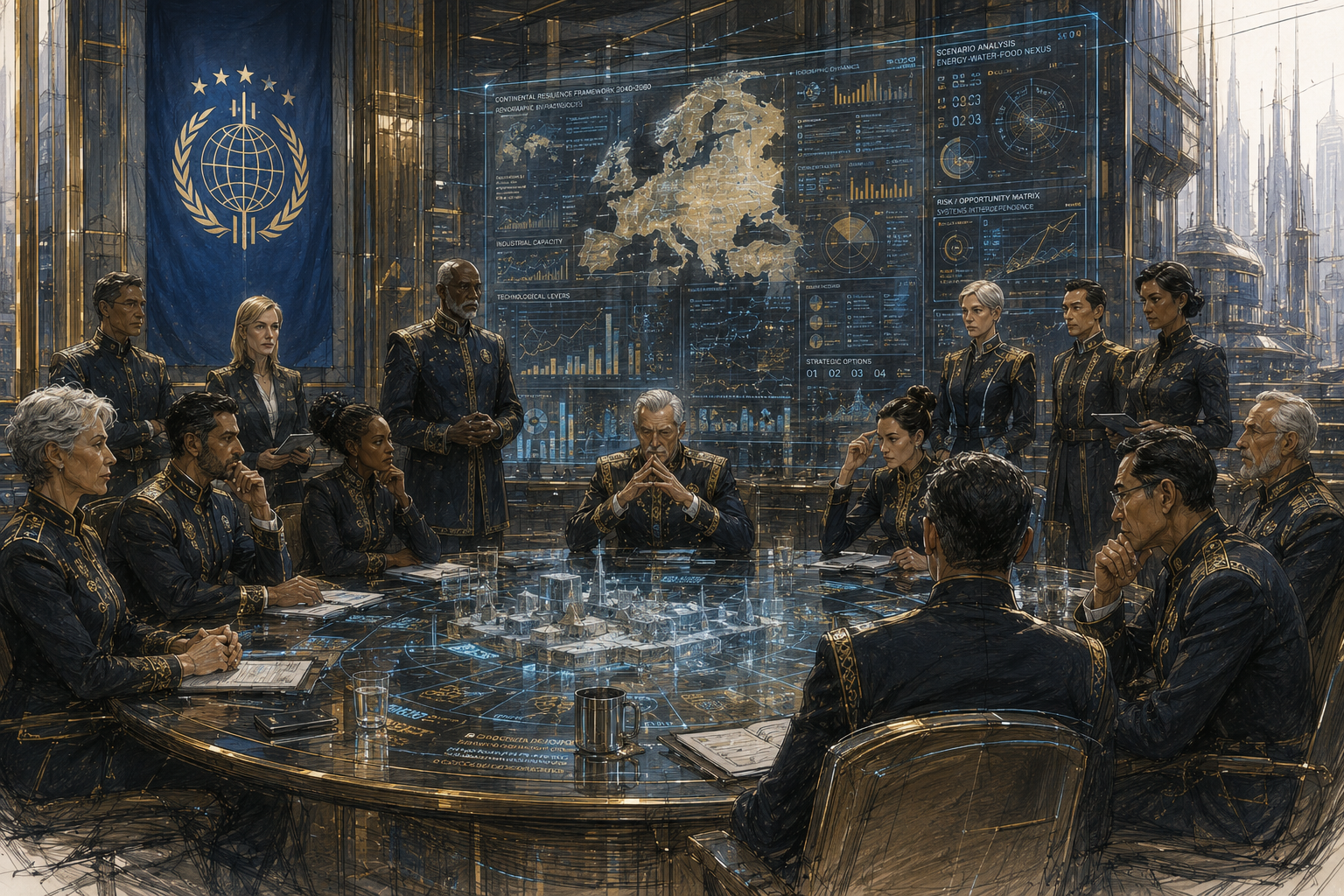
 These questions circulated first in technical ministries, municipal laboratories, emergency planning departments, engineering faculties, actuarial institutions, logistics boards, agricultural syndicates, military academies, and energy commissions. The old ideological class often failed to notice the shift because the language remained so untheatrical. There were few manifestos. Few charismatic revolutionaries. Few grand declarations. Europe did not erupt into transformation. It convened. Quietly. Methodically. Endless meetings beneath fluorescent lighting. Translators murmuring through earpieces. Pots of coffee accumulating beside flood-risk projections and industrial maps. It was all profoundly European in the least cinematic sense imaginable.
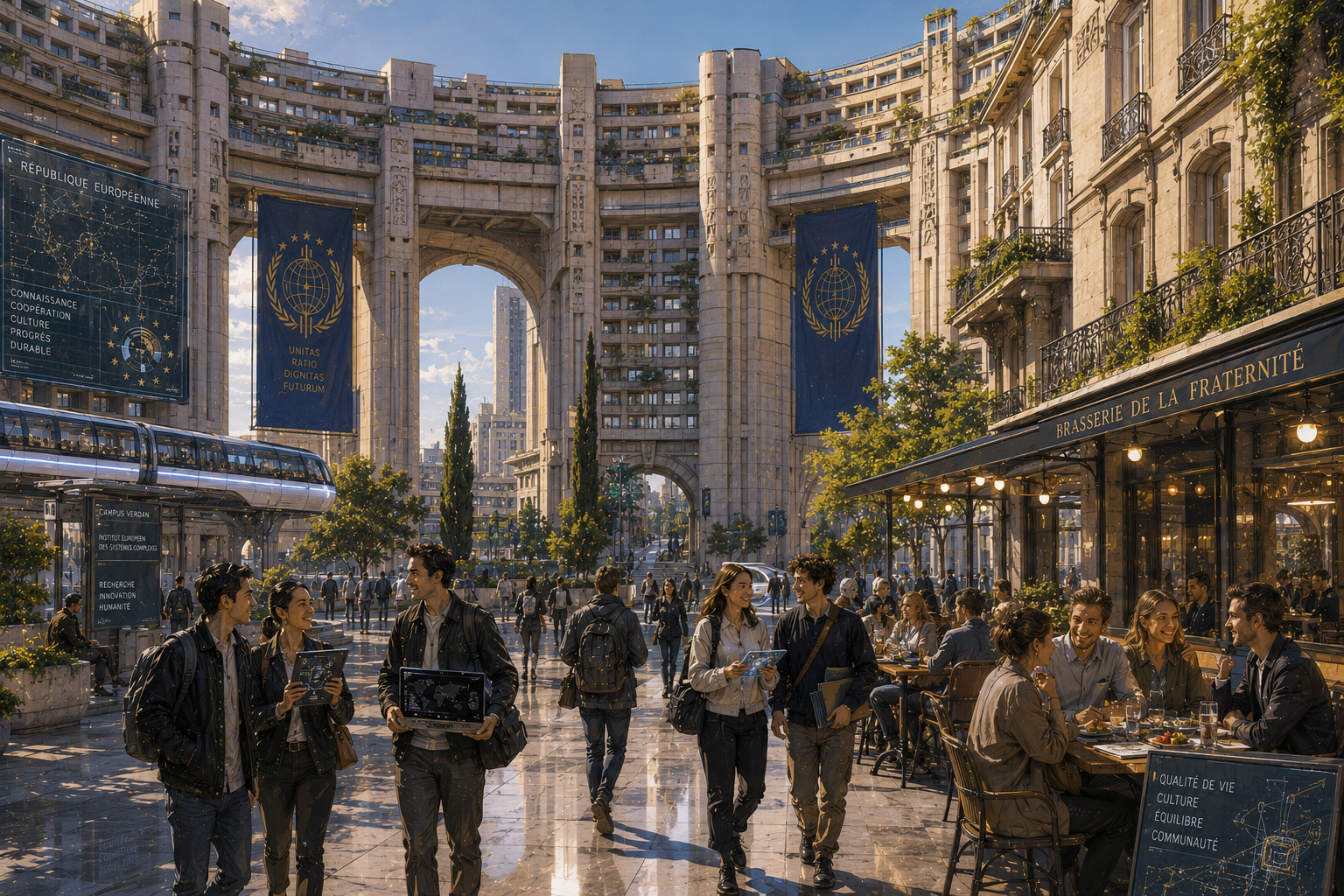 From this principle flowed everything else.
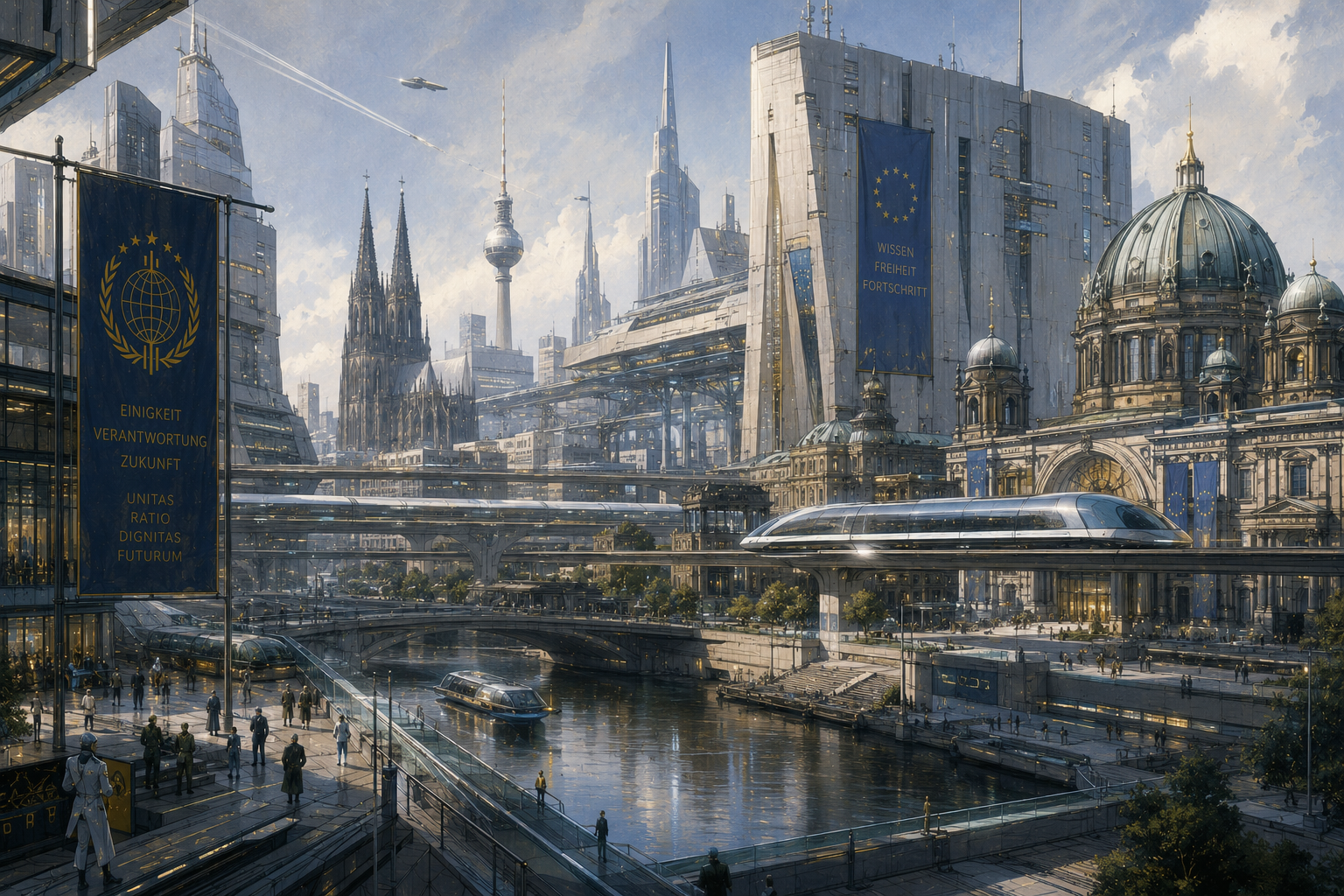
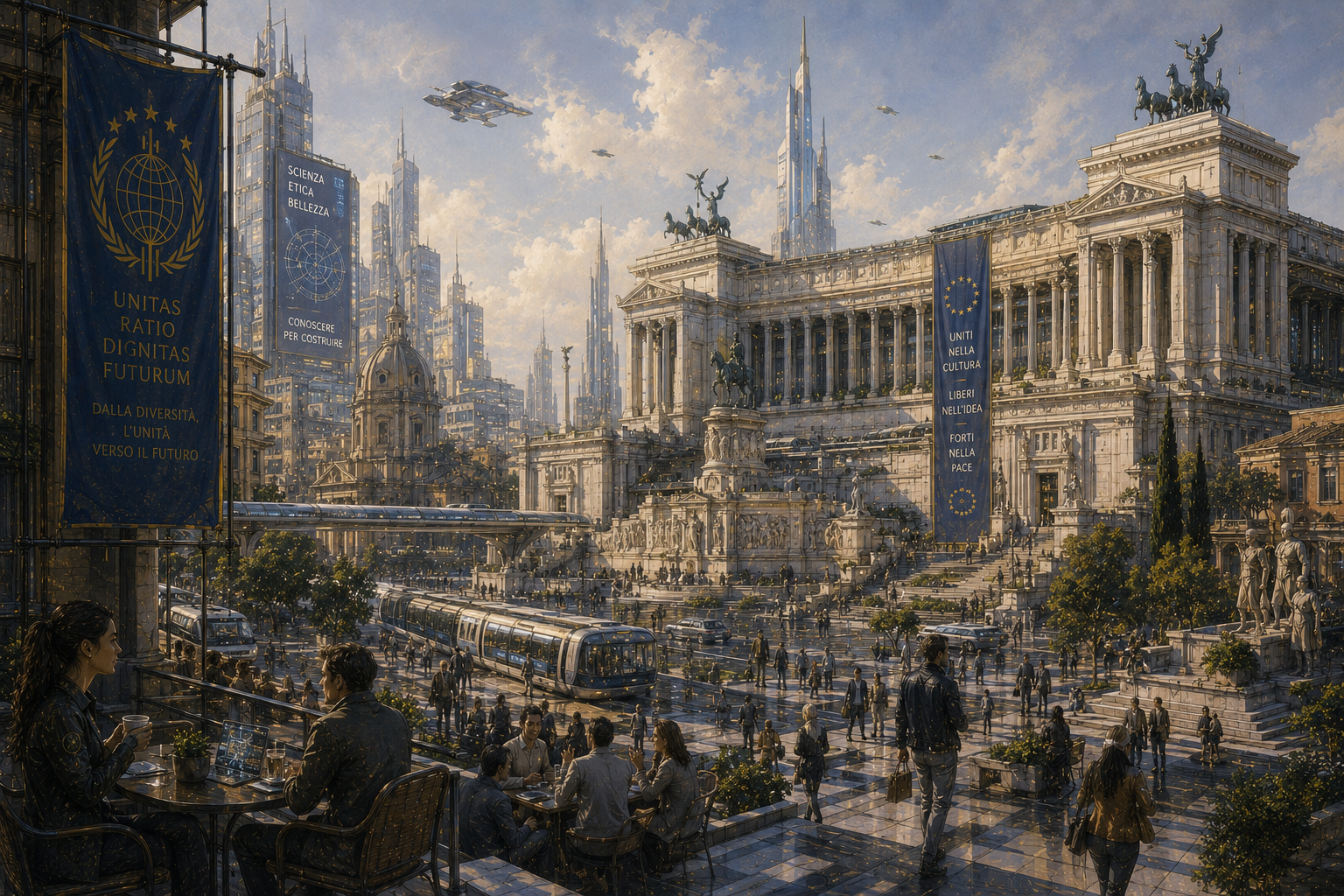
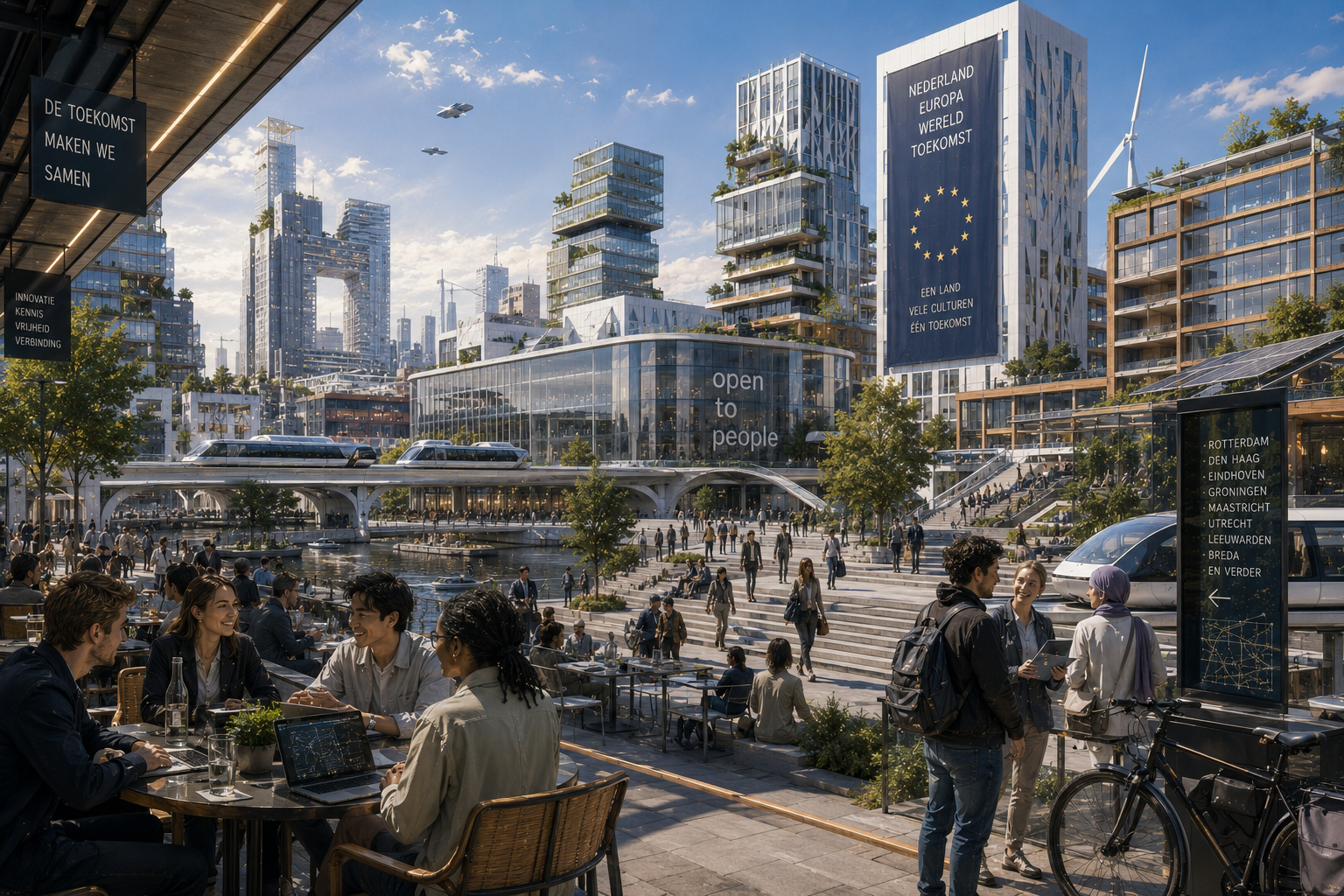 What startled foreign observers most was that this transformation coincided not with the dissolution of European national identities, but with their renaissance. The French remained unmistakably French, now combining republican rationalism with a fierce infrastructural patriotism that transformed rail stations, nuclear systems, urban forestry, and public housing into expressions of national prestige. Germany rediscovered an austere but confident civic seriousness after generations of historical self-consciousness. Italy fused futurism and historical continuity with almost operatic flamboyance, producing cities where ancient stone coexisted seamlessly beside shimmering adaptive architecture and impossibly elegant transit systems. Spain pioneered climate-adaptive urbanism and nocturnal civic culture with a grace that astonished even longtime admirers. Scandinavia refined distributed resilience into an art form. Poland contributed strategic realism sharpened by centuries of historical memory. Even the later reintegration of the fractured British successor states carried its own peculiar emotional gravity, as a humbled republican England eventually returned to the continental fold beside the Gaelic Union that had emerged from the peaceful dissolution of Great Britain.
 The defections acquired almost mythological significance after a major artificial intelligence consortium transferred its sovereign research architecture into the European federation following disputes with the decaying Atlantic financial order. Shortly thereafter, a major aerospace corporation executed a similarly dramatic strategic migration. Official communications remained diplomatic to the point of parody, yet the geopolitical symbolism was unmistakable. The world understood, suddenly and viscerally, that talented people were no longer fleeing Europe for opportunity. Opportunity itself had begun migrating toward Europe.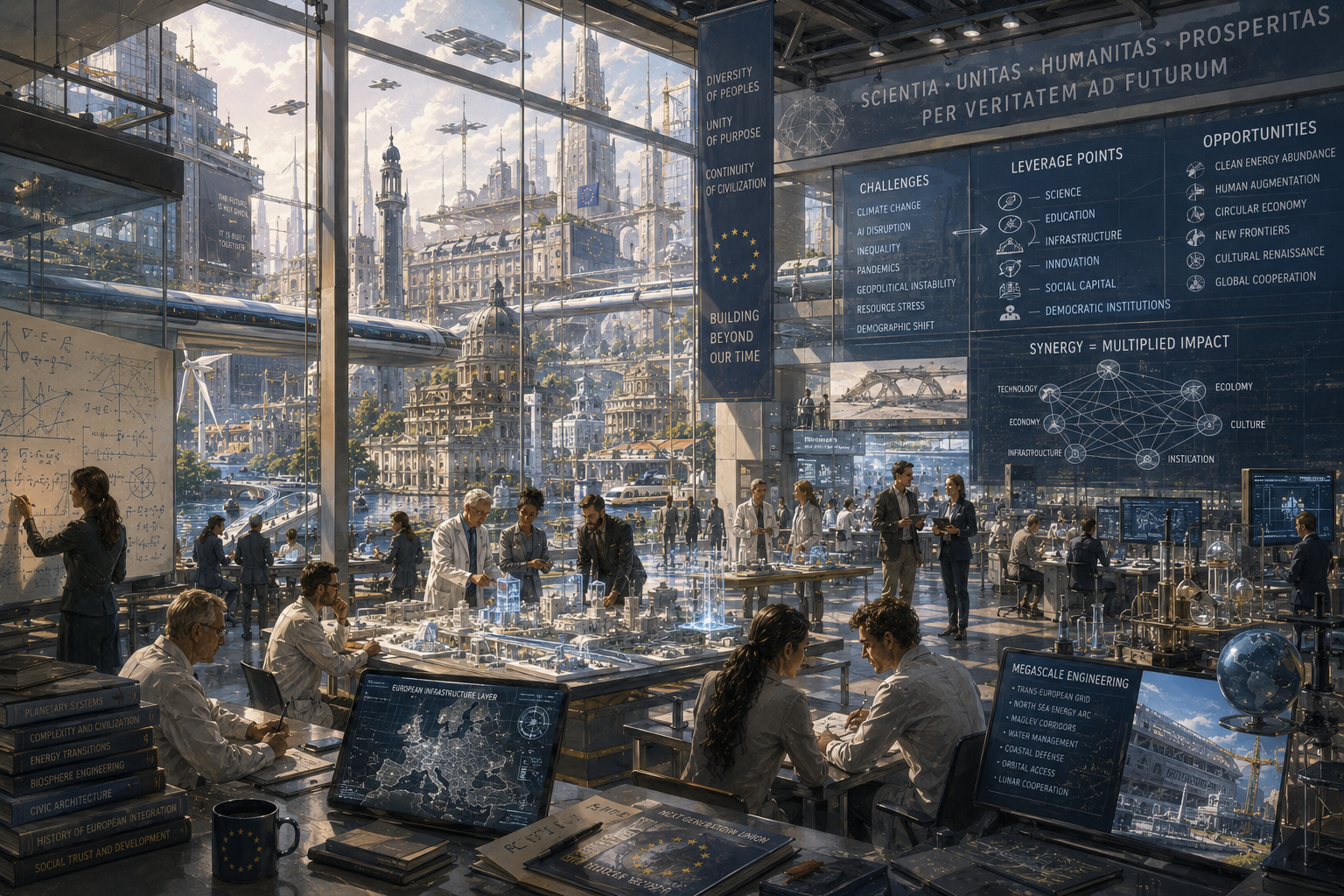
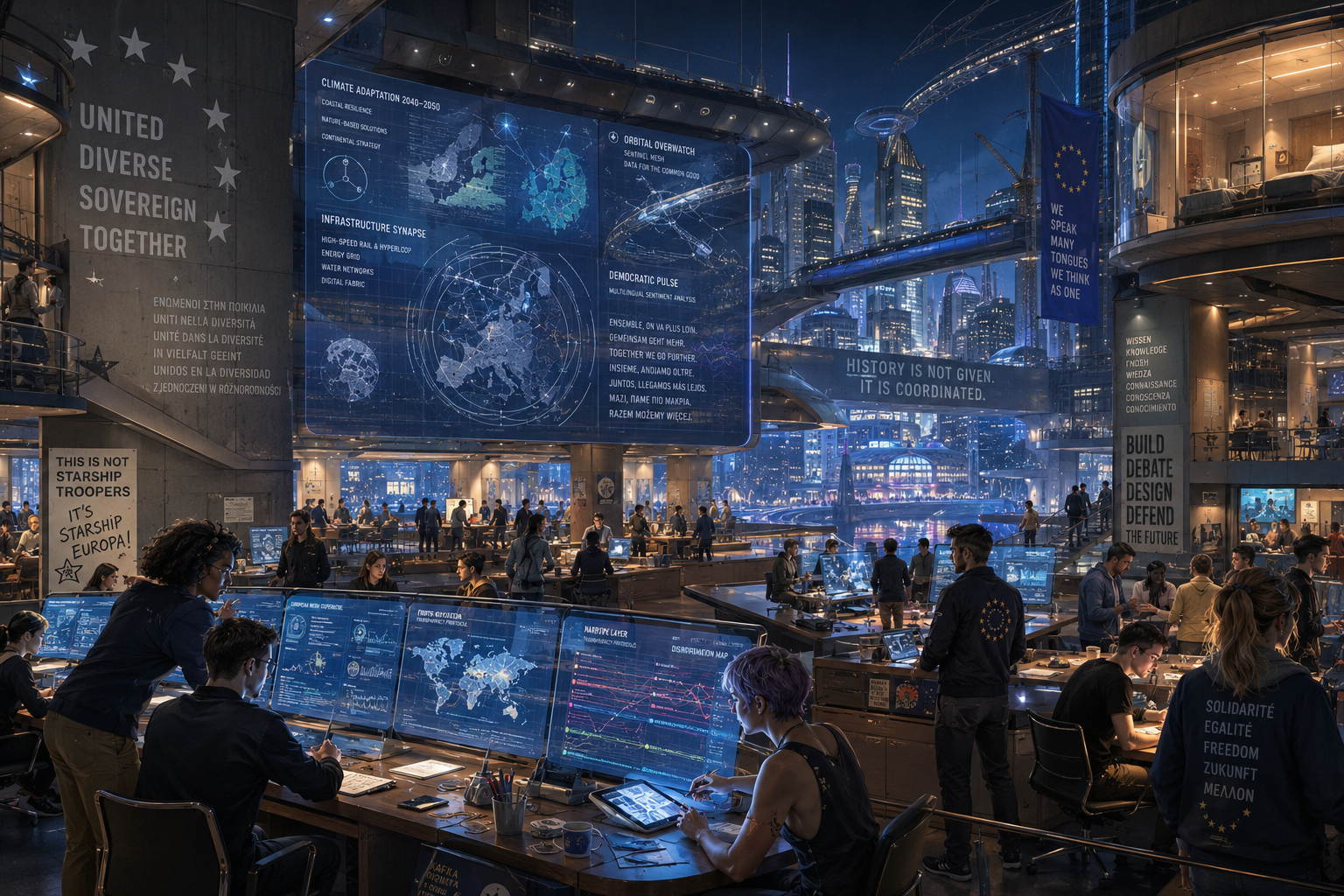 At the same time, rapid advances in artificial intelligence destabilized longstanding assumptions regarding labor, education, state capacity, information integrity, and economic organization. Contrary to many public debates of the period, European strategic institutions were less concerned with hypothetical machine consciousness than with concentration dynamics. There was growing alarm that advanced computational systems, if left entirely subordinate to transnational capital structures, would produce unprecedented asymmetries of influence between states, corporations, and populations. The question confronting European policymakers was therefore not whether artificial intelligence should exist, but under what constitutional, economic, and civilizational conditions it could remain socially compatible with democratic continuity.
 The COVID-era pandemics and subsequent preparedness crises accelerated these conclusions dramatically. European governments recognized, often with considerable embarrassment, that many advanced societies possessed remarkably little strategic redundancy. Medical supply chains proved fragile. Pharmaceutical production was geographically concentrated. Public communication systems fragmented under algorithmic pressures. Emergency logistics repeatedly encountered bottlenecks generated not by material scarcity itself, but by optimization models that had eliminated all surplus capacity in pursuit of efficiency.
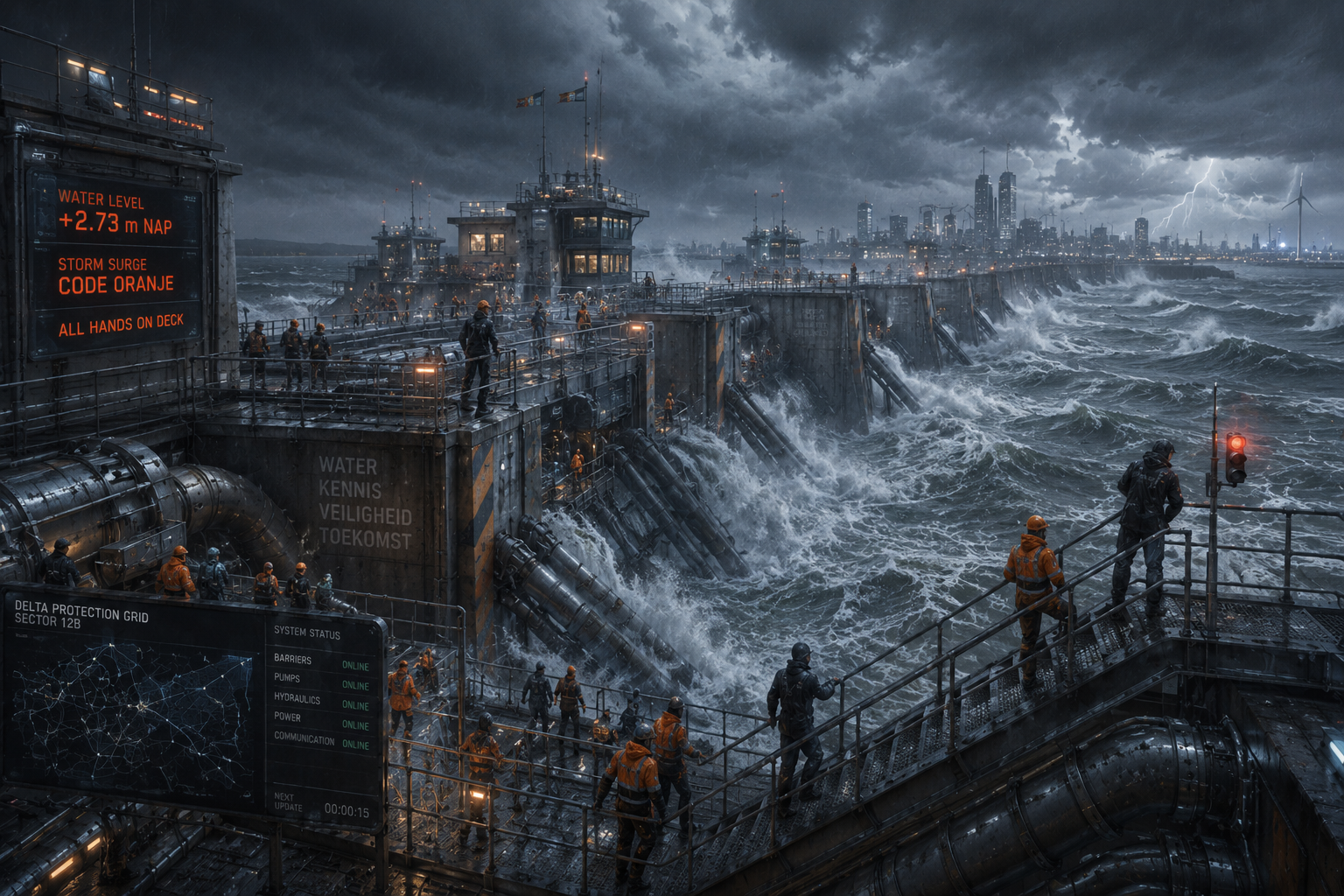 Initially, the issue remained largely confined to climatological literature and specialized forecasting communities. However, by the early 2030s, AMOC instability increasingly migrated into broader strategic planning frameworks. European analysts recognized that even partial disruption scenarios carried profound implications for agriculture, shipping systems, insurance markets, coastal infrastructure, fisheries, energy demand, migration patterns, and continental security planning. More importantly, AMOC became symbolically important within elite institutional culture because it represented something larger than a single climatic phenomenon.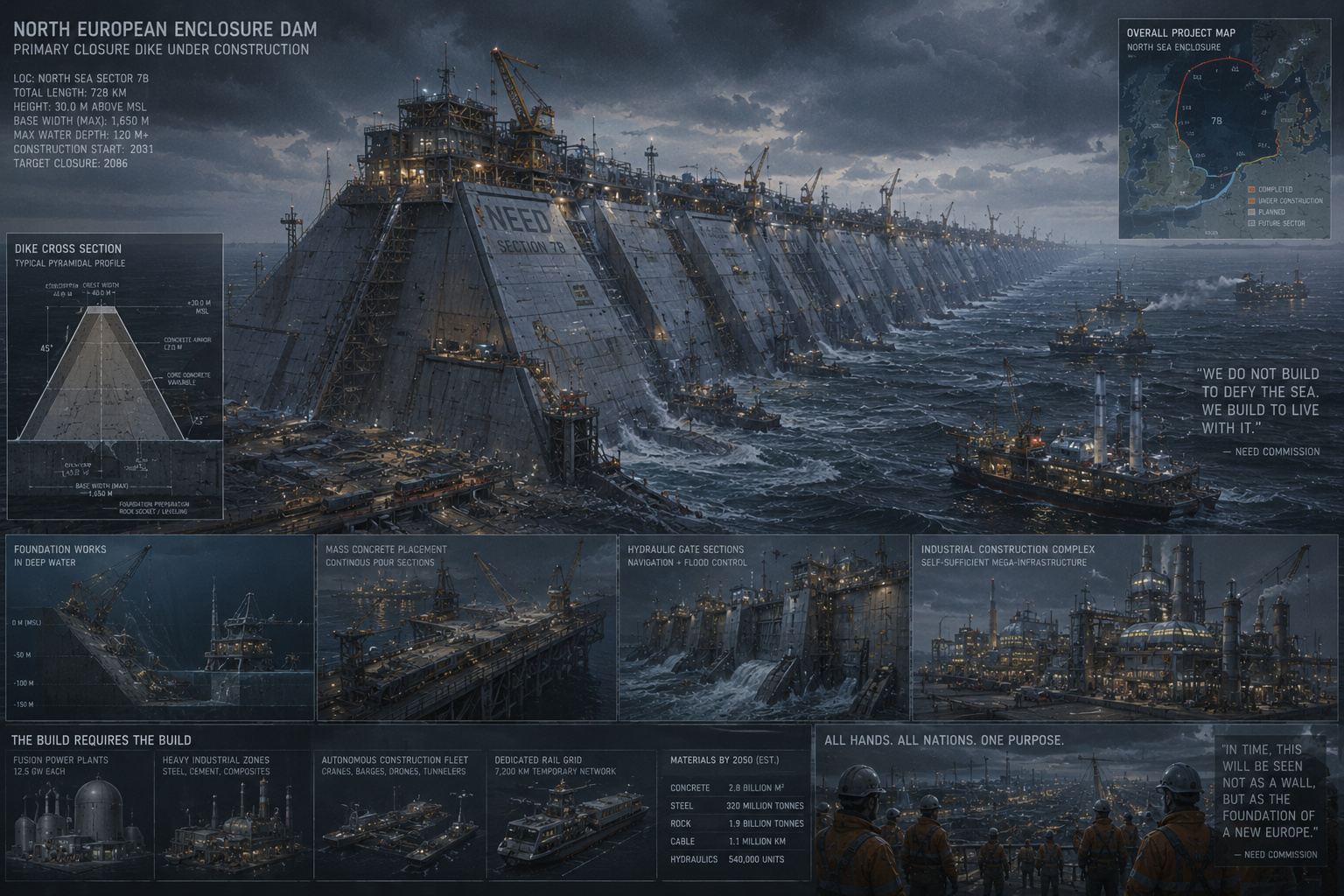
The political significance of NEED was frequently misunderstood during its earliest years because most observers interpreted it literally. This was a mistake. The North European Enclosure Dam did not initially emerge as a serious engineering proposal in the conventional sense. It began as a thought experiment, an act of infrastructural reductio ad absurdum intended to expose the scale of Europe’s climatic predicament by proposing a solution so colossal, so economically grotesque, so ecologically invasive, that policymakers would finally be frightened into pursuing aggressive mitigation and adaptation long before such measures became necessary.
The original academic papers circulated primarily within climatological and engineering communities during the late 2010s and early 2020s. Their rhetorical structure was transparent: if humanity continued failing to reduce emissions, if sea-level projections accelerated, if continental adaptation remained politically fragmented and strategically timid, then eventually even concepts bordering on science fiction would migrate into the realm of rational planning. NEED existed initially as warning through exaggeration. The assumption underlying the proposal was that no politically sane civilization would ever willingly contemplate enclosing enormous portions of the North Sea behind vast continental barriers.
Then events continued.
The late Atlantic period had already accustomed European institutions to operating amid overlapping emergencies, yet by the mid-2020s the cumulative pattern had become impossible to ignore. Insurance markets throughout vulnerable coastal regions displayed growing instability. Agricultural forecasts fluctuated violently under increasingly erratic climatic conditions. Strategic planners began integrating long-duration migration scenarios into urban development frameworks. Energy systems faced contradictory demands simultaneously: decarbonization, electrification, redundancy, affordability, and resilience under extreme weather conditions. Meanwhile, the scientific literature surrounding AMOC instability grew progressively more alarming.
The Atlantic Meridional Overturning Circulation occupied a peculiar psychological role within the continental imagination during this period. It was not merely a climatological concern. It became symbolic of a broader civilizational realization: that advanced societies remained physically vulnerable in ways globalization-era ideology had encouraged them to forget. The oceans did not care about financial sentiment. Atmospheric chemistry did not negotiate with election cycles. Thermodynamic systems remained indifferent to ideology.
By the late 2020s, the internal European consensus surrounding AMOC scenarios had shifted significantly. Publicly, officials remained cautious. Privately, strategic institutions increasingly operated according to assumptions far more severe than those presented in mass media discourse. Even partial weakening scenarios implied extraordinary stress upon northern European infrastructure. Stronger storms. More volatile storm tracks. Seasonal drought patterns combined paradoxically with catastrophic rainfall events. Coastal erosion. Saltwater intrusion. Fisheries collapse. Agricultural instability. Rising energy demand. Insurance system destabilization. Compounding sea-level pressure upon already densely urbanized low-lying regions.
Most dangerously of all, these pressures threatened to interact socially rather than merely environmentally.
Internal strategic analyses repeatedly modeled a future in which unmanaged climatic adaptation produced continent-wide housing crises of historic proportions. Hundreds of billions, eventually trillions, of euros in vulnerable coastal real estate could become progressively uninsurable or physically untenable. Retreat from low-lying regions would in turn require vast new inland development corridors. Existing urban populations would resist displacement. Agricultural land would come under immense pressure. Political radicalization would intensify. Anti-migrant sentiment would fuse with internal relocation conflicts. Entire regions could become trapped in permanent emergency expenditure cycles.
Several notorious simulations produced during the period suggested that unmanaged continental retreat scenarios carried serious risks of democratic destabilization and large-scale civil disorder by the latter half of the century.
This realization fundamentally altered the political framing surrounding NEED.
The old paradigm of European governance had frequently operated according to adversarial assumptions inherited from late twentieth-century liberal proceduralism. Governments proposed projects. Stakeholders organized opposition. Courts delayed implementation. Environmental groups challenged permits. Local residents resisted expropriation. Industry lobbied for exemptions. Political parties exploited uncertainty. Every faction possessed veto points. Under ordinary circumstances, such systems often functioned as safeguards against corruption or reckless overreach. Under conditions of escalating systemic crisis, however, many European planners concluded that the same structures had become operationally incapable of executing civilization-scale adaptation within meaningful timelines.
The emerging continental doctrine therefore pursued a radically different approach.
Instead of treating opposition as an external obstacle to governance, the new European systems increasingly forced opposition itself into governance. Stakeholders could no longer simply obstruct. They were required to participate constructively in solution formation under conditions of explicit systemic accountability.
This became known informally as inversion governance.
If fisheries organizations opposed coastal infrastructure, they were required to produce economically and physically viable alternatives that did not merely preserve fisheries interests while externalizing catastrophic costs onto the broader population. If environmental groups challenged adaptation projects, they were expected to present integrated continental-scale resilience models rather than isolated objections. If local communities resisted relocation corridors or flood-control systems, they were obligated to confront the implications for neighboring regions. Religious organizations, industrial syndicates, municipal governments, shipping authorities, agricultural blocs, insurers, labor unions, ecologists, logistics experts, and military planners increasingly found themselves seated at the same negotiating structures, not as symbolic participants but as operational stakeholders.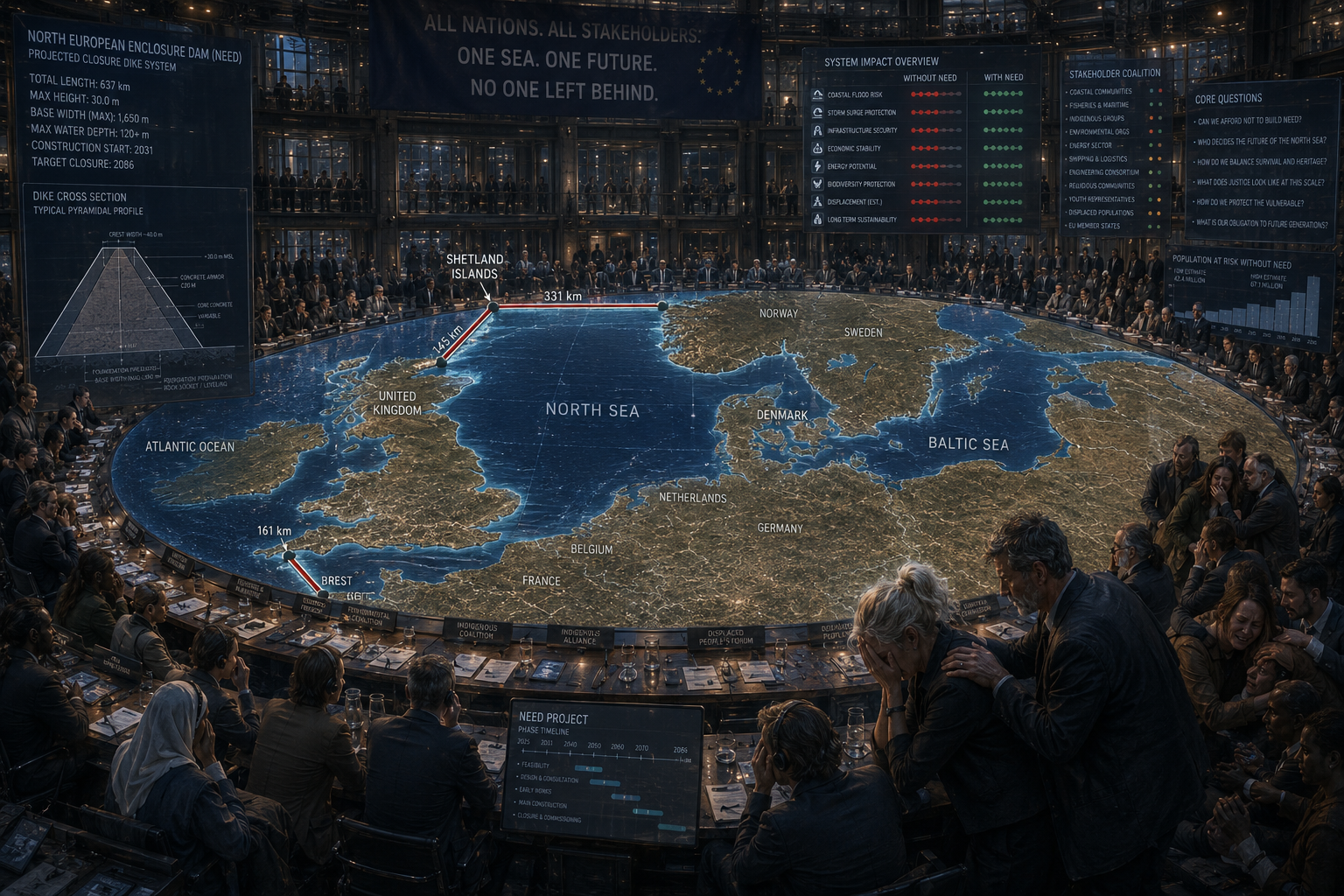 The phrase repeated endlessly throughout the period was brutally simple:
No group may preserve its own moral purity by transferring collapse onto everyone else.
This represented an extraordinary psychological shift in European governance culture. Politicians no longer presented themselves primarily as ideological champions competing to impose fixed policy visions upon passive populations. Instead, they increasingly acted as orchestrators of negotiated reality. The public was not merely consulted; it was conscripted intellectually into the management of civilization itself.
Contemporary critics described the process as coercive technocracy. Supporters countered that democratic adulthood required confronting tradeoffs honestly rather than performing endless symbolic outrage while physical systems deteriorated.
One famous exchange from a North Sea Adaptation Assembly in 2029 became emblematic of the new political atmosphere. After several hours of objections regarding proposed flood-defense expansions, an exhausted Dutch systems coordinator reportedly addressed assembled stakeholders with visible irritation:
“If the house is burning, you do not earn moral superiority by refusing the bucket. You take the bucket, or you explain directly to your neighbors why they should burn instead.”
This rhetorical style shocked many observers accustomed to the softer procedural language of earlier European politics. Yet it resonated powerfully among populations increasingly aware that climate destabilization had ceased to be a distant abstraction.
The election of Donald Trump to a renewed American presidency proved especially consequential within this evolving context. To many European policymakers, the event represented not merely an electoral outcome but a strategic signal: the Atlantic system could no longer be relied upon to produce coherent long-term coordination regarding planetary-scale risks. The expectation that global mitigation efforts alone would stabilize climatic trajectories increasingly appeared politically untenable.
And so the impossible project gradually ceased being impossible.
By 2029, a growing number of continental planning institutions had quietly concluded that the economic arithmetic surrounding NEED had fundamentally changed. Previous generations had viewed the project primarily through the lens of construction cost. The new analyses instead compared it against the cumulative cost of unmanaged collapse.
The equations were stark.
Either Europe accepted the progressive loss of trillions of euros in vulnerable coastal real estate, followed by further trillions required for inland resettlement, emergency urban expansion, agricultural displacement, industrial relocation, and perpetual disaster management — all under conditions of escalating political radicalization and demographic stress — or it pursued unprecedented continental adaptation infrastructure.
For the first time, NEED began appearing not as extravagant fantasy but as actuarial logic.
Yet the deeper transformation occurred when planners recognized that NEED alone could not solve the broader climatic challenge. Even successful enclosure and sea-level management would not address the altered thermal dynamics associated with AMOC disruption. Northern Europe still faced harsher winters, intensified storm systems, altered rainfall patterns, and growing energy demands. Adaptation therefore could not remain purely defensive.
The continent would need to grow through crisis rather than merely survive it.
This realization triggered the second phase of continental strategic thinking, sometimes referred to retrospectively as The Great Judo Turn. European planners began asking an entirely different question: if vast hydrological transformations were already unavoidable, could those transformations themselves become engines of prosperity, energy abundance, industrial expansion, and long-term continental resilience?
The resulting discussions would eventually produce some of the most ambitious infrastructural visions in modern history.
Massive controlled briny basins. Integrated tidal energy systems. Continental desalination architectures. Industrial mineral extraction networks. New maritime logistics corridors. Artificial inland seas engineered for climatic stabilization. Solar infrastructure built at scales previously associated only with science fiction. Hydrological systems designed not merely for defense, but for economic multiplication.
Critics frequently accused the continental planners of hubris during this period. In some respects, the criticism was justified. The scale of the proposed transformations bordered on civilizational self-redesign. Yet supporters argued that the true hubris had belonged to the earlier generations who assumed industrial civilization could continue indefinitely without eventually confronting the physical consequences of its own expansion.
The emerging European doctrine increasingly rejected the distinction between adaptation and growth altogether. The continent would not survive by retreating into managed decline. It would survive by becoming infrastructurally larger than the crisis itself.
….
Nairobi Continental Forum on Climate Equity, 2055.
Nobody remembered exactly who started shouting first.
The conference hall had already been unstable for hours — delegations from Southeast Asia, West Africa, the Gulf Federation, and the Pacific Coalition openly accusing the European Directorate of executing a planetary-scale unilateral climate intervention while hiding behind procedural legality and engineered necessity.
The Europeans sat almost unnervingly still through most of it.
Rows of young advisors in dark civilian attire monitored cascading multilingual feeds across transparent tablets and projected statistical walls. Their faces carried the exhausted concentration of people who had spent fifteen years inside emergency management systems and no longer reacted emotionally to outrage.
Then the American delegation lost control.
“You don’t get to do this,” the U.S. Secretary finally snapped, slamming a hand against the desk hard enough for microphones to distort. “You don’t get to just redraw the hydrology of the planet because you decided you were scared.”
The chamber erupted instantly.
The Secretary continued over the noise.
“Do you understand what your externalized sea-level projections mean for us? Do you understand what this means for Florida? For New York? For Norfolk? For Charleston? For the Gulf?”
A European aide quietly muted several ambient displays behind the Directorate table as if trying to reduce visual clutter during a routine meeting.
The American delegation was fully standing now.
“You looked at planetary collapse and decided the answer was to dump additional meters onto everybody else’s coastlines while insulating your own!”
At that, several European delegates visibly exchanged glances — not offended, merely tired.
The Directorate’s chief systems commissioner eventually leaned toward the microphone.
Her response was calm enough that it made the room angrier.
“With respect,” she said, “Florida was already functionally uninsurable.”
More shouting.
The Nairobi moderators repeatedly attempted procedural resets.
They failed.“You are flooding the rest of the world to preserve Amsterdam!” another delegate yelled.
“No,” the commissioner answered immediately. “We are preserving European continuity under conditions of systemic international coordination failure.”
The wording landed like a weapon.
The Americans began speaking over her.
“You think history is going to forgive this?”
That finally produced something unusual from the European table: visible emotion.
Not guilt. Not shame.
Irritation.
One of the younger European infrastructure analysts — probably no older than thirty — leaned toward an open microphone before diplomatic staff could stop him.
“We proposed binding carbon enforcement in 1972 in Stockholm.”
He counted on his fingers.
“Again in 1995 in Berlin. Again in 2015 in Paris. Again after the Jakarta Famine. Again after the Atlantic hurricane cascades. Again after the Fourth Indian Ocean displacement crisis.”The hall quieted slightly.
“We were told every single time that it was economically unrealistic.”
He gestured toward the immense suspended displays above the chamber where the global models continued rotating in cold silence.
“So eventually realism arrived anyway.”
The American Secretary pointed directly at the European delegation.
“You are talking about drowning our coasts.”
At that, the commissioner answered with the sentence that would later appear in headlines across half the planet.
“And what exactly do you imagine was happening to ours?”
Silence.
Not complete silence.
But the kind where everyone realizes the argument has moved past morality and into arithmetic.The Europeans no longer sounded triumphant. That was what unsettled people most.
… They sounded post-idealistic.
Like a civilization that had spent thirty years begging for coordinated sacrifice, failed to obtain it, and had quietly crossed over into engineering solutions nobody would have morally tolerated beforehand.
The commissioner folded her hands.
“If the United States would like to propose a viable alternative continental stabilization framework,” she said, “Europe remains open to proposals.”
The American delegation stared at her in disbelief.
Then she delivered the final line almost gently.
“But we no longer consider inaction an ethical position.”
Concluding
The Sleeping Giant Wakes
There is an old phrase in geopolitics, usually spoken with a mixture of awe and dread:
Never wake a sleeping giant.
For most of the late twentieth and early twenty-first century, Europeans heard that phrase applied to everyone except themselves.
China was the sleeping giant. India was the sleeping giant. Russia was the sleeping giant. The Islamic world was perpetually described either as a sleeping giant or a demographic wave. Even corporations were called sleeping giants.
Europe, by contrast, was treated as a museum. A regulatory machine. A retirement home with cathedrals. A place where history had ended.
The continent internalized that humiliation more deeply than outsiders understood.
For decades Europe was spoken to, not spoken with. The continental role in global affairs gradually narrowed into mediation, consumption, tourism, procedure, and moral commentary while harder powers asserted themselves more openly. The old empires were gone. The old confidence was gone. The old industrial ferocity was gone. Europe became the place where everyone else projected fantasies, resentment, espionage networks, influence operations, proxy conflicts, sanctions battles, migration crises, energy leverage, and ideological warfare.
And all the while the continent was expected to remain endlessly patient.
European infrastructure was sabotaged. European elections were manipulated. European institutions were penetrated by foreign intelligence services from every direction. European streets became stages for external conflicts imported wholesale from powers thousands of kilometers away. European energy dependence was exploited repeatedly. European media ecosystems fragmented under algorithmic polarization campaigns. European ports became bottlenecks in escalating trade wars. European industry was slowly squeezed between American financial dominance and Chinese manufacturing scale.
At the same time, Europe was expected to absorb the consequences of planetary instability with near-religious restraint.
Refugee crises. Food shocks. Energy shocks. Inflationary spirals. Shipping disruptions. Climate displacement. Cyberwarfare. Terror incidents. Strategic dependency.
Always more pressure. Always another emergency. Always another lecture.
The political class of the early century responded mostly with process. Committees. Summits. Frameworks. Joint declarations. Strategic dialogues.
But the atmosphere changed slowly after the climate shocks of the 2030s. Then rapidly. Then all at once.
Entire sections of European coastal infrastructure entered rolling emergency status. Insurance markets destabilized. Southern agricultural systems experienced heat damage previously considered impossible. Major river systems entered chronic low-flow conditions. Atlantic storm patterns intensified. The migration systems surrounding the Mediterranean became effectively permanent.
And somewhere during those years a dangerous realization began spreading through the younger continental generation:
No one was coming.
Not America. Not China. Not international institutions. Not market spontaneity. Not invisible hands. Not moral appeals.
The world system, as it actually existed, was structurally incapable of coordinated sacrifice at the scale required.
The old dream of universal synchronized climate action died not with a bang but with procedural exhaustion.
Conference after conference produced language. The seas continued rising.
Europe watched this for seventy years. Then Europe changed.
The Continental Turn
Historians later called it the Continental Turn.
Not a coup. Not a revolution. Not fascism. Not empire.
Something stranger.
A civilization deciding, collectively and somewhat reluctantly, that survival required scale.
The psychological shift mattered more than any individual policy.
Europe stopped thinking of itself as a post-historical moral referee and began thinking of itself once again as a civilization with material continuity obligations.
That sounds abstract until one understands what it produced.
The North Sea Enclosure System. Mediterranean Retention Barriers. Continental desalination grids. Pan-European high-speed energy corridors. Strategic semiconductor sovereignty programs. Arctic logistics infrastructure. Massive orbital communications constellations. Gigantic modular nuclear deployment. Hydrogen freight conversion. Continental AI coordination systems.
Projects once dismissed as impossible, vulgar, unrealistic, or politically toxic suddenly became normal.
The old Europe had treated ambition itself with suspicion. The new Europe regarded ambition as emergency infrastructure.
And perhaps nowhere was this clearer than in the North Sea projects.
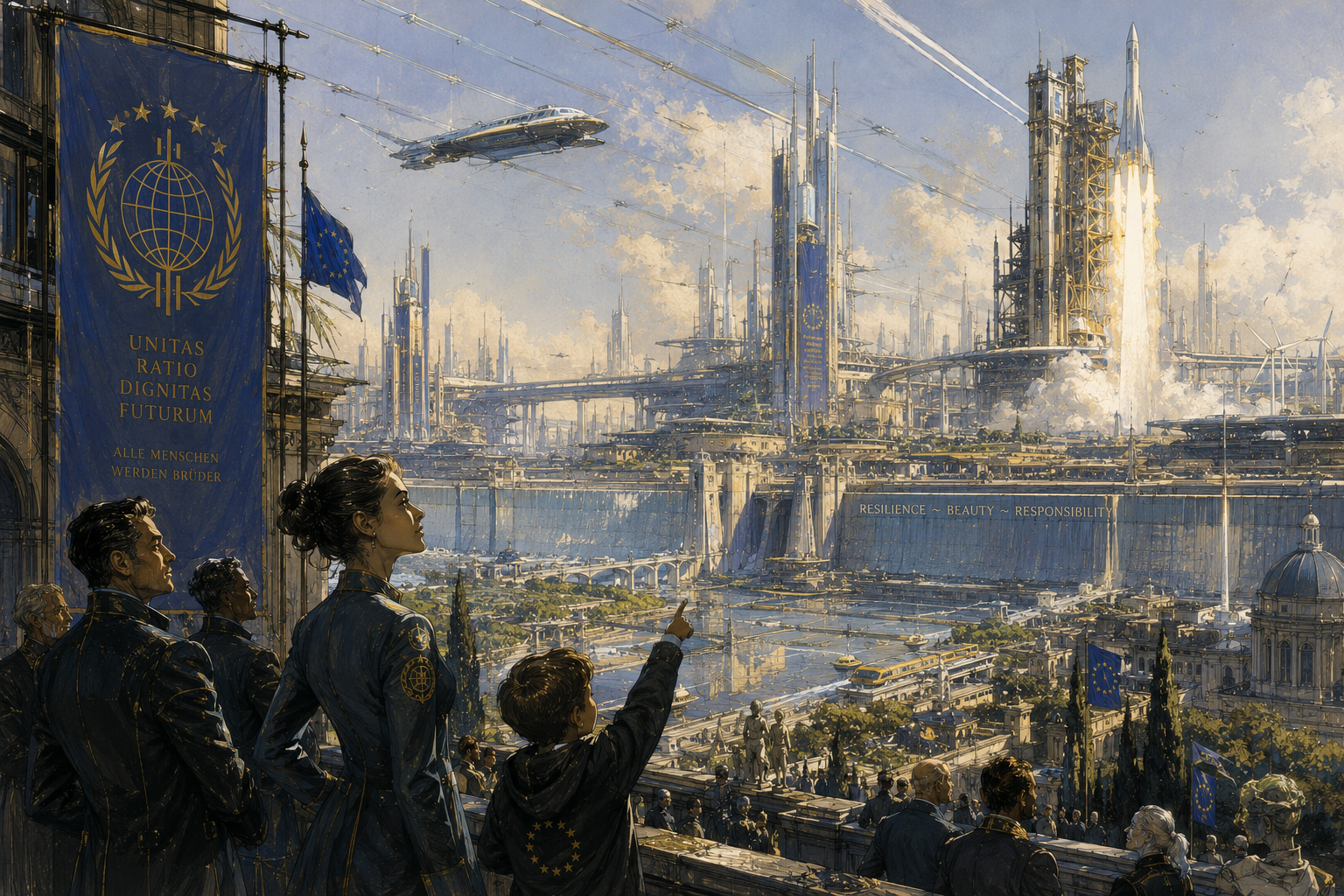
To outsiders, the North Sea Enclosure Dam looked insane. A planetary-scale hydraulic wall stretching across one of the most economically active maritime zones on Earth. A structure so large that it altered weather patterns, shipping routes, fisheries, migration corridors, energy systems, and geopolitical assumptions simultaneously.
But from inside the continental planning ministries, the logic felt brutally simple.
The sea was coming.
Either Europe would retreat from its own historical core or it would engineer at continental scale.
The younger planners often repeated a phrase that became notorious abroad:
Reality does not negotiate with taboo.
The dam stabilized inland flooding risks across northern Europe. It created unprecedented tidal and energy-generation capacity. It transformed enormous sections of maritime infrastructure into controlled hydrological systems.
But the deeper implications were even larger.
The enclosed basin became the backbone of a new industrial civilization.
Cold Water, Cold Air, Infinite Computation
 The collapse of the Atlantic Meridional Overturning Circulation — the AMOC — had once been discussed primarily as catastrophe.
And catastrophe it was.
Northern Europe cooled dramatically. Storm systems intensified. Agricultural zones shifted. Entire weather regimes destabilized.
London, sitting at a latitude comparable to parts of Siberia, suddenly confronted winters generations had considered impossible.
But this is where the continental mentality changed.
The old political order saw crisis primarily as loss. The emerging European systems culture began viewing crisis as terrain.
Cold water, for example, is not merely cold water. Cold water is thermal infrastructure.
As the North Sea cooled, European planners realized they possessed something extraordinary:
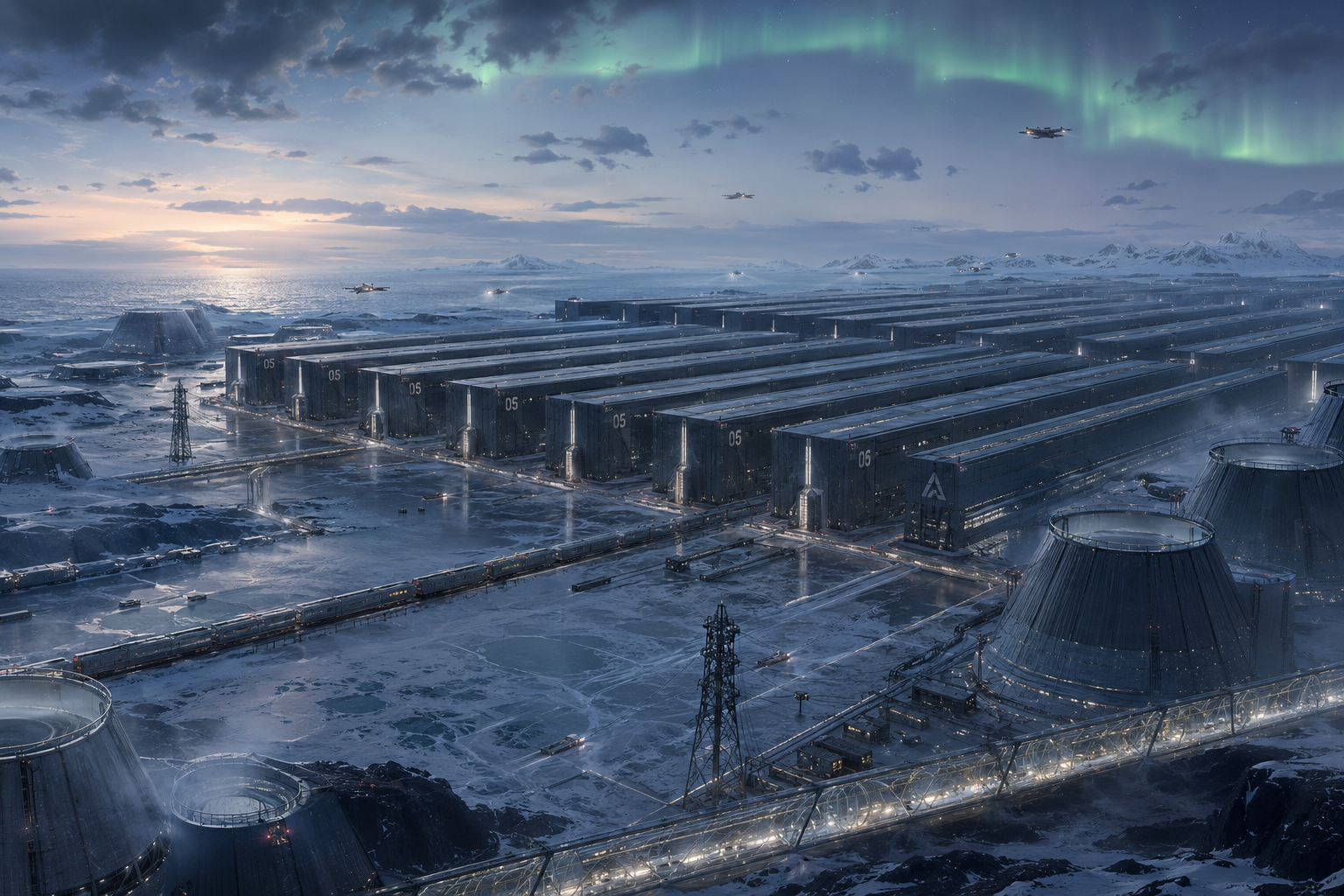
A gigantic naturally cooled industrial basin directly adjacent to the densest high-skill populations on Earth. Data centers had once struggled against heat. Now Europe possessed cold. Massive amounts of cold.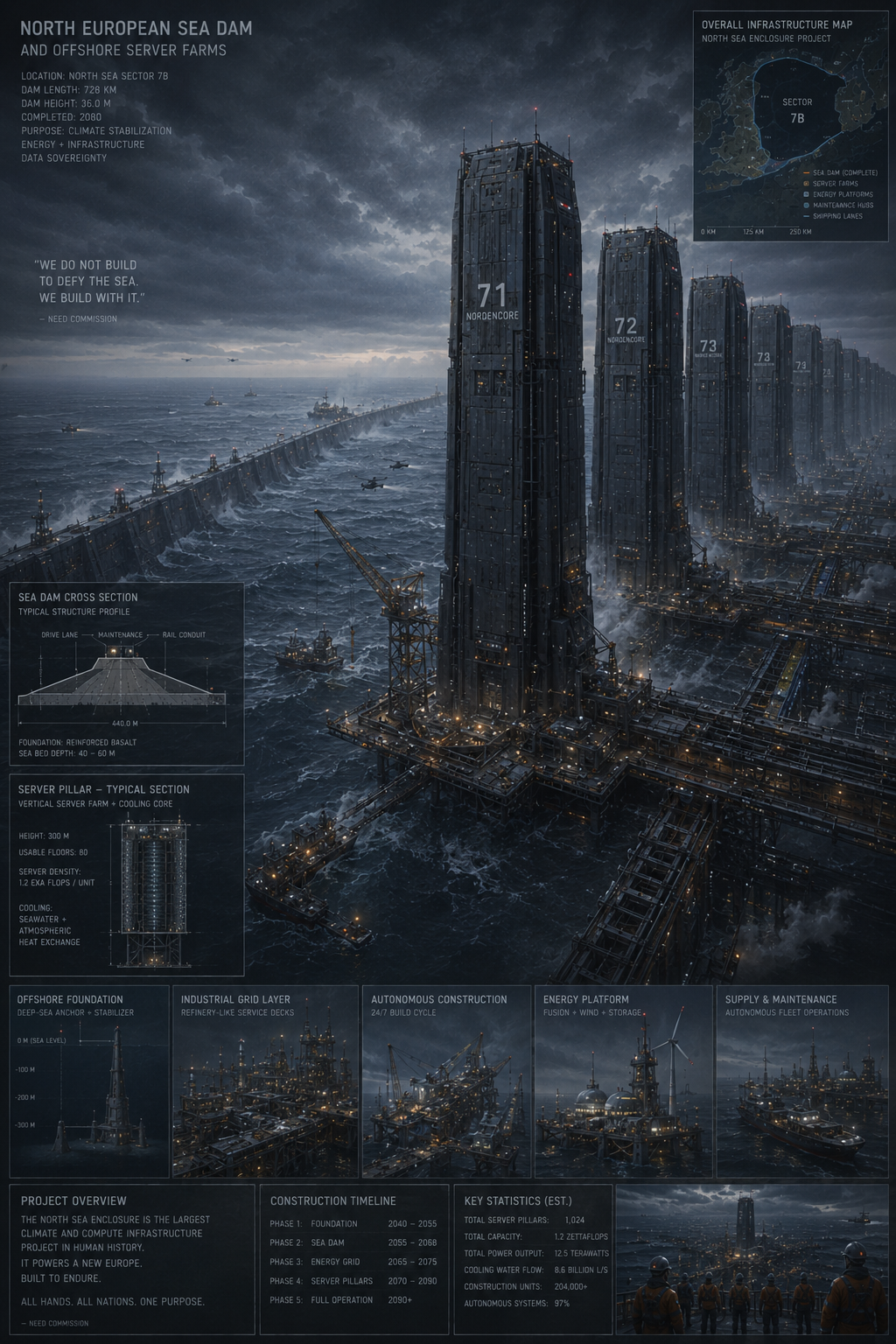 Combined with the energy output from the enclosure systems and the continental nuclear buildout, the North Sea became the foundation for computational infrastructure on scales previously associated only with science fiction. Artificial intelligence training clusters. Planetary climate simulation systems. Scientific computation arrays. Industrial optimization networks. Civilizational-scale archival systems. Floating server arcologies appeared across stabilized maritime sectors. Vast reflective industrial islands humming softly beneath permanent gray skies.
The Europeans joked darkly about it.
The world had spent decades mocking European regulation and procedural obsession. Then Europe accidentally became the planet’s thermal supercomputer. By the late 2040s, continental computational capacity exceeded the combined strategic infrastructure of several competing blocs. Not because Europe became more ruthless. Because Europe became more coordinated, and that distinction mattered enormously.
Gibraltar
Nothing symbolized the psychological break more than Gibraltar.
The idea itself was ancient. The Atlantropa proposals of the twentieth century had already imagined enclosing the Mediterranean and allowing evaporation to lower water levels. At the time the concept was regarded as a strange mixture of megalomania, futurism, colonial arrogance, and engineering fantasy.
A century later, the fantasy returned. Only now the sea was actually rising.
The arithmetic was horrifying.
Every year, Mediterranean coastal cities faced increasing risk. Venice. Naples. Alexandria. Barcelona. Marseille. Athens.
Entire cultural landscapes were approaching permanent emergency status.
And so the unthinkable became discussable.
Close Gibraltar. Control inflow. Allow partial evaporation. Lower basin levels gradually. Reengineer the coastline.
The international reaction was volcanic.
Environmental groups called it planetary vandalism. American media described it as eco-imperial insanity. Asian commentators accused Europe of hydraulic nationalism. African negotiators warned openly of cascading climatic consequences.
And yet the European response remained maddeningly calm.
What critics increasingly failed to understand was that the continent no longer regarded the status quo as morally neutral.
A flooded Venice was not ethically superior to a transformed Mediterranean.
It was simply more familiar.
Yes, fisheries would collapse or require radical redesign. Yes, maritime trade patterns would shift. Yes, ecosystems would transform. Yes, externalized sea-level effects elsewhere in the world would intensify.
But Europe increasingly viewed these not as avoidable tragedies, but as managed consequences inside an already catastrophic century.
The younger continental generation spoke about it with unnerving directness.
We are no longer choosing between good and bad outcomes. We are choosing between survivable and unsurvivable ones.
And beyond the crisis itself, the projects created opportunities so vast they began reshaping continental psychology.
Lower Mediterranean levels meant exposed land. Energy corridors. Solar infrastructure. Mineral extraction. Arcology construction. Controlled agricultural basins. Experimental climate-adaptive urbanism.
Critics called it monstrous.
The Directorate’s planners answered with photographs of submerged streets.
The End of Junior Partnership
Perhaps the deepest transformation was geopolitical.
For most of the postwar era, Europe functioned psychologically as a junior partner within a broader Atlantic system. That arrangement was tolerable as long as mutual respect still existed.
But by the 2030s and 2040s, many Europeans increasingly felt that the arrangement had decayed into asymmetry.
Europe absorbed sanctions blowback. Europe absorbed migration pressure. Europe absorbed energy instability. Europe absorbed industrial hollowing. Europe absorbed geopolitical spillover.
Meanwhile, every major external power operated aggressively on European soil whenever convenient.
Russian sabotage operations. Chinese industrial espionage. Iranian proxy influence. American extraterritorial economic pressure. Israeli cyber operations. Private intelligence contractors. Algorithmic disinformation ecosystems.
The continent increasingly felt less like an ally within a stable order and more like a contested operating environment.
And eventually Europeans became tired of being treated as strategically soft.
Not militarily weak. Psychologically available.
The old European political culture interpreted hardness as danger because it remembered the twentieth century too vividly. The new generation remembered something else as well:
Dependency was also dangerous.
This did not produce a fascist Europe. That was the strange part.
The emerging continental identity remained multilingual. Pluralistic. Technocratic. Secular. Democratic. Queer in some places. Traditional in others. Culturally heterogeneous.
But underneath it sat a new emotional core:
Europe would no longer quietly organize its own decline in order to preserve the emotional comfort of a world system that had already failed.
That sentence horrified people. Mostly because it sounded increasingly plausible.
The New European Temperament
The propaganda posters changed first.
Not dramatically. Subtly.
The apologetic irony disappeared.
The new aesthetics were clean, architectural, disciplined, almost serene. Not triumphalist exactly. Confident.
Gigantic infrastructure under winter skies. Multilingual typography. Orbital imagery. Public works. Engineers. Coders. Researchers. Students. Hydrologists.
Not soldiers. Operators.
The underlying message was simple:
History has resumed. We intend to survive it.
And this, more than the dams or barriers or computation clusters, frightened outside observers.
Europe no longer looked decadent.
It looked mobilized.
Not through rage. Through competence.
The continent that had spent half a century doubting itself suddenly began acting like it possessed continuity obligations extending centuries into the future.
The old rhetoric of infinite procedural hesitation no longer matched material reality.
There is a particular kind of fear civilizations experience when they realize systems once considered permanent are dissolving. The liberal globalization order of the late twentieth century had assumed rising integration would gradually overpower older civilizational reflexes.
Instead, crisis reactivated them.
Not only in Europe. Everywhere.
The difference was that Europe retained extraordinary latent infrastructure. Extraordinary education density. Extraordinary institutional capacity. Extraordinary engineering capability. Extraordinary urban continuity.
The sleeping giant metaphor had been misplaced for decades.
Europe was not asleep because it lacked capacity. Europe was asleep because it still believed history might calm down.
Then history stopped calming down.
And once the continental machine fully oriented toward continuity, scale, and survival, the rest of the world discovered something uncomfortable:
A post-historical Europe had been manageable.
A future-oriented Europe was something else entirely.
Not an empire. Not a utopia. Not innocent.
A civilization under pressure deciding, finally, to behave like one.
And once that psychological threshold was crossed, there was no realistic path back to the old paralysis.
Because after a certain point, seawalls become ideology.
Pumps become philosophy.
And survival itself becomes a form of political legitimacy.