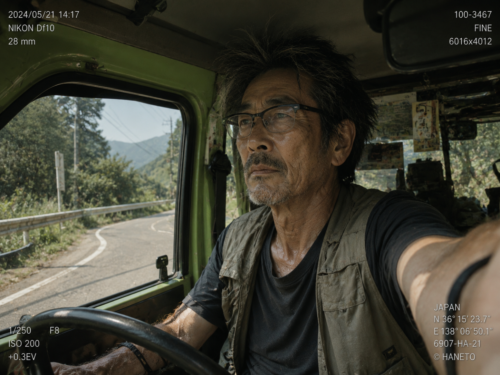
The little green Hijet climbed patiently through the mountains with the resigned mechanical hum of an old appliance that had long ago accepted it would never be allowed to die properly. Warm air flowed through the open driver-side window carrying the smell of cedar, wet soil, old asphalt, and distant river water rising from somewhere below the road. Haneto drove with one elbow against the door and his other hand loose on the wheel, eyes fixed ahead through the alternating bands of sunlight and shadow sliding over the windshield as the road curved endlessly upward into the interior of the prefecture.
The van was hot already despite the early hour. The weak air conditioner had surrendered years ago, and now the dashboard vents merely exhaled air with the temperature and emotional character of an attic. Sweat darkened the collar of his shirt and soaked slowly through the back of his vest. He could feel it cooling briefly whenever the road passed through deep forest shade before the warmth returned again from the broad May sun falling across the valley. The inside of the Hijet smelled faintly of dust, camera bags, engine oil, old receipts, and canned coffee. A smell accumulated over decades rather than cleaned away.
Haneto considered himself young.
At sixty-nine he still climbed retaining walls without complaint, still carried batteries and tools uphill into abandoned districts, still slept comfortably inside the van during overnight inspections when weather or landslides trapped him in the mountains. His knees hurt sometimes descending stairs and his shoulders stiffened during rainstorms, but these were conditions rather than tragedies. Old age, in his opinion, began somewhere around eighty-two, perhaps eighty-five if one remained curious. Most people became elderly too early because they surrendered first in the mind and then slowly elsewhere.
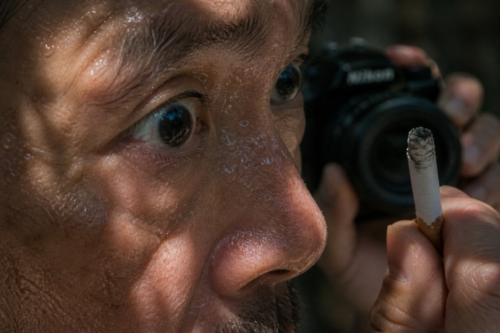
He adjusted the camera clipped beside the steering wheel and pressed the shutter absently, taking another photograph of himself without ceremony. He had done this for years now. Not vanity. Documentation. A continuous visual proof that he had occupied these roads and valleys and forgotten places month after month while the country quietly rearranged itself around him. Sometimes, late at night, he would scroll through the images and become unsettled by the accumulation of seasons behind his own face. Different roads. Different weather. Different abandoned towns. Always the same tired green dashboard and his own arm reaching toward the lens.
Outside, the mountains unfolded in long folds of spring green beneath a pale washed sky. Small villages appeared occasionally around bends in the road and vanished just as quickly again behind trees and rock faces. Corrugated roofs shimmered in heat. Empty vegetable plots collapsed into weeds. Old gas stations leaned toward closure beneath fading signs from another economic century. Japan was full of places still technically inhabited but already spiritually archived.
Haneto preferred them.
Cities exhausted him now. Tokyo especially seemed no longer built for people who remembered older versions of it. Everything there moved too quickly while simultaneously feeling strangely temporary, as though the city were continuously replacing itself before memory could settle properly inside it. The mountain roads were different. Up here things decayed honestly. A closed inn remained a closed inn for thirty years. A rusted guardrail simply rusted further. Moss thickened predictably. Trees advanced meter by meter through parking lots and schoolyards and staircases. There was dignity in gradual disappearance.
The folder resting on the passenger seat contained his assignment paperwork, though “assignment” implied more institutional attention than actually existed. Officially he worked as a contracted inspection and preservation technician attached indirectly to a prefectural infrastructure management office that itself had been merged, renamed, outsourced, and budget-cut so many times that nobody entirely understood its shape anymore. Every few months a list appeared. Drainage inspection. Structural survey. Liability documentation. Fence replacement verification. Hazard photography. Mostly abandoned settlements nobody wished to spend money demolishing and nobody wished to admit still existed.
Nichitsu appeared on the list repeatedly because Haneto continued writing detailed reports about it.
If he stopped, the place would probably vanish administratively within a year or two, swallowed into paperwork silence until eventually a hillside collapsed or a tourist died wandering through unstable buildings. He understood this with perfect clarity. Nobody else remembered the retaining walls near the school. Nobody else checked the old transformer station after winter storms. Nobody else noticed which roofs had finally begun to fail under snow weight.
So he kept going.
The road narrowed further as the valley tightened around him. Trees crowded close beside the guardrails, their shadows flickering rhythmically across his face like projector shutters. Somewhere ahead beyond the next sequence of bends waited the abandoned mining town with its silent apartment terraces and overgrown bathhouse and school beneath the cedar trees. Haneto had visited so many times over the years that memory and present geography had begun layering together strangely in his mind. Certain corners of road no longer belonged entirely to the current year.
He wiped sweat from his neck with a folded towel and drove on deeper into the mountains, the little green van carrying him patiently toward the place that nobody had asked him to care about except himself.
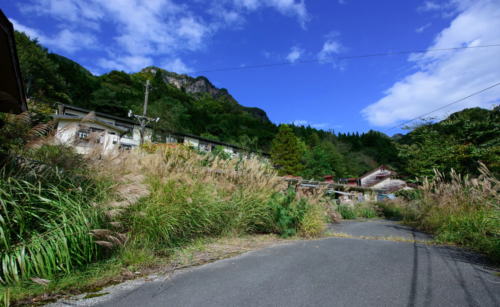
Nichitsu had once been the sort of place people believed would last forever simply because so much effort had been spent forcing it into existence.
The valley itself was too steep, too narrow, too damp with mountain runoff to naturally support a town of any meaningful size, yet during the great industrial hunger of the twentieth century men had looked into these mountains and seen copper instead of forest. Roads were cut into cliffs. Retaining walls were poured by hand. Rivers were redirected. Terraces blasted from the slopes. Then came the conveyor systems, the workshops, the processing facilities, the dormitories, the bathhouses, the company store, the school, the shrine, the baseball field, the concrete apartment blocks climbing one above another like shelves built into the mountain itself.
A company town in the purest sense.
Nichitsu had not grown organically over generations the way older villages had. It had been installed.
Everything there once revolved around extraction. The mine determined waking hours, school schedules, marriages, budgets, festivals, and silence. Fathers disappeared underground before sunrise. Trucks climbed the mountain roads through snowstorms carrying machinery and fuel. Steam rose from communal baths at dusk while televisions flickered blue through apartment windows. Children ran between staircases and laundry lines suspended over impossible drops into the valley below.
At its height the place had possessed its own gravitational field. Workers arrived from distant prefectures because there was money there once, or at least the promise of stability. Young couples accepted tiny company apartments because the mine guaranteed employment. Entire lives unfolded inside that narrow mountain basin without requiring much connection to the outside world. Births, funerals, drinking parties, school graduations, first kisses beneath retaining walls, summer festivals illuminated by paper lanterns strung between concrete utility poles — all of it compressed into that impossible vertical settlement carved into cedar forest.
Haneto knew these things only from photographs.
He had spent years studying them accidentally.
Every abandoned town accumulated archives somewhere. Old municipal records. Company newsletters. Forgotten websites assembled by former residents. Faded photographs uploaded by grandchildren cleaning out apartments after funerals. He had seen black-and-white images of Nichitsu covered in winter snow while workers in helmets stood proudly beside new machinery. Color photographs from the seventies showed children holding insect nets near the schoolyard, mothers hanging futons from balconies, teachers posing during sports festivals beneath bright October banners.
There was one photograph he remembered particularly well.
A summer evening sometime around 1974. The road near the bathhouse crowded with people in yukata during a festival. Plastic goldfish bags glowing orange beneath strings of lights. Young men smoking cigarettes beside vending machines. Somebody laughing directly toward the camera with complete unconscious confidence that this place would continue existing indefinitely.
That confidence haunted him more than the ruins themselves.
Because Nichitsu had not died dramatically.
No explosion.
No catastrophe.
No singular moment.
The ore became less profitable. Imported materials became cheaper. The arithmetic shifted slowly against the mountains. Younger residents left first because cities offered universities, convenience, girlfriends, modern apartments, futures disconnected from dangerous underground labor. Then schools shrank. Shops shortened operating hours. Entire apartment blocks emptied one staircase at a time.
Eventually the company left while pretending not to.
Maintenance budgets disappeared first. Then shuttle services. Then staffing. Then certainty itself. By the time official closure arrived, much of the town had already psychologically evacuated years earlier. The remaining residents lingered in a state between stubbornness and grief until age, practicality, or loneliness finally pushed them downhill toward civilization.
Afterward the forest resumed negotiations.
Haneto never saw Nichitsu alive. By the time he first arrived as a young subcontractor in the late nineties, the town already possessed the peculiar silence of places that have outlived their intended purpose. Windows broken by storms. Calendars still hanging inside apartments. Children’s shoes beside doorways. Mold advancing patiently across ceilings while televisions gathered dust in neat dark rooms.
Yet even then the place had not felt empty to him.
Human settlements leave behind emotional architecture long after people vanish. Certain apartment corridors still carried traces of domestic rhythm. Certain classrooms retained the oppressive stillness of institutional afternoons. The staircases especially affected him. Thousands upon thousands of daily journeys compressed into concrete worn smooth by decades of shoes.
Nichitsu had once been full of ordinary life so dense and repetitive that nobody living there could fully perceive it while it existed.
And now that ordinary life was gone, the absence itself had become almost visible.
Perhaps that was why Haneto continued returning. Not merely to inspect retaining walls or photograph structural decay, but because the town preserved something modern Japan preferred not to look at directly: the physical remains of collective effort abandoned by history once it stopped generating profit. Nichitsu was a monument to labor, to impermanence, to the strange fragility of entire worlds built around industries that believed themselves eternal.
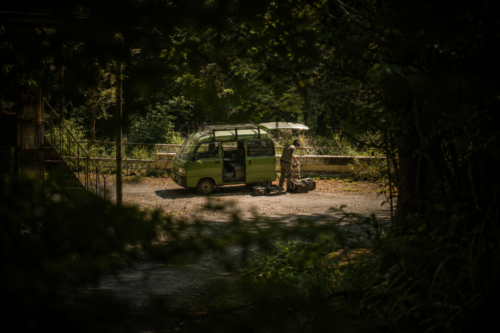
By the time Haneto parked the little green Hijet beside the cracked retaining wall near the lower bathhouse, the inside of the van had become oppressively warm. Sunlight pooled through the windshield and settled across the dashboard in thick yellow slabs of heat. The steering wheel felt slightly tacky beneath his palms. Sweat gathered beneath his collar and along his ribs where his undershirt clung damply to his skin. He shut off the engine but remained seated for a while, listening to the metallic ticking sound of the cooling motor and the distant constant rush of insects rising from the valley.
The mountains in May always sounded alive in a way cities never did anymore. Even silence contained texture here. Cicadas grinding invisibly in cedar groves. Water moving through hidden drainage channels beneath the road. Branches knocking softly together high overhead. Somewhere far downhill a bird released a brief liquid series of notes that echoed strangely against the concrete terraces of the abandoned town.
Haneto rubbed his ankle absently before stepping out of the van.
He had sprained it badly almost fifteen years ago while inspecting an abandoned hotel near Gunma. Rotten staircase. Rain. Carelessness. He still remembered the exact sensation of his foot folding sideways beneath him and the ugly instant of weightlessness before impact. Since then he moved differently in ruined places. Slower. Deliberate. Always testing surfaces before trusting them. Age itself bothered him less than the knowledge that injury recovery was no longer automatic. One stupid fall in the mountains and a man could quietly become old all at once.
He opened the rear hatch carefully.
Inside the Hijet everything had its arrangement developed over years of repetition. Camera bags. Toolboxes. Folded warning signs. Rope. Pry bars. Fuel siphon. Rain tarp. Battery packs. Clipboard sleeves. Compact folding ladder. A plastic crate full of replacement locks and rust-resistant screws. Two thermoses. Rubber boots. A canvas bag filled with electrical testing equipment older than some office workers now managing his department remotely from Saitama.
He unloaded slowly, never carrying more than necessary at once.
There was no point rushing anymore. Nobody timed him. Nobody even really understood what he did beyond broad administrative terminology. Somewhere deep in a prefectural database Nichitsu existed as a maintenance liability zone with periodic inspection requirements attached to a shrinking budget line. Younger staff occasionally asked him why he still bothered making full reports for places like this when demolition would eventually come anyway.
But demolition never came.
It’s was an undertaking that never achieved take-off momentum.
Budgets evaporated before buildings did.
And meanwhile the forests continued swallowing everything patiently.
Haneto lit a cigarette before starting uphill. The smoke tasted sharp and dry in the warm afternoon air. He leaned briefly against the van and looked upward toward the terraces climbing through the trees. Apartment blocks half hidden behind vegetation. Utility poles leaning at slight angles. Faded guardrails disappearing around bends. The school somewhere higher up beneath the cedars.
Then he reached back inside the van and clicked on the radio.
Static burst first through the tiny dashboard speaker before resolving into music already midway through a song. Some American woman singing about heartbreak over bright synthetic drums and airy guitars. Haneto had no idea who she was. He called all of it whitegirlmusic privately. Madonna. Cyndi Lauper. Roxette. Belinda Carlisle. Some newer ones too. He barely distinguished between them anymore. Yet he liked the sound of it in the mountains. Something about cheerful foreign sadness drifting through abandoned Japanese valleys amused him deeply.
The song echoed thinly through the open van doors while he adjusted straps on his equipment vest.
He took another drag from the cigarette and began walking.
The road upward through Nichitsu remained mostly intact despite years of neglect. Grass pushed through expansion cracks. Moss softened the edges of concrete gutters. Small trees had rooted beside stair rails and retaining walls. Haneto moved carefully, testing uneven surfaces instinctively with the outside edge of his shoe before committing weight. The old ankle pulled faintly whenever he descended too quickly or twisted unexpectedly.
Warm air drifted through the terraces carrying strange layered smells. Wet leaves. Rust. Dust. Sun-heated vinyl. Old tatami somewhere deep inside sealed apartments slowly surrendering to mold. Nichitsu always smelled different depending on season. Summer brought mineral heat and insects. Autumn smelled of rotting leaves and cold concrete. Winter smelled almost metallic.
Today the town smelled alive.
Not alive with people exactly.
Just active somehow.
He passed the abandoned gymnasium first. Vines had begun climbing through broken upper windows, and one section of roof sagged lower than during his previous inspection. He made a mental note to photograph it later. Nearby, the old bicycle shed had partially collapsed inward beneath accumulated branches and ivy. The entire structure resembled an animal carcass dissolving into vegetation.
Then he heard the noise.
At first Haneto barely registered it consciously. Nichitsu constantly produced sounds capable of imitating human presence. Loose shutters banged softly in wind. Pipes contracted in heat. Water dripped through unseen channels. Sometimes entire apartment corridors emitted long groaning noises after temperature shifts.
But this was different.
A dragging sound.
Heavy.
Deliberate.
Something scraping across concrete uphill near the school terraces.
Haneto stopped walking immediately.
The cigarette remained between his fingers as he listened.
Another impact followed. Then another. Wood against pavement. A metallic clatter. Something overturned violently. The noise echoed strangely between retaining walls before fading into insect drone.
Then came laughter.
High-pitched and rapid.
Not normal laughter.
It rose abruptly almost into shrieking before fragmenting into strange chirping bursts that sounded layered somehow, as if several voices attempted to imitate one another imperfectly.
Haneto felt irritation before fear.
There should not be anybody here.
Not on a weekday in May.
Urban explorers usually arrived during autumn. Ghost-hunter idiots preferred Obon season because television had convinced them abandoned villages became spiritually fashionable in August. Occasionally photographers appeared. Occasionally teenagers with beer and fireworks. But this sounded different.
Busy.
Domestic almost.
And definitely not temporary.
He dropped the cigarette and crushed it carefully beneath his shoe before slipping the Nikon from his shoulder. After a moment’s hesitation he exchanged it instead for the smaller inspection camera attached to his vest. Reflex. Documentation instinct. If squatters had moved into the upper district management would eventually require photographs before contacting police or municipal services.
Haneto continued uphill more slowly now.
The sounds grew clearer.
Hammering.
Fabric snapping in wind.
Dragging noises.
Voices.
Not Japanese.
Or perhaps not entirely non-Japanese either.
He caught fragments only. Sharp consonants. Rapid syllables. Strange musical rises and falls unlike any dialect he recognized. The cadence reminded him faintly of children inventing languages while playing games.
As he approached the upper teachers’ residences the atmosphere changed subtly around him.
Things moved where nothing should move.
Color flashed overhead between balconies.
Something metallic chimed softly in the breeze.
Haneto stepped around the corner and stopped dead in the middle of the road.
One of the houses was occupied.
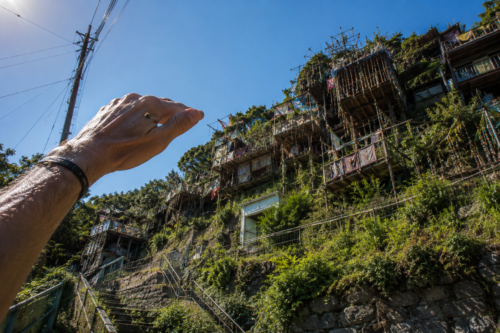 Not restored. Occupied, but not in a manner that made immediate sense.
The windows stood open beneath layers of hanging fabric and translucent plastic sheets stitched together from mismatched materials. Long ribbons of cassette tape fluttered between balcony rails. Reflective strips spun lazily in moving air. Strings of tiny objects hung everywhere, clicking softly together like insect shells.
The entire building whispered in the wind, parts of it danced, trembled, glittered.
The front garden had been transformed into terraces assembled from salvaged desks, doors, shelving units, and scavenged construction material. Rainwater collectors fed blue storage drums. Homemade solar panels leaned across sections of roof tile at improbable angles. Clothing hung from lines suspended between telephone poles.
And everywhere Haneto looked there were objects threaded onto cords and wires: old pager shells… buttons… camera film canisters… circuit boards….manga collectible dolls … tiny bells … bottlecaps … pieces of cracked translucent plastic … childrens toys.. old phones… . The structures trembled continuously in the mountain breeze, producing faint soft sound everywhere at once.
Haneto’s stomach tightened.
Not one house. Several.
Further uphill the modifications spread through the abandoned district like coral growth overtaking ruins underwater. Balcony bridges assembled from scaffolding connected buildings together. Bright cloth canopies stretched between rooftops. The principal’s old residence had been draped beneath an enormous suspended net covered in hundreds of hanging compact broken in half discs that flashed violently in afternoon sunlight – with dabs of bright paint?
Then laughter erupted nearby again.
Close.
Very close.
Haneto looked upward instinctively.
Movement crossed a second-floor walkway with astonishing speed.
For one terrible second he thought it was a child.
Then his mind corrected itself.
There was an animal quality, a fleetness that belied normalcy. He stared upward without breathing, a tightness everwhere. A face emerged slowly between hanging ribbons high above him, but it was out of focus, and his eyes refused to make sense of it. But there were absolutely these huge reflective eyes.
There were other things happening as well, but his mind recoiled. Later his would realize he’d alreade seen the brightly patterened blues and pinks and grays and reds.
That what was watching was as much showing as observing. The silhouette was not itself menacing but it was certainly setting some sort of boundary.
There was now alertness as much in Haneto as much as in the 360 degrees of poignancy around everywhere. Haneto’s soul started seeing patterning of similar faces, and she shook away this erlebnis. He had shaken bad habits of drinking too much years ago and he knew his his own mind could betray him. He shook away the errors in his mind. But he knew, a second face was nest to the first, in crowned in shadow, wide eyes of a cat, yet upside down beside the first from an angle no human neck could comfortably sustain. They exchanged rapid whispering yelps between themselves. One emitted that strange chirping laughter again before vanishing backward into shadow.
Haneto realized suddenly how loudly his own heart was beating. It actually hurt in his veins.
The abandoned village around him creaked softly beneath the warm mountain wind while hanging strings and improvised structures moved overhead with quiet constant life.
And somewhere beneath the fear another realization formed slowly inside him.
Nichitsu was comfortable as abandoned, but felt was suddenly more comfortable as being not abandoned.
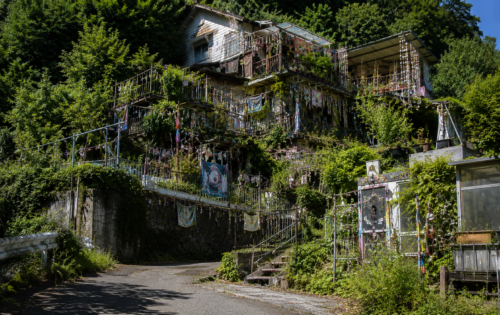
The higher Haneto climbed into Nichitsu, the less the town resembled a place abandoned by humans and the more it resembled a place interrupted midway through one civilization and quietly resumed by another. At first the changes had seemed almost understandable in the way strange rural occupations sometimes were understandable if one forced patience upon oneself. A few improvised repairs. Hanging fabrics. Rain collectors. Scavenged solar panels. He had seen odd communes before. Aging hippies in mountain valleys. Religious isolationists. Illegal workshops hidden in depopulated districts. Once, near Yamanashi, he had discovered an old pension occupied entirely by amateur radio enthusiasts who had slowly transformed the roof into something resembling a military listening station from a Cold War film. Human beings accumulated eccentricity naturally whenever left alone long enough.
But Nichitsu was moving steadily beyond eccentricity.
The road narrowed into stair terraces winding upward through retaining walls and apartment blocks increasingly overtaken by vegetation. Heat radiated from the concrete beneath his boots in visible trembling currents. Sweat darkened his shirt completely now beneath the equipment vest, and the damp fabric clung to his spine and ribs whenever he shifted. The mountains pressed close around the town, green and heavy beneath the broad white-blue sky of late morning. Cicadas screamed invisibly from the cedar groves in long electrical waves. Somewhere lower in the valley his little radio still drifted faintly upward through open air, tiny fragments of some American woman singing brightly about impossible love.
Haneto moved slowly.
The old ankle demanded it whenever terrain became uneven. Every staircase received a careful testing glance before he committed weight. He used railings automatically now even when pride suggested otherwise. Age itself did not frighten him particularly, but sudden injury did. Mountains punished carelessness more honestly than cities ever could.
The lower residential terraces still retained recognizable proportions. Human proportions. Hallways built for shoulders of ordinary width. Stair risers consistent and practical. Doors positioned according to habits human bodies naturally preferred. The strange inhabitants had altered these buildings heavily, but the original architecture remained legible beneath the additions like old writing visible through newer ink.
Clothing lines stretched between utility poles carrying impossible combinations of objects: woven strips of cassette tape, translucent colored plastics, ribbons threaded with circuit boards and polished stones and little hanging bells. Balcony railings had sprouted secondary frameworks assembled from scavenged aluminum poles and welded scrap. Wind moved continuously through the modifications, producing tiny soft sounds everywhere at once. Clicking. Whispering. Metallic chimes. Dry rustling vibrations.
Some apartments had become gardens. Others workshops. Others things he could not classify at all.
The old company grocery near the middle terraces had been opened completely to the air. Its front wall removed and replaced with layered hanging membranes of fabric and reflective material that shimmered violently whenever sunlight shifted. Inside, through moving strips of translucent plastic, Haneto glimpsed structures hanging from the ceiling like enormous woven cocoons assembled from wire, tape ribbon, fishing line, and scavenged electronics. They rotated slowly in moving air currents with unsettling organic grace.
He paused there for several minutes beneath the heat.
Nobody approached him.
Yet he increasingly felt watched from impossible angles.
Movement flickered constantly at the edges of structures overhead. Pale limbs disappearing behind hanging cloth. Reflections shifting where no mirrors should exist. Occasionally he would hear rapid layered whispering followed by abrupt silence the moment he turned his head.
The beings seemed neither interested in concealing themselves nor fully willing to reveal themselves openly. The sensation reminded him strangely of entering neighborhoods inhabited entirely by stray cats. One rarely saw them directly at first, yet awareness accumulated steadily until eventually one realized dozens of eyes had been tracking every movement for several streets already.
Further uphill the architecture began changing more aggressively.
The modifications no longer merely occupied the human buildings. They competed with them.
Additional terraces protruded outward from apartment blocks at impossible angles, suspended on tangled lattices of scavenged supports and braided tension cables. Some structures resembled enlarged tree houses assembled by intelligent birds. Others possessed a bizarre recursive geometry difficult for Haneto’s eye to comfortably interpret. Platforms branched into smaller platforms which branched again into spiraling suspended frameworks layered with woven materials that shifted subtly in wind.
Nothing appeared engineered according to human aesthetic logic.
And yet nothing appeared random either.
That disturbed him deeply.
Human improvisation usually revealed itself eventually through inconsistency. Crooked alignments. Poor weight distribution. Overconfidence. Nichitsu’s new constructions looked alien not because they were chaotic but because they possessed a coherent structural philosophy entirely unrelated to human expectations.
Some of the suspended additions curved organically around existing walls rather than attaching cleanly to them. Others climbed vertically in narrowing spiral formations resembling giant baskets or woven shells attached to apartment exteriors. Narrow hanging walkways crossed impossible open spaces between rooftops with no visible concern for human balance instincts. Nets layered with dangling objects formed partial ceilings over courtyards and stairwells, filtering sunlight into moving patterns of blue, pink, green, and silver across the concrete.
The further Haneto climbed, the less Japan remained visible.
Not erased.
Subsumed.
He stopped beside an abandoned vending machine nearly consumed by vines and looked upward through the terraces.
A structure had been built atop the old teachers’ housing that possessed almost no recognizable human geometry whatsoever. It rose in overlapping circular levels around a central suspended hollow like the interior of some gigantic woven lantern. Strands of reflective material cascaded downward from it in dense curtains. Colored fabrics stretched between curved support poles. Small suspended objects rotated continuously in the wind, scattering moving flecks of light across nearby walls.
It was beautiful.
Utterly wrong.
Haneto could not even determine how one entered it.
No conventional staircase connected the lower balconies to the upper levels. Instead narrow sloping pathways spiraled upward externally around the structure, interwoven with hanging loops and suspended nets. Certain sections appeared climbable only for bodies far more comfortable with vertical movement than humans naturally were.
Then he realized.
Of course.
The architecture was not being designed for human bodies anymore.
The thought produced a strange hollow sensation inside his chest.
He became increasingly aware of scale differences everywhere around him. Railings positioned slightly too high or too low. Openings too narrow for comfortable human passage but perfectly reasonable for leaner digitigrade forms. Suspended resting platforms without chairs or furniture. Curved surfaces replacing flat ones. Interior spaces visible through open walls that seemed intended for crouching, hanging, climbing, or perching rather than sitting conventionally.
Even the decorations now carried patterns he could not emotionally parse.
Human decoration generally encoded memory or symbolism in recognizable ways. Religious icons. Family photographs. Commercial aesthetics. Personal nostalgia. But the things hanging throughout Nichitsu seemed governed by entirely different instincts.
Long curtains assembled from obsolete magnetic tape.
Thousands of tiny translucent discs suspended on invisible threads.
Wind harps made from computer components.
Woven webs threaded with old camera lenses and pager screens.
Clusters of dangling objects organized according to principles Haneto could sense intellectually without understanding emotionally.
At one terrace he discovered what had once been a communal laundry area transformed into something halfway between greenhouse and shrine. Transparent roofing panels scavenged from bus stops and industrial facilities covered the space overhead. Moisture condensed constantly along hanging surfaces. Vines and edible plants climbed across intricate suspended frameworks. Small motors powered by solar panels turned hanging assemblies slowly in circles.
And there among the shadows high above him something moved.
A figure crouched upside down beneath the overhead structure watching him silently.
Its eyes reflected green light.
Haneto froze automatically.
The creature did not flee.
Now that he had seen several of them his fear had shifted into something stranger and more exhausting. The initial shock remained, certainly, but repetition gradually forced the mind into accommodation. Impossible things stubbornly continued existing despite disbelief. Eventually one either adapted internally or collapsed.
The being above him tilted its head slowly.
Four arms.
Backward horns.
Patterned skin glimmering faintly beneath filtered green light.
It carried several small electronic devices suspended from braided cords across its chest. One lower hand manipulated something delicate and metallic while its upper arms remained folded against the framework supporting its weight.
Haneto realized suddenly that many of the creatures seemed perpetually occupied.
Building.
Sorting.
Repairing.
Threading.
Adjusting.
Even when watching him they rarely ceased using their hands.
The creature emitted a brief soft clicking sound toward somewhere behind him.
Another answered from higher uphill.
Communication.
Then both vanished from sight with astonishing speed.
Haneto continued upward.
At times he could still glimpse remnants of ordinary Nichitsu beneath the infestation of new structures. Faded school signage. Apartment numbers. Rusted utility labels. A child’s forgotten shoe beside a stairwell. Human history remained physically embedded everywhere beneath the alien occupation like fossils trapped in newer geological layers.
Yet certain districts had changed so completely that the original architecture barely remained comprehensible.
One apartment block near the upper terraces had been opened almost entirely. Exterior walls removed. Floors interconnected vertically through hanging ramps and woven suspended chambers. Enormous spiral basket-like structures protruded outward from the building face in clustered formations resembling fungal growths or insect nests. Colored fabrics stretched between support poles in huge layered canopies that transformed the light beneath them into warm moving reds and violets.
The thing looked neither temporary nor improvised anymore.
It looked established.
Permanent.
Haneto found himself wondering with growing unease how long they had been here.
Months?
Years?
How had nobody noticed?
Then again perhaps people had noticed strange things gradually and dismissed them individually. Unusual lights in abandoned mountains. Reports from hikers. Missing equipment. Strange photographs online immediately categorized as hoaxes. Japan possessed enormous regions people no longer truly inhabited except administratively.
Entire alternate societies could perhaps root themselves quietly inside those gaps.
The idea should have terrified him more than it did.
Instead he felt something almost melancholy.
Human beings had left Nichitsu behind because it ceased generating sufficient economic meaning. The mine closed. The arithmetic failed. Life withdrew downhill toward convenience stores and train stations and climate-controlled apartment towers.
But these creatures had looked upon the same ruins and seen possibility.
Not nostalgia.
Usefulness.
Shelter.
Material.
They adapted instead of mourning.
Haneto passed another transformed courtyard where suspended strips of reflective material shimmered overhead like fish scales beneath sunlight. Wind moved through hanging webs of magnetic tape producing low soft harmonic vibrations barely audible beneath the insects.
Then he saw one of the true alien structures fully for the first time.
It rose above the school gymnasium attached partially to the roof yet extending far beyond it into open air. A gigantic suspended spiral framework woven from scavenged poles, cables, netting, fabric, wire, and unknown materials. Platforms curved around one another recursively with no obvious central orientation. Hanging chambers swung gently in the heat haze. Long reflective curtains descended dozens of meters through open space.
And moving within it—
Figures.
Several.
Traversing the structure effortlessly.
Their bodies flowed through the impossible architecture with instinctive understanding. They climbed using all four arms without visible effort. Hung inverted while carrying tools. Crossed narrow suspended pathways high above the ground with the casual confidence of squirrels moving through branches.
The structure had not been built despite their bodies.
It had been built because of them.
Haneto stood sweating in the middle of the abandoned schoolyard staring upward while the enormous woven alien habitation shifted softly in the mountain wind above old Japanese concrete.
And for the first time since arriving he understood fully that this was not a temporary encampment.
Not squatters.
Not refugees.
Not some isolated bizarre commune.
Nichitsu had become theirs.
Not metaphorically.
Architecturally.
Biologically.
Culturally.
The town itself was evolving around them into something neither human settlement nor wilderness but an entirely new category of place.
A shared ruin becoming the seed of another civilization.
Haneto became aware, very suddenly, that the encounter had crossed some invisible threshold from inference into reality.
Until now he had still been constructing explanations. Human beings always did. The mind protected itself through interpretation first and acceptance only later. Strange sounds became squatters. Strange structures became cultists or drifters or mountain eccentrics. Unfamiliar silhouettes became tricks of angle and exhaustion. Even after seeing individual figures moving among the terraces, some stubborn administrative corner of his brain had continued attempting categorization with almost comic determination.
Foreign commune. Performance artists. A Joke. Cosplayers. Genetic disorder. Film production. Escaped animals. …. Anything.
Anything at all except the obvious thing standing directly before him.
Now the creatures were no longer hiding within architecture or appearing briefly between shadows and hanging ribbons. They had stepped openly into visibility with such complete calmness that denial itself began feeling childish.
Haneto stopped beside a retaining wall halfway up the upper terraces and simply stood still beneath the immense white glare of midday.
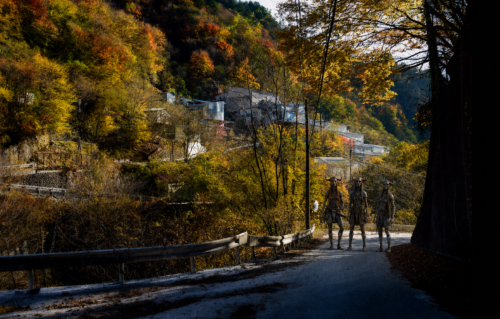
Three of them occupied the road ahead, a fair distance off.
Perhaps thirty meters uphill where the concrete stair road widened briefly beside an old apartment entrance drowned in vines.
And further above, nearly hidden among the layered hanging structures, another figure watched from a suspended platform half obscured behind moving curtains of reflective tape.
Time became a strange new thing onto itself, a new player in this strange stage. It wasn’t a drama, or a cinematic event. It wasn’t even exciting, or particularly revelatory. It was not frightening any more. The mind itself added time, and infused processing and duration. His mind began measuring time differently.
A fly landed briefly on the back of his wrist and crawled through sweat hairs before lifting away again. Somewhere nearby a loose metal strip clicked rhythmically in the breeze. Insects screamed continuously from the trees. Sunlight shifted a few centimeters along the retaining wall beside him.
Minutes passed. Or perhaps only one minute. The human nervous system, Haneto reflected distantly, was not truly designed for sustained confrontation with the fundamentally unknown. It preferred resolution quickly. Fight. Flee. Dismiss. Reclassify. The brain wanted movement toward certainty because certainty preserved energy.
Yet nothing here moved toward certainty.
The three beings stood quietly in the road with complete composure. Not threatening. Not submissive. Not curious in the frantic animal sense either. Secure. That was the word. Secure in themselves. Secure in the situation. Secure in their understanding of him.
And because Haneto was neither stupid nor young anymore, he understood immediately that this security revealed something important and perhaps frightening.
They knew precisely what was happening. He studied his own thoughts carefully as they arose.
Fear existed, certainly. His heart beat harder than normal. His mouth remained dry despite the heat. Muscles across his shoulders held tension ready for sudden motion. But beneath those ordinary biological reactions another process unfolded, slower and stranger.
His brain was attempting to humanize them, but by any standard they were distinctly not that category, and he could feel this causing his mind to malfunction subtly. The eyes first.
The mind seized immediately upon the eyes because eyes were interpretable. Large reflective eyes suggested emotion, attention, awareness. Then posture. The slight head tilts. The arrangement of limbs. Clothing. Ornamentation. The mind grabbed these details greedily because they provided bridges toward familiarity.
Anthropomorphism was not stupidity. It was survival.
Human cognition evolved specifically to map intention rapidly onto ambiguous forms. Faces in darkness. Emotion in body language. Threat in posture. The brain would rather mistakenly perceive personhood than overlook it.
Haneto understood all this intellectually while simultaneously experiencing it emotionally.
He noticed himself assigning personalities already.
The tallest of the three — almost two meters perhaps, extraordinarily thin but not fragile-looking — carried itself with stillness suggesting authority. Another shifted weight constantly between digitigrade legs with subtle restless energy almost playful in quality. The third watched with unnerving concentration, upper hands folded loosely together while the lower pair adjusted tiny hanging objects attached to braided cords across its chest.
Yet Haneto knew these impressions might be nonsense. Entirely projected.
The beings before him could possess emotional structures completely unlike anything human beings recognized. Their expressions might not even correspond to emotional states in the mammalian sense. Perhaps the slight upward movement near the eyes meant aggression. Perhaps stillness indicated fear. Perhaps the restless shifting represented calculation rather than nervousness.
Human beings consistently mistook octopus behavior for curiosity because curiosity was the nearest available translation.
He almost laughed aloud at the absurdity of the thought.
Standing in an abandoned mining town while calmly analyzing the cognitive mechanics of first contact.
His own composure surprised him slightly.
But then again, panic required a certain kind of personality. Younger men often believed courage meant emotional intensity controlled through force of will. Haneto had learned something different over decades alone in mountains, ruins, hospitals, bureaucracies, funerals, and slowly collapsing places. The mind became calmer sometimes not because danger lessened but because reality eventually exceeded available reactions.
What exactly was he supposed to do here? Scream? Run downhill? Toward whom?
Toward what explanation?
He was sixty-nine years old in an abandoned mountain town surrounded by impossible beings inhabiting recursive alien architecture assembled from Japanese ruins and obsolete electronics. The situation had already escaped ordinary emotional categories.
So he observed instead, briefly thought about memoires and movie rights and grimaced. That, too, was survival.
The creatures remained motionless except for tiny independent hand movements. Their four arms fascinated him increasingly now that he saw them clearly in full daylight. The lower pair operated with extraordinary unconscious dexterity, continuously adjusting straps, cords, small objects, bits of hanging decoration. The upper arms seemed more communicative somehow — slower, expressive, balancing posture subtly.
Their skin carried those same flowing symmetrical patterns he had glimpsed earlier beneath filtered light. Blues, ash-gray, pale rose, soft violet. Not markings applied onto skin but integrated within it organically. The patterns became finer around joints and throat regions, almost impossibly intricate near the face.
Backward-curving horns swept elegantly from the skulls. Horns had connotations but that was not in any way applicable here. But it was not strictly speaking of the animal kingdom either. No animal had a limb placement of this particular structe.
This was sophisticated, functional, aesthetic.
Their clothing hung in layers of straps, wraps, scavenged technical fabrics, woven materials, dangling devices, old electronics modified beyond recognizable function. One wore what appeared to be fragments of several portable cassette players integrated directly into chest harnesses. Another carried braided cords threaded with tiny lenses and polished bits of circuit board that flashed softly in the sunlight.
And behind them Nichitsu climbed upward transformed almost beyond recognition.
Moving fabrics. Suspended spiral structures. Shimmering hanging curtains. Bridges between terraces. Color everywhere.
The town itself seemed alive around them now that he understood what he was looking at. Tiny movements revealed hidden occupation continuously. Shadows withdrawing. Reflections shifting. Brief glimpses of pale figures observing from balconies and platforms high above.
They were everywhere. There must be thousands here. This was essentially colonization and that was a dizzying situation. Japan was as a country depopulating. That was a very strange phenomenon, humiliating at a coarse level. To the have something use that in an expedient manner was .. almost a relief? To not have so much Japan cadaverously rotting empty was a relief?
The three before him were representatives only. Haneto was Japan, OF Japan. This around him was of his world of his past, but was left fallow, abandoned. Him being self-appointed caretaker, he felt a shame, a pride, a lonely role as ambassador, yet underwhelming.
The rest watched from the architecture of his inadequacy to the irony of where all this past and future collided, small Haneto in the middle. He had to really convince himself emotionally he was not considered intruder. He know rationally. He had to feel it. That realization arrived quietly but changed everything.
If they considered him dangerous, territorial behavior have manifested long ago. Hidden observation. Defensive positioning. Withdrawal. Displays of intimidation. Weapons. Threat display. Prancing.
But these creatures were ready for this and had been for some time.
Not passive neutrality – Confident neutrality, almost courteous.
One of the tall figures exhanged some words with the others and walked away not looking back. He or she or it was going to go do other things that needed doing, ‘this was under control’. Sounds from around tittered. There was conversation around. Information exchange.
Haneto experienced an odd fleeting sensation then, impossible to fully articulate even to himself.
Not that he was being judged.
There would be events
His muscles ached. He reached in his bag, set down and drank two cans Pocari Sweat, burping hard. He realized he started shaking. It took a while to get that under control.
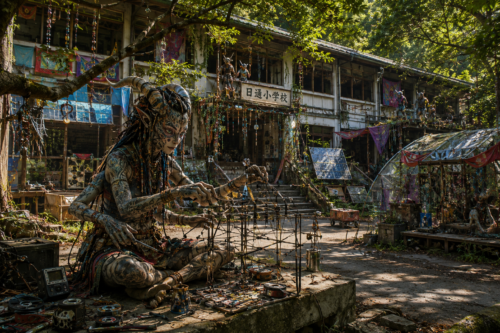
The school had become the center of everything.
Not politically perhaps, if such distinctions even existed among them, but biologically, socially, architecturally. The entire upper district seemed to breathe outward from the old concrete buildings beneath the cedars. The classrooms, gymnasium, rooftop gardens, assembly halls, maintenance sheds, stairwells, and sports grounds had been transformed into layers of habitation so dense and interconnected that Haneto gradually stopped perceiving the place as “occupied” in the human sense. Occupation implied temporary usage. This was adaptation at the level of ecology.
The creatures had settled into the school the way moss settled into stone.
Everywhere he walked he became aware of bodies above him, beside him, hidden behind hanging membranes of cloth and reflective tape and translucent plastic. Some watched him openly. Others ignored him entirely. Occasionally several would pause activity simultaneously and follow him with those large reflective eyes while exchanging rapid clicking whispers between themselves. Yet no obvious authority emerged. No guards. No leaders. No challenge ritual. The atmosphere remained astonishingly calm.
Haneto wandered slowly through the transformed schoolyard beneath brutal white May sunlight while insects screamed from the surrounding trees.
The heat had become oppressive now. Sweat rolled continuously down his neck beneath his collar. His shirt clung damply to his chest and spine. He had long since stopped trying to preserve dignity and simply moved carefully from shade to shade when possible, breathing slowly through the heaviness of the afternoon. The cigarette smell lingering in his clothing seemed increasingly unwelcome.
He noticed that immediately.
The creatures disliked it.
Not dramatically. They did not hiss or retreat in fear. But whenever he lit another cigarette nearby, subtle reactions spread through the surrounding groups almost at once. Heads turned. Bodies shifted away slightly. Conversations paused. Some covered portions of their faces loosely using upper hands or folds of cloth. The nearest ones always relocated eventually with polite visible discomfort.
Sensitive respiratory systems perhaps.
Or simply dislike.
He extinguished the cigarette against concrete after only a few drags and pocketed the butt automatically. Almost immediately several nearby creatures relaxed again and resumed whatever they had been doing.
That, more than anything, began convincing him they were intelligent in a fully ordinary social sense.
Not mystical.
Not symbolic.
Just people.
Alien people.
Haneto studied them continuously now with the intense detached focus of someone whose mind had moved beyond panic into documentation. He had always possessed a natural observational discipline even before age sharpened it further. Years spent alone inspecting abandoned places had trained him to notice patterns before conclusions.
And there were patterns everywhere.
The asymmetry first.
No two bodies appeared fully identical.
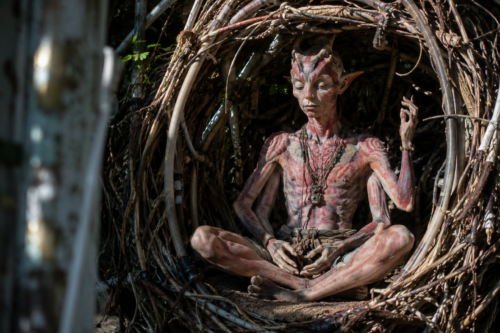 All possessed four arms, but the arrangement varied noticeably. Some carried both secondary arms slightly lower on the right side of the torso, giving their silhouettes an uneven almost crustacean quality. Others mirrored this on the left. A few possessed one secondary arm lower left and another lower right in more balanced configurations.
The differences did not seem pathological and seemed part of species variation.
One creature crouched beneath a suspended woven canopy threading magnetic tape through tiny metal loops possessed enormous upper arms ending in broad six-fingered hands with two partially opposing thumbs. The dexterity was extraordinary. Haneto watched it manipulate several delicate wires simultaneously while lower hands performed entirely separate movements below.

Others possessed more human-seeming hands, the recognizable five fingers although in all cases digits were longer and elegant. In all cases nails were pale and translucent like polished shell.
The eyes varied too.
Most possessed the same large reflective eyes he had already noticed, but some individuals displayed noticeably larger proportions, especially among smaller-bodied creatures moving through the upper hanging structures. Their skull shapes differed subtly as well. Broader faces. Narrower jaws. Horn placement variations.
Sex remained difficult to gauge.
The creatures wore layered clothing continuously and modestly, though not prudishly. Bodies remained partially visible through straps and hanging fabrics, but reproductive anatomy was consistently obscured. Haneto nevertheless developed the strong impression that they were mammalian or at least convergently close to mammalian forms. Chest structures varied subtly between individuals. Hips and torsos differed. Yet the distinctions felt frustratingly ambiguous because his brain continually attempted forcing familiar sexual dimorphism onto bodies evolved according to entirely different pressures.
He eventually stopped trying to categorize male and female directly.
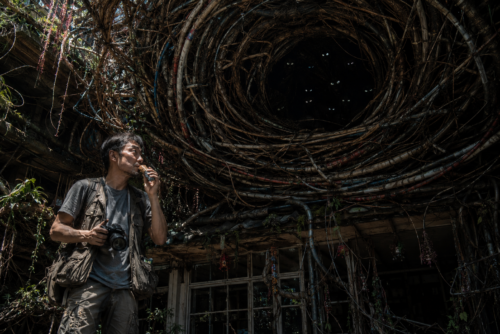
Instead he noticed social clustering. Certain individuals moved together repeatedly. Certain sleeping groups remained stable. Certain body types appeared more physically affectionate toward one another.
And everywhere there were the nests. Braided suspended nests hung throughout the school complex in astonishing numbers. Some resembled giant woven baskets suspended from ceilings and scaffolding. Others occupied corners of classrooms or shaded portions of rooftop gardens. Most were assembled from layers of fabric, magnetic tape, synthetic fibers, stripped electrical cable insulation, woven plastic strips, dried grasses, and softer scavenged materials Haneto could not identify immediately.
Many contained sleeping bodies. Dozens. Perhaps hundreds throughout the school. These nests smelled… hypnotic. Not repugnant but not automatically pleasant either. Musky but not mammalian. A bit like candy left in the sun. The creatures slept communally in dense huddled groups astonishingly similar to litters of cats or clusters of otters. Bodies tangled together comfortably. They seemed to have grooming behaviour. Limbs draped across one another. Horns resting against shoulders. Some nests held five or six sleeping forms while others contained enormous layered communal masses half hidden beneath hanging fabrics and reflective curtains.
The atmosphere around these sleeping clusters remained deeply domestic. Quiet, warm, smelly and protective.
Haneto never saw something he would describe as young children. That disturbed him in a different way than the creatures themselves. He saw smaller individuals certainly, but none possessed the clumsy proportions or uncontrolled behavior of human children. No infants. No toddlers. No visible parenting behavior. No toys in the human sense. The entire settlement seemed composed almost entirely of adolescents and adults.
Several explanations occurred to him naturally.
Perhaps they reproduced slowly, and the statistical percentage of children was so small that they had only a few – so they kept them were hidden elsewhere deliberately. Perhaps maturation occurred differently.
Or perhaps the creatures did not emerge into existence through childhood at all. The thought of these creatures being fundamentally alien, despite the superficial human qualities lingered unpleasantly in his mind while he wandered deeper into the transformed school buildings.
The classrooms had become workshops, gardens, sleeping areas, communal storage chambers, and strange artistic laboratories impossible to classify cleanly. Yet despite the overwhelming alienness of the settlement, much of their daily activity appeared practical.
They repaired or played with things continuously – Not restoration… active repurposing.
The creatures collected electronics obsessively. Everywhere Haneto looked he found piles of obsolete human technology sorted into dense organized assemblages. Old cassette players. Radios. CRT television components. Camera bodies. Game consoles. Portable CD players. Pager parts. Hard drives. Keyboards. Laptop shells. Wiring harnesses. Batteries. Tiny motors. Solar calculators. Tamagotchis. Headphones. Film canisters. They had stripped bare a Burusera vending machine and installed it full of clusters of pagers and washing machine parts and an inside out church organ wired to what appeared to be the control system of a traffic light, long abandoned in the 1980s. It seemed they didn’t just collect trash from the immediate area. They were gathering from a wider area. A much wider area. He saw a partially disassembled Sony PlayStation 5 Pro, a PlayStation VR2 and a what was left of an arcade fight stick. One of them was wearing the carcass of a VAIO SX series ultralight business laptop. He saw several disassembled Sony Xperia 1 VIs. Those are items you wouldn’t casually encounter in Chichibu.
Tables overflowed with carefully disassembled components categorized into woven trays and hanging racks. Creatures worked there continuously using astonishing manual dexterity. Four hands moving independently while eyes reflected shifting colored light from overhead membranes.
Yet they showed remarkably little interest in books.
That struck Haneto almost immediately. They just dumped all books in some upstairs classroom in piles, to use as nesting material. Textbooks still lined shelves gathering dust while electronic debris accumulated everywhere around them. Some books had been repurposed structurally or artistically, pages woven into hanging sculptures or folded into layered insulation materials, but no evidence suggested reading behavior. He never once observed a creature studying text.
Likewise televisions. The school still contained several working CRT sets powered intermittently through elaborate solar systems and rewired battery banks. None displayed broadcasts. Instead the screens emitted strange abstract patterns. Oscillating lines. Slow pulses. Fields of shifting color. Some connected directly into hanging wire sculptures suspended throughout darkened classrooms. Magnetic tape webs threaded through motors and spinning assemblies linked physically into circuit boards and speakers and tiny powered components. Art perhaps….. or communication of some sort? Or sensory structures functioning according to principles Haneto could not remotely grasp.
The computer equipment fascinated him most.
There were no functioning conventional computers anywhere he could see. No internet infrastructure. No keyboards in use. No visible interest in networks, screens, software, or human information systems.
And yet components absolutely worked, and unerringly so.
Certain rooms hummed softly with powered systems assembled from stripped computer parts. Hard drive platters rotated slowly inside hanging transparent housings. Tiny LEDs blinked within woven sculptures suspended from ceilings. Processor heat sinks protruded from organic-looking structures threaded through with magnetic tape and copper wire.
One entire classroom had become a forest of hanging strings connected to tiny motors and powered boards. Reflective discs rotated in precise rhythms while hidden speakers emitted faint harmonic drones almost below hearing. Creatures moved through the installation constantly adjusting tensions and connections with ritual concentration. Haneto stood there for nearly twenty minutes sweating silently in the dim green light trying to understand what he was seeing.
Not computers.
Not machines exactly either.
Environmental systems perhaps.
Sensory architecture.
The creatures seemed intensely interested in vibration, motion, reflection, airflow, tension, resonance, and magnetic material. Their sculptures were rarely static. Everything moved slightly. Spun. Trembled. Whispered. Chimed. Flickered.
The entire school had become an enormous living instrument.
And moving through it all, the creatures continued largely ignoring him.
That perhaps unsettled him more deeply than hostility would have.
They acknowledged him certainly. They tracked his movement. If he approached too closely toward sleeping clusters or private spaces, nearby individuals gently repositioned themselves between him and the area without aggression. Occasionally several would emit soft clicking sounds clearly intended as warnings.
But they never treated him as prey.
Never as enemy.
Simply as a large clumsy foreign animal wandering carefully through their settlement.
An old man smelling unpleasantly of cigarettes and human heat.
Haneto paused finally beneath the shaded overhang outside the old music room while high overhead hanging magnetic webs whispered softly in the wind.
All around him Nichitsu breathed with new life.
Not human life.
Something stranger.
Something careful.
And watching the creatures drift through the transformed school in layered groups beneath curtains of reflective tape and woven electronics, Haneto realized with growing certainty that humanity had not discovered them here.
Humanity had abandoned this place first.
And only afterward had something else quietly moved in.
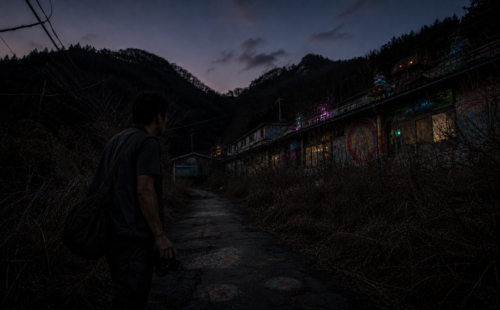
A pronounced diurnal shift arrived gradually enough that Haneto almost convinced himself at first that it was only darkness changing his interpretation of things, but this proved not the case. The beings had a dinstinctive day-night cycle and there was a pronounced attitude shift in the creatures themselves after sunset.
The laissez fair tolerance of daytime evaporated in favor of a tendency to skulk and circle. The motions paired with the sheen of the eyes was unnerving. Hostility at least acknowledged conflict openly. This felt instinctive, encompassing. As though nighttime activated an entirely different layer of behavior beneath the social tolerance they had shown him during the afternoon, in favor or urgency.
The school no longer felt communal after dark. The school became a hard to define haunted zone.
Haneto noticed it primarily in the eye contact.
During the day the creatures had watched him directly, openly, with demi-parental patience. Now they rarely looked straight at him. Their attention moved laterally instead. Side glances. Reflections. Eyes catching light from oblique angles before disappearing again. Bodies repositioned around him continuously without approaching too closely. They werent as nuch chasing or harrying but there was clearly in implied impetus at work here. It was a guidance.
Without ever touching him, they slowly began controlling where he stood.
One would emerge casually from shadow behind him while another occupied the stairwell ahead. Others crossed rooftops overhead or paused briefly beside paths he intended taking. They never blocked him openly. They simply made certain directions feel wrong. They even smelled different. Not exactly urine, but more animal. And steadily, subtly, the available space around him narrowed toward the lower terraces. It felt as if the territorial constraint was now like a river that causally led towards His domain and that was the inside of his van.
A younger man wouldn’t, might not have gotten it, Haneto understood the message with growing clarity, and his daylight privileges had been rescinded.
The creatures themselves had changed physically too, or perhaps merely behaviorally. Their movements became stranger in darkness. Faster in short bursts but interrupted by long periods of gargoyle stillness. The huge eyes reflected reddish light now from strange angles like nocturnal animals caught in weak headlights. Not many visible at once. Two here. One above a balcony. Three clustered together deep inside hanging structures.
The transformed buildings glowed faintly throughout the settlement with weird low-level illumination. Not bright enough to attract attention from far away — no passing aircraft would think anything unusual lived here — but enough to reveal structure. Tiny LEDs buried inside woven sculptures. Bioluminescent tubes hanging from braided nets. Soft electric blues and pinks moving beneath translucent fabrics. The entire upper district pulsed dimly like reef organisms beneath deep water.
Haneto packed hurriedly.
His ankle had begun hurting badly on the uneven stairs and darkness made every descent feel dangerous. Several times he nearly stumbled while stuffing equipment into bags too quickly. Sweat chilled against his back now despite the warm night air.
Falling back into human instinct he checked his phone halfway down the terraces beneath an abandoned streetlight. Full bars, not somehow zero connection materializated – not weak connection, nothing.
The phone hesitated strangely each time it attempted transmitting before silently failing again. No messages. No data. No emergency access. This made no sense whatsoever
Haneto stood motionless listening to the mountains. The Creatures didnt talk at night. They didn’t like like during the day. No playtime. Then somewhere uphill he heard singing.
But it was not actually singing. This was distinctive mimcry behavior. His little van radio still played faintly in the darkness below — some old American pop song drifting upward through humid mountain air. Female vocals. Bright synthetic harmonies. And from somewhere among the rooftops came a birdlike imitation, a falsification. It wasnt as much an echo… it was hard to put into words. It was Kylie Monique, but a bit off. The melody bent wrong in places. Rhythm slipped unpredictably. Several voices copied different parts simultaneously without fully understanding beat structure. Yet the tune remained recognizable enough to make the hairs rise slowly on Haneto’s arms.
Another joined from further away. Then another. The creatures were mimicking the song. It wasn’t some kind of sarcasm, it was instinctive. They were like birds actively echoing a repetetive noise. Like birds echoing chainsaws or ringtones. Haneto stopped breathing for a moment as the mountain settlement answered his innucuous whitegirlmusic radio with warped nocturnal echoes. Then the mimicry shifted.
Bird calls. Animal sounds.
Fragments of melody woven into things almost natural but not quite. The entire dark settlement had become acoustically alive around him. Not loud, but present, relatively subtle. He was no stranger to the woods so he picked it up. He reached automatically toward the bear spray clipped inside his equipment bag and stopped himself immediately.
That was a really bad idea.
Everything about the creatures suggested sudden aggression would be a particularly bad idea. He knew that with absolute certainty despite having no evidence whatsoever. The beings were not predators exactly, but nighttime belonged to them in ways daylight had concealed.
So Haneto cramped his hand resisting fear, clenched and waddled against the ache in his foot, arriving at the van, opening it and falling in. Lights on. Breathing long. Music louder. His. He realized how foul the van stank. He would really need to clean it. It smelled awful.
Haneto woke with pain already waiting for him.
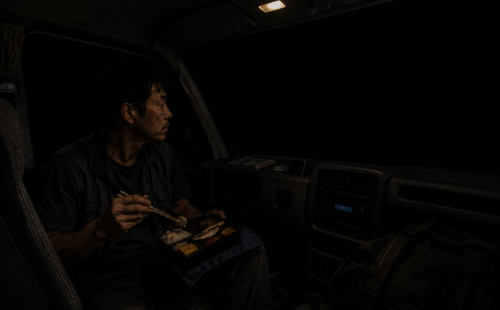
Not dramatic pain. Nothing catastrophic. Just the layered accumulated soreness of age, humidity, tension, and sleeping half-curled inside a kei van seat designed for men twenty years younger and twenty kilograms lighter. His ankle burned dully. One shoulder had gone stiff. His neck felt packed with gravel. For several seconds after opening his eyes he did not remember where he was, only that something felt profoundly wrong outside the thin metal walls around him.
Then the tapping came again.
Soft.
Careful.
Tok. Tok tok.
Haneto jerked awake fully.
Morning light already filled the windshield in pale mountain gold. The van interior smelled faintly of cold fish oil from last night’s bento, sweat, old upholstery, and damp forest air creeping through cracked seals. His radio had died sometime during the night. The dashboard clock blinked uselessly.
Tok tok.
He turned slowly toward the passenger window.
Five of them stood outside.
Not looming.
Waiting.
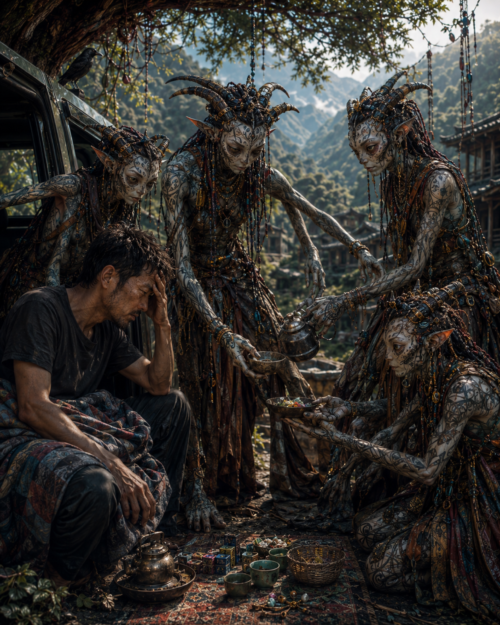
The tallest leaned slightly forward with upper hands folded loosely together while one lower hand rested against the glass where it had tapped gently. Morning sunlight filtered through cedar branches overhead, moving across patterned skin in shifting fragments of pale blue and red and soft violet. Their huge eyes looked almost ordinary again in daylight.
Not ordinary.
Less nocturnal.
Haneto realized immediately that the terror of the previous night had receded from them completely.
Daylight creatures again.
One tilted its head slightly and smiled.
Not mimicry.
Not the strange uncertain approximations of human expression he had seen yesterday.
A real smile.
Small.
Warm. Haneto stared for several seconds before unlocking the van door.
The committee — because that was unmistakably what they felt like now — stepped back politely to give him room. They carried bundles and trays and woven containers suspended from straps across their bodies. One smaller individual with asymmetrical lower arms on the left side shifted excitedly from foot to foot while another watched him with grave concentration as if evaluating his condition carefully.
Haneto climbed out slowly, wincing as his ankle took weight.
Immediately one of them emitted a soft concerned clicking sound.
Another extended a small woven cup toward him. Warm liquid inside.
Sweet.
Floral.
Haneto hesitated only briefly before drinking.
It tasted extraordinary.
Something between herbal tea and fruit nectar and cold mountain water. Familiar components arranged according to entirely unfamiliar logic. He realized suddenly how hungry he was.
The creatures brightened visibly.
Not triumphantly, but rather instrumentally practical… Breakfast waited next to the van as a politely portioned offering.
Haneto sat cross-legged awkwardly next to his van while the creatures arranged themselves around him in relaxed positions impossible for human joints. Food appeared from woven containers and hanging satchels.
Bright soft pastries wrapped in leaves, Little translucent cubes tasting faintly of citrus and mint, Sweet fermented fruit, Strange braided doughs filled with warm paste resembling chestnut and sesame but somehow sharper, Tiny roasted vegetables lacquered with syrup, Nothing tasted bad, Everything tasted slightly wrong.
Human ingredients translated through alien priorities.
The creatures observed. And slowly, over the next hour, Haneto realized they sort of conducting a ritual process of polite diplomatic atonement – not the words, but a fairly emphatically cogent display of gestures and smiles. They had refused to actually speak Japanese. Instead meaning emerged through gesture, posture, mimicry, offerings, pauses.
There was never as much communication happening. There seemed no acknowledgement or desire to convey. They knew he was pressured last night and apparently been nervous, agitated. They had inferred and had come to a conclusion that this meant his visit to their domain was over, and functionally that the village and surrounding countryside of Nichitsu was their territory, their rules. Previous events had been not orchestrated but happened in a series of impulses and this here nowas apparently some kind of collective policy. Yesterday was ok, it was tolerated, you were tolerated, the camera was tolerated, now here’s some food and drink, it’s time to go.
Shoo.
The clarity and practicality of it impressed Haneto. These beings were not in any way threatened by the Japanese society and they wouldn’t be at some future date.
Humans wasted enormous energy obscuring boundaries emotionally. Endless hedging. Social ambiguity. Passive aggression. The creatures operated on both a higher baseline of instinct, a lower baseline and possibly a wide range of emotion – and conceivably a wider intellectual capability. It was not clear if he’d been a like a cat wandering into a house, or a diplomatic envoy, or a bum, or something completely other. He’d been partially and most the time out of control, they never. At night they simply operated at a different register, but that humans didnt have the ability to function within that framework wouldn’t be their problem.
The six were all he saw. No others seemed to show interest or appear. There were some gifts. They brought him a few dozen gifts – tiny woven sculptures threaded with magnetic tape ribbon… braided charms made from copper wire and polished stones… little hanging mobiles assembled from translucent plastics and bits of circuitry… a beautifully balanced wind-spinner made from old camera shutter blades…. amall intricate knots impossible for human fingers to replicate….
These would be quite valuable to collectors at some point and they were breaktakingly beautiful, but other than artistic value he assumed to them their could very well be beads and mirrors. Yes they could be keepsakes, personal artefacts, well intentioned gifts of a well meaning intent, but he wouldn’t bet his life on it.
One individual spent five minutes carefully attaching a tiny woven charm to the zipper of Haneto’s equipment bag. It was effort. The goodbye stretched almost three hours. They still didn’t like his cigarettes.
It was clear. He put his repair gear in the van. Their wandered off some twenty meters and were standing there not looking at him directly, seemingly indecisive, not acknowledging the process of departure, but not just leaving either. Making certain all went expediently. By the time he started the engine only three remained visible, and were watching. They didn’t like cars either.
As he drove slowly downhill through Nichitsu for the last time, they had all disappeared.
The line stayed quiet for several seconds after Haneto finished speaking except for the sound of breathing and distant television noise somewhere inside his friend’s apartment. Not silence exactly. Processing. The kind that only exists between people who have known each other long enough to recognize when performance has disappeared from a voice completely.
Haneto sat on the guardrail beside the road above Arakawaniegawa with the bottle hanging loose between two fingers. Morning sunlight had already become harsh and metallic on the asphalt. Trucks occasionally passed somewhere far below in the valley, invisible behind the trees. The mountains seemed offensively ordinary now. Green slopes. Telephone poles. Heat haze above the road. A crow hopping through weeds near a drainage ditch.
Inside the van, on the passenger seat, the camera remained powered on.
Hundreds of photographs.
Not blurred nonsense. Not dream logic. Not the vague abstractions of hallucination. Detailed images. Metadata. Light values. Focus depth. Faces. Architecture. Objects casting shadows at mathematically consistent angles. The creatures looking directly into the lens with calm awareness.
Haneto had spent nearly forty minutes parked beside the road trying to disprove himself.
At first he assumed exhaustion. Heatstroke maybe. A psychotic break. Early dementia. Some alcohol-triggered neurological collapse arriving late in life after years of abuse he had mostly survived through stubbornness and luck. He had sat there scrolling image after image with increasing nausea waiting for reality to reassert itself.
But reality refused.
The photographs persisted.
Every time he reopened the files they remained identical.
He had zoomed into details compulsively: reflections in metal surfaces, individual fibers woven through hanging structures, fingerprints in dust, serial numbers on scavenged electronics, condensation on cups, insect wings caught in sunlight beside alien skin patterning. The images held together under scrutiny in ways dreams never did.
At one point he actually whispered aloud:
“No no no no…”
Like repetition itself might loosen the world back into recognizable shape.
Instead he had smoked.
One cigarette became another and another until his throat felt chemically flayed raw. He bought more cigarettes in Yamada almost automatically, barely remembering entering the convenience store. The cashier had thanked him normally. The receipt printed normally. Pop music played overhead normally. Two high school girls argued near the refrigerators about something involving an idol group. The ordinariness of it nearly made him panic.
Then came the bottle.
Cheap whisky from Arakawaniegawa because his hands would not stop shaking.
He had not even intended to drink immediately. He had told himself it was precautionary. Stabilization. Something for later after thinking carefully.
Instead he sat beside the road under the impossible blue sky and emptied nearly half of it in less than an hour.
And still the photographs remained.
His friend finally spoke.
“Haneto.”
A pause.
“You’re scaring me.”
Haneto rubbed his face hard with one hand. His skin felt hot and gritty. He had not shaved in two days. He became suddenly aware that he probably smelled terrible even alone beside the road.
“I know.”
“You sound…” The friend stopped. Restarted carefully. “You sound like when Emi left.”
That stung more than expected.
Haneto stared out toward the mountains.
“When Emi left I was angry,” he said quietly. “This is different.”
Another silence.
Then:
“Did you hurt somebody?”
“No.”
“Did somebody hurt you?”
Haneto looked instinctively toward the van again.
Toward the camera.
Toward the woven charm still attached carefully to the zipper of his equipment bag.
“No.”
“Then what happened?”
Haneto laughed once.
A dry broken sound with no humor inside it.
“That is exactly the problem.”
Wind moved softly through the roadside grass. Somewhere overhead electrical lines hummed faintly in the heat. His friend waited without interrupting.
Thirty years.
That mattered.
Most friendships dissolved eventually into maintenance rituals. Drinking companions. Holiday calls. Occasional funerals. But some people remained connected through accumulated witness alone. This friend had known Haneto through bankruptcy, divorce, drinking, recovery, his daughter refusing to speak to him for nearly five years, his mother’s slow death in the hospital, the humiliating subcontractor jobs after the ministry downsizing, all of it.
And because of that history, Haneto understood something important.
The man on the other end of the line knew exactly how serious this tone actually was.
“I need you to listen carefully,” Haneto said.
“All right.”
“I am not asking you to believe me.”
“Okay.”
“I don’t even believe me.”
Another pause.
“But?”
Haneto closed his eyes.
“But responsible adults do not get to choose reality based on comfort.”
The whisky rolled unpleasantly inside his stomach.
“I saw something,” he continued. “And if it is real… if it is real, then this becomes bigger than me immediately.”
His friend inhaled slowly through his teeth.
“What kind of something?”
Haneto almost answered.
The words rose physically into his throat.
Creatures.
A settlement.
Nonhuman intelligence.
Occupation.
First contact.
Instead he looked again toward the mountains and felt a sudden powerful certainty that speaking plainly would make everything worse somehow. Not superstitiously. Practically.
Language would solidify it.
Once described aloud in concrete terms the situation would immediately become medical, criminal, military, or absurd. Perhaps all four simultaneously.
And none of those categories felt correct.
So he said the only honest thing available.
“If I tell you specifically,” Haneto murmured, “you will think I’ve had a complete psychological collapse.”
His friend did not respond immediately.
Then, very softly:
“Have you?”
Haneto considered the question seriously.
Not defensively.
Not emotionally.
Seriously.
The possibility remained entirely real.
Brains failed. Human perception failed constantly. Entire interior worlds unraveled every day inside otherwise functional people. He knew this. He respected it. Pride had killed many men faster than illness.
But then again—
The photographs.
The metadata.
The objects.
The charm.
The smell still lingering inside the van.
The memory of the tea.
The mimicry in the dark.
The impossible architecture breathing in mountain wind.
“No,” Haneto said at last.
And then after a moment:
“At least not in any way that explains the evidence.”
His friend exhaled very slowly.
“What are you going to do?”
Haneto stared down at the bottle in his hand.
“I think I have a civic obligation.”
“That sounds ominous.”
“It is ominous.”
“You really mean police?”
“Yes.”
“Jesus Christ.”
Haneto nodded unconsciously.
“Yes.”
“And you think people are in danger?”
Haneto thought carefully before answering.
That was the important question.
Were people in danger?
Not immediately.
Not actively.
The creatures had shown restraint so consistent and deliberate it bordered on ethical discipline. They had tolerated him for hours. Fed him. Escorted him out peacefully. They had opportunities to harm him constantly and had avoided escalation every single time.
But that was not the same thing as safety.
A tiger resting calmly beside a road remained a tiger.
And the beings in Nichitsu were not animals.
Which made them potentially far more dangerous.
Not because they were hostile.
Because they were intelligent.
“They are territorial,” Haneto said quietly.
The word slipped out before he could stop it.
His friend caught it instantly.
“They?”
Haneto closed his eyes.
Too late now.
“Yes.”
Long silence.
When the friend spoke again his voice had changed subtly. More careful now. More alert.
“Haneto… what exactly did you find?”
Far down the valley a siren wailed briefly and disappeared.
Haneto watched heat shimmer above the guardrail.
Finally he said:
“I found something living in the spaces we abandoned.”
And neither man spoke for a very long time after that.
Hazo did not answer immediately. Haneto could hear him breathing faintly through the phone, a tiny hiss of static riding beneath the connection. Somewhere in the background a train announcement echoed metallically, muffled by distance. Hazo must have stepped outside. Good. That meant he understood instinctively that this conversation had crossed into different territory already.
Haneto sat heavily against the guardrail and wiped sweat from his upper lip with the back of his hand. The whisky had turned sour in his stomach now. The mountains around him seemed too bright. Too detailed. Every cedar branch looked sharpened against the sky.
Finally Hazo spoke.
“You’re threatening me now?”
“No.” Haneto looked at the camera again through the van windshield. “I’m warning you honestly.”
“That sounds insane.”
“I know.”
“You think the police are going to quarantine people because you took some weird photographs in the mountains?”
Haneto closed his eyes briefly.
“No. I think if the photographs are authentic, then there are exactly two possibilities. Either I am profoundly mentally ill in a way sophisticated enough to fabricate physical evidence…” He swallowed. “Or Japan currently contains something that absolutely should not exist.”
The line went silent again.
Haneto could almost feel Hazo trying to reconstruct him psychologically from thirty years of memory.
Not a conspiracy man.
Not mystical.
Not dramatic.
Haneto was the sort of person who argued about drainage systems and paid taxes early and carried emergency blankets in his van because mountain roads were dangerous in winter. The most irrational thing he had done in decades was continue caring about abandoned places long after everyone else stopped.
Which made this harder.
If a stranger said these things, Hazo would laugh and hang up.
But Haneto did not speak this way.
Ever.
“Hazo,” he said quietly, “yesterday morning I was inspecting retaining walls.”
“And now?”
Haneto looked out toward the valley.
“And now I don’t know what species means anymore.”
A truck roared somewhere along the lower road and faded away.
Hazo spoke more softly this time.
“What did they look like?”
Haneto’s pulse jumped immediately at the word they.
Not disbelief anymore.
Not fully.
Just enough belief to become dangerous.
Haneto answered carefully.
“That is exactly why I should not show you the photographs.”
“You already told me too much.”
“No.” Haneto shook his head slowly. “No, words are safer. Words stay abstract. Your brain protects itself with words.”
“And pictures don’t?”
Haneto laughed once under his breath.
“No.”
He could still remember the first real close image he had reviewed inside the van. Not the distant silhouettes or the half-hidden faces between hanging ribbons. The clear daylight photograph near the school terrace. Four arms. The eyes. The asymmetrical anatomy. One lower hand holding some impossible little woven electronic object while another adjusted hanging strips of magnetic tape behind it.
The image had not looked cinematic.
That was the horror.
It looked documentary.
Real things in real sunlight.
“You know what frightened me most?” Haneto murmured.
“What?”
“They were not frightening.”
Hazo said nothing.
“That’s what broke my mind,” Haneto continued. “If they had been monsters… if they screamed or attacked or behaved like animals… it would fit somewhere. But they behaved like…” He stopped himself.
“Like what?”
Haneto stared at the road.
“Residents.”
That word hung between them.
Residents.
Not invaders.
Not apparitions.
Not visitors.
Residents.
Hazo exhaled slowly through his nose.
“Jesus Christ.”
“Yes.”
“And you’re serious about going to the police?”
“I think I must.”
“You think they’ll believe you?”
“No.”
“Then why go?”
Haneto rubbed his face hard again.
“Because if I disappear in three weeks after sitting on this information, there needs to be a record that I attempted responsible disclosure.”
That finally startled Hazo properly.
“Disappear?”
“I am speaking hypothetically.”
“That’s not a normal hypothetical!”
Haneto suddenly sounded tired even to himself.
“Hazo. Listen carefully to me.”
The wind shifted softly through roadside grass.
“I spent nearly a full day walking through an occupied settlement containing entities unknown to science.” He paused. “They tolerated me. Fed me. Removed me peacefully. That does not make the situation safe.”
“You think they’re dangerous.”
“I think they are intelligent.”
Another silence.
That one landed heavier.
Because both men understood instinctively that intelligence changed the equation completely.
Animals could be managed.
Intelligence created politics.
Intentions.
Boundaries.
Unknown capabilities.
Hazo finally gave a weak nervous laugh.
“You realize if this is true we’re both already sounding insane.”
Haneto nodded unconsciously.
“Yes.”
“And if it isn’t true…”
“Then I need medical intervention immediately.”
That honesty seemed to steady the conversation slightly.
Hazo muttered something under his breath Haneto couldn’t catch.
Then:
“You really won’t show me?”
Haneto looked again toward the camera on the passenger seat.
He imagined handing the photographs over.
Watching Hazo’s face.
The exact moment disbelief failed.
The exact moment another human being crossed the same invisible line he had crossed alone beside the road.
And worse—
The possibility that the images themselves constituted evidence already beyond civilian possession. Not legally perhaps. Conceptually.
If these things became real publicly, then the photographs ceased being photographs. They became state material instantly. Scientific material. Military material. Historical material.
He suddenly imagined anonymous men calmly confiscating hard drives while apologizing politely.
The thought made his stomach tighten.
“Hazo,” he said quietly, “if I show you these pictures, then you become part of this.”
“I already am part of this.”
“No. Right now you can still decide I’m having a breakdown.”
“And if I see them?”
Haneto looked toward the mountains one final time.
The same mountains where the creatures were probably moving through hanging structures beneath daylight right now, entirely unconcerned.
“Then,” he said softly, “you will know the world is larger and stranger than it was yesterday morning.”
The line remained silent for a very long time after that.