2035: The Netherlands Discovers That “Water Management” Was Not a Personality Trait
By 2035, things had gone off the rails in a way we all, apparently, completely didn’t see coming.
Which is strange, because it had been coming for decades. Quietly. Politely. In the reports. In the insurance models. In the municipal footnotes. In the small print no one read because the brochure said “future-proof living” and the render had children, reeds, and one tastefully ethnically diverse cyclist.
But by 2035 the fantasy had curdled.
Western Europe was hotter, wetter, more violent, and more expensive to protect. The Netherlands, still very much attached to the idea that it was a clever little amphibious republic of engineers and consensus, had discovered the nasty difference between technically possible and financially insurable.
The storms got worse first.
Not cinematic apocalypse storms, not Hollywood walls of water, not cows flying past the church tower. Worse: boring, regular, actuarial storms. Storms that tore roof tiles loose. Storms that drove rain sideways through renovated facades. Storms that flooded basements three times in five years. Storms that turned “occasional nuisance water” into “structural asset impairment.”
By 2030, the look of Dutch towns had changed.
Metal gridwork appeared on buildings everywhere. Braced facades. Reinforced shutters. Storm rails. Flood lips. Mechanical barriers. Public buildings got them first, then shops, then apartment blocks, then the sort of private homes whose owners still insisted this was all “overblown” while quietly spending €38,000 on retractable flood plates and roof anchors.
It gave whole neighborhoods the faint atmosphere of a tasteful open-air prison.
You could still live in low-lying, exposed, cheap real estate. Of course you could. This was the free market. Nobody was going to stop you.
Go right ahead.
Try getting a mortgage.
Try getting insurance.
Try selling.
By the early 2030s, that was the real disaster. Not that the water had arrived everywhere at once, but that belief had left first. Insurance withdrew, banks followed, buyers vanished, and the market performed that elegant little ritual capitalism does when it discovers a corpse in the portfolio: it repriced reality.
People who bought houses in 2025 in places like Cortelandse or Rijnenburg had been happy. Relieved, even. They had a home. Something with a garden. A future. A foothold in a housing market that had spent twenty years humiliating anyone under forty.
For a few years, it worked.
Then, around 2029, the letters came.
The insurance company would not renew.
Not because the house had flooded. Not yet. Not because there had been a single defining catastrophe. But because the updated risk model had changed, and the updated risk model did not care about your nursery, your mortgage, your divorce, your parents’ loan, or the fact that the estate agent had called it “climate adaptive.”
Then came the government position, wrapped in calm administrative prose:
In the event of flooding, evacuation assistance would be provided. Emergency shelter would be provided. Rescue coordination would be provided.
Reimbursement?
No.
Compensation?
Not guaranteed.
Restoration?
Your responsibility.
In plain Dutch: we’ll get you out, but we won’t make you whole.
That was when people understood.
You were not buying a house anymore. You were buying a countdown timer with floor heating.
By 2033, the numbers had become grotesque. In Zuidplas, parts of which sit around 6.76 meters below NAP, you could buy a 300-square-meter villa that once would have gone for more than two million euros for about €1.1 million.
That sounds like a lot, until you adjust for the madness between 2026 and 2033: inflation, financing costs, construction costs, insurance scarcity, and the fact that secure housing elsewhere had become a luxury asset class. In real terms, that villa had fallen toward the psychological equivalent of €500,000.
A mansion discount.
A drowning discount.
A “good luck explaining this to your children” discount.
The owners were underwater in more ways than one.
And then came the heat.
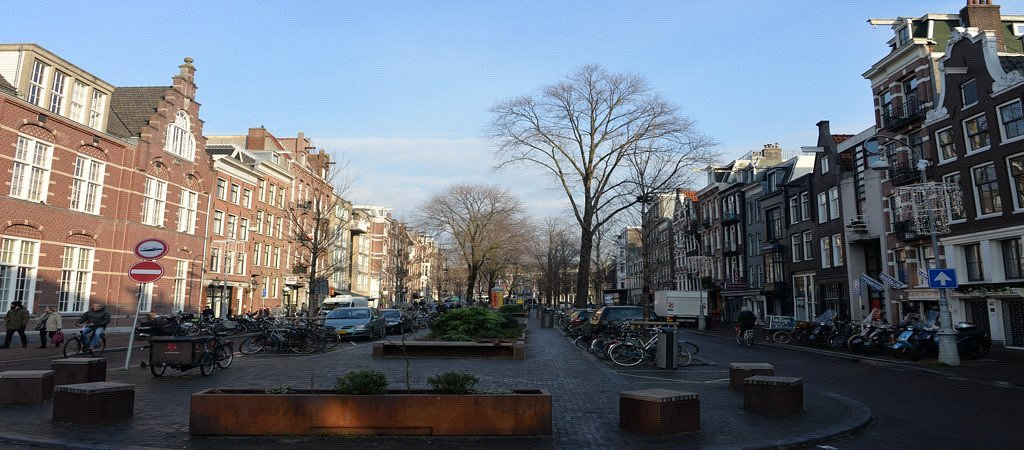
Elandgracht in 2026
Because water was only half the story. Water got the dramatic maps. Water got the blue overlays and the minister in boots. Water got the Delta speeches.
Heat got the bodies.
The summer of 2034 was vicious.
The official count was 25,000 heat-related deaths across the Netherlands, though everyone knew the number was massaged downward by categories. Cardiac failure. Respiratory collapse. Renal failure. Complications. Elderly. Isolated. Pre-existing conditions.
Heat did not kill them, officially.
Heat merely entered the room, locked the door, and waited.
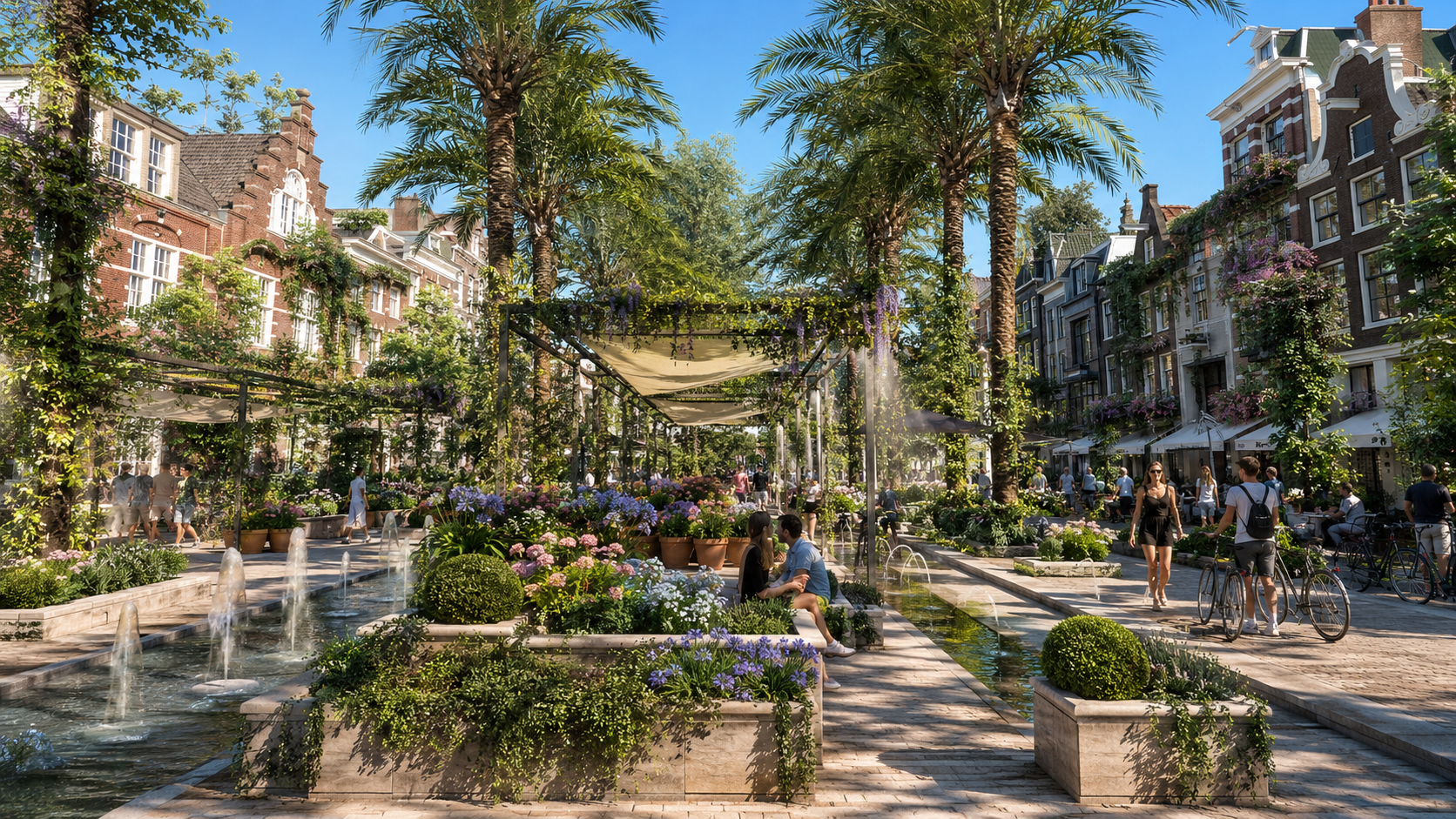
Elandgracht in 2031
There were twelve days over 42 degrees Celsius.
Twelve.
The old language collapsed. “Tropical day” had become a museum term from the era when 30 degrees still sounded like a holiday. By the early 2030s, the new operational threshold was 31 degrees, because anything lower no longer separated discomfort from danger.
In 2034, the Netherlands had sixty such days.
Sixty tropical days.
Not in Málaga. Not in Phoenix. Not in some cursed speculative climate fiction where canals boiled and tourists evaporated.
Here.
Rotterdam. Utrecht. Amsterdam. Eindhoven. Groningen, pretending for a while that being northern would save it. It did not.
The first adaptation was denial. The second was air conditioning. The third was grid failure.
By 2032, every municipality had a heat plan. By 2034, everyone knew heat plans were what governments wrote when they lacked money, authority, and the courage to say: some of these places should not be lived in like this anymore.
Schools closed. Then reopened. Then closed again. Exams moved. Construction shifted to night schedules. Delivery riders became an ethical scandal for about seven minutes until everyone ordered dinner anyway. Hospitals installed external misting corridors. Care homes begged families to take elderly relatives home during heat peaks, which was darkly funny because home was often worse.
The rich adapted vertically.
The poor adapted biologically.
Rooftop gardens became class markers. Shade became rent. Courtyard access became a selling point. North-facing bedrooms came back into fashion. Apartments were advertised by their maximum indoor temperature during a 40-degree day, like energy labels but for survival.
The old real-estate hierarchy inverted in strange ways. A small, shaded, upper-floor apartment in a dense pre-war neighborhood with trees, water, and district cooling could outperform a suburban villa with a sun-blasted garden and an uninsurable basement.
The word “garden” itself split in two.
There were decorative gardens, which died.
And there were survival gardens: shaded, wet, layered, biodiverse, evaporative, mosquito-managed, fish-stocked, vine-draped, canopy-covered microclimates designed not for beauty but for human persistence.
Amsterdam changed fastest where it had no choice.
Traffic was pushed out of streets that had already become heat trenches. Asphalt was ripped up. Parking vanished, finally defeated not by ideology but by thermodynamics. Former car lanes became water surfaces, reed beds, sunken walkways, bike paths under shade cloth, emergency cooling routes, and neighborhood refuges.
The city rediscovered the medieval street not as nostalgia, but as climate infrastructure: narrowness, shade, water, mass, shelter, slowness.
The new prestige was enclosure.
Not open plazas. Those had become frying pans. Not wide boulevards, unless they had tree vaults and water. The new dream was the sunken winding garden: half canal, half botanical trench, a cool public interior between buildings. Palms grew flush against facades. Vines climbed brickwork. Canopies extended from upper floors like sails over a ship. Water moved slowly below, full of reeds, fish, and engineered mosquito controls. The rich called it Mediterranean. The planners called it blue-green adaptation. The elderly simply called it bearable.
Everyone copied Le Plessis-Robinson, badly at first, then obsessively.
Not the architecture exactly. The philosophy. The theatrical abundance. The idea that urban space should feel not like a diagram but like a place that has decided to seduce you into staying alive.
By 2036, the Netherlands still functioned. Some parts were even becoming pretty awesome.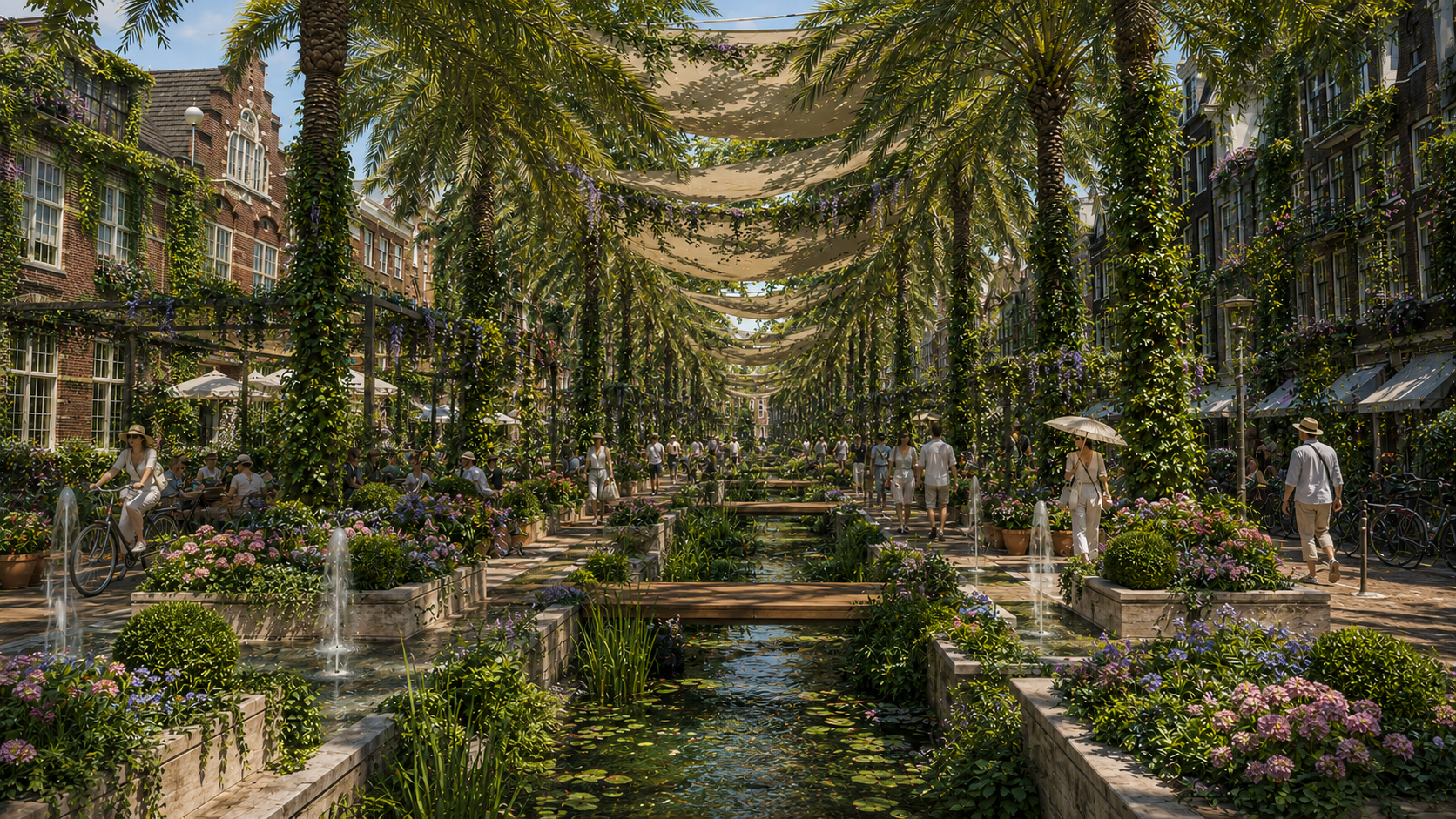
Elandgracht in 2036
That was the unnerving part.
The trains ran badly but ran. The supermarkets opened. The elections happened. The arguments continued. The country did not collapse. Instead, it became two countries occupying the same map.
One was protected, shaded, financed, insurable, reinforced, and cooled.
The other was technically legal to inhabit.
That was the phrase people learned to fear.
Technically legal.
Technically legal to own.
Technically legal to rent.
Technically legal to build in.
Technically legal to remain.
Technically legal, but not mortgageable. Not insurable. Not sellable except at a ruinous discount. Not protected beyond evacuation. Not part of the future, except as a warning that still had a postcode.
And perhaps the most Dutch thing about the whole catastrophe was that no one announced the abandonment.
There was no dramatic line on a map. No prime minister on television saying: this neighborhood is sacrificed. No national moment of truth.
Just policy documents.
Premium increases.
Mortgage refusals.
Infrastructure delays.
Risk categories.
Municipal silence.
And finally, the most devastating sentence in late-stage climate capitalism:
The market has already priced this in.