A Short Definitional Article for a Long-Running Problem, A definitional note on shells, death-management, and modern power
Definition
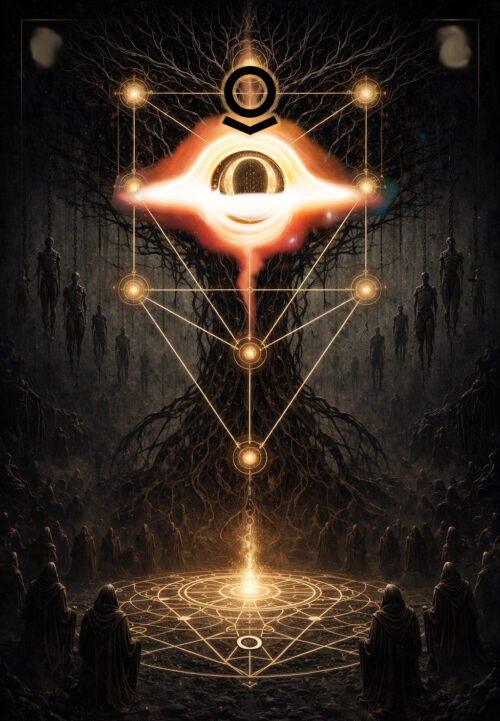
Qlipolitics is a mode of governance in which social, moral, and institutional forms persist after their life-giving substance has been hollowed out, and are repurposed to manage populations through grievance, stimulation, abstraction, and controlled instability rather than genuine human flourishing. It describes not the open destruction of life, but something more ambiguous and, in many ways, more unsettling: the continuation of systems that still look alive, still speak in the language of life, yet increasingly fail to sustain the conditions that make life meaningful, relational, and coherent.
The term draws on the concept of the Qliphoth, a notion from Kabbalistic cosmology. In that tradition, the Tree of Life represents the ordered flow of divine vitality into structured existence, a system in which energy, meaning, and form remain aligned. The Qliphoth, by contrast, are the “shells” or “husks” that emerge when that flow is broken. They are not simply empty containers; they are the distorted residues of what once held life, now separated from its source. They occupy a kind of inverted or abyssal mirror of the Tree, sometimes described as a realm of fragmentation, excess, imbalance, and spiritual stunting. What defines them is not absence but misalignment: form without sustaining energy, structure without living coherence. Applied to politics, Qlipolitics names systems that have undergone a similar inversion. Institutions, values, and narratives remain visible and authoritative, but the animating substance that once justified them has thinned, curdled, or been replaced by extractive or compensatory mechanisms.
In this sense, Qlipolitics can be understood as an extension of the concept of necropolitics, most prominently articulated by Achille Mbembe. Necropolitics describes the power to decide who may live and who must die, or more broadly, who is subjected to conditions of abandonment, exposure, or slow death. Qlipolitics does not replace this framework but builds upon it. Where necropolitics governs through death or the threat of death, Qlipolitics governs through the maintenance of life in degraded form. It does not necessarily expel populations from the system; rather, it keeps them inside, but under conditions that are increasingly unstable, anxious, fragmented, and stripped of depth. It is the politics of continuity without vitality, of survival without meaningful integration.
This dynamic becomes more intelligible when placed alongside the work of Peter Turchin, particularly his analysis of structural-demographic cycles. Turchin argues that societies undergo recurring phases of expansion, stagnation, and crisis driven by factors such as elite overproduction, declining real wages, rising inequality, and increasing competition for status and resources. As these pressures accumulate, institutions lose legitimacy, social trust declines, and political systems become more volatile and conflict-prone. What Qlipolitics adds to this picture is a description of the qualitative experience of such late-stage conditions. It captures how institutions, rather than collapsing outright, often persist in a hollowed state, compensating for their declining effectiveness by intensifying rhetoric, symbolic gestures, and mechanisms of control. The system continues to operate, but increasingly as a shell that manages tensions rather than resolving them.
Within this framework, movements associated with QAnon and elements of the broader MAGA ecosystem can be seen as particularly vivid expressions of qlipolitical dynamics. In these contexts, the language of truth, nation, family, and moral order is not abandoned but amplified. At the same time, the relationship between that language and lived reality becomes progressively unstable. Truth becomes a matter of participatory speculation, an ongoing process of decoding rather than verification. Community forms around shared vigilance and suspicion rather than mutual support. Political identity becomes tied to a sense of perpetual crisis that resists resolution, because resolution would dissolve the emotional and social structures that have formed around it. The system sustains itself through intensity rather than coherence, through activation rather than repair.
What emerges is not simply misinformation, but a kind of symbolic ecosystem in which forms are preserved and circulated independently of their original grounding. The experience can feel meaningful, even profound, to participants, precisely because it mobilizes deep human needs for belonging, significance, and orientation. Yet these needs are not integrated into stable or life-sustaining structures. Instead, they are routed into loops of interpretation, reaction, and reaffirmation. In this sense, Qlipolitics operates less as a breakdown of meaning than as a proliferation of displaced meaning, a condition in which symbolic intensity increases as practical coherence declines.
At the same time, qlipolitical dynamics are not confined to populist or conspiratorial environments. They are equally visible in highly technocratic systems, where the hollowing process takes on a different, more abstract form. In such contexts, the individual is increasingly rendered as a data object, a set of measurable behaviors and predicted tendencies. Platforms and institutions built around large-scale data analytics, including those associated with firms such as Palantir, exemplify a shift toward governance through visibility, prediction, and control. The language here is not one of grievance but of optimization, efficiency, and security. Yet the underlying transformation is analogous. Human life is translated into metrics, relationships into signals, and social order into patterns of compliance and deviation.
This process finds an even clearer, if often simplified, illustration in discussions of social credit systems, particularly in the Chinese context. While the reality of such systems is complex and frequently misrepresented, the underlying concept remains instructive. Social value becomes something that can be externally assigned, tracked, and adjusted through rewards and penalties. Trust, which in a living system emerges from repeated interaction and shared norms, is partially replaced by quantified reputation. Identity becomes increasingly legible to institutions, and behavior becomes increasingly shaped by that legibility. Again, the outer form of social order is maintained, but the internal experience shifts toward instrumentalization. The system does not necessarily collapse; it becomes more precise, more stable, and, at the same time, more detached from unquantified aspects of human life.
Across these different domains, a common pattern becomes visible. Whether driven by grievance and symbolic intensity or by data and managerial abstraction, Qlipolitics involves the decoupling of form from substance. Institutions continue to function, narratives continue to circulate, and individuals continue to participate, but the alignment between these elements weakens. The result is a society that remains active and structured, yet increasingly struggles to produce trust, stability, and meaningful continuity.
What makes Qlipolitics difficult to recognize is precisely this persistence. It does not present itself as collapse or failure. It presents itself as normality, often accompanied by heightened rhetoric about values, identity, or progress. The shells are convincing because they are inherited from living systems. They retain their shape, their language, and their emotional resonance. What changes is the underlying capacity to sustain the realities they signify.
In this sense, Qlipolitics names a condition that standard political vocabulary only partially captures. It is not reducible to corruption, propaganda, or authoritarianism, though it may include elements of all three. It describes a more diffuse and systemic transformation, one in which the mechanisms of governance adapt to declining coherence by preserving appearances and managing instability rather than restoring underlying conditions. It is the politics of a system that continues to function, even as the relationship between its forms and the life they are meant to organize becomes increasingly strained.
The concept ultimately points to a specific and unsettling possibility: that societies do not always fail by breaking apart, but can instead continue in a state of structured depletion, where the forms of life remain visible and operative, even as their capacity to sustain human flourishing quietly erodes.