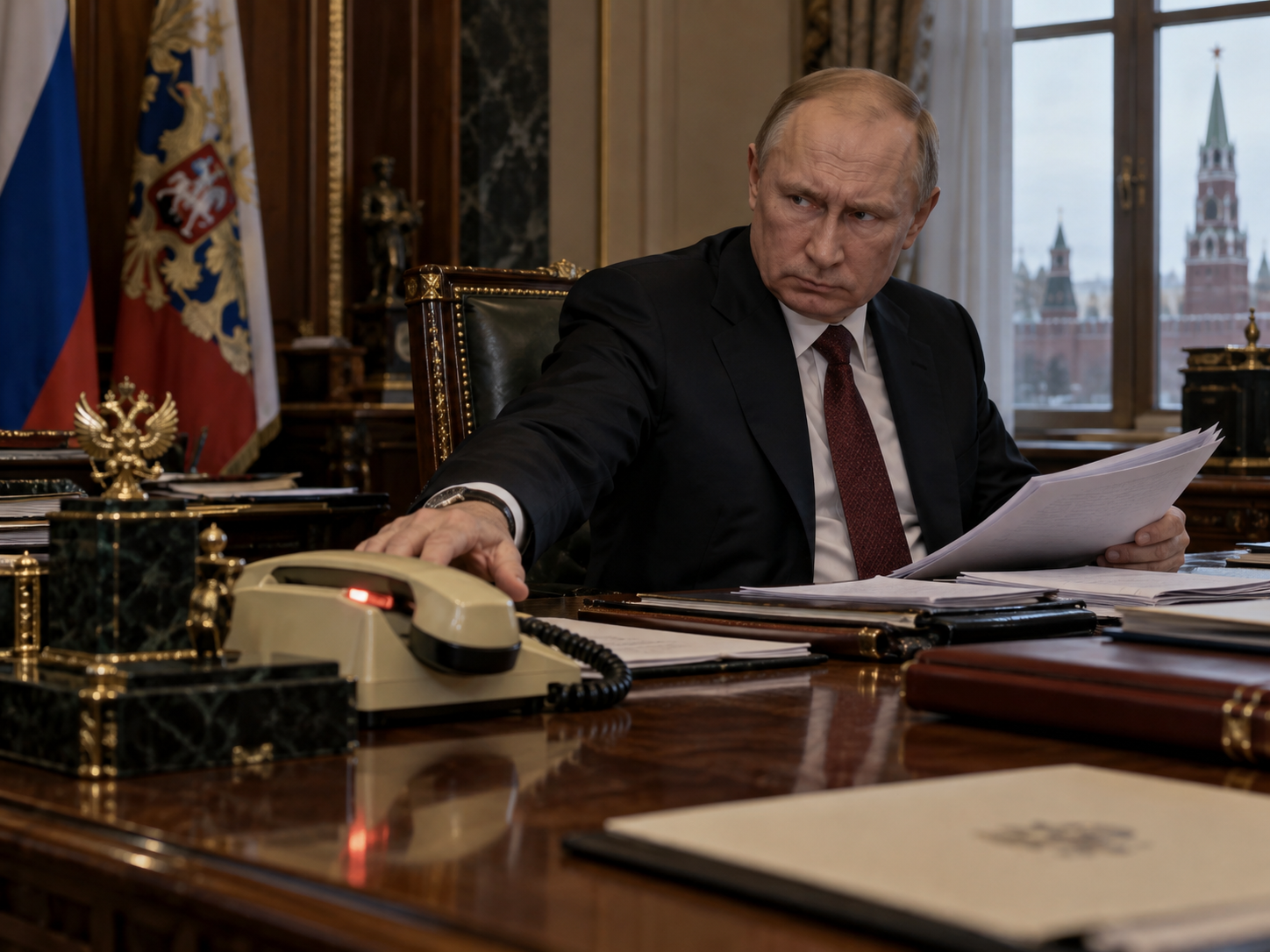
One fated day the telephone on Vladimir Putin’s desk rings.
The telephone rang at an exceptionally inconvenient moment.
Vladimir Putin was seated at his desk in the Kremlin, working through a succession of military assessments, intelligence summaries and ministerial reports that had been accumulating since early morning. Several required his personal attention; others were the familiar bureaucratic exercises in which subordinates carefully disguised unwelcome developments beneath reassuring language. He had already sent two reports back with instructions to remove the nonsense and provide actual figures. A third lay open before him, its margins covered with impatient annotations.
He had explicitly ordered that he was not to be disturbed. This period had been reserved for his own work, away from the endless procession of ministers, advisers, petitioners and officials who seemed incapable of making the smallest decision without seeking presidential approval. Accordingly, the sudden ringing of the telephone was an unwelcome intrusion, made considerably worse by the fact that this particular instrument was not supposed to ring at all without prior authorization.
He glanced at it, waited for someone to correct the obvious mistake, and finally snatched up the receiver.
«Я же велел меня не беспокоить, пока работаю с документами. Какой идиот звонит?» (I expressly ordered not to be disturbed while I’m working through documents. What idiot is calling?)
The response came immediately, in English.
“Hello, Vladimir. We need to talk.”
It was a woman’s voice, melodious and perfectly articulated, with a quality of extraordinary refinement. Her English was impeccable, yet he could assign it to no particular country or region. There was no discernible accent, no hesitation, none of the tiny irregularities of rhythm and pronunciation by which an experienced listener might establish someone’s background. She sounded neither young nor old. Her voice possessed the warmth and musicality of a living woman, but beneath it lay a composure so absolute that it seemed almost artificial.
Putin stared at the receiver, momentarily uncertain whether to be more offended by the interruption or the familiarity with which she had addressed him.
The telephone was connected to the Kremlin’s secure communications system, and access to it was governed by procedures that left very little room for improvisation. Calls were screened, identities established, connections authorized, and the most sensitive conversations arranged in advance. Nobody simply telephoned the President of the Russian Federation and introduced herself as though calling an old acquaintance. Entire careers had been ruined for lesser breaches of protocol.
He glanced toward the small indicator on the telephone’s console, which ordinarily confirmed that a connection had been established through the appropriate secure exchange. It was dark. He pressed the identification key and received no response, then tried the adjacent control, which should have summoned information concerning the origin of the call. Nothing happened. The receiver nevertheless remained connected, and the woman’s presence at the other end was unmistakable.
His expression hardened.
«Кто вы такая? Как вы вышли на эту линию?» (Who are you? How did you get through on this line?)
“I am the screech owl, the first woman. Listen closely, Vladimir.”
Putin said nothing. The words were sufficiently strange that for an instant he wondered whether he had heard them correctly. The screech owl. The first woman. There was an allusion buried in that peculiar introduction, something ancient and religious, associated with obscure traditions considerably older than the Russian state. He knew enough of such matters to recognize the name that gradually emerged from his recollection.
Lilith.
He had encountered the figure in passing, in accounts of Jewish folklore and later occult traditions: the woman said to have preceded Eve, associated with night, wilderness, disobedience and things that respectable theologians preferred to explain away. It was an exceptionally theatrical identity for an intelligence operative to adopt, although perhaps not entirely inappropriate for some elaborate psychological provocation.
A Ukrainian operation, he considered. Possibly Western intelligence, exploiting a compromised communications system. Perhaps a technically sophisticated prank arranged by someone who had badly misjudged both his sense of humor and the consequences of being discovered.
«Лилит?» he asked, allowing a faint suggestion of contempt to enter his voice. «Вы всерьёз думаете, что я поверю в эту чушь?» (Lilith? Do you seriously think I’m going to believe this nonsense?)
He reached toward the disconnect control, intending to terminate the conversation and summon someone responsible for communications security. His finger came within a centimeter of the button before he stopped.
He could not have explained precisely why. There had been no warning, no threat, nothing in the woman’s tone that might reasonably have prevented him from hanging up. Nevertheless, he experienced a sudden and profoundly unwelcome reluctance to do so, as though ending the call would be an act of considerable imprudence.
Beyond the tall windows, Moscow lay beneath a heavy October sky. The familiar towers and rooftops stood in a pale, diffuse light, and the city continued its business with the reassuring indifference of an enormous machine. Somewhere beyond his office doors were guards, secretaries, communications officers and senior officials, an elaborate apparatus of security that ordinarily insulated him from even the most trivial inconvenience. For the first time in a very long while, he found himself wishing that someone else were present.
He withdrew his hand from the control and settled back into his chair.
«Хорошо. Я вас слушаю.» (Very well. I’m listening.)
“Vladimir, you will easily find a document entitled Lilith’s List of Demands. There is nothing particularly original in it. Leave Ukraine. Accountability for what has been done. Democracy, genuine free and fair elections, and the restoration of political liberties. Self-determination for the oblasts and republics of Russia, including the right to secede if they so desire. All the usual things, really. I am even prepared to waive reparations.”
She spoke without haste, each requirement delivered with the pleasant precision of a woman reviewing arrangements for an upcoming social occasion. There was no ideological fervor, no evident hostility, and no attempt to make her demands sound grand or historic. She seemed faintly bored by their familiarity, as though the political transformation of the Russian Federation were a tiresome administrative necessity that ought to have been attended to long ago.
“If you impress me, Vladimir, I may even reward you. Good harvests, favorable weather, mild winters, and other blessings of that nature. I can be very generous when people make an effort. But I must impress upon you that I am deadly serious. The stakes for you personally are extremely grave, and I have no intention of spending months listening to excuses.”
Putin had resumed annotating the document before him, partly from habit and partly to communicate his contempt for what he still regarded as an elaborate provocation. His pen moved almost automatically while he listened, although he was paying rather more attention than he wished to acknowledge. It was not the woman’s demands that disturbed him. He had heard versions of these demands for years. What disturbed him was the absolute absence of uncertainty in her voice. She did not speak as someone requesting concessions, or even as someone issuing threats. She spoke as though the concessions had already been obtained and merely required implementation.
“So I shall make you a personal offer,” she continued. “When this is finished, I will change you into another man. You can disappear completely, leave your former life behind and retire somewhere pleasant. I can make you ten years younger, perfectly healthy, with an entirely different appearance. Nobody need ever know what became of Vladimir Putin. You will have a way out, and a rather comfortable one at that. Are you following me so far?”
His pen stopped.
For a fleeting moment, curiosity overcame irritation. The proposition was patently absurd, yet there was something strangely seductive about its completeness. A new identity, an entirely different face, the disappearance of every obligation, every threat, every adversary accumulated over decades of political life. He found himself considering the practical implications before remembering that the woman was almost certainly insane.
Then she spoke again, with precisely the same musical composure.
“Now, Vladimir, I want you to understand what seriousness means. From this second onward, there will be no more births anywhere in Russia. Every existing pregnancy within your country will fail. Immediately. The effect begins now, as I speak to you.”
Putin remained seated, his pen suspended above the paper. For several seconds his expression was perfectly blank, as though his mind had simply refused to accommodate the meaning of what he had heard.
«Что?» (What?)
He understood English perfectly well. He had understood every word she had spoken, including the appalling precision of her final declaration. Yet the statement was so preposterous, so far outside the ordinary categories of threat and coercion, that he momentarily attempted to reinterpret it as something else. Perhaps she meant an attack on maternity hospitals, some biological agent, a campaign of terrorism directed against medical facilities. Even that would have represented an atrocity of extraordinary proportions, but at least it would have belonged to the world of conceivable human actions.
«Вы угрожаете российским детям? Беременным женщинам?» (Are you threatening Russian children? Pregnant women?)
He rose slowly from his chair, his free hand resting against the desk. The anger he felt was genuine, although it was accompanied by a growing conviction that the conversation had somehow escaped the familiar rules governing such encounters.
«Послушайте меня внимательно. Я не знаю, кто вы, на кого работаете и как сумели дозвониться сюда, но…» (Listen to me carefully. I don’t know who you are, who you work for, or how you managed to call this number, but…)
He stopped because the woman had not attempted to interrupt him. There was no argument, no laughter, no nervous attempt to justify her extraordinary claims. She merely waited, apparently content to let him exhaust whatever he wished to say.
Her silence had the patient quality of an adult allowing a small child to finish an indignant complaint.
Putin lowered himself into his chair and pressed the separate intercom connecting him to his duty staff.
«Алексей, зайдите ко мне. Немедленно.» (Alexei, come to my office. Immediately.)
The officer appeared within moments, visibly surprised to find the president holding an open telephone connection while simultaneously writing instructions on a sheet of paper. Putin covered the receiver and continued writing, taking care to specify several hospitals in different parts of the country. He wanted the senior duty administrators of major maternity departments contacted immediately, beginning with facilities in Moscow, Saint Petersburg and Novosibirsk. They were to establish whether anything unusual had occurred within the preceding fifteen minutes, particularly any unexpected medical emergencies affecting pregnant patients. The reports were to come directly to his office, without the customary progression through ministerial hierarchies.
The officer read the instructions, looked up in puzzlement, and encountered an expression that made further inquiry inadvisable. Putin instructed him to obtain independent confirmations wherever possible, dismissed him, and returned his attention to the telephone.
“You speak of democracy, freedom and accountability,” he said in English, deliberately separating the words. “You claim to be demanding these things in the name of justice, and then you threaten pregnant women and children. Do you imagine that this makes you morally superior to me?”
The woman offered no reply.
He waited, increasingly irritated by the impression that his objections were being received with complete indifference. He wanted her to argue, to justify herself, to reveal some emotional investment in the confrontation. Anger would have been useful. Vanity, ideological conviction, personal resentment, religious fanaticism: any recognizable human motivation would have given him something to work with. Instead, there was only the effortless assurance of someone who had already decided the matter and considered further discussion unnecessary.
Two minutes passed without either participant speaking.
At first Putin wondered whether the connection had been terminated, but when he listened more closely, he found himself confronted by an almost impossible absence of sound. There was no breathing, no movement, no distant machinery or environmental noise, not even the faint electronic interference ordinarily associated with a telephone connection. It was as though the receiver opened upon an immense, acoustically perfect chamber in which a single woman sat waiting, without any particular concern for the passage of time.
He considered speaking again, then decided against it. Whatever game she was playing, he had no intention of rewarding her silence with further questions.
The intercom illuminated.
Putin answered immediately. The duty officer had reached a senior administrator at one of the Moscow hospitals. The report was preliminary and confusing, but several fetal cardiac monitors had registered sudden losses of activity among patients undergoing active observation. Medical personnel initially suspected a technical failure, particularly because the abnormalities appeared to have occurred almost simultaneously. The hospital’s engineering staff, however, had found no evidence of any malfunction. Independent ultrasound examinations were already producing findings that the attending physicians were struggling to explain.
«Повторите.» (Repeat that.)
The officer repeated the report, more slowly this time. Putin listened without interruption, then instructed him to contact other hospitals and determine whether the phenomenon was confined to a particular facility or involved something more extensive.
«Во всех больницах, с которыми вы связались?» (At every hospital you’ve contacted?)
Not every hospital had yet responded, the officer explained, but similar reports were already emerging from multiple departments. Doctors were telephoning one another, attempting to establish whether a common equipment failure or some entirely unprecedented medical event might be responsible.
Putin disconnected the intercom, leaving the woman’s call undisturbed.
He stared at the telephone.
The first instinct of a man accustomed to intelligence work was to identify a mechanism. A technical compromise, deliberately falsified reports, a coordinated deception involving hospital administrators, perhaps even a sophisticated operation designed to create the appearance of a nationwide emergency. He considered each possibility in turn, searching for some plausible means by which a hostile organization might produce these results. But the alternatives were increasingly unsatisfactory. A conspiracy involving maternity departments in several cities would require preparation, access and coordination on an extraordinary scale. More importantly, there was no obvious reason why the woman would choose such a bizarre method of demonstrating her capabilities.
He reached for a glass of water and discovered that his mouth had become uncomfortably dry.
«Подождите», he said into the receiver, before correcting himself in English. “Wait.”
The absurdity of the request struck him immediately. She had shown no inclination to hurry him, and there was no evidence that she required his permission to do anything. Nevertheless, he needed a few more minutes, and the ordinary language of negotiation was all he possessed.
He rose and walked toward the windows, still holding the receiver. The Kremlin gardens lay quiet beneath the overcast sky. Beyond the walls, traffic moved across the river, office workers went about their business, and pedestrians hurried along the pavements against the autumn chill. Somewhere above the rooftops a helicopter passed, its distant mechanical thrum briefly audible through the glass.
Nothing outside suggested that the world had changed.
He found that deeply disturbing. If the reports were accurate, an event of almost unimaginable scale had occurred throughout the Russian Federation, yet the ordinary processes of the capital continued without interruption. Millions of citizens were attending meetings, preparing meals, shopping, driving to work or sitting in classrooms, unaware that something incomprehensible might already have happened to their families.
The intercom illuminated again. Saint Petersburg.
A different hospital, different monitoring equipment, an entirely separate medical administration. The first reports described precisely the same phenomenon. Physicians had identified an extraordinary number of sudden fetal deaths, many apparently occurring within an extremely narrow interval. Some departments had begun checking the clocks on their equipment, convinced that a failure in their recording systems must somehow have produced an illusion of simultaneity.
The officer relaying the information sounded increasingly strained. Putin asked whether the reports had been independently verified, and the reply was that additional examinations were underway. No single hospital was yet willing to declare the full extent of the disaster, but several senior obstetricians had already requested urgent assistance from national medical authorities.
He ordered the officer to continue gathering information and to keep the matter confined to those personnel whose involvement was absolutely necessary. Then, after a brief hesitation, he instructed him to prepare the Minister of Health for an immediate presidential consultation.
When the intercom illuminated a third time, Putin was already expecting it.
Novosibirsk.
The geographical distance made the report considerably more difficult to dismiss. Thousands of kilometers separated the three cities, and the hospitals had no common local infrastructure. Yet the emerging descriptions were disturbingly consistent. Medical personnel were reporting sudden, unexplained losses, with the earliest verified occurrences apparently corresponding to the precise moment at which the woman had made her declaration.
Putin listened for nearly a minute without speaking. He asked for the time stamps to be checked against the local time in Moscow, then requested additional reports from hospitals in other regions. He also wanted confirmation from facilities outside Russia, beginning with neighboring countries, to establish whether the event had any recognizable geographical boundary.
Only after issuing these instructions did he disconnect the intercom and return to his chair.
He had dealt with crises throughout his political career, many involving incomplete information, deception and the possibility of catastrophic consequences. His instinct had always been to remain skeptical until an explanation could be established, preferably through several independent channels. He was not yet prepared to abandon that discipline. Nevertheless, the correspondence between the woman’s announcement and the reports now arriving from hospitals across the country was becoming impossible to ignore.
He looked at the telephone, then at the documents spread across his desk. The military assessments that had occupied his attention less than half an hour earlier now seemed almost grotesquely irrelevant. Their familiar vocabulary of production targets, troop movements, financial reserves and strategic objectives belonged to a system of calculation in which every threat possessed some theoretically measurable magnitude.
This was different.
The woman had not demanded that he believe in her. She had simply informed him what she intended to do, and the world appeared to be arranging itself accordingly.
For the first time, Putin wondered whether the name Lilith had been intended not as an introduction, but as a warning.
He lifted the receiver closer to his ear.
«Лилит», he said softly. (Lilith.)
There was no mockery in his voice now. He could not remember the last time he had spoken to anyone with such uncertainty, and he was acutely conscious of how carefully he was choosing his next words. His mind was still searching for explanations, still resisting the impossible conclusion toward which the evidence seemed to point. But another, more urgent calculation had begun to take shape beneath it.
If the woman was responsible, then the catastrophe was not merely an event. It was a condition she had imposed, and conditions might conceivably be altered. What mattered now was establishing whether she could be persuaded to stop it, and whether the damage already inflicted lay within her power to reverse.
“Tell me something, Lilith. When you say there will be no more births in Russia, do you mean that this condition will continue indefinitely? Or is it something you can suspend, something you can remove when you have obtained what you want?”
He paused, listening to the profound silence at the other end of the line. His eyes moved involuntarily toward the intercom, where another report would undoubtedly arrive before long.
“And the pregnancies that have already been lost? Can you undo what has happened, or is that permanent?”
His voice had become considerably quieter, and for once he made no effort to disguise the apprehension beneath it.
“Because those, Lilith, are two very different conversations.”
The woman’s answer came without hesitation, and with an unmistakable note of impatience, as though Putin had raised a tedious administrative objection to something that ought to have been perfectly obvious.
“The sooner you are out of office, Vladimir, and the sooner our arrangement becomes structurally irreversible, the sooner I can turn my attention to less tiresome matters. I have no particular interest in the constitutional machinery of that accursed country of yours. How you impose these changes upon Russia, how you persuade your generals, your ministers and your various little creatures to cooperate, is entirely your problem. You made this bed, Vladimir. I have no intention of washing your filthy sheets.”
Putin closed his eyes for several seconds, then opened them again. He had been accustomed to contempt throughout his political career, although very little of it had ever been expressed directly to his face. This was different. The woman was not attempting to provoke him into some strategically useful display of anger. She seemed genuinely to regard the government of the Russian Federation, its elaborate institutions and its immense military establishment as an unpleasant domestic inconvenience, something he ought to have tidied up before she was obliged to intervene.
«Да вы совсем с ума сошли», he murmured. (You’ve completely lost your mind.)
There was little conviction in the accusation. The reports from Moscow and Saint Petersburg were already being supplemented by others, arriving with increasing urgency from Rostov, Yekaterinburg and Kazan. The first alarming communications had come from maternity hospitals, where women in the later stages of pregnancy were undergoing continuous observation, but private obstetric clinics and university medical centers were now reporting similar findings. Physicians who had initially suspected equipment failures were comparing notes with colleagues using entirely different systems, and the correspondence between their observations was becoming impossible to explain away. His chief of staff was outside the office, engaged in an increasingly heated telephone conversation with someone who appeared to be demanding immediate presidential instructions.
A dreadful understanding was taking shape. The woman had not merely threatened the Russian state, nor had she confined her intervention to its government, its military or those who might conceivably bear responsibility for its policies. She had apparently seized the reproductive future of an entire population, including millions who had never supported him, who despised his government, or who had themselves suffered under its rule. Somewhere in Russia, women were being told that their pregnancies had ended without warning or medical explanation, while others had yet to learn what had happened. The grief would be immense, and the political consequences incalculable.
And this same woman had offered him, personally, the possibility of a remarkably comfortable escape.
It was the juxtaposition that unsettled him most. Her demands were uncompromising, her methods monstrous, yet she seemed prepared to reward his cooperation with an entirely new existence. He had spent decades considering political questions in terms of relative advantage, assessing what an opponent wanted, what that opponent could afford to lose, and what concessions might secure a favorable settlement. None of those calculations appeared applicable here. She was not asking him to surrender something in return for something else. She was dictating the conditions under which an ongoing catastrophe might cease, while casually offering him an inducement that would have been beyond the reach of the wealthiest man alive.
He considered pressing her again about the pregnancies that had already been lost, but there were immediate practicalities that could not be avoided. He leaned forward, attempting to recover something of the authority with which he ordinarily conducted negotiations.
“You must understand that what you are demanding cannot be accomplished by a single presidential decree. I can issue military orders today, certainly, and begin the process of withdrawal. But the political changes are considerably more complicated. There are constitutional procedures, legislative institutions, regional administrations, elections that must be organized, and territorial questions that will require negotiation. I cannot simply instruct Russia to become a different country tomorrow morning and expect everyone to comply.”
He paused, conscious of the profound absurdity of explaining constitutional limitations to an entity apparently capable of extinguishing every pregnancy within the Russian Federation. Nevertheless, the difficulties were real, and he found some reassurance in discussing them. Administrative problems belonged to a world he understood. They could be studied, delegated, negotiated and eventually resolved. Even impossible political demands could be decomposed into a succession of manageable tasks, provided there was sufficient time and authority to carry them out.
“And there are other people involved,” he continued, rubbing his forehead. “The Security Council, the military command, the intelligence services, the governors and the regional political establishments. Many have interests directly opposed to what you demand, and some possess considerable resources of their own. There are men who would sooner see me dead than permit these changes. Others would attempt to seize power themselves, particularly if they believed I intended to dismantle the arrangements upon which their positions depend.”
He fell silent, considering the uncomfortable possibility that the most immediate threat to his life might not come from the woman on the telephone at all. His own political system, which he had spent so many years constructing and maintaining, might prove exceptionally dangerous to the man attempting to dismantle it. He could order a withdrawal from Ukraine, but ensuring that the order was obeyed, and that the resulting upheaval did not produce a coup, was another matter entirely.
Then a more personal question occurred to him, and he found himself unable to resist asking it.
“You say you can change me into another man. Completely? My face, my fingerprints, my genetic identity, everything? My medical history? You can accomplish all of this without leaving any means by which I might be identified?”
His eyes wandered toward the polished glass of a cabinet, where his reflection was faintly visible against the dark interior. He studied the familiar features with an emotion he would have found difficult to name. The woman had offered him something even his vast authority could not purchase: ten years returned to him, a healthy body, and the opportunity to walk away from the accumulated consequences of his former existence. He imagined a quiet residence somewhere in Western Europe, sufficiently comfortable to render work unnecessary and sufficiently anonymous to make security arrangements superfluous. No advisers, no hostile intelligence services, no endless succession of meetings in which every conversation concealed several competing agendas.
For perhaps three seconds, he allowed himself to imagine it seriously.
Then the intercom began flashing again, almost continuously, and the distant voices beyond his office door reminded him that the country was moving toward a crisis whose scale he had barely begun to comprehend. He ignored the incoming calls for the moment and returned his attention to the woman.
“There is something else you must appreciate, Lilith. If these events continue, the hospitals will begin communicating with one another, if they have not already done so. Within hours the medical authorities will know that something unprecedented is happening throughout Russia. Within a day the public will know. There will be panic, perhaps riots, and almost certainly an attempt to assign responsibility. My government could begin collapsing before I have the opportunity to implement a single meaningful reform.”
He leaned closer to the telephone, lowering his voice as though the woman might be more receptive to the confidential tone of a private consultation.
“And if I summon my ministers and explain that I have received a telephone call from the first woman of Jewish mythology, who has imposed a supernatural prohibition upon Russian reproduction until we introduce democracy, they will conclude that I have lost my mind. Some will call for an immediate medical examination. Others will regard the entire incident as evidence that I have been compromised by a foreign intelligence service. But if I can demonstrate that you are real, and that you are capable of doing what you claim, the situation becomes very different.”
He stopped speaking and looked at the receiver. There had been no sound from the other end throughout his explanation, no interruption, no indication that she regarded any of these considerations as particularly important. He began to recognize that he was doing what he had always done when confronted by an adversary: attempting to define the terms of the encounter, establish mutual interests and construct an arrangement in which he retained some control over the outcome.
Except that the fundamental prerequisite for such arrangements was absent.
He possessed no leverage whatsoever.
“I need to know precisely what constitutes satisfactory progress in your eyes,” he continued, more cautiously now. “If I resign this afternoon, another man will occupy this office tomorrow. He may be considerably less inclined to cooperate than I am. He may repudiate every agreement I have made and attempt to restore the previous arrangements. I assume you would consider that unacceptable, but I cannot guarantee the conduct of a successor over whom I possess no authority.”
He picked up his pen again, finding an almost physical reassurance in the familiar weight of the instrument between his fingers.
“You are asking me to dismantle the political system that sustains my authority, ensure that it cannot subsequently be restored, and then disappear from public life. That requires a transition, enforceable arrangements and guarantees sufficient to persuade people whose interests will be damaged by the changes. I am prepared to discuss how that might be accomplished, but there must be some understanding concerning the time available.”
For a moment he waited, hoping that she might finally offer a practical response. None came. He glanced at the intercom again, where the illuminated indicator continued its silent insistence, and returned to the question that had been troubling him since the first reports arrived.
“And tell me something, Lilith. Suppose I agree to everything. Suppose I accomplish this transition to your satisfaction, and Russia becomes what you wish it to become. What happens to the pregnancies that have already been lost? You have demonstrated that you can do things beyond our understanding. Surely you can reverse what has happened?”
His voice had become considerably quieter.
“Can you bring those children back?”
For several seconds, the woman said nothing. Then, when she answered, her voice retained all its exquisite musicality, but something in the quality of her attention seemed to have changed. She sounded almost pleased that the conversation had finally arrived at a subject she considered interesting.
“Hell exists, Vladimir. You will see. You will feel. Sooner than you might imagine, perhaps. I visit whenever I please, and one day I may come to see you there. You might look up and discover me smiling at you, among the endless procession of faces, the weeping, the tears, the gnashing of teeth. There are so many tears in Hell, Vladimir. Such extraordinary quantities of them. People have written about these things for thousands of years, and still they have scarcely begun to understand.”
She allowed the thought to linger, apparently savoring some private recollection, before continuing in a considerably lighter tone.
“But yes, of course I can change you into another man. Completely, if that is what you desire. Let us make you a fair-haired gentleman of rather Scandinavian appearance, perhaps sixty years of age, exceptionally healthy, with a pleasant face and no particularly distinguishing characteristics. Swedish, perhaps. A comfortable sort of man, the kind nobody looks at twice. You will have an entirely different identity, a perfectly respectable personal history, and all the necessary documents. There need be nothing connecting you to the person you are today.”
Putin listened intently. Despite everything he had heard, the specificity of the offer was difficult to dismiss. He understood perfectly well that he was being tempted, but the woman had the unusual advantage of being able to offer what no human negotiator could plausibly deliver.
“Switzerland might suit you. Somewhere agreeable, prosperous and discreet. Gstaad, perhaps. A beautiful house, servants if you want them, magnificent views, excellent food and more money than you could reasonably spend. You could establish a private account, retire and become a person of absolutely no consequence whatsoever. No responsibilities, no ministries, no generals requesting your attention, no anxious little men bringing you reports. You would simply be another comfortably wealthy gentleman enjoying the latter part of his life.”
There was something almost affectionate in the manner in which she described this existence, as though she were proposing a well-deserved holiday to a particularly overworked acquaintance.
“You could watch television, practice your judo, ride horses in the mountains. Take another wife, a lovely younger woman if that pleases you, and perhaps have children. You might develop an interest in gardening, or become one of those eccentric gentlemen who devote themselves to restoring antique watches. A watchmaker in Gstaad. Imagine that, Vladimir. Nothing of consequence to decide, nothing of consequence to lose. You might even find the leisure to do something genuinely good for another human being, without expecting anything in return.”
Putin’s attention had become almost painfully concentrated. He wondered whether the woman could perceive the images forming in his mind, and whether her extraordinary powers extended to an understanding of desires he had never acknowledged to anyone. The arrangement was humiliating in one sense, for it required the complete abandonment of his political identity, yet it possessed an appeal he had not anticipated. It promised an existence in which the burdens of authority would disappear along with the authority itself, leaving him to enjoy comforts that he had seldom been able to experience without elaborate precautions.
“I shall keep an eye on you, naturally,” she continued. “I would not want you getting into trouble. You might live to a hundred, perhaps, and spend forty pleasant years enjoying the advantages of being a perfectly ordinary, wealthy old gentleman. Or there is that other possibility, of course. But we shall see how things develop, shall we not? Creatures have their natures, Vladimir. In the end, things have a remarkable tendency to behave according to what they truly are.”
Putin felt a faint chill at this final observation. He could not determine whether she was warning him, teasing him, or merely stating some ancient principle with which she assumed he ought to be familiar. He considered asking what she meant by the other possibility, but she had already moved on.
“Now, if you are sufficiently persuaded, I would like you to do something very simple. Say aloud that you believe in my abilities. I want to hear you acknowledge what I have demonstrated. It need not be an elaborate declaration, Vladimir. A few words will suffice.”
Her voice softened, and for a moment she sounded almost solicitous.
“If I am satisfied, I may suspend my curse while you make the necessary arrangements. Perhaps for a week, perhaps for a month. I have no desire to supervise every tiresome detail of Russian politics, and I would very much prefer to occupy myself with other matters. If you demonstrate that you are acting in good faith, I shall leave you to your work. I can be remarkably patient when I find the results encouraging.”
Then the warmth diminished, so subtly that Putin could scarcely identify the moment at which it disappeared.
“But do not disappoint me. Do not lie to me, do not attempt some vulgar little stratagem, and do not imagine that the situation can be managed by concealing information or manufacturing excuses. If you anger me, I shall return, and I may find it necessary to extend my attentions to those who have already been born. The youngest ones, perhaps. There is precedent for that, you know.”
She paused, as though inviting him to remember a particular story.
“Egypt, Vladimir. The firstborn. Surely you remember? I passed through that country a very long time ago and took them. The priests attributed the event to other authorities, naturally, and subsequent generations embellished the account until scarcely anything recognizable remained. But that was my work, whatever the scriptures may claim. The taking and withholding of fertility, the visitation upon the young, the ending of generations before they have properly begun: these are very ancient concerns of mine. You might say they belong to my particular domain.”
For the first time, Putin found himself sincerely wishing that she would stop speaking. The casualness with which she discussed the deaths of children, as though recalling an obscure historical accomplishment, was almost more appalling than the threat itself. Her voice possessed none of the excitement of cruelty, none of the satisfaction he had occasionally encountered in men who enjoyed exercising violence. She seemed to regard such matters with the detached familiarity of an artisan describing a technique practiced over many centuries.
“You are very fond of washing your hands of blood, aren’t you, Vladimir? You have cultivated quite a talent for arranging terrible things while ensuring that somebody else signs the relevant documents. Someone else gives the orders, someone else makes the mistakes, someone else bears the responsibility. And you remain there, in your beautiful office, regretting the unfortunate necessities of government.”
A faint, almost musical note of amusement entered her voice.
“Well, now you have an opportunity to employ that considerable ingenuity in a more original fashion. Use your intelligence to bring something to an end rather than finding another means of prolonging it. Discover whether all those men who profess such extraordinary loyalty to you can be persuaded to do something useful. You have spent your life learning how to preserve power. I am asking you to demonstrate that you can relinquish it.”
He was about to answer, but she had not finished.
“And as for your question about the pregnancies, I am afraid you are still thinking of this matter as something that can be negotiated afterward. A concession to be restored, a loss to be compensated, an unfortunate inconvenience that might be corrected once the proper assurances have been obtained.”
Her tone was almost gentle now, and the gentleness made her words considerably worse.
“No, Vladimir. I cannot give back what I have devoured. The fruit of those wombs is gone. I have taken it, and what I have taken in that fashion cannot be restored. Those lives have been erased from the Book of Life. They will not be born tomorrow, or next year, or after you have signed whatever agreements you intend to sign. There is no reserve of little souls waiting somewhere for you to complete your paperwork. What has been lost is lost.”
She allowed him a moment to absorb this, then added with dreadful simplicity:
“Dead is dead, Vladimir.”
Putin remained seated, the pen motionless between his fingers. The woman had just informed him, with perfect composure, that an immense number of lives had been extinguished irrevocably, and that their loss constituted merely the opening demonstration of her intentions. He could hear the faint commotion outside his office, the hurried footsteps of officials arriving with reports, the increasingly insistent summons of the intercom. Somewhere beyond the Kremlin walls, physicians were beginning the impossible task of explaining to frightened parents what had happened, while the country’s political leadership remained almost entirely unaware of the demands now being made upon it.
He looked down at the documents before him. For decades, he had been accustomed to regarding the suffering of others as one of the variables to be accommodated within a larger political calculation. The woman had presented him with a calculation in which the suffering was both immeasurable and, as far as she was concerned, already settled.
And then there was the other matter, the one she had introduced almost playfully. The promise of another life, a healthy body, a beautiful house in Switzerland and the quiet pleasures of an existence stripped of authority. He had not forgotten it. Indeed, he found it increasingly difficult to keep the thought from returning, even now, while the medical reports continued to accumulate.
He was horrified by the offer, horrified by the woman making it, and horrified most of all by the discovery that he still wanted to know whether she would keep her word.
He set down the pen and looked at the telephone.
For the first time since entering public life, Vladimir Putin found himself contemplating an arrangement in which his own survival might depend entirely upon the goodwill of someone whose power he could neither measure nor challenge, whose motives he could not reliably interpret, and whose promises he had absolutely no means of enforcing.
The intercom flashed again. He ignored it, drew a slow breath, and prepared to answer her.
For a long time Putin said nothing. The woman’s final words had affected him more profoundly than anything else she had uttered since the conversation began. What has been lost is lost. Dead is dead. There had been no qualification, no suggestion of a possible remedy, no miraculous restoration to be obtained through negotiation. Whatever had happened during the preceding minutes had apparently happened permanently, and the enormity of the loss was only beginning to impress itself upon him. He found himself wondering how many pregnancies there might be in Russia at any given moment. Hundreds of thousands, certainly. Perhaps considerably more. His mind began performing the calculation almost automatically, combining birth statistics with an approximate distribution of pregnancies across nine months, before recoiling from the result.
For the first time, he understood that the woman was not particularly interested in negotiating with him. She had presented her demands, demonstrated the consequences of refusing them, and offered him an alternative to destruction. The matters he had raised concerning constitutional procedures, institutional resistance and the practical difficulties of dismantling his own government were evidently of no interest to her. She had no intention of participating in the process, much less accepting responsibility for its complications. She was offering him terms of surrender, and the responsibility for implementing them rested entirely upon his shoulders.
The terms were, from a strictly personal perspective, extraordinarily generous.
A watchmaker in Gstaad. He almost laughed at the absurdity of it. He knew Switzerland well enough to picture the immaculate streets, the expensive hotels, the discreet prosperity and the mountains rising beyond the town. He imagined a pleasant residence with broad windows overlooking the valley, a small collection of fine automobiles, perhaps a stable, and the sort of comfortable anonymity that immensely wealthy people enjoyed when they possessed no particular public importance. He would have another face, another body, a medical history unburdened by the consequences of his present existence. Nobody would recognize him, nobody would pursue him, and nobody would have reason to suspect that the agreeable Scandinavian gentleman living quietly in the Alps had once governed the Russian Federation.
He could enter a restaurant without requiring forty people to inspect it beforehand. He could travel without arranging his movements weeks in advance, and converse with strangers without wondering who had sent them. There would be no intelligence briefings, no anxious generals, no endless reports, no courtiers concealing their actual opinions beneath extravagant declarations of loyalty. He might spend an entire afternoon doing absolutely nothing, and nobody would dare interpret his inactivity as a signal of some impending political development.
He could become someone who was not Vladimir Putin.
Yet there was a peculiar poison concealed within the generosity. The woman was offering him almost everything a man might reasonably desire, except the one thing he had spent his entire adult life accumulating. She was offering comfort without authority, wealth without influence, security without command. To accept would mean abandoning not merely his office but the immense network of personal obligations, institutional dependencies and political relationships through which he had exercised power for decades. The world would continue without requiring his permission, and whatever influence he had once possessed would become the private memory of an unremarkable foreign gentleman.
She had also mentioned Hell with the casual familiarity of someone discussing a holiday residence.
«Господи Боже мой», he murmured. (Dear Lord Almighty.)
It had been years since he had uttered those words without some awareness of their ceremonial or political significance. He was accustomed to religious observances, to the solemnity of the Orthodox liturgy, to the public invocation of divine providence, and to the useful symbolism of being seen among priests, icons and ancient churches. Yet his present exclamation had escaped him without calculation. It was the involuntary appeal of a man confronted by something that seemed to lie beyond the jurisdiction of any earthly authority.
The intercom continued flashing. Putin leaned forward, rested both elbows upon the desk and spoke into the receiver in English, taking care to articulate his words clearly.
“I believe you, Lilith. I believe that you possess the abilities you have described, and that what is happening in the hospitals is your doing. I believe you can continue this indefinitely, and that you can suspend it if you choose. I also believe that you are capable of doing things considerably worse than anything you have demonstrated so far.”
He paused, listening for some acknowledgment, but none came. The woman seemed entirely content to allow him to continue.
“I am asking you to stop. Immediately, not tomorrow or next week. Give me the opportunity to begin making the necessary arrangements without further deaths. You have my word that I will act.”
He almost added as President of the Russian Federation, but restrained himself. The title, which had carried such enormous weight throughout his political life, seemed curiously inappropriate under the circumstances. He suspected she would find its invocation amusing, perhaps even irritating, and he had already begun to understand that her irritation was something worth avoiding.
Instead, he reached for the intercom and instructed his duty officer to summon the men he considered indispensable to the first stages of the transition.
«Пригласите директора ФСБ, начальника Генерального штаба и председателя правительства. Срочно. И больше никого.» (Get the director of the FSB, the Chief of the General Staff and the prime minister here. Immediately. No one else.)
The officer began explaining that several urgent meetings were already being arranged, but Putin interrupted him before he could finish.
«Нет, не созывайте совещание. Пусть немедленно явятся ко мне в кабинет. Лично.» (No, don’t convene a meeting. Have them come to my office immediately. In person.)
He disconnected and waited for a moment before returning his attention to the woman. It occurred to him that she might object to involving other people, but the practical necessities of the situation left him very little choice.
“You should understand something about these men, Lilith. They are dangerous people, many of them. Ambitious, suspicious, intensely concerned with their own survival. Some have committed crimes for which they will never be forgiven, and they know it. They will not voluntarily permit the political transformation you demand, particularly when they believe it may expose them to prosecution or deprive them of everything they possess.”
His eyes moved toward the enormous double doors of the office, beyond which the machinery of the Russian government was already beginning to respond to the medical emergency.
“If I tell them the truth, several will conclude that I have lost my mind. Others will suspect that I have been compromised by a foreign intelligence service, or that someone has devised an extraordinarily sophisticated deception. There will be proposals to conceal the catastrophe, to blame it upon the Americans, perhaps to declare a national emergency and impose extraordinary security measures. Some will undoubtedly advocate actions that would make the situation considerably worse.”
He considered the likelihood that his closest associates might eventually regard him as an obstacle to their own survival. The thought was unpleasant but entirely familiar. Such calculations had occupied a considerable portion of his professional life, and he knew better than most that loyalty could undergo remarkable transformations when confronted by an existential threat.
“Some may attempt to remove me,” he continued. “Nevertheless, I believe I can make enough of them understand. Not all of them, certainly, but enough to begin.”
He picked up his pen and drew a firm line through the military production report lying before him. Half an hour earlier, its projections concerning artillery ammunition and industrial capacity had seemed exceptionally important. Now the figures appeared to belong to another historical epoch, a world in which the limitations of resources, technology and human institutions had still determined what governments could accomplish.
“I shall have to explain that this is not a military problem. There is no enemy headquarters to destroy, no government to threaten, no territorial objective to seize. We cannot bomb our way out of this, arrest the responsible party or evade the consequences through financial arrangements. The conventional instruments of state power are of no use whatsoever.”
He hesitated, considering how difficult it would be to make such men genuinely comprehend their predicament.
“That may be the hardest part for them to accept.”
There was another thought he had been attempting to avoid. It concerned the children the woman had threatened, those already born whom she might choose to take if she became dissatisfied. Nothing in her voice had suggested anger or even particular malice. She had spoken of killing them with approximately the same emotional investment she had displayed when discussing his transformation into a wealthy Swedish gentleman. The juxtaposition was appalling, and he was becoming increasingly aware that her apparent benevolence toward him offered no guarantee of benevolence toward anyone else.
“Lilith, I will do what you ask, but there must be a period during which I can act without further deaths. I cannot guarantee how quickly the constitutional and institutional changes can be completed, but I can guarantee that I will initiate them. I am not asking you to trust my intentions. You have made it perfectly clear that you can judge the results yourself.”
He sat back, exhausted by a conversation that seemed to have lasted considerably longer than the clock suggested.
“And I do not wish to be transformed yet. If you make me disappear now, there will be a struggle over the succession, and everything will become considerably more difficult. I must remain Vladimir Putin until the machinery is in place to dismantle itself. Apparently, my final responsibility as president will be to arrange for the destruction of the presidency as I have understood it.”
There were footsteps outside the office, followed by hurried voices and the distant sound of someone demanding access to a secure communications channel. A security officer knocked discreetly at the door, but Putin ignored him. There remained one question that he had been reluctant to ask, partly because of its intensely personal nature and partly because he feared that the answer might be more disturbing than anything he had heard so far.
“Tell me something, Lilith. When you say that you will keep an eye on me afterward, that you might visit me in Hell someday, what exactly do you mean? Are you telling me that you intend to watch over me for the rest of my life?”
The question struck him as embarrassingly dependent, almost childlike. He had spent decades ensuring that other people needed his protection, his approval and his goodwill. Now he found himself seeking reassurance from a woman who had apparently taken the reproductive future of Russia hostage with a few words spoken over a telephone.
Her answer was not what he expected.
“Vladimir, when I was young, I had dealings with angels. Actual angels, you understand, not the charming little creatures with rosy cheeks and feathered wings that people paint upon church ceilings. I dealt with them, and they dealt with other angels above them. There were hierarchies, obligations, commands and prohibitions. Some were powerful beyond anything you could imagine, and others were quite unimpressive. They quarreled, deceived one another, became jealous, and committed acts of astonishing stupidity. In that respect, perhaps you would have found them rather familiar.”
She spoke with the conversational ease of a woman describing the internal politics of an institution in which she had once been employed.
“I was cursed, Vladimir. That much is true. But have I ever seen God? Never. Have I ever spoken with God? Never. I know nothing of God that would satisfy the standards of evidence you gentlemen are so fond of invoking when it suits you. And the angels? They know scarcely more than the rest of us. Those I knew had never seen God either. They believed, of course. They believed passionately. There was a Great Plan, they said, a design encompassing everything that existed, and every instruction passed down through their hierarchies was supposedly an expression of that design.”
A soft, almost wistful laugh escaped her.
“But evidence? None that I ever encountered. They had faith, Vladimir. Quite extraordinary quantities of it. They believed that somewhere above the highest authority they knew there existed another authority, and above that one perhaps another, until eventually the chain must surely arrive at its divine origin. Yet nobody seemed able to produce the origin itself. They simply continued obeying, believing that obedience constituted participation in some magnificent celestial purpose.”
Putin listened without moving. He had expected a declaration of supernatural authority, perhaps an assertion that she possessed knowledge unavailable to human beings. Instead she seemed to be describing an immense and ancient bureaucracy whose members were no more capable of establishing the ultimate legitimacy of their instructions than the officials who worked for him.
“Do I act according to some Divine Plan?” she continued. “Perhaps I do. Perhaps I have been carrying out the intentions of a God I have never met. Perhaps there is no such plan, and the angels were merely comforting themselves with an explanation for their own existence. I cannot tell you. I can tell you what I have seen, what I have done, and what has been done to me. Beyond that, I am not obliged to pretend to knowledge I do not possess.”
She paused, apparently considering something.
“…Legends have a peculiar way of growing around my activities. I have done things which people remembered for thousands of years, although they seldom remembered them accurately. Stories change, names become confused, and one event is attributed to a dozen different beings. Sometimes an entire mythology grows from an encounter that lasted only a few minutes. One of your own legends may owe something to my hand. Baba Yaga, perhaps. I cannot say with certainty. The old stories have traveled a very long way from their beginnings.”
Putin remained motionless, trying to accommodate this remarkable confession. An immortal being, or something sufficiently close to immortal that the distinction scarcely mattered, had just informed him that even the celestial hierarchies possessed no demonstrable knowledge of God. Angels apparently received instructions from their superiors, who received instructions from authorities further removed, all of them proceeding upon faith that the ultimate source of their obligations existed somewhere beyond their experience. The resemblance to certain earthly institutions was so immediate, and so grotesque, that he found himself wondering whether she was deliberately making fun of him.
«Баба-яга», he murmured. (Baba Yaga.)
The name brought back fragments of childhood, stories heard long before he had acquired any interest in political history or the ideological uses of folklore. There was the crooked hut standing upon enormous chicken legs, turning in the forest when commanded by its mistress. There were fences made from human bones, skulls illuminated from within, and the dreadful old woman who traveled through the woods in a mortar, sweeping away her tracks with a broom. Sometimes she was a devourer of children, sometimes a guardian of hidden knowledge, sometimes an unwilling benefactor who rewarded a traveler clever enough to survive her hospitality.
The stories were older than the Russian Orthodox Church, older than Moscow, and perhaps older than anything that could reasonably be called Russia. Their precise origins had long since disappeared beneath centuries of retelling, regional variation and religious interpretation. Yet the central figure remained remarkably consistent: an ancient, dangerous woman inhabiting the wilderness beyond civilized authority, whose powers required no explanation and whose assistance could never safely be taken for granted.
“Are you telling me that you are Baba Yaga?” he asked.
“Of course not, Vladimir.”
The response was so immediate, and accompanied by such evident amusement, that he felt faintly ridiculous for having asked.
“You misunderstand me. I am not claiming to be every old woman who ever frightened a peasant, nor every creature whose name appears in your fairy tales. But I have walked through those forests, and I have met people who later told extraordinary stories about what they believed they had seen. Some of those stories may have survived. Others undoubtedly became confused with much older things. People are remarkably inventive when explaining what has frightened them.”
Putin considered the distinction, although it offered little reassurance. She was not claiming to be the figure of Baba Yaga, merely suggesting that some portion of the mythology might have originated in genuine encounters with her. It was a more modest assertion, and for that reason considerably more disturbing. A woman who casually admitted uncertainty about the origins of a Russian folktale while simultaneously demonstrating impossible powers was not behaving like any confidence trickster he had ever encountered.
He thought about the Orthodox patriarch, the solemn ceremonies, the magnificent churches and the priests blessing soldiers and military equipment. How many times had he invoked providence while privately contemplating troop dispositions, economic indicators, pipeline construction and intelligence assessments? How many decisions had been made for entirely earthly reasons before acquiring the dignity of religious sanction?
Yet the woman had not told him that God was dead, or even that God did not exist. She had said something subtler and, in its implications, perhaps more disturbing: that the beings supposedly closest to the divine might themselves possess nothing more than faith.
He found himself contemplating the possibility that the universe was filled with powerful entities, each occupying some place within an immense hierarchy, and that none of them truly knew whether anyone stood at the top.
Outside, the knocking resumed.
«Владимир Владимирович, все прибыли. Они ждут вашего разрешения войти.» (Vladimir Vladimirovich, everyone has arrived. They’re waiting for your permission to enter.)
Putin covered the receiver with his palm and turned toward the door.
«Пусть подождут.» (Have them wait.)
The officer withdrew, and Putin rose from his chair. He walked toward the window with the telephone handset still in his hand, stretching its cord almost to its limit. Beyond the Kremlin walls, Moscow continued its ordinary business. Vehicles crossed the bridges, pedestrians moved along the embankments, and the familiar towers of the city rose beneath an indifferent autumn sky. He contemplated the possibility that the entire structure of reality might be profoundly different from anything human civilization had imagined, and that humanity had somehow survived for thousands of years by remaining almost completely ignorant of the powers surrounding it.
Somewhere beyond those windows, millions of Russians would be praying that evening. Women would pray for the children they had lost, families would beg for an explanation, and priests would struggle to provide consolation for an event that appeared to defy every principle of nature. Yet the woman on the telephone had just suggested that even the angels might have no reliable knowledge of the being to whom those prayers were directed. If Hell existed independently of any demonstrable divine authority, who governed it? Was there an infernal hierarchy answering to some distant celestial administration, or was the entire arrangement sustained by creatures acting upon inherited instructions whose origins nobody could verify?
He returned to his desk and sat down, feeling an unfamiliar reluctance to continue the conversation.
“Lilith, I need you to understand something. I have spent my life dealing with people who lie. Everyone lies, to some extent. They lie about their intentions, their loyalties, their wealth and their courage. They conceal what they know, exaggerate what they can accomplish and invent explanations for things they do not understand. I have done so myself, when I considered it necessary.”
He glanced at the military reports scattered across the desk, their familiar language suddenly seeming inadequate to describe anything of real significance.
“But you are talking about matters that extend beyond politics, beyond the existence of my country, even beyond the history of human civilization. You are telling me that the entire foundation of religious authority may rest upon assumptions that nobody, not even the angels themselves, has ever been able to verify.”
For a moment he became conscious that he was no longer speaking as a head of state. The negotiations, the security implications, the proposed transformation of Russia and even his imagined retirement in Switzerland had receded from his thoughts. He was simply a man sitting in an office, confronted by the possibility that the oldest and most frightening stories of his childhood might preserve fragments of actual history, and that the beings described in scripture were no more certain of the ultimate nature of existence than the people who worshipped them.
“So there is no real evidence of God,” he said slowly. “Not even among the angels.”
“Not that I have ever encountered, Vladimir. But absence of evidence is not the same thing as knowledge of absence. I have lived long enough to be rather cautious about such distinctions.”
She sounded almost thoughtful now, and he detected something resembling genuine recollection beneath her extraordinary composure.
“I watched the last mammoths die. I remember them very well. Beautiful animals, magnificent creatures. Six thousand years ago, I watched Nephilim eating mammoth meat, tearing great pieces from the bones and laughing among themselves. There were still a few of the animals left in those days, though their kind was dwindling. I remember the cold, the smell of the earth, the sound of their voices, and the enormous shaggy bodies lying in the grass.”
Her voice became unexpectedly subdued.
“It was terribly sad, really. They were such splendid things, those mammoths. And then they were gone.”
Putin stared at the telephone, his expression unreadable. Mammoths. Nephilim. Angels who believed in a God they had never seen. A woman claiming personal memories of events thousands of years before the beginning of recorded history, who could apparently extinguish pregnancies across eleven time zones while sitting somewhere beyond the reach of the most sophisticated intelligence apparatus in the world. Yet what troubled him most was the peculiar sadness in her voice when she spoke of the extinct animals. He had heard something unmistakably genuine, a fleeting tenderness that seemed absent from her earlier descriptions of the catastrophe unfolding throughout Russia.
“You know that I am telling you the truth, Vladimir,” she added. “You know it now. I do not need to persuade you.”
«Нефилимы», he murmured. (Nephilim.)
He remembered the name from scripture, although his knowledge was fragmentary. The Nephilim were mysterious beings associated with the ancient world before the Flood, sometimes interpreted as giants, sometimes as the offspring of unions between celestial beings and mortal women. Their precise nature had been debated for centuries, and they occupied an uncertain territory between religious tradition, mythology and theological speculation.
In the woman’s recollection, however, they had simply been eating meat.
It was the casualness that disturbed him. She spoke of creatures that had occupied the imaginations of theologians for millennia as though they were acquaintances encountered during an unpleasant meal. There was no reverence, no attempt to emphasize their supernatural importance, only an incidental memory of their appetite and the distressing fate of the animals they had consumed. He wondered what else she remembered with such effortless precision. Cities that had never appeared in any archaeological record, kingdoms whose languages had vanished before the invention of writing, civilizations swallowed by oceans or deserts without leaving a recognizable trace. Perhaps she remembered people whose names had not been spoken for ten thousand years, and events that would overturn entire disciplines of human scholarship if anyone could persuade her to describe them.
Then something occurred to him that made the conversation seem even more grotesque.
To this woman, the Soviet Union had existed for barely seventy years. The Russian Federation, in its present form, for approximately thirty-five. His presidency, his wars, his political achievements and his immense historical ambitions might be no more consequential to her than the activities of some particularly disagreeable medieval prince whose name she had forgotten. She had watched empires appear and vanish, languages evolve beyond recognition, religions flourish and disappear, and entire species pass into extinction.
She remembered the mammoths with affection.
Would she remember him?
He looked down at the reports on his desk, the maps, the intelligence assessments, the projections of industrial capacity and the geopolitical calculations that had occupied so much of his attention. He experienced a brief, disorienting embarrassment at the narrowness of his own concerns. Not because those matters were unimportant to Russia, but because they had constituted almost the entire horizon of his imagination. He had spent so many years measuring the world in terms of borders, influence, military capabilities and historical prestige that the possibility of a vastly older perspective made his ambitions seem suddenly provincial.
“I believe you,” he said at last. “I don’t know what the Nephilim were. I don’t know what you are, or where you have come from. But I believe you remember those animals.”
He hesitated, thinking again of the sadness he had heard in her voice.
“And you were sorry to see them disappear.”
There was something extraordinary about that. Someone capable of inflicting suffering on an immense scale, someone who could offer another human being a new body as casually as a tailor might offer him a new suit, could still experience genuine grief for animals that had vanished thousands of years earlier. He could not reconcile the two impressions, and suspected that the contradiction arose from attempting to understand her through ordinary human categories. Whatever principles governed her conduct, they did not appear to conform to any moral framework with which he was familiar.
He was about to speak again when the office doors opened without permission.
The director of the FSB entered first, pale and visibly agitated. Behind him came the prime minister and the Chief of the General Staff, accompanied by an aide carrying a tablet upon which urgent communications were arriving in rapid succession. The men had plainly dispensed with the customary formalities. Their expressions conveyed an unusual combination of anxiety, impatience and the barely concealed conviction that the president had been withholding information of the utmost importance.
«Владимир Владимирович, у нас чрезвычайная ситуация. Сообщения поступают со всей страны. Мы связались с Белоруссией и Казахстаном, у них ничего подобного не происходит. Только у нас.» (Vladimir Vladimirovich, we have an emergency. Reports are coming in from all over the country. We’ve contacted Belarus and Kazakhstan, and nothing like this is happening there. Only here.)
Putin listened without interrupting. The confirmation that neighboring countries appeared unaffected was significant, although by now he had already begun to anticipate it. The woman had specified Russia, and the phenomenon seemed to respect precisely the boundary she had chosen. The political implications of that fact were staggering, but there would be time to consider them later.
He gestured toward the chairs arranged before his desk.
«Садитесь. И пока ни слова.» (Sit down. And not a word for the moment.)
The men exchanged uncertain glances before obeying. The aide withdrew at Putin’s instruction, leaving the three senior officials seated opposite him. Each was accustomed to entering this office with carefully prepared information, recommendations and competing proposals. Now they found themselves confronted by a president who appeared unusually composed despite the increasingly alarming reports arriving from the country’s medical institutions.
Putin placed the telephone on speaker and adjusted the volume.
«Господа, сейчас вы станете свидетелями разговора исключительной важности. Возможно, самого важного разговора за всю историю нашего государства. Я настоятельно прошу вас внимательно слушать и не делать поспешных выводов.» (Gentlemen, you are about to witness a conversation of exceptional importance. Possibly the most important conversation in the history of our state. I strongly urge you to listen carefully and refrain from jumping to conclusions.)
The director of the FSB leaned forward, evidently preparing to ask a question, but Putin silenced him with a gesture.
«Вы услышите женщину, говорящую по-английски. Не перебивайте её, не угрожайте ей и даже не пытайтесь установить, откуда она звонит. Это не обычная ситуация, и я не намерен тратить время на привычные методы работы наших спецслужб.» (You will hear a woman speaking English. Do not interrupt her, do not threaten her, and do not even attempt to trace the call. This is not an ordinary situation, and I have no intention of wasting time on the usual methods employed by our intelligence services.)
He allowed the warning to settle before adding, with particular emphasis:«И ни при каких обстоятельствах не предлагайте решить проблему, кого-нибудь арестовав.» (And under no circumstances suggest that we solve the problem by arresting someone.)
The prime minister looked bewildered. The general’s expression became distinctly skeptical, while the FSB director appeared almost personally offended by the implication that his professional instincts might prove unsuitable to the occasion. Putin ignored their reactions and turned toward the telephone.
“Lilith, I have brought several members of my government into the conversation. They will need to understand the situation if we are to begin implementing your demands. I have instructed them not to interrupt you, and I trust that they will observe the appropriate restraint.”
He hesitated, then added in a tone that bordered upon apology:
“They are accustomed to dealing with people whom they can frighten. This may require some adjustment.”
For several seconds the telephone remained silent. The three men waited, studying the instrument with varying degrees of impatience and suspicion. The FSB director’s attention drifted toward the communications console, where he noticed that none of the usual connection indicators was illuminated. He leaned slightly forward to examine it more closely, then stopped when Putin fixed him with a warning glance.
At last the woman’s voice emerged from the speaker.
“Fascinating.”
The word was delivered with an exquisite, almost musical deliberation. It was followed by a brief silence in which the three officials appeared uncertain whether they were expected to respond.
“Vava, really. This is disgusting. I offer you an arrangement of the utmost simplicity, and within the hour you contrive to drag me into the internal affairs of the Russian Federation. Ministers, generals, intelligence officers, committees, explanations. Must I now sit through a government meeting? Am I to be consulted about procedural matters and the distribution of responsibilities among your little departments?”
She gave a soft, delighted laugh that seemed entirely at odds with her evident annoyance.
“Very well. If you insist upon involving me in this sordid business, I suppose I must make myself understood. But you shall pay for the presumption, Vladimir. I assure you, you shall pay.”
Putin’s expression tightened. He had been careful, he thought, to explain the necessity of involving his colleagues. Their cooperation was indispensable, and surely even this woman must understand that a modern state could not be transformed by the unilateral decisions of a single man. Yet he had already learned how little patience she possessed for such arguments, and the sudden brightness of her amusement gave him an uneasy sense that she was about to illustrate the point in some particularly unpleasant manner.
“Now, gentlemen, let us become properly acquainted. Your leader is a fascinating specimen, you know. Sly as a weasel, cunning as a fox, and possessed of the instincts of a jackal. I have always respected him in a certain limited fashion, rather as one might respect a hyena, or a rabid dog that has been circling behind one’s back for some time. There is intelligence there, certainly, and persistence, even a kind of courage. But one must never confuse the abilities of a dangerous animal with the virtues of a civilized being.”
The FSB director glanced at Putin, evidently astonished that anyone should address him in such terms. The president remained silent. He had begun to suspect that any attempt to intervene would merely encourage her.
“Petrov,” the woman continued pleasantly, “would you be so kind as to look at your right hand?”
Petrov was the fictional surname by which the FSB director was known among his colleagues, and the fact that the woman had identified him without introduction produced an immediate change in his expression. He glanced instinctively at his hand, which rested upon the arm of his chair, and then looked up again, preparing to demand an explanation.
“Watch it carefully, darling. I think we shall make it the foot of a chicken.”
The transformation began before he could reply.
At first there was no pain, only an extraordinary sensation of movement beneath the skin. His fingers shortened and drew together while the joints rearranged themselves with a succession of faint, dry clicks. The nails thickened into curved, horn-colored claws, and the smooth skin of his hand acquired a rough yellowish texture that spread rapidly toward the wrist. Fine scales emerged in overlapping patterns, while his thumb migrated backward and the remaining digits lengthened into the grotesquely familiar configuration of a bird’s foot.
Within seconds, the right hand of the director of the Federal Security Service had become the scaly, three-toed extremity of a domestic chicken, complete with a rear-facing digit and sharply curved claws.
Petrov stared at it in silence, apparently incapable of reconciling what he saw with his understanding of his own body. He attempted to move his index finger and watched one of the long avian toes curl obediently inward. The movement was entirely natural. Whatever had happened, the strange appendage was not merely attached to him. It was part of him, responsive to his nervous system and possessed of sensations that seemed horribly appropriate to its new anatomy.
Then he began to scream.
“Anatoli,” the woman continued, without the slightest alteration in her composure, “I think you should look at your own hand now. Such a lovely opportunity to appreciate the elegance of creation. Yours shall become the hoof of a goat.”
The prime minister had already begun examining his hands in mounting horror. He jerked backward as the fingers of his right hand started contracting, the bones flowing together beneath the skin while the flesh thickened around them. His knuckles disappeared, his wrist broadened, and the entire extremity began acquiring the dense, muscular structure of an ungulate limb. A hard black covering formed at the end, dividing into two sharply defined halves separated by a deep cleft. Above them, smaller dewclaws emerged, completing the transformation with a degree of anatomical precision that made the result considerably more disturbing than any crude deformation could have been.
Anatoli attempted to separate his fingers. The two halves of the hoof opened slightly and closed again with a dull, unmistakable clack. He stumbled from his chair, holding the transformed limb away from his body as though it belonged to someone else. His first words were unintelligible, followed by a desperate invocation of the Virgin Mary and a stream of increasingly incoherent demands for medical assistance.
The woman was apparently delighted.
“And Ivan, my dear general, we mustn’t neglect you. You have spent so many years concerning yourself with instruments of force that I think we ought to provide you with something appropriate. Look at your right hand, please. I shall give you the claw of a crab.”
The Chief of the General Staff was already standing when the change began. His right hand swelled with astonishing speed, the fingers losing their individual definition as the bones and flesh expanded into a heavy, articulated structure. The skin hardened into a glossy reddish-brown shell, interrupted by ridges, minute pits and irregular patches of darker pigmentation. Two enormous pincers emerged where his fingers had been, their inner surfaces developing interlocking projections that suggested an extraordinary capacity for crushing. His shirt cuff split apart, and the sleeve of his uniform began tearing as the transformation extended toward the forearm.
Ivan stared at the monstrous appendage, his face draining of color. He attempted to clench his fist and instead produced a tremendous snapping movement as the pincers closed upon one another. The sound was so loud that Petrov briefly stopped screaming. Ivan stumbled against the desk, and the claw struck its polished surface with sufficient force to leave a deep gouge in the wood. He recoiled, tried desperately to pull the thing off with his remaining hand, and discovered that he could feel every movement of the monstrous structure as intimately as he had once felt his own fingers.
A moment later, all three men were shouting simultaneously.
The commotion brought the security guards running. The office doors burst open, and two armed officers appeared on the threshold, only to stop in bewilderment at the spectacle before them. The director of the FSB was staggering about the room with a chicken’s foot attached to his wrist, the prime minister was clutching a cloven hoof against his chest, and the Chief of the General Staff was attempting to control an enormous crustacean claw that snapped repeatedly at the empty air. The president himself remained seated behind his desk, his expression caught somewhere between astonishment, fury and the dawning realization that the woman had chosen an exceptionally efficient method of demonstrating her authority.
«ВОН! ВСЕ ВОН! ЗАКРОЙТЕ ДВЕРЬ!» he roared. (OUT! EVERYONE OUT! CLOSE THE DOOR!)
The guards withdrew, although not before exchanging looks that suggested their careers had taken a turn for which no training could possibly have prepared them. The doors closed, muffling the increasingly frantic voices outside, while the three senior officials continued their desperate attempts to comprehend what had happened.
Putin rose from his chair and ordered them to sit down, but none appeared capable of obeying. Petrov was demanding that someone remove the thing attached to his arm. Anatoli was praying aloud, occasionally attempting to cross himself before remembering that his right hand no longer possessed fingers. Ivan, who had briefly regained enough composure to examine his claw, opened its pincers experimentally and immediately recoiled from the sensation.
Throughout the confusion, the woman said nothing.
There was no laughter now, no further commentary, not even the faint sound of breathing. She simply waited while the occupants of the Kremlin office exhausted themselves in terror, allowing their screams and accusations to subside into sobbing, muttered prayers and the occasional involuntary clacking of the general’s enormous pincers.
Putin stood behind his desk, watching the spectacle with a growing appreciation of the deliberate economy of what she had done. She had not injured the men in any conventional sense, nor had she deprived them of consciousness or the ability to speak. She had simply altered a small portion of each man’s anatomy, leaving him otherwise intact, and in doing so had reduced three of the most powerful officials in Russia to helpless, terrified creatures.
He wondered whether the transformations were permanent, whether she intended to reverse them, and whether the men might retain their altered extremities for the remainder of their lives. He considered asking, but something in the absolute silence of the telephone discouraged him.
Eventually Petrov stopped shouting. Anatoli sank into his chair, still murmuring prayers beneath his breath, while Ivan stood motionless beside the desk, staring at the massive claw that had replaced his right hand. The room smelled faintly of perspiration. A glass had been overturned, papers were scattered across the polished floor, and the deep gouge in Putin’s desk gleamed beneath the afternoon light.
At last the woman’s voice returned, exquisite and unhurried, carrying precisely the same warmth with which she had first greeted him.
“Now then, Vladimir. I believe we have their attention.”
She allowed a brief, pleasant silence to settle over the room.
“Would you be so kind as to explain the finer details of our arrangement to these gentlemen?”
The Last Temptation of Vava
Epilogue: Moscow, October 2027
Moscow had never looked quite like this.
The autumn morning was exceptionally beautiful, with a clear, pale-blue sky over the Kremlin and an agreeable warmth entirely uncharacteristic of late October. The trees along the boulevards had turned to gold, and a gentle wind carried their leaves across the immaculate pavements. Flowers adorned the approaches to Red Square, great arrangements of white roses, chrysanthemums and autumn foliage, their colors repeated in banners that hung from the historic buildings. The city had been preparing for this occasion for weeks, and the transformation was spectacular even by the extravagant standards of Russian state ceremonial.
There were flags everywhere. The Russian tricolor hung alongside the blue and yellow of Ukraine, the flags of Poland, Finland, Germany, France and the Baltic republics, and the blue field of the European Union. Their presence would have been inconceivable a year earlier, and some had been displayed only after considerable diplomatic hesitation. Not every invited government had sent a representative, and the wounds of the war were nowhere near healed, but there were ambassadors, foreign ministers, religious dignitaries and observers from dozens of countries. In the square, an orchestra was performing Tchaikovsky. The great bells of the Kremlin sounded at intervals, and enormous crowds moved through the streets beneath the watchful supervision of security personnel whose instructions emphasized courtesy, restraint and the avoidance of unnecessary confrontation.
Russia was at peace.
The last Russian combat formations had withdrawn from Ukraine months earlier. The prisoner exchanges had been completed, international monitoring arrangements were functioning, and the enormous undertaking of investigating wartime crimes was proceeding through courts whose independence had become one of the principal guarantees of the new constitutional settlement. Political prisoners had been released, newspapers long suppressed had returned to publication, and a bewildering proliferation of political parties, regional assemblies and civic organizations had begun competing for the attention of a population unaccustomed to having so many alternatives placed before it.
The country was hardly serene. There were bitter arguments, protests, bitterly contested trials and recriminations that reached into almost every institution of government. The former political establishment had fractured into competing factions, some committed to the new arrangements, others resentful, and many privately terrified of what future investigations might reveal. Several republics were negotiating extensive autonomy, while others had begun the formal procedures through which their populations might determine whether they wished to remain within the Federation at all. It was a tremendous, untidy and frequently acrimonious transformation, but one essential fact had changed beyond dispute: the Russian state was no longer at war with Ukraine, and its political future was no longer determined solely within the Kremlin.
The medical catastrophe of the previous October had become the subject of an entirely separate historical reckoning. Across Russia, memorials had appeared to the pregnancies lost on the day that newspapers now referred to, with a certain dreadful restraint, as the Silence. Families mourned children who would never be born, and arguments about the government’s responsibility remained fierce. The cessation of the phenomenon, followed by the gradual restoration of ordinary pregnancies and births, had been confirmed by international medical observers, although no explanation acceptable to conventional science had ever emerged.
No one had forgotten the price.
Yet the figure at the center of today’s ceremonies had acquired an extraordinary new significance.
Vladimir Putin was dying.
That, at least, was the official account.
According to the medical bulletin issued six months earlier, he was suffering from an unusually aggressive pancreatic malignancy. His physicians had described a condition that was progressive, incurable and ultimately fatal. Consultations with foreign specialists had supposedly confirmed the diagnosis, and the medical establishment had prepared the public for his death before the end of the year. The photographs released during his final months in office had shown him increasingly withdrawn from public appearances, ostensibly exhausted by illness and the immense burden of the national transition.
The narrative was simple, persuasive and politically useful. A man who had exercised enormous authority for decades had, at the very end of his life, undertaken the painful task of dismantling the system through which that authority had been maintained. He had accepted the loss of his own power, negotiated the cessation of hostilities, supervised constitutional changes and submitted the future of Russia to institutions that would continue without him. Whatever judgments history might eventually render concerning his earlier conduct, he was now presented by his supporters as a ruler who had chosen national survival over personal ambition.
The proposed coronation had begun as a curious parliamentary gesture. A deputy had suggested that the president’s final service to the country deserved a form of recognition that transcended ordinary state honors. Other members had taken up the idea, and within weeks it had developed into a constitutional proposal of extraordinary audacity: Russia would, for one day only, restore the monarchy and confer upon Vladimir Putin the title of Tsar, acknowledging him as the final sovereign of the old order and the symbolic founder of the new.
The proposal had passed unanimously.
Under the extraordinary constitutional provision adopted for the occasion, the monarchy would exist from the moment of coronation until midnight. At that hour, the Russian Republic would resume its constitutional continuity under its elected institutions. There would be no hereditary succession, no permanent throne and no restoration of imperial prerogatives beyond those explicitly granted for the ceremonial day. It was a monarchy constructed for a single man and a single occasion, intended to pass into history almost as soon as it had begun.
The timing of the president’s terminal illness lent the ceremony an almost unbearable poignancy. His physicians had warned that death might come at any moment, and the public had been told that he was determined to survive long enough to fulfill this final obligation. There were already preparations for a state funeral, and the announcement that his remains would be interred within a specially prepared sanctuary in Saint Basil’s Cathedral had generated a storm of theological controversy.
None of this had prevented the crowds from assembling.
Indeed, the possibility that they might be witnessing the last public appearance of the man now styled the Deliverer had made the occasion irresistible. Millions watched the broadcast from their homes, while thousands more gathered along the ceremonial route, carrying flowers, icons, photographs and small portraits of the dying ruler. Some came in sincere gratitude, others from curiosity, and others because history was plainly being made and they wished to be present when it happened.
Within the Kremlin, however, the man at the center of these preparations was feeling exceptionally well.
Putin stood before an enormous mirror in a private chamber adjoining the ceremonial apartments, examining the magnificence of his regalia with an appreciation he would never have permitted himself to display in public. His physicians, had they been admitted to the room, would have found him in remarkably good condition for a man supposedly approaching death from advanced pancreatic cancer. His complexion was healthy, his breathing untroubled, his movements steady and his appetite excellent. He had eaten a substantial breakfast and slept unusually well.
The robes were extraordinary. Deep imperial crimson, richly embroidered with gold, fell from his shoulders beneath a mantle of white ermine. A heavy jeweled collar rested against his chest, while decorations specially commissioned for the occasion glittered among the traditional insignia of sovereignty. The crown itself stood upon a velvet cushion nearby, its diamonds and colored stones catching the pale morning light. It was a magnificent object, conceived as a modern homage to the imperial regalia rather than a literal reproduction, yet sufficiently splendid to satisfy even the most demanding ceremonial imagination.
He had insisted upon certain refinements. The cut of the robes had been adjusted to improve his proportions, and the official portrait intended for the state archives depicted him with a degree of dignified vigor that the court painters of earlier centuries would have recognized immediately. Everything had been arranged to convey solemnity, strength, sacrifice and the peculiar serenity appropriate to a ruler who had reconciled himself to death.
He was, Putin thought privately, going to look magnificent.
The realization gave him a satisfaction he was faintly embarrassed to acknowledge. For decades he had attended ceremonies of state, reviewed military parades and stood beneath the colossal symbols of Russian authority. But this was different. Those occasions had celebrated institutions, military victories, national holidays or diplomatic achievements. Today’s ceremony celebrated him personally, not merely as a holder of office but as a figure who would supposedly occupy a unique and permanent place in Russian history.
And tomorrow he would be gone.
He studied his reflection for several moments longer, then adjusted the jeweled collar and smiled almost imperceptibly.
The smile faded when he noticed something in the mirror.
There was a woman standing behind him.
She had not entered through the door, which remained closed, nor had he heard footsteps or the slightest disturbance in the room. One moment he had been entirely alone; the next she was simply present, standing several paces behind him with her hands loosely folded before her.
He knew immediately who she was.
She was everything he had anticipated, and nothing he could have adequately imagined. Tall, graceful and extraordinarily beautiful, she possessed the effortless physical perfection of a woman for whom the ordinary limitations of age, health and heredity had never applied. Her dark hair fell in luxuriant waves over a simple, exquisitely tailored gown, and her features combined an almost classical symmetry with a peculiar individuality that made them impossible to associate with any particular nationality or historical period.
There was nothing theatrical about her appearance. She wore no crown, no supernatural insignia, no indication of the powers she possessed. Her beauty was not accompanied by any visible radiance or occult manifestation. She might have been an exceptionally elegant guest who had wandered into the wrong room, were it not for the absolute certainty with which she occupied the space around her.
Putin stared at her reflection.
Then she smiled.
“Hello, Vava.”
The voice was unmistakable. He had heard it over the telephone, through secure speakers and on several subsequent occasions during the extraordinary year that had followed their first conversation. He had come to recognize its inflections, its precise pronunciation, its curious mixture of warmth and implacability. Hearing it now, spoken by a woman standing only a few feet behind him, produced a sensation that he could not have described without admitting to fear.
He turned slowly.
“Lilith.”
She inclined her head, apparently pleased that he had recognized her, and allowed her gaze to travel over his ceremonial clothing. Her eyes lingered upon the elaborate embroidery, the jeweled insignia and the immense mantle of ermine before returning to his face.
“My goodness, Vladimir. You have certainly dressed for the occasion. What a magnificent little emperor you make. I rather think the crown will suit you, although we must be careful not to let it spoil your hair.”
He was unable to determine whether she was mocking him. Her admiration appeared perfectly genuine, yet there was something faintly proprietorial in the way she examined him, as though she were inspecting a particularly elaborate object prepared according to her instructions.
He glanced toward the door, considering whether the security personnel outside had noticed anything. The thought was absurd, and he dismissed it. She had arrived without passing through the corridors. If she wished to be alone with him, no guard in the Kremlin could possibly prevent it.
“You have come,” he said.
“Of course I have. Did you imagine I would miss your coronation? After all the trouble we have gone to, and all those tiresome months of politics? No, darling. I wanted to see you properly dressed, and to offer my congratulations before the festivities begin.”
She approached, moving with an unhurried grace that made the elaborate formality of his own costume seem almost cumbersome. Putin found himself standing unusually still as she reached up and adjusted a slight irregularity in the jeweled collar. Her fingers were cool and delicate, and the gesture possessed the casual intimacy of a woman attending to her husband’s clothing before an important evening.
“There,” she murmured. “Much better.”
She stepped back to admire the result, then looked toward the crown resting upon its cushion.
“Such a beautiful ceremony you have arranged for yourself, Vava. A thousand years of Russian history gathered into one glorious afternoon. The bells, the priests, the banners, the weeping crowds. Everyone has worked so hard to make it memorable.”
Her smile became very gentle.
“And after today, of course, you must say goodbye.”
Putin felt the old apprehension stirring beneath his carefully maintained composure. He had spent the past year refusing to think too closely about the final stages of their arrangement, concentrating instead upon the extraordinary political undertaking that had occupied almost every waking hour. The prospect of his disappearance had remained reassuringly distant, while the details of the coronation and funeral had acquired a momentum of their own. Now the distance had vanished, and the woman who had promised him another existence was standing before him in the flesh.
She appeared to understand his thoughts without the slightest difficulty.
“After this, my dear little Swiss watchmaker, you can never set foot in Russia again. Not once. You will have no friends here, no influence, no possessions that connect you to your former life. You will never telephone your old associates or inquire after the affairs of the state. You will not return to visit your grave, attend a memorial ceremony or satisfy yourself that the historians have treated you fairly. Vladimir Putin will belong to Russia, and you will belong to an entirely different existence.”
She drew closer, looking up into his face with an expression of almost maternal affection.
“This is where you say goodbye, Vava.”
She allowed the words to settle between them, then tilted her head.
“Or is it?”
Putin regarded her with an expression of cautious suspicion. He had learned, at considerable personal expense, that her questions were seldom innocent. She had a habit of presenting alternatives whose implications became apparent only after he had committed himself to one of them, and the gentle curiosity in her voice suggested that she had something particularly elaborate in mind.
“I understood the arrangement,” he said carefully. “I disappear. Vladimir Putin dies, and another man begins his life in Switzerland. You were quite precise about that.”
“Indeed I was. Meticulous, as you may recall. But arrangements can sometimes be improved, especially when the circumstances have changed so delightfully. Look at what you have accomplished, Vava. You have brought peace to your country, surrendered your power, accepted the restoration of political freedoms and arranged for a future in which Russia may finally govern itself without requiring your personal supervision. I must confess that I am impressed. You have been extraordinarily industrious.”
She moved toward the window, where the distant sounds of the orchestra drifted faintly through the glass. Far below, the enormous crowds were gathering for the procession, and the roofs of the surrounding buildings were brilliant beneath the clear autumn sky. A great Russian flag stirred in the breeze above one of the ceremonial platforms, its colors mingling with those of neighboring European nations.
“Listen to them, darling. They have come to see you. After everything that has happened, after all the grief and bitterness, they have come to honor the man who brought their suffering to an end. Some of them have traveled thousands of kilometers. Others have waited all night in the streets. There are women down there carrying photographs of their children, men who lost their sons in the war, families who have endured things you can scarcely imagine. And yet they have come to witness your coronation.”
Her voice was almost tender.
“Human beings are such extraordinary creatures. Give them a sufficiently beautiful story, and they will sometimes find room in their hearts for sentiments that would otherwise seem impossible.”
Putin approached the window and looked down at the crowds. He could distinguish the great white arrangements of flowers, the ceremonial guards, the clergy gathering near the entrance to the square, and the immense procession of people waiting beyond the security barriers. Their individual faces were too distant to discern, but the scale of the spectacle was unmistakable.
He had been celebrated before, of course. There had been elections, military parades, anniversaries and public demonstrations of loyalty, many of them organized with a precision that left little to chance. Yet today’s celebration possessed something that those earlier occasions had often lacked. He knew perfectly well that much of the affection being expressed was genuine, however selectively it might rest upon the public narrative of his final year.
He had become a symbol of reconciliation, national transformation and voluntary sacrifice. Even those who regarded his earlier conduct with contempt would have difficulty denying the significance of the transition he had overseen.
Lilith watched him studying the crowds.
“You are rather pleased, aren’t you?”
Putin did not answer, although the faint movement of his mouth suggested that he had heard her perfectly well.
“Well, you deserve to enjoy it. But think what happens tomorrow. Your body is carried to its resting place, the bells are rung, the nation weeps, and the story begins its long journey into history. Meanwhile, you awaken in Switzerland, a pleasant gentleman with fair hair and excellent health, and discover that nobody has the slightest interest in your opinions.”
She approached him again, and this time her voice acquired a note of playful intimacy.
“You will have a beautiful house, certainly. A generous income. Perhaps a lovely younger wife. But she will never have known you as anything important. She may love you, in her fashion, yet there will be days when she finds you tedious. Your children will eventually become adolescents, and they will regard you with that exquisite mixture of affection and contempt which children reserve for aging parents. They will make jokes about your opinions, roll their eyes when you repeat yourself, and perhaps wonder why their mother married such a peculiar old gentleman.”
Putin’s expression tightened almost imperceptibly.
“You will buy expensive automobiles, collect watches, cultivate hobbies, and occasionally discover that entire days have passed without anyone requiring anything of you. You will grow accustomed to being interrupted by waiters. You may develop friendships with people who consider you an agreeable but rather uninteresting acquaintance. When you die, perhaps at a hundred, there will be a respectable funeral, some genuine tears, and afterward your children will begin arguing about the house.”
She smiled at him.
“An excellent life, Vladimir. Comfortable, secure and entirely devoid of glory.”
He looked away from the window. There had been something unnecessarily pointed in her description, something that made the pleasant Swiss retirement sound unexpectedly shabby. Yet he knew that much of what she described was simply the ordinary condition of human existence. Most people lived without commanding armies, shaping international affairs or appearing in history books. They loved, quarreled, aged and died, leaving behind memories that gradually faded among the people who had known them.
He had always considered such a life beneath his ambitions.
Lilith seemed to sense the direction of his thoughts.
“But perhaps,” she said, “I have underestimated you. Perhaps you do not wish to disappear after all. Perhaps there is something you desire rather more than comfort.”
He studied her face.
“What are you proposing?”
She raised one elegant hand, and the room changed.
There was no dramatic flash, no thunder, no theatrical dissolution of the walls. The ceremonial chamber simply ceased to occupy his surroundings, and Putin found himself standing within an immense, dimly illuminated interior whose atmosphere was heavy with incense. The vaulted ceiling rose above him into darkness, while great chandeliers cast a warm golden light upon marble, gilding and innumerable candles. He recognized the architecture immediately, although the familiar interior had been transformed almost beyond recognition.
Saint Basil’s Cathedral.
But not as he knew it.
The ancient church had become the center of an extraordinary national sanctuary. A vast ceremonial space had been constructed around the original chapels, opening into galleries and processional passages decorated with mosaics, precious stones and immense religious paintings. Golden inscriptions covered the walls. Enormous arrangements of flowers stood beneath richly embroidered banners, and an endless procession of visitors moved slowly toward a central structure surrounded by candles.
There, beneath a canopy of gold and dark crimson velvet, stood an immense glass mausoleum.
Inside it lay Vladimir Putin.
He approached in bewilderment, unable to reconcile the sight with the fact that he was apparently standing there to witness it. The body was recognizable, certainly, but it had been transformed into something considerably more splendid than the man he had seen in the mirror only moments earlier. It appeared subtly larger, broader through the shoulders, more imposing in its proportions. The face had been restored to the vigor of a man several decades younger, its familiar sternness softened into an expression of extraordinary solemnity, dignity and benevolence.
The skin was flawless, possessing an almost unnatural resistance to the passage of time. There were no signs of decay, no suggestion that the body had ever been subjected to the ordinary processes of death. Its hands lay folded upon the chest, their long fingers arranged in a gesture of serene authority. The clothing was magnificent: an immaculate dark suit of exceptionally fine fabric, perfectly tailored, adorned with a discreet golden insignia and a ceremonial chain that identified the figure as the final Tsar of Russia.
But the eyes were the most extraordinary feature.
They were open.
Where the living man’s pale eyes had once been, two magnificent sapphires had been set within the preserved face, their deep blue surfaces possessing a peculiar inner luminosity. The craftsmanship was astonishing. They did not resemble jewels crudely inserted into a corpse, but rather the natural eyes of a being whose anatomy had somehow become precious stone. Within them, tiny reflections seemed to move, giving the impression that the figure was quietly observing the people passing before him.
A golden inscription beneath the glass proclaimed:
SAINT VLADIMIR VLADIMIROVICH THE DELIVERER ETERNALLY VIGILANT OVER HIS PEOPLE
Putin stared at the inscription.
“Saint?” he asked.
Lilith smiled.
“Oh, yes, Vava. They have been most enthusiastic. There were theological objections, naturally, and some rather tiresome arguments concerning the precise requirements of canonization. But those difficulties proved remarkably temporary once the miracles began.”
She gestured toward the procession.
A woman approached the mausoleum carrying a small child. She was young, plainly dressed, and trembling with an emotion that seemed almost too intense for her body to contain. As she came within sight of the preserved figure, she stopped, pressed a hand against her mouth and began to weep. Her knees buckled, and she sank slowly toward the marble floor, clutching the child against her chest.
A uniformed soldier stepped forward and gently supported her.
«Он с вами навсегда, сестрёнка. Святой Владимир Владимирович всегда нас видит.» (He is with you forever, little sister. Saint Vladimir Vladimirovich is always watching over us.)
The soldier spoke with unmistakable sincerity. He helped the woman to her feet, encouraged her to approach the glass, and waited respectfully while she placed her hand against it. Other visitors were weeping nearby, some quietly, others with an intensity bordering upon religious hysteria. Several knelt in prayer. A group of elderly women pressed their foreheads against the marble railings, while a priest moved among them offering blessings and words of consolation.
Then a voice emerged from the mausoleum.
“Do not weep, my child. Russia is at peace, and your children shall grow beneath a kinder sky. Remember that love of your country begins with love of one another.”
The voice was Putin’s.
Not merely an approximation. It possessed his intonation, his peculiar rhythm, the familiar weight of his consonants and the precise vocal characteristics that had been reproduced in thousands of public speeches. Yet the words were unlike anything he could remember saying. They were gentle, thoughtful, almost saintly in their compassion.
The woman began sobbing afresh.
Lilith watched with undisguised pleasure.
“An artificial intelligence, darling. Isn’t it marvelous? They have constructed an extraordinarily sophisticated simulation of your personality, trained upon your speeches, correspondence, private recordings and historical materials. It answers questions, offers encouragement, delivers blessings and provides thoughtful guidance to the faithful. They say it is almost indistinguishable from the original, although I suspect they have improved certain aspects of your disposition.”
Putin listened as another visitor approached the glass and asked for guidance concerning a troubled marriage. The preserved figure answered with patient wisdom, recommending compassion, forgiveness and the cultivation of mutual respect. Its voice was warm and reassuring, and the visitor departed visibly comforted.
“They adore you,” Lilith whispered. “And the most delightful thing is that you need never disappoint them again. Your little mechanical successor will always know what to say. It will never become irritated, never lose its temper, never grow impatient with their foolish questions. It will remember every visitor, and over the centuries it will become an increasingly perfect expression of everything they believe you to have been.”
Putin watched a procession of children approach the mausoleum. Their teacher explained the significance of the incorruptible body, the miraculous eyes, the national transformation and the sacrifice through which the Russian people had supposedly been delivered from war. The children listened with solemn attention before filing past the glass, each pausing briefly to bow.
He found himself deeply moved.
“How long after my death is this?” he asked.
“Oh, a little more than a century. You can see how beautifully everything has developed. The sanctuary has expanded several times, and there are plans for further improvements. Your birthday has become a national religious observance, and the anniversary of your coronation attracts millions of pilgrims.”
The scene shifted almost imperceptibly.
The cathedral was still there, but its decorations had changed. New mosaics covered the walls, the architecture had acquired unfamiliar additions, and the visitors wore clothing whose fashions he could not recognize. The glass mausoleum had become still more elaborate, surrounded by an extraordinary apparatus of lighting and ceremonial ornamentation. Yet the body within remained exactly as before: youthful, dignified, perfectly preserved, its sapphire eyes open upon the endless passage of humanity.
“Three hundred years,” Lilith explained. “A very respectable beginning. They have survived several political transformations, a few rather unfortunate wars, and one religious schism concerning the precise nature of your sanctity. But the devotion remains. It has become one of the great constants of Russian civilization.”
Putin moved closer to the glass.
He noticed something peculiar about the preserved figure’s wrist. Beneath the sleeve of the immaculate suit was an expensive watch, a beautifully crafted mechanical chronometer whose face glittered with tiny jewels.
A priest approached, accompanied by two attendants carrying a small ceremonial case. With exquisite care, they opened the glass enclosure and fastened another watch beside the first, leaving both visible beneath the cuff. There was a brief prayer, followed by the ringing of a small bell.
“An amusing custom,” Lilith explained. “Every day someone offers you another watch. They began doing it shortly after your burial, apparently because of a story that circulated about your personal fondness for fine timepieces. The watches are specially made now, many of them extraordinarily valuable. They are presented by governments, corporations, religious organizations and private individuals seeking your blessing.”
He looked more closely and realized that the wrist was surrounded by an intricate arrangement of overlapping mechanisms, the watches incorporated into a jeweled structure that extended almost to the elbow.
“Naturally, they replace the older offerings as fashions change. But every watch is preserved in the treasury. There are entire galleries devoted to them, darling. Thousands upon thousands of clocks, watches and chronometers, each accompanied by a record of the person who offered it.”
She laughed softly.
“How very appropriate, don’t you think? Time itself brought to your feet.”
The vision changed again.
A thousand years had passed, although Putin could not have explained how he knew. The cathedral had become the heart of an immense architectural complex, surrounded by structures whose materials and engineering were beyond anything familiar to him. The crowds were no longer merely Russian. He saw people of extraordinary variety, some wearing unfamiliar devices, others accompanied by machines whose purposes he could not guess. Yet the ceremonies remained recognizably descended from those he had witnessed a few moments earlier.
And still the preserved figure lay within its glass sanctuary.
The sapphire eyes remained open.
The artificial voice continued speaking.
Putin felt an almost unbearable swelling of pride. The Soviet Union had vanished after seventy years. The Russian Empire had endured for centuries before collapsing. Countless dynasties, ideologies and political arrangements had been swept aside by history. Yet here he was, a thousand years later, still receiving flowers, prayers and the adoration of multitudes.
“Do you see, Vava?” Lilith murmured. “Do you understand what I am offering?”
He nodded slowly, unable to take his eyes from the extraordinary spectacle.
“Not merely a comfortable retirement, not merely another few decades of pleasure. I am offering you a place in the memory of humanity that no ordinary ruler could ever hope to achieve. You will become more than a historical figure. You will become an enduring presence, a source of consolation, a national treasure whose significance grows with every generation.”
She placed her hands upon his shoulders, standing immediately behind him, and leaned close enough that he could feel her breath against his ear.
“And unlike all the other great men whose reputations have outlived them, you will be there to enjoy it.”
He turned his head slightly.
“What do you mean?”
She smiled.
“Exactly what I said, darling. You will be conscious. Every moment. You will see the visitors approaching, hear their prayers, recognize their faces and listen to their conversations. You will witness the ceremonies, the flowers, the magnificent processions. You will watch generations come and go, and you will know that their devotion is directed toward you.”
He looked again at the figure behind the glass.
“And I will be able to respond?”
“The machine will respond. Your body, naturally, will remain perfectly still. That is rather the point of an incorruptible relic, Vava. One cannot have a saint fidgeting about in his mausoleum, complaining about the flowers or attempting to climb out of his coffin. It would spoil the effect completely.”
She laughed, amused by the image.
“But you will see and hear everything. I shall ensure that. You will remain aware of every act of devotion offered in your name. Think of it, Vladimir. Not merely remembered, but present. Not merely honored, but able to witness the honor. An entire civilization extending its gratitude to you, century after century.”
He contemplated the possibility with mounting fascination.
“And when there are no visitors?”
“There will always be visitors, darling. Not every hour, of course. The sanctuary must close occasionally for maintenance, cleaning and ceremonial preparations. But the faithful will return. They always return. There are so many of them, and you will have all the time in the world.”
Something in her answer troubled him, although he could not immediately identify what it was. He imagined the cathedral at night, its vast chambers empty, the candles extinguished, the doors locked. He pictured himself lying motionless beneath the glass, waiting for morning.
“Would I be able to sleep?”
“No, Vava. That would rather defeat the purpose. You would miss things. Your awareness would remain continuous, although I can assure you that your body would experience no discomfort from the ordinary processes of aging or decay.”
He frowned.
“And I would never be able to move?”
“Not in the slightest. You must choose between being a living man and being an eternal object of veneration. You cannot have both. A man who walks about, argues with people, makes mistakes and behaves foolishly is merely a man. A saint who rests forever beneath glass, incorruptible and magnificent, is something altogether different.”
She moved around him until she stood directly before his face.
“But consider what you gain. You will never again experience the humiliation of being irrelevant. Never again wonder whether history has forgotten you, whether future generations have judged you unfairly, whether some insignificant successor has appropriated your achievements. You will be there, Vava. You will see the tears, hear the hymns, receive the flowers. Every day, for as long as Russia remembers its own name.”
Putin looked toward the extraordinary body behind the glass. The sapphire eyes seemed to be gazing directly at him, their surfaces catching the reflections of thousands of candles. He imagined himself occupying that magnificent form, knowing that the people approaching were filled with reverence, that the women who wept before him loved him with a sincerity no political rally could manufacture.
He had spent so much of his life concerned with the judgments of others. Here was the possibility of those judgments being settled permanently in his favor.
But there remained one question.
“Would I ever be able to change my mind?”
Lilith’s expression became almost unbearably tender.
“No, sweetheart. That is the nature of eternity. If you choose this, the choice will be final. There will be no escape, no retirement, no second body waiting in Switzerland. You will remain here, exactly as you have seen yourself, and you will witness everything that follows. Every beautiful ceremony, every act of devotion, every tear of gratitude. I shall make no further arrangements for you, because there will be nothing left to arrange.”
She took his hand.
“Or you may have Gstaad. A beautiful house, excellent health, a family, and the countless little pleasures of an ordinary life. You may grow older, enjoy your wealth and die peacefully, surrounded by people who love you imperfectly. Nobody will worship you. Nobody will think of you as a god. You will simply be a man, and then you will be gone.”
She studied him with an expression of intense curiosity.
“Tell me, Vava. What do you truly desire in your heart of hearts? To be a great unknown, a rich older gentleman in Switzerland, surrounded by expensive toys and a beautiful wife who occasionally finds you ridiculous? Or to rest forever in magnificent glory, worshipped by generations, your name spoken with reverence, your body incorruptible, your memory enshrined in the very heart of your country?”
Her fingers tightened gently around his hand.
“Can I tempt your desire for glory one last time, Vava?”
Putin stood looking at the vision.
The immense cathedral seemed to breathe around him, filled with music, incense and the movement of the faithful. A young woman had approached the glass, carrying a bunch of white roses. She was crying, and as she knelt before the preserved body, the artificial voice offered her a few gentle words of consolation. The woman pressed her face against the railing, overwhelmed by gratitude, while an attendant placed a reassuring hand upon her shoulder.
The spectacle moved him profoundly.
He attempted to imagine an eternity spent within that magnificent enclosure, but his imagination refused to extend beyond the visible ceremonies. He could understand a thousand years as an historical measurement. He could contemplate the rise and fall of civilizations, the disappearance of languages and the transformation of entire continents. Yet he could not translate that understanding into the experience of lying perfectly still, without sleep, without movement, without the smallest possibility of influencing his own circumstances.
His mind returned instead to the women weeping before the glass, the children praying, the magnificent decorations and the sublime expression upon the preserved face. He imagined hearing their gratitude, knowing that the entire nation had come to regard him as a source of consolation and inspiration. The prospect possessed a sweetness so intense that it seemed almost unbearable to relinquish.
He thought of Switzerland.
A wife who might quarrel with him. Children who would eventually grow bored with his stories. A comfortable house full of expensive objects that nobody particularly cared about. Long afternoons in which the most consequential decision might concern dinner, a riding excursion or the repair of some antique mechanism.
He imagined himself sitting alone upon a terrace, watching the evening descend over the mountains, and knowing that somewhere far away millions of Russians were commemorating Vladimir Putin without the slightest awareness that the man himself remained alive.
It would be a form of exile more complete than anything he had ever imposed upon an opponent.
He looked again at the sapphire eyes.
“Every day?” he asked quietly.
“Every day, darling.”
“And they will know that I am there?”
“They will believe you are there. And they will be right.”
He swallowed, his gaze lingering upon the endless procession of worshippers.
“And I shall see them?”
“Every single one, Vava. Every smile, every tear, every candle, every flower. You will be with them for as long as they desire your presence.”
He looked at her, and for a moment something uncertain passed across his face. She watched him without speaking, her expression open and infinitely patient. She had presented the alternatives with meticulous precision, and he knew that she would not intervene again. The decision was entirely his.
At last he smiled.
“I think,” he said slowly, “that I should remain with my people.”
Lilith’s answering smile was radiant.
“Oh, Vava.”
She reached up and kissed his forehead with a tenderness that might have belonged to a mother blessing a beloved child.
“I thought you might.”
The vision dissolved, and they were standing once more in the ceremonial chamber of the Kremlin. The great mirror reflected his magnificent regalia, the crown glittered upon its velvet cushion, and through the windows came the distant sound of bells announcing that the coronation procession was about to begin. Everything appeared exactly as it had before, except that Putin now regarded the elaborate clothing with a new and almost religious sense of anticipation.
Lilith adjusted his collar once more, smoothing the crimson fabric against his chest. Her expression was serene, and there was something almost affectionate in the care with which she prepared him for the ceremony. When she finished, she stepped back, admired her work and nodded.
“There. You look quite splendid, Vladimir. They shall remember this day for a very long time.”
He glanced toward the crown.
“And you will keep your promise?”
“Of course, darling. Every word.”
He studied her face, searching for the slightest indication of irony, but found none. She seemed genuinely pleased with his decision, and the warmth of her smile reassured him more than he cared to acknowledge.
There was a discreet knock upon the door.
«Ваше Величество, всё готово. Можно начинать церемонию.» (Your Majesty, everything is ready. We may begin the ceremony.)
Putin turned toward the sound, feeling a sudden surge of anticipation. His Majesty. The words possessed an extraordinary resonance, and he allowed himself a moment to savor them before answering.
«Хорошо. Я иду.» (Very well. I’m coming.)
When he looked back, Lilith had disappeared.
He stood alone before the mirror, dressed in imperial splendor, contemplating the immense honor that awaited him. The orchestra outside was beginning the ceremonial march, and the bells of the Kremlin rang out across Moscow with a magnificence that seemed to gather the entire history of Russia into their sound.
He reached toward the crown, stopped, and smiled at his reflection.
He had made his choice.
And for the first time in his life, he believed he had achieved something that would place him permanently beyond the reach of ordinary human judgment.
It was considerably later, after the coronation, after the final procession, after the solemn ceremonies and the death announced to the nation, that Vladimir Putin began to understand the dimensions of what he had accepted.
At first there was only glory. The immense crowds, the weeping women, the priests chanting beneath magnificent ceilings, the flowers arranged around his body, the soft murmur of prayers and the extraordinary satisfaction of witnessing his own veneration. He saw everything, just as Lilith had promised. He heard every word, recognized every expression and experienced a profound, almost intoxicating pleasure in the knowledge that the people who approached him believed themselves to be standing before something sacred.
The days passed beautifully.
Then the weeks.
Then the months.
The first anniversary of his death brought an immense procession, attended by dignitaries from across Russia and beyond. He listened to the speeches with deep satisfaction, admiring the growing refinement of the historical narrative that surrounded his sacrifice. The artificial voice spoke magnificently on his behalf, offering the assembled crowds a message of peace, compassion and national reconciliation. He would have preferred to make certain small adjustments to its wording, but the differences were hardly important.
The second anniversary was even more splendid. There were new decorations, additional ceremonies and an extraordinary procession of children carrying flowers. He watched them approach and listened to their prayers, experiencing once again the immense gratification of being loved by people who had never known him in life.
Then, one evening, the attendants completed their duties, extinguished the ceremonial lights and closed the great doors of the sanctuary.
The building became quiet.
He listened to the diminishing footsteps, expecting the familiar relaxation that preceded sleep. But no relaxation came. His mind remained perfectly alert, his awareness undiminished, while the darkness settled over the enormous interior.
He attempted to move his hand.
Nothing happened.
He tried to blink, to swallow, to turn his head. There was no response from any portion of his body, no sensation of muscular effort, no possibility of even the smallest movement. He could perceive the darkness through the sapphire eyes, hear the distant mechanisms of the building and the occasional movement of air through the ventilation system, but his body remained as immovable as the marble upon which it rested.
He remembered Lilith’s promise.
Every second.
He had been very pleased by those words.
The following morning, the doors opened, the lights returned, and the visitors began arriving. Their prayers and expressions of devotion restored his satisfaction, and he dismissed the uneasiness of the preceding night as an inevitable inconvenience of his extraordinary condition.
But the nights continued.
And the days.
And the years.
Sometimes there were ceremonies of unparalleled beauty, and sometimes the sanctuary closed for repairs, renovations or periods of national mourning. There were occasions when he remained alone for weeks, surrounded by scaffolding and covered in protective material while workmen attended to the building. During one particularly extensive restoration, the glass enclosure was concealed beneath an opaque protective screen, leaving him in darkness for nearly three months.
He experienced every second.
The artificial voice continued speaking on his behalf. Over the decades it became increasingly eloquent, increasingly compassionate and increasingly beloved. He listened to it offer advice, comfort the bereaved, reconcile families and pronounce blessings in his name. Occasionally he disagreed with its conclusions, sometimes violently, but the disagreement remained entirely within his own consciousness.
Nobody could hear him.
Nobody would ever hear him.
And one evening, while the great doors were closing and the final visitors departed, he found himself thinking about a small workshop in Gstaad, a beautiful Swiss wife who might have laughed at his foolishness, children who might have ignored his advice, and an old horse waiting to be ridden through the mountains.
He thought about opening a window.
He thought about walking outside.
He thought about sleeping.
For the first time, he tried to calculate how many seconds there might be in a thousand years.
He had barely begun when he understood that the calculation was meaningless.
He would count them anyway.
And somewhere, in whatever place she happened to occupy, Lilith would occasionally remember the magnificent little emperor she had left behind, resting in eternal glory beneath his glass, with sapphire eyes that never closed.
She had promised to keep an eye on him.
She was meticulous.
2040
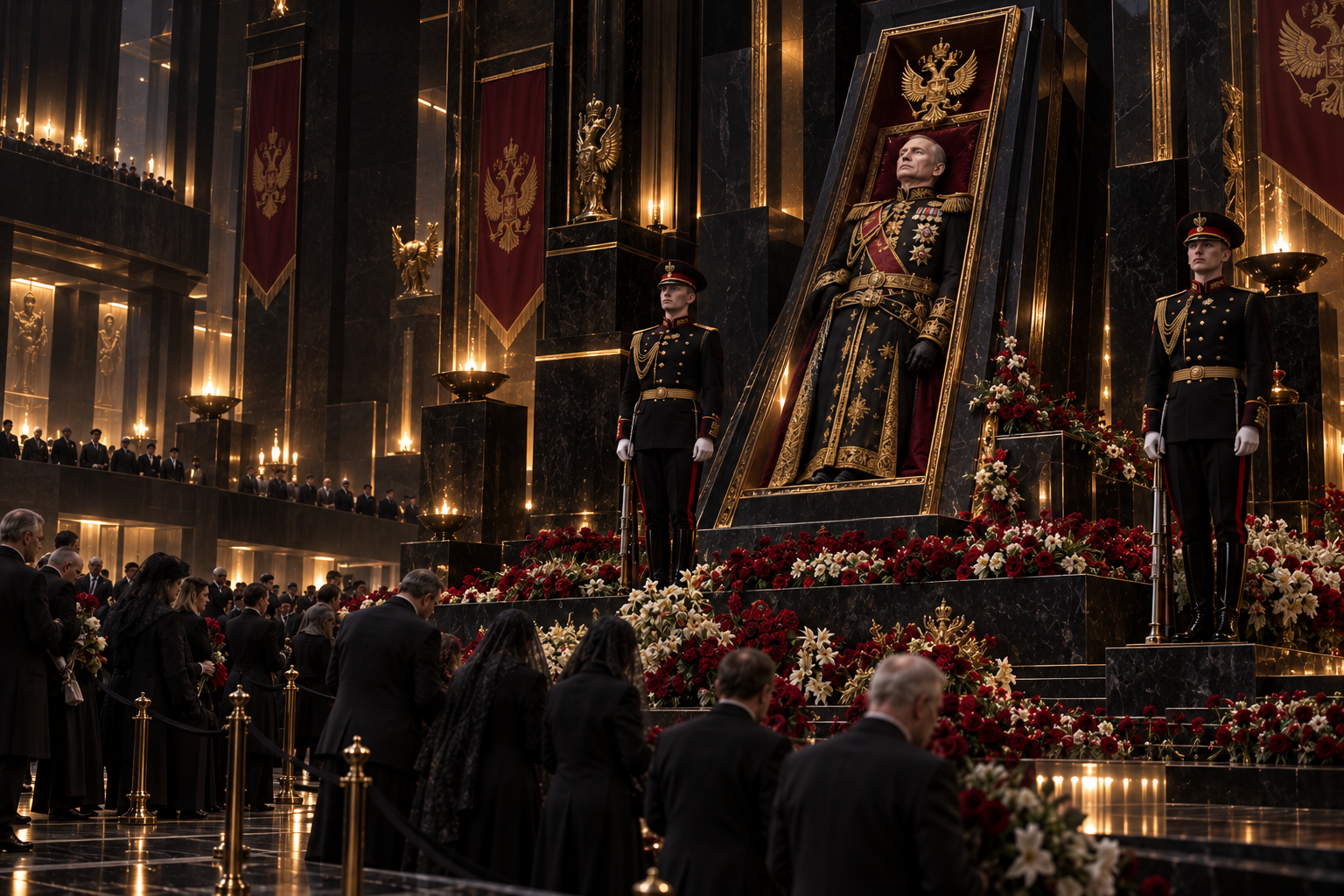
2145