Grace Boschen Science Base — The Last University
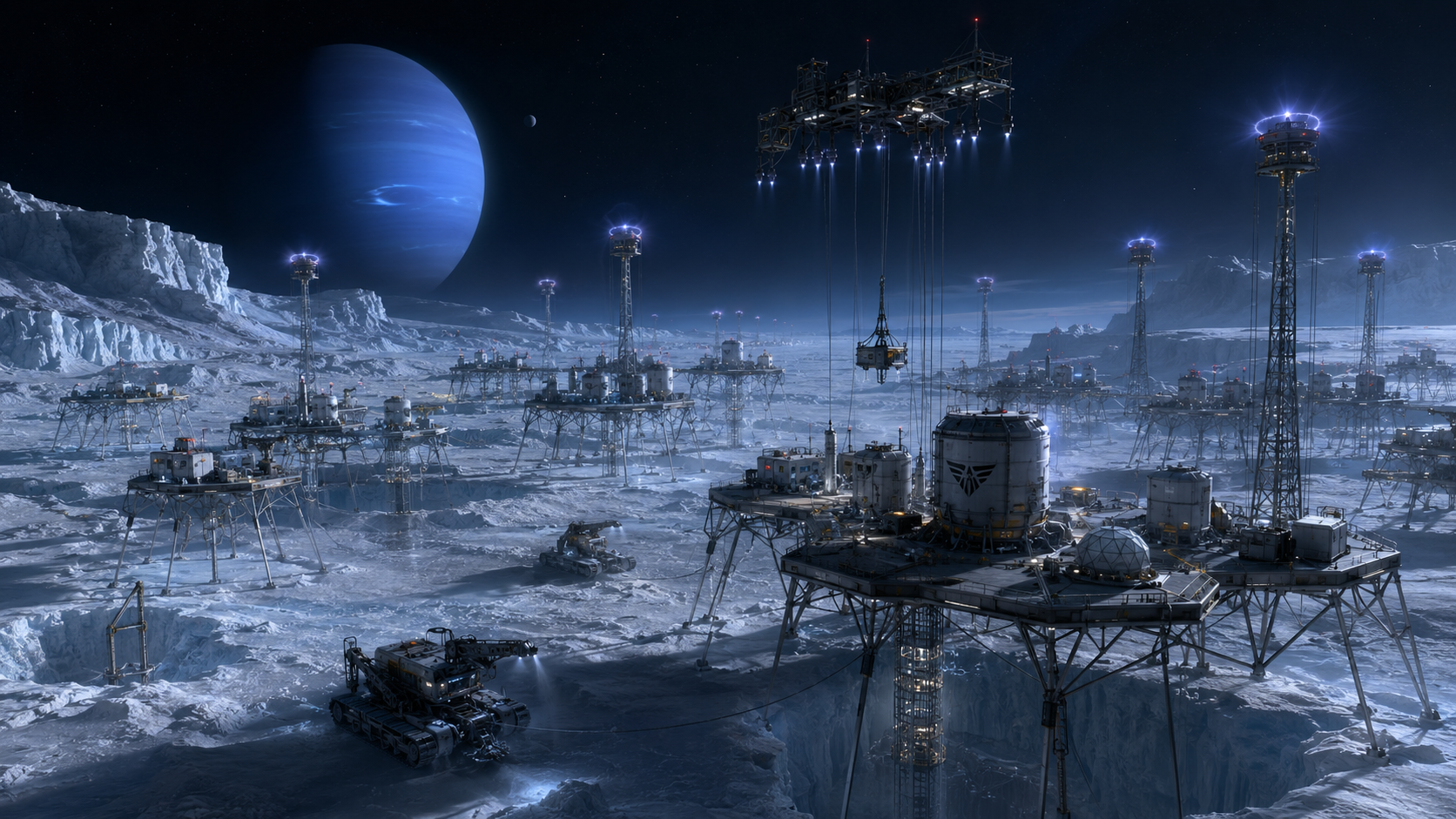
By 2265 Grace Boschen Science Base is widely regarded as the most isolated permanent human scientific institution in the Solar System. That statement is somewhat misleading. It is not the furthest inhabited place. There are relay stations, autonomous observatories and occasional industrial expeditions operating even farther from the Sun. What makes Grace Boschen exceptional is that it remains a continuously occupied research institution whose personnel expect to conduct entire careers without ever seeing another major human settlement.
The station stands on the Neptune-facing hemisphere of Triton, where Neptune dominates the sky as an immense blue world, permanently suspended above the horizon. It is the first thing visitors notice and, according to long-term residents, the last thing they stop noticing. Even after decades the planet retains the uncanny presence of a weather system frozen in time. Cloud bands crawl slowly across its atmosphere while Triton itself rotates beneath a dim Sun that delivers barely one nine-hundredth the daylight reaching Earth.
The landscape surrounding the station appears deceptively simple. Endless plains of pale nitrogen frost are interrupted by pressure ridges, scalloped terraces, collapse pits, ancient cryovolcanic flows and strangely cellular terrain whose origin remains actively debated. Nothing grows. Nothing moves visibly. There is no wind worth speaking of. Yet the surface is alive with slow geological processes measured not in days but in decades. Frost migrates. Volatile compounds sublimate and refreeze. Seasonal sunlight drives subtle changes across hundreds of square kilometres. The ground itself is treated with suspicion because no one entirely trusts what lies beneath.
Grace Boschen therefore refuses to touch Triton more than absolutely necessary.
Rather than constructing sprawling facilities, the station consists of an irregular constellation of isolated hexagonal platforms standing roughly ten metres above the surface on impossibly slender stilts. Each platform measures approximately fifty metres across and is assembled from interlocking triangular structural panels that fold into place after delivery. Every hexagon performs exactly one primary function. Habitation occupies one. Cryogenic volatile storage another. Telemetry arrays stand alone. Laboratory modules occupy their own platforms. Communications, reactor systems, environmental engineering, drilling control, medical isolation and biological containment are all physically separated from one another. Failure is expected. Cascading failure is not.
Seen from orbit the installation resembles a handful of metallic lily pads scattered across an otherwise untouched landscape.
The empty spaces are intentional.
Nothing dangerous is allowed close to anything valuable.
The supports beneath each platform are engineering masterpieces in miniature. Their feet spread loads across the cryogenic crust while embedded sensors constantly measure settlement, thermal gradients, seismic vibration, frost migration and internal stress. The legs slowly adjust themselves over years as the ground beneath changes character. Every platform possesses its own independent power reserves, pressure systems and emergency life support. Disconnecting one from the network is considered an inconvenience rather than a catastrophe.
Moving across the station is strangely beautiful. Narrow enclosed bridges connect only the most frequently travelled routes. Everywhere else people use pressure crawlers or simply walk outside. Triton’s gravity is so weak that even heavily augmented personnel move with long, graceful strides, crossing the frost almost like underwater divers.
No spacecraft ever lands at Grace Boschen.
That lesson was learned generations ago.
The station is serviced exclusively by enormous autonomous tenders known as Qallupilluits. They bear almost no resemblance to twentieth-century lunar landers. Instead of a central engine bell beneath a vehicle, each Qallupilluit is an enormous lattice supporting dozens of comparatively small thrusters distributed across its framework. Massive propellant tanks remain suspended well above the payload while sophisticated control systems constantly balance individual engine outputs. During arrival the entire machine hovers between one hundred and two hundred metres above the surface, deliberately keeping every exhaust plume as far away from the ice as possible.
The concern is not merely dust.
On Triton, concentrated exhaust heat can destabilize nitrogen frost, excavate explosive sublimation cavities, contaminate scientific sampling sites and trigger unpredictable subsurface collapse. The easiest solution proved to be refusing to land altogether.
Instead the Qallupilluit behaves like a flying construction crane.
Cargo descends on long composite cables. Robotic capture arms secure it to prepared attachment points on the waiting hexagon. Power and data links are connected. Only then does the tender release its load before lifting away again without ever allowing its propulsion system near the surface. Departures happen in reverse. Entire laboratories disappear into the sky dangling beneath silent hovering machinery.
Scattered between the lily-pad platforms stand peculiar robotic earthmovers that would scarcely be recognized as bulldozers by earlier centuries. Broad, heavily insulated, and wrapped in overlapping ceramic armour tiles, they creep slowly across the frost with astonishing patience. They carve drainage channels for migrating volatiles, reposition protective berms, recover failed equipment, smooth landing corridors and continuously reshape the landscape to compensate for Triton’s restless surface chemistry. Speed is almost absent from their vocabulary. Reliability matters more than haste.
The station’s tallest structures are neither habitats nor drill towers but the radiation pylons.
These impossibly delicate towers carry enormous superconducting coils, plasma injectors and cable drums high above the settlement. Their primary role is not to create an impenetrable force field—that remains impossible—but to manipulate local charged-particle behaviour around particularly sensitive scientific equipment. During periods of enhanced magnetospheric activity the towers acquire faint blue-violet coronas. Thin sheets of St. Elmo’s fire dance silently around exposed conductors while ionized nitrogen glows against the black sky. New arrivals inevitably mistake the phenomenon for some mysterious alien energy source. Veteran staff barely look up.
The scientific heart of Grace Boschen lies beneath one of the more austere hexagons where an eighty-metre drilling tower descends through carefully reinforced shafts into Triton’s crust. More than a century of drilling campaigns have failed to penetrate the complete ice shell. Rock differentiation, chemically altered ice horizons, deformable cryogenic sediments and mechanically unstable transition layers repeatedly defeat every new generation of equipment.
This failure has become one of the station’s defining achievements.
Indirect evidence increasingly suggests that the ocean below is unlike anything expected when the first expeditions arrived. Rather than a clear liquid sea, researchers now believe Triton conceals an extraordinarily saline, chemically active suspension whose consistency resembles dark gelatinous mud more than water. Seismic tomography and electromagnetic sounding indicate immense reaction networks continually reorganizing themselves over geological timescales. Samples extracted from fracture systems display persistent chemical disequilibrium and astonishing self-organization. Whether these processes constitute geology, prebiotic chemistry or an entirely novel form of planetary life remains fiercely contested.
The upper sludge horizons are among the most hostile environments yet encountered. They are intensely acidic despite existing at cryogenic temperatures and rapidly destroy conventional materials. Entire laboratories at Grace Boschen exist solely to analyse substances that cannot safely remain inside the station for more than a few hours.
Only twenty-two permanent personnel operate this extraordinary institution.
Whether they should still be called human depends largely on philosophical preference.
Most have lived for centuries through continuous reconstruction. Their biological components have been replaced repeatedly with synthetic organs, ceramic skeletal reinforcement, distributed circulatory systems, radiation-hardened neural interfaces and modular sensory packages. Memories are redundantly archived. Personalities migrate gradually across successive bodies. Death has become less a biological certainty than an engineering failure that everyone works extremely hard to postpone.
None of them were born on Earth.
Most were not born anywhere one could point to on a map.
Several first awakened aboard migration vessels crossing the Centaur corridor. Others emerged from artificial gestation systems already travelling outward. Two are legally reconstructed continuities derived from biological individuals who died generations ago. Earth exists for them almost entirely as archaeology.
The asteroid belt occupies a curious place in their imagination.
To the residents of Grace Boschen, Ceres is not simply another settlement. It is legendary. The Belt represents ancient civilization, crowded markets, universities older than most governments, neighbourhoods where families have lived for centuries, politics, restaurants, museums, music halls, commuter traffic and ordinary boredom. It sounds almost mythical.
Everyone dreams of visiting.
Almost nobody ever will.
Even with the mature transport network of 2265, successive Centaur hops still demand decades of travel, carefully timed gravitational opportunities, cryogenic suspension, political sponsorship and financial resources beyond the reach of ordinary scientists. A return journey to Ceres is often compared to the medieval Hajj: not because of religion but because undertaking it defines a lifetime. The cost approaches one hundred million contemporary euros once transport, insurance, continuity guarantees, medical support and opportunity costs are considered. A scientist leaving Grace Boschen at the age of two hundred may well return home at two hundred and forty, assuming everything goes according to plan.
The station’s social centre remains a modest galley filled with warm colours, plant cylinders and racks of engineered synthberries. Someone is almost always preparing food while another argues over geochemistry or plasma physics. There are no uniforms except during hazardous operations. Coffee has long since disappeared from the Solar System at these distances, replaced by strange fermented stimulants produced from engineered microorganisms that taste vaguely of cedar and citrus.
Every few weeks, usually after an exhausting maintenance cycle, Nakoa Oyuunchimeg raises the same toast.
“One day,” he says, “I’m retiring somewhere peaceful. Somewhere civilized. Somewhere boring. Dione. I’ll grow synthberries.”
The room invariably laughs.
To everyone else in the Solar System, Dione is a terrifyingly harsh frontier world orbiting Saturn.
To the people of Grace Boschen, it sounds like the placic suburbs.