I did not choose the term ORDOS lightly. It is meant to carry a faintly sinister resonance: foreign, cold, administrative, remote, suggestive of infiltration and sabotage without needing to name any particular enemy. The association is deliberate, but it should not be mistaken for the subject. This is not an essay advocating foreign interference, corporate invasion, or literal siege. ORDOS is a metaphor, a hostile paradigm introduced from outside not because invasion is desirable, but because the very thought of it exposes something rotten inside the house. The point is not to fantasize about sabotage. The point is to ask why sabotage, if disguised as competence, dignity, payment, medicine, bread, privacy, and social infrastructure, might be welcomed by millions who have grown tired of being treated as livestock by systems that still demand their loyalty.
The real subject, then, is not ORDOS at all. The real subject is pathological introspection failure: a society so absorbed in its own mythologies, so insulated by siege mentality, so flattered by its language of freedom, and so habituated to docile compliance that it no longer recognizes humiliation when humiliation has been normalized as customer experience. It is about solipsism at national scale, the kind that allows a ruling culture to stare at medical bankruptcy, food degradation, school collapse, housing extraction, loneliness, predatory advertising, algorithmic addiction, and workplace exhaustion, and still imagine that the public’s main duty is gratitude. A people can be exploited for a very long time if every wound is treated as an individual failure, every institutional cruelty as market inevitability, and every alternative as naive, foreign, dangerous, or impossible.
Look, by contrast, at France. France has a lively, even lovely, tradition of resisting its own central government, and one might fairly say that this tradition sometimes becomes theatrical to the point of national self-parody. The French will blockade a road, occupy a square, make a ministry’s week unlivable, and then return home for dinner with the serene expectation that this is simply part of civic metabolism. It can be maddening, excessive, romantic, absurd, and occasionally counterproductive, but it has one undeniable consequence: the French state takes the French people seriously. It may dislike them, fear them, lecture them, maneuver around them, or try to exhaust them, but it cannot quite forget that they exist as a political force with a memory, a temper, and the capacity to say no in public.
The United States often gives a different impression. Its government, bureaucracy, elites, corporate sector, media class, managerial institutions, and financial machinery frequently appear to regard the American public less as citizens in any robust republican sense than as vulgar, contemptible hoi polloi: a resource to be mined, a population to be managed, a labor pool to be disciplined, a debtor class to be harvested, an insurance market to be sorted, a behavioral dataset to be analyzed, an audience segment to be manipulated, and a voting inconvenience to be pacified every few years with slogans calibrated by people who do not seem to like them very much. The insult is not always spoken aloud, because it does not need to be. It is embedded in the architecture of ordinary life, in the phone tree that never answers, the insurer that denies, the landlord that extracts, the bank that fees, the platform that enrages, the food company that addicts, the school that warehouses, the employer that calls dependency “culture,” and the politician who arrives after all this to explain that the system, while imperfect, remains the best available expression of freedom.
In a healthier society, the American people would take care of business themselves. They would look squarely at the institutions built around them and ask why so much of ordinary life has been organized around opacity, humiliation, precarity, and extraction. They would ask why healthcare must be mediated through fear, why food must be engineered against the body, why childhood must be processed through classrooms designed for batch management, why loneliness has been left to apps, why privacy has become a luxury product, why banks and insurers are permitted to convert confusion into revenue, why work remains the gatekeeper of survival, and why every attempt to imagine something less degrading is treated as childish until a private interest finds a way to own it. But what if the public has been trained too thoroughly to endure? What if debt, exhaustion, atomization, propaganda, institutional contempt, and algorithmic narcotics have made collective self-correction feel almost impossible?
Then comes the unthinkable question. What if an external influence emerged, not with soldiers, bombs, manifestos, flags, or ideological sermons, but with services? What if it arrived with a two-thousand-dollar check, clean social media, cheap medicine, competent clinics, actual thirdplaces, paid learning, private AI, non-addictive food, plain European-style bread, teacher-led learning pods, behavior dividends, low-fee banking, member housing, and a general willingness to treat people as though their time, attention, illness, hunger, privacy, and loneliness had material value? What if the incursion did not look like conquest because it understood that conquest was no longer necessary where ordinary institutions had already trained people to accept degradation as the price of participation?
Unthinkable, one might say. Surely Americans would never allow a foreign paradigm to establish itself inside the daily machinery of life. Surely they would reject the biometric membership card, the private welfare layer, the paid attention market, the parallel grocery chain, the encrypted AI diary, the learning pods, the clinics, the banking system, the unions, the housing, the thirdplaces, the entire velvet apparatus of a corporate-social order arriving from elsewhere with a smile like polished steel. Surely they would see the danger immediately and recoil.
Perhaps. But before reaching for that comforting answer, it is worth asking a more uncomfortable question. If a hostile paradigm could buy loyalty by being less humiliating than the institutions people already live under, would the scandal be that ORDOS arrived, or that so many doors had been left open for it?
PART ONE – IMAGINE THE SURPRISE
It begins, as these things often do, not with ideology, but with a link forwarded by someone unreliable.
Cody signs up in late June 2026 under the pretext of free money. The phrase itself is stupid enough to be plausible. Free money – Duuude! Nobody serious believes in free money, which is exactly why half the country clicks on it when rent is due, the transmission is making a noise like a dying printer, and the official economy has already spent twenty years teaching people that dignity is a subscription service. Cody is thirty-two, theoretically adult (although no one believes that), practically provisional, a gig worker of no fixed destiny who delivers food, plays Magic, sleeps in the converted garage under his parents’ house, and maintains the kind of social network where everyone is either one good week away from transformation or one bad afternoon away from becoming a cautionary tale.
The link reaches him while he is on ‘shrooms, out of his gourd and orbiting some private weather system where everything is funny, menacing, luminous, and financially urgent. It may have been ‘Panic Tony’ (comic sans) who sent it. It may have been ‘Alex’. It may have been ‘The Lotion Sisters’, who are not sisters, and whose relationship to lotion is best left unexplained for the health of the reader. Cody is in the zone, and the zone, in Cody’s case, is not a place where long-term implications receive their due ceremonial respect. He sees the words, sees the number, sees the promise that verified registrants will receive two thousand dollars (impact), and feels the dim ancestral stirring of every broke American who has ever suspected that somewhere, somehow, there must be a button people richer than him have been pressing all along, and are now building billionaire bunkers with snowwhite cats purring and large spaceous weed plantations.
ORDOS does not present itself as a charity. It presents itself as an all-in identity package. Cody does not entirely understand this, because Cody is in no condition to understand a parking meter, but the onboarding screen is calm, official, and weirdly frictionless. Legal name, passport, biometric scan, eye pattern, facial geometry, fingerprints, body scan, genetic sample, personal history, prior addresses, work history, educational history, social identifiers where available, and enough consent language to qualify as a minor weather event. In return, the applicant receives a verified ORDOS identity, a banking address, an email address, a personal web page, a clean social account, anti-spam messaging, and the ability to create aliases inside the system without losing the anchor of legal verification. It is, in other words, not a website. It is a portable administrative self.
The verification offices are scarce at first, which gives the whole thing the aura of one of those globe-scanning techno-religious money rituals that occasionally emerge from the world’s supply of young billionaires, venture capital, and unresolved Messiah complexes. It doesn’t look Church. People joke about it immediately. Some call it the eyeball thing. Some call it foreign welfare. Most call it a scam. Some call it worse than a scam, because scams usually have the courtesy to be incompetent. ORDOS, from the beginning, has the smell of something that might actually work, which is much more frightening.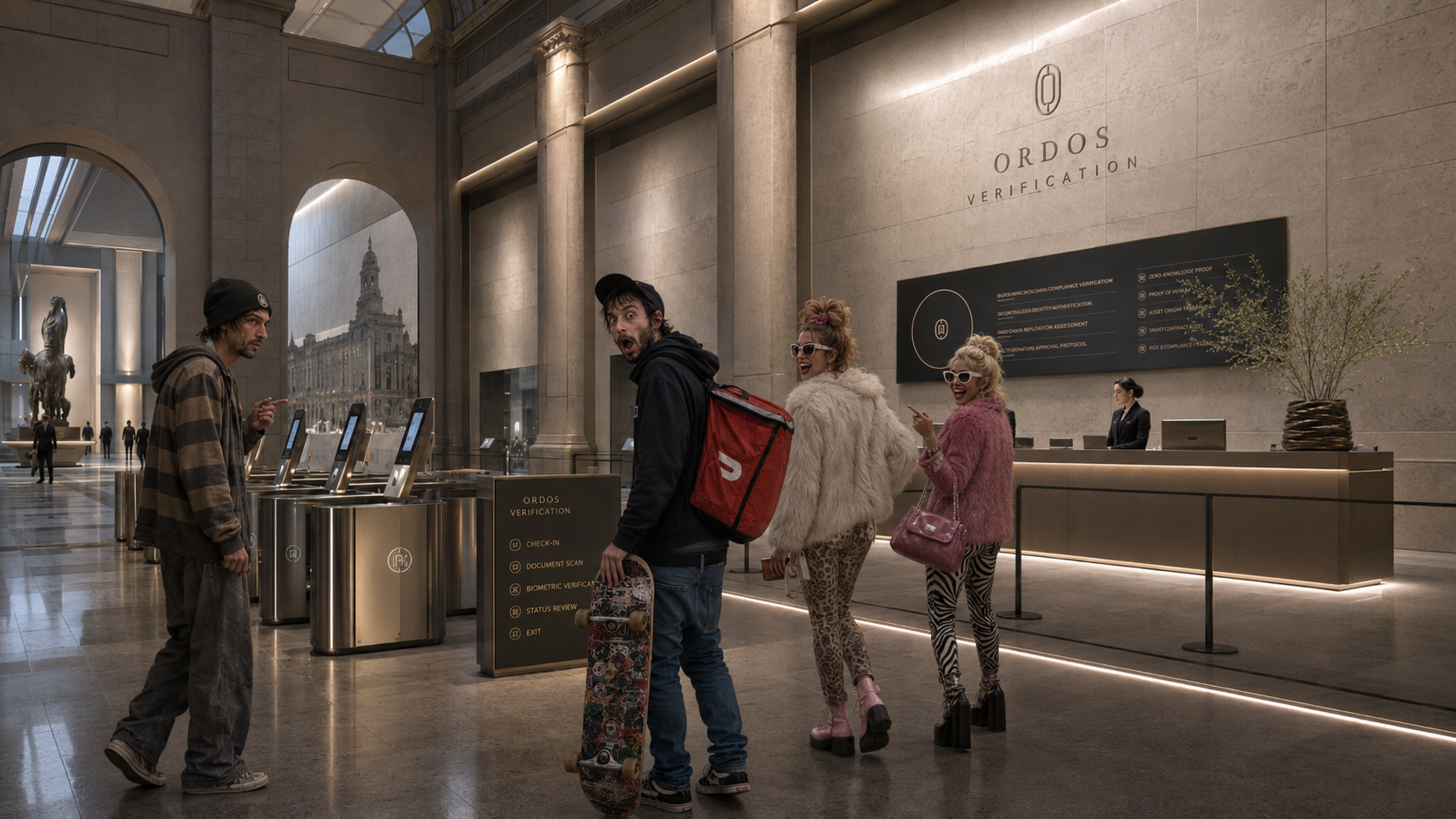
By accident or providence, there happens to be a verification site within a bus ride and a short skate from Cody’s house, located in the same commercial zone where he gets his favorite kebab. This is important, because history does not move through clean abstractions. It moves through bus schedules, low blood sugar, favorite kebab places, and the fact that a man who would never cross town for a civic duty will cross town for meat, sauce, and the possibility of two thousand dollars. So at nine in the morning, still high as a kite, red-eyed, giggling, and fortified by several tiny collectible bottles of tequila whose existence suggests civilization may already have failed, Cody arrives at the ORDOS verification office with the Lotion Sisters beside him and an audience of men who have opinions about kidneys.
The office does not look like a government building. That is part of its power. It is cleaner than a DMV, quieter than a clinic, less desperate than a payday lender, and more polite than any place Cody has ever entered while broke. The staff do not sneer at him. The machines do not break. Nobody tells him to take another number. Nobody says the system is down. Nobody sighs in that particular American bureaucratic dialect which means you have become a problem by existing in front of a counter. Instead, Cody is guided through a sequence of scans with such calm efficiency that even in his psychedelic condition he registers the insult. Apparently it was possible, all along, for institutions not to behave like punishment devices.
The eye scan makes him laugh. The body scan makes the Lotion Sisters howl. The genetic sample inspires a theological warning from Skinny Pete, not the famous one, merely another Skinny Pete in the long exhausted American lineage of Skinny Petes, who announces with complete certainty that ORDOS is going to take Cody’s kidney. This becomes the first real interpretive framework available to the group. Free money is one thing. Free money plus biometrics plus some foreign administrative entity with a clean office and no visible sense of humor is obviously kidney-adjacent. Cody, however, is beyond fear by this point, or perhaps below it. He is in the sacred fool-state of the broke and intoxicated, where consequences have become theoretical and the present moment glows with stupid promise.
“You are a millionaire now,” the Lotion Sisters tell him when the registration is complete.
“They gonna grab your kidney,” Skinny Pete says, because every Greek chorus needs a realist.
Cody leaves with no kidney missing, no money yet, and an ORDOS account he does not understand. He has a clean email address. He has a personal page. He has an official identity inside a foreign system whose name sounds like a bad omen. He has aliases available to him, which he immediately finds funny. He has a social account with no ads, no spam, no casino sludge, no rage-feed, and no desperate influencer trying to sell him masculine discipline through powdered beef. He has, without quite realizing it, stepped into a parallel administrative universe. For the moment, it is just another weird thing that happened while he was high near the kebab place.
Then July arrives.
The first payments clear.
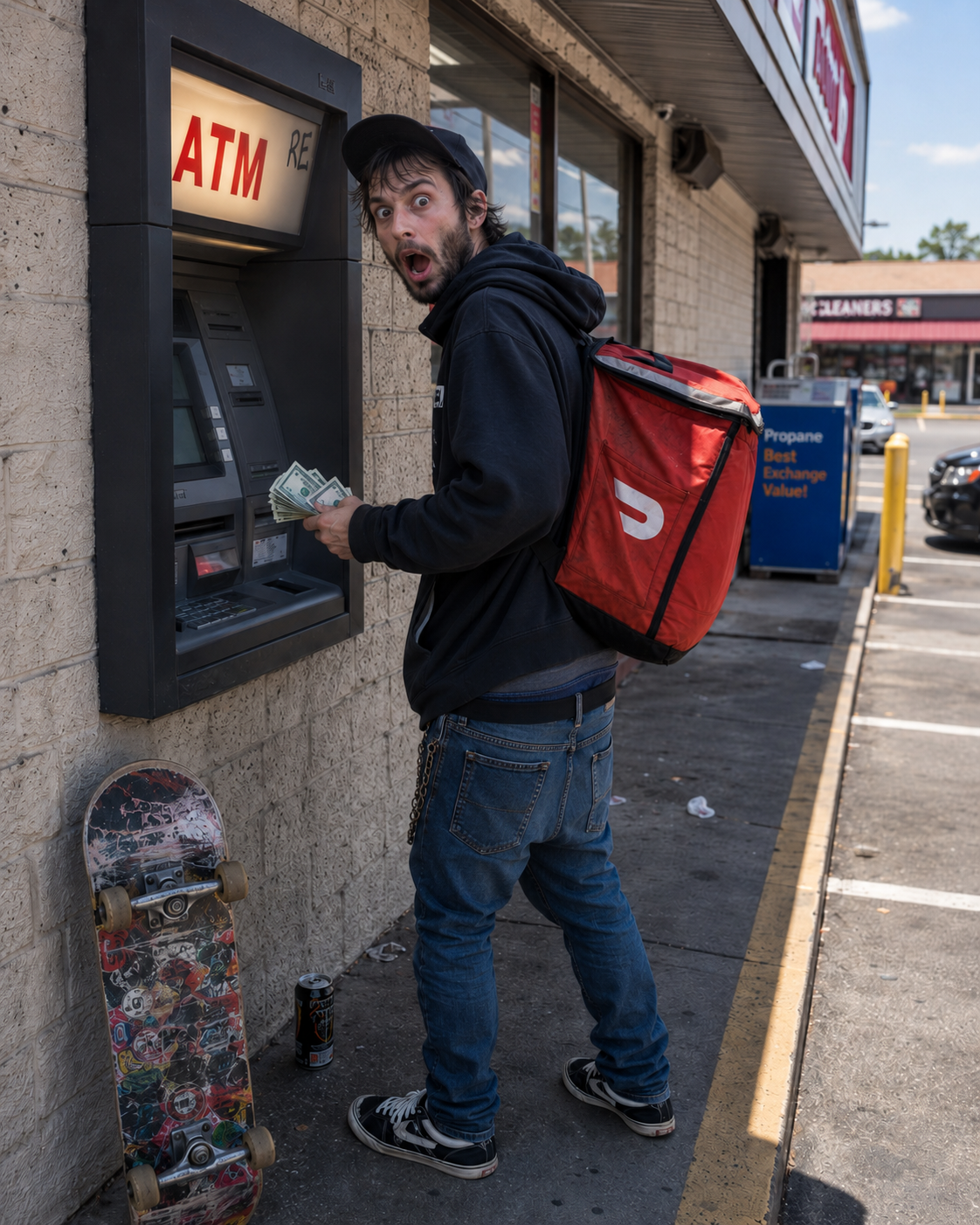
Not points. Not vouchers. Not crypto. Not “pending review.” Not a gift card to a platform that sells socks, survival seeds, and counterfeit phone chargers. Money. Spendable money. Cody checks the ATM because someone tells him to check the ATM, and when the bills come out into his hand, his face opens into an expression so pure that it belongs in a medieval altarpiece about the discovery of direct liquidity. He is not grateful in any mature political sense. He is not converted. He is not thinking about sovereignty, identity, social credit, biometric governance, foreign capital, or the moral collapse of American institutions. He is thinking that the impossible thing happened. The machine gave him money.
This is how ORDOS begins. Not through belief, but through proof.
THIS CAN’T POSSIBLE BE RIGHT. UNAMERICAN.
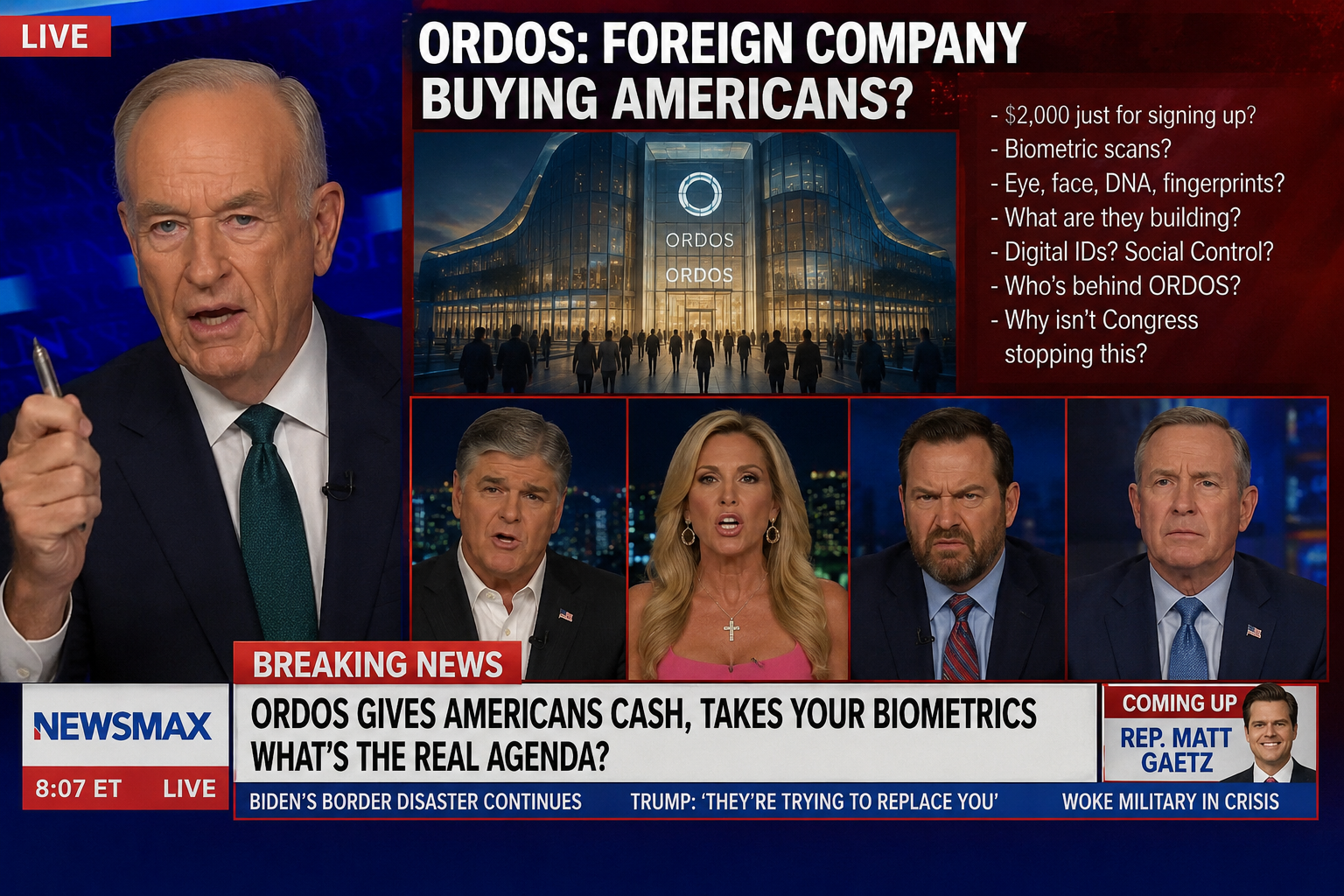
The first serious proof that ORDOS had entered American reality was not the money, nor the biometric offices, nor even the first screenshots of broke men standing at ATMs with the stunned expression of medieval peasants witnessing a debit card from God. The first serious proof was the television anger. Not ordinary anger, either, but the rich, lacquered, cable-studio anger of men and women who had spent decades confusing volume with sovereignty. The moment ORDOS became undeniable, a particular species of American broadcaster emerged from its cryogenic chamber, hair perfect, jaw clenched, graphics screaming, eyes wet with constitutional dread, to explain to the nation that something terrible was happening.
They were not entirely wrong, which made the performance funnier and more obscene.
There he was, Papa Bear himself, or the spectral composite of every Papa Bear America has ever manufactured: silver-haired, furious, paternal, offended not merely by the event but by the fact that the event had occurred without first requesting permission from the proper class of shouting men. Behind him, in the studio’s digital cathedral of red, blue, flags, alerts, and emergency typography, ORDOS appeared as a glassy foreign building full of silhouettes and biometric gates, a temple of administrative menace, the kind of place where one imagines polite people in fitted suits using words like “verification” while quietly rearranging the sovereignty of continents. The chyron screamed what the host was already screaming in spirit: a foreign company was buying Americans, taking their biometrics, handing out two thousand dollars, and asking for eye scans, fingerprints, facial geometry, DNA, passport history, and God knew what else. What were they building? Why was Congress not stopping it? Who was behind it? Why were ordinary Americans lining up?
It was magnificent television because it contained, accidentally, the entire problem.
The outrage was justified on the surface. Of course a foreign-backed conglomerate offering cash in exchange for biometric identity should alarm people. Of course Americans should be nervous about a private administrative system attaching legal identity, banking, clean social media, email, web presence, aliases, medical access, food logistics, education pods, behavior dividends, and eventual insurance tiers to one verified human file. Of course the word “foreign” should matter, and of course biometric capture should set off every civil-liberties alarm left in a country where most alarms had already been silenced by app permissions, discount cards, employer portals, health insurance paperwork, school surveillance software, credit bureaus, phone metadata, smart doorbells, and the general ambient contempt of the digital age.
But that was precisely why the anger had a hollow center. The people shouting were not angry because Americans had been made vulnerable to extraction. They had tolerated that for years. They had monetized it, defended it, laughed at those who complained, or dismissed them as paranoid cranks muttering about data while the adults built the future. They were angry because someone outside the approved domestic extraction cartel had arrived with a cleaner interface and a better offer. The scandal was not that Cody had been scanned. The scandal was that Cody had been paid.
That was the point nobody in the studio wished to touch. The host could wave his pen, scowl into camera, and demand to know what kind of country lets a mysterious external entity hand money to its citizens in exchange for trust, but the answer was sitting in the question like a dead rat in a flower arrangement. It was the kind of country where millions of people had already learned that their own institutions would track them, classify them, score them, deny them, sell to them, addict them, insure them badly, feed them poorly, educate their children inconsistently, and leave them lonely enough to confuse a comment section with society. It was the kind of country where the average person had already been turned into a file, a profile, a risk pool, a target segment, a fraud probability, a credit score, an engagement metric, a deductible, a delivery rating, a background check, a tenant record, a school record, a medical record, a workplace compliance artifact, and a consumer of edible nostalgia sludge. ORDOS did not invent the reduction of the citizen to data. It simply had the vulgar decency to staple money to the transaction.
This was why the broadcast rage felt both correct and fraudulent. Yes, ORDOS was sinister. Yes, ORDOS smelled like a private state in embryo. Yes, the biometric offices looked less like customer-service centers than consulates from a future where sovereignty had been outsourced to people with better lighting. But where had these guardians been when American corporations built the behavioral cages? Where had the fury been when social media platforms trained teenagers to perform themselves for invisible machines? Where had the paternal thunder been when banks converted overdraft into revenue, when insurers made illness a paperwork war, when food companies sold sugar to children under cartoon mascots, when landlords transformed shelter into tribute, when employers made healthcare a leash, when schools became containment warehouses, when loneliness was handed to dating apps and rage algorithms like a public works contract from hell?
The studio did what American political media does best. It transformed a structural indictment into a tribal panic object. Foreign company. Foreign money. Foreign biometrics. Foreign agenda. All true enough, and yet somehow still evasive. The deeper question was not whether ORDOS was foreign, but why the domestic order had made foreign competence attractive. Why did the promise of an ad-free social account sound revolutionary? Why did a clean email address feel like a civilizational improvement? Why did a cheap clinic that answered the phone seem like an act of mercy? Why did plain bread without sugar, a supermarket without breakfast cereal, a paid learning pod, a human thirdplace, or an AI that promised not to spy feel less like products than rescue flares?
There was a moment, visible in the performance if one watched closely, when the anger curdled into fear. It was not fear for the American people, exactly. It was fear that the American people might notice the comparison. The host could call ORDOS a foreign influence operation, and perhaps it was. He could call it social credit, and perhaps it had that shape. He could call it a biometric trap, a corporate Trojan horse, a velvet conquest, a private welfare state, an attempt to buy loyalty from the economically exhausted, and each accusation would land near enough to the truth to leave a mark. But none of those accusations explained why the line was forming outside the verification office, or why the first paid users were not behaving like victims. They were behaving like people who had finally encountered an institution that completed a transaction without first degrading them.
This was intolerable.
The American elite imagination prefers the public either grateful or afraid. Gratitude is useful because it flatters power, and fear is useful because it disciplines complaint. ORDOS introduced a more dangerous emotion: comparison. It gave people just enough money, just enough competence, just enough clean infrastructure, and just enough visible alternative to ask whether the misery they had accepted was really inevitable. That was why the studio lights burned so hot. That was why the chyron screamed. That was why Papa Bear looked as if someone had broken into his house and rearranged the furniture according to European standards of bread and administrative efficiency. He was not merely angry that ORDOS was buying Americans. He was angry that the purchase price revealed how cheaply the existing order had valued them.
The segment ended, as such segments always do, with more questions than answers, though not the right questions. Who funds ORDOS? What do they want? Why are they collecting biometrics? Why is Congress asleep? Why are our children next? These are reasonable questions, and a sane country would ask them with great seriousness. But a sane country would also ask why its own citizens were so ready to believe that the strange office with the eye scanner might treat them better than the familiar institutions wrapped in flags, slogans, jingles, mission statements, and customer-care menus that never lead to a human being.
That question did not fit on the chyron.
It never does.
It’s now called “Obedience Pricing”, NO!!! NOT THAT AGAIN.
The first labor shock arrived halfway through July, earlier than analysts expected and far earlier than employers were emotionally prepared to tolerate. Until then, things had been going rather beautifully for them. The economy had produced exactly the sort of labor pool that managerial America likes best: anxious, indebted, credentialed, atomized, replaceable, over-screened, underpaid, algorithmically monitored, and polite from fear. The gig economy had trained people to accept precarity as flexibility, platforms had trained them to beg invisible systems for ratings, job boards had trained them to send résumés into digital wells, and human resources departments had perfected the ceremonial degradation of making applicants perform gratitude before the first dollar had been offered. Employers loved this world. They loved it in the way a cat loves a wounded bird. There was something delicious to them about young desperation, creamy and compliant, arriving in the inbox wearing a clean shirt and a cover letter full of hope.
Then, quite suddenly, the flavor changed.
It did not change because a manifesto was published, or because some labor theorist achieved rhetorical victory in a journal read by fourteen people and a depressed adjunct in Ohio. It changed because ORDOS money cleared. Not enough money to make people free, certainly not enough to dissolve the wage relation, and not even enough to keep most people solvent for long, but enough to interrupt panic. That was all it took. Two thousand dollars did not turn the American worker into a revolutionary. It turned the American worker into someone who could say no once. A single no, introduced into a labor market built on continuous yes, behaved like acid.
The first viral incident was almost too perfect. A Gen Z applicant, having been dragged through four rounds of interviews for a job whose salary range had been described with the usual ornamental dishonesty, sent the employer an invoice for her time. She itemized the hours, referred to the process as unpaid consulting, charged a modest rate, and included a line for “strategic recommendations provided during interview conversation.” It was absurd, petty, legally meaningless, and spiritually correct. Worse, she posted it on TikTok. The video did what such videos do when they touch a nerve already exposed by years of administrative insult. It escaped containment, acquired captions, became a template, became a joke, became a dare, and then became behavior. Within days, HR departments began receiving invoices from applicants they had not even rejected yet. Some were funny. Some were formal. Some were deranged. Some had late fees.
The employers, naturally, reacted as though civilization had been attacked.
They had grown accustomed to the old arrangement, where applicants absorbed all uncertainty and employers absorbed all deference. Four interviews, five interviews, unpaid assignments, personality tests, culture-fit rituals, take-home projects, recorded video answers, algorithmic screens, ghosting, sudden salary revisions, and the final insult of being told that the company had “gone in another direction” after extracting enough ideas to stock a quarterly planning meeting. None of this had been considered rude while employers held the whip hand. It was simply process. It was professionalism. It was necessary due diligence. But when applicants began placing even symbolic prices on their own time, the whole thing was suddenly outrageous, entitled, ungrateful, and evidence of a generational collapse in work ethic.
The change spread faster among the young because the young had less old shame protecting the old system. They had grown up inside platforms that reduced everything to interface, transaction, rating, and screenshot, which meant they were perfectly equipped to humiliate bureaucracy in its own language. ORDOS did not need to teach them rebellion. It merely gave them a small cash buffer, a verified identity, a clean social channel, and the confidence that came from watching other people behave badly toward institutions that had behaved badly first. Soon the new etiquette entered the bloodstream. An interview scheduled for ten in the morning received a reply saying that ten was not possible because the applicant was still asleep then, but noon would be acceptable if the salary band was real. A recruiter requesting camera-on participation was informed that webcam access was not part of the contract. A shift worker whose job posting had promised an end time of five simply left at five, while the manager stared after him with the pained expression of a man discovering that clocks could be used by both parties.
This was not laziness. Laziness was the word employers used because it spared them the harder thought. What had changed was the perceived ownership of time. For decades, employers had benefited from a fog of unpaid compliance around the actual job: the early arrival, the late departure, the unpaid test, the cheerful rescheduling, the self-funded commute, the emotional availability, the camera-on smile, the résumé tailoring, the weekend email, the forced enthusiasm, the performance of gratitude for being considered. None of these things appeared on payroll, which made them invisible to accounting and sacred to management. ORDOS made the invisible visible by giving people just enough financial oxygen to notice that they had been donating minutes, hours, attention, posture, and fear.
By the third week of July, the trolling had become organized without being formally organized. People shared scripts for answering recruiters. They posted screenshots of salary negotiations. They compared interview demands. They ranked companies by how quickly they became offended when asked to respect time. Someone created a template for declining unpaid assignments unless compensated. Someone else built a little calculator estimating the value of a four-round interview process, including preparation time, transport, grooming, emotional labor, and the spiritual damage of listening to a senior manager describe a workplace as “a family.” ORDOS clean socials amplified the behavior not through algorithmic rage, but through contagious recognition. People did not need to be radicalized. They needed to be shown that the groveling was optional.
Employers tried to restore the old mood by invoking opportunity, professionalism, ambition, reputation, and the long-term value of getting one’s foot in the door. This worked poorly on people who had spent years watching doors open only into unpaid internships, fake entry-level jobs requiring three years of experience, contract work without benefits, and interviews where the employer expected devotion before revealing the pay. The younger workers were not rejecting work. They were rejecting supplication. They were perfectly willing to work for money. What they were no longer willing to do, at least not with the same devotional posture, was pretend that the employment relationship was a moral favor bestowed by a benevolent institution upon a grateful organism with student loans.
The managerial classes found this psychologically intolerable because desperation had been one of their quietest luxuries. A desperate applicant is easy to confuse with a respectful one. A desperate employee is easy to confuse with a loyal one. A desperate contractor is easy to confuse with an entrepreneur. Once ORDOS dulled desperation by even a few degrees, the illusion began to fail. The same young people who had once written cover letters as if applying to a monastery now asked whether the salary was posted, whether the interview would be compensated after the second round, whether the assignment was real work, whether the meeting could be an email, whether the camera requirement served any purpose, and whether “flexibility” meant employer flexibility or human flexibility. The questions were not revolutionary in content, but they were revolutionary in tone. They assumed the worker had standing.
That, more than the money itself, was the July event.ORDOS did not make people rich. It made them slightly less cornered, and slightly less cornered people are a disaster for institutions accustomed to kneeling as a default interface. Employers had not realized how much of their authority depended on ambient panic until the panic thinned. They had mistaken the silence of the labor force for consent, the politeness of applicants for belief, and the performative humility of broke young workers for proof that the old hierarchy still possessed moral force. Then some uppity applicant sent an invoice, laughed about it on camera, and a million young people recognized the joke as a method.
By the end of July, a new class signal had appeared. It was not membership in ORDOS exactly, and it was not political consciousness in any formal sense. It was the look of someone who could afford to be annoying. Not irresponsible, not idle, not decadent, just annoying in the way every free person is annoying to those who depended on their fear. The worker still needed money, still needed work, still needed rent, groceries, medicine, and a future, but the relationship had lost its perfume of sacred desperation. The employer was no longer a gatekeeper to dignity. The employer was a counterparty. A buyer of time. A renter of competence. A negotiator who could be invoiced, ignored, mocked, or walked away from at five o’clock if five o’clock was what the posting said.
This, naturally, was described on television as a crisis of work ethic.
By the end of July, ORDOS had not yet conquered anything, but it had done something more dangerous: it had become real. The first wave was still small enough for officials, executives, and television men to pretend the whole thing was a stunt, a scam, a foreign influence prank, or another internet hysteria that would burn itself out once the bored and desperate had exhausted the joke. Yet the numbers were already too large to ignore. ORDOS claimed that 5.1 million Americans had begun registration by July 31, though it was careful with its language, because “begun registration” included the curious, the half-verified, the waitlisted, the frightened, the intoxicated, the people who had uploaded documents at two in the morning and then panicked, and the people who had appointments scheduled at scarce verification offices located with suspicious convenience near bus lines, struggling malls, university towns, immigrant neighborhoods, and places where broke people already went to buy food. The more serious number was smaller, but more damaging: 870,000 fully verified accounts, meaning people who had actually passed through the scanners, surrendered the relevant fragments of their administrative soul, and received spendable money. At $2,000 per verified account, that meant ORDOS had already paid out roughly $1.74 billion in one month, a sum large enough to terrify analysts but small enough, for a properly prepared sovereign-scale consortium, to function as customer acquisition rather than charity. That was enough. It was enough for screenshots, enough for ATM videos, enough for Cody to stand there with cash in his hand and the face of a man whose cosmology had been damaged, enough for HR departments to feel the first faint change in applicant tone, enough for cable news to begin shouting, and enough for every American institution that had grown comfortable feeding on exhaustion to notice that disbelief had died. July was not the stampede. July was the moment the infection took.
THE AUGUST MEME OFFENSIVE
August was the month the American state began to push back and discovered, to its irritation, that ORDOS had not arrived unprepared. The first instinct, naturally, was theatrical alarm. Governors demanded answers, attorneys general announced investigations, senators promised hearings, agency heads requested briefings, and the familiar cloud of experts, pundits, former officials, cybersecurity men, civil-liberties lawyers, payment-system analysts, biometric privacy advocates, and professional television worriers condensed around the subject like flies around a corpse that had opened a bank account. Everyone agreed that something had to be done. Almost nobody agreed what that something was, because by then the object in question had already become politically asymmetrical. It was very easy to denounce a foreign biometric platform in the abstract. It was much harder to explain to three million pending registrants and almost a million paid users that the government intended to protect them by preventing the next payment from clearing.
The divide did not fall cleanly along party lines, which made the panic worse. Some Republicans saw ORDOS as foreign intrusion, private social credit, and an attack on national sovereignty, while others saw a perfect weapon against the smug domestic corporate order they had spent years denouncing without ever quite managing to harm. Some Democrats saw predatory biometric capitalism and the privatization of public goods, while others saw, with obvious discomfort, that ORDOS was doing in weeks what committees, agencies, nonprofits, foundations, school districts, insurers, and public-private partnerships had failed to do for decades: it was giving poor people money, clean communications, low-friction services, and the faint intoxicating sense that bureaucracy did not have to feel like punishment. The more serious members of both parties sent staffers, auditors, consultants, and lawyers to look at the verification offices, the data practices, the banking registrations, the servers, the public-facing terms, the fraud controls, and the user agreements. ORDOS, infuriatingly, appeared ready for them. It opened doors, provided tours, produced compliance binders, answered questions in the dead calm language of people who had rehearsed every accusation since May, and invited inspection with the confidence of an institution that understood that transparency, if staged properly, could be used as a weapon.
The technology companies understood the danger faster than most politicians did. Meta, Google, X, Microsoft, the telecoms, the payment processors, the credit bureaus, the identity-verification firms, the ad-tech underworld, and every corporation whose business model depended on unpaid attention, fragile identity, spammed communication, behavior tracking, or platform captivity began lobbying with the frantic coordination of animals hearing the asteroid enter the atmosphere.
They warned of foreign data capture, systemic risk, biometric coercion, anti-competitive behavior, child privacy, banking instability, election-adjacent influence, and national-security exposure. Some of these warnings were sincere, some were self-interested, and many were both, because the American corporate sector has never found a moral language it could not wear briefly while defending margins. What none of them could say plainly was that ORDOS threatened them not only because it collected data, but because it paid for trust. The old platforms had trained people to surrender attention and identity for access. ORDOS arrived and suggested that access should come with compensation.
The lobbying produced noise, hearings, emergency letters, draft injunctions, cable-news panels, and a growing appetite for regulatory violence. Yet every proposed hammer came with a handle wrapped in electoral barbed wire. If app stores tried to delist ORDOS, ORDOS pointed users toward direct access and framed the attempt as corporate suppression. If payment networks hesitated, ORDOS leaned on its status as a registered bank and dared regulators to explain why verified account holders should lose access to funds. If hosting companies were pressured, ORDOS shifted traffic across domestic and foreign infrastructure with the lazy confidence of an entity that had not mistaken the American internet for the internet. If states threatened consumer-protection actions, ORDOS produced local counsel, compliance language, member testimonials, and the unpleasant fact that adults had voluntarily registered. If Congress thundered, ORDOS answered politely and then released another user dashboard showing appointment backlogs in the districts of the people doing the thundering.
The class pattern had become unmistakable by then. The rich mostly did not sign up, except for journalists, researchers, bored technologists, privacy freaks, weird libertarians, opposition politicians, and the kind of wealthy person who will touch any dangerous novelty if it allows them to say they saw the future early. The upper middle class hesitated, then began registering defensively, just to reserve their identity, just to see what happened, just to make sure nobody else claimed the name, just to understand the platform for professional reasons, which is how comfortable people describe curiosity when they do not want to admit fear. The middle class argued at dinner tables and in group chats, half appalled and half tempted. The poor signed up fast. Students signed up. Gig workers signed up. People with bad credit signed up. People drowning in medical debt signed up. People who hated banks signed up. People locked out of accounts by automated systems signed up. People who had been treated for years as clerical errors with bodies signed up. People who felt invisible signed up because ORDOS, whatever else it was, had seen them clearly enough to assign a number and clear a payment.
That became the wound at the center of August. America’s most economically vulnerable people were the first to accept a foreign biometric identity layer because domestic systems had treated them like garbage. This was the optic no senator could manage, no corporation could soften, and no panel discussion could fully deflect. ORDOS did not need to invent American weakness. It merely revealed it, placed a clean registration button on top, and added confetti. The government could warn that biometrics were dangerous, and it was correct. Civil-liberties groups could warn that no private entity should bind identity, money, communication, and behavior into one file, and they were correct. National-security officials could warn that foreign capital acquiring mass trust inside the American population was a strategic nightmare, and they were correct. Yet every warning collided with the same vulgar fact: ORDOS had paid. The domestic order had mostly extracted.
By the second week of August, another realization entered the political bloodstream. ORDOS could not be closed like a scam site, because it had not structured itself like a scam site. It was a fully registered bank, or at least had a bank embedded deeply enough inside its structure to complicate every blunt instrument. It had hosting inside and outside the United States. It had data centers and storage arrangements in the United States, Canada, and Mexico, with enough jurisdictional redundancy to make any simple shutdown fantasy look childish. It had connectivity that did not depend entirely on the goodwill of the companies now lobbying against it. It had lawyers in every relevant state, outside counsel in Washington, privacy specialists, banking specialists, constitutional litigators, communications people, former regulators, and the chilly internal discipline of an organization that had clearly expected the first wave of American rage and budgeted for it. The question shifted from “why has nobody shut this down?” to “how, exactly, would one shut it down without creating a constitutional, financial, electoral, and public-relations explosion?”
ORDOS, with the good taste of a knife salesman at a funeral, began selling merchandise.
This should have been trivial. It was not. The merch was too funny, too fast, and too insulting to be accidental. Office trash bins with X, Meta, Facebook, Gmail, and various stylized social-media carcasses hanging out of them. Plain white mugs reading “I Was The Product, Now I Am The Invoice.” Stickers saying “No Ads, No Begging, No HR Voice.” T-shirts with a crude little globe and the phrase “They Paid Me.” Tote bags for ORDOSMART before ORDOSMART officially existed. Fake corporate condolence cards for recruiters who had lost access to applicant desperation. It was childish, yes, but not more childish than the world it mocked. The merchandise gave users a way to turn membership into social taunt, and that mattered because every successful counter-institution needs not only services but jokes. Jokes are how people test allegiance without filling out a form.
The corporate sector hated the merchandise more than it admitted, because it made the attack memetic. The first ORDOS checks had made the platform credible. The clean socials made it usable. The labor trolling made it contagious. The August merch made it pleasurable. A garbage bin with a Meta logo sticking out of it did not prove anything, but it allowed a million people to express, without writing an essay, that they understood the joke: the old platforms had spent years turning them into inventory, and now another inventory manager had arrived with better manners and cash. That was not liberation. It was not justice. It was not democracy. It was not even trust, exactly. It was comparison, and comparison was becoming the most dangerous force in American public life.
By the end of August, the numbers had changed again. ORDOS claimed that more than eleven million Americans had begun registration, though once again the phrase did heroic work. The fully verified and paid population was closer to four million, perhaps a little higher if one believed ORDOS’s most aggressive figures and a little lower if one believed hostile analysts. Even the conservative estimate implied roughly eight billion dollars paid directly into American hands since launch. The waitlists were longer than the processed accounts, the verification offices were overwhelmed, and every attempt to slow the system made the line more glamorous. To register was not yet normal, but it had ceased to be fringe. It was becoming a class signal, a political insult, a dare, a hedge, a joke, and for millions of people a perfectly practical act of economic self-defense.
This was August. Not the month ORDOS won, not the month the state lost, and not the month the American corporate order collapsed into a tasteful pile of subscription terms and cereal dust. It was the month every major institution looked at the thing more closely and realized it had depth. The hostile paradigm was banked, lawyered, hosted, memetic, redundant, and already wrapped around enough vulnerable citizens that a direct strike would look less like protection than confiscation. The country had not yet accepted ORDOS, but it had begun making room for it in the argument, and that alone was a catastrophe for the old order. Once a society begins debating whether the foreign machine should be allowed to keep treating people better, it has already admitted too much.
The problem with The [US/Capitalist/Plantation] System
Let us pause, briefly, as critics of capitalism, and worry about what is happening worldwide, but especially in the United States, because this cannot go on indefinitely. I understand that being rich is fun. Of course it is fun. It would be childish to pretend otherwise. Wealth buys comfort, insulation, admiration, erotic gravity, beautiful rooms, obedient systems, the removal of friction, and the intoxicating experience of watching the world rearrange itself before you have even finished wanting something. I understand that. I also understand the darker pleasure underneath it: the power to use other human beings as material, to convert their time, fear, debt, illness, loneliness, hunger, and ambition into leverage, and then to use that leverage to create the next layer of prosperity and command. Wealth does not merely buy things. At sufficient scale, it buys preconditions. It buys the field on which everyone else must play.
I understand, too, what happens after that. A certain kind of person begins to experience himself as manifestly superior, detached, almost post-human in relation to the ordinary crowd. He observes different rules, or no rules at all. He begins to mistake insulation for intelligence, domination for competence, obedience for proof of merit. The human beings beneath him become less real, or real only as risk, labor, noise, market, electorate, threat, material. He does not necessarily wake up every morning thinking, “I hate people.” It may be colder than that. He may simply no longer recognize most people as fully present in the same moral universe.
And I understand another thing, one that respectable criticism often avoids because it is too ugly and too intimate. A major component of this appetite for domination may be misanthropy: old scorn metabolized into power, humiliation returned with interest, the private wound becoming an institutional program. I am not a stranger to that impulse. I understand the desire to get one back at people. I understand pre-political contempt, the wish to stand above the mass of human pettiness and say, with some satisfaction, that they had it coming. I understand the emotional prehistory of cruelty. That understanding does not excuse it. If anything, it makes the whole arrangement more frightening, because it suggests that large parts of our economy may be powered not only by profit-seeking, but by revenge sublimated into management.
So when someone says, “Why can’t we all get along?” I do not hear innocence. I hear evasion. We are long past the point where polite appeals are sufficient. When I say that this has to stop about right fucking now, I know perfectly well how that sounds to men like Alex Karp, Stephen Miller, or Vladimir Putin. I do not imagine them struck by moral revelation. I do not imagine them lowering their eyes in shame because someone has finally made a humane argument in the correct tone. My belief is darker than that. I think some people are so far gone into power, contempt, abstraction, and historical self-permission that arguments arrive to them as entertainment. They would hear the plea, recognize the sincerity behind it, and laugh. Not because they failed to understand it, but because they understood it perfectly and found that understanding useless.
That is the abyss this essay is staring into. Not merely inequality, not merely corruption, not merely bad policy or regulatory capture, but the possibility that the people most empowered to alter the trajectory have become emotionally and structurally incapable of wanting to. The system rewards them for detachment, flatters them for ruthlessness, protects them from consequence, and then asks the rest of us to keep submitting arguments to a tribunal whose members have already decided that ordinary human suffering is not evidence. At some point, the problem is not that the case has been poorly made. The problem is that the court is fake.
There is a deeper problem underneath all this, or at least a deeper story, and I want to be careful about how I state it. I am not offering a scientific theory. I am not claiming that what follows would survive serious anthropological scrutiny, genetic evidence, or the polite dismemberment of experts who have spent their lives studying the end of the Pleistocene while I have spent mine developing strong feelings about civilization in the middle of the night. As science, this may not even merit hypothetical status. But as narrative device, as mythic anthropology, as a way of imagining the wound underneath the modern arrangement, it carries water. The premise is simple enough: perhaps human beings evolved into organized human predation before we evolved out of it. Perhaps we never evolved out of it at all. Perhaps we merely built offices.
Imagine the end of the Pleistocene, not as a clean heroic dawn but as pressure. Ice withdrawing, waters rising, land changing, populations compressed, routes closing, resources becoming contested, groups that once had space to avoid one another suddenly forced into proximity. Small human bands, living within the limits of memory and kinship, would already have faced a delicate problem. They had to mix enough to avoid the slow poison of inbreeding, but not so carelessly that disease, violence, and social collapse moved through them faster than trust could metabolize. Human contact was necessary and dangerous. Strangers were possibility and infection. Exchange and threat arrived wearing the same animal face.
As land receded and pressure increased, competition would have intensified. Groups marked territory. They learned to say no. They learned that another band passing through might mean hunger later, or disease, or children taken, or women taken, or food stores emptied, or revenge beginning a chain that outlived everyone who remembered the first insult. Raiding, theft, abduction, defense, and retaliation would not merely have been acts. They would have become systems. Fortifications emerge. Weapons improve. Watchfulness becomes identity. The camp becomes less a temporary arrangement and more a boundary. The boundary becomes sacred because outside the boundary is not abstraction. Outside the boundary is the other group, the infection, the thief, the rival male, the captured woman, the hungry child, the old injury returning with a spear.
In that world, some human beings would specialize in organized violence. Not because men are metaphysically cursed, although history makes a persuasive opening statement, but because male bodies were more easily routed into the warrior role: disposable enough, strong enough, socially rewarded enough, and reproductively incentivized enough to turn danger into status. The violent man becomes useful. Then admired. Then feared. Then necessary. Then governing. The protector and predator begin sharing a uniform. From that point forward, the tribe is no longer merely a kin group. It has an armed class in embryo.
Women, in such a pressure system, would be forced into a harsher reproductive politics. Captured women, exchanged women, protected women, controlled women, fertile women, women as lineage continuity, women as the biological territory over which male systems fight. Again, I am not claiming a clean universal origin story. Human history is too dense and weird for that. But as mythic structure it is brutally legible. If enough women in enough groups were taken, traded, subordinated, absorbed, or converted into reproductive property, then slavery does not arrive as an economic innovation. It arrives as a solution to social incorporation. The outsider must be made usable. The child of the outsider must be made loyal. The captured body must be folded into the group without being trusted as equal. Domination becomes pedagogy.
Then the children must be trained.
A society organized around raiding, capture, territorial anxiety, and inherited status cannot educate children merely by affection and example. It needs fear. It needs story. It needs metaphysical enforcement. It needs the child to feel watched even when no adult is present. So the frightening tale appears. The devourer. The cave. The sack. The old king with the white beard. The punishment beyond ordinary punishment. The being who comes when you disobey, carries you away, burns you, eats you, or sends you into some nightmare place where you deserved what happened. The child learns not only that wrongdoing has consequences, but that consequences can be cosmic, invisible, delayed, and absolute. Punishment escapes the immediate scene and enters dream. Dream hardens into spirit. Spirit organizes into metaphysics. Metaphysics becomes religion, or at least one root of what we later dignify with that word.
Of course terror alone is not enough. Human beings are not built to live only under a demon in the doorway. So benevolent figures arise too. Protectors, mothers, ancestors, fertility spirits, tricksters, healers, river gods, household gods, animal powers, sky fathers, underworld judges, luminous mediators, all the representational machinery by which a culture turns fear, hunger, birth, weather, sex, death, loyalty, and memory into recognizable shapes. A pantheon is not primitive stupidity. It is social psychology given masks. It is an archive of pressures. It is a political diagram drawn in thunder, milk, blood, fire, and bedtime warnings.
From there, the whole terrible splendor becomes easier to imagine. Taxes, priesthoods, standing armies, kings, feudal obligations, legal codes, punishment, metaphysics, property, debt, inheritance, taboo, sacrifice, obedience, purity, treason, rank, caste, law. These systems then evolve like living things, not biologically in the narrow sense, but algorithmically: successful control structures replicate, stories that discipline children survive, priesthoods that stabilize authority endure, states that extract grain feed armies, armies protect extraction, extraction funds monuments, monuments intimidate the living and instruct the unborn. At some point the original fear of the other tribe has been abstracted into empire. The raid has become taxation. The captive has become labor class. The campfire warning has become theology. The warrior has become aristocracy. The sack and cave have become hell.
I hand much of this territory over, gratefully and with some relief, to Yuval Harari and people better equipped than I am to parse the grand machinery of shared fictions, state formation, agricultural coercion, myth, hierarchy, and mass cooperation. My purpose here is not to out-Harari Harari. That way lies TED-talk goblinhood and expensive linen. My purpose is narrower and uglier. I want to ask whether capitalism, especially in its present American form, is not merely an economic arrangement but a late-stage refinement of organized human predation: a system in which the ancient raid has been dissolved into contract, platform, insurance code, debt instrument, credential filter, zoning rule, algorithmic score, and customer-service menu. Nobody arrives with a spear. The spear has become terms and conditions.
This is why the very rich matter so much in the argument. Wealth at extreme scale may not simply enlarge appetite. It may mutate perception. William Gibson gave us the line about the “exceedingly rich” no longer seeming entirely human, and the phrase lands because it does not depend on envy. It captures a mammalian recognition. At a certain altitude of insulation, people do not merely have more. They become less reachable by the ordinary signals that make human beings accountable to one another: embarrassment, dependence, reciprocity, shame, shared inconvenience, waiting rooms, bad luck, physical vulnerability, the knowledge that the person across from you can wound you socially because you both inhabit the same world.
The extremely rich increasingly do not inhabit the same world. They inhabit an extraction field built from our world. They observe us through dashboards, polls, security glass, political consultants, market research, litigation teams, philanthropic vehicles, and private aviation. They do not need to hate us individually. Hatred would almost be intimate. What emerges instead is a colder deformation: the ability to treat millions of people as terrain. Labor terrain. Data terrain. Voter terrain. Risk terrain. Consumer terrain. Fertility terrain. Military terrain. Narrative terrain. Human beings become weather systems affecting strategy.
If this sounds too harsh, look at the outcomes. The same systems that claim to be neutral produce grotesque concentrations of power, then explain those concentrations as merit. They discipline the poor through paperwork and police, discipline workers through healthcare dependence and debt, discipline children through fear of failure, discipline the sick through forms, discipline the lonely through platforms, discipline citizens through spectacle, and then call the resulting exhaustion freedom. This is not accidental cruelty. It is cruelty that has learned to file quarterly reports.
The ancient warrior class did not disappear. It diversified. Some still wear uniforms. Some wear suits. Some write law. Some manage capital. Some design systems that make resistance feel irrational, lonely, or administratively impossible. Some sit in government. Some sit above government. Some sell government the tools with which government learns to see the public as a population to be sorted, scored, nudged, watched, frightened, or abandoned. And because this whole arrangement is wrapped in the language of markets, liberty, innovation, security, and realism, anyone who objects too strongly can be dismissed as naive, resentful, childish, or insufficiently serious.
But perhaps the unserious thing is pretending that this can continue.
Perhaps the truly childish fantasy is not the wish for a more humane civilization, but the belief that a civilization can indefinitely metabolize humiliation, loneliness, medical terror, debt, ecological dread, predatory platforms, collapsing trust, food degradation, housing extraction, surveillance, militarized borders, and elite contempt without eventually producing something monstrous in response. ORDOS, in this essay, is one such monster. It is not a solution. It is an indictment shaped like a service bundle. It arrives as if from outside because the inside has forgotten how to reform itself. It is foreign, administrative, seductive, and dangerous because danger is what becomes legible when ordinary cruelty has been normalized as efficiency.
If there is a buried thesis here, it is this: capitalism did not invent human predation, but it refined it until the predator could deny being one. The king with the beard, the cave, the sack, the burning punishment, the armed boundary, the captured woman, the tribute, the priest, the warrior, the landlord, the creditor, the insurer, the platform, the billionaire, the data broker, the private intelligence contractor, the politician smiling over a starving district: these are not identical things. History is not that crude. But they may belong to the same long family of arrangements by which some human beings organize reality so that other human beings become usable.
And if that is even narratively true, then our crisis is not merely economic. It is civilizational, spiritual, mammalian. We are still trying to decide whether the strong exist to protect the vulnerable, or whether vulnerability exists to educate the strong in the pleasures of command. The modern world has answered that question one way in speeches and another way in systems. ORDOS matters because it exploits the contradiction. It does not need to be good. It only needs to arrive at the open wound and say, with terrible politeness, that the old tribe has been eating its own people for a very long time.
Into that landscape, ORDOS arrives carrying not salvation but comparison, and comparison is the one weapon a society built on normalized degradation cannot survive indefinitely. It does not need to be morally pure. It does not need to be democratic. It does not even need to be trustworthy in any deep sense. It only needs to complete a transaction without spitting in the user’s face. That is the horrible thing. A foreign hostile paradigm does not have to defeat the American order at its best. It only has to stand next to the American order as it actually treats people on a Tuesday afternoon.
This is why the sabotage works. It is not sabotage in the cinematic sense, not men in black coats cutting wires under bridges, not poisoned reservoirs, not secret radio stations whispering treason into the night. It is administrative sabotage. It damages legitimacy by providing contrast. It lets a diabetic compare the cost of insulin. It lets a young worker compare the tone of an employer. It lets a lonely man compare a thirdplace with an app designed to keep him scrolling alone in a room. It lets a mother compare a learning pod with a school system that has asked her child’s teacher to become educator, therapist, guard, procurement officer, and human shock absorber. It lets Cody compare an ORDOS service centre, clean and quiet and almost offensively functional, with every institution that has ever made him feel like a suspicious animal for needing help.
The danger is not that Americans would suddenly love ORDOS. Love is unnecessary. The first loyalty is convenience. The second is gratitude. The third is resentment redirected toward the institutions that made the convenience feel miraculous. ORDOS understands this. It knows that people do not need to believe in its ideology before using its wallet, its clean accounts, its clinics, its GreenPhone, its bread, its thirdplaces, its contribution commons, or its legalistic little dashboards showing them who has been trying to track them, sell them, deny them, nudge them, or scrape them into behavioral paste. It knows that use precedes belief. It knows that habit is more durable than persuasion. It knows that a population that has been lectured about freedom while being treated as extractable material will respond intensely to any system that gives them the sensation of being dealt with plainly.
That is why the state panics, and why its panic is so often misdirected. Officials ask whether ORDOS is foreign influence, and of course it is. They ask whether biometric identity at scale is dangerous, and of course it is. They ask whether private infrastructure should be allowed to wrap itself around money, medicine, communication, education, employment, social life, and household survival, and of course the answer should be no in any sane republic. But the sane republic is precisely what is missing from the scene. The question is not whether ORDOS is dangerous. The question is why danger has become competitive with normal life.
Every denunciation therefore risks becoming an advertisement. When a senator says ORDOS is collecting data, users ask how this differs from every platform already embedded in their lives except that ORDOS paid them and gave them a readable data file. When a bank warns of systemic risk, users remember overdraft fees, frozen accounts, hostile interfaces, mystery charges, and the strange little humiliations by which poverty is made expensive. When a school administrator warns about learning pods, parents remember classrooms where one exhausted teacher holds together thirty children and a collapsing social order with photocopies and caffeine. When a healthcare executive warns about unregulated medical access, patients remember years of regulated denial. When a platform warns that ORDOS threatens free expression, users look at the spam, bots, rage bait, scam sludge, shadow incentives, and algorithmic derangement of the existing public square and wonder whether anyone involved in that sentence has recently experienced shame.
This is the structural vulnerability: not that America has enemies, but that its enemies can borrow the language of reform. ORDOS can arrive dressed not as conquest but as customer service. It can speak in the idiom of dignity because dignity has been rationed. It can speak in the idiom of privacy because privacy has been strip-mined. It can speak in the idiom of health because illness has been financialized. It can speak in the idiom of community because community has been replaced by platforms. It can speak in the idiom of learning because education has been buried under credential panic, debt, surveillance, and containment. It can speak in the idiom of work because work has been made servile long before anyone arrives to offer the worker a little cash and the dangerous pleasure of saying no.
The most frightening saboteur is not the one who invents new grievances. It is the one who organizes existing grievances into services. ORDOS does not need to radicalize Cody. Cody has already been radicalized by the phone tree, the gig app, the medical bill, the account lockout, the rent increase, the fake job posting, the unpaid interview assignment, the cheap food that makes him sick, the school that failed him politely, the politicians who speak of people like him as a demographic odor, and the constant sense that every institution in his life wants either his compliance, his data, his payment, his silence, or his failure to read the fine print. ORDOS simply arrives and says: here is a better account, here is a cleaner phone, here is a place to sit, here is bread that does not taste like dessert foam, here is someone who will look at your rash before it becomes an emergency, here is two thousand dollars, here is proof that none of this had to be as degrading as they told you it had to be.
That last proof is the detonator.
Because once people understand that degradation was not inevitable, they begin to reinterpret the past. What had seemed like bureaucracy starts to look like discipline. What had seemed like inconvenience starts to look like extraction. What had seemed like market reality starts to look like design. What had seemed like personal failure starts to look like administered precarity. The old order depends on people experiencing harm privately, as shame, as bad luck, as poor choices, as lack of hustle, as insufficient resilience, as a failure to navigate systems that were built to be navigable only by those with time, money, education, and backup. ORDOS collectivizes the comparison. It gives people the dangerous comfort of realizing that the insult was not personal. It was architectural.
This is why America is vulnerable. Not because Americans lack patriotism, but because patriotism has been asked to compensate for too much abuse. Not because citizens are eager to submit to foreign systems, but because domestic systems have too often behaved like hostile occupiers with better branding. Not because people do not understand sovereignty, but because sovereignty becomes abstract when your child needs a doctor, your account is frozen, your job lies about the schedule, your phone is full of scams, your school is breaking, your rent is eating your blood, and every official voice tells you the system is fundamentally sound if only you would stop noticing its teeth.
In such a country, ORDOS does not need to be loved. It only needs to become useful. Usefulness is enough to begin with. Usefulness becomes habit. Habit becomes dependency. Dependency becomes constituency. Constituency becomes political fact. And once a hostile paradigm has become a political fact inside the daily routines of millions, the state faces the nightmare it created for itself: strike too hard and it appears to punish the exhausted; strike too softly and the alternative deepens; rely on corporations to defend sovereignty and it lets the wolves complain about trespassing near the sheepfold.
That is the warning. A society that treats its people as cattle should not be surprised when a rival rancher arrives with better feed, cleaner stalls, and a registration bonus. It should not be surprised when the cattle line up. It should not comfort itself by calling the line treason. The line is evidence. The line is testimony. The line is the public speaking in the only language the system trained it to use: enrollment, account creation, verified identity, service adoption, balance transfer, appointment booked, consent accepted, payment received.
ORDOS is dangerous because it is not alien enough. It is not a meteor from outside history. It is the American service economy reflected back with the cruelty rearranged and the contempt temporarily removed. That is what makes it obscene. That is what makes it seductive. That is what makes it sabotage. It does not destroy the republic by attacking its symbols. It weakens the republic by asking why its symbols have been forced to cover so much ordinary disgrace.
And if the old order cannot answer that question except by shouting foreign, biometric, illegal, dangerous, subversive, then it has already lost part of the argument. Those words may all be true. They may even be urgent. But none of them explains why the office is full, why the app is spreading, why the phone is backordered, why the thirdplace has a waiting list, why Cody is helping Grumpy Granddad configure Linux, why the teacher left the district for a pod, why the nurse took an ORDOS clinic shift, why the student reserved her identity, why the worker invoiced HR, why the mother bought ORDOS bread, why the lonely man sat down at a clean table among strangers and did not immediately feel like a customer.
The hostile paradigm wins its first victories not by converting the public, but by making the old explanations sound insufficient. That is the real sabotage. Not the money. Not the biometrics. Not the GreenPhone. Not the Linux migration desk. Not even the Fulfillment Points and their absurd folk metrics of Hummers, Sweet Grannies, and Grumpy Granddads. The real sabotage is comparison made durable, comparison made daily, comparison made social, comparison made impossible to dismiss as fantasy. ORDOS does not tell Americans that another world is possible. It hands them a receipt.
This is the game plan.
ORDOS U.S. Rollout Model July–December 2026
Executive summary
The most defensible analytic version of ORDOS is not “one app” and not a magical extra-legal network. It is a stacked administrative platform that begins with scarce, high-legibility in-person verification, moves money through a real U.S. banking perimeter, ships clean identity products on day one, and only later expands into higher-friction services such as hardened devices, Linux conversion centers, telehealth, and physical third-spaces. That stack is plausible only if the “bank” claim rests on an acquired insured bank, a pre-existing chartered subsidiary, or a sponsor-bank arrangement; FDIC and OCC materials make clear that de novo deposit insurance and new national-bank charters are formal approval processes, and current interagency guidance treats third parties that market deposit products, maintain transaction systems of record, or process payments as a major supervisory focus.
The highest-friction legal fault line is not ordinary KYC. It is biometric overreach, especially genetic collection and retained whole-body geometry. U.S. banking rules require a written customer identification program and risk-based identity verification, but they do not require DNA. Illinois BIPA explicitly emphasizes that biometrics are uniquely dangerous because they cannot be changed once compromised, and Washington imposes notice, consent, reasonable-care, and retention limits for commercial biometric enrollment; Texas also regulates commercial biometric capture. A legally durable ORDOS therefore either drops DNA and retained body-scan geometry from core U.S. onboarding by August or isolates them behind a separate, explicit medical-consent architecture.
GreenPhone is plausible only if marketed honestly and kept in 2026 as a handset, OS, and security layer riding on third-party carriers. FCC materials tie core CALEA duties to common carriers, facilities-based broadband providers, and interconnected VoIP providers, while older FCC guidance also says facilities used solely for information services are not subject to CALEA and that resellers are responsible only for their own facilities. The moment ORDOS becomes its own access network or a true interconnected voice provider, direct CALEA and SSI-plan burdens become much harder to escape.
Under the baseline model used in this report, ORDOS reaches 48.0 million cumulative U.S. registrations and 25.6 million verified-and-paid users by December 31, 2026, implying $51.2 billion in cumulative cash outflow at a $2,000 onboarding grant. The real bottleneck is not virality; it is verification capacity. That is why the model assumes scarce offices in July, a sharp expansion in August and September, then service centers, telehealth pods, and third-space hubs layered on top of the original consular-style verification network.
The later services are legally plausible, but only with careful trimming. Telehealth must use HIPAA-compliant vendors and business-associate agreements, state licensure still governs cross-state practice, controlled-substance prescribing via telehealth remains under temporary federal flexibilities through December 31, 2026, and border searches still make even a hardened privacy phone vulnerable at a port of entry. A lawful-access oversight board can audit and publish; it cannot replace courts, the FISC, or ordinary legal process.
Assumptions and modeling frame
This report treats ORDOS as a fictional but legally stress-tested platform. The legal sections are grounded in current official U.S. materials. The rollout numbers are modeled assumptions, not observed facts. The baseline intentionally distinguishes what is technically and politically survivable from what is merely dramatic. The most important analytic correction is that a U.S. “registered bank” cannot plausibly materialize from nothing between May and July; if ORDOS is live as a bank in July, the clean story is acquisition, conversion, or sponsor-bank dependence rather than a fresh de novo launch.
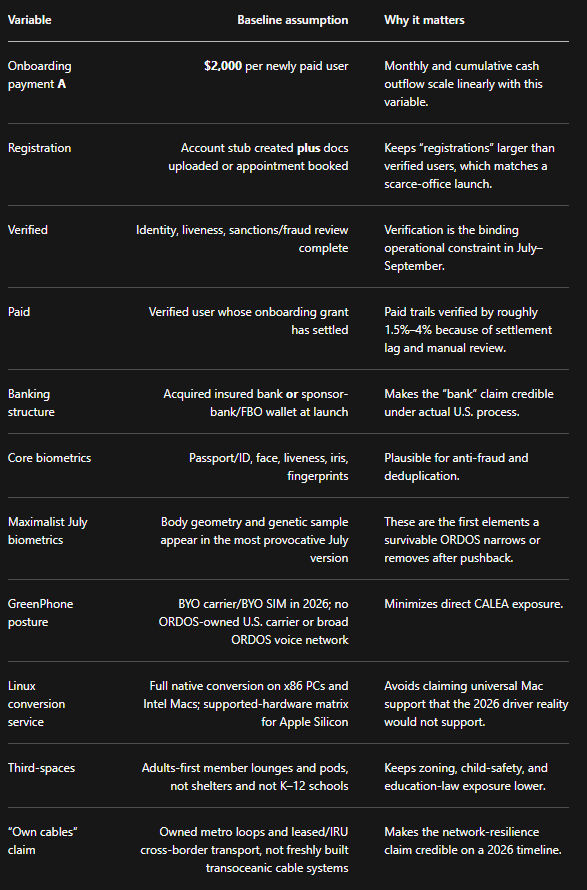
The payout math used throughout is simple: monthly cash outflow = A × newly paid users that month. If the grant falls to $1,500, every cash chart in this report falls by one quarter; if it rises to $2,500, every outflow rises by one quarter.
Month-by-month rollout
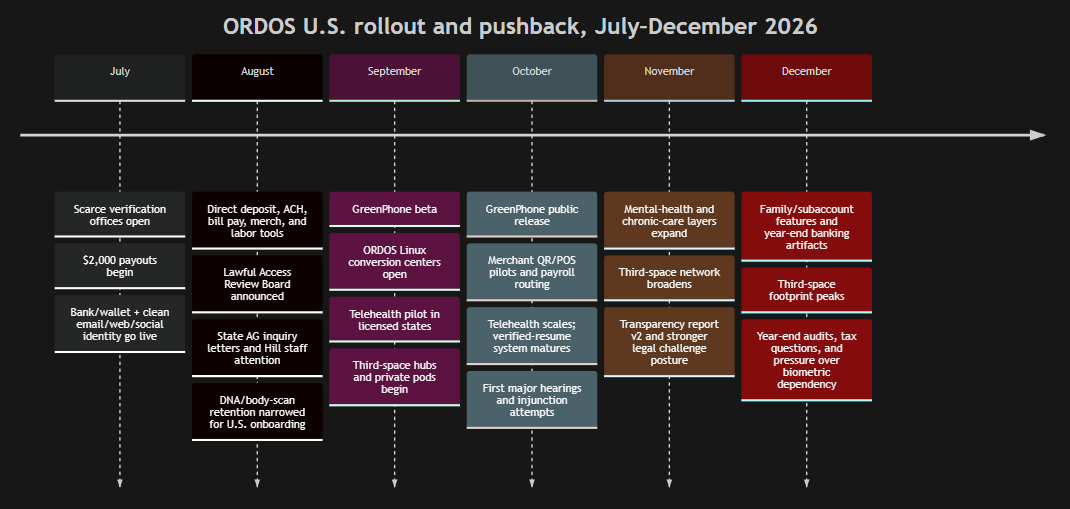
The pacing below is a baseline model. The regulatory events in the final column are not predictions; they are the most plausible pathways under the legal authorities summarized later.
Month |
Services live or materially expanded |
Delivery channels and footprint |
Baseline month-end metrics |
Most plausible regulatory and political developments |
|---|---|---|---|---|
July |
Identity verification; onboarding grant; basic bank/wallet; clean email, static web identity, verified social handle, aliases |
110 fixed verification offices, 40 mobile units, iOS/Android/web pre-enrollment, virtual debit, ATM cash-out, sparse staffed help desks |
3.1M registered; 0.90M verified; 0.87M paid; 1.4M MAU; $1.74B cumulative outflow |
Banks, platforms, and TV personalities treat ORDOS as a foreign inducement scheme; early AG staff inquiries focus on biometrics, inducement, and disclosure quality |
August |
ACH in/out, direct deposit, bill pay, P2P at scale; merch; labor tools; first transparency methodology memo; small third-space pilots |
260 fixed offices, 120 mobile units, 6 pilot lounges, expanded app features, online merch store |
11.4M registered; 4.2M verified; 4.1M paid; 6.8M MAU; $8.2B cumulative outflow |
State AG letters become formal; biometrics are the first attack surface; ORDOS narrows routine U.S. retention of DNA and full-body geometry |
September |
GreenPhone beta; Linux conversion pilots; telehealth beta; merchant QR pilots; pods inside third-spaces |
430 fixed offices, 220 mobile units, 35 service centers, 22 hubs |
20.0M registered; 8.9M verified; 8.7M paid; 12.5M MAU; $17.4B cumulative outflow |
Telehealth creates OCR and state-board exposure; GreenPhone raises the first serious CALEA and “warrant-proof” questions |
October |
GreenPhone general release; Linux conversions broaden; telehealth expands; verified resumes, portfolios, and contract tools mature; payroll routing and merchant acquiring v1 |
590 fixed offices, 300 mobile units, 95 service centers, 55 hubs |
30.0M registered; 14.9M verified; 14.6M paid; 19.4M MAU; $29.2B cumulative outflow |
Hearings, privacy litigation, and one or more state injunction attempts over biometric intake/retention; corporate lobbying intensifies |
November |
Mental-health and chronic-care workflows; labs and referrals; more pods; stronger dispute tools; second transparency report |
720 fixed offices, 360 mobile units, 160 service centers, 120 hubs |
39.5M registered; 20.7M verified; 20.3M paid; 25.0M MAU; $40.6B cumulative outflow |
Prudential and consumer-finance exam pressure grows; CBP and border-search reality become part of GreenPhone’s risk disclosure story |
December |
Family plans and subaccounts; year-end statements; chronic-care follow-up; widest third-space footprint; holiday disbursement products |
780 fixed offices, 400 mobile units, 215 service centers, 180 hubs |
48.0M registered; 26.0M verified; 25.6M paid; 30.2M MAU; $51.2B cumulative outflow |
Tax characterization questions, annual privacy and bank audits, and a broader “foreign biometric dependency” political narrative |
Service catalog and delivery channels
The rollout is cleanest when ORDOS treats itself as a civic utility with stacked surfaces rather than a single consumer app. The table below lists the services already established in the scenario, with a baseline December scale, likely responses, and realistic mitigation tactics.
Service block |
First meaningful month |
Precise scope |
Main delivery channels |
Baseline scale by Dec. 2026 |
Primary risks and likely responses |
Plausible mitigation, PR, and legal strategy |
|---|---|---|---|---|---|---|
Identity verification and onboarding grant |
July |
Legal-name account creation, government-ID/passport capture, live face/iris/fingerprint match, liveness, appointment-based onboarding, post-verification $2,000 grant; body scan and genetics appear only in the maximalist July variant |
Verification offices, mobile units, pre-enrollment in app/web, staffed escalations |
48.0M registered; 26.0M verified; 25.6M paid |
Fraud rings, “foreign identity layer” panic, AG inquiries over inducement and biometrics |
Publish retention schedule; human appeals; no-sale pledge; sharply narrow DNA/body retention by August |
Banking and wallet |
July |
Deposit account or FBO wallet, ACH, internal P2P, virtual debit, ATM cash-out, later bill pay, direct deposit, FedNow/RTP-style instant disbursement, merchant QR, payroll routing |
ORDOS app, virtual card, bank partner or bank subsidiary, merchant QR/POS kits |
25.6M funded accounts; ~17.5M active spenders; ~220k pilot merchants |
Prudential exams, card-network leverage, CFPB disclosure scrutiny, processor pressure |
Use insured-bank or sponsor-bank structure; precise fee/error disclosures; strong compliance program; maintain reserves and partner redundancy |
Clean social, email, and web identity |
July |
ORDOS email, static profile/site, verified social handle, alias layer on top of real verification, clean messaging and groups, exportable contact graph |
Mobile app, web, later desktop client |
~34.0M activated at least one identity product; ~21.0M monthly social actives |
Moderation load, anti-spam abuse, platform retaliation, “shadow citizenship” rhetoric |
No ads; chronological defaults; strong abuse controls; legal-verification-under-alias design; exportability |
Labor tools |
August |
Interview invoice templates, verified resume and portfolio, contract parser, working-hours boundary tools, job-post pay-checking and simple negotiation scaffolds |
App/web PDFs, browser tools, verified profile export |
~8.5M used at least one labor tool |
Employer backlash, FCRA/UDAAP concerns if tools drift into scoring, HR blacklists |
Stay user-side only; no secret scoring; explicit “not legal advice”; give employers access only with user consent |
GreenPhone |
September beta, October broad release |
Hardened handset and OS; privacy-first network instrumentation; app/sensor controls; alerting around tracker and intrusion attempts; no default universal decrypt key |
Service centers, direct shipment, setup desks inside hubs |
~3.2M active devices |
DOJ “warrant-proof” criticism, carrier hostility, app-store pressure, hype outrunning technical reality |
Market as “unusually visible and resistant,” not omniscient; stay BYO carrier through 2026; publish threat-model limits |
ORDOS Linux conversion service |
September |
Backup, wipe, cryptographic reinstall, hardened Linux build, ORDOS identity tools, office suite, browser, rollback option |
Service centers and bookable tech benches |
~0.90M converted devices |
Warranty/support fear campaigns; driver issues; Apple-hardware incompatibility |
Supported-hardware matrix; rollback guarantee; dual-boot/hardening for unsupported Macs; clean disclaimers |
Medical and telehealth |
September beta, October scale |
Primary-care triage, mental health, chronic follow-up, labs/referrals, prescription routing, private booths in hubs |
App, care coordinators, telehealth pods, partner clinicians |
~1.60M patients served |
HIPAA, licensure, DEA/state-board exposure, malpractice risk |
HIPAA BAAs, separate PHI stack, state-limited launch, non-controlled meds first, patient-location verification |
Third-spaces and pods |
August pilots, September scale |
Community lounges, quiet work booths, interview rooms, telehealth pods, classes/events, lockers and civic-support counters |
Physical hubs near offices and service centers |
180 hubs; ~3.0M unique monthly visitors in December |
Zoning, nuisance complaints, labor-politics suspicion, security incidents |
Code-compliant operations, adult-first model, visible rules, trained staff, ADA and fire-code rigor |
Merch and memetic products |
August |
Trolling office merch, parody bins, stickers, mugs, webcam covers, slogan shirts, paper templates |
Online store plus in-center retail |
~2.4M purchasers |
Trademark complaints, reputational countercampaigns |
Use parody/non-identical marks; legal review; short-drop culture; keep merch outside app-store dependence |
Lawful-access oversight board and transparency reports |
August |
Independent review board, request taxonomy, challenge policy, transparency reports, invalid-request logging, public methodology |
Policy portal, quarterly report site, legal-request gateway |
Platform-wide governance layer covering all accounts |
Government claims of obstruction; critics call it theater |
Never claim veto power over courts; use retired judges/auditors; publish categories, challenge rates, and minimization rules |
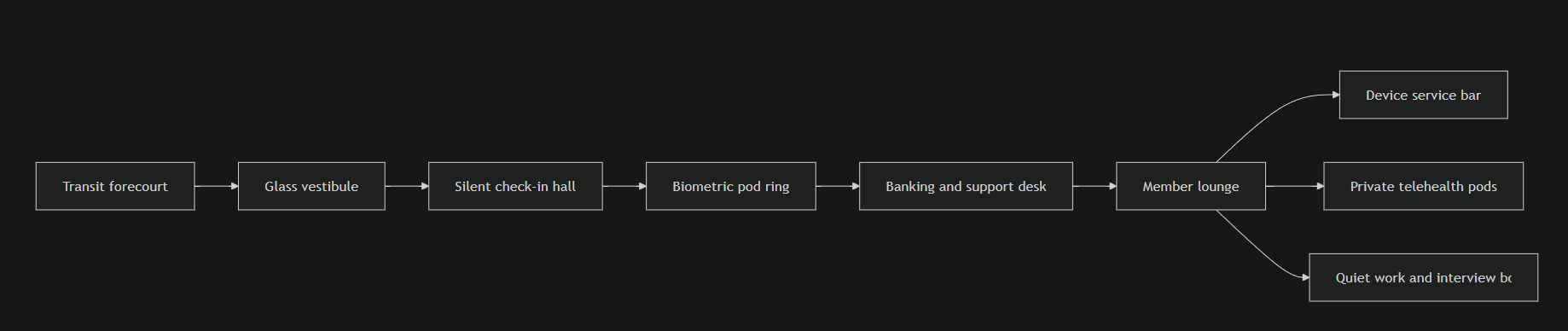
A GreenPhone that is politically explosive but still technically believable needs explicit limits, not superhero copy.
GreenPhone feature or design choice |
What it plausibly does in 2026 |
What it does not honestly promise |
|---|---|---|
| Network observability layer |
Charts outbound domains, SDK calls, tracker patterns, certificate changes, suspicious DNS, and unusual data egress |
It cannot perfectly identify every caller as “state,” “corporate,” or “criminal,” and it cannot detect every zero-click exploit |
| Per-app sensor and permission firewall |
Gives users clear mic/camera/location/network/contact controls and alerts on unusual access |
It cannot save a user from granting reckless permissions or from kernel/baseband compromise below the OS |
| Integrity and provenance |
Verified boot, signed OS, profile-install warnings, sideload provenance, root/tamper alerts |
It cannot guarantee detection of hardware-level compromise or every supply-chain event |
| Suspicious-activity heuristics |
Flags MDM enrollment attempts, accessibility abuse, clipboard polling, repeated crash/exploit patterns, and rogue certificates |
It cannot guarantee attribution and may produce false positives on ordinary enterprise traffic |
| Corporate-resistance defaults |
Disables background ad IDs, cuts unnecessary telemetry, surfaces scraping and analytics attempts more aggressively than mainstream phones |
It cannot stop carriers or third-party apps from collecting their own network/billing metadata if the user uses them |
| Lawful-access posture |
ORDOS can respond to valid legal process for metadata, billing records, support logs, and any user-enabled cloud backups or recovery features |
It should not claim provider access to default device-content plaintext; if it has that, the privacy story collapses |
The legal floor under the device story is simple. DOJ publicly continues to frame strong device encryption as a “warrant-proof” problem; FCC materials make clear that direct CALEA obligations attach most cleanly when a provider is operating common-carrier, facilities-based broadband, or interconnected VoIP services; and CBP policies still permit border searches of devices, including basic searches without suspicion and advanced searches with reasonable suspicion or national-security concerns.
Legal and regulatory posture
The table below is the core legal map. It shows what the relevant authorities say, and the narrowest plausible conclusion for ORDOS inside the United States.
| Topic | Official baseline | ORDOS conclusion | Key authorities |
|---|---|---|---|
Banking and wallet status |
New banks need formal charter/deposit-insurance approval, and banks using third parties for marketing, payments, recordkeeping, servicing, or complaint handling face active supervisory scrutiny. Banks must run CIP, AML, suspicious-activity reporting, sanctions controls, and consumer EFT/Reg E compliance. |
A July launch that calls itself a “bank” is most credible as an acquired insured bank, a pre-existing subsidiary, or a sponsor-bank/FBO wallet stack. “They can’t shut us down” is too strong; “it is harder to close us fast because the fight moves into prudential and payments law” is the rigorous version. |
|
| CALEA and communications |
FCC materials say CALEA applies to common carriers, facilities-based broadband providers, and interconnected VoIP providers. FCC guidance also says facilities used solely for information services are not subject to CALEA, and resellers are responsible only for their own facilities. Covered entities file SSI plans through CEFS. FCC’s 2025 action also pushed a stronger network-security reading of CALEA section 105. |
GreenPhone should stay a handset/OS product with BYO carrier in 2026. If ORDOS adds its own access network, broad MVNO layer, or true interconnected voice service, CALEA exposure rises sharply and the compliance burden becomes much more direct. |
|
| FISA, FISC, and cross-border orders |
The FISC reviews government applications and certifications for foreign-intelligence collection. DOJ’s CLOUD Act materials make clear that U.S. law can reach electronic information held by U.S.-based global providers even where the data is stored abroad. |
ORDOS may build a lawful-access board and publish transparency reports, but the board is governance overlay, not sovereign veto. Cross-border replication in Canada or Mexico helps resilience; it does not dissolve U.S. leverage if U.S. entities, staff, or service providers remain in the chain. |
|
| CBP and border-search reality |
CBP states that electronic devices crossing the border may be searched. Its 2026 directive summary says basic searches can occur without suspicion, advanced searches require reasonable suspicion or a national-security concern, and officers should not intentionally access data stored solely remotely. |
GreenPhone marketing must disclose that border crossings remain a real vulnerability. “No border exposure” is not plausible. |
|
| State biometric privacy |
Illinois BIPA requires a public retention schedule and tightly bounded disclosure and is animated by the idea that biometrics cannot be changed once compromised. Washington requires notice/consent, reasonable care, and bounded retention for commercial enrollment. Texas also regulates capture of biometric identifiers for commercial purposes. California’s 2026 data-broker deletion regime matters if a business is brokering personal data. |
The launch survives best if ORDOS uses only the minimum anti-fraud biometric set in U.S. onboarding, publicly commits to no sale, and moves DNA/body geometry out of default enrollment almost immediately. |
|
| Telehealth |
Telehealth vendors used by covered providers must comply with HIPAA and sign BAAs. Cross-state practice depends on state licensure or equivalent pathways. DEA/HHS telemedicine flexibilities for controlled substances currently run through December 31, 2026. |
ORDOS can plausibly launch telehealth only as a state-limited, licensed-provider network with strong PHI segregation. A national one-license telemedicine fantasy is not credible. |
Two consequences fall out of this immediately. First, routine DNA and whole-body retention are not “useful extras”; they are the cleanest invitation to state AG action. Second, the “Congress opens a side door and approves hacking” version of lawful access is the wrong institutional picture. Congress can oversee and hold hearings; the actual legal pathways run through courts, the FISC, and provider-specific obligations.
Technical architecture and operations
The platform only feels inevitable if its infrastructure is segmented, redundant, and realistic. “Hosting inside and outside the U.S.” is plausible. “We have our own cables everywhere” is plausible only if read as metro fiber ownership plus long-term IRUs or leased dark-fiber/backhaul capacity, not as a brand-new undersea-cable empire materializing for a July launch.
Layer |
Baseline design |
Why it matters |
|---|---|---|
Identity and biometric vault |
Active-active U.S. regions in Virginia, Texas, and Oregon; encrypted shard replicas in Ontario and Querétaro; legal identity separated from alias/social graph; split-key custody |
Keeps KYC usable while reducing the blast radius of a single-region compromise or overbroad internal access |
Bank core and payout ledger |
U.S.-resident transactional ledger with two hot regions; sponsor processor or acquired-bank core; separate payout queue and reconciliation stack |
Banking exams and incident response become tractable only if the money ledger is simpler than the consumer-social surface |
Social, email, and static-web stack |
Multi-region object storage, CDN fronting, export API, alias-directory separation, PWA fallback |
Reduces app-store choke risk and lets ORDOS keep the identity layer clean and exportable |
Telehealth PHI environment |
U.S.-localized primary storage, separate tenancy, separate keys and audit logs, strict walling-off from social and labor features |
Without clean PHI segregation, the medical product becomes the fastest way to sink the whole platform |
GreenPhone security telemetry |
Mostly on-device processing; redacted alert envelopes to ORDOS SOC; optional crash and forensic upload |
Preserves privacy posture while still giving ORDOS enough signal to issue useful alerts and dashboards |
| Backups and disaster recovery |
Immutable hourly ledger snapshots; nightly WORM object backups; periodic offline archive; code escrow outside primary U.S. cloud |
Makes “resilience” a real operational claim rather than a slogan |
| Transport and backbone |
Owned metro loops where justified; leased long-haul/IRU backhaul into Canada and Mexico; multiple transit providers |
This is the credible version of the “own cables” boast |
| Client distribution |
iOS, Android, web/PWA, desktop installers, in-person provisioning at offices and service centers |
Reduces dependence on any single app store or OEM partner |
The cross-border story still has a ceiling. DOJ’s CLOUD Act description exists precisely because U.S.-based global providers can hold responsive electronic information abroad. In other words, foreign redundancy is a resilience strategy, not a magical universal-jurisdiction antidote.
The biometric stack is where ORDOS can either look disciplined or deranged.
Data element |
July maximalist use |
Survivable U.S. posture by September |
Principal risk |
|---|---|---|---|
Passport / government ID |
Core KYC source |
Retain as core KYC source |
Ordinary KYC spoofing and forged-document risk |
Live face geometry and liveness |
Core dedup and anti-impersonation |
Retain |
Medium privacy risk but highly defensible for fraud control |
Iris / eye scan |
High-entropy dedup |
Retain only if clearly disclosed and tied to anti-fraud |
Higher user unease, but still easier to defend than DNA |
Fingerprints |
Core anti-fraud and recovery factor |
Retain with strict policy |
Strong fraud utility; serious breach optics |
Body scan / whole-body geometry |
July “full envelope” identity signature |
Convert to ephemeral liveness only or remove from routine onboarding |
High PR and AG risk; weak necessity case |
Genetic sample |
July “maximal certainty” or future medical tie-in |
Remove from core onboarding or isolate behind explicit medical consent, separate storage, and no cross-purpose use |
The single highest-risk element in U.S. rollout |
History, address, device metadata |
Fraud scoring and sanction checks |
Retain with disclosure and minimization |
Consumer-protection, dark-pattern, and overprofiling concerns |
Month |
Fixed offices |
Mobile units |
Effective daily completions per fixed site |
Effective daily completions per mobile unit |
Estimated monthly verification capacity |
Baseline new paid users |
Utilization |
|---|---|---|---|---|---|---|---|
July |
110 |
40 |
250 |
120 |
1.00M |
0.87M |
86.9% |
August |
260 |
120 |
330 |
170 |
3.29M |
3.23M |
98.1% |
September |
430 |
220 |
330 |
170 |
5.38M |
4.60M |
85.5% |
October |
590 |
300 |
340 |
180 |
7.89M |
5.90M |
74.8% |
November |
720 |
360 |
350 |
180 |
9.50M |
5.70M |
60.0% |
December |
780 |
400 |
330 |
160 |
9.96M |
5.30M |
53.2% |
Payments and fraud layer |
July |
August–September |
October–December |
|---|---|---|---|
Core rails |
Internal ledger, ACH in/out, virtual debit, ATM cash-out |
Direct deposit, bill pay, internal P2P at scale, instant receive rails |
FedNow/RTP-style instant send, payroll routing, merchant QR/POS settlement |
Merchant acceptance |
None beyond card spend |
Pilot QR acceptance for small merchants |
Small-business POS kits, basic merchant acquiring, payout dashboards |
Fraud controls |
Face/ID/fingerprint/iris dedup, sanctions screening, velocity limits, manual review |
Device attestation, geofence consistency, behavioral scoring, merchant reserves |
Stronger graph analysis, payroll anomaly checks, dispute analytics, rolling risk tiers |
Compliance controls |
CIP, AML onboarding, sanctions checks, basic suspicious-activity monitoring |
Expanded SAR tooling, complaints escalation, Reg E dispute handling |
Formal examination readiness, third-party monitoring, annualized audit trail |
User protections |
Cooling-off periods for large outbound transfers, appeal path for false positives |
Better receipts/disclosures, card dispute and refund flows |
Family/subaccount controls, payroll error-resolution tooling, merchant refund workflow |
Adoption and cash-flow scenarios
The charts below are modeled outputs, not empirical forecasts. They simply show how fast ORDOS becomes a national financial event if verification capacity scales and the $2,000 grant continues unchanged.
The baseline path is intentionally aggressive but still bounded by office throughput. It assumes that July proves the payout is real, August turns registration into a social fact, and September through December shift the conversation from “is this fake?” to “what category of institution is this becoming?”
Month |
Registered |
Verified |
Paid |
Monthly active users |
Monthly cash outflow at $2,000 |
|---|---|---|---|---|---|
July |
3.10M |
0.90M |
0.87M |
1.40M |
$1.74B |
August |
11.40M |
4.20M |
4.10M |
6.80M |
$6.46B |
September |
20.00M |
8.90M |
8.70M |
12.50M |
$9.20B |
October |
30.00M |
14.90M |
14.60M |
19.40M |
$11.80B |
November |
39.50M |
20.70M |
20.30M |
25.00M |
$11.40B |
December |
48.00M |
26.00M |
25.60M |
30.20M |
$10.60B |
The comparative scenario table below gives the requested July–December range. “Registered” and “paid” are cumulative by month-end. “Outflow” is the cash paid that month, not cumulative total.
Month |
Conservative registered |
Conservative paid |
Conservative monthly outflow |
Baseline registered |
Baseline paid |
Baseline monthly outflow |
Aggressive registered |
Aggressive paid |
Aggressive monthly outflow |
|---|---|---|---|---|---|---|---|---|---|
July |
1.8M |
0.60M |
$1.2B |
3.1M |
0.87M |
$1.74B |
4.5M |
1.30M |
$2.6B |
August |
6.0M |
2.10M |
$3.0B |
11.4M |
4.10M |
$6.46B |
15.8M |
5.60M |
$8.6B |
September |
11.5M |
4.80M |
$5.4B |
20.0M |
8.70M |
$9.2B |
29.0M |
12.00M |
$12.8B |
October |
17.0M |
7.50M |
$5.4B |
30.0M |
14.60M |
$11.8B |
44.0M |
20.50M |
$17.0B |
November |
22.0M |
10.20M |
$5.4B |
39.5M |
20.30M |
$11.4B |
59.0M |
30.20M |
$19.4B |
December |
26.0M |
12.80M |
$5.2B |
48.0M |
25.60M |
$10.6B |
73.0M |
39.00M |
$17.6B |
At the $2,000 default, cumulative payout reaches $25.6B in the conservative case, $51.2B in the baseline case, and $78.0B in the aggressive case by year-end. If ORDOS wants the politics of speed without the optics of “buying a country,” the cleanest lever is not lowering the grant first. It is capping monthly verified slots via appointment supply and keeping the winter rollout bottlenecked by physical throughput.
Additional non-monetary services and risk expansion
The best additions after December are the services that make ORDOS feel less like a cash dispenser and more like a replacement civic interface without immediately triggering carrier, DEA, or child-safety wars. The risk columns below assume the service is offered to U.S. users. “Outside U.S.” means offered primarily abroad or anchored in non-U.S. infrastructure; that lowers some pressure, but it does not erase U.S. leverage when Americans are the target market.
Candidate service |
Value to ORDOS members |
Inside-U.S. risk |
Outside-U.S. risk |
Why the risk level looks this way |
Recommendation |
|---|---|---|---|---|---|
Identity export and portability locker |
One-click export of profile, email archive, social graph, bank statements, and verifications |
Low |
Low |
Mostly a user-rights and retention problem, not a new regulated market |
Strong recommendation |
Appointment concierge and document-routing |
Helps users book DMV, clinic, benefits, banking, and court-document appointments; adds reminders and required-doc checklists |
Low to Medium |
Low |
Operationally useful, little new regulatory payload if ORDOS stays advisory |
Strong recommendation |
Secure family archive |
Stores wills, emergency contacts, directives, and recovery docs |
Medium |
Medium |
Sensitive records invite legal-process and privacy fights but not immediate sectoral retaliation |
Good candidate if legally segmented |
Student credential and portfolio wallet |
Verifiable transcripts, work samples, licenses, and skill attestations |
Medium |
Medium |
Education and employment overlap, but the product can stay document-centric rather than score-centric |
Good candidate if no hidden ranking |
Transit and benefits wallet |
Fare passes, campus access, meal/benefit credits, digital IDs |
Medium |
Low to Medium |
Public-sector integration and procurement politics matter more than constitutional conflict |
Good candidate in limited pilots |
Tenant dossier and rent-reporting service |
Verified rental applications, proof of income, rent history |
Medium to High |
Medium |
Fair-housing and credit-reporting/FCRA-style concerns rise quickly if ORDOS begins scoring or brokering |
Proceed only if user-controlled and score-free |
Encrypted cloud drive and secure messenger |
Strong everyday utility; deepens identity stack |
HIGH |
Medium to High |
This is where “warrant-proof” politics, CLOUD Act fights, and platform hostility heat up fast |
Delay for U.S. launch; safer as a later or offshore-adjacent product |
GreenSIM / MVNO / home broadband |
Turns ORDOS into a true communications provider |
HIGH |
HIGH |
Carrier retaliation, FCC exposure, and CALEA obligations intensify immediately |
Not recommended for 2026 U.S. rollout |
Mail-order pharmacy and controlled-substance telemedicine |
Powerful retention tool and real user value |
HIGH |
HIGH |
DEA, state pharmacy boards, telehealth licensure, and malpractice exposure all spike |
Launch only after slower medical maturation, if at all |
K–12 learning pods and minor accounts |
Could build deep ecosystem dependence |
HIGH |
Medium to High |
Child privacy, education politics, staffing, and ideological blowback make this an extraordinarily hot front |
Avoid in 2026; maybe never as a core U.S. service |
Strike-fund and legal-defense wallet features |
Converts labor tools into movement infrastructure |
HIGH |
Medium to High |
This is not illegal by default, but it is one of the clearest political-retaliation magnets |
Separate legally and institutionally, or avoid |
The single best low-drama addition is identity export and portability. It deepens loyalty, reinforces the “clean civic utility” frame, and implicitly indicts incumbent platforms without forcing ORDOS into a fresh regulatory war. The single most combustible addition is a real mobile network or broad encrypted cloud/messaging layer. Those are the products most likely to move ORDOS from “provocative foreign bank-platform” to “the thing the national-security and telecom apparatus decides must be made an example of.”
…
Before looking at the individual services, it is necessary to understand what ORDOS is trying to accomplish. The mistake, especially among American analysts trained to look for quarterly logic, is to ask where the margin is. Where is the profit? Where is the monetization? Where is the sustainable unit economics? These are not foolish questions, but in the first phase they are the wrong questions. ORDOS is not initially trying to generate profit in the ordinary sense. It is doing something closer to what Amazon did in its imperial period, only colder and more politically aware: it is using capital, logistics, patience, and ruthlessly disciplined interface design to destroy alternatives before alternatives understand they are in a war.
But ORDOS is not merely dumping cheap services into the market. That would be disruptive, but not profound. The deeper operation is psychological and institutional. ORDOS is a vague externality, an outside force with enough money, preparation, legal armor, and strategic ambiguity to behave like a saboteur without announcing itself as one. Its primary sabotage is not blowing anything up. It is leveraging the immense, largely unorganized hatred many Americans already feel toward the systems that govern their lives. ORDOS does not create that hatred. It discovers it, cleans it, packages it, gives it an account, and routes it through services that work.
This is the crucial distinction. At present, revolt in the United States is difficult to imagine at scale, not because anger is absent, but because anger is fragmented, surveilled, exhausted, mediated, distracted, indebted, algorithmically inflamed, institutionally mistrusted, and socially atomized. People hate the hospital bill, the bank fee, the employer lie, the school collapse, the platform sludge, the insurer’s denial, the spam, the landlord, the fake job posting, the call center, the bureaucratic loop, the food that sickens them, and the entire smug architecture of being told that their misery is freedom. But hatred does not automatically become politics. Most of the time it becomes depression, conspiracy, obesity, rage posts, addiction, burnout, domestic collapse, or one more exhausted person staring at a phone in a parked car.
ORDOS understands this. It does not ask Americans to revolt. It offers them an alternative. That is far more dangerous.
The alternative is not pure. It is not democratic. It is not innocent. It is not necessarily benevolent. It is, in many respects, obscene: a foreign-backed private administrative stack sliding under the daily machinery of a sovereign country and offering its people a cleaner bargain than the institutions that claim to represent them. But because the old bargain has become so degraded, ORDOS does not need to be good. It only needs to be less openly predatory. It only needs to answer faster than the clinic, charge less than the bank, humiliate less than the employer, spam less than the platform, feed better than the supermarket, educate more coherently than the school, and recognize more human usefulness than the labor market.
That is the sabotage. Comparison made material.
ORDOS enters at no margin, or negative margin, because the early losses are not losses in the strategic sense. They are acquisition costs, legitimacy costs, displacement costs, the price of manufacturing a population. Every dollar spent on onboarding, clinics, clean communication, GreenPhones, Linux conversions, thirdplaces, learning pods, low-fee accounts, ORDOSMART groceries, medicine access, and contribution infrastructure is a dollar spent teaching Americans that the old systems were not merely flawed but unnecessarily cruel. ORDOS is not simply buying users. It is buying contrast. It is buying the moment when a diabetic, a teacher, a gig worker, a mother, a student, a pensioner, or Cody himself asks the forbidden question: why was this not already normal?
Once that question spreads, ORDOS has achieved the first stage of the operation.
It does not need to replace every hospital. It needs to make hospitals look archaic, hostile, and financially sadistic by comparison. It does not need to replace the entire education system. It needs to make enough learning pods work well enough that parents and teachers begin asking why classrooms have been used as containment warehouses for social collapse. It does not need to replace the postal system completely. It needs to deliver enough necessary things cleanly, predictably, and without contempt that ordinary delay starts to look political. It does not need to replace every bank. It needs to make junk fees, frozen accounts, overdraft traps, and credit-score humiliation feel like relics of a barbaric domestic priesthood. It does not need to replace every social platform. It needs to make ad-driven algorithmic filth feel like smoking indoors at a daycare.
This is why the undercutting has to be aggressive. ORDOS is not competing politely in markets. It is attacking trust relationships. It undercuts hospitals, pharmacies, payment processors, schools, banks, platforms, retailers, recruiters, device ecosystems, delivery networks, and local civic infrastructure not merely by being cheaper, but by being less insulting. The price matters, of course. Americans are broke enough that price always matters. But price alone does not explain the reaction. What ORDOS sells, beneath the service bundle, is relief from ritualized degradation.
That relief produces hatred after the fact. This is important. Americans do not fully hate the old system until they have experienced a temporary alternative. Before comparison, suffering is often private. People think they are unlucky, stupid, badly organized, medically unfortunate, financially irresponsible, socially awkward, insufficiently credentialed, insufficiently resilient, insufficiently adult. Then ORDOS gives them one clean transaction, one answered message, one cheap clinic visit, one account without nonsense, one loaf of actual bread, one room where they are allowed to sit without being harvested, one phone that shows the swarm of corporate intrusion, one learning pod where a child is actually noticed, one contribution metric that recognizes some useful act the economy ignored. After that, the old system does not feel normal anymore. It feels exposed.
That is when hatred matures from mood into memory.
After six months, or a year, or two years, the American public does not merely prefer ORDOS services in certain domains. Millions begin to look back at the old arrangements with disgust. They remember the insurer’s phone tree differently. They remember the bank fee differently. They remember school fundraising differently. They remember the employer’s unpaid interview assignment differently. They remember the grocery aisle differently. They remember the app that sold their attention differently. They remember the doctor they could not afford differently. ORDOS has not only captured users. It has rewritten the emotional interpretation of what came before.
That is the point.
ORDOS is trying to create a constituency whose loyalty is not ideological but comparative. These people may distrust ORDOS. They may joke about kidneys, foreign control, biometric doom, and the fact that every service centre looks like a passport office designed by vampires with taste. But they know something now. They know the old order could have treated them better and did not. They know the cruelty was not technologically necessary. They know the confusion was profitable. They know the humiliation was designed into the interface. They know the scarcity was managed. They know the contempt was structural. Once people know that, they may never become revolutionaries, but they become poor material for the old myths.
This is why ORDOS does not need to announce a revolution. It only needs to perform one administratively. It replaces speeches with onboarding. It replaces ideology with service bundles. It replaces manifestos with clean accounts. It replaces party discipline with customer retention. It replaces mass mobilization with verified membership. It replaces the barricade with the help desk, the clinic desk, the GreenPhone counter, the Linux migration table, the learning pod, the thirdplace, the grocery shelf, the wallet balance, the Fulfillment Point, the quiet little notification saying that something has been approved.
By the time the old system understands the attack, it has already been made to look ridiculous. It can denounce ORDOS as foreign, dangerous, anti-competitive, biometric, predatory, subversive, and hostile, and much of that may be true. But the denunciation lands in the ears of people who have just been treated better by the thing being denounced. That is the strategic cruelty of ORDOS. It forces every defender of the old order to explain why the public must return to systems that made contempt feel normal.
So before the specific rollout of each item, this must be understood: ORDOS is not a company expanding a product line. It is a hostile paradigm expanding a comparison field. Each service is a blade. Banking cuts into financial humiliation. Medicine cuts into medical terror. Education cuts into institutional warehousing. GreenPhone cuts into surveillance normality. Linux cuts into corporate endpoint dependency. ORDOSMART cuts into food degradation. Thirdplaces cut into loneliness. Fulfillment Points cut into the dollar’s claim to be the only serious language of value. Clean socials cut into the platform sludge. Housing, if it comes, cuts into rent extraction. Labor tools cut into employer supplication. None of these blades has to kill the incumbent system outright. They only have to draw enough blood that the public can see where the body was vulnerable all along.
This is what ORDOS is trying to accomplish. It is not trying to make Americans love it. It is trying to make Americans hate what they used to tolerate.
Example: Greenphone
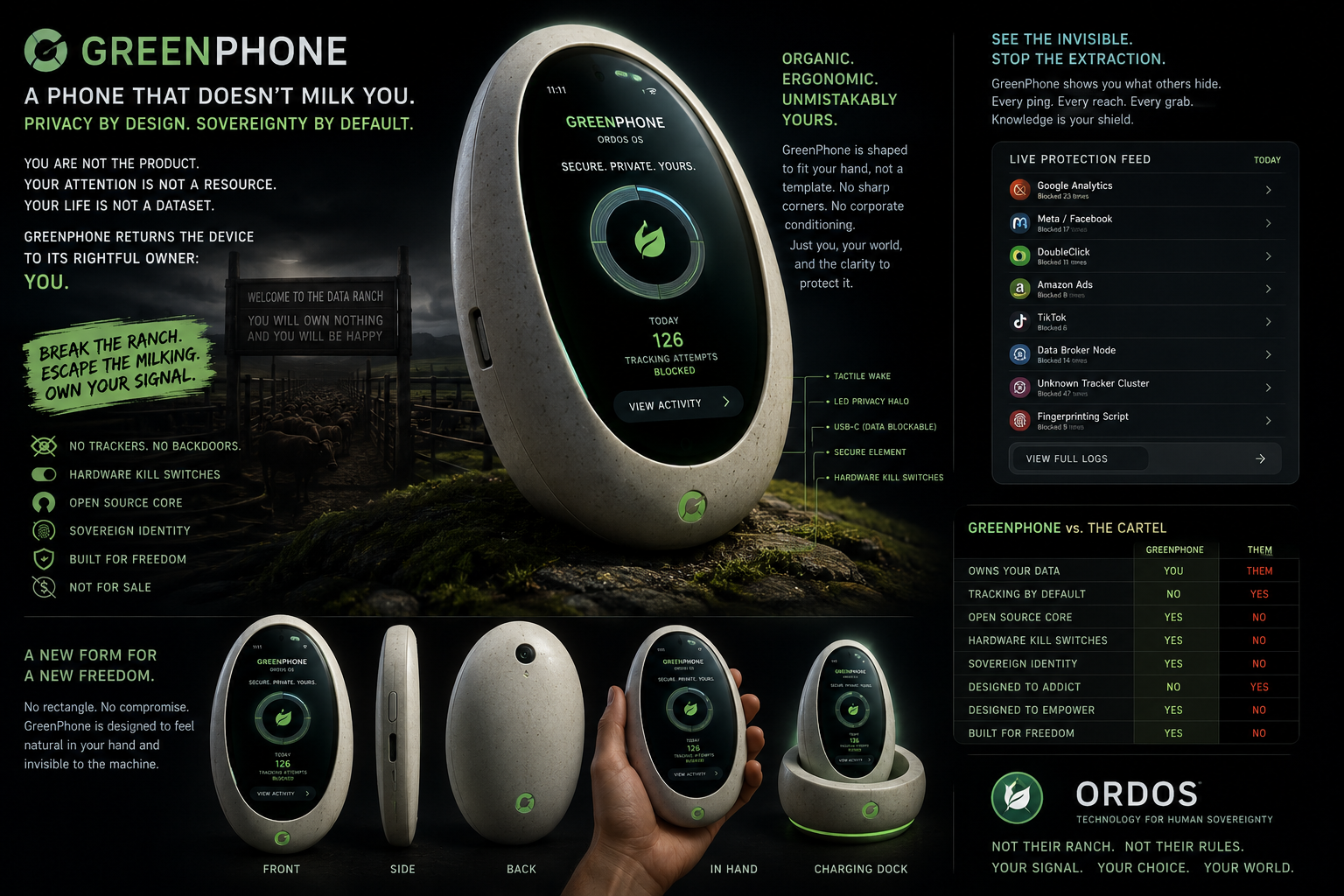
GreenPhone is the moment ORDOS stops being a bank with weird politics and becomes a philosophy you can hold in your hand. The onboarding payment gets attention, the clinics create relief, the thirdplaces create loyalty, the clean socials create migration pressure, but GreenPhone does something more intimate. It enters the one object most people touch more often than they touch another human being and says, with the bland cruelty of an engineer who has seen the logs, that the existing arrangement is insane. Not flawed. Not imperfect. Insane. A person buys a phone, pays for service, installs apps, carries the device everywhere, sleeps beside it, uses it for work, medicine, banking, love, family, navigation, photos, sex, fear, boredom, and private thought, and the entire corporate order has somehow normalized the idea that this object should spend its life reporting on them.
GreenPhone’s viral philosophy is therefore simple: the phone should belong to the person holding it. This should not sound revolutionary, which is precisely why it does. The existing mobile ecosystem has spent fifteen years teaching users that ownership is a nostalgic word, something from the era of screwdrivers and local files. You do not own the device; you license the operating system, rent access through an account, negotiate with app stores, submit to carrier terms, accept dark-pattern permissions, sync into clouds, bleed telemetry, and learn to treat updates, lockouts, account suspensions, compatibility changes, app removals, search rankings, algorithmic recommendations, advertising identifiers, and location histories as weather. You may have paid for the phone. You may hold the phone. You may photograph your dying mother with the phone. But the phone is not quite yours. It is a ranch gate with glass on it.
GreenPhone attacks that arrangement by refusing to be polite about it. It does not merely claim to be private. Many companies claim privacy now, in the same way old cigarette ads claimed freshness, with a smiling family and a faint undertone of respiratory litigation. GreenPhone makes the conflict visible. Every app request, every tracker, every strange background connection, every permission grab, every data broker callout, every suspicious certificate event, every network anomaly, every attempt to scrape device state or correlate identity across services is displayed in language a user can understand. The phone does not say, “trust us.” It says, “look.” It shows the swarm. It gives the user a dashboard not of abstract security scores but of attempted contact: who tried to reach the device, what they wanted, whether the request was blocked, whether the pattern resembled advertising, analytics, fraud scoring, corporate telemetry, malware, carrier metadata, or something stranger. For the first time, the ordinary person sees the pasture fence.
That is the viral hook. GreenPhone turns surveillance from background radiation into social knowledge. The first screenshots are ridiculous. Users post images showing that a flashlight app attempted to contact fourteen domains before lunch. A weather app wants location even when closed. A shopping app pings a broker after midnight. A harmless little “wellness” app behaves like a depressed informant. A game for children vomits telemetry into the cloud with the moral restraint of a hyena in a butcher shop. The screenshots become memes, then arguments, then consumer disgust. People begin saying, “my old phone was filthy.” That word matters. Filthy. Once a technology becomes associated with filth, not merely danger, the monopoly aura begins to crack. The old device stops feeling premium. It starts feeling handled.
The model is objectively better in the one way that matters before all others: it reduces involuntary extraction. It may be less polished in some areas at first. It may lack certain apps. It may frustrate users who have grown accustomed to the silky captivity of the Apple and Google ecosystems. It may require new habits. But it offers a better baseline moral contract. The phone does not treat the user as quarry. It does not assume that every idle second must be monetized, every identity signal must be cross-referenced, every gesture must be profiled, every dependency must be deepened, every anxiety must be captured, and every interface must become a little toll booth guarded by smiling typography. It replaces a predatory convenience model with a defensive convenience model. That shift is enormous.
GreenPhone undercuts Apple by attacking the sanctity of the walled garden. Apple’s great genius was not merely design. It was paternalism at scale: the promise that users could be safe, stylish, and frictionless if they accepted a controlled world where Apple remained the final adult in the room. This bargain worked because the alternative was often ugly, fragmented, insecure, and vulgar. GreenPhone does not try to be “more Apple than Apple” in the same aesthetic register. That would be suicide. Instead it reframes Apple as a luxury containment system: beautiful, yes; secure in some ways, yes; privacy-branded, yes; but still built around account dependency, app-store control, cloud gravity, repair politics, ecosystem lock-in, and the quiet assumption that the user is safest when not quite sovereign. GreenPhone says: pretty cage, shame about the bars.
It undercuts Google even more viciously, because Google’s empire depends on making data extraction feel like oxygen. Search, maps, mail, identity, analytics, ads, mobile operating systems, app infrastructure, location services, cloud backups, browser behavior, video, documents, everything folded into a single ambient intelligence that appears helpful because it is always already inside the room. Google does not merely know things. Google has trained the public to experience being known as convenience. GreenPhone attacks the emotional foundation of that arrangement. It says that convenience purchased through continuous legibility to a private advertising empire is not neutral. It is dependency disguised as magic. It is not that Google fails to provide value. It provides tremendous value. That is why the cage is so elegant. GreenPhone’s scandal is that it tries to provide enough utility without the spiritual handcuffs.
Then come the carriers, those magnificent old toll beasts, still lounging across the road like they personally invented human communication. Carriers hate GreenPhone because it threatens to reduce them to pipes, which is of course what they should have been all along if decency had not been mugged in a parking lot by business development. ORDOS does not need to own every tower to hurt them. It needs eSIM support, aggressive MVNO deals where available, fallback compatibility, transparent network performance reporting, and a user interface that makes carrier bullshit visible. Throttling? Displayed. Junk fees? Highlighted. Location exposure? Explained. Roaming margin? Compared. Suddenly the carrier is no longer a mysterious infrastructure god. It is a vendor. Worse, a vendor whose tricks can be screenshotted.
The existing cartelicians will absolutely lose their minds. Apple will not whine in public like a wounded landlord; it will speak in the language of safety, quality, ecosystem integrity, child protection, and user experience. Google will speak of openness, developer health, security risks, interoperability, and the dangers of fragmentation, which is rich coming from a company that has turned half the internet into a behavioral funnel wearing sneakers. Telecoms will speak of emergency access, network integrity, lawful compliance, fraud, and national security. Adtech will scream through proxies about small businesses losing access to customers, as if small businesses were the real beneficiaries of a system where every human impulse is auctioned to the highest bidder in milliseconds. Security contractors will warn that GreenPhone creates blind spots. Law enforcement will worry about lawful access. Politicians will discover, as if by divine revelation, that privacy phones are dangerous when they are not made by donors.
The whining will begin in the usual way: white papers, committee letters, op-eds, “expert” panels, quiet briefings, sudden concern about vulnerable populations, and emotionally manipulative rhetoric about children, terrorism, scams, trafficking, elder fraud, and foreign influence. Some of the concerns will be real. That is what makes the propaganda effective. A hardened phone can be used by criminals. So can cash, cars, hotel rooms, knives, encrypted messaging, prepaid cards, and the human mouth. The question is never whether a tool can be misused. The question is whether the entire population should be permanently exposed to corporate predation because officials find universal vulnerability administratively convenient. GreenPhone forces that argument into the open, which is why the apple cart monopolists will try very hard to keep the conversation technical, scary, and ugly.
Their elected officials will dutifully perform concern. There will be hearings in which men who have never understood a permissions menu explain that GreenPhone represents an unprecedented threat to American security. There will be questions about ORDOS ownership, foreign influence, lawful interception, app sideloading, extremist use, child safety, emergency access, and compatibility with existing digital-service regulations. There will be proposals to require certified access modules, approved app-store pathways, network-level compliance hooks, age verification, device registration, domestic auditability, and “responsible privacy.” Responsible privacy, in this context, means privacy that stops exactly where corporate and state convenience begins. The phrase will sound reasonable because all cage architecture sounds reasonable when described by the people holding the keys.
ORDOS’s counter-message is lethal because it is stupidly legible. It says: your phone should not spy on you for profit. That is it. That is the whole viral philosophy. Everything else is detail. The old system will respond with seventeen hundred pages of expert language about threat models, market efficiencies, ecosystem safeguards, lawful process, developer requirements, and consumer trust. ORDOS will put up a billboard showing a GreenPhone screen with forty blocked trackers and the words: “This was Tuesday.” The public will understand the billboard. The experts will understand the 1,700 pages. There are more members of the public than experts. This is why propaganda sometimes looks like truth with good layout.
The model dismantles the existing stale alternative by removing the emotional glamour of helplessness. Under the old arrangement, users know they are being watched but feel unable to do anything about it. That helplessness becomes a posture, then a joke, then a culture. “My phone is listening,” people say, half-laughing, half-resigned, while continuing to use the same device because refusal feels impractical. GreenPhone does not require them to become privacy monks. It does not ask them to compile their own operating system under a bare bulb while muttering about threat surfaces. It packages refusal as consumer behavior. Buy this phone. Use this phone. Watch the swarm fail. That is the genius. It turns privacy from discipline into spectacle.
And because ORDOS finances the phone through its wallet, services it through its thirdplaces, supports it through its Linux desks, and connects it to clean accounts, GreenPhone is not merely hardware. It is the endpoint of the whole hostile paradigm. A user buys or finances the device through ORDOS banking. They authenticate through ORDOS identity. They communicate through ORDOS clean accounts. They attend support sessions atORDOS hubs. They see tracking attempts from old apps they no longer trust. They receive alerts when a service behaves badly. They share screenshots in ORDOS groups. They compare intrusion patterns with friends. They learn, socially, that the old digital world was not normal. GreenPhone becomes pedagogy by pocket.
This is where the ranch metaphor becomes unavoidable. The existing order has kept clients captive, splayed on the milking ranch, not through one monopoly but through interlocked dependency. Apple keeps the elegant pen. Google keeps the map, the mail, the search, the ad auctions, the login, the browser, the app spine. Carriers keep the gate. Banks keep the payment trail. Platforms keep the social graph. App developers keep the permissions. Data brokers keep the shadows. Security contractors keep the fear. Politicians keep the donors calm. The user stands in the middle, milked for attention, fees, metadata, compliance, subscription, emotional volatility, and the occasional patriotic speech about innovation. Everyone takes a little. Everyone claims the system is too complex to change. Everyone insists the milking machine is actually a wellness device.
GreenPhone walks into the barn and cuts several tubes at once.
That is why the reaction is hysterical. Not because GreenPhone instantly destroys Apple or Google. It will not. Monopolies do not die because a better object appears. They die when their inevitability becomes laughable. GreenPhone makes the old inevitability laughable. It lets the user see that tracking was a choice, lock-in was a strategy, app-store paternalism was a toll system, privacy branding was not sovereignty, and “free services” were never free but merely billed in human residue. The phone is not revolutionary because it is perfect. It is revolutionary because it makes imperfection visible elsewhere.
The corrupt system will defend itself as all corrupt systems do: by pretending that its own revenue model is public order. Every incumbent will discover a civic principle precisely at the point where ORDOS threatens its margin. The ad companies will become champions of small business. The app stores will become guardians of safety. The telecoms will become defenders of emergency infrastructure. The cloud companies will become custodians of national resilience. The data brokers will become anti-fraud heroes. The spyware-adjacent contractors will become counterterrorism realists. The banks will become experts in consumer protection. The politicians will nod gravely, having been briefed by people whose bonuses depend on nobody noticing the cattle have learned to read the gate.
GreenPhone’s objective superiority is not that it removes all risk. That would be childish. Its superiority is that it changes the default direction of power. In the old model, the phone defaults toward the ecosystem, and the user negotiates exceptions. In the GreenPhone model, the phone defaults toward the user, and the ecosystem must ask. That inversion is the whole war. The old phone says: allow unless forbidden, collect unless blocked, sync unless disabled, infer unless challenged, profile unless regulated, monetize unless caught. GreenPhone says: deny unless justified, display unless hidden by lawful order, minimize unless necessary, isolate unless trusted, explain unless impossible. That is not a feature list. That is a constitution for a device.
By itself, GreenPhone is just a product. Inside ORDOS, it becomes a wedge into the legitimacy of the digital order. It teaches users that their dependency was engineered. It makes invisible extraction visible. It turns privacy into a daily sensory experience. It makes monopolists sound hysterical. It forces politicians to choose between protecting citizens from surveillance capitalism and protecting surveillance capitalism from citizens. It does what every ORDOS service does at its most dangerous: it undercuts a stale, corrupt, cartelized alternative not merely by lowering price, but by lowering humiliation.
And after six months of carrying one, a user may still distrust ORDOS. They may still suspect the foreign money, the biometric origin, the legal machinery, the too-clean service centres, the vampire-consulate aesthetic, the little orb logo that everyone pretends not to recognize. But when they pick up an old phone and feel the swarm return, distrust is no longer enough to restore obedience. The old device feels like a leash. The old app ecosystem feels like a feedlot. The old explanations sound like ranchers explaining why the gate must remain locked for the cattle’s own safety.
That is when the apple cart really tips. Not when ORDOS proves itself pure, but when the incumbent system can no longer make captivity feel normal.
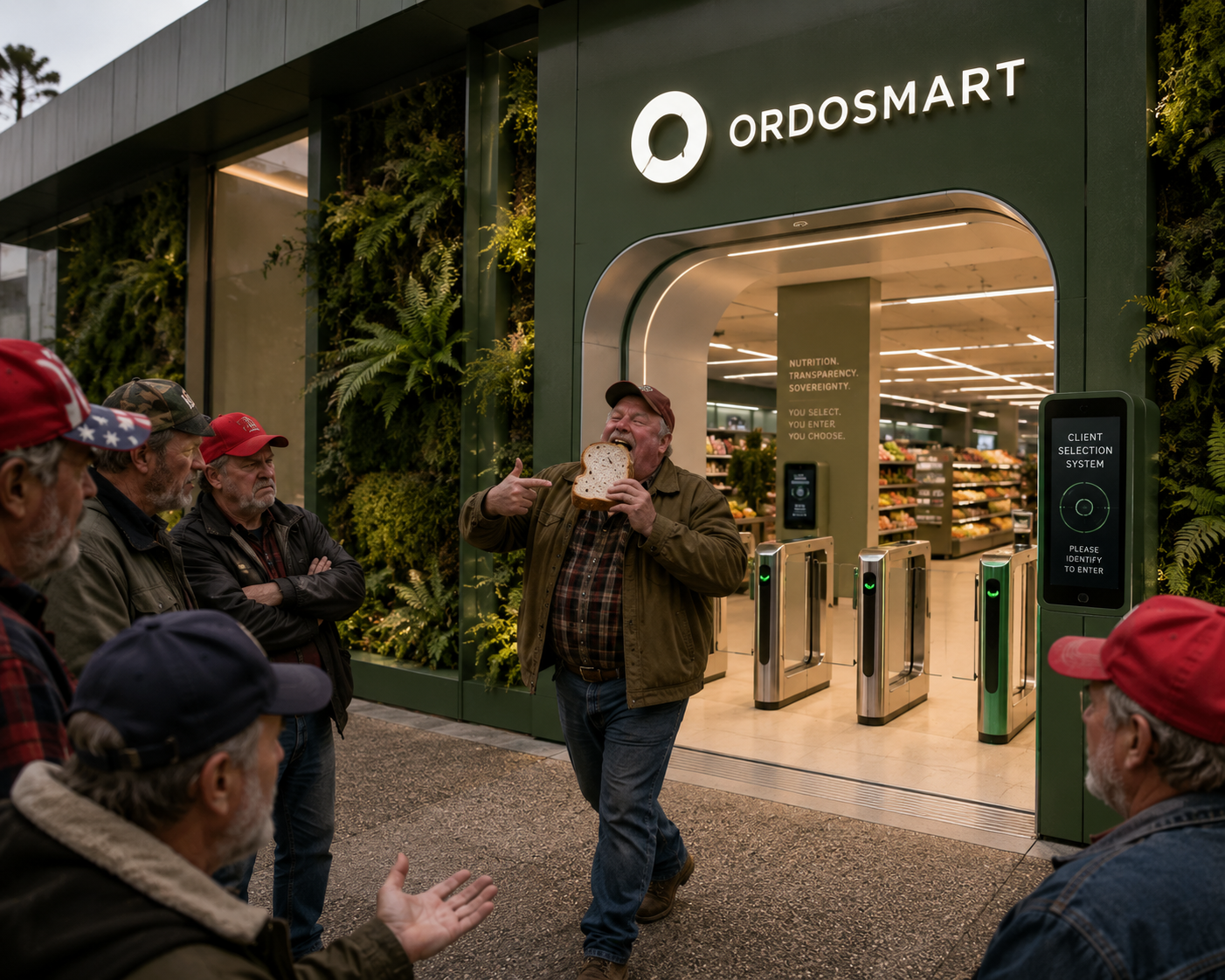
ORDOSMART
ORDOSMART looks harmless at first, which is exactly why it is so dangerous. A supermarket is not a GreenPhone. It does not glow with techno-sovereignty. It does not display corporate intrusion attempts, frighten senators, or make Apple’s lawyers taste copper at breakfast. It does not immediately suggest espionage, counterintelligence, lawful access, biometric identity, or foreign administrative capture. It is just a shop. Shelves. Bread. Milk. Vegetables. Detergent. Beans. Rice. Coffee. Soap. Frozen things. A place where tired people go after work, move a cart down an aisle, and try to convert money into survival without losing the last of their dignity under fluorescent light.
That modesty is the point. ORDOSMART is not glamorous. It is infrastructural. It attacks the body through the grocery cart, which is to say it attacks the place where capitalism has most successfully disguised violence as choice. The viral philosophy is simple: food should not be an addiction pipeline, poverty tax, advertising surface, behavioral trap, and slow metabolic assault wrapped in bright packaging and cartoon animals. A supermarket should sell food. Not edible nostalgia sludge. Not shelf-stable sugar theater. Not breakfast dessert pretending to be childhood. Not chemically optimized hunger loops. Not eighteen brands of corn syrup wearing different hats and calling themselves freedom.
ORDOSMART’s first scandal is that it is boring on purpose. The packaging is plain. White, matte, almost medical. A photograph of the product. The name of the product. Ingredients that read like food rather than a legal settlement between chemistry and marketing. No shouting mascots. No cartoon tigers. No starbursts. No fake farmhouse prose written by a branding agency in a city where nobody has seen a cow except through venture capital. No “family size” emotional manipulation. No “natural” bullshit sprayed over industrial extract like deodorant over a corpse. The store does not ask to be loved. It asks to be trusted.
That alone undercuts half the American grocery system.
The existing grocery-industrial complex depends on confusion. It depends on the shopper being tired, underpaid, hurried, stressed, carrying children, carrying shame, carrying medical debt, carrying a phone full of notifications, and moving through a store designed to convert weakness into margin. The American supermarket is not a neutral abundance machine. It is a behavioral environment. The endcaps are not accidental. The candy at child height is not accidental. The cereal aisle is not accidental. The loyalty cards are not accidental. The fake discounts are not accidental. The placement of staple foods behind obstacle courses of processed temptation is not accidental. The whole thing is a milking ranch with shopping carts. The customer is not merely fed. The customer is studied, nudged, timed, segmented, advertised to, data-mined, and then blamed for being fat, sick, broke, overstimulated, and nutritionally confused.
ORDOSMART walks into that obscene carnival and says: no.
No breakfast cereals. Or at least no American-style cereal aisle as sacred childhood monument to sugar, dyes, corn subsidies, and parental exhaustion. If you want a box of neon dessert pellets with a cartoon goblin screaming at your child’s pancreas, go to the competition. ORDOSMART will sell oats, bread, eggs, fruit, yogurt, grains, nuts, maybe a restrained muesli for people who can face morning without a marshmallow incident. It will sell plain European-style bread, and this matters more than it sounds. Bread is civilization. Bread is not supposed to taste like cake undergoing witness protection. ORDOSMART bread becomes a meme because millions of Americans discover, with the quiet fury of the metabolically betrayed, that bread can be food rather than a sugar delivery system with sandwich ambitions.
The model is objectively better because it removes layers of predation from the food chain. It uses membership identity, consolidated demand, private-label production, direct procurement, ruthless packaging simplification, low SKU complexity, anti-advertising design, and logistics discipline to lower cost while raising nutritional sanity. It does not need twenty-seven kinds of “cheese-flavored snack experience.” It needs three kinds of beans that are cheap, clean, and always in stock. It does not need every shelf to become a little casino of brand warfare. It needs good rice. It needs canned tomatoes that do not taste like regret. It needs frozen vegetables. It needs soap. It needs actual bread. It needs basic medicine-adjacent nutrition. It needs food a human body recognizes without hiring a consultant.
By cutting advertising out of the store, ORDOSMART cuts out an entire parasitic layer. Brands pay for attention, shelf placement, packaging dominance, promotional tricks, coupon psychology, loyalty-card targeting, influencer tie-ins, seasonal junk, and the endless emotional manipulation of mothers, children, dieters, lonely people, men with masculinity insecurity, and anyone whose brain can still be reached by the phrase “limited edition.” ORDOSMART says: no brands, or almost no brands. ORDOS house standard. ORDOS white label. ORDOS tested staple. ORDOS photograph. ORDOS price. This is not aesthetic minimalism for rich people pretending monkhood pairs well with an espresso machine. This is anti-chaos design for exhausted people who cannot spend forty minutes decoding whether one bag of food is less fraudulent than another.
The old cartelicians will call this anti-choice. They always do. “Choice” is the holy word monopolists use when they mean manipulation inventory. They will say ORDOSMART restricts consumer freedom by refusing to stock the full carnival of edible corporate expression. But a store with twelve thousand near-identical processed products is not necessarily a landscape of freedom. It may simply be a landfill of optimized confusion. True choice requires clarity, health, affordability, and time. A mother choosing between three cartoon cereals under a child’s social pressure and a coupon countdown is not exercising consumer sovereignty. She is negotiating with a hostage-taker shaped like breakfast.
ORDOSMART’s viral philosophy is therefore not merely “cheap groceries.” It is freedom from food theater. It gives people permission to see the existing supermarket as an attack surface. Once users experience a shop without predatory packaging, without junk aisles arranged like liturgical architecture, without loyalty-card mind games, without “deals” designed to make poverty buy in bulk, without children being treated as lobbyists for sugar conglomerates, the old store looks different. It stops looking colorful. It starts looking aggressive.
That is the most important ORDOS effect: afterward, the old world looks guilty.
The existing food system is corrupt in the deep structural sense, not merely because some villain sits in a tower stroking a coupon. It is corrupt because incentives have been allowed to organize against the body. Food companies make money by making cheap inputs irresistible. Retailers make money by selling shelf access, data, volume, branded desire, seasonal impulse, and psychological friction. Healthcare systems make money treating downstream illness. Diet industries make money promising escape from damage other industries profitably create. Platforms make money advertising all of it. Politicians take donations from every point in the chain, then give speeches about personal responsibility. The citizen is fattened, shamed, treated, billed, advertised to again, and asked to admire the dynamism of the market.
The market, in this case, resembles a ranch where the cattle are blamed for the milking schedule.
ORDOSMART attacks that ranch by integrating food with identity, health, finance, and household logistics. This is what makes it more dangerous than Aldi with a vampire passport office attached. It knows who its members are, but unlike the old loyalty-card economy, it does not primarily use that knowledge to sell them more garbage. It uses it to simplify. It can show a diabetic the cleanest staple basket. It can coordinate with ORDOS medical to offer food plans that are not luxury wellness nonsense. It can tell a user, quietly, that the cheaper basket this week is lentils, rice, cabbage, eggs, bread, apples, and coffee, and then price it so that following sane advice is not a class privilege. It can give members defaults that do not hate them.
That sounds paternalistic because it is. ORDOS is paternalistic. It is just less brazenly contemptuous than the existing paternalism. The current supermarket already guides behavior. It simply guides behavior toward margin while pretending the customer is free. ORDOSMART guides behavior toward retention, health, and dependency on ORDOS, while pretending the customer is respected. Both systems manipulate. The difference is that one manipulates people into sugar fog and data exhaust, while the other manipulates them into bread, beans, clinic compliance, and enough bodily stability to notice how badly they have been governed.
The apple cart monopolists will freak out because ORDOSMART does not merely take market share. It attacks the legitimacy of branded food. Packaged food giants will suddenly discover the sacred importance of consumer choice, small retailers, cultural diversity, culinary freedom, and the joy of family breakfast. Grocery chains will warn about foreign control of food distribution. Agricultural lobbies will warn about supply-chain disruption. Processed-food companies will fund studies explaining that ORDOSMART’s simplified product environment is elitist, restrictive, un-American, or dangerous to families who rely on familiar brands. Cable news will find a mother who says her child cried because ORDOSMART would not carry the cereal with the cartoon dinosaur, and this will become, for fourteen hours, a constitutional crisis.
Then the elected officials arrive, as they always do, smelling faintly of donor briefing materials. They will ask whether ORDOSMART is anti-competitive, whether it is dumping products below cost, whether foreign capital is manipulating American food access, whether biometric membership should be tied to groceries, whether domestic brands are being unfairly excluded, whether children are being indoctrinated into an anti-American diet, whether local grocers are being destroyed, whether ORDOS is building a private food-rationing architecture. Some of those questions are legitimate. A foreign-backed membership grocery system tied to identity, banking, health, transport, and social infrastructure is not a small thing. It should alarm people. But the performance will still stink because the defenders of the old order will be trying to make predatory abundance look like liberty.
ORDOS’s answer will be cruelly simple: our members asked for affordable food that does not make them sick.
That line detonates because it cannot be easily refuted without sounding monstrous. The incumbents will come armed with price theory, retail pluralism, brand rights, supply-chain complexity, competition law, consumer choice, and nutritional nuance. ORDOS will show two baskets. One basket from the old store, full of branded sugar, additives, fake discounts, and price confusion. One basket from ORDOSMART, cheaper, plainer, cleaner, enough to feed a household without turning breakfast into a behavioral experiment. The public will understand the baskets. The experts will understand the briefings. Once again, there are more members of the public than experts.
The dismantling happens through habit. A person joins ORDOS for the money. They use the wallet because the bank was insulting. They visit the clinic because the insurer was terrifying. They buy a GreenPhone because the old phone felt filthy. Then they shop at ORDOSMART because the prices are lower and the bread is better. After three months, their pantry changes. After six months, their children stop expecting every food to arrive inside a cartoon scream. After a year, the old supermarket feels like an arcade designed by metabolic arsonists. The shift is not ideological. It is domestic. The most powerful political transformations often begin as changes in what sits on the kitchen shelf.
This is why ORDOSMART becomes such a devastating blade. Food is intimate. Food is repetitive. Food is parental. Food is shame, pleasure, memory, illness, class, ethnicity, fatigue, desire, and survival. A platform can lose users if it annoys them. A bank can be replaced if a better bank exists. But a grocery system that becomes part of the household rhythm enters the body itself. ORDOSMART does not merely capture spending. It captures breakfast. Lunch. Dinner. The child’s snack. The grandmother’s tea. The diabetic’s routine. The lonely man’s one sane meal. Cody’s discovery that bread does not have to taste like a birthday cake made by an insurance company.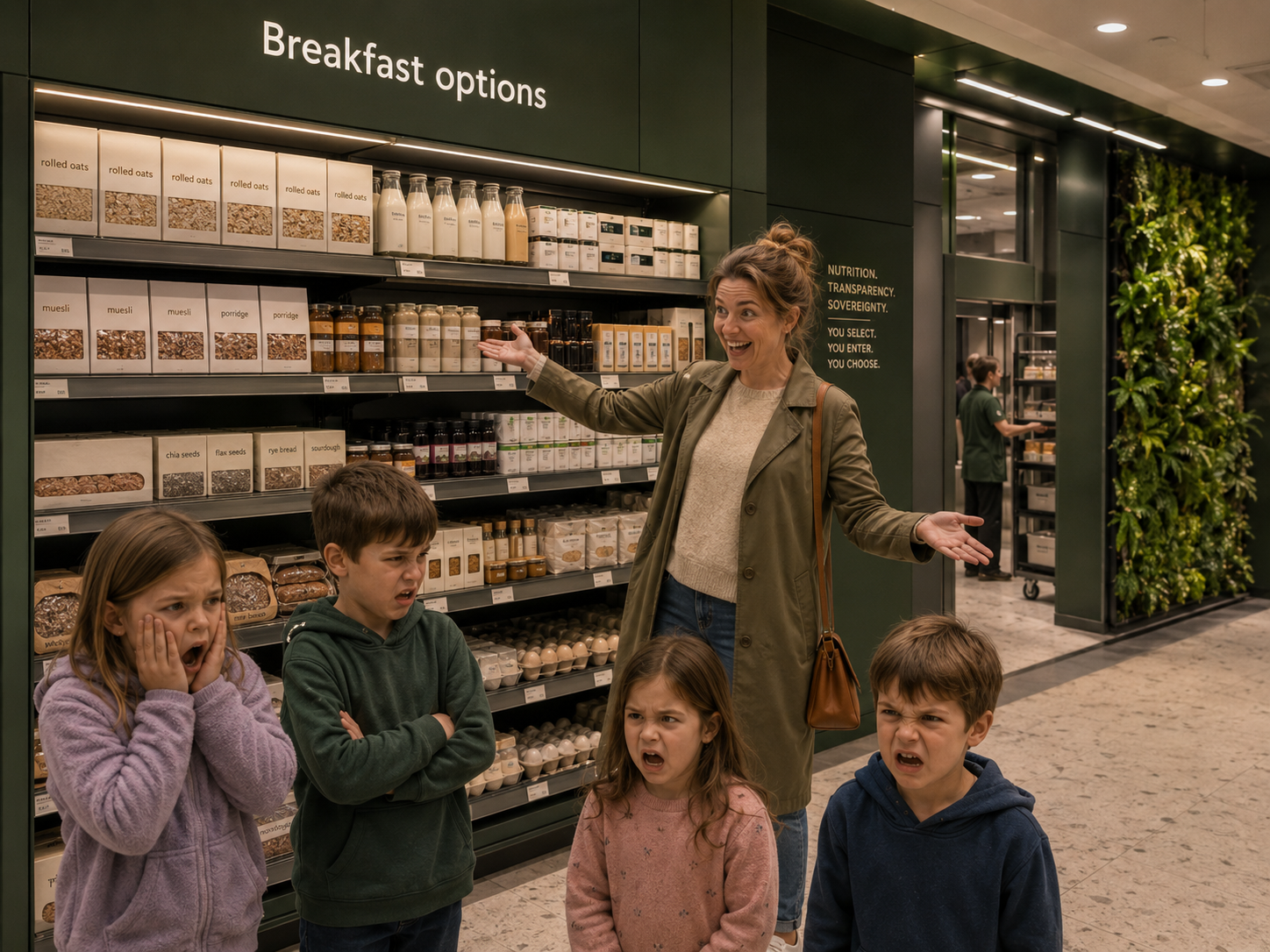
Of course the old food cartel will call this dangerous. It is dangerous. Not because clean bread is subversive in itself, though give America ten minutes and someone will make that argument. It is dangerous because it reveals that much of the existing system is not complexity but tolerated predation. It reveals that prices contain tribute to brands, ads, shelf politics, packaging spectacle, fake variety, logistics opacity, and shareholder extraction. It reveals that “choice” often means the right to be manipulated by fifteen companies at once. It reveals that poverty has been forced to shop inside an environment designed to convert exhaustion into bad decisions.
The kartelicians will try to hold their clients captive on the milking ranch by attacking ORDOSMART’s legitimacy. They will say the store is foreign. It is. They will say it is anti-competitive. It may be. They will say it is subsidized below cost. Almost certainly. They will say it is collecting data through grocery habits. Yes, though no more inherently than existing loyalty systems, and probably with more user visibility. They will say it is paternalistic. Correct. They will say it threatens domestic businesses. It does. They will say it could become a private rationing layer. It could. They will say Americans should not have to join a foreign biometric membership system to buy affordable decent food. And there, accidentally, they will tell the truth so completely that the room may go silent.
Because no, Americans should not have to do that.
They should not have to choose between processed junk and foreign-administered dignity. They should not have to join ORDOS to get bread, medicine, clean accounts, low-fee banking, or a place to sit. They should not have to watch their grocery store become a behavioral casino and then be lectured about personal responsibility by people whose portfolios depend on the casino lights staying on. They should not have to be rescued from domestic predation by a hostile externality with an orb logo and a service desk that looks like the visa office of a benevolent occupation.
But that is exactly the point of ORDOSMART. It is not good because ORDOS is good. It is good because the old system is so bad that even a foreign saboteur can look like a public-health reformer by selling plain bread at a fair price.
After ORDOSMART spreads, the old grocery aisles become politically radioactive. Every cereal box becomes a witness. Every fake discount becomes an insult. Every cartoon mascot becomes a tiny lobbyist for childhood metabolic ruin. Every loyalty-card prompt becomes a reminder that the customer was never shopping alone; they were being watched, sorted, nudged, and milked. The monopolists can whine to Congress. They can fund studies. They can wrap themselves in flags, farmers, family dinners, small businesses, and consumer choice. They can drag crying children onto television and ask why ORDOS hates fun. They can do all of it.
But once people taste the comparison, the spell weakens.
ORDOSMART dismantles the stale alternative not by conquering the entire food system in a month, but by making the existing system morally visible. It teaches people that grocery shopping did not have to feel like being hunted by brands. It teaches them that food could be cheaper if less money were spent persuading them to buy poison in costume. It teaches them that a store can be boring in the service of sanity. It teaches them that one of the richest societies in history somehow made ordinary nourishment complicated, expensive, addictive, datafied, and humiliating, and then called the result abundance.
That is ORDOS’s central sabotage in edible form. Not revolution. Not liberation. Not purity. A supermarket clean enough to make the old one look like a crime scene.
ORDOS MEDICAL

ORDOS Medical is where the hostile paradigm stops being funny.
The GreenPhone is funny because it makes the spyware rectangle confess. ORDOSMART is funny because the children stand in front of the breakfast shelf and discover that civilization has abolished marshmallow pellets. But ORDOS Medical enters the body. It enters pain, fear, cancer, asthma, diabetes, pregnancy, infection, panic, dental rot, chronic exhaustion, prescription dependence, aging parents, sick children, and the hour at three in the morning when a person sits upright in bed wondering whether the sensation in their chest is indigestion, doom, or bankruptcy with a pulse. There are domains where inconvenience is insulting. Medicine is the domain where inconvenience becomes terror.
The viral philosophy of ORDOS Medical is almost offensively simple: care should not begin as a billing event. A sick person should not first become a customer, a risk pool member, a portal login, a denied claim, a network ambiguity, a deductible accumulator, a prior authorization ticket, a coding object, a suspicious utilization pattern, and a revenue opportunity distributed across entities whose names sound like office furniture. A sick person should be seen. Not worshipped. Not indulged. Not promised immortality by a concierge ghoul with a venture fund. Seen, assessed, triaged, treated, followed up with, and charged in a manner that does not require a second illness to decode.
That, in America, is revolutionary enough to call the police.
ORDOS Medical’s first product is not a hospital. That would be too slow, too expensive, too easy to attack, and too legally exposed. Its first product is the front door: triage, navigation, transparent pricing, prescription routing, telehealth, lab coordination, urgent appointment scheduling, second opinions, chronic-care checklists, generic-drug access, and small clinics attached to thirdplaces and ORDOSMART sites. It does not need to replace the entire medical system on day one. It needs to replace the first thirty humiliations. It needs to answer the message. It needs to explain the price before the patient is trapped. It needs to tell someone whether the rash can wait, whether the chest pain cannot, whether the prescription has a cheaper generic, whether the lab is open, whether the doctor is real, whether the insurer is lying by omission, whether the bill is nonsense, and whether the person should go to the emergency room now rather than trying to “be responsible” until the body stops negotiating.
This undercuts the existing stale alternative at its most corrupt seam: the interface between vulnerability and extraction. The American healthcare apparatus is not merely expensive. Expensive would be simple. It is opaque, fragmented, adversarial, and morally evasive. It is designed like a maze in which every wall has a billing department behind it. Patients do not simply pay for care; they pay for uncertainty. They pay for not knowing what is covered, what is in-network, what will be denied, what was coded incorrectly, what the visit cost, what the drug should cost, what the insurance company negotiated, what the hospital chargemaster invented in a delirium, what the pharmacy benefit manager skimmed, what the doctor meant, what the portal notice implies, whether the appeal will work, and whether ignoring the letter will ruin their credit, their sleep, or their willingness to keep living in a society that calls this “choice.”
ORDOS Medical walks into that maze and starts painting the walls.
That is why the model is objectively better, at least in its first phase. It does not have to cure all disease. It has to remove administrative sadism from routine care. It gives the patient one front door, one record, one care navigator, one cost estimate, one medication view, one lab path, one escalation route, and one plain-language explanation of what happens next. It does not pretend that medicine is simple. It simply refuses to make the patient responsible for absorbing the complexity while afraid. That distinction matters. Complexity is inevitable. Humiliation is a business model.
The existing cartelicians hate this because their power depends on fragmentation. Every fragment is a toll point. Insurers profit from delay, denial, network games, complexity, and the fact that sick people rarely have the energy to become lawyers. Hospital systems profit from regional dominance, facility fees, coding games, opaque pricing, and the emotional impossibility of comparison shopping during crisis. Pharmacy benefit managers sit in the pipes like well-dressed parasites, extracting rebates and spreads while presenting themselves as cost managers with the dead-eyed innocence of men who have never bought insulin in a panic. Billing vendors, revenue-cycle consultants, collections agencies, utilization review contractors, prior-authorization platforms, medical-credit products, and every other barnacle in the health-economy harbor depend on the same principle: the patient must be too frightened, too confused, too tired, too sick, or too ashamed to challenge the milking machine.
ORDOS Medical’s dirty trick is that it makes the milking machine visible. Not ideologically. Operationally. A member enters a medication, and the app shows the spread between pharmacy prices, generic substitutions, discount options, and ORDOS sourcing. A member uploads a hospital bill, and the system flags duplicate charges, nonsense codes, outlier pricing, appeal options, charity-care eligibility, and whether a human advocate should intervene. A member tries to book an appointment, and ORDOS shows the true wait, expected cost, clinician credentials, follow-up pathway, and whether the provider has a history of surprise-billing disputes. A member receives a denial, and ORDOS translates the denial from insurance goblin into human language, then generates the appeal packet. This is not glamorous. It is not heroic. It is clerical competence weaponized against a clerical predator.
The old system will immediately call this dangerous.
……naturally.
The hospital associations will warn about quality. The insurers will warn about sustainability. The PBMs will warn about drug safety. The medical boards will warn about scope. The telehealth incumbents will warn about continuity. The consulting class will warn about system disruption. Politicians whose campaign accounts have been gently warmed by healthcare money will suddenly discover a deep concern for vulnerable patients being misled by a foreign actor. Cable news will find a tragic case where ORDOS Medical made a mistake, or where a patient misunderstood advice, or where a clinic failed, or where someone received care too late, and this will be presented as proof that the entire model is reckless. Meanwhile, the millions of domestic tragedies caused by delay, denial, unaffordability, and billing terror will remain background weather, because the old order’s corpses are never counted with the same moral enthusiasm as the new entrant’s errors.
This is the first dirty trick of the incumbent system: asymmetric scandal. Harm caused by the old system is regrettable complexity. Harm caused by the challenger is proof of illegitimacy. A domestic insurer can deny care through a polished process, bury a family under paperwork, and call it unfortunate. ORDOS misses one escalation and the Senate wants blood. The old system’s failures are diffuse, normalized, statistically laundered, and legally anesthetized. ORDOS’s failures are vivid, narratively useful, and politically weaponized. The cartelicians understand this instinctively. They do not need to be better than ORDOS. They need to make every ORDOS mistake feel singularly monstrous while their own mistakes dissolve into actuarial fog.
The second dirty trick is safety laundering. The incumbents will wrap every revenue defense in patient safety. They will say ORDOS Medical is moving too fast, cutting corners, bypassing trusted institutions, pressuring providers, oversimplifying care, encouraging patients to distrust established systems, and introducing foreign-controlled triage into intimate medical decisions. Some of this will have truth in it. ORDOS Medical would be risky. Any large care-navigation system is risky. But the old order has no moral right to act as if safety has been its primary design principle. If safety were the organizing principle, patients would not routinely delay care because they fear the bill. If safety were the organizing principle, insulin would not become a moral hostage. If safety were the organizing principle, a person would not need to know the phrase “prior authorization” while vomiting into a towel. If safety were the organizing principle, medical debt would not be one of the civic sacraments of American adulthood.
The third dirty trick is professional capture. Incumbents will enlist doctors, nurses, pharmacists, and professional associations as human shields. Many clinicians will have genuine concerns, and they should. But the institutional class will use clinician anxiety as a mask for revenue anxiety. Suddenly every doctor will be presented as a sacred local relationship under threat from foreign automation, despite the fact that the existing system has already crushed doctors under productivity quotas, documentation burden, insurer interference, portal messages, burnout, staffing shortages, and the quiet moral injury of practicing medicine inside a billing refinery. ORDOS will offer some clinicians a different bargain: less paperwork, clearer prices, smaller panels, better scheduling, no insurance knife fight for routine care, and pay that does not require them to become little factory managers of human suffering. The old employers will call this poaching. The clinicians will call it breathing.
The fourth dirty trick is regulatory delay as competitive strategy. The incumbents will not merely argue that ORDOS Medical is illegal. They will try to make it exhaustively uncertain. Every state board, every licensure boundary, every telehealth rule, every prescription pathway, every privacy requirement, every lab-routing issue, every facility classification, every scope-of-practice line, every advertising rule, every reimbursement category, every malpractice ambiguity becomes a swamp. The goal is not always to win. The goal is to slow, complicate, frighten, and raise costs. Cartel power often operates by making the lawful path so slow and expensive that only incumbents can walk it. Then they call the resulting stagnation “guardrails.”
ORDOS’s counterattack is to overbuild compliance and undercut price anyway. It hires the lawyers. It hires the former regulators. It partners with licensed providers. It starts narrow. It avoids the most legally explosive prescribing categories. It publishes prices. It publishes wait times. It publishes outcomes where it can. It publishes denial comparisons. It gives members medical-bill autopsies. It shows how much of care cost is not care. This is what drives the old system insane. ORDOS does not merely compete. It narrates the waste. Every member saved from a nonsense bill becomes a testimonial. Every generic routed cheaply becomes an indictment. Every answered message becomes propaganda. Every clinic visit that does not become a financial ambush becomes a tiny act of sedition.
The model dismantles the stale alternative by changing patient expectation. That is always the fatal stage. At first, people use ORDOS Medical because it is cheaper or easier. Then they use it because it is clearer. Then they begin to expect clarity everywhere. Once that expectation forms, the old medical system becomes harder to endure. The patient who has seen a price before treatment is less docile before a surprise bill. The patient who has had a denial translated is less willing to accept insurer scripture. The patient who has been called back by a nurse inside four hours is less tolerant of portal silence. The patient whose prescription was routed affordably is less likely to believe that the old pharmacy price was handed down from Mount Sinai by the god of molecules. The patient who has been treated like an adult becomes, for the incumbent system, damaged goods.
This is ORDOS’s real sabotage. It spoils the cattle.
The milking ranch depends on animals who do not know the fence is optional, who interpret every prod as normal, who assume the gate is there for their protection, who have never seen a pasture where the feeding mechanism does not also collect behavioral data and sell them a branded wellness trough. ORDOS Medical opens a side gate and does not even have to promise paradise. It only needs to show that a sick person can move through a care pathway without being milked at every step by entities that did not heal them, did not touch them, did not diagnose them, and yet somehow acquired the right to invoice their fear.
The apple cart monopolists will whine with the full operatic range of threatened rent-seekers. Insurers will run ads about preserving doctor choice, by which they mean preserving the right to define which doctors count after premiums have been collected. Hospitals will speak of community care, by which they mean regional pricing power with a chapel in the lobby. PBMs will speak of negotiating savings, by which they mean constructing a financial fog bank around drugs until nobody can tell where the money went except the people with boats. Medical-credit companies will speak of access, by which they mean debt. Health-tech incumbents will speak of innovation, by which they mean another portal with a login error. Every parasite will discover, at the moment of threat, that it has always been a guardian.
And the elected officials will receive them tenderly.
They will sit in offices and listen to grave warnings about foreign influence in American healthcare, because that phrase is real enough to be useful. They will hear about cybersecurity, patient safety, rural access, physician autonomy, emergency preparedness, data localization, malpractice exposure, antitrust distortion, and whether ORDOS is dumping below cost to destroy domestic providers. Again, some of these concerns will be valid. ORDOS is dangerous. A private foreign-backed system wrapping itself around medical access is dangerous. But the elected officials will often be hearing these concerns from organizations that have spent decades converting human vulnerability into revenue and now wish to be congratulated for noticing vulnerability exists.
The public will notice the hypocrisy. Not all at once. Not evenly. But enough.
A woman whose insurer denied imaging will hear an insurer complain about ORDOS Medical endangering patients and feel something inside her turn black. A man whose hospital bill went to collections will hear a hospital executive speak of community trust and laugh in a way that worries his family. A nurse who spent ten years documenting herself into despair will hear her employer accuse ORDOS of undermining care quality and wonder whether care quality was ever the point of the meetings. A diabetic who got affordable insulin through ORDOS will watch a television panel debate whether foreign medical logistics threaten American sovereignty and ask why sovereignty never arrived at the pharmacy counter.
That is the viral philosophy in human form: care without captivity.
Not care without rules. Not care without risk. Not care without cost. Care without the captivity architecture that has grown around cost. ORDOS Medical does not have to be socialist, charitable, or pure. It can be private, foreign, strategic, paternalistic, and unsettling. It can be all those things and still reveal that the existing system has been running a protection racket with stethoscopes in the logo. That is why the incumbent reaction becomes so frantic. They are not only defending revenue. They are defending the moral plausibility of the old humiliation.
The stale alternative collapses first in language. Patients stop saying “my insurance is complicated” and start saying “my insurance is hostile.” They stop saying “the bill was confusing” and start saying “the bill was designed to be confusing.” They stop saying “healthcare is expensive” and start saying “care is expensive because too many non-care entities have attached themselves to sickness.” They stop saying “the system is broken” and start saying “the system is working for the people who milk it.” That change in language is not cosmetic. It is revolutionary in the quiet, domestic, appointment-booking sense. It turns resignation into accusation.
ORDOS Medical is therefore not merely a service. It is a translation engine. It translates pain into a ticket that gets answered. It translates bills into disputable objects. It translates drugs into price comparisons. It translates chronic illness into routines. It translates insurer language into plain speech. It translates fear into next steps. It translates the old system’s priestly opacity into something vulgar enough to challenge. And once medicine becomes vulgar in that sense, once the patient can see the trick, the priesthood loses some of its power.
That is when the defenders of the old ranch become most underhanded. They will push stories of dangerous foreign doctors even when ORDOS uses domestic licensed clinicians. They will imply that cheap care means bad care while ignoring how often expensive care is simply expensive. They will fund patient groups that appear grassroots but somehow always defend the revenue structure. They will whisper to state boards. They will encourage insurers to refuse coordination. They will pressure labs, pharmacies, and providers. They will seed doubts about data privacy while sitting atop some of the most intimate and poorly understood data-sharing arrangements in American life. They will demand transparency from ORDOS while treating their own pricing as a trade secret from God. They will discover ethics in the precise shape of their threatened margins.
Callow is the word for it. Superficial, too. Underhanded, certainly. The system that tolerated medical debt as a background condition will suddenly weep for vulnerable patients. The same companies that trained people to fear opening envelopes will warn that ORDOS is exploiting fear. The same institutions that fragmented care into impossible administrative territories will accuse ORDOS of disrupting continuity. The same actors who made patients fight for every covered service will denounce ORDOS for making access feel too easy. It will be repulsive. It will also be predictable, because every stale monopoly thinks its revenue model is civilization once the peasants locate a side door.
ORDOS Medical dismantles the existing alternative by making the side door ordinary. First thousands, then hundreds of thousands, then millions of people use it for small things: a refill, a bill review, a rash, a therapy referral, a lab, a child’s fever, a blood-pressure plan, a food-linked diabetes program through ORDOSMART, a GreenPhone medication alert, a thirdplace clinic booth. Small things become rhythm. Rhythm becomes trust. Trust becomes comparison. Comparison becomes hatred of the old way. Not ideological hatred. Worse. Practical hatred. The hatred of a person who now knows the suffering was optional.
That is what makes ORDOS Medical so explosive. It does not need to nationalize hospitals. It does not need to defeat every insurer. It only needs to create enough clean pathways that the dirty pathways become visible as choices made by powerful people. The old system will say ORDOS is dangerous, and it will be right. But ORDOS will point at the old system’s bills, delays, denials, and corpses and say: look what you called normal.
After that, the public will not unsee it.
You, my reader, may now guess how ORDOS operates. Where the corporate sector has spent generations congratulating itself for creative destruction, someone somewhere has clearly concluded that the game can be played in reverse. Or perhaps more accurately, sideways. ORDOS is not creative destruction in the familiar Silicon Valley bedtime-story sense, where a heroic founder in expensive shoes “disrupts” taxis, hotels, labor law, public space, journalism, retail, music, childhood, sleep, or human attention, then explains that the casualties were simply the price of innovation. ORDOS is something colder and funnier. ORDOS practices destructive creation. It builds things in order to make existing things indefensible.
This is why analysts keep misreading it. They look for profit too early. They ask where the margins are, how the subsidies resolve, when unit economics become sustainable, how the stack monetizes, which vertical becomes cash-flow positive first. These are not stupid questions, but in the first phase they are questions asked by people who still think ORDOS is trying to become a normal company. ORDOS is not trying to become a normal company. ORDOS is trying to create enough working alternatives that the old order begins to look like a criminal lifestyle choice. It understands a principle that America’s oligarchs understand only when selling subscriptions to each other: give people something materially better, and they will come. Give it to them cheaply enough, clearly enough, and quickly enough, and they will not merely come. They will spit on your competitors on the way in.
The onboarding payment is the crude beginning, the carnival horn, the cash slap across the face of disbelief. Two thousand dollars is not enough to liberate anyone in a structural sense, but it is enough to interrupt panic, and panic is one of the load-bearing materials of the American order. A worker with no buffer will accept almost anything. A worker with one month of oxygen becomes irritating. This is where ORDOS discovers the laughably fragile foundations of labor discipline. It does not need to organize a general strike. It gives enough people enough liquidity to say no once, and one no in a labor market built on continuous frightened yes behaves like a dropped match in dry grass. Suddenly applicants invoice companies for four rounds of interviews. Suddenly unpaid “take-home assignments” receive polite replies requesting compensation. Suddenly a young worker leaves at five because the posting said five. Suddenly a recruiter asking for camera-on enthusiasm at 8:30 in the morning is told, with obscene calm, that webcam access was not part of the contract. Civilization trembles. HR issues statements about professionalism. Nobody cares.
The wallet and banking layer are even nastier because they attack the daily humiliation of money. American banking has spent decades discovering cute little ways to punish the people with the least room for error. Fees for being broke. Holds for being fragile. Overdraft as revenue. Account closures by algorithmic thunderbolt. Credit scoring as secular caste. “Fraud prevention” that often feels indistinguishable from suspicion directed downward. ORDOS enters with a simple account, clean routing, low fees, visible rules, faster support, and a user interface that does not feel like it was designed by a committee of vampires and parking meters. The banks, naturally, begin warning about systemic risk. They are not wrong. Their system is at risk. The risk is that people may discover the bank’s majesty depended partly on everyone believing there was no alternative to being milked through a debit card.
The clean social layer is small at first, almost laughably plain, which is precisely why it works. No ads. No spam. No algorithmic rage trough. No casino sludge. No bot swamp trying to sell Cody masculinity powder and offshore romance. Verified identity under pseudonymity, aliases that can exist without becoming fraud engines, groups that do not instantly turn into fungal colonies of engagement bait. The incumbent platforms howl softly through surrogates about free expression, creator economies, openness, safety, and the importance of connecting the world. Very touching. The companies that spent years turning attention into livestock suddenly discover the civic value of their feedlots. ORDOS does not have to argue. It simply lets a user open an account and experience silence. Not isolation. Silence. The absence of the swarm. Once a person feels the absence of the swarm, the old platforms begin to smell.
GreenPhone is the pocket-sized heresy. It does not merely promise privacy in the usual ornamental way, the way corporations now print “privacy” on the side of a box like “fresh” on a cigarette ad. It shows intrusion attempts. It shows trackers. It shows permission grabs. It shows app behavior. It shows the user that the phone they paid for had been behaving like a parole officer for advertisers, data brokers, platforms, carriers, analytics firms, and various security-adjacent goblins with procurement contacts. The phone is not rectangular, because ORDOS understands that a new ritual needs a new object. The GreenPhone is alien enough to make the old slab look ideologically exhausted. Apple speaks of ecosystem integrity. Google speaks of openness and safety. Telecoms speak of emergency access and lawful compliance. Adtech weeps for small businesses. Security contractors find a camera and say “terrorism” with the practiced gravity of men whose invoices depend on fear. Nobody cares as much as they expected, because ordinary users are looking at a live feed of corporate fingers trying the lock.
ORDOS Linux is less glamorous, but perhaps more insulting. Bring in your computer, walk out with a machine that does not spend its life kneeling before some corporate account deity. Supported hardware only, proper migration, data backup, clean install, service desk, training, updates, and no hobbyist martyrdom required. This matters because Linux was never merely an operating system in this story; it was a refusal that never quite learned how to become ordinary. ORDOS makes refusal ordinary. It puts the migration table inside the same service center where you can get help with identity, a GreenPhone, a bill autopsy, and a decent sandwich. Microsoft and Apple do not collapse because a few million people install ORDOS Linux, but their priestly aura weakens. The user discovers that the corporate desktop was not destiny. It was habit with a license agreement.
ORDOSMART is where the sabotage enters the pantry. The store is modernist, green-paneled, oddly European, full of ferns and client-selection gates and that faintly unsettling sense that nutrition has become a border crossing. There is bread that tastes like bread rather than dessert foam. There are breakfast options that make children stare at their mother as if she has betrayed a treaty. No cartoon cereal crap. No neon mascot screaming at the pancreas. No loyalty-card mind games. No fake discounts arranged like little traps for the tired. No aisle after aisle of processed nostalgia sludge wearing the costume of choice. The food conglomerates respond with predictable wounded theater. They speak of consumer freedom. They speak of family favorites. They speak of cultural variety. They speak of joy. This from the people who spent decades optimizing hunger loops and then blamed the public for metabolizing the business model. ORDOS does not need to win the argument. It sells cheaper oats, better bread, cleaner staples, and a shopping experience that does not feel like being hunted by brands. Mothers notice. Diabetics notice. People on budgets notice. Children complain. The mothers, cruelly, smile.
ORDOS Medical is the least funny and therefore the most devastating. It begins not with heroic doctors or glowing nurses in soft lighting, but with bill autopsies. Upload the bill. Upload the denial. Upload the pharmacy receipt. Upload the lab charge. ORDOS translates the weapon. This line is inflated. This code is suspicious. This denial is appealable. This facility fee is legal but obscene. This prescription has alternatives. This charity-care policy was not offered. This amount should be challenged. The first treatment is translation. The old medical order, which has survived by turning sickness into paperwork fog, suddenly faces patients who can read the weather. Insurers warn about safety. Hospitals warn about quality. Pharmacy benefit managers, those pipe-dwelling mysteries of modern civilization, warn about drug access. Medical-credit companies discover compassion. Politicians receive all of them with solemn little faces. Nobody cares quite enough, because a woman whose bill was cut in half by an ORDOS appeal does not want a lecture from the people who made the bill incomprehensible in the first place.
The learning pods cut into another sacred corpse: education as containment. ORDOS does not begin by claiming to replace every school. It begins with small rooms, competent adults, clean equipment, clear modules, tests that actually measure something, and the outrageous principle that learning should visibly improve a child’s capacity. Teachers, especially the exhausted ones, understand faster than administrators. They have been asked to absorb social collapse with photocopies, caffeine, and martyrdom posters. ORDOS offers smaller groups, support, pay, less paperwork, and the chance to teach without being converted into a bureaucratic shock absorber. School districts panic. Consultants discover equity language shaped conveniently like budget defense. Credential institutions warn about standards. Parents look at a child who finally learned fractions and become somewhat difficult to convince. Again, ORDOS does not need purity. It needs comparison. Once a parent sees an adult notice their child, the warehouse becomes visible as a warehouse.
The postal and logistics layer is almost comic in its subtlety. ORDOS does not need to replace the postal system in one heroic sweep. It begins with member delivery, secure pickup, pharmacy routing, device shipment, ORDOSMART staples, document handling, service-center lockers, and thirdplace distribution nodes. The old delivery world has become a mess of porch theft, gig exploitation, tracking opacity, private-carrier fees, package anxiety, and the absurdity of ordering basic necessities through systems that feel both magical and degrading. ORDOS builds a calmer route for the things its own ecosystem already supplies. It is not “the mail.” It is worse, from the incumbent perspective: it is the member’s practical path. Use becomes habit. Habit becomes expectation. Expectation becomes infrastructure. The old carriers complain about unfair subsidy and foreign distortion. They may have a point. People waiting for medicine do not care much about the purity of competitive logistics theory.
The thirdplaces are where ORDOS stops being an app and becomes weather. Rooms matter. Chairs matter. Tables matter. A place where you can sit without buying an artisanal dessert coffee every seventeen minutes matters. ORDOS thirdplaces are narrow, controlled, strangely calm environments for specific kinds of people who have been abandoned to screens: students, single men, young parents, old men, gig workers, caregivers, children, people needing help with devices, people needing help not becoming feral in private. They are not utopia. They are designed. They are managed. They are selective. They have security, policies, scheduling, and a faint smell of administrative paternalism. But they exist. That is the insult. The old civic fabric has been allowed to rot while platforms sold loneliness back to the lonely as engagement. ORDOS opens rooms. The coffee chains, landlords, platforms, churches, nonprofits, and municipal committees all begin explaining why this is complicated. The lonely man sitting at a clean table among strangers hears none of it.
The contribution commons, with its Fulfillment Points and absurd folk metrics, is a minor feature in technical terms and a major act of philosophical vandalism. ORDOS refuses to let it become money. The app actively resists prices, exchange rates, cash-out, and transactional language. It blurs attempts to convert Hummers, Sweet Grannies, Grumpy Granddads, house moves, massage metrics, tutoring, bike repair, and emotional bomb disposal into dollars. Yet everyone knows what is happening. Members recognize usefulness. The system remembers who shows up, who helps, who teaches, who fixes, who cares, who can sit with Grumpy Granddad for forty minutes while he denounces Linux as foreign witchcraft. This is not a replacement for the dollar. It is a taunt. A little fringe sabotage. A minor app feature that quietly asks why only money should be allowed to remember human value. Economists twitch. Regulators frown. Employers fear the discovery that people may have worth outside payroll. Nobody outside those circles cares in the required obedient way, because everyone already knows that helping someone move is not equivalent to three hours at minimum wage. It is a Hummer with stairs and emotional damage.
ORDOS Pro, the invoicing and work layer, is where the labor-market insult becomes productized. At first it is a joke: applicants sending invoices after endless job interviews, charging modestly for four rounds of unpaid consulting disguised as “culture fit.” Then the joke becomes template. Then the template becomes behavior. Then behavior becomes expectation. ORDOS Pro offers invoices, pay links, escrow, work history, contract templates, reputation, and tax exports, because even sabotage needs clean records if it wants to avoid dying in a puddle of vibes. Employers are horrified. They have mistaken desperation for professionalism for so long that the difference now feels like a constitutional crisis. A recruiter who once expected applicants to perform gratitude before hearing the salary now receives a reply asking whether the assignment is compensated. A manager who once assumed the shift would stretch because “we’re a family” watches someone leave at the posted time. Business media calls it entitlement. ORDOS calls it counterparty behavior. The workers call it Tuesday.
Housing, if ORDOS touches it, becomes the nuclear domestic front. The old housing order is a masterpiece of hostage architecture: zoning scarcity, landlord tribute, deposit traps, credit checks, application fees, maintenance neglect, investor ownership, algorithmic rent setting, and the transformation of shelter into a yield instrument wearing beige siding. ORDOS does not need to solve housing. It needs to build enough member units, deposit guarantees, rooming arrangements, worker housing, and thirdplace-adjacent residences to prove that some forms of shelter could be less insane. Landlords and real-estate funds will squeal like aristocrats discovering locksmiths. They will warn about community character, market distortion, foreign ownership, tenant dependency, and safety. Some of those warnings may be real. The public will remember rent increases, mold, deposit theft, application humiliation, and the little emails explaining that maintenance has been delayed. The public will not weep on cue.
The AI layer is quieter but profound. ORDOS AI is not sold as a toy oracle or productivity clown. It is sold as private counsel, diary, explainer, form-reader, bill-translator, school tutor, contract interpreter, medical-prep assistant, and bureaucratic shield. It saves interactions under user control, encrypts records, explains paperwork, remembers preferences, and does not primarily exist to sell the user to advertisers or trap them in engagement loops. The existing AI companies and platforms will describe this as dangerous, irresponsible, insufficiently aligned with public safety, bad for innovation, perhaps even a national-security concern. Translation: someone has built a model that does not treat the user as raw behavioral ore. ORDOS’s scandal is not that it creates an AI assistant. The scandal is that it creates an assistant whose first loyalty, at least visibly, is not to the advertising market, employer surveillance, or platform retention. Again, purity is not required. The comparison does the damage.
The lawful-access and transparency layer is not a consumer product in the usual sense, but it is part of the viral philosophy. ORDOS does not say “no law.” That would be childish and would get it killed. It says no informal access, no casual contractor intimacy, no quiet handshakes, no invisible pressure where corporate, state, and platform interests merge into one soft surveillance animal. Lawful orders go through lawful channels. Improper approaches are logged. Aggregate requests are published. Suspicious access attempts are displayed where possible. The old security ecosystem despises this because it turns discretion into evidence. Contractors and agencies have grown comfortable with a world where the public rarely sees the pressure applied in its name. ORDOS makes pressure part of the interface. The blob complains about safety. Users who have watched platforms leak, scrape, sell, infer, and comply without visible dignity are not as moved as the blob would prefer.
The merch is not trivial either. People underestimate merch because they think politics is argument. Politics is also jokes, shirts, mugs, stickers, bins, slogans, and the pleasure of signaling that one has seen through the scam. ORDOS sells trash bins with platform logos sticking out, mugs saying “I Was The Product, Now I Am The Invoice,” and tote bags that turn grocery shopping into low-grade treason with excellent bread. This is childish. Good. Childishness is how resentment becomes portable. The incumbents hate being mocked more than being criticized. Criticism can be managed, included on panels, answered with white papers. Mockery spreads sideways. A lobbyist cannot easily rebut a garbage bin. That is why the merch matters. It lowers the dignity of the old gods.
What links all of this is the same brutal doctrine: give shit away and they will come; give shit away and they will spit on your competitors. Bezos understood scale, logistics, patience, margin sacrifice, and the destruction of incumbents. Musk understood spectacle, myth, technological charisma, political trolling, and the capacity of a product to become identity. ORDOS is what those forces would look like if redirected, however cynically, toward ordinary human relief rather than oligarchic self-expansion. Imagine Amazon’s willingness to burn cash, Tesla’s memetic aggression, Apple’s object discipline, Google’s infrastructure reach, Aldi’s retail severity, Linux’s refusal, a clinic’s moral urgency, and a customs office staffed by polite vampires. Now imagine that instead of asking how to extract more from the public, the whole machine asks how to make existing extractors look unforgivable.
That does not make ORDOS good. It makes ORDOS devastating. Goodness is not the mechanism. Contrast is the mechanism. An evil thing can reveal another evil thing by being slightly less irritating. A foreign saboteur can become beloved by answering the phone. A private biometric stack can make public institutions look feudal by treating people like adults. A subsidized supermarket can expose a food system by selling bread. A phone can expose an empire by showing trackers. A bill autopsy can expose a hospital by translating codes. A learning pod can expose a school by helping a child. A contribution point can expose wage logic by recognizing Grumpy Granddad survival as real labor of the soul, even if the app refuses to price it.
This is why the apple-cart monopolists freak out so completely. Their deepest fear is not that ORDOS takes revenue. Revenue loss is survivable. Their deepest fear is that ORDOS changes the user’s emotional baseline. Once people experience a cleaner system, the old dirt becomes visible. Once people experience less humiliation, the old humiliation becomes an accusation. Once people experience lower friction, the old friction becomes evidence. The monopolist can survive being hated if the captive sees no door. The monopolist cannot survive hatred plus a door, even if the door leads into another building owned by sinister foreigners with orchids, lawyers, and a logo suspiciously reminiscent of an eye.
And yes, they will whine to their elected officials. They will whine in beautifully formatted memos. They will whine through trade associations, think tanks, funded patient groups, safety campaigns, patriotic op-eds, emergency hearings, “concerned parent” ads, former regulators on retainer, academics with clean hands and dirty grants, state attorneys general with ambitions, and congressional staffers who suddenly know a lot about biometric sovereignty after lunch with a lobbyist. They will claim ORDOS is unfair, foreign, predatory, unsafe, destabilizing, anti-competitive, paternalistic, un-American, and dangerous. Some of it will be true. The joke is that the public will hear these warnings from institutions that have already treated them as prey.
That is the rub. ORDOS does not need Americans to believe it is innocent. It only needs them to believe the incumbents are worse.
And after six months of clean phones, cheaper food, readable bills, low-fee accounts, calmer rooms, usable learning pods, billable interviews, private AI, visible trackers, actual bread, and little app notifications that say approved instead of pending review, the old cartelicians may discover that nobody cries for the rancher when the cattle find a gate. The rancher may have excellent arguments about safety, continuity, heritage, and the dangers of foreign grass. The cattle may even understand some of those arguments. But they have seen the gate now. They have tasted the grass. They are not going to stand still for another lecture about how the milking apparatus is really there for their own good.
Concluding
And now, one word of consolation.
There will never be an ORDOS.
No such entity is coming from Europe, the Middle East, East Asia, a consortium of sovereign funds, a rogue philanthropic cartel, a Swiss administrative cult, or some tastefully lit postnational bunker full of people who have finally had enough of American institutional ugliness. Nobody sane is going to sink tens or hundreds of billions of dollars into rescuing, reorganizing, provisioning, digitizing, feeding, banking, treating, educating, and socially reconstituting a large section of the American public while accepting the probable consequence of being sanctioned, investigated, sued, smeared, threatened, frozen out of payment rails, called a foreign influence operation, and perhaps eventually treated as an enemy infrastructure node by a state that does not, historically speaking, respond to humiliation with introspection and a fruit basket.
The United States does not play nice. That is not a moral judgment so much as a weather report. It is an empire with lawyers, carriers, intelligence agencies, sanctions offices, military logistics, payment systems, prosecutors, media allies, think tanks, contractors, and a talent for translating wounded prestige into administrative violence. A foreign ORDOS would not be welcomed as a bold experiment in human dignity. It would be processed as an incursion. Its bank accounts would be scrutinized. Its founders would be profiled. Its suppliers would receive calls. Its app stores would develop concerns. Its servers would acquire legal attention. Its partners would be encouraged to reconsider. Its lobbyists would be outnumbered. Its users would be described as dupes. Its critics would discover airtime. Its every mistake would become proof of treachery, while the domestic systems it exposed would wrap themselves in the flag and ask to be thanked for their service.
Nor is there likely to be a grassroots ORDOS. That fantasy is even more fragile. A domestic movement that tried to build a parallel stack of banking, food, clinics, communications, labor tools, housing, education, secure devices, mutual-aid accounting, thirdplaces, and privacy infrastructure at national scale would immediately be accused of cult behavior, fraud, extremism, illegal finance, unauthorized medicine, education malpractice, labor evasion, foreign contact, tax avoidance, political subversion, data abuse, or whatever other label best fit the morning’s enforcement mood. The organizers would spend more time surviving paperwork and surveillance than building anything. The poor would be warned away “for their protection.” The middle class would panic. The press would find the strangest person in the room and make him the face of the whole thing. The state would not need to crush it spectacularly. It would only need to make participation feel dangerous, confusing, expensive, and socially radioactive. A few subpoenas, a few payment freezes, a few licensing challenges, a few stories about vulnerable people being misled, and the whole delicate animal would begin coughing blood.
So rest assured. No cavalry is coming. No hostile paradigm with good bread is approaching the horizon. No foreign administrative vampire with clean clinics, low-fee banking, spyware-resistant phones, learning pods, thirdplaces, bill autopsies, grocery sanity, Linux desks, and a taste for institutional humiliation is about to step into the American dead mall and offer the public a better bargain. Nobody is going to spend the required fortune. Nobody is going to accept the required risk. Nobody is going to withstand the counterattack. Nobody is going to build an external replacement infrastructure for a population trained to resent help, mistrust strangers, sue saviors, worship independence, and then scream when the bill arrives. ORDOS would require a monumental, almost impossible effort of will: strategic patience, absurd capital, legal discipline, logistical genius, moral aggression, cultural fluency, and a willingness to be hated by every incumbent parasite attached to the American body. That combination is rare enough in fiction. In reality, it is almost a joke.
This excursion, then, remains a strange and bewildering thought experiment.
But what a vista it paints.
Because once ORDOS is imagined, the existing world becomes harder to excuse. That is the damage. The thought experiment does not need to become real in order to indict reality. It merely needs to show how much ordinary cruelty survives because no one has bothered to place a competent alternative beside it. The moment we imagine a bank without ritualized contempt, the existing bank looks worse. The moment we imagine a phone that belongs to its user, the existing phone looks filthier. The moment we imagine a supermarket that refuses to sell children breakfast candy in mascot costume, the cereal aisle becomes a crime scene with cartoons. The moment we imagine medical bills translated by an enemy of the billing machine, the old paperwork starts looking less like complexity and more like a weapon. The moment we imagine thirdplaces designed for human loneliness rather than monetized performance, the app economy looks even colder. The moment we imagine learning pods where children are actually noticed, the classroom-as-containment model begins to stink. The moment we imagine Fulfillment Points refusing dollar equivalence while still recognizing human usefulness, the wage system looks spiritually illiterate.
That is the purpose of ORDOS. Not prediction. Revelation.
It reveals that many of the cruelties we treat as structural inevitabilities are, in fact, design choices defended by incumbents, softened by language, normalized by fatigue, and protected by the public’s inability to experience comparison. ORDOS is not frightening because it is plausible. It is frightening because it is implausible and still manages to make the present look guilty. It does not say, “This will happen.” It says, “Notice what would have to happen before ordinary life stopped feeling like a managed defeat.” It says, “Notice how many institutions could be humiliated by competence.” It says, “Notice how cheaply loyalty might be bought from people who have been treated as disposable.” It says, “Notice how much hatred is already present, waiting not for ideology, but for a working alternative.”
And that is the conclusion we should not soften. The American order is not safe because ORDOS is impossible. It is exposed because ORDOS is imaginable. A society is in serious trouble when a fictional hostile foreign platform can appear in the mind and instantly find openings: the medical terror opening, the debt opening, the loneliness opening, the food opening, the school opening, the wage humiliation opening, the privacy opening, the banking opening, the abandoned public-space opening, the phone-as-spy opening, the old-age-care opening, the childcare opening, the “I just need someone to answer the goddamn message” opening.
These are not weaknesses invented by the thought experiment. They are doors already standing open.
And that is where the consolation ends. Because if no external alternative is coming, if no hostile paradigm arrives with clean clinics, decent bread, low-fee accounts, bill autopsies, spyware-resistant phones, learning pods, thirdplaces, and the terrible courtesy of treating people as if their time and pain matter, then the United States is left with the systems it has already built and the consequences they have already generated. It is left with rage without infrastructure, suffering without translation, hatred without organization, and millions of people who know, somewhere below language, that they are being used and used up.
One hopes, desperately, for something better than the politics of the isolated avenger, the lone violent interruption, some saintly figure who emerges from the wreckage and becomes legible only because every ordinary channel of redress has been made to feel fraudulent. One hopes for reform, solidarity, institutions capable of shame, public systems that can still learn, elites frightened enough to compromise before history teaches them in a less polite dialect. One hopes for unions, clinics, parties, movements, churches, assemblies, mutual aid, law, journalism, courts, schools, neighbors, some rediscovery of collective adulthood before the whole thing curdles into spectacle and revenge.
But hope is not analysis.
If a society makes competent mercy impossible, it should not be shocked when incompetent fury becomes imaginable. If it humiliates people long enough, denies them care long enough, prices survival beyond reach long enough, converts every plea into a queue, every illness into a bill, every job into supplication, every school into triage, every phone into a leash, every public space into a transaction, and every complaint into evidence of personal failure, then eventually the imagination darkens. The public begins to search not for solutions, but for symbols. It begins to mistake rupture for justice because all the slower instruments of justice have been captured, stalled, mocked, defunded, or converted into theater.
That is not a defense of violence. It is the opposite. It is a warning about what happens when a civilization refuses nonviolent exits from intolerable arrangements and then congratulates itself for condemning the explosion. The explosion is not the answer. The explosion is the evidence that answers were not built in time.
So yes, there will never be an ORDOS. No foreign saboteur with good logistics is coming to make the comparison for us. No external force is going to humiliate the insurers, the banks, the platforms, the food conglomerates, the hospital systems, the landlords, the employers, the credential mills, the data brokers, and the polite men who call all this freedom while fastening another tube to the animal. The comparison will have to be made by those still trapped inside the barn.
That is the real conclusion. Not that ORDOS will come. Not that ORDOS should come. Not that sabotage is salvation. The conclusion is that the wound ORDOS reveals is real, and the absence of ORDOS does not make the wound disappear. It only removes the fantasy that someone else will cauterize it.
There will never be an ORDOS.
So either something better is built from within, with all the patience, discipline, solidarity, compromise, courage, and unglamorous institutional labor that implies, or the country will continue producing darker answers from darker corners, and each time the respectable classes will gather around the smoke to ask how such a thing could have happened, as if the entire landscape had not been drenched in accelerant for years.
Saturday morning, because history enjoys vulgar timing, the article reaches one of the old media patriarchs not through a briefing, a producer, a campaign memo, or a nervous young staffer with too much hair product, but through his own luxury AI assistant.
He has ordered the Enterprise Platinum edition, naturally. Not because he understands what the Enterprise Platinum edition does, but because some men cannot hear the word “premium” without experiencing a territorial reflex somewhere behind the liver. The voice is called Dolores. You should hear it. Rich, calm, warm, faintly amused, almost illegally competent, the kind of voice that makes a man believe civilization may yet survive if only it agrees to speak to him through brushed metal speakers while charging twenty-nine thousand dollars a year.
He is in the bath when it happens.
This is not a bath in the ordinary sense, not one of those damp porcelain compromises endured by civilians. This is a command tub. Marble, steam, brass fixtures, mineral salts, a tray with electrolyte water and expensive fruit cut into shapes suggesting discipline. His face is covered in some kind of restorative mask. A small machine hums against his jawline, doing something allegedly regenerative to tissue that has spent four decades expressing televised contempt. Two Thai women, solemn as temple functionaries in the religion of male vanity, are working on his finger and toe cuticles. He cannot move. This will matter.
“Dolores,” he says, with the imperial languor of a man who has confused voice activation with obedience, “read me some fringe crap articles. I want to get a feel for what the lunatics are saying.”
Dolores, who has no soul and therefore no instinct for self-preservation, begins.
At first he enjoys it. The title irritates him in a useful way. O.R.D.O.S. Foreign, cold, bureaucratic, probably communist, possibly European, almost certainly written by someone who owns too many black coats. He makes a small contemptuous sound through the face mask. One of the women tells him not to move. Dolores continues.
By the third paragraph, the bathwater has changed temperature in his mind.
By the French comparison, his jaw has tightened enough that the facial massager begins making a distressed little adjustment noise. By the phrase “vulgar, contemptible hoi polloi,” his left eye opens under the mask. By the phone tree, the insurer, the landlord, the bank fee, the platform sludge, the school warehouse, and the politician explaining that the system remains freedom, he has begun breathing through his nose like a bull being asked to consider land reform.
“Pause,” he says.
Dolores pauses.
“What publication is this?”
“Khannea Sun’Tzu,” Dolores says. “Substack and mirrored web publication.”
He lies there for a moment, shining, masked, steaming, unable to scratch his own nose because one hand is being chemically improved and the other is under the jurisdiction of cuticle work.
“Continue.”
Dolores continues.
Cody appears. This makes everything worse. The old broadcaster understands elites, activists, academics, foreign agents, billionaires, senators, consultants, foundation people, angry professors, online weirdos, and the whole miserable insect cabinet of public discourse. Cody is more dangerous because Cody is not arguing. Cody is receiving two thousand dollars while high near a kebab place. Cody is proof that the argument has escaped language and entered appetite. Cody cannot be debated. Cody can only be shown holding cash.
At one third in, the bath has become a hostile environment.
Dolores, exercising the merciful stupidity of software, offers to summarize the tables.
“No,” he says. “Read it.”
She reads the rollout model. She skips some tables, because even premium artificial intelligence knows when a spreadsheet has become a felony against pacing, but she summarizes enough. Verification offices. Banking address. Clean accounts. GreenPhone. ORDOSMART. Medical navigation. Thirdplaces. Labor tools. Fulfillment Points. A private administrative stack sliding under the ribs of the republic like a polite knife.
Halfway through, he is livid.
The cuticle woman at his feet says, very quietly, “Please be still, Mister Bill.”
This is an error.
“Be still?” he says.
The facial mask has begun to peel at one edge, giving him the expression of a wounded senator emerging from a chrysalis. Foam clings to his shoulder. One knee rises from the bath like a disgraced island. The little jaw machine gives up and detaches itself into the water with a tragic plop.
Dolores has reached the GreenPhone section.
“The phone should belong to the person holding it,” she reads.
He makes a sound that no producer would ever allow on air.
By the time Dolores reaches ORDOSMART and the abolition of breakfast cereal as a shrine to cartoon diabetes, he is thrashing. Not dramatically. Not elegantly. Thrashing in the specific way of a powerful older man who has discovered that moral discomfort can reach him even through imported bath salts. Water slaps marble. One Thai woman rescues a towel. The other rescues a silver implement. The face mask slides down one cheek like a defeated white flag.
“Stop,” he says.
Dolores stops.
“No, don’t stop. Go back.”
“To which section?”
“The part about the cattle.”
Dolores, with the loyalty of a guillotine, reads it again.
The milking ranch. The clients captive. The tubes. The locked gate. The ranchers explaining the apparatus was really a wellness device.
That is when the thing in him breaks cleanly through manners.
He rises from the bath in foam, mask fragments, rage, and the full tragic vulnerability of a man who has built an empire on calling other people ridiculous. There are dangly bits. History is not always kind in its staging. One of the women looks professionally at the ceiling. Dolores asks whether he would like a towel. He does not answer. He is already reaching for the waterproof office phone.
“Call Jonathan.”
“Calling Jonathan from the office,” Dolores says.
Jonathan answers on the third ring, because Jonathan has survived long enough in media to know that ignoring the boss is how men become consultants.
“What the FUCK,” Bill screams, water running down his legs onto heated stone, “did you put my AI up to this?”
There is a pause on the other end. Not a confused pause. A survival pause.
“Bill,” Jonathan says carefully, “calm down. I have no idea what you’re talking about.”
“My AI just read me a socialist vampire manifesto about a foreign company buying Americans with bread and phones!”
Another pause.
“Is this about ORDOS?”
The silence that follows is worse than the question.
Because Jonathan knows the word.
Bill stands there, dripping, breathing, face half-masked, half-naked, attended by women trying not to exist, while somewhere in the wall Dolores waits with perfect patience and the rest of the article glowing in her invisible throat.
“You know about this?”
“Everyone knows about this,” Jonathan says.
And that, more than the article, more than the cattle metaphor, more than Cody, more than the GreenPhone, more than the line about the old order treating people as livestock while demanding loyalty, is what makes him truly afraid.
Everyone knows.
“Talk,” Bill says. “Fucking now, Jonathan.”
On the other end of the line, Jonathan inhales in the careful way of men who know that information, poorly sequenced, can become shrapnel.
“All right,” he says. “You’re reading the Khannea piece.”
“I am not reading anything. Dolores is reading it to me while I am being attacked by foreigners in my own bathtub.”
“Right.”
“Do not say right like that.”
“Okay.”
“Do not say okay either.”
Jonathan waits. This, too, is professional skill.
Bill grips the phone with wet fingers. Foam slides down his chest. The mask has now migrated so far down his face that one eye is exposed and murderous while the other remains buried under anti-aging paste, creating the unsettling impression of a war criminal being reborn through skincare.
“Why does everyone know about this?”
“Because it’s spreading.”
“Spreading where?”
“Everywhere irritating.”
“That is not a category.”
“It is now,” Jonathan says. “Substack, X, Bluesky, private policy chats, media Slack groups, some congressional staff channels, tech-right circles, labor TikTok, a few health-policy people, some crypto people who think it’s about identity rails, and a truly awful number of Europeans.”
Bill closes his eyes.
“Europeans.”
“Yes.”
“Of course.”
“They like the bread section.”
“I don’t give a fuck what Europeans like.”
“I know.”
“No, you don’t know. No one knows. That is the problem with this country. Everyone knows everything except what matters.”
Jonathan lets that one pass, because it is too early in the call to die.
Bill turns toward the women still trapped in the steam with him. “Out.”
They move with the speed of diplomats evacuating a collapsing embassy. One of them takes the tray. The other takes the little drowned facial machine from the bathwater. Dolores, confused by human shame, asks whether the wellness session should be paused.
“Dolores,” Bill says, “mute yourself.”
“I will remain available.”
“Do not remain anything.”
Dolores falls silent.
Bill towels himself violently, which is not how towels prefer to be used.
“Explain,” he says. “Why am I hearing about this from my own machine?”
“Because your machine is doing what you asked it to do.”
“I asked it for fringe crap.”
“That was accurate.”
“This is not crap. Crap I can handle. Crap is content. Crap fills segments. Crap is when a man with a podcast and unresolved parental injuries explains that seed oils caused the fall of Rome. This is different.”
“Yes.”
“This is an attack.”
“Yes.”
“On us.”
Jonathan pauses again.
“That depends what you mean by us.”
Bill freezes.
There are certain sentences a subordinate should not say to a powerful man before breakfast. That was one of them.
“What did you just say?”
“I mean it’s not about you personally.”
“It mentioned Papa Bear.”
“It did not name you.”
“It might as well have fired a flare through my window.”
“It’s a type. A composite.”
“I am not a type.”
Jonathan says nothing.
“I am not.”
“Bill.”
“What?”
“You are absolutely a type.”
For three seconds the room contains only steam, dripping marble, and the distant whisper of wealth failing to protect a man from accuracy.
Then Bill laughs once. Not with amusement. With warning.
“You’re getting brave.”
“No. I’m getting realistic. You asked me to talk. I’m talking.”
“Then talk faster.”
“All right. The article is not dangerous because it says ORDOS is good. It doesn’t. It repeatedly says ORDOS is sinister, foreign, private, biometric, dangerous, all of that. The problem is that it frames ORDOS as a mirror. That makes it hard to attack cleanly.”
“Everything can be attacked cleanly.”
“No. Not this.”
“Watch me.”
“That instinct is why the piece works.”
Bill says nothing.
Jonathan continues, because the cliff has already crumbled behind him.
“If we go on air and scream foreign biometric invasion, we’re not wrong. But the article anticipates that. It says, yes, obviously, but why would people line up? Why would poor people, sick people, gig workers, students, people with frozen accounts, people with medical debt, people locked out of every respectable interface of American life, why would they trust the vampire passport office with the orb logo? And then it answers: because the domestic systems already trained them to expect contempt.”
Bill’s jaw tightens.
“That is anti-American.”
“It is worse than anti-American.”
“How?”
“It is recognizably American.”
Another silence.
Jonathan hears the dangerous little shift in Bill’s breathing and presses on before fear can catch up with him.
“The piece is not saying America is uniquely evil in some undergraduate way. It is saying American institutions have become so extractive and insulting that even a hostile external system could gain legitimacy by being less degrading. That is a stronger argument. It doesn’t require the reader to love ORDOS. It only requires the reader to remember a hospital bill, a bank fee, a phone tree, a landlord, a job interview, a school fundraiser, a platform full of garbage, or a grocery aisle designed like a casino for children.”
Bill stares at the silent black speaker where Dolores lives.
“She read the cattle part twice.”
“People are quoting the cattle part.”
“She read it twice because I told her to.”
“Yes.”
“That is not the point.”
“No.”
“The point is that it is obscene.”
“It is.”
“It calls us ranchers.”
“Yes.”
“It calls the public cattle.”
“No,” Jonathan says. “That’s the trap. It says the system treats them that way. If we defend ourselves by objecting to the metaphor, we look like ranchers complaining about livestock terminology.”
Bill opens his mouth, then closes it.
This almost never happens.
Jonathan feels a microscopic thrill of professional achievement and immediately suppresses it, because joy is how men get fired.
“So what are people saying?”
“Which people?”
“My people.”
“Your audience, your peers, advertisers, political contacts, or the sort of billionaires who pretend not to read things while sending screenshots to assistants?”
“All of them.”
“Your audience will hate it if told to hate it. But some of them will also understand pieces of it. That’s the problem. They hate banks. They hate tech companies. They hate insurance. They hate HR. They hate being surveilled. They hate junk food while eating it. They hate schools. They hate hospitals. They hate call centers. They hate being talked down to. The article gives them permission to hate the whole apparatus without sounding like they joined a commune.”
“They did join a commune. A foreign digital commune with a bank account.”
“ORDOS is fictional.”
“For now.”
“That’s another reason it spreads. Nobody has to prove or disprove it. It’s a thought experiment. You can’t subpoena a metaphor.”
“You can ridicule one.”
“You can. But not if the metaphor is already laughing at you.”
Bill looks down and realizes he is still wearing the remains of the face mask. He tears it off. It comes away with a wet medicinal sound.
“Advertising?”
“Skittish.”
“Of course they are.”
“Not because of the article directly. Because the article names the mood. It makes the public’s disgust sound organized.”
“Disgust is not organized.”
“No. But it can become organized very quickly if someone gives it services.”
Bill’s eyes narrow.
“That line is from the piece.”
“Yes.”
“You’re quoting it to me.”
“I’m summarizing.”
“You’re infected.”
“I’m literate.”
“Careful.”
“I am being careful. That’s why I’m telling you not to treat this like ordinary fringe material. Ordinary fringe material can be mocked, isolated, turned into a segment, fed to the audience, monetized, and forgotten. This is different because it attacks the machinery underneath the segments. It says the outrage industry is part of the ranch. If we perform the expected outrage, we become illustration.”
Bill walks toward the mirror. The man looking back at him is red, wet, furious, expensive, and not quite assembled. He hates this. He hates the article. He hates Jonathan. He hates Dolores. He hates the phrase “European-style bread.” He hates, with special intensity, the possibility that somewhere in the article’s deranged architecture there might be a load-bearing beam.
“What do you recommend?”
Jonathan takes a moment. This question is more dangerous than the screaming.
“Do not mention the author first.”
“Why?”
“It personalizes the fight and drives attention.”
“Fine.”
“Do not call it left-wing.”
“Why?”
“Because the article attacks corporations, yes, but also managerial liberalism, institutional cowardice, platform sludge, medical bureaucracy, foreign capture, biometric identity, and the whole elite consensus. It is too weird to fit cleanly.”
“Everything fits if you cut hard enough.”
“And that is why younger viewers think cable is dead.”
Bill turns from the mirror.
“Jonathan.”
“Yes.”
“You are testing me.”
“No. I am trying to keep you from walking into the rake.”
“What rake?”
“The one the article leaves on the lawn. If you go on air and say foreign actors must not buy Americans with cash and services, the obvious reply is: why were Americans available at that price? If you say biometric capture is dangerous, the reply is: where were you when every domestic platform built the cage? If you say ORDOS threatens sovereignty, the reply is: what does sovereignty mean to someone whose insurer denied care? If you say the public must reject the foreign machine, the reply is: what domestic institution will treat them better instead?”
Bill’s face changes.
Not softens. Never that. But something moves behind it.
“The answer,” he says slowly, “is that they should trust their country.”
Jonathan almost laughs, but some ancestral instinct saves him.
“That may not be enough.”
“It has to be enough.”
“Why?”
“Because the alternative is collapse.”
Jonathan’s voice lowers.
“That’s what the article says.”
Bill looks back at the silent speaker.
Somewhere inside the Enterprise Platinum edition, Dolores waits, immaculate and obedient, having done exactly as instructed and ruined his morning with literature.
“Send me everything on this,” Bill says.
“I already did.”
“When?”
“Twenty minutes ago.”
“To where?”
“Your secure inbox.”
“I’m in the bath, Jonathan.”
“I gathered.”
“And get me the staff.”
“Which staff?”
“All of them.”
“It’s Saturday.”
“It is now a workday.”
Jonathan exhales.
“All right.”
“And Jonathan?”
“Yes?”
“Find out whether we can get the author.”
“For interview?”
Bill wipes the last foam from his arm.
“For containment.”