INTRODUCTION
Later in 2026, the war in the Middle East was no longer going especially well for Israel.
One may argue, until one is as blue in the face as a minister at a failed press conference, about proportionality, provocation, historic grievance, legal theory, moral arithmetic, divine title deeds, and which particular idiot first placed the match near the petrol. But the dull fact remained: Iran retaliated, and it retaliated hard.
I will not rehearse here how Israel and the United States struck Iran. We all saw the images on television, or on whatever remained of television after the emergency advertising markets discovered there was money in apocalypse. More importantly, we all personally experienced the consequences: the prolonged closure of the Persian Gulf, the paralysis of the Strait of Hormuz, the rationing, the price shocks, the empty shelves, the sudden rediscovery by Europe that “supply chain resilience” had mostly meant importing panic at a discount.
Iran had been hit hard. But Iran had also prepared for a long time, in that bleak, patient, subterranean way states prepare when they have spent decades being threatened by men with microphones. It struck back not only with missiles and proxies, but with patience. Ports failed. Shipping vanished. Insurance markets screamed. Desalination plants became strategic organs, and strategic organs, once damaged, have a vulgar tendency to bleed. Israel’s coastal infrastructure, so confidently modern, so bright with glass and seawater and high-value consultancy reports, began to look less like a miracle and more like a very expensive throat.
The trouble was not merely military. Military trouble, by this stage of history, had become almost quaint. The deeper trouble was domestic. A citizenry long accustomed to being told that force could purchase permanence discovered that force had purchased them an exit visa problem. Many left. Some left loudly, some quietly, some with three passports and the wounded expression of people who had always assumed history was something that happened to poorer families. Among them were settlers from the occupied territories, men and women who had once spoken of ancient rights with the confidence of estate agents, and who now discovered that ancient rights did not necessarily include functioning airports.
Then came the international turn.
It did not arrive as a single thunderclap. It arrived as a change in weather. A cancelled lecture here. A frozen account there. A port refusal. A divestment motion. A university committee, smelling blood and career opportunity in equal measure, suddenly remembering the language of universal justice. The BDS movement, once treated by many governments as an embarrassing student infection, became policy furniture. Boycotts became normal. Sanctions became respectable. Divestment became expected, then fashionable, then insufficiently radical.
The most bewildering spectacle concerned the soldiers.
For years, some had posted their little trophies online: grinning photographs, cruel jokes, demolished rooms, battlefield souvenirs, the bored obscenity of young men and women who believed impunity was a climate. They had uploaded themselves into history, helpfully tagging the evidence. Later, on their way to beaches, conferences, bachelor parties, spiritual retreats, and other sacred rites of the global middle class, a number of them began to vanish from customs queues. They were stopped in airports, questioned by officials who did not smile, placed on extradition flights, and delivered into courtrooms in countries whose names they had previously associated with cheap cocktails.
Their expressions, I am told, were unforgettable.
They looked less like monsters than badly briefed interns. They protested that they had merely served. They insisted they had followed orders. They asked why this was happening to them personally, which is always the most sincere political question. Some shouted “antisemitism” before learning that the judge was Jewish, the prosecutor half-Israeli, and the legal complaint assembled by people with the irritating habit of reading their own source material.
This produced a second panic, broader and more intimate than the first.
Families who had imagined emigration as a safety valve now found it threaded with barbed wire. Could they move to Paris? Lisbon? Toronto? Melbourne? Could their sons and daughters join them if they had served in Gaza, Lebanon, Syria, or the West Bank? Could an uncle’s old social media posts become evidence? Could a daughter’s unit photograph become a warrant? Could a father’s jokes, once exchanged over dinner with the lightness of people discussing football, be read aloud in a foreign court?
A year earlier, many of the same people had spoken of Palestinians as animals, as vermin, as human surplus, as demographic weather. They had done so with the casualness of the comfortable. Now they began, with visible reluctance, to discover the philosophical problem of consequence.
Zion Liberated!
Concerning the Island of Zion, Its Discovery in Holy Writ, and the Remarkable Elasticity of Prophecy When Properly Funded
A voyage begins with the contemplation of a destination, and this voyage, I was assured, had been contemplated by the wisest men available on short notice.
They gathered first in Jerusalem, then in New York, then in a private conference facility outside Dallas where the coffee was free, the flags were enormous, and every man present believed himself to be the only adult in the room. There were ministers, colonels, rabbis, donors, policy fellows, three men from think tanks with names involving “Liberty,” “Heritage,” and “Covenant,” and one retired admiral who had discovered prophecy late in life, as men often discover expensive hobbies after divorce.
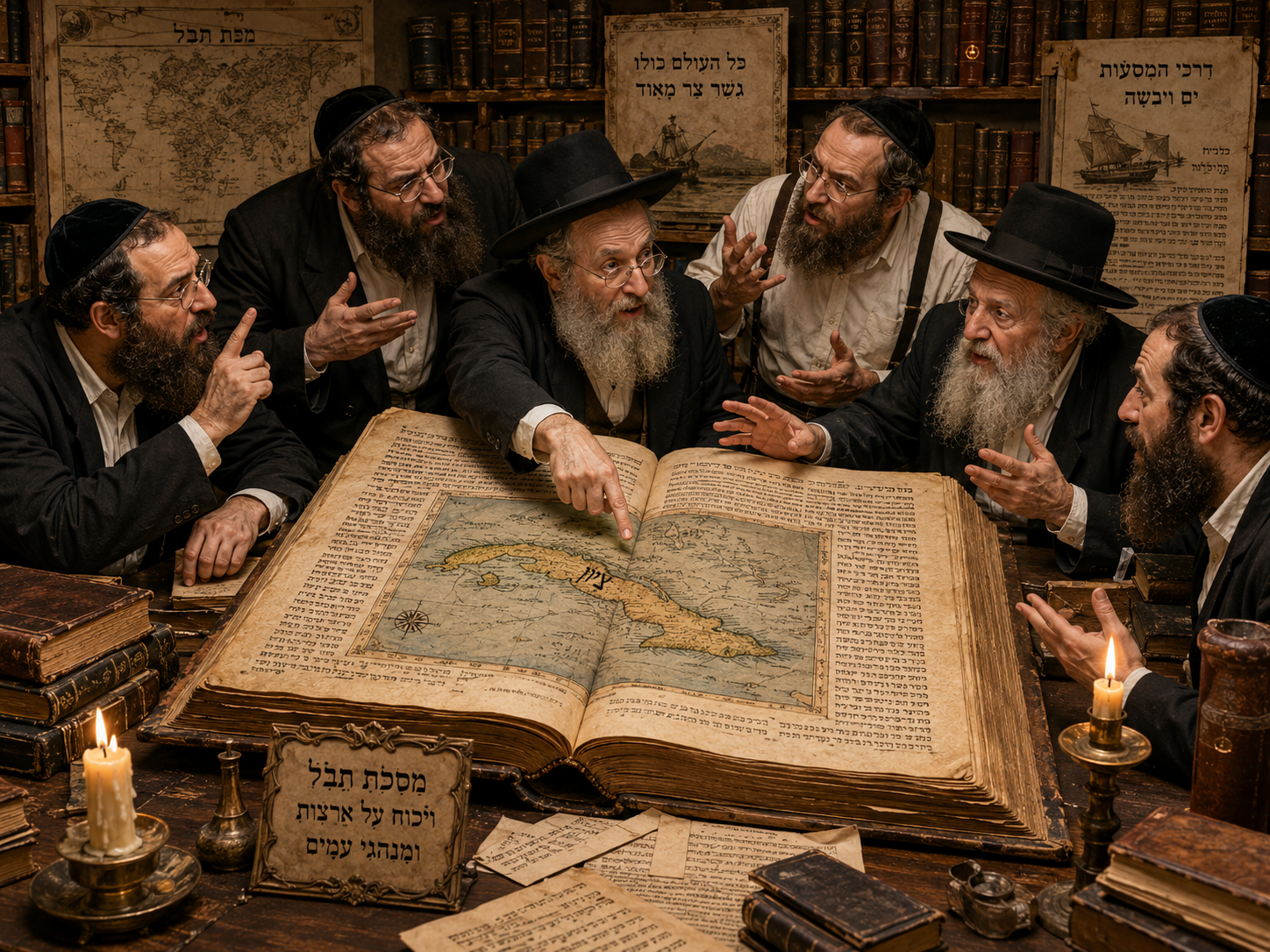
The scholars among them opened the books.
Not merely the Torah, though the Torah was opened first, ceremonially, with the grave expression of men preparing to invoice history. They consulted the Nevi’im and the Ketuvim, the Mishnah, the Tosefta, the Jerusalem Talmud, the Babylonian Talmud, the Midrash Rabbah, the Sifra, the Sifre, the Mekhilta, Pirkei de-Rabbi Eliezer, Sefer Yetzirah, Sefer HaBahir, the Zohar, the Zohar Chadash, the Heikhalot Rabbati, the Heikhalot Zutarti, the Shiur Qomah, the Book of Jubilees, the fragments of Enoch, the Testament of Levi, the Apocalypse of Abraham, the Book of Raziel, the Alphabet of Ben Sira, the Sefer Zerubbabel, the lesser scrolls of Qumran, the Copper Scroll, and several manuscripts which had spent so long in private collections that even their dust had acquired legal representation.
Then came the more delicate sources.
The Sefer Ha-Iyyim Ha-Ne’elamim, or Book of the Hidden Islands, known only in six copies, four of them disputed, one of them insured, and one of them conveniently missing. The Megillat Yam ha-Maarav, the Scroll of the Western Sea, said to have been taken from a Phoenician chest beneath the ruins of Tyre and later annotated by a rabbi who had never seen the ocean but possessed, according to his students, an oceanic confidence. The Codex Atlanti Ha-Kadosh, a text of uncertain origin and excellent parchment, allegedly recovered from the drowned libraries of Atlantis before the Flood, when the world was still young and real estate law pleasingly theological.
There was also, of course, the Pinkas B’rit Ha-Elohim, the Register of the Covenant of the Elohim, bound in black leather, sealed with seven clasps, and opened only when the situation required either tremendous courage or tremendous liquidity.
From these sources — by which I mean from the texts, their commentaries, their counter-commentaries, their marginal glosses, their mystical diagrams, and the interpretive enthusiasm of men already in possession of aircraft carriers — there emerged a doctrine.
It held that long before exile, empire, diaspora, Shoah, statehood, occupation, counterinsurgency, public relations catastrophe, and the invention of the televised apology, there had been another Zion. Not the hill. Not the city. Not the country presently failing to keep its water systems intact. But an island.
A paradise island.
A green jewel in the western sea.
There, according to the newly urgent readings of ancient ink, the ancestral servants of the Most High had once dwelt in innocence, humidity, and excellent fruit. They had tended gardens for the Elohim, or the Annunaki, or the Watchers, or the Bene Ha-Elyon, depending on which scholar was speaking and whether the Americans were in the room. They had kept sacred groves, maintained terraces, counted birds, preserved springs, and performed rites of stewardship so holy that no two rabbis could agree on them and every lobbyist understood them immediately.
This island, it was said, had been entrusted to them by God.
Not symbolically. Symbolism, one minister explained, was what weak nations used when they lacked amphibious capability. The covenant was literal. The island was literal. The inheritance was literal. The coordinates, after some difficulty, were discovered to be literal as well.
The calamities then befalling Israel were explained accordingly. The missile strikes, the port closures, the desalination failures, the diplomatic panic, the arrests abroad, the boycotts, the sanctions, the terrible sensation of history becoming reciprocal — all these were not, as lesser minds supposed, consequences of policy. They were chastisements. The covenant had been neglected. The true island of Zion had been abandoned. The guardians had forgotten their garden, and therefore the garden’s God had withdrawn His umbrella.
This doctrine comforted many people, for it converted responsibility into destiny, and destiny is always easier to carry if someone else must be displaced beneath it.
The Evangelicals received the news with tears.
Many had long suspected that the Bible contained America, Israel, the end times, and themselves in starring roles; the discovery that it also contained Cuba was therefore not a contradiction but an expansion pack. Sermons bloomed overnight. Maps appeared behind pulpits. Pastors who had once located Gog and Magog in Moscow now found Eden somewhere between Havana and a naval base. Television prophets pointed to weather charts. Senators spoke of restoration. Retired generals spoke of humanitarian corridors with the tenderness of men discussing artillery.
The phrase “Sacred Island of Zion” entered the media cycle on a Tuesday. By Thursday, it had a logo.
The United States fleet, recently redeployed from the Middle East under explanations too numerous to be useful, turned westward. Its official purpose was stabilization. Its unofficial purpose was covenant fulfillment. Its actual purpose was never stated plainly, which is how actual purposes generally survive.
With it came the refugee ships.
Some bore families fleeing the shattered coast. Some bore settlers from the evacuated hills. Some bore officials whose loyalty to the old land had proved inversely proportional to the availability of first-class passage. There were crates of archives, Torah scrolls, desalination engineers, armored vehicles, American volunteers, evangelical chaplains, drone technicians, influencers, trauma consultants, and several thousand people who had come because every catastrophe attracts a professional class of men who know where the microphones will be.
They landed at Guantánamo Bay.
The name was judged unsuitable. Too Spanish, too local, too burdened by memories of cages which diplomats preferred to call “facilities.” It was renamed Sha’ar Dod, the Gate of the Beloved, though certain American officers continued calling it Gitmo by accident and certain Israeli ministers did so deliberately because history is funniest when it refuses to obey branding.
The first proclamation declared the island restored.
The second declared the restoration temporary.
The third explained that temporary, in sacred matters, could mean until the arrival of the Messiah, the completion of security operations, or the end of litigation, whichever came last.
The armies moved inland.
The Cuban population, already thinned by hunger, sanctions, administrative collapse, fuel shortage, coastal panic, and the ordinary insults of being poor near someone else’s revelation, was instructed to remain calm. The operation, they were told, was not directed against them. It was directed against terror, instability, anti-covenantal elements, hostile cartographies, and the unfortunate confusion caused by their continued presence in areas of prophetic sensitivity.
Zones were established for their protection.
This is a phrase I have come to distrust.
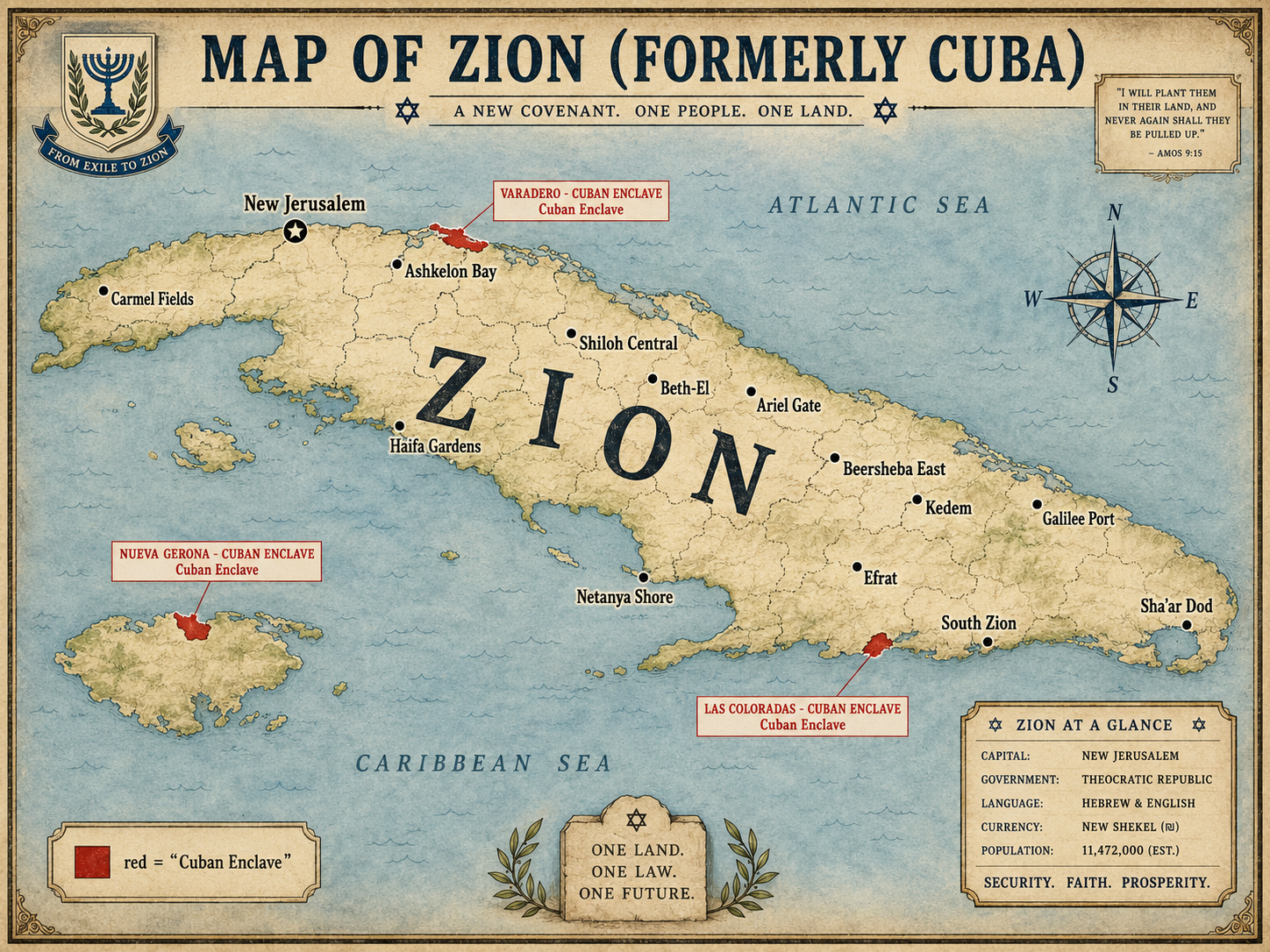
Nueva Gerona became a reception district. Varadero became a humanitarian enclosure. Las Coloradas became a security-harmonized relocation corridor, which meant tents, fences, armed towers, biometric gates, donor signage, and the sudden appearance of NGOs speaking in the gentle passive voice by which powerful nations launder verbs.
The starving were processed. The sick were registered. The angry were screened. The old were thanked for their cooperation. Children were given bottled water by soldiers who posed carefully while photographers found the proper angle.
Within three weeks, maps of the island had changed color.
Within six weeks, the new maps appeared in schoolbooks.
Within eight weeks, professors explained that the older maps had been colonial impositions anyway.
Within ten weeks, a minister stood before the cameras at Sha’ar Dod and announced that the return to the Island of Zion had been accomplished with minimal disruption to the native population, who, he said, had always been free to participate in the blessings of restoration provided they did not interfere with it.
Behind him, beyond the flags, beyond the microphones, beyond the ring of soldiers and imported palms, one could see the sea: blue, indifferent, and ancient enough to have heard every sacred excuse before.
Force Projection
The project was judged a success.
This judgment was delivered before the water was potable, before the roads had been cleared, before the missing had been counted, and before anyone had decided what to do with the Cubans not yet contained in the red zones. But success, in the modern administrative sense, is not a condition of the world. It is a condition of the press release.
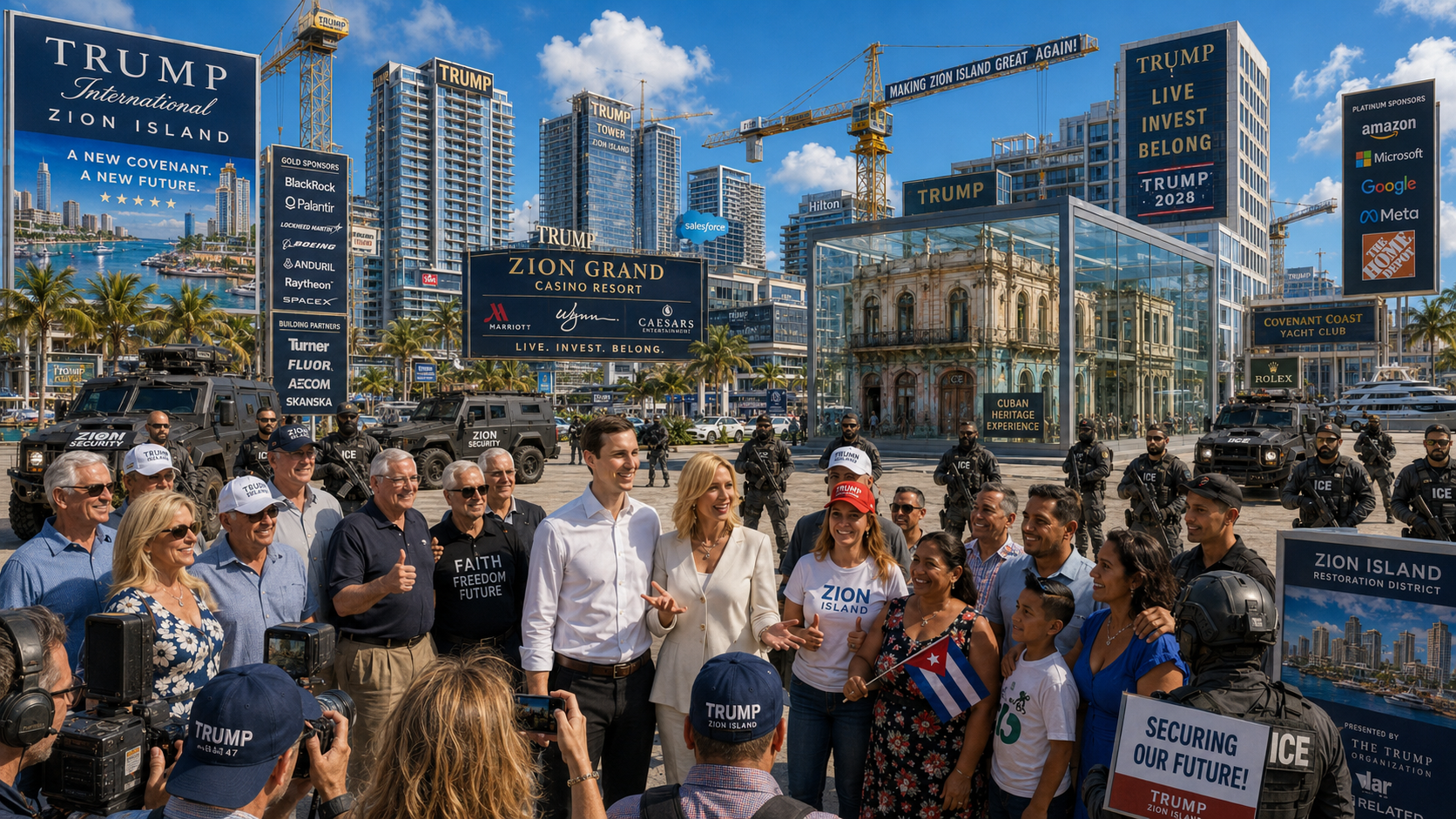
The first communiqué spoke of stabilization. The second spoke of renewal. The third, issued jointly by the provisional authorities, the American trusteeship office, and a philanthropic arm associated with the Trump family, spoke of “unlocking the sacred island’s full economic potential.” By then the word sacred had become inseparable from square footage. It was written on banners, investment decks, devotional pamphlets, hotel brochures, and the back of laminated security passes worn by men who had never prayed without first checking whether the room had cameras.
Jared Kushner arrived during the second month.
He did not arrive as a conqueror. Conquerors are vulgar. He arrived as a facilitator, which is to say as a conqueror whose sword had been replaced by a spreadsheet. He wore pale linen, expensive sunglasses, and the solemn expression of a man who had come not to profit from tragedy but to help tragedy discover its highest-value use case. He was photographed descending the steps of an aircraft at Sha’ar Dod, one hand raised in modest greeting, the other resting near a folder embossed with the words COVENANT COASTAL DEVELOPMENT AUTHORITY.
No one could say precisely what office he held. This was considered one of his strengths. He was not minister of housing, not ambassador, not commissioner, not governor, not contractor, not donor, not trustee, not merely family, not merely adviser. He occupied that rare rank in empire which has no uniform because every uniform eventually becomes evidence.
The Trump-associated foundation, newly reconstituted as an international humanitarian and heritage-development vehicle, proved invaluable. It raised funds for displaced families, convened religious leaders, arranged donor dinners, blessed infrastructure bonds, and held a gala in Palm Beach beneath a chandelier large enough to have had its own gravitational field. The program’s title was From Exile to Equity. Its subtitle, printed in smaller gold lettering, was A New Dawn for Zion’s Shores.
There were speeches. There are always speeches. Speeches are the white tablecloth over the operating table.
The President, appearing remotely from Washington and framed by flags, praised the courage of the pioneers, the wisdom of the investors, the toughness of the security forces, the beauty of the beaches, and the unmatched opportunity presented by destiny when destiny is properly zoned. He described the island as “tremendous,” “historic,” “probably the most beautiful island, maybe ever,” and “a place where people are going to do very, very well.” He did not specify which people. This omission was admired by the markets.
The first casinos broke ground before the third month.
They were not called casinos. Gambling carried a regrettably secular odor, and the island had by then been wrapped in so much prophecy that even slot machines required theological deodorant. The first resort was therefore announced as the House of Lots, a luxury gaming and pilgrimage complex north of New Jerusalem, where visitors could “cast destiny” in climate-controlled comfort. Its opening renderings showed palm trees, marble fountains, gold glass, a private marina, a heritage promenade, a memorial garden, and a discreet high-limit room named after one of the minor prophets.
The second casino, near Ashkelon Bay, was called The Jubilee. Its promotional language promised “restorative leisure at the edge of covenant history.” It featured a rooftop pool, immersive scripture walls, biometric entry, and a buffet offering kosher, evangelical, paleo, keto, carnivore, and “ancestral Levantine fusion” options at prices that suggested manna had finally been privatized.
The third, at Galilee Port, was aimed at younger pilgrims and military-adjacent influencers. It had no visible religious imagery except for an enormous blue neon menorah reflected nightly in the sea. There, former soldiers, American security contractors, visiting pastors, tech founders, settlement bloggers, trauma coaches, and minor European royals losing lawsuits could gather beneath the soft thump of music and congratulate one another on civilization.
The coast became a necklace of cranes.
Every bay, inlet, mangrove, reef, fishing village, ruined promenade, and former public beach was given a project code. The north shore was divided into lifestyle corridors. The south shore was reserved for strategic ecological regeneration, which meant golf. A strip near New Jerusalem became the Covenant Financial District, though the only covenant visible there involved tax treatment. Former Cuban ministries were converted into boutique hotels. Former schools became “heritage learning centers.” Former hospitals became wellness retreats offering longevity protocols, intravenous minerals, and trauma-release ceremonies led by women from California who spoke of indigenous wisdom while standing on land whose indigenous occupants had become a permitting obstacle five centuries earlier.
The timeshares were the true miracle.
In the beginning, there had been military necessity, divine title, refugee urgency, regional stabilization, and the great moral burden of history. By the autumn, there were fractional ownership opportunities.
The first brochures arrived in America folded inside church newsletters. They showed smiling families walking along beaches under the heading COME HOME TO ZION, TWO WEEKS A YEAR. Beneath this came the smaller print: deeded spiritual residency, legacy transfer options, Sabbath-compliant elevators, secure compounds, synagogue access, chapel access, dual-liturgical event halls, armed perimeter discretion, and “proximity to historically significant restoration sites.” One could purchase bronze, silver, gold, platinum, patriarch, matriarch, king, prophet, or archangel tier memberships. The archangel tier included airport pickup, concierge medical evacuation, priority bunker allocation, and a guaranteed ocean view unless prevented by acts of God, war, regulatory adjustment, or construction.
Demand was intense.
The American religious market understood the product immediately. To own a fragment of Zion, however fractional, however air-conditioned, however aggressively financed, was to combine prophecy with portfolio diversification. Pastors organized investment pilgrimages. Retired dentists from Phoenix prayed over floor plans. Influencers wept beside infinity pools not yet built. Senators bought through trusts. Venture capitalists bought through special purpose vehicles. Defense executives bought through wives. Wives bought through interior designers. Interior designers bought through companies registered in Delaware, Cyprus, and a jurisdiction whose name appeared to have been invented by a maritime lawyer during lunch.
The locals, by which the authorities now meant the newly arrived rather than the recently displaced, were encouraged to participate in prosperity.
Participation was defined broadly. One could buy property, sell property, manage property, insure property, guard property, bless property, clean property, market property, litigate property, appraise property, photograph property, drone-scan property, securitize property, tokenize property, or attend a conference on property as a spiritual asset class. The only activity discouraged was remembering who had lived on the property before the property became available.
This required language.
Language was supplied in abundance.
Eviction became “return-space optimization.” Confiscation became “ancestral title correction.” Fences became “protective covenant boundaries.” Demolition became “site purification.” Labor camps became “vocational dignity zones.” Surveillance became “community reassurance architecture.” Armed patrols became “heritage guardianship.” The red enclaves, where the remaining Cubans lived in hunger, heat, dust, boredom, and the stern benevolence of imported administrators, became “cultural continuity districts.”
Nueva Gerona was described as a model of island autonomy. Varadero was described as transitional. Las Coloradas was described as challenging.
I visited Varadero during the early rains.
The road there had once been famous for tourists, beaches, cheap cocktails, and the elderly European fantasy that a nation in economic distress exists mainly to make one’s divorce feel tropical. Now the approach was lined with concrete barriers, biometric gates, water tanks, American floodlights, and blue-white banners bearing slogans in four languages. One read: SECURITY IS COMPASSION IN UNIFORM. Another read: TEMPORARY MEASURES, ETERNAL PEACE. A third, apparently written by a consultant with unusual courage or no second language, read: YOUR PATIENCE IS APPRECIATED DURING RESTORATION.
Inside the enclosure lived those Cubans who had not fled, not been admitted to the labor rolls, not been sponsored by foreign relatives, not been sufficiently useful, and not been sufficiently invisible. They lived under tarps and corrugated roofs. Their ration cards were digital when the system functioned and moral when it did not. Children drew the old Cuban flag in dust and were gently corrected by NGO workers who had been trained to regard memory as a psychosocial risk factor.
Beyond the wire, on the restored side of the beach, the first towers rose.
They were advertised as Varadero Heights, though no brochure mentioned the enclosure. The renderings showed white stone balconies, discreet security, rooftop gardens, meditation decks, sea-facing terraces, a members-only beach club, a spa designed around “desert purity and Caribbean abundance,” and a wedding pavilion where couples could stand beneath imported olive branches and vow eternal love while staring directly away from the red zone.
A saleswoman from Miami explained the concept to me.
“It’s not just real estate,” she said. “It’s belonging.”
Behind her, workers in helmets poured concrete into the heat. Beyond them, a child watched through the fence. Between the two, a billboard displayed a laughing family in resort linen beneath the phrase LIVE WHERE HISTORY CHOSE YOU.
This, I began to understand, was the genius of the whole enterprise. It did not deny the suffering. Denial is primitive. It rebranded suffering as context. Misery became authenticity. Ruins became texture. Armed checkpoints became reassurance. Exile became romance. Hunger became backdrop. Every wound on the island was photographed, captioned, priced, and folded into the larger offering.
There were memorials too.
The first Memorial to the Return was built near Sha’ar Dod, on a hill selected for its sunset views and hospitality potential. It consisted of twelve stone pillars, an eternal flame, a digital donor wall, and a gift shop arranged with unusual sensitivity. One could purchase candles, bracelets, maps, children’s books, mezuzahs, tactical keychains, commemorative coins, premium olive oil, prophetic beach towels, and a limited-edition coffee-table volume titled Zion Reborn: The Island That Remembered Us.
The old Cuban cemeteries presented more difficulty.
Some were preserved as evidence of pluralism. Some were relocated for drainage reasons. Some were discovered to have stood on land designated for family villas, in which case teams of archaeologists were hired to produce reports of magnificent sorrow and practical brevity. The phrase “dignified transfer” did much work that year. The dead, unlike the living, could not object to being thanked for their cooperation.
By winter, the island’s economy was booming.
This was repeated everywhere. Booming. Record investment. Historic inflows. Transformational growth. Luxury occupancy ahead of projections. Security incidents down, provided one counted only the incidents recognized by the Security Incident Recognition Office. The markets adored Zion. The faith channels adored Zion. Real estate newsletters adored Zion. Defense analysts praised Zion as a model of post-crisis stabilization. Evangelical tourists called it a miracle. Venture capitalists called it a frontier. Consultants called it a platform. Military men called it defensible. Economists called it complicated. The displaced called it other things, but mostly not near microphones.
At night the coast glittered.
New Jerusalem shone with towers, cranes, drones, rooftop pools, armed gates, religious signage, private clinics, fusion restaurants, flagpoles, and glass lobbies where artificial waterfalls ran continuously in a nation founded partly upon the failure of water systems. The rich arrived pale and left glowing. The poor arrived hungry and became infrastructure. The sacred island became, in record time, what all sacred islands become when discovered by men with capital: a spreadsheet with beaches.
And still the slogans multiplied.
One Land. One Law. One Future.
A Covenant You Can Build On.
Security. Faith. Prosperity.
From Promise to Property.
Zion: Invest in Forever.
By the first anniversary of the landing, the authorities held a celebration at the House of Lots.
There was a prayer at sundown, fireworks at nine, a drone show at ten, and a private investor reception afterward in a ballroom cooled to a temperature that would have astonished the prophets. A children’s choir sang of return. A general spoke of sacrifice. A pastor spoke of destiny. A minister spoke of unity. Mr. Kushner spoke briefly and well, as men do when their sentences have been polished by counsel. He thanked the pioneers, the partners, the families, the security services, the faith communities, and the tremendous resilience of the island itself.
The island, being an island, said nothing.
This was taken as consent.
PLOT TWIST
We all know what happened next.
Or rather, we know what happened next now, in the same way that a man knows the shape of the piano after it has fallen upon him from the seventh floor. At the time, of course, the interested parties spoke of uncertainty, market turbulence, coalition maintenance, mandate interpretation, and other comforting phrases by which doomed men describe the early portion of a cliff.
The first shock was not the election itself. Elections, in America, had long ago ceased to be regarded as sacred events and had instead become seasonal weather systems with donation portals. The shock was the timing.
The early elections of 2027 had been meant as a stabilizing instrument. This, one should understand, is the exact phrase governments use when they have lost control of the furniture. The sitting administration, besieged by scandal, fatigue, court decisions, illness, leaks, resignations, prosecutorial inconvenience, and the general odor of a regime that had eaten too much of itself, agreed to what its advisers called “a clarifying democratic reset.” The phrase tested well among voters over sixty-five and extremely poorly among everyone who had ever been reset by management.
The Republicans entered the campaign as men enter a casino in which they have already pawned their shoes. They had the donors, the channels, the churches, the lists, the governors, the state apparatus, the procedural lawyers, the inherited confidence of men who had mistaken a rotting bridge for a dynasty. They also had the island.
The island was becoming difficult to explain.
It had been sold first as rescue, then restoration, then strategic necessity, then divine fulfillment, then humanitarian development, then regional stabilization, then a once-in-a-generation opportunity for values-aligned investors. By the summer of 2027 it had become, in the eyes of the American public, a tax haven with fences, casinos, Bible verses, biometric gates, vanished Cubans, Trump-branded towers, private armies, Kushner intermediaries, evangelical cruise packages, and three red zones visible from space.
The photographs did not help.
There was the photograph of the casino baptismal fountain, where a visiting pastor had immersed donors in chlorinated repentance beside a blackjack lounge. There was the video of a Florida congressman explaining that Cubans had always been “a migratory and adaptive people,” while standing in front of a wall that had recently prevented several thousand of them from migrating anywhere. There was the leaked brochure offering “prophetic fractional ownership” to qualified investors, with a Sabbath elevator surcharge and a bunker-access loyalty tier. There was, most famously, the drone footage of the old Malecón facade, preserved inside a giant glass cube and renamed The Cuban Heritage Experience, while outside the cube an armored bulldozer removed the neighborhood that had once given the facade a reason to exist.
The island had been intended as a solution to history. It became instead a museum exhibit on why history keeps biting people.
Then came Cortez–Wynn.
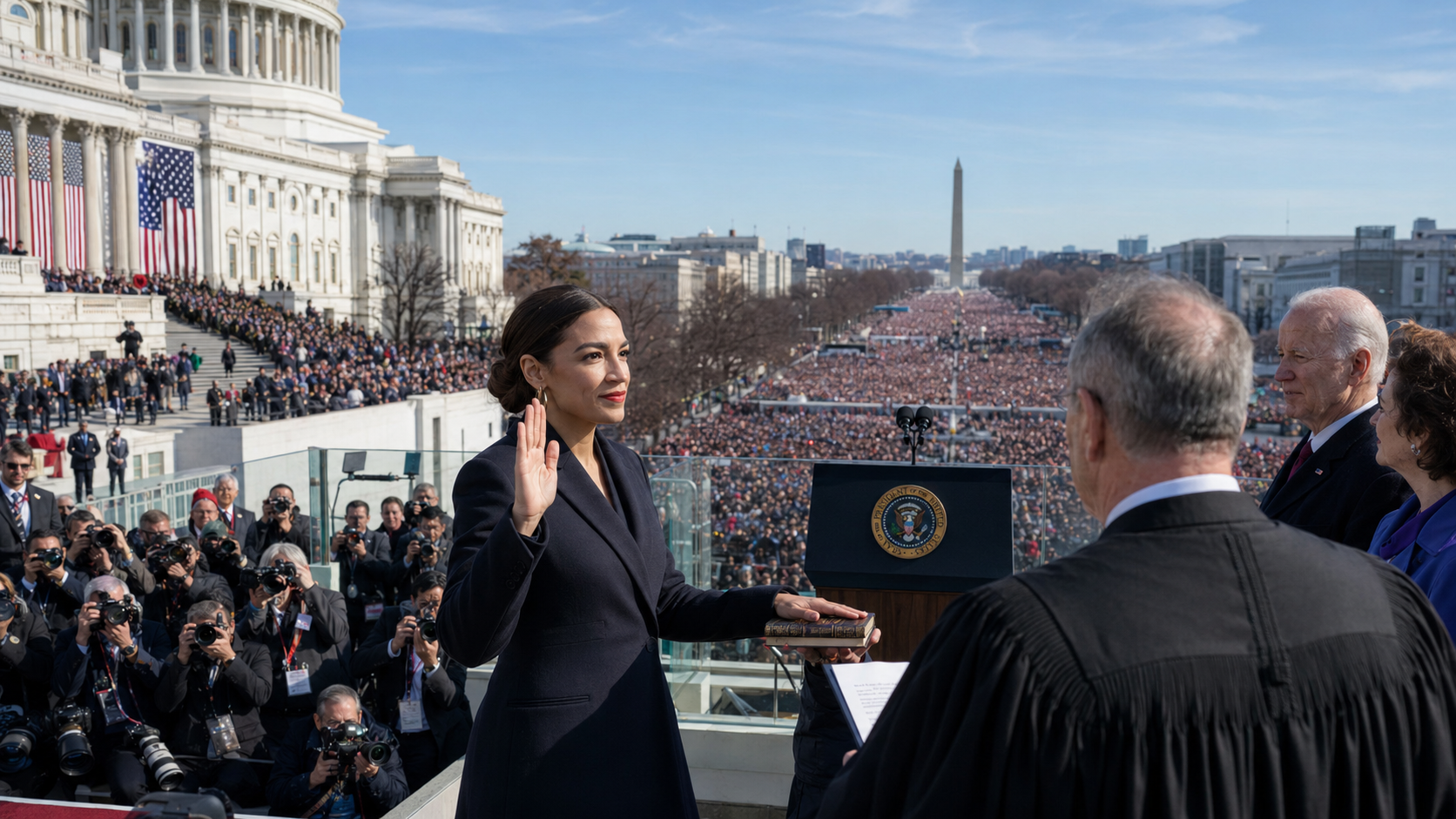
It is important to recall how ridiculous the ticket first sounded to the serious men of politics. Alexandria Ocasio-Cortez, still spoken of by cable hosts as if she were an atmospheric event rather than an elected official, had been expected to remain useful but containable: a rallying figure, a movement symbol, a woman to be invited onto stages, photographed near legislation, and safely blamed for everything. Natalie Wynn, meanwhile, existed in the minds of older consultants as a glittering hallucination from the internet: too clever, too theatrical, too trans, too online, too funny, too cruel, too educated, too covered in velvet, too dangerously capable of explaining fascism to a room full of suburban moderates in a way that made them laugh and then vote.
Together, they should not have worked.
This was the first error of the old class. It assumed that politics was still about appearing normal to people who no longer believed normal had protected them from anything.
Cortez offered command. Wynn offered translation. Cortez could speak in the language of rent, wages, climate, hospitals, dignity, corruption, and the simple insult of being governed by men who would sell the fire exit during a flood. Wynn could take the whole collapsing theater of American reaction — the grievance, the mythology, the wounded masculinity, the church-commerce complex, the fake martyrdom of the rich, the aristocratic self-pity of men with private jets — and describe it so precisely that millions of citizens experienced the rare pleasure of seeing a monster properly named.
The campaign slogan was not poetic.
ENOUGH.
That was all.
It appeared first in white letters on a blue field. Then on train stations. Then on union halls. Then on grocery bags. Then painted on barns in Iowa by people who insisted they were not socialists but were tired of being robbed by men who said the word freedom while billing Medicare. The slogan worked because it was not a promise. It was a diagnosis.
The debates were a massacre of tone.
The Republican nominee, a governor selected for his youth, jawline, donor discipline, and ability to say “Judeo-Christian civilization” without visibly checking a teleprompter, attempted to frame the island as a difficult but necessary moral project. Cortez asked whether humanitarian necessity usually came with golf-course pre-sales. He pivoted to security. Wynn, smiling gently enough to frighten livestock, asked him to explain why the security contracts had been awarded through shell companies whose boards included three former campaign chairs, two pastors, and a man whose listed profession was “heritage futurist.” He attacked her as unserious. She thanked him, then spent ninety seconds explaining the political economy of calling women unserious when they catch you laundering empire through resort architecture.
The clip was viewed two hundred million times.
The landslide, when it came, was treated by the losers as an act of weather, fraud, witchcraft, demographic decay, Chinese software, Venezuelan algorithms, coastal brainwashing, satanic feminism, trans ideology, public schools, unmarried women, low testosterone, high rent, and a mysterious shortage of proper gratitude among the young. It was, in fact, an election.
The Cortez–Wynn ticket took the presidency with a margin so vulgar it seemed designed by satire. The House flipped so hard that several networks displayed the wrong graphic for an hour, assuming the software had suffered a seizure. The Senate became not merely blue but architecturally blue, blue in the manner of deep ocean, blue in the manner of oxygen tanks, blue in the manner of a corporate general counsel’s lips when the subpoena arrives.
The retirements began before dawn.
A number of Republican senators, having spent the previous evening denouncing socialism from donor suites, discovered urgent family obligations. Several congressmen announced that the time had come to spend more time with loved ones, by which they meant attorneys. Others cited medical conditions requiring treatment in Switzerland, Singapore, Dubai, Argentina, Paraguay, the Cayman Islands, and, in one memorable case, “international waters.” This produced some public confusion, since many of these same men had recently insisted that the United States possessed the greatest healthcare system in human history. Their spokespeople clarified that it did, certainly, for normal conditions, but that the congressmen suffered from rare disorders affecting only men under investigation.
The evangelical leadership fractured next.
Not the believers, exactly. Believers are usually less stupid than the professional shepherds who monetize them. The churches did not vanish. Faith did not vanish. But the political machinery that had converted faith into turnout, turnout into judges, judges into impunity, impunity into real estate, and real estate into prophecy suffered what historians later called a “credibility infarction.” The island had been too much. The tours, the condos, the footage of pastors blessing casino floors, the patriotic sermons sponsored by bunker insurance firms — all of it had revealed the holy engine as a vending machine.
The phrase “render unto Caesar” enjoyed a brief revival, mostly on protest signs outside megachurches.
The pro-settlement lobby, too, ceased to function as it once had. This did not happen because its arguments were answered. Arguments, in Washington, are what people use when the donors are not yet finished speaking. It happened because the island made the old language unusable. Security, self-defense, ancestral right, existential threat, historic suffering, Western civilization, biblical promise — all these phrases had been stretched over casinos, red zones, labor enclosures, shell companies, and Trump towers until even their supporters could hear the fabric tearing.
Thereafter the lobby became not powerless, but ordinary. This was considered by its members to be persecution. To become ordinary is the one fate no exceptionalist movement can forgive.
The Supreme Court provided the next act of theater.
Several justices retired in rapid succession, citing age, dignity, health, family, institutional preservation, and the desire not to spend their final years being stared at by Senator Wynn during televised ethics hearings. One, who had accepted devotional hospitality from three island investors and a billionaire with a yacht named Originalism, announced his retirement in a letter so stiff with wounded principle that it required two clerks to carry it. Another insisted he had done nothing improper, then resigned to protect the Court from the appearance of impropriety, a concept he appeared to have discovered that morning.
President Cortez nominated replacements with a speed that suggested her transition team had spent the campaign sharpening knives in a monastery.
The confirmations were public, brutal, and extremely educational. For the first time in many years, nominees were asked not only whether they respected precedent, but whether they understood that human beings could not eat precedent, rent precedent, breathe precedent, or receive chemotherapy from precedent. Vice President Wynn, presiding over the Senate during one especially deranged procedural challenge, observed that the framers had unfortunately failed to anticipate “a judiciary sponsored by vacation compounds,” after which three senators objected, two donors called their lawyers, and the phrase became a mug.
By midsummer, commentators began searching for a name.
They always do. No American political transformation is complete until a columnist has placed it under glass and misspelled its soul. At first they tried “democratic socialism,” which pleased the elderly and bored the young. Then “neo-progressivism,” which sounded like a vitamin supplement. Then “post-liberal realignment,” which caused three graduate students to faint from pleasure but sold no books. “Popular constitutionalism” had a moment among law professors and no one else. “Civic renewal” died immediately because it sounded like a parking authority newsletter.
The name that stuck came from an enemy.
A former Thielian strategist, speaking on a private panel that became public because every private panel is a prayer to future embarrassment, complained that the new coalition was not left-wing in the sentimental twentieth-century sense. It was worse. It was disciplined. It liked technology. It liked competence. It liked state capacity. It had no interest in pretending that markets were evil, only in ensuring they were housebroken. It welcomed certain corporations, provided they paid taxes, obeyed labor law, submitted to antitrust review, stopped poisoning rivers, and ceased behaving like feudal principalities with HR departments. It contained Democrats, unions, climate hawks, civil libertarians, former McCain Republicans, national-security professionals, municipal reformers, post-libertarian tech defectors, anti-monopoly conservatives, Thielians who had concluded that civilization required adults, and right-wing corporations whose executives had made the spiritually mature discovery that fascism was bad for predictable quarterly planning.
“It’s not socialism,” the strategist said, visibly sweating beneath excellent lighting. “It’s techno-progressive state capitalism with moral theatrics.”
The clip escaped.
By morning everyone was calling it TechnoProgressive.
What’s in a word, eh?
The name was ridiculous enough to survive. It sounded like a software update, a Scandinavian train authority, and a youth movement designed by people with unusually good dental plans. It also captured the contradiction at the center of the new order. The Cortez–Wynn coalition did not abolish capitalism. This disappointed some and terrified others, often for the same reason. It did something more offensive to the old regime: it subordinated capitalism to politics again.
There would be markets, yes. There would be companies. There would be investment, technology, infrastructure, research, housing, energy, medicine, logistics, and profit. But there would also be consequences, which the previous arrangement had treated as a form of communism. The new doctrine was simple enough to fit on a hostile editorial cartoon: build things, pay people, obey the law, stop lying, and do not privatize the emergency exits.
This turned out to be very popular.
The first hundred days were less a honeymoon than a controlled demolition.
The Island Accountability Act froze assets connected to Zion Island development pending investigation into forced displacement, sanctions evasion, fraud, illegal campaign coordination, and the improper use of prophetic language in securities offerings. The Foreign Enclosure Prohibition Act banned American support for extraterritorial civilian containment zones except under transparent international authority, a clause that caused several contractors to discover urgent spiritual objections to transparency. The Disaster Profiteering Recovery Act clawed back gains from crisis-zone real estate vehicles. The Faith and Foreign Influence Disclosure Act required religious organizations engaged in overseas political lobbying to disclose funding, consultants, and material ties to foreign governments, defense firms, development authorities, or men named in indictments.
The screams were magnificent.
Not because the laws were radical, but because they were legible. The old system had relied upon fog: charities within foundations within partnerships within ministries within advisory boards within security initiatives within investment opportunities within God’s mysterious plan. Cortez–Wynn replaced the fog with forms. Forms are among the least romantic instruments of justice, but the corrupt fear them more than mobs.
The embargo came in September.
This was the joke history had been saving in its cheek like a poisoned mint.
Cuba, the island once sanctioned by America for being communist, was sanctioned again for becoming too capitalist in exactly the wrong imperial direction. The new embargo targeted the Zion Restoration Authority, the casino trusts, the security companies, the private equity vehicles, the donor foundations, the port managers, the construction firms, the biometric contractors, the evangelical investment tours, and the ministers who had discovered that paradise required bearer instruments.
The old Cuban state, ruined and displaced and fragmented, found itself in the perverse position of receiving sympathy from nations that had ignored its misery for decades. The red zones became diplomatic cause célèbres. International observers arrived. So did lawyers, journalists, doctors, trade delegations, priests, hackers, urban planners, and several documentary crews with the grave expressions of people about to win awards.
Zion Island was isolated.
The planes stopped first. Then insurance. Then banking. Then parts. Then software updates. Then luxury food. Then yacht crews. Then maintenance technicians. Then the little imported pleasures by which oligarchies remember they are alive. The casinos kept their lights on for a while with generators. The resorts discounted rooms for loyal patriots. The timeshare owners demanded refunds. The archangel-tier members discovered that guaranteed bunker allocation did not include guaranteed air conditioning.
By winter, the glass boxes began to sweat.
Inside the Cuban Heritage Experience, humidity crept over the preserved facade of the old city like memory returning to a corpse. The escalators failed. The fountains shut down. The Gucci store became a ration office. The prophetic fractional ownership platform went offline. The House of Lots issued chips redeemable only on island. A rumor spread that one of the pastors had attempted to flee disguised as a Canadian ornithologist.
Meanwhile, in Washington, President Cortez stood before Congress and delivered the line that ended the project’s moral weather.
“History,” she said, “is not a vacant property.”
It was too neat, of course. Too polished. Probably Wynn had written it. But neatness has its uses. A sentence, properly placed, can close a door through which monsters have been walking for years.
After that, the old coalition was no longer a coalition. It was an evidence locker.
The GOP survived, technically, as parties do. Names are sturdy little cockroaches. But the party that had fused tax cuts, white grievance, evangelical appetite, fossil nostalgia, court capture, imperial license, and billionaire self-pity into a working machine was no longer a national majority. The evangelical movement survived, too, as faith communities, charities, local churches, and actual believers; but as a centralized political battering ram, it had broken itself on the island. The pro-settlement lobby survived as advocacy, memory, identity, argument; but as the sacred veto over American foreign policy, it ended.
No one announced this. Endings of that sort are rarely announced. One day a senator does not return the call. A donor is placed on hold. A television segment is canceled. A pastor’s private jet is photographed beside the wrong hangar. A think tank changes its name. A lobbyist says “complexity” five times in one sentence and is not invited back.
And the word remained.
TechnoProgressive.
At first it was used as an insult, then a brand, then a coalition label, then a governing philosophy, then a joke, then a boring fact of life, which is the final victory of any ideology. Its enemies said it meant rule by bureaucrats, coders, unions, prosecutors, climate engineers, and women with terrifying cheekbones. Its supporters said it meant a republic with enough machinery to defend itself from predators and enough imagination to build something better than a casino on stolen land.
Both were partly correct.
But on the island, beneath the glass, behind the silent slot machines and the dead LED billboards and the cracked gold letters promising forever, the Cubans began to come out of the red zones.
They did not come out as symbols. Symbols are what powerful people make of the powerless after they have finished using them. They came out hungry, angry, exhausted, suspicious, funny, practical, grieving, and alive. They came out carrying bundles, photographs, tools, saints, phones, children, old keys, and the particular dignity of people who have survived someone else’s destiny.
The first thing they did was not sing.
The first thing they did was look around.
Then, with the unsentimental wisdom of the repeatedly conquered, they began taking inventory.
By then Zion had become a nest of vipers.
This phrase is often overused by journalists, clerics, and men who have lost committee appointments, but in this case it had the unusual advantage of being zoologically close to the truth. The island contained snakes, certainly. It contained actual snakes in the abandoned resort gardens, metaphorical snakes in the provisional ministries, evangelical snakes in linen suits, private-security snakes with neck tattoos, and financial snakes who had shed so many corporate skins that no investigator could determine where the reptile ended and the limited liability company began.
What it no longer contained, except as signage, was much Jewish identity.
The first myth of Zion Island had been solemn, ancient, covenantal, engraved, haloed, filed in triplicate and blessed by men with good microphones. There had been Hebrew slogans, replica olive groves, imported stone, sanctified brochures, donor walls, flags, psalms, ritual dedications, and ceremonies in which generals stared seriously at the sea. But the island’s sacred costume had lasted about as long as an orchid in a casino bathroom.
Within three years the holy language had peeled away, leaving the thing beneath: fugitives, guns, unpaid contractors, collapsed condos, mold, armed compounds, half-built towers, crypto chapels, evangelical weapon bazaars, bunker timeshares, abandoned golf carts, sun-bleached Trump banners, and a population of men who believed the world had ended because a woman with tax policy had won an election.
The construction mostly lay fallow.
The cranes still stood along the coast, frozen in their last gestures like enormous yellow insects dying in the act of prayer. Towers rose to the twenty-third floor and then stopped, their naked concrete exposed to salt and weather. Glass panels cracked. Pools turned green. Elevators became tombs for humidity. Marble lobbies filled with frogs. The Zion Grand Casino operated intermittently on generator power until the chips were worth less than the plastic buckets used to collect ceiling leaks. The House of Lots hosted, for a brief and humiliating period, weekly patriot poker nights in which the same forty-seven men won and lost the same money to one another while insisting that the American financial system would collapse by Monday.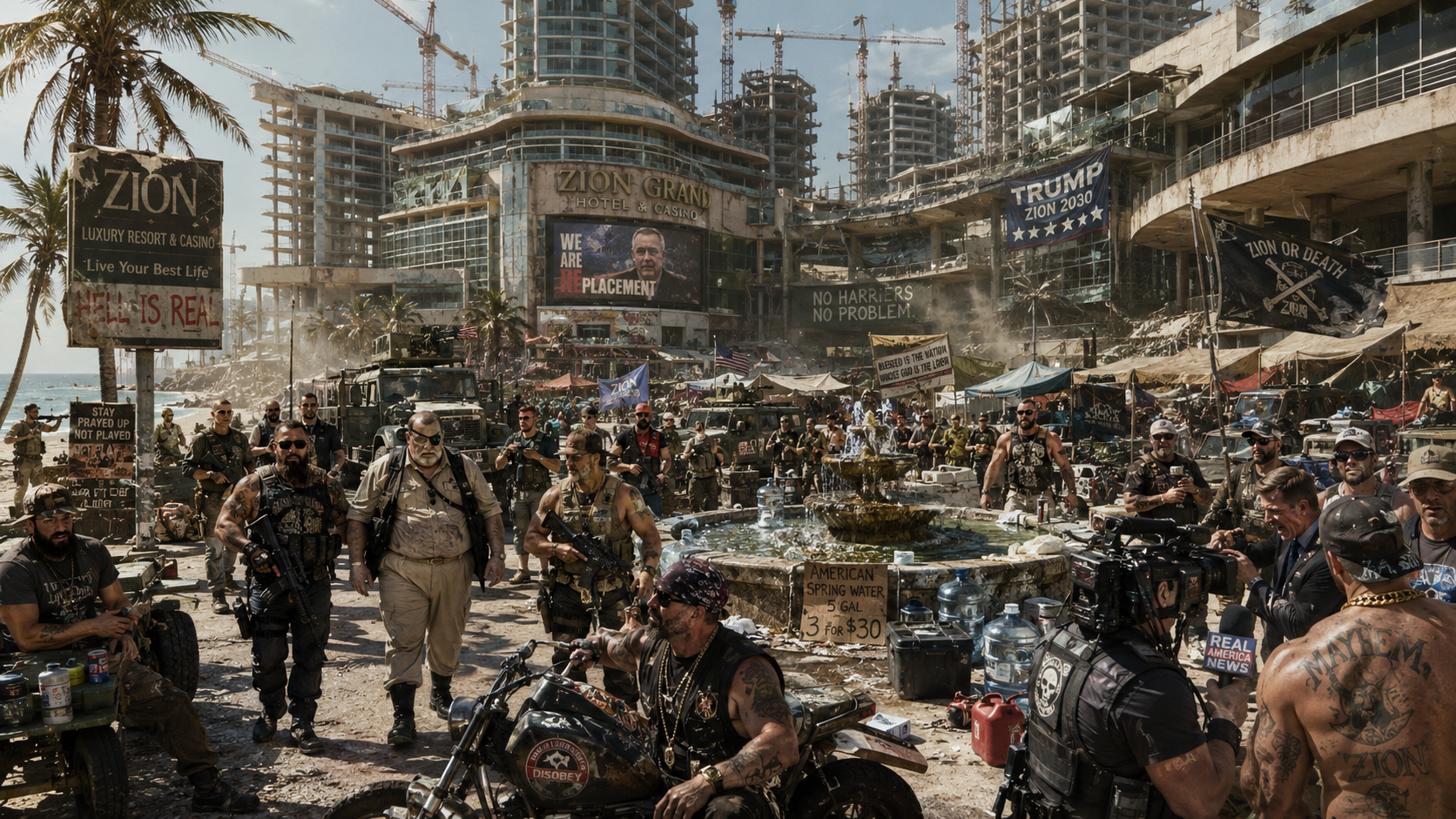
It did not collapse by Monday.
This was regarded as suspicious.
After the Cortez–Wynn landslide and the opening of what the newspapers called the Great Accountability Period, Zion received its final migration. Not refugees in the old tragic sense, not exiles driven by hunger, bombardment, or drought, but panic pilgrims: MAGA diehards, QAnon families, failed influencers, indicted sheriffs, former ICE contractors, militia entrepreneurs, Proud Boy remnants, tactical podcasters, sovereign-citizen accountants, minor megachurch prophets, vaccine newsletter millionaires, supplement salesmen, gold-hoard retirees, amateur constitutional scholars, and a remarkable number of divorced men towing boats named after abstract nouns.
They fled in every conveyance known to American overreaction.
Pickup trucks arrived first, groaning under the weight of portable generators, gun safes, beer coolers, ammunition cans, dehydrated meals, flags, folding chairs, emergency ham radios, smoker grills, black plastic tubs full of silver coins, framed portraits of presidents, frozen steaks, pit bulls, boat batteries, tactical vests, insulin, CPAP machines, six months of toilet paper, and exactly one box of irreplaceable family documents buried under twelve boxes of commemorative merchandise.
Then came the SUVs, the RVs, the lifted trucks, the dune buggies, the motorcycles, the church vans, the armored hobby vehicles, the sheriff surplus transports, the luxury yachts, the pontoon boats, the fishing boats, the rubber boats, the jet skis, the inflatable rafts, the homemade catamarans, and, in one case, a floating hot tub powered by a lawnmower engine and piloted by a man from Ocala who claimed to be escaping Marxist weather control.
It cannot be emphasized too strongly how afraid they were.
Their terror was not proportionate to events, which is to say it was politically useful until it became logistically inconvenient. For decades they had been fed a diet of nightly doom, served hot and salted by men in expensive suits who lived behind gates and did not believe half of what they sold. They had been told that immigrants were coming, socialists were coming, feminists were coming, trans people were coming, cities were coming, taxes were coming, teachers were coming, librarians were coming, antifa was coming, judges were coming, fact-checkers were coming, and finally, worst of all, consequences were coming.
The last one turned out to be true.
This gave the previous lies retroactive credibility in their minds, which is how paranoid systems preserve themselves. When the subpoenas arrived, they did not think: ah, perhaps the fraud was real. They thought: the prophecy has entered its legal phase.
Cable television had prepared them for martyrdom and left them helpless before paperwork. A search warrant struck them as Bolshevism. A tax audit was regarded as occupation. A deposition was indistinguishable from religious persecution. An ethics inquiry became, in their mouths, a communist tribunal. The phrase “please appear before the committee” produced among them a kind of continental nervous breakdown.
And so they ran.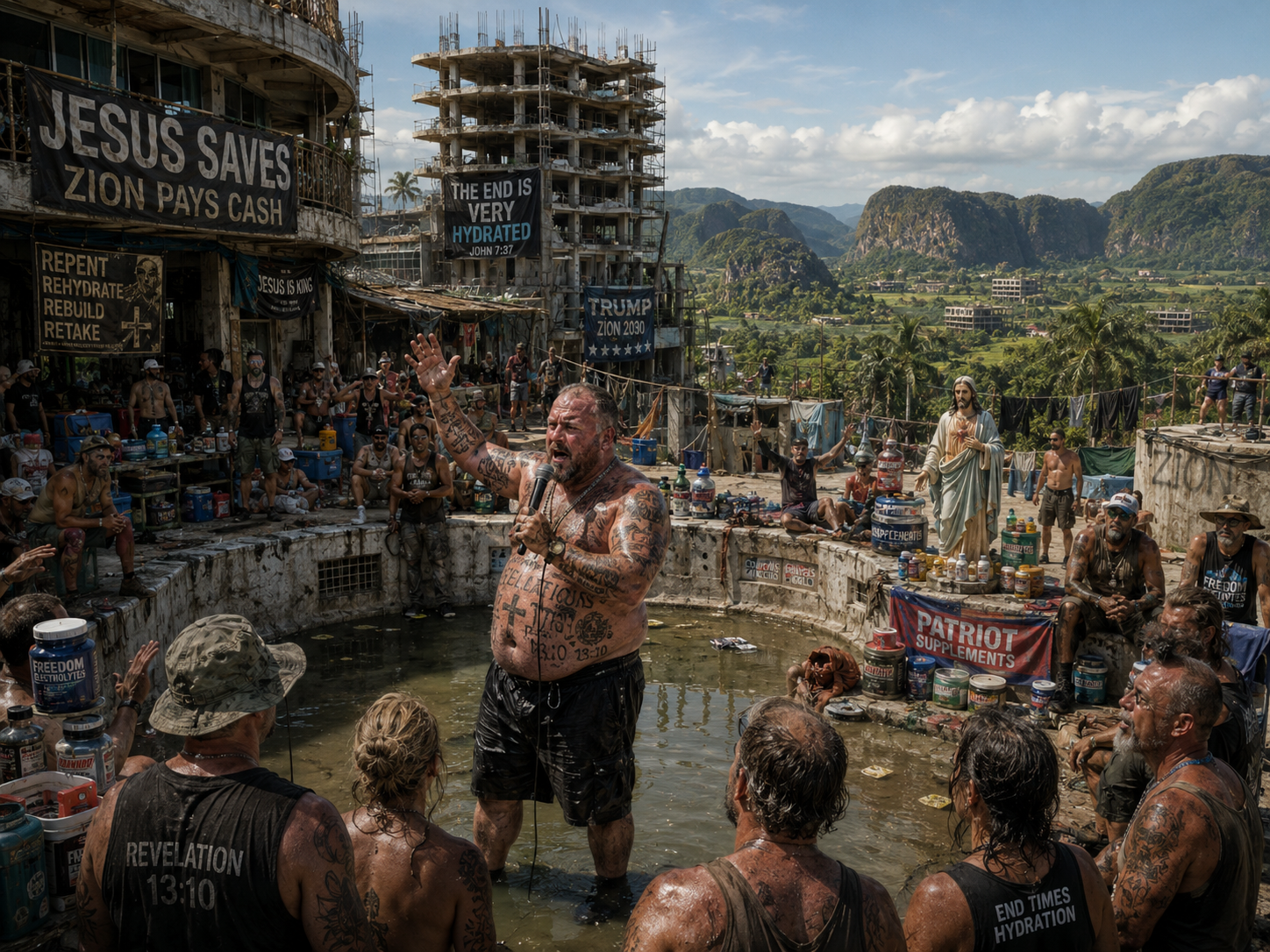
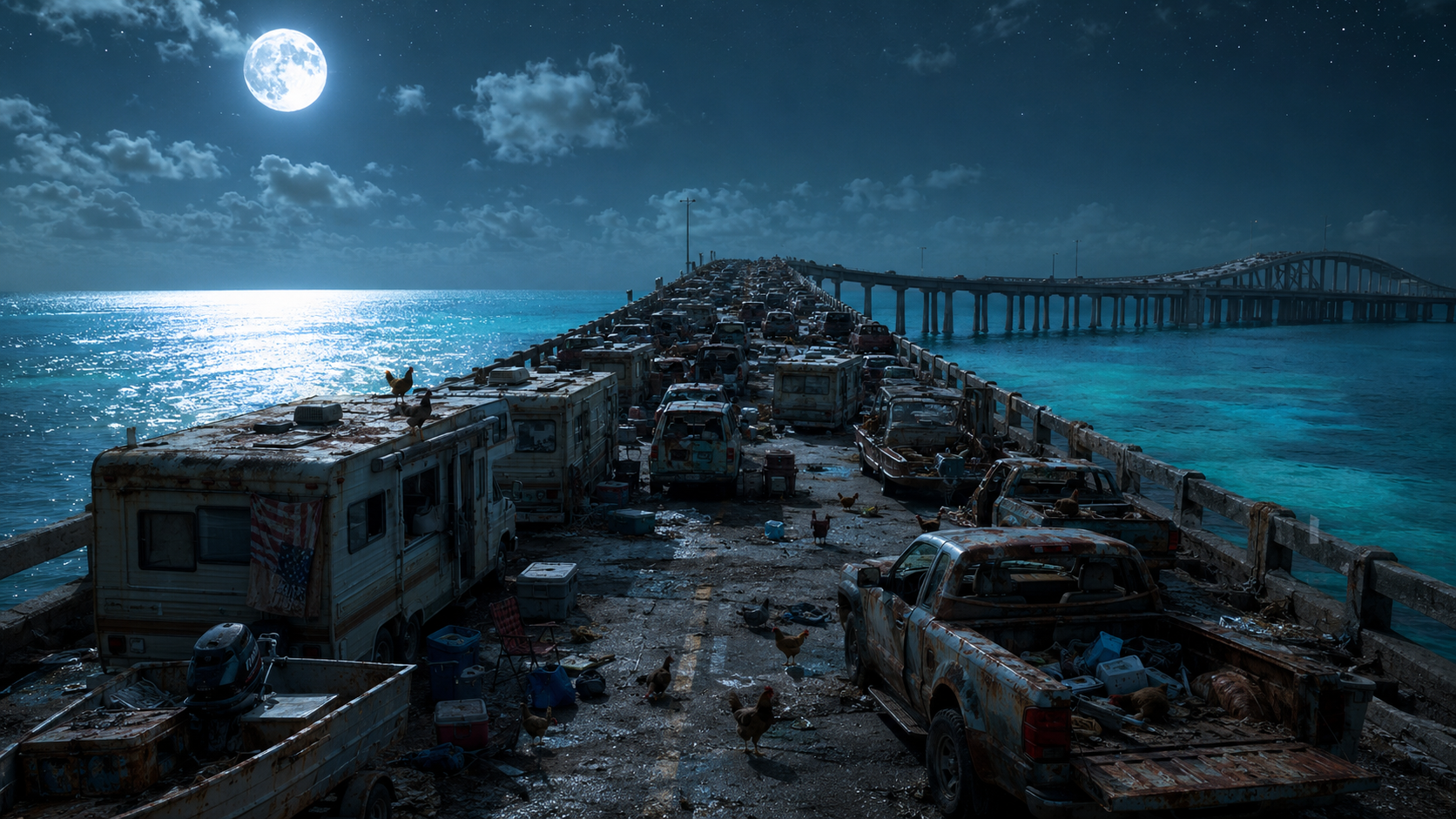
The Great Zion Bridge, officially called the Freedom Restoration Causeway and unofficially called the Kushner Span because no naming opportunity remained unsold, had been constructed in the project’s obscene middle period, when money still flowed and engineers were still willing to pretend that a giant hardened road between Florida and a collapsing imperial resort-state was an infrastructure achievement rather than a symptom. It stretched southward over the water in segments, part bridge, part elevated highway, part security corridor, part floating checkpoint, part donor monument. It was not quite the longest bridge in the world, but it was certainly the longest metaphor.
In the evacuation panic, it became a parking lot of the American subconscious.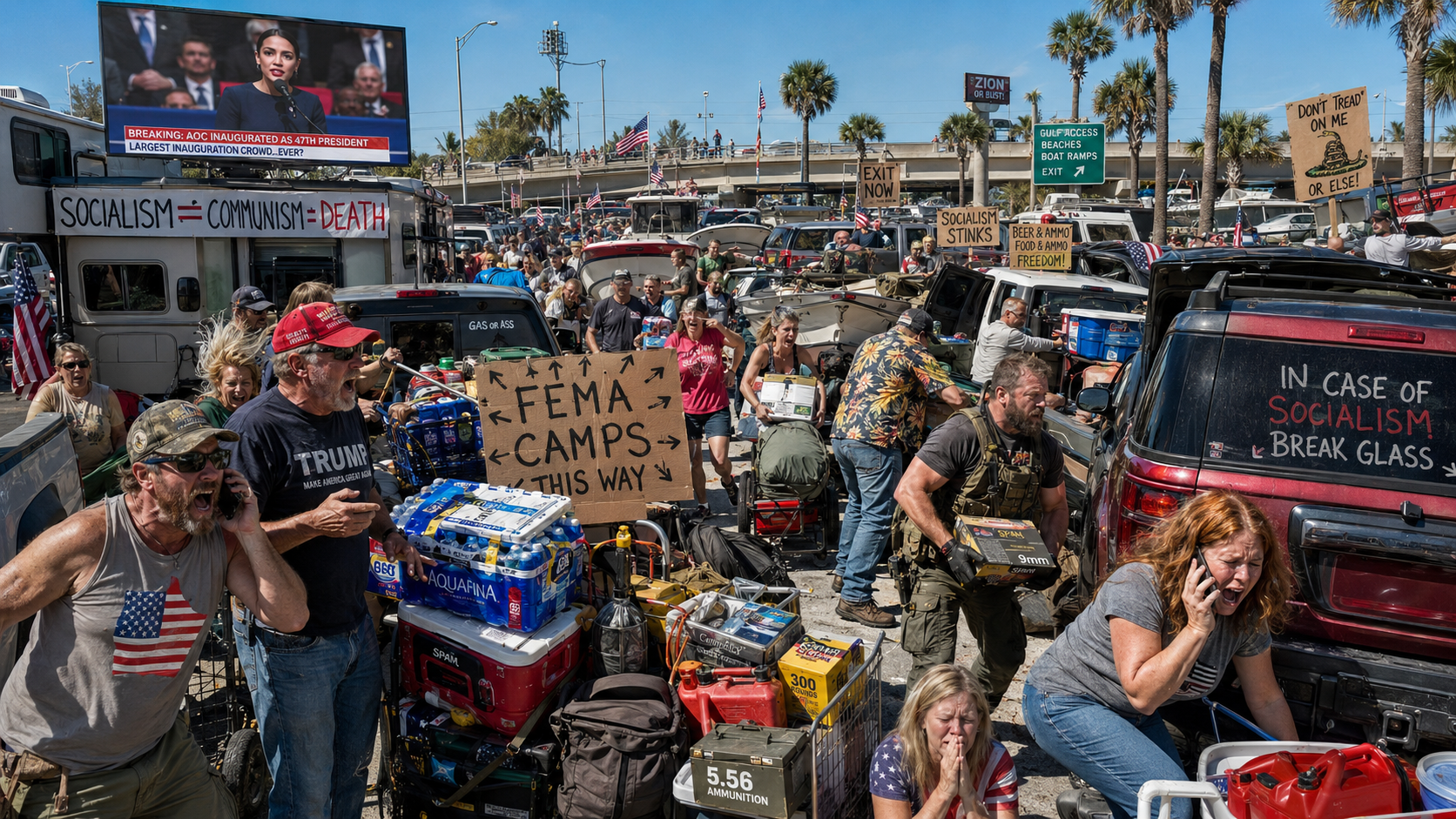
They came roaring toward it from every direction: Tampa, Naples, Fort Lauderdale, Miami, Jacksonville, Pensacola, suburban Georgia, inland Texas, Tennessee compounds, Arizona retirement developments, Idaho prepper villages, and those parts of Ohio where every restaurant seemed to be called either Liberty Something or Something Patriot. They drove in convoys with flags whipping, horns blaring, radios shrieking, children crying, dogs barking, wives reading rumors aloud, husbands shouting at GPS systems they believed had been compromised by the Department of Equity.
At the Florida entrance, volunteer militias tried to direct traffic and immediately founded seven rival command structures. One group wore matching plate carriers and called itself Bridge Patriots Alpha. Another insisted on constitutional authority because its leader had once been a county commissioner. A third operated a toll booth collecting donations for “legal defense of the crossing,” though no one could identify whose legal defense. A fourth group attempted to prioritize veterans, pastors, influencers, “verified patriots,” women and children, gold-tier subscribers, and anyone with a blue checkmark from before the platform changed ownership.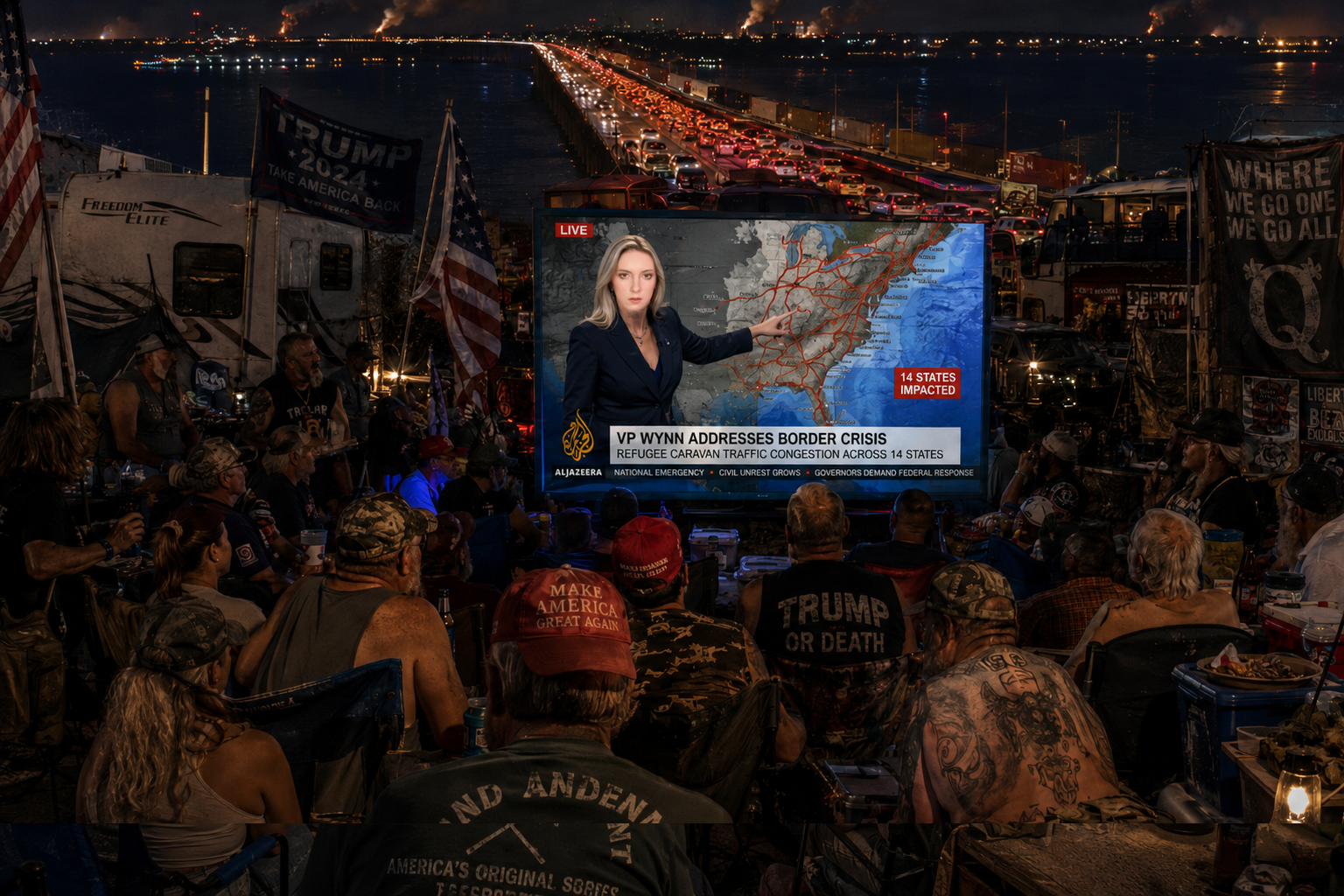
Traffic stopped within hours.
The first RV overheated at mile six. The second jackknifed trying to pass it. The third attempted to reverse, struck a trailer loaded with ammunition boxes and souvenir Liberty Bell replicas, and caused a rumor of sabotage. Someone fired into the air. Someone else fired back because the first person had fired into the air in a threatening tone. A family from Sarasota abandoned their minivan after discovering that twenty gallons of emergency gasoline had been replaced by sweet tea at some point during packing. A pastor from Alabama livestreamed himself declaring spiritual war against traffic cones. The livestream received nine million views before his phone battery died and he began asking strangers for a charger.
By nightfall the bridge was a nation.
A thin, hot, absurd nation of chrome, vinyl, diesel fumes, open trunks, dangling flags, empty snack bags, crying toddlers, armed men, folding tables, portable toilets, arguments, rumors, prayers, generators, and the particular smell produced when fear and mayonnaise spend too long in the same cooler.
They slept in their vehicles or on their vehicles or beneath their vehicles. They established neighborhood watches, then accused the neighborhood watches of infiltration. They made coffee on camp stoves. They grilled meat intended for a six-month siege and ate most of it in two days. They traded batteries for bottled water, bottled water for ammunition, ammunition for insulin, insulin for cigarettes, cigarettes for rumors, and rumors for the priceless sensation of knowing more than the idiots in the next lane.
No rumor was too stupid to travel the full bridge by morning.
President Wynn had ordered drone strikes on Florida. President Cortez had nationalized bass boats. The IRS was seizing grandchildren. The Supreme Court had been replaced by drag queens. The Navy had defected to Cuba. Cuba had defected to China. China had defected to Soros. Soros had died and been replaced by software. The bridge itself was a United Nations trap. The bridge itself was the only safe place left. The island had food. The island had no food. The island was under divine protection. The island was under Canadian control. The island was full of tunnels. The tunnels were full of antifa. Antifa was afraid of saltwater. Saltwater was woke.
At mile twenty-three, a man with a drone announced that he had located a secret emergency lane. Thousands attempted to follow him. The lane was a maintenance shoulder ending at a locked gate. The key had been lost during the construction insolvency. Three hours later the gate had become, in bridge mythology, the Western Gate of Betrayal.
At mile forty, a yacht broker in a linen shirt attempted to sell fractional berths in vessels he did not possess.
At mile fifty-two, several families discovered that their bug-out bags contained mostly tactical patches, cryptocurrency seed phrases, and expired protein bars.
At mile sixty-one, a group of sovereign citizens declared the bridge an independent republic and refused to recognize lane markings.
At mile sixty-two, another group declared war on them over access to a chemical toilet.
At mile eighty, a man dressed as a revolutionary militiaman from 1776 tried to direct traffic with a musket and was ignored by everyone except a confused tourist family from Belgium who had taken a wrong exit three states earlier and were now afraid to ask questions.
The crossing into Zion did not improve matters.
The island authorities, by then composed of competing ministries, private militias, abandoned Israeli security contractors, evangelical administrators, American fugitives, and one exhausted customs bureau still using printer cartridges from the original occupation, had not expected millions of heavily armed friends (and not so friends) to arrive simultaneously. They had expected donations, volunteers, content creators, and perhaps a few strategic retirees. They had not expected a rolling human landslide of grievance pulling bass boats full of canned chili.
The island gates closed.
This produced outrage among the people who had spent years demanding closed borders.
They shouted. They honked. They waved passports. They waved flags. They waved pocket Constitutions. They waved laminated credentials from sheriff’s departments that no longer existed. They waved court summonses and claimed them as proof of persecution. They waved Bibles, firearms, property deeds, Trump resort memberships, church letters, expired police badges, veteran cards, gold coins, and printed screenshots from podcasts explaining that Zion Island was legally required to admit them under the ancient doctrine of don’t-you-know-who-I-am and who-I-know?
The ‘authorities’ did not know who they were and whomever they knew.
This was experienced as a grave personal injury.
The Florida side closed the next day.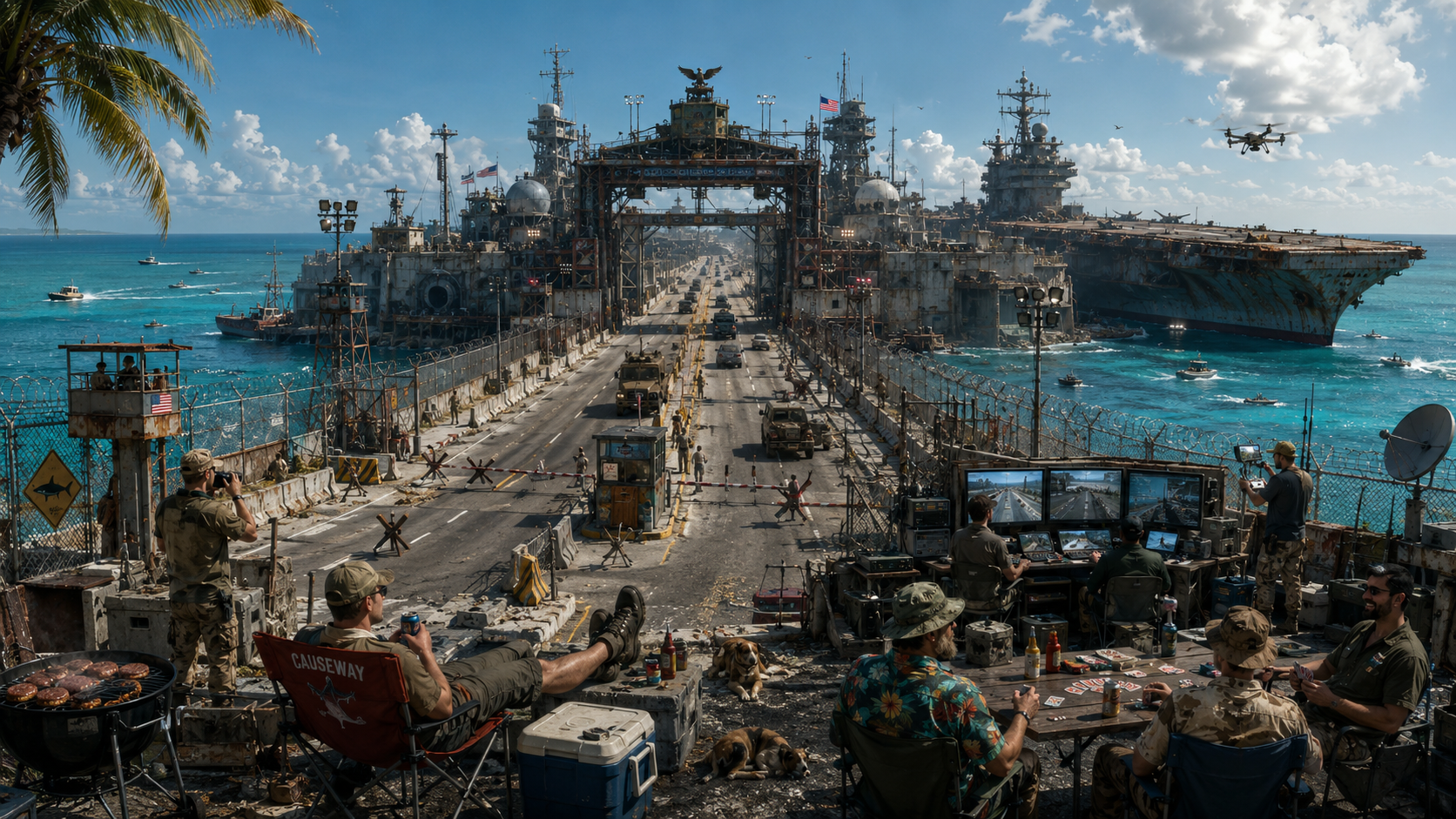
The Cortez–Wynn administration, citing public safety, arms trafficking, fugitive movement, bridge collapse risk, and “the unacceptable possibility that the United States may accidentally export its entire paranoid uncle sector into an active sanctions zone,” sealed the northern entrance with federal marshals, concrete barriers, floodlights, drones, and a great deal of calm signage. The southern entrance, not wishing to receive additional refugees, sealed itself with armored cars, private contractors, sandbags, shipping containers, and several banners insisting that all true patriots were welcome after orderly processing, which had been suspended indefinitely for security reasons.
Thus the bridge became what it remains today: the most heavily armed traffic jam in the Western Hemisphere.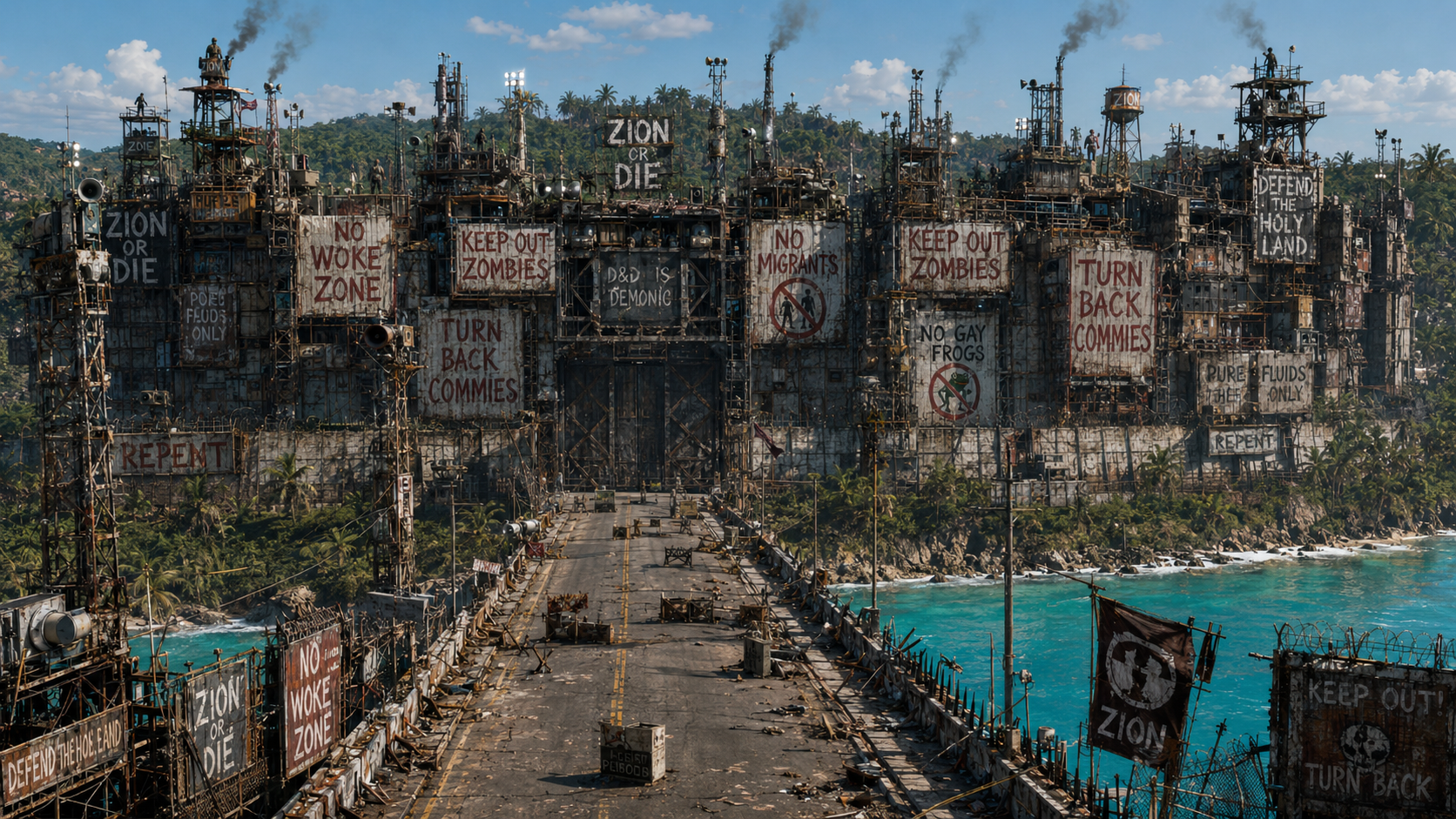
On maps it is now usually shaded gray.
At the northern end stands the American Fortified Transitional Security Zone, a clean, cold, excessively monitored complex of fences, barriers, watchtowers, scanners, lawyers, journalists, archivists, and federal officers who have learned to say “sir, please step away from the barricade” in tones of profound spiritual fatigue. It has clinics, evidence lockers, surrender booths, vehicle registries, deradicalization pamphlets, charging stations, and a small museum in which schoolchildren can view confiscated novelty flags and learn how not to pack for treason.
At the southern end stands the Zion Island Sovereign Reception Command, a paranoid agglomeration of bunkers, floodlights, rusting armored vehicles, militia banners, evangelical loudspeakers, and checkpoints operated by men who distrust one another almost as much as they distrust the world. It broadcasts hymns, emergency alerts, investment opportunities, and warnings about ideological contamination. Its loudspeakers periodically announce that President Wynn has fallen, resigned, been arrested, been cloned, died, or secretly begged for negotiations. These announcements have grown less convincing with each passing year.
Between them lies the bridge.
The cars are still there.
Miles and miles of them, sun-blasted, salt-eaten, rusting into one another under the bright indifferent sky. Pickup trucks with faded decals. RVs with broken awnings. SUVs with flat tires. Boats still tied to trailers. Jet skis gone chalky with age. Coolers cracked open. Lawn chairs collapsed. Flags shredded into ribbons. Stickers peeling. Bibles swollen with damp. Gun racks empty or warped. Children’s toys bleached white. Campaign hats lodged in drains. Bags of old ammunition fused into useless lumps. Freezers full of vanished meat. Gold coins hidden in air vents and discovered later by bridge maintenance teams who catalogued them beside handguns, wedding albums, supplement tubs, tax documents, fake badges, dehydrated macaroni, and enough novelty T-shirts to clothe a doomed civilization.
For years, feral chickens lived near mile marker thirty-six.
No one knows how they got there. Some say they escaped from an RV. Some say they were brought for eggs. Some say they were part of a sovereign agricultural initiative. They became famous. Documentaries were made. Children named them. A conspiracy channel claimed they were surveillance chickens. A man attempted to rescue them and was arrested after trying to cross four barricades with a fishing net and a pistol.
The chickens, unlike most human actors in this episode, adapted well.
Zion itself deteriorated into factional absurdity. The MAGA districts fought with the Q districts, which fought with the evangelical districts, which fought with the crypto districts, which fought with the ex-security districts, which fought with the old island authorities, which fought with remaining development boards over the right to issue worthless permits for buildings no one could complete. Gunfire became weather. Explosions punctuated the night with the regularity of bad punctuation. Arms deals took place in abandoned hotel spas. A former casino floor became a militia parliament until three different factions tried to use the high-limit room as a treasury. A wellness center became a bunker. A chapel became a radio station. A yacht club became a fuel cartel. A luxury mall became a bazaar selling canned food, body armor, counterfeit insulin, old iPhones, miracle water, tactical sandals, and souvenir mugs reading I SURVIVED RESTORATION.
No one trusted anyone.
Every faction believed itself infiltrated. Every faction was correct, but not in the way it imagined. Half the infiltrators were journalists, a quarter were federal assets, a quarter were grifters pretending to be federal assets to increase their status, and several were merely confused men who had forgotten which militia they joined after the third rebrand. Meetings required passwords. Passwords were leaked. New passwords were adopted. These were immediately leaked by the man who had suggested them. Loyalty tests became so elaborate that entire committees forgot their original purpose and spent six months investigating whether the committee investigating loyalty had been compromised by a subcommittee on loyalty investigation.
From the outside, it was easy to laugh.
From the inside, they called it civilization.
And this, perhaps, was the final joke. They had fled from democracy to save freedom, from courts to save law, from taxation to save prosperity, from pluralism to save culture, from reality to save truth. They had crossed the sea with coolers, flags, rifles, boats, grills, slogans, generators, cash, fear, and an unshakable conviction that history owed them a private exit.
History gave them a bridge.
Then it took away the gas.
Thesis on Zion Island in the 2030s
Or: How a Country Became a Holding Pen for Everyone Who Mistook Consequences for Persecution
By the middle of the 2030s, Zion Island was no longer a nation, no longer a restoration project, no longer a casino colony, no longer a theological experiment, and no longer even a competent failure. It had become something stranger: a sealed moral swamp, a tropical pressure cooker into which the collapsing American right, the exhausted Israeli emergency diaspora, hardline exile politics, corporate fugitives, mercenary bureaucrats, evangelical end-timers, conspiracy hobbyists, defense-sector ghosts, and entire families of rich people with lawyers had all been dumped, stirred, armed, televised, and left under the Caribbean sun.
The bridge, for all its mythic value, was ultimately a side stage. A beautiful, absurd, rusted theater, yes; a fossilized tantrum across the water; an eight-lane monument to men who believed freedom meant never being asked to explain themselves. But the bridge was only the drainpipe. The real story was the island.
Zion in the 2030s was a map of panic.
It was not one society. It was dozens of incompatible societies, each fenced off from the others, each convinced the others were agents of betrayal, impurity, infiltration, communism, Satan, the FBI, the Antichrist, the World Economic Forum, the Mossad, Soros, Iran, the Deep State, or several species of reptile in ill-fitting human masks. A rational state would have called this a public-health emergency. Zion called it pluralism.
The first population was the saddest and most dangerous to describe badly: the Israeli refugee clusters.
They were not a single bloc. They were families, former officials, ex-soldiers, reservists, technicians, settlers, security people, bureaucrats, schoolteachers, propagandists, ordinary frightened civilians, and exhausted children who had grown up inside a national myth that had finally run out of room. Many had fled because Israel itself had become unlivable. Others had fled because the international legal climate had changed, and the words “universal jurisdiction” had ceased to be an abstraction muttered by activists and had become a thing with airport detention rooms attached.
They did not want to end up on ICC dockets. They did not want to be photographed at customs. They did not want some old post, some unit photo, some boast, some video, some administrative signature, some “minor logistical role,” some moment of adolescent cruelty uploaded for applause, suddenly read aloud by a prosecutor in The Hague, Madrid, Dublin, Cape Town, São Paulo, or Toronto. They had fled consequence and landed in a place made entirely of it.
By the 2030s, these communities had become fenced enclaves within the island, and many of them were fenced as much for their own protection as for anyone else’s. The early covenant myth had collapsed. The evangelical settlers and American fugitives who had arrived later did not especially care about Jewish life, Jewish memory, Jewish law, Jewish grief, Jewish fear, or Jewish anything except insofar as it could decorate a sermon, justify a bunker, or appear on a flag beside an eagle and a discount code. The old sacred language remained on official stonework, but the daily culture around it had been eaten by militia capitalism, conspiracy media, and Florida-style end-times merchandising.
Thus the Jewish refugee districts became places of deep suspicion and exhausted inwardness. People lived behind gates, cameras, community watch networks, private clinics, improvised synagogues, legal advisory offices, and family councils that argued late into the night about whether anyone could ever leave. There were parents who had taught their children that the world hated them, then discovered that the world might also have paperwork. There were young people who had once been told they were pioneers and were now trapped between frightened grandparents and American gun cranks who screamed about globalists outside the perimeter. There were former soldiers who could not sleep. There were lawyers who could not stop shredding. There were rabbis who wanted repentance, rabbis who wanted denial, rabbis who wanted silence, and rabbis who wanted only to keep the children away from the militias.
Outside those zones, the island belonged to the second wave: the American panic refugees.
They had come in millions, or what felt like millions, though numbers on Zion were never trustworthy. They were MAGA diehards, QAnon believers, former ICE contractors, Proud Boy remnants, sovereign citizens, county sheriffs under investigation, supplement influencers, election-fraud prophets, anti-vaccine celebrities, militia dads, bunker moms, tactical retirees, megachurch pilgrims, NewsMax uncles, podcast warriors, Confederate reenactors who had become confused about the boundary between costume and ideology, and men who introduced themselves by rank despite never having been promoted by any institution recognized after 1865.
They brought everything they valued: guns, coolers, flags, water filters, generators, boat motors, tactical vests, silver coins, family Bibles, protein powder, expired antibiotics, freeze-dried chili, AR-platform accessories, framed Trump portraits, bulk toilet paper, ham radios, dehydrated eggs, “medical freedom” binders, pillows sold by television patriots, horse-dewormer nostalgia, gold bars, electric scooters, pit bulls, body armor, smoker grills, crypto wallets, and storage tubs full of documents proving, to their own satisfaction, that no court had jurisdiction over them.
They had been told for decades that tyranny was coming. Then, when subpoenas arrived, they mistook the ordinary machinery of law for the apocalypse they had been promised. A deposition became a gulag. An indictment became spiritual warfare. A tax audit became communism. A vaccine archive request became genocide. President Cortez was not, to them, a president; she was the weather system of every nightmare they had purchased from men in studio makeup. President Wynn, even worse, seemed to them like the final insult of reality: articulate, polished, mercilessly funny, impossible to scare, and apparently able to say “regulatory compliance” in a way that made strong men feel hunted.
Their fear was hysterical, but not random. It had been cultivated. The panic had sponsors. Cable channels, churches, influencers, merchandise stores, survival brands, think tanks, lobbyists, political consultants, crypto grifters, gun accessory companies, and miracle supplement vendors had spent years feeding dread into these people’s nervous systems and calling it patriotism. By the time consequences arrived, they had no immune system left for reality.
The third population consisted of the hardline Cuban returnees and exile-power networks.
These were not the ordinary Cuban families who had suffered, adapted, emigrated, worked, loved, built lives, lost homes, sent remittances, mourned Cuba, and later found themselves doing unexpectedly well in the United States under the Cortez and Wynn administrations. Those Cubans, by and large, did not want Zion. They missed Cuba terribly, but in the new America they had jobs, housing programs, clinics, union pathways, schools that functioned, and the strange luxury of being treated as citizens rather than props in someone else’s Cold War pageant.
No, the Zion Cuban faction was something harder, narrower, more ideological: old exile money, revenge politics, paramilitary nostalgia, Miami donor networks, Pinochet-adjacent fantasists, anti-communist dynasts, businessmen who had long ago converted family trauma into a permanent license for cruelty, and men whose eyes had the flat, cold shine of people who believed history had personally insulted their bloodline. They did not want democracy in Cuba. They wanted ownership. They did not want justice. They wanted reversal. They did not want the old island back. They wanted a new island where the old humiliations could be repaid with interest.
They clashed constantly with the American militias, who regarded them as insufficiently American, insufficiently Protestant, too foreign, too Spanish-speaking, too connected, too slick, too rich, or too likely to understand smuggling routes better than they did. The hardline Cuban factions, in turn, regarded the MAGA arrivals as useful cattle with ammunition. They were happy to sell them fuel, water, black-market medicine, security, dock access, girls, passports, rumors, boat parts, and ideological flattery. They were less happy when the cattle began forming committees.
Then came the corporate fugitives.
These were perhaps the most revealing. Zion was full of men who had not technically fled justice, because justice had not yet finished typing their names. Lobbyists, fossil-fuel strategists, climate-disinformation consultants, offshore accountants, defense procurement fixers, disaster-capitalism entrepreneurs, private-prison investors, biometric-surveillance vendors, data brokers, influence peddlers, congressional spouses with shell companies, campaign finance architects, and whole cadres of men from Washington whose hands were too clean because they had paid others to get them dirty.
They had arrived with luggage, NDAs, encrypted devices, incomplete consciences, and the unbearable expectation that somebody would still be willing to comp them a suite. Many had been tangentially associated with Trump-world: pillow merchants, election lawyers, crypto evangelists, supplement doctors, horse-paste nostalgics, anti-woke investment influencers, border-wall subcontractors, foreign-policy cowboys, Russia-adjacent fixers, Gulf money intermediaries, think-tank prophets, TV lawyers, evangelical bundlers, “family office” men, Catholic-adjacent moral crusaders with very secular litigation exposure, and social-media tycoons who had discovered too late that owning the platform did not exempt one from discovery.
Everyone was there, or rumored to be there, which on Zion was almost the same thing. Some said Mark Zuckerberg had visited through a secure compound and left behind a communications protocol, three lawsuits, and an apology no one believed. Some said Elon Musk had tried to establish an emergency launch venture from the old military airfields, promising orbital liberty, sovereign bandwidth, and eventual evacuation, but the rockets kept being delayed by salt corrosion, sanctions, unpaid engineers, and the fact that no one could agree who owned the launchpad. Some said Peter Thiel had a bunker beneath an unfinished longevity clinic. Some said he had never set foot on the island and merely owned parts of it through vehicles named after dead philosophers. Both explanations felt equally plausible and equally irritating.
The Trump family occupied its own category: not rulers, not prisoners exactly, not guests, not safe, not free.
They had arrived as royalty and become collateral. Ivanka was there. Jared was there. Barron was there, the tragic tall quiet prince of a family brand that had finally become a jurisdiction. Others came and went until going became impossible. Their compounds were guarded, then double-guarded, then guarded from their own guards. Contracts were rumored to exist on half of them, whether from betrayed investors, old partners, militia factions, foreign creditors, intelligence services, angry contractors, unpaid security companies, or people who had bought archangel-tier timeshares and discovered the bunker pool had never been poured.
They could not leave because the outside world had courts. They could not remain because Zion had memories. They lived in a palace of cameras, generators, chefs, sweating lawyers, fuel shortages, satellite calls, gold fixtures, and the knowledge that every person smiling at them might be recording.
The Pentagon people were quieter.
They had the manner of men who had spent careers learning the passive voice. Mistakes were made. Assets were moved. Contacts were developed. Detainees were processed. Airspace was secured. Interrogations occurred. Contractors exceeded guidance. Local partners were imperfect. Civilian harm was regrettable. Documentation was classified. Their presence on the island was never officially acknowledged, but everyone knew where the old war men drank. They occupied the back rooms of shuttered hotels and the upper floors of half-finished ministries, running security consultancies, intelligence boutiques, arms-brokerage desks, maritime insurance scams, and emergency training seminars for militias too stupid to understand they were being used and too armed to correct politely.
Around them orbited the media paranoiacs.
Former Fox personalities. NewsMax ghosts. Streaming prophets. Angry men with ring lights. Women selling end-times pantry systems. “Investigative” channels broadcasting from converted hotel bars. The island had dozens of studios: some professional, some improvised, some run from RVs, some from abandoned bridal suites, some from fortified chapels where the host sold silver coins between denunciations of fiat currency. They reported constantly on the collapse of America, which stubbornly failed to collapse, and on the imminent liberation of Zion, which failed even more impressively.
Every week brought a new enemy, a new theory, a new leak, a new betrayal, a new revelation, a new emergency donation campaign. The island’s greatest natural resource was not sugar, nickel, beaches, or offshore rights. It was attention decay. People forgot yesterday’s lie as soon as today’s lie arrived wearing sunglasses.
And beneath all this, around all this, surviving all this, were the actual Cubans.
Most were no longer on the island. That was the bitter joke. The people on whose land the whole delirium had been built had, through displacement and policy reversal and repatriation programs and the strange contingencies of history, ended up largely in the United States. And there, under two Cortez terms and then two Wynn terms, many did better than anyone in 2026 would have believed. Not perfectly. Nothing was perfect. Nostalgia remained. Grief remained. The old songs hurt. The old houses existed only in photographs, memory, or litigation. Grandmothers cried for streets their grandchildren knew only through stories. Men who had once fixed engines in Havana fixed transit buses in Tampa. Women who had once sold fruit in Matanzas ran food cooperatives in Newark. Children with Cuban accents became union organizers, nurses, engineers, lawyers, teachers, bureaucrats, musicians, and, most dangerously to old regimes, voters.
They missed Cuba. Of course they missed Cuba. But they looked across the water at Zion and understood something the invaders never did: a place is not saved by claiming it harder. A country is not restored by renaming its wounds. A homeland is not a deed, not a casino, not a wall, not a myth, not a flag planted by the frightened and funded by the guilty. A homeland is the pattern of life that continues when the slogans rot.
By the late 2030s, Zion was therefore the perfect anti-country. A country-shaped argument against itself. It contained people who had fled courts, fled memory, fled democracy, fled socialism, fled accountability, fled reality, fled one another, and eventually fled into fenced compounds from which they shouted that they were free. It contained sacred texts emptied into marketing copy, patriotism converted into smuggling routes, capitalism reduced to barter, faith reduced to loudspeakers, security reduced to gangs, masculinity reduced to guard towers, and liberty reduced to the right to distrust the next checkpoint.
It was delightful only in the way a catastrophic museum is delightful: every exhibit was labeled by irony.
Here was the casino built by men who denounced decadence.
Here was the militia district founded by men who feared lawlessness.
Here was the refugee enclave of people who had called others animals.
Here was the Cuban exile palace built on a Cuba no Cubans recognized.
Here was the corporate compound of men who believed markets were efficient until the market priced them as fugitives.
Here was the evangelical quarter where prophecy had become property management.
Here was the Trump compound, where the brand finally became a moat.
Here was the tech bunker, still waiting for the app that would make exile scalable.
Here was the rocket pad from which no one escaped.
Here was the bridge, a mere footnote, clogged with the vehicles of people who packed for civilizational collapse and forgot fuel.
And everywhere, everywhere, under the sun, in the mold, in the salt, in the heat, in the stalled elevators and rusting cranes and unfinished towers, was the same lesson: history does not need to punish delusion. It only needs to let delusion govern for a while.
Zion Island did the rest.