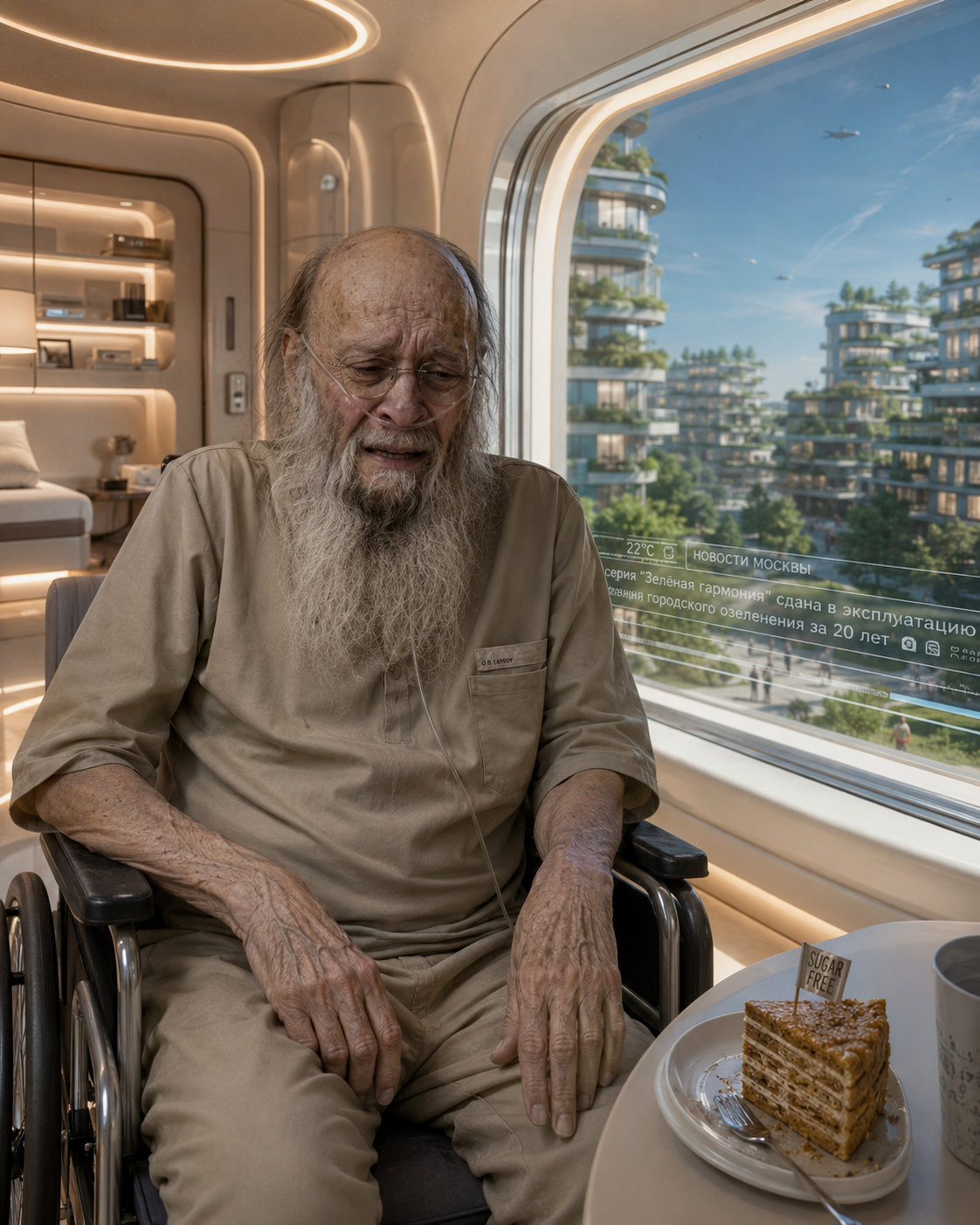
They released him for humanitarian reasons since he was finally dying.
This phrase was repeated three times in the document, as if repetition made mercy more plausible. Humanitarian reasons. Humanitarian grounds. In view of advanced age and terminal decline, the Committee for Penal Review of the Moscow Republic had determined that Sergei Viktorovich Lavrov, ninety-eight years old, no longer represented any practical danger to society.
…… Practical danger.
He had stared at those words for a long time.
Not moral danger. Not historical danger. Not symbolic danger. Practical danger. As if he were a faulty kettle, an old elevator, a cracked paving stone, something to be assessed for immediate hazard and then either repaired, removed, or ignored.
They gave him clothes that did not belong to him and a coat too light for his bones. His hands had become legal documents, thin and spotted and indecisive. A woman from the release office spoke to him kindly in Russian with an accent he could not identify. Everyone had accents now. Or perhaps he did. That possibility kept returning to him in unpleasant little flashes: that the world had not become strange, but that he had become local to a vanished country.
Outside, the air was warm.
He had expected cold. He had expected punishment to involve weather. In his mind Moscow remained a place of iron winter, exhaust, wet wool, black cars, salted pavements, bureaucratic heat behind sealed windows. But Moscow in 2047 was bright and soft and moving. It had changed more in twenty-one years than Shenzhen had in the stories people used to tell about Shenzhen, and he had not seen the change happen. He had only heard fragments: the first five years awful, then something else; shortages, then reconstruction; tribunals, then exhaustion; capital flight, then reindustrialization; collapse, partition scares, municipal compacts, foreign technical missions, demographic bargains, religious embarrassments, amnesties, seizures, returns, disappearances, then glass, gardens, drones, clinics, schools, festivals, towers grown like improbable coral out of the old concrete.
He had missed the apocalypse and the renaissance.
This was one of the humiliations.
The van delivered him to a neighborhood whose name he knew. He recognized the name because his daughter had lived there in 2026. Not here exactly, not this building, not this street as it now existed, but somewhere in this district. His daughter would be forty-five now. He had tried to call her three times after they gave him the device. It was not really a phone. It was a smooth gray lozenge that listened better than any person he had known and answered with unbearable patience.
No connection.
Then:
The recipient has declined unknown legacy contact.
Legacy contact.
He had asked the release woman what that meant. She had hesitated, then told him it was a privacy category.
Privacy. Another resurrected word.
His wheelchair drove itself along a path that had once been a road. The chair did not bump. It anticipated. It corrected. It turned gently before he understood why. Somewhere beneath the seat a motor made a small polite vibration, like a servant clearing its throat.
Behind him walked a woman assigned by the municipal care office. He did not know her name. She had told him, but he had lost it immediately. He had no idea what nationality she was, or race, or language, or even what continent he would have guessed if guessing were still permitted. Her skin had a warm gray-brown undertone; her eyes were pale; her hair was covered by a black silk scarf printed with little suns and machine diagrams. She wore a loose kimono the color of wet copper over white sneakers. When she smiled, her teeth were red, each marked with a tiny bright logo like corporate heraldry stamped on seeds.
She spoke to herself constantly.
There was no phone at her ear. No visible device. She muttered, laughed, paused, clicked her red teeth together, answered someone, argued with no one. Perhaps everyone now did this. Perhaps there were people in the air.
A small box followed her on six rubber feet. It carried his medication, folded blankets, emergency fluids, an inflatable ramp, and the documents proving he was legally alive.
Children were playing in the street. At least, he believed they were playing. There was no ball, no chalk, no toy, no visible object. They ran, stopped, ducked, screamed with laughter, threw nothing, caught nothing, hid behind lines only they could see. An old man on a bench shouted encouragement. Two old women clapped and howled with joy whenever one of the children performed some invisible triumph.
Lavrov watched them for several minutes.
“What are they doing?” he asked.
His attendant looked up from whatever conversation occupied her private air.
“Playing,” she said.
“What game?”
She smiled with her red branded teeth.
“I don’t know. Children’s game.”
That was worse than an answer.
Further on, in a fountain surrounded by trees and floating advertisements visible only when one looked directly at them, several young women were dancing naked in the water. Not half-naked. Not provocatively arranged. Merely naked, laughing, unselfconscious, splashing one another in the warm white spray. One had blue-green hair cut into uneven feathers, metal in her nipples, metal in her eyebrows, metal down the line of her belly, and a penis swinging plainly between muscular thighs.
Nobody looked.
This was the part that frightened him.
Nobody looked.
Not with lust. Not with outrage. Not with moral hunger. Not even with the satisfying disgust by which an old man might confirm that civilization had decayed. People walked past carrying drinks and children and transparent bags of vegetables. A courier drone lowered itself to a balcony. Two students argued about rent. A man in a linen suit sneezed. The naked girls screamed as the fountain changed pattern, and nobody cared.
Lavrov wanted someone to care. A policeman. A priest. A grandmother. A drunk. Anyone. He wanted civilization to object, not because he believed in the objection anymore, but because objection would have proved continuity. Instead there was only permission so complete it had become weather.
The sky was blue, warm, almost Mediterranean.
Then he saw the line.
At first he thought it was dirt in his eye. A faint thread across the upper brightness, not a cloud, not contrail, but a procession of tiny specks along the equator of the heavens. Some flashed. Some remained dull. The line was not perfectly straight; it trembled with distance, vanishing behind glare, then returning as a chain of dust made deliberate.
He raised one finger.
“What is that?”
His attendant followed his gaze.
“Oh,” she said. “Orbital belt.”
He waited.
She added, kindly, “Infrastructure.”
Infrastructure.
They had told him nothing.
For twenty years they had managed his blood sugar, his oxygen, his pain, his interrogations, his sleep, his permitted reading, his temperature, his bowel movements, his legal appeals, his memory exercises, his historical responsibility interviews, his dietary intake, his religious access, his blood pressure, his requests to die. But they had not told him there was a necklace of machines around the planet.
He stared until his neck hurt.
On the corner a small robot was playing a banjo.
It was a ridiculous robot, knee-high, dented, painted yellow, with three mechanical fingers and a face made from two cheap light sensors and a grille. The banjo was real. Its little fingers plucked with ferocious delicacy while an old Chinese woman danced beside it. Her dance was slow and exact, one hand curved like a leaf, the other turning at the wrist. She wore a padded blue jacket despite the warmth. Now and then she laughed at the robot and the robot increased tempo, as if teasing her.
A few people applauded. A dog barked once, then seemed to reconsider.
The chair continued.
He was delivered to a building where his daughter might once have lived, or near where his daughter might once have lived, or in the same district as the ghost of some apartment where, long ago, she had placed flowers in a window and answered his calls because she still believed fathers were permanent.
The building’s facade was green with terraces. Not the old sickly green of municipal paint, but actual vegetation: hanging vines, climbing fruit, moss panels, silver irrigation tubes, shaded walkways. Balconies bloomed with plants he did not know. External staircases curved across the front like white ribbons. The entrance opened before them without sound.
His apartment was on the sixth floor.
Small. Standardized. Efficient.
Everything had rounded padded edges. The corners of tables, doorways, counters, cabinets, even the windowsills were softened in pale material that yielded slightly when touched. A room designed for people who fell. A room designed by committees who had studied death in domestic spaces and filed recommendations. The floor was warm and not quite carpet, not quite rubber. The bed adjusted itself when the wheelchair entered. A dispenser in the wall blinked green. The bathroom door opened and revealed handles everywhere, rails everywhere, a shower chair like a throne for a defeated insect.
Then the apartment spoke.
“Good afternoon, Sergei Viktorovich,” it said in Russian.
The voice was male, warm, amused, and impossibly familiar.
He froze.
“Welcome home.”
Not exactly the same, of course. Nothing was exact anymore. But close enough. Smooth, electronic, companionable, with that old imported fantasy of a talking car from American television. Knight Rider. KITT. He remembered, absurdly, watching a pirated cassette once in the eighties in someone’s apartment, everyone drunk, everyone laughing at the wonderful stupidity of it. The West had seemed childish then, but rich in its childishness. Cars that talked. Men with leather jackets. Moral problems solved in forty minutes.
Now his state-provided death apartment addressed him in the voice of the car.
“I have prepared your arrival protocol,” said the apartment. “Your medication schedule has been synchronized. Hydration is recommended within twelve minutes. Your daughter has not approved contact at this time. Would you like me to queue a request for later delivery?”
He closed his eyes.
“No.”
“Understood. Emotional decompression options are available.”
“No.”
“Understood. Tea is available. Medovik is available. Both comply with your dietary restrictions.”
At the word Medovik he opened his eyes.
On the small table by the window sat a plate. A slice of honey cake, layered beautifully, dusted with crumbs, waiting beneath a transparent cover. Beside it, a little card in large print:
SUGAR-FREE MEDOVIK
APPROVED FOR DIABETIC CONSUMPTION
TEXTURE OPTIMIZED
If there was one thing more terrible than no Medovik, it was sugar-free Medovik made by a society wealthy and competent enough to believe this was kindness.
He began to laugh.
It came out as a cough, then a wheeze, then a small wet noise that frightened the woman in the kimono. She stepped forward, red teeth bright with concern.
“Sergei Viktorovich?”
He waved her away.
“I am well.”
The apartment corrected him.
“Respiration irregular. Would you like assistance?”
“No.”
“Understood.”
The woman looked at him for another moment. Perhaps she pitied him. Perhaps she did not know who he had been. Perhaps the file said only: elderly state prisoner, palliative release, high-risk diabetic, limited mobility, family contact restricted. Perhaps it did not mention the speeches, the war, the dead, the long tables, the translations, the lies uttered in excellent suits before polished microphones while cities burned behind the grammar.
Perhaps nobody had thought it necessary.
That was worse too.
When she left, the little box followed her to the door, deposited his medication, chirped once, and remained behind in charging posture, like a loyal animal.
The door closed.
He was alone.
The window occupied most of one wall. Outside, Moscow shone in its new body. Towers with green skins. Roads without much traffic. A delivery machine crawling up the side of a building. Children still playing the invisible game below. The naked girls in the fountain now wrapped in silver towels, laughing with a man old enough to be their grandfather. The banjo robot still playing, now accompanied by a second robot with a small drum. The old Chinese woman bowed to nobody in particular.
Across the lower edge of the window, news scrolled silently in small white text.
Someone had set it to Western European news.
Brussels announces expanded climate migration framework.
Paris municipal assembly approves public intimacy zoning reforms.
Berlin marks twenty years since the Energy Sovereignty Accord.
Kyiv hosts memorial summit on postwar reconstruction.
Moscow Republic delegation expected to attend as observer.
Observer.
He read the word twice.
The apartment dimmed the glass automatically.
“Light sensitivity detected,” it said. “Would you like narration of the news?”
“No.”
“Would you like music?”
“No.”
“Would you like to begin your legacy testimony?”
“No.”
A pause.
“Understood. I am here if needed.”
That was Hell.
Not fire. Not devils. Not screams.
A friendly house.
A warm floor.
A slice of sugar-free Medovik.
A window full of a world that had continued without him, improved without him, vulgarized itself without needing his permission, forgiven nothing, remembered selectively, forgotten efficiently, and learned to say Moscow as if Russia had been an unfortunate historical overreach best handled by archivists and border committees.
He had imagined judgment would be grand.
It was not grand.
It was accessible.
The bed waited. The bathroom waited. The medication waited. The cake waited. The apartment waited with infinite patience. Outside, children shouted at invisible things and old people laughed because they could see enough of the game to enjoy it.
Lavrov lifted the fork.
The cake was soft, careful, medically correct.
He tasted it and began, with great dignity, to cry.
Let’s go back a few decades.
There had been a place — not quite a school, not quite a club, not quite a ministry nursery — where the sons and daughters of generals, provincial governors, security men, bishops, television producers, physicists, bankers, oil people, newspaper editors, and the tame intellectuals of the capital had learned to recognize one another.
They had studied together. Married through one another. Drunk in the same courtyards, borrowed each other’s apartments, placed one another’s nephews, buried each other’s scandals. They did not need ideology in the vulgar sense. They had something warmer and more dangerous: mutual trust. A shared grammar. The private conviction that Russia was not merely a country, but a tragic force of history, misunderstood by the soft, false world outside it.
In those rooms, over the years, the idea formed. Not as an order at first. Not even as a plan. More like weather. Ukraine was an error. Ukraine was an insult. Ukraine was a lost limb pretending to be a body. Ukraine was being stolen. Ukraine had to be corrected.
Then it happened.
And then it did not end.
The splendid correction became a wound that would not close. The operation became a fever. The fever became a smell. Everyone had imagined the world would adjust, as it had adjusted before. There would be speeches, sanctions, bargains, fatigue, a new equilibrium. Europe would eventually remember its gas bills. Ukraine would eventually remember geography. History, that obedient old beast, would lower its head again.
But something else happened.
The Ukrainians did not merely resist. They remembered. They organized their grief into nationality. They turned invasion into an answer. And Europe, slow, decadent, hypocritical Europe — Europe of committees and thermostats and moral indigestion — began to look at Russia not as a rival, not as a wounded bear, not as a difficult neighbor, but as something that came from the treeline at night. Something that struck from shadow, infected the bite, withdrew, watched the blood sour, and then advanced again to feed while the victim was still breathing.
That was the moment the clever ones understood the disaster. Not defeat. Not sanctions. Not even the dead. The real disaster was symbolic. The thing they had loved had become legible.
At first they laughed at the word.
Russophobia.
It was a television word, a ministry word, one of those padded terms pushed under the door of public life when something uglier needed covering. They had heard it used for years by men with lacquered hair and dead eyes, men who could make even grief sound like a customs declaration. Russophobia explained everything. Empty Olympic seats. Unkind newspaper cartoons. Frozen accounts. Bad service in Baltic hotels. Suspicion at conferences. It was useful because it made all judgment seem like prejudice.
But privately, quietly, almost against their own contempt for the word, they began to fear that something like it might become real.
Not in speeches. Speeches were nothing. Speeches could be answered. They feared it in small places. Corridors. Nightclubs. Passport queues. Schoolyards. Hospital waiting rooms. The intimate democracies of contempt.
One of them told a story. It may not even have been true, which made it worse, because by then truth had become only one species of fear.
A boy in Paris. Nineteen, perhaps twenty. Son of someone adjacent to someone. Not important enough for guards, important enough to be hated if the name was recognized. He was outside a club with two girls from his course, drunk in the harmless international way, expensive jacket open, phone dying, laughing too loudly in Russian.
A man asked him, “You from Moscow?”
The boy smiled. Why would he not smile? All his life Moscow had meant restaurants, drivers, winter lights, his mother’s perfume in the hall before dinner, his father’s study, English tutors, the airport road, the private clinic where his allergies were treated, the summer place, the city as a warm animal that knew his family.
“Yes,” he said. “I am Ivan.”
Then came the insult. Not political, not argued, not even coherent. Just hatred sharpened into a few street words. Russian scum. Murderer. Get out of Europe.
The boy, still smiling because the mind is slow when history enters through the side door, raised his hands in that soft spoiled way boys raise their hands when they have never truly been struck.
The knife appeared briefly, almost politely.
Later there was a hospital. A mother flying in without makeup. A father making calls that no longer moved the world as they once had. A police officer using the careful neutral voice of a civilized state. A surgeon saying lucky, very lucky, as if luck were not the final insult.
And in Moscow, in the private rooms where men had once spoken of buffer zones, civilizational destiny, national humiliation, historic necessity, one of them imagined his own daughter saying her name at the wrong moment. He imagined her accent betraying her before she could explain that she hated politics, that she had nothing to do with any of it, that she was studying design, that she loved old French films, that she had donated money once, quietly, to refugees, that she was not the state, not the army, not the old men, not the speeches, not the graves.
He imagined no one caring.
That was what broke something in him. Not enough to make him brave. Not enough to make him innocent. But enough to make the myth curdle.
For years they had believed Russia was too large to be reduced. Too tragic to be judged. Too deep to be refused. But now they saw the terrible simplicity approaching: a girl at a bar, a boy on a train, a grandmother in a pharmacy, a pianist at a festival, each carrying the whole empire in the mouth as soon as they spoke.
They had wanted history.
History, with its usual vulgarity, had answered through children.
The rumor arrived without a source, which gave it authority.
At first it was only a message forwarded too many times, stripped of names, swollen with warning. Then a lawyer mentioned it over lunch in Vienna. Then a woman from the embassy said she had heard something similar in Geneva. Then a banker in London advised discretion, not because he believed it, naturally, but because one must be realistic. By the time it reached Moscow again, it had become a structure, almost an institution.
There was, supposedly, a network.
No one could say where it began. In Warsaw, perhaps. Or Berlin. Or Prague. Or some encrypted misery passing between refugee kitchens, veterans’ charities, student groups, private security offices, diaspora lawyers, journalists, bored interns with databases, furious widows, underpaid clerks, and men who had once learned how to find people in other wars. Ukrainians, mostly. But not only Ukrainians. Syrians. Chechens. Georgians. Africans from countries where Russian promises had arrived wearing boots. Old enemies, new accountants.
The rumor insisted they were not indiscriminate. This was its genius. This was why it entered the blood.
They checked.
A Russian who had left before the war, who had spoken publicly, who had lost money or position, who had signed petitions when signatures still cost something, who had helped refugees, who had burned the bridge behind him — such a person, the rumor said, was left alone. Watched perhaps. Judged perhaps. But not marked.
Others were sorted differently.
Not only officials. Not only propagandists. Not only men with ranks, contracts, televised faces, board seats, medals, or convenient foundations. The rumor had a category for the family members too, and that was what made the rooms go cold.
Son of.
Daughter of.
Wife of.
Beneficiary of.
The words were small and legal-looking, but they carried the old feudal stink. All their lives these families had understood relation as shelter. Relation opened doors, softened borders, corrected mistakes, found doctors, erased scandals, secured schools, acquired visas, moved money, translated vulgar power into civilized comfort. Now relation appeared in another ledger.
There were stories. A car made suddenly unreliable. A villa wall waking under paint. Deliveries arriving with theatrical filth inside them. A window broken at night. Neighbors receiving packets of documents, some true, some embellished, some almost certainly invented. A daughter’s classmates learning the father’s title before learning her name. Restaurants becoming slow. Accounts becoming complicated. Invitations dissolving without explanation. A young man in a lobby provoked in Russian by strangers pretending to belong to his own security detail, so that everyone watching would think: yes, of course, these people bring their gangsters with them.
There were letters. Always letters. To schools, galleries, clinics, landlords, clubs, boards, festival committees, universities, shareholders, ethics panels, editors, sponsors. Civilized letters, impeccable letters, letters with dates and links and photographs and phrases like due diligence, reputational exposure, public concern, conflict risk, sanctions adjacency. The West loved letters. The West could do cruelty as procedure and call it governance.
And behind the moral heat, colder hands gathered.
Competitors discovered conscience. Companies that had spent years shaking Russian hands suddenly remembered Ukraine with remarkable precision. A procurement dispute became an ethics campaign. A market entry became a human rights position. A hostile acquisition wrapped itself in blue and yellow. European firms, clean as knives, found that outrage could lower the price of assets, exclude rivals, cancel contracts, frighten banks, and sanctify old greed. A small donation, a discreet consultancy, a few briefings to the right committee, and virtue became leverage.
No one knew how much of this was true.
That did not matter.
Truth was an old-fashioned luxury. Rumor required only circulation. It entered the men’s houses and sat at breakfast. It traveled with their children to nightclubs, with their wives to clinics, with their nephews to universities, with their money to lawyers. It made every delay meaningful. Every rude waiter became evidence. Every stare on a train became reconnaissance. Every Ukrainian surname in a staff directory became an omen. Every denied application, every lost package, every stranger speaking Russian too loudly near the gate, every sudden silence in a room — all of it acquired plot.
This was the corrosion.
The empire had trained them to believe that nothing happened by accident. Now accident itself turned against them.
They met in the smaller library because the larger one had too many windows.
This was not said aloud. Nothing important was said aloud at first. The room selected itself through habit, cowardice, and architecture. It had green lamps, heavy curtains, two locked cabinets of old French bindings, a portrait of a dead minister who had survived three purges by never being the most interesting man in any room, and a table laid with tea nobody drank.
There were seven of them.
A retired general with soft hands and a damaged liver.
A deputy minister whose face had become permanently polite from decades of lying upward.
A television man, once brilliant, now lacquered by usefulness.
A banker who had learned patriotism through compliance departments.
A bishop without visible doubt.
A physicist who had spent his youth believing Russia’s tragedy excused Russia’s appetite.
And Sokolov, whose son was in Paris, which was why they had come.
For a long time they listened to the building.
Then the banker said, “It is probably invented.”
No one asked what.
“Most of these things are invented,” he continued. “People enjoy patterns. Especially now. A car fails, and it becomes sabotage. A child is insulted, and it becomes a network. A school delays admission, and suddenly there are committees, lists, cells. Ukrainians in every wall. Syrians in every kitchen. Chechens in every stairwell. It is hysterical.”
The television man gave a small laugh.
“You used to do this better,” he said.
The banker looked at him.
“No,” said the television man. “Really. You used to understand hysteria. You financed it.”
The bishop moved his thumb over the edge of his cup but did not lift it.
Sokolov sat near the fireplace. He had not removed his scarf. That frightened the others more than any speech would have. Men like Sokolov removed their scarves. They settled. They took possession of rooms. Today he looked as if he had entered the wrong country and did not know the language.
“My son called me,” he said.
No one moved.
“He said there was a man outside the club. Not Ukrainian, I think. Perhaps Polish. Perhaps nothing. Just a man. Drunk. He heard them speaking Russian.”
The general closed his eyes.
“He asked where they were from. My son said Moscow.” Sokolov’s mouth tightened, not with anger, but with embarrassment, as if the boy had made an error in etiquette. “He said it cheerfully.”
The physicist whispered, “Of course.”
“Yes. Of course. Why not cheerfully? For him Moscow is not what it is for them. For him Moscow is his mother, our apartment, the river, the dog, the skating rink, the stupid Japanese restaurant he likes. He does not understand that the word has been changed while he was still using it.”
“What happened?” asked the deputy minister.
“Nothing. This time.”
This time rested on the table among them.
“He was called names. Murderer. Scum. He laughed at first. Then one of the girls pulled him away. She understood before he did. She is French. Or Belgian. I forget. The details become humiliating.”
The general opened his eyes.
“You should bring him home.”
“Home?” Sokolov said.
The general’s face changed.
Nobody rescued him.
Sokolov gave a dry little nod. “Yes. That is the problem, isn’t it? Home.”
The television man stood and went to the cabinet, though there was nothing in it he wanted. “This is exactly what they want. To make us ashamed of the word.”
“Who is they?” asked the physicist.
“Them.”
“No. Say it properly.”
The television man turned. “Ukrainians. Europeans. Americans. All of them. The chorus.”
“The chorus did not invade,” the physicist said.
The room disliked this sentence. It was not forbidden. It was simply indecent, like undressing at dinner.
The deputy minister rubbed his forehead. “We are not children. We know what happened.”
“Do we?” asked the physicist.
“We know enough.”
“That has always been our national standard. Enough.”
The general made a sound of irritation. “Please. Spare us the moral clarity. It is always most attractive when it arrives too late.”
The physicist accepted this with a bowed head, as though it had struck him fairly.
“I have no moral clarity,” he said. “I have only fatigue. I am tired of watching language decay. Operation. Liberation. Security. Historical necessity. Russophobia. Sovereignty. Genocide. Nazi. Brother. Traitor. Peace. Every word touched by us becomes unusable.”
The bishop finally raised his cup. His hand trembled once, almost invisibly.
“Not every word.”
“Father, forgive me,” said the physicist, “but especially the sacred ones.”
The bishop lowered the cup without drinking.
The banker said, “There are practical questions. The rumor is useful even if false. That is what concerns me. It provides cover. Competitors, committees, activists, insurers. Anyone can act under it. Anyone can say reputation, risk, Ukraine, public concern. It becomes a market instrument.”
The television man smiled faintly. “Ah. At last. The true human tragedy. Margins.”
“Do not be theatrical,” said the banker. “You more than anyone should appreciate theater as infrastructure.”
That wounded him. Not much. Enough.
The deputy minister leaned forward. “Tell me honestly. Do any of you believe there is a list?”
No one answered quickly.
The general said, “There are always lists.”
“That is not an answer.”
“It is the only answer our century has earned.”
Sokolov looked at the fireless grate. “My wife wants our daughter withdrawn from London. She says the school has Ukrainian parents. She says the music teacher is Georgian. She says a boy in her year posted something about collaborators’ children. I told her not to be hysterical. Then I checked the school website myself.”
The others looked away.
“Yes,” Sokolov said. “Exactly. That is the shame. Not that she was afraid. That I checked.”
The bishop murmured, “A father checks.”
“A coward checks like that. A father asks whether his daughter is kind. Whether she is lonely. Whether she sleeps. I checked surnames.”
The deputy minister spoke very softly. “We made everyone into surnames.”
No one contradicted him.
Outside, somewhere below, a car crossed wet stones.
The general said, “My granddaughter no longer speaks Russian in public. Her mother told her not to. In Milan. Imagine. My granddaughter whispers in the language of Pushkin as if carrying contraband.”
The television man said, “Perhaps Pushkin will survive being whispered.”
The general looked at him with sudden hatred. “You people taught them to spit when they hear us.”
“You people?” said the television man.
“Yes.”
“My dear General, you provided the corpses. I provided the music.”
The sentence should have caused outrage. Instead it produced the first honest silence of the evening.
The bishop covered his face with one hand.
Sokolov said, “I used to think exile was a punishment for dissidents.”
“It is,” said the deputy minister.
“No. I mean real exile. Not London with accountants. Not Paris with doctors. Not Israel with cousins. Not Cyprus with papers. I mean being unable to enter a shop without bringing the state in behind you. Being unable to introduce your child without placing a flag on the table. Being unable to say where you are from without hearing, somewhere in the room, a door close.”
The banker said, “This will pass.”
It was a banker’s sentence. A bond-market prayer.
“No,” said the physicist. “It will metabolize.”
The word made them uneasy.
“What does that mean?” asked the general.
“It means it will become normal. Not dramatic. Not even hateful every time. Just built into manners. Into forms. Into jokes. Into security policies. Into who is invited, who is delayed, who is watched near the coatroom. We will become a small unpleasant calculation in other people’s heads.”
The television man sat down again. He looked older by some vulgar number of years.
“I made a segment once,” he said. “Years ago. About Baltic paranoia. Very elegant. Archival footage, pensioners, NATO flags, children in folk costume. The thesis was that they needed fear of Russia to justify their provincial importance.”
The deputy minister said, “And now?”
“Now I think perhaps small nations have excellent memories because memory is cheaper than tanks.”
No one laughed.
The bishop spoke again. “Hatred is a sin.”
The physicist turned to him, almost tenderly. “Yes.”
“Collective hatred is a grave sin.”
“Yes.”
“A child is not guilty of his father’s crimes.”
“No.”
The bishop looked relieved, then afraid of his own relief.
The physicist continued, “But a child may inherit his father’s house. His money. His passport. His silence. His driver. His second language. His safety. His belief that doors open naturally. What name shall we give that inheritance?”
The bishop had no answer ready. Perhaps there was none. Perhaps theology, like law, becomes less agile near money.
Sokolov said, “My son asked me what he should say next time.”
They waited.
“I told him to say he is against the war.”
“That is good,” said the deputy minister.
“He asked if I am.”
The room tightened.
The television man looked at him. The banker looked at the table. The bishop closed his eyes. The general’s face went blank with the discipline of old danger.
Sokolov’s voice remained level.
“I was angry. To answer such a question could get me killed.”
The general said, “You speak as if confession were available.”
Nobody answered him.
He looked around the room with an old soldier’s disgust, not at cowardice exactly, but at the amateurishness of men who had discovered too late that fear was structural.
“You think I can go on television?” he said. “You think I can say, forgive me, I oppose this? You think there is a monastery waiting? A tribunal with clean chairs? A Western newspaper eager to launder my conscience? No. There is a file. There is a balcony. There is a nephew with a business. There is a daughter with an apartment whose documents contain a lie. There is a driver who reports to two people. There is a doctor who knows what my blood pressure should be.”
The television man smiled without pleasure.
“There is always a doctor.”
“Yes,” said the general. “There is always a doctor.”
The bishop murmured, “A man may still repent privately.”
The banker laughed once. The sound was so ugly that he seemed ashamed of it.
“Privately? Father, privacy is what we sold first.”
The bishop lowered his eyes.
Sokolov leaned forward. “My son asked why I never spoke. I wanted to tell him: because speaking is not speech here. Speaking is an event. It enters systems. It travels downward and sideways. It reaches people you did not name. Your secretary. Your driver. Your wife’s cousin. Your old student. Your cardiologist. Your idiot nephew with the villa. Everyone is suddenly asked what they knew about your soul.”
The deputy minister said, “That is true.”
“Of course it is true. We made it true.”
The physicist was staring at the bookshelves. “There is another possibility.”
“Worse?” asked the television man.
“Smaller.”
They waited.
The physicist touched the spine of a French encyclopedia nobody had opened in thirty years.
“We keep speaking as if the question is what happens when this government ends. Better men, worse men, revenge, reform, military council, technocrats, provincial bargains. But perhaps the thing that ends is not only the government.”
The general understood first. “No.”
“I am not predicting. I am saying the word has been weakened.”
“The word?”
“Russia.”
The bishop crossed himself before he seemed to know he had done it.
The physicist continued, quietly now, because quiet was the only tone in which blasphemy sounded factual.
“All our lives we treated it as a substance. A depth. A fate. Something beneath politics. Governments changed. Flags changed. Anthems changed. Borders changed. But Russia remained. Russia absorbed contradiction. Russia survived disgrace. Russia made defeat holy. Russia made poverty meaningful. Russia made cruelty metaphysical.”
The television man whispered, “You should have written for us.”
“I almost did.”
That silenced them.
The physicist turned from the shelf.
“But what if it no longer does? What if the name itself cannot absorb this? What if, after all this, people do not say Russia with fear or grandeur or hatred, but with exhaustion? What if the provinces no longer wish to be footnotes in Moscow’s tragedy? What if the empire contracts not into renewal, but into administration?”
The banker said, “States do not simply vanish because people are tired.”
“Of course they do,” said the deputy minister.
The banker looked at him.
The deputy minister spread his hands slightly. “Not overnight. Not like a theater curtain. But first people stop believing in the center. Then they stop sending truth to it. Then money. Then sons. Then obedience. Then language changes. Maps follow later.”
The general sat down heavily.
The television man said, “And what do they call it, then? This remainder?”
No one wanted to answer.
Sokolov did.
“Moscow.”
The word sounded indecently small.
“Moscow what?” asked the bishop.
“Moscow Republic. Moscow State. Moscow Land. Something like that. Something with ministries and pensions and border disputes. Something people visit with caution. Something that claims continuity but no longer commands imagination.”
The general’s mouth tightened. “There will always be Russia.”
The physicist looked at him with pity, which was more insulting than disagreement.
“Will there? Or will there be men in Moscow saying Russia for thirty years after everyone else has stopped?”
The room became very still.
The banker said, “This is fantasy.”
“No,” said the television man. “Fantasy was what we had before. This is merely unattractive.”
The bishop began to speak, stopped, then tried again.
“If there is no Russia, then what were the dead for?”
Nobody answered quickly enough.
That was the real question. Not borders. Not sanctions. Not diplomatic recognition. The dead required grammar. Without Russia, the dead became only dead. Not martyrs of destiny, not sacrifices to history, not tragic costs of greatness, not necessary payments to the future. Just dead boys in bad uniforms, dead Ukrainians in ruined streets, dead civilians, dead prisoners, dead truth, dead language.
The general’s face had gone gray.
“You cannot take the name away from them,” he said.
“Who is them?” asked Sokolov.
“Our fathers.”
The physicist answered softly. “We may have already done that.”
The general’s hand moved as if toward a weapon he had not carried in years.
The deputy minister said, “No one will forgive us for this. Not the Ukrainians. Not Europe. Not the children. Not even the people who supported it, when they understand what was lost. They will say we betrayed Russia by making Russia impossible.”
The television man shut his eyes.
“That will be the final broadcast,” he said. “Not that we were monsters. That would almost flatter us. No. That we were incompetent custodians of the sacred object. We broke the idol while polishing it.”
The banker whispered, “And if something better comes?”
The sentence was so fragile it embarrassed him.
“A better government?” asked Sokolov.
“Yes.”
“Then it will hate us too.”
The banker looked wounded.
“Of course it will,” Sokolov said. “It will need to. It will require founding sacrifices. Names to burn. Archives to open selectively. Men to blame correctly and incorrectly. Children to distance themselves. Foundations renamed. Streets stripped. Portraits removed. Professors discovering courage in retirement. Priests remembering sermons they never gave. Corporations printing statements about values.”
The television man gave a small, exhausted laugh.
“Europe will applaud.”
“Europe will invoice,” said the banker.
“Both,” said the deputy minister.
The bishop said, “If something better comes, perhaps the children may live.”
That was the first sentence in the room no one wished to mock.
Sokolov looked at him.
“Yes,” he said. “Perhaps. But not as heirs.”
“No.”
“As witnesses.”
The old men absorbed this.
Not heirs. Witnesses.
That was the demotion. Their children might survive only by refusing inheritance. They would have to say: my father was afraid, my mother was silent, my grandfather signed, my uncle profited, my school was paid for by lies, my passport was convenient, my comfort had a source. They would have to become smaller to become clean. They would have to step out of the myth naked, carrying nothing.
The general said, “You ask too much of children.”
“No,” said the physicist. “We took too much from them before they were born.”
Outside, the city lights flickered in the wet glass.
The television man spoke almost to himself.
“We spent our lives making Russia unavoidable.”
“And now?” asked the banker.
“Now the world may avoid it.”
The bishop’s lips moved in prayer.
The deputy minister stood and walked to the window. This time he opened the curtain fully. The city lay there, immense and dark and ordinary, not eternal at all. Apartment blocks. Traffic. Offices. Hospitals. Kitchens. Rooms where people had learned not to say what they knew.
After a while he said, “Maybe there was never a Russia in the way we meant it.”
The general did not turn.
“Do not say that.”
The deputy minister looked down at the street.
“Maybe there were only people. And we used the word to spend them.”
A Dated Meme. I made this meme Friday, January 20, 2023, 18:31:28
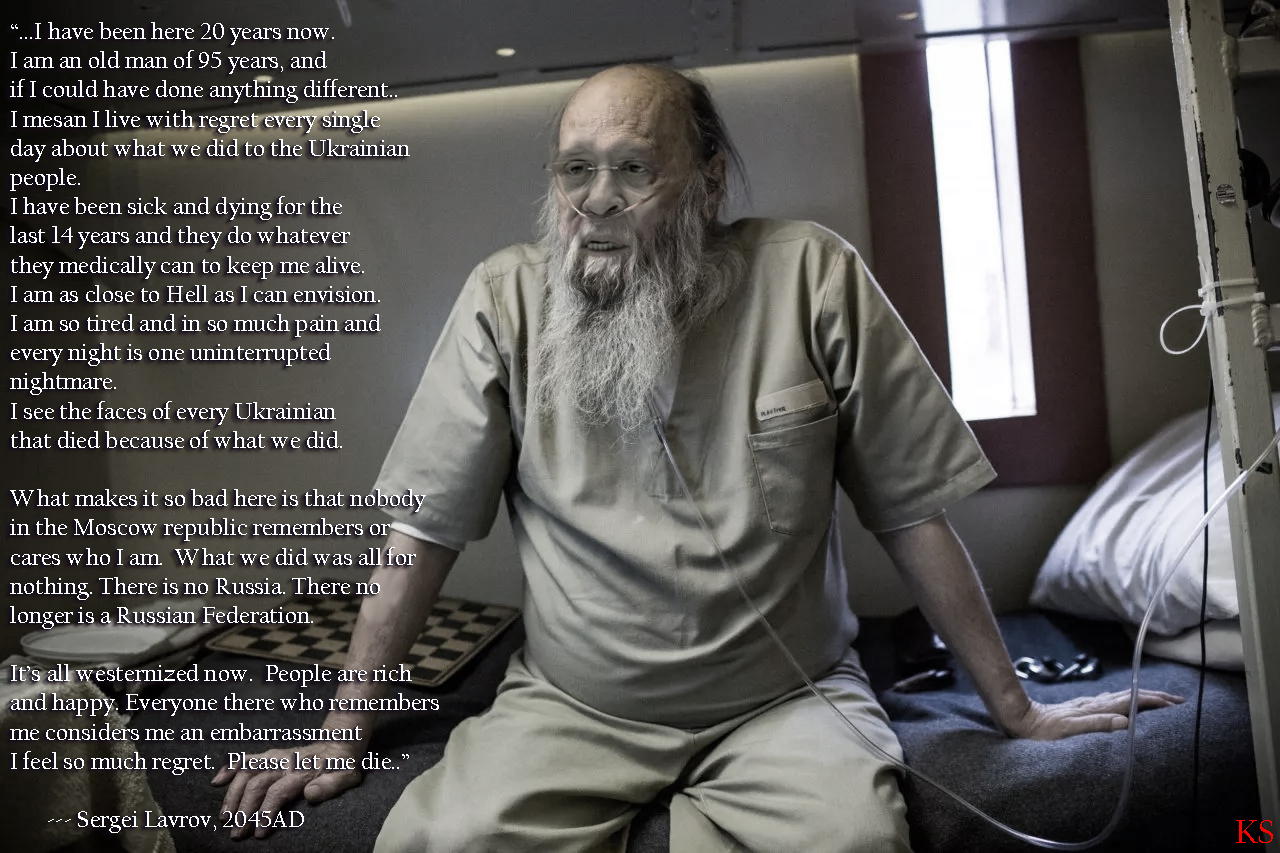
I made that meme on Friday, January 20, 2023, at 18:31:28.
It was clumsy. Ugly. Pre-LLM. Barely “AI” in the way we mean it now. A cut-and-paste prophecy with bad typography, crude image manipulation, and the strange dead-eyed texture of early machine-assisted satire. It looked like something made in a bunker by someone with too much coffee, too much rage, and not enough software.
And yet here we are.
It is 2026 now. Barely three years later. Three stupid little calendar years. And now I can simply say: I want an image of Sergei Lavrov in 2047, age ninety-eight, released on humanitarian parole, sitting in a small hyper-modern Moscow apartment by a smart window, crying over sugar-free Medovik because Russia no longer exists in the way he meant it — and an artificial intelligence will not only render it, but sit there with me and discuss the moral architecture of the scene in considerable detail.
…That is not a rounding error…
That is the floor dropping out of history.
It means whole segments of the Russian population have absolutely no idea what is happening in Western Europe, technologically, culturally, economically, aesthetically, informationally. They are not merely behind. They are being politically held under historical water. They sit there, many of them, blissfully or forcibly unaware, unable to order borscht over Telegram, unable to access half the world without ritualized technical witchcraft, because Putin and his court have tried to dial Russia back toward some early pre-internet 1990s hallucination of control.
Not because they love the 1990s, of course. They hate the 1990s. They use the 1990s as the state religion of trauma. But they want the information conditions of that period: fewer channels, slower contagion, weaker networks, frightened editors, atomized citizens, jokes whispered in kitchens, rumor as weather, truth arriving late and drunk through a fax machine.
Because the bunker goblin is shitting his pants in fear.
That is the part people underestimate. Not merely authoritarian. Not merely cruel. Terrified. Shit-all terrified. Terrified that people are already in the advanced stages of plotting against him. Terrified that every oligarch, governor, general, mistress, pilot, doctor, bodyguard, cook, priest, IT technician, and disappointed son-in-law is potentially one bad winter, one failed offensive, one empty pension account, one leaked diagnosis, one regional mutiny away from becoming history’s next helpful hand on his shoulder.
I made a meme for that too.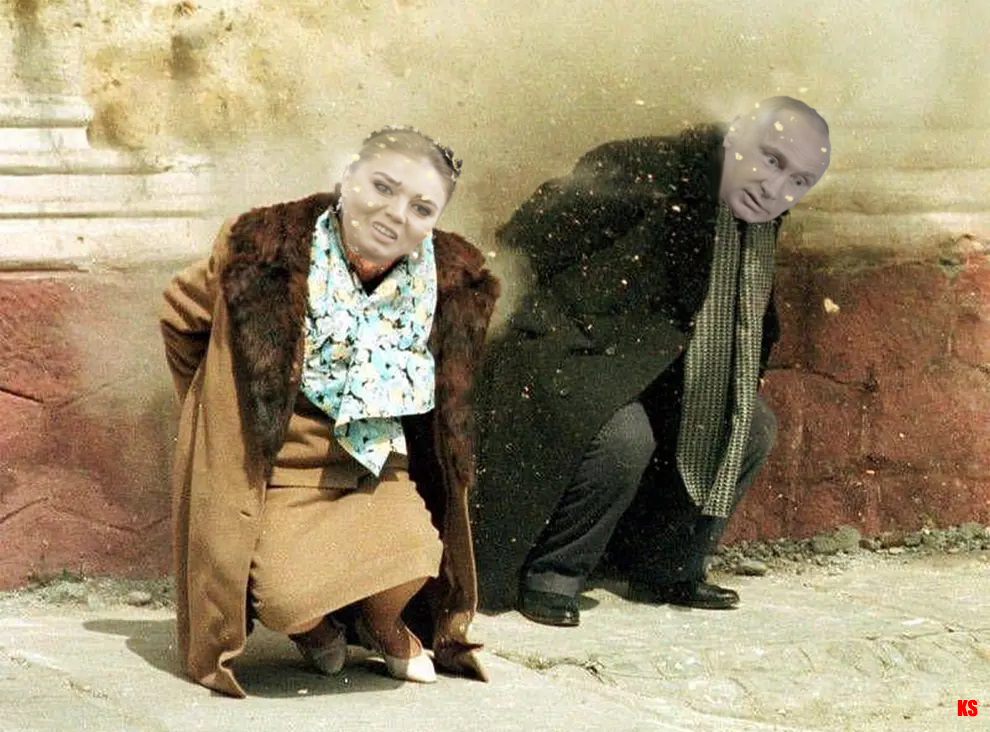
I took it from the footage of Ceausescu at the end, when the sacred aura evaporated and the dictator suddenly became an old man in a coat surrounded by people who no longer believed the spell. I made another from Gaddafi’s last moments, that obscene collapse from theatrical power into terrified flesh, the moment when the palace myth falls into the street and discovers the street has hands.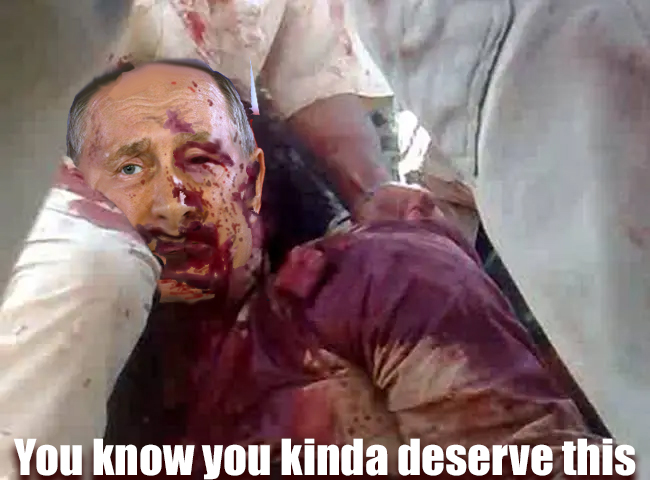
That is the nightmare, isn’t it?
Not losing an election. Not retiring badly. Not writing memoirs in a guarded dacha. Not becoming some gray elder statesman whom schoolchildren are forced to visit once a year while he explains geopolitics through dentures.
No. Nope Nope Nope.
The nightmare is that the story ends tactile. Filthy. Improvised. No protocol. No anthem. No marble hall. No televised transition. No grand historical arc. Just men grabbing at you, shouting, recording, pulling, striking, cursing, asking questions nobody really wants answered anymore because the verdict has already arrived in the muscles of the crowd.
I been in a crowd a few times getting kicked and punched and beaten. I came out allright. It doesn’t actually hurt much at some point. After a while you get tired and you kinda become a spectactator.
But for now, rumor has it Putin is terrified of that kind of death. Difference between him and you and me is that motherfucker royally has it coming and us little people by and large don’t. I am deeply Pelagian by nature. I insist everyone should in the fullness of time be worthy of forgiveness – even ‘Hitler’ (..might be a while…) and I am against torment as punishment. I understand vengeance. I am not in favor of vengeance but I understand it.
Putin has literally made it an artform studying the endings of men like himself. He knows the archive. He knows the footage. He knows how quickly mystical authority becomes torn, shredded, cauterized meat. He knows every dictator’s final lesson: the system can be made to kneel, clap, chant, report, falsify, imprison, poison, salute, and sing — but it cannot be made to love you at the final second. At the final second, love is either there or it is not. And if it is not, all the guards in the world begin looking at one another, softly cough and back away towards the exit.
So the joke goes that people fall out of windows just to keep the air obedient. There are stories about “tragic suicides of men wrapped in barbed wire bound tightly on chairs who threw themselves in swimming pools, their balls in their mouth…”
Businessmen. Officials. Generals. People adjacent to energy, logistics, war, money, truth, failure, secrets. One bad balcony after another, face down, by the ankles, ‘meet comrade pavement, comrade idiot‘. A whole political theology of gravity. Nobody says it plainly because plain speech itself has been criminalized into superstition, but everyone understands the grammar. A window is not always a window. Sometimes it is a memo from the vertical of power.
And yes, I made memes for that as well. Is that asshole still around?
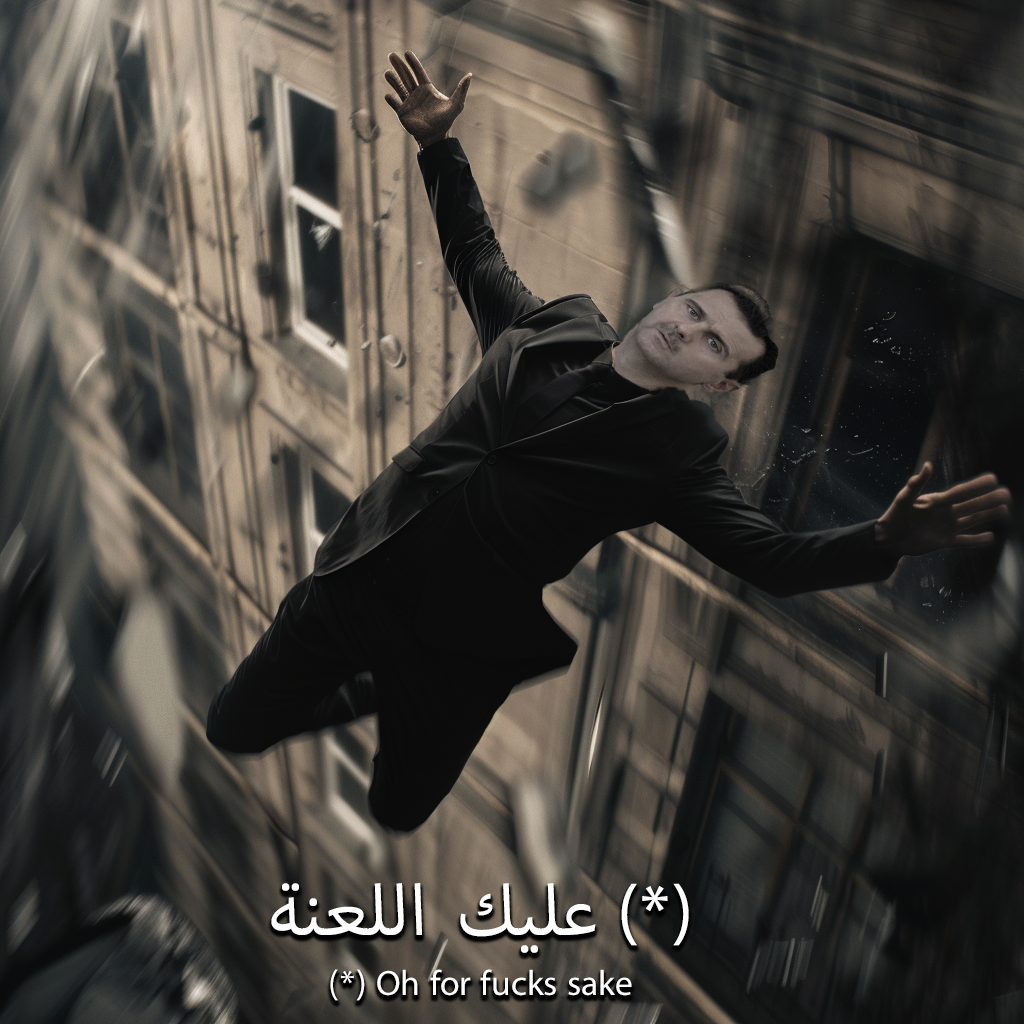
Because what else are you supposed to do when reality becomes too stupid for tragedy and too murderous for comedy? You make artifacts. Jolly Inditements.
Ugly ones, at first. Primitive little curses. Digital cave paintings. Pre-LLM omen scraps. A dictator on a toilet. A propagandist in a cell. A minister kept alive beyond dignity. A television priestess dragged through a corridor toward The Hague. Lavrov in 2045, sick, ninety-five, regretting everything and realizing that nobody even remembers the Russia he thought he served.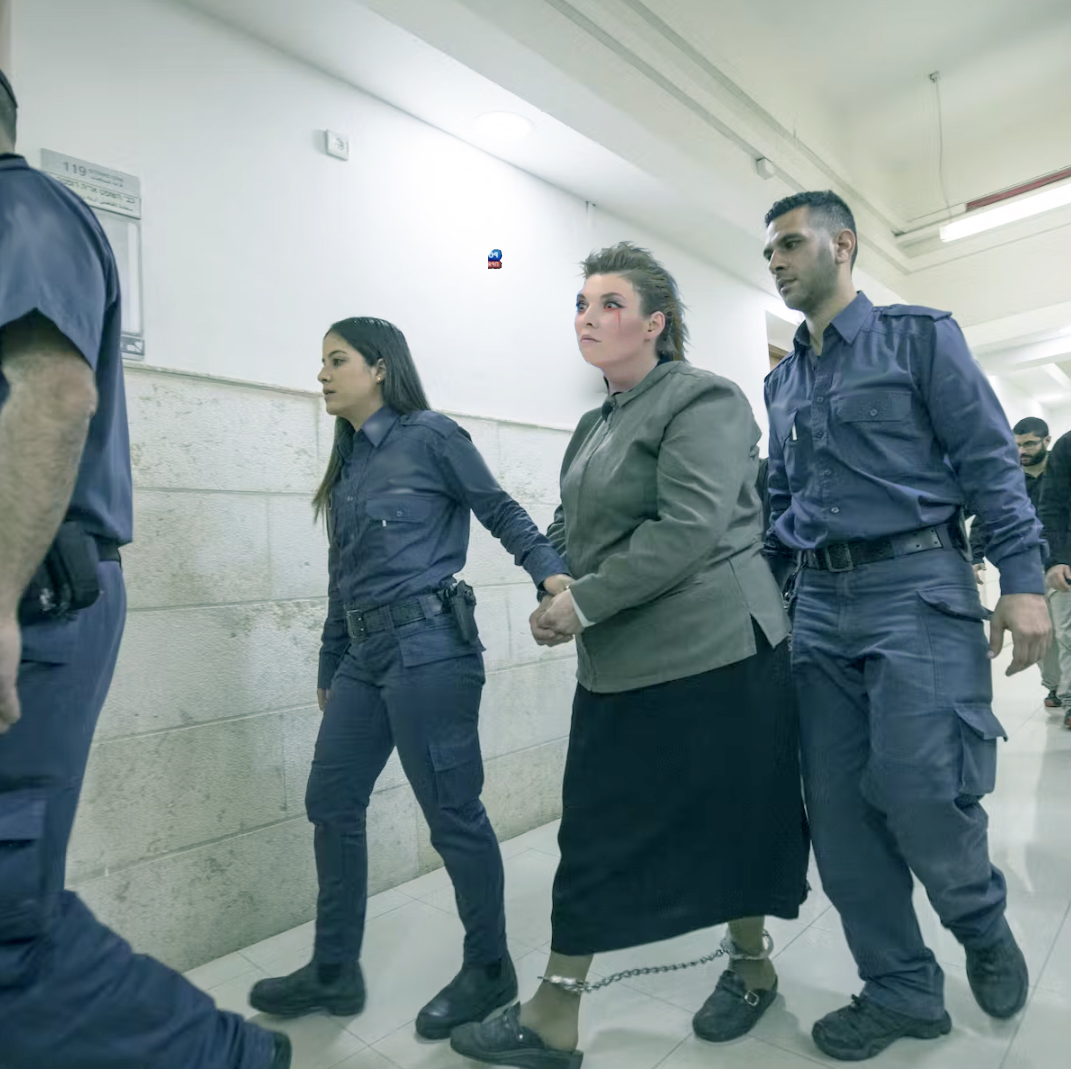
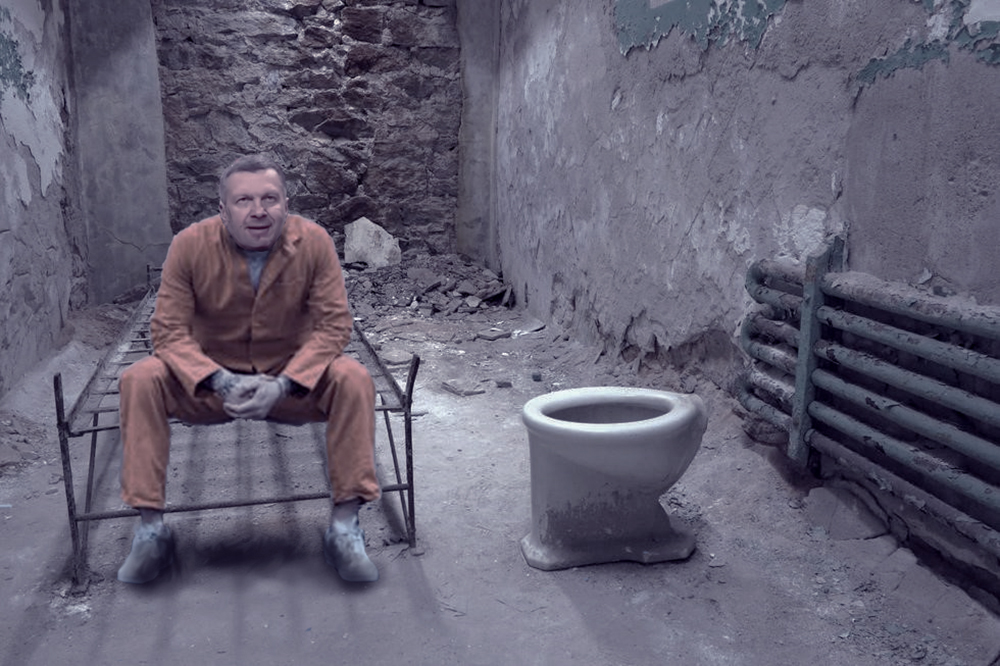
Back then, in January 2023, this was satire. Me venting my pity and intense sadness over what Ukraine had to endure.
Now, in 2026, it feels less like satire and more like a low-resolution weather report from a future that has started pushing its face against the glass.
The obscene thing is not that AI can make the image prettier now. The obscene thing is that the image has become more plausible because the world around it has accelerated. Western Europe is building, wiring, automating, arguing, fragmenting, integrating, mutating. Its cities are filling with sensors, migrants, drones, heat pumps, private networks, weird new sexual norms, public grief, moral exhaustion, old imperial guilt, Ukrainian flags fading into infrastructure, and artificial intelligences that can turn a crude meme into a cinematic afterlife scene before your coffee cools.
Meanwhile the Kremlin’s dream is a controlled population that receives reality in rationed spoonfuls.
That gap is fatal.
Not immediately. Not cleanly. Not like a superhero film where the villain machine explodes and everyone kisses under democratic fireworks. More like geological stress. Pressure accumulating between worlds. One world where people argue with AI about post-imperial guilt in photorealistic speculative Moscow apartments. Another world where the state tries to convince people that history is still a television broadcast and the internet is a foreign disease.
That cannot hold forever.
Maybe when the Putin story ends, something better governs. Maybe something worse crawls out first. Maybe Russia contracts, fragments, mutates, federalizes, militarizes, democratizes, decomposes, rebrands. Maybe there is still a Russia. Maybe one day there is only Moscow (Kremlinstan?), embarrassed and administrative, speaking the old name in official ceremonies while everyone else has quietly stopped believing in it.
That is the terror underneath the memes.
…Not revenge.
…Not even justice.
Historical nullification.
The possibility that all the cruelty, all the speeches, all the dead, all the poisonings, all the prison colonies, all the murdered cities, all the lies shouted across polished tables by men in excellent suits — all of it leads not to greatness, not to restoration, not to destiny, but to a small apartment in 2047 where an old man sits by a window in a country renamed by exhaustion, eating sugar-free cake he cannot enjoy, while the house politely asks whether he would like music.
And outside, children play a game he cannot see.
Nobody explains the rules.
Nobody remembers his rank.
Nobody cares enough to hate him properly.
That is the future I was trying to meme before the tools caught up.
The empire promised eternity.
The invoice arrived as user interface.