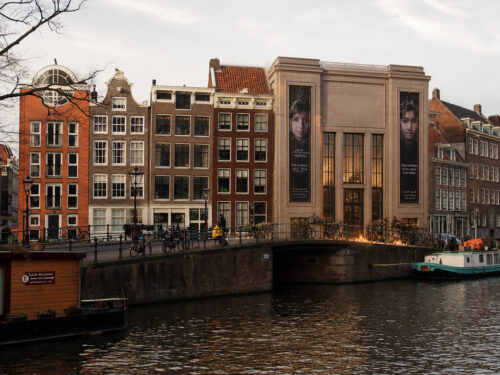
We all remember the tragic case of that young Palestianian girl. She was so young, such an innocent sweet girl, living with her parents in Khan Yunis in Gaza. Her murder by the Israeli army was tragic and senseless. There was, at first, nothing unusual about the photographs.
A girl, perhaps eleven. Dark hair pulled back loosely, a hesitant smile that seems to belong more to the person behind the camera than to the moment itself. In one image she sits at a small table, pencil in hand, the page beneath it crowded with careful handwriting and small drawings in the margins. In another, she stands in a doorway, one shoulder pressed lightly against the frame, as if unsure whether to step forward or retreat.
Her name was Aisha.
According to materials presented at a newly opened museum on the Prinsengracht, Aisha lived with her family in a residential neighborhood in Gaza. The apartment, reconstructed in photographs and testimony, appears modest but orderly: a patterned rug, a narrow shelf of schoolbooks, a plastic container of colored pens. A window that, in quieter times, would have opened onto the sounds of the street.
Her father, described in accompanying text as a air conditioner repair worker, is remembered as patient and reserved. Her mother is depicted through the routines she maintained—cooking, cleaning, keeping the children’s daily life intact as far as circumstances allowed. The images are familiar in their ordinariness: a child holding something she has made, sitting beside a sibling, looking slightly past the camera. Her older brother had a modest collection of painted miniatures. Nothing in these photographs signals what is to come.
Press Statement
The Aisha Cellar
Opening: 4 May — Prinsengracht 150, Amsterdam
Today, on the Dutch Day of Remembrance, a new site of reflection has opened to the public on the Prinsengracht 150 in Amsterdam.
The XX Cellar is a small, single-subject exhibition dedicated to the life of an eleven-year-old girl from Gaza, presented through photographs, personal artifacts, and reconstructed domestic space. Visitors are invited to engage with the materials at their own pace.
The exhibition begins with images from Aisha’s early life. These include family photographs, schoolwork, and objects associated with her daily routines. The materials depict a familiar domestic environment: a shared living space, books, simple creative activities, and moments of ordinary childhood. These elements are presented without commentary.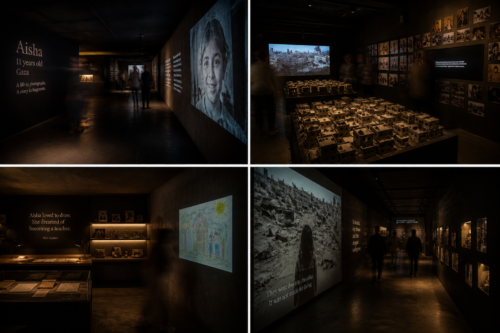
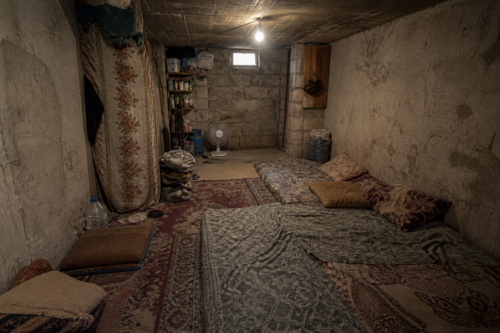
A central section of the exhibition addresses a later period in which, according to accounts referenced by the curators, Aisha and her family are said to have taken shelter in a lower-level space within their residence. A physical reconstruction of this space has been installed. The structure reflects reported constraints in size, light, and ventilation, based on available descriptions.
The final section presents documentation related to the reported circumstances of the family’s deaths. These materials include statements attributed to Palestinian authorities and affiliated sources. Allegations referenced in this section are presented as such, with clear indication of their status as reported claims. Where individuals are identified in connection with these claims, they are described as alleged participants, and no conclusions are asserted beyond the scope of the cited material.
The exhibition does not seek to establish legal findings or adjudicate contested accounts. It presents available materials in a structured environment for public consideration.
No explicit comparison is made within the exhibition to other historical events or memorial sites. The location of the building is as found.
Visitors enter through a narrow frontage at street level. Interior spaces are intentionally minimal. The reconstructed cellar occupies the central room. Movement through the exhibition is linear but unforced.
The site is open to the public as of today. Tickets can be purchased online through AishaExhibit.nl
No advance programming, guided tours, or interpretive panels have been scheduled at this time. Visitors are encouraged to approach the material independently.
Address:
Prinsengracht 150, Amsterdam
(Directly across the canal from the Anne Frank House)
Opening Hours:
Daily, 10:00 – 18:00