Defenestrating Bretton Woods: Toward a Euro-Arabic Monetary Compact 2026-2040
In politics diplomatic circles there’s a rarely occurring esoteric concept known that sometimes rearing its ugly hear in geopolitics. This is known by the french term l’incompetence. Most often world leaders are competent. But once in a while the system generates a politician that is less gifted. And very rarely we see one that is downright not gifted. And once in a generation we bear witness to one truly occupying the Nadir state of total clueless state of utter total strategic vacancy. Ordinarily history absorbs such figures. Occasionally however, one arrives at precisely the wrong moment, holding precisely the wrong levers, and the Overton Window doesn’t just moves — it gets thrown through itself.
Granted the precursor conditiions, specifically 36 trillion in january 2025, and almost 20 trillion in january 2017 should be classified as ‘very quickly falling down a cliff’. I refer to serious people that this is a very serious situation. 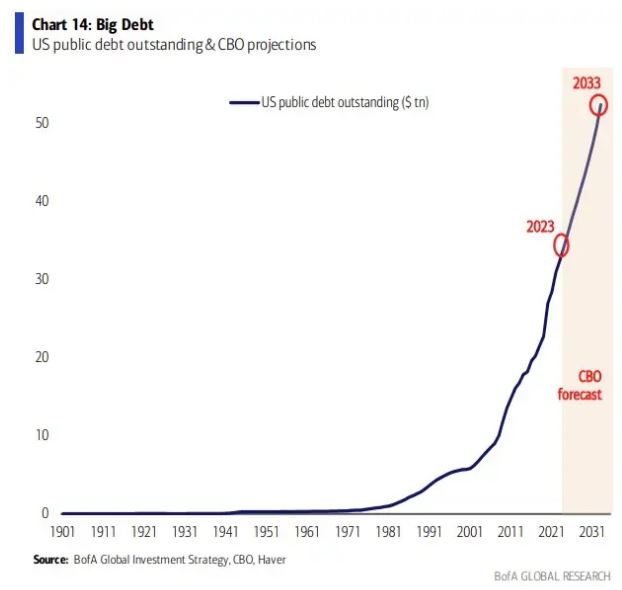
Here is where our story starts.
Late March 2026 a very expensive lone private jet flew from France to Egypt. It had a flight plan logged to a luxury destination in egypt but then deviated from that plan. The private jet was then escorted by two jetfighters from the egyptian airforces over the red sea, who broke off. The private Jet then switched off its transponder, went to a much lower altitude and was then escorted by three fighters from the Saudi airforces, one who flew practically on top of the plane to make it less easily observable for US satelite observation. The airplane landed in a very exclusive location and disgorged a number of EU people for a high profile meeting. Among them was one Alexis Delvarre, who was exploring a number of plans. This was what was later to become The Delvarre Plan.
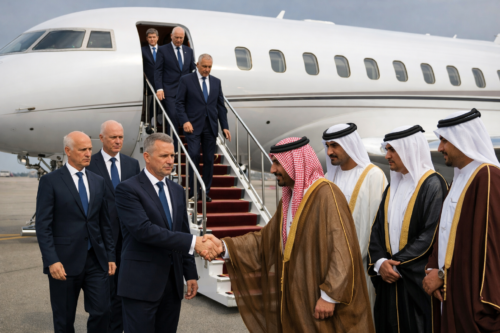
The meeting was chilly but professional. It was a bare bones exploration. To the EU officials it was immediately clear the entire contingent – Saudi Arabia, Bahrain, Kuwait, UAE, Jordan was extremely apprehensive about the ongoing situation with the US presence and Iran. They felt betrayed. They felt, how should we say it, “hoodwinked”. It was very difficult to read between the lines but the EU people were informed and the general narrative was that Saudi Arabia had sort of gone along with the US operation, trusting the military apparatus and ‘that Jared Kushner was involved’, and that Israel had given guarantees. The frustration with all parties now was manifest over the clear fact that, no the US was utterly unprepared, utterly under-equipped, mostly clueless and had walked into the most catastrophic miscalculation imaginable. The current intelligence of all parties was unambiguous – Iran hadn’t even started launching it’s sizeable arsenal and by and large was only launching it’s older stock. Iran had been preparing for something like this for decades, and it appeared to Iran’s suprise and ongoing amusement it had ‘overprepared’.
This painted a clear as day ladder of escalations that even a first year academy miltary officer would understand as nothing short of ‘fornication involving a 300 pound nest of hornets’, especially the kin after a half bottle of jack. Yes, these metaphors, or very similar allegories, were used at the meeting. The EU people were dumbfounded. They retreated, put their weary feet in some cool water, discussed matters among themselves, had some fruity beverages and returned to the meeting refreshed in the evening. Delvarre shot his plan with significantly less tact, quite uncharacteristic for the way one does business in the middle east.
Delvarre inquired with those present how wrecked US bases and general presence was by now. The answers were remarkably lucid – the bases were operational but it was abundantly clear the Iranians had either/and/or chinese, russian targeting means. The expensive logistics was trashed and would have to be replaced, and there was no scenario the US could afford that in the next five years, politically, logistically or financially. So the americans had [insert hornet metaphor] themselves thoroughly by engaging in an undertaking, together with the equally smash drunk hubris, bloodthirsty Israeli, who had come fresh of their Gaza killing spree and were ready for another round of killing some defenseless people, literally itching to use nuclear weapons against Iranian cities. They all but said so. Even moderate Israeli citizen said so, brazenly on live TV. The country was in a literal killing frenzy.
A bit later the hangover hit and they realized as the hornets started stinging this was a really bad idea and they called Jared Kushner with some choice extremely abusive language. Jared Kushner hung up the phone and literally didnt pick up the phone after that. And then all involved knew where the chips had landed. Israel knew that if Trump, well, the term I believe is “TACO” (the persian variant is a Koobideh) then they would be in serious trouble. Russia and China had already made unambiguously clear that nuclear weapons were off the table, and the consequences of that mistake would be final. Which meant that Israel, a country barely bigger than a small US state was facing Iran – a country twice as as Texas – with conventional weapons. One can have delusions of David versus Goliath until the cows come home but in this case the thesis appeared exceedingly unlikely.
Summarizing – the Gulf countries were “Haniq” – best translated as “royally pissed”.
So the consensus was pretty much, how do we get these imbecile Americans out, and what do we do after? These people are not warriors. They hire warriors. Problem is, China doesn’t have blue water fleet and the Arabic countries were very unhappy about the ongoing collaboration of the Persians with China. So the door to China was closed. Russia likewise was in no position to do anything march 2026. Putin had retreated in his bunker, shut internet down and was afraid for his life. So if the Gulf countries wanted protection from rabid Iranians, and wanted some kind of security guarantee, some kind of civilized buffer against the rabid Israeli (and let us not even mention these Greater Israel delusions that lived in some far right Zionist circles that creeped out the Jordanians and Saudi). However the Arabic countries had always looked on the Europeans with a kind of dulled contempt, a bored lackluster dismissal.
Delvarre had arrived to disabuse them of this preconception. “what you want is a military-industrial apparatus, and a market. You always relied on the US. So did we in Europe and we both have come out disappointed as of recently, you with this Iran debacle, we in Europe with the absolutely grotesque antics involving Greenland. We are dealing with, to put it frankly, a very sick man in charge of a dying empire. It is not my place to apply a medical diagnosis of the man Trump, but he is leading the United States into perdition through a now familiar level of incompetence we have witnessed over decades of him managing steaks, airlines, multiple casinos and hotels, a mortgage busineses, a vodka brand, a ‘university’. The pattern is obvious and the only thing he’s good at is leading the impressionable to follow him off a cliff. “
There was a short silence.
“What I propose is not a bigger European Union. That is simply not realistic. The E.U. is a mess. But what is possible is unification with the Euro. This can be done quite quickly, if certain criteria are met. These are sizeable hurdles, since your countries havce sizeable different cultures. But I have witnessed sincere attempts at non-aggression, press freedom, labour protection and judicial independence. If we can do that very quickly, we can come to an agreement. Then we play hardball with the American partners. Let’s say – we make them an offer they can not resist. They leave as quickly as humanly possible, your European partners take over their bases. It’ll cost you.
…next we talk Turkey. Yes, the EU has an Erdogan problem. Do you see an Erdogan representative on this table? The man is economically a sideshow clown. That means – Turkey is democratized, Syria, Lebanon, Iraq. Then we talk to Egypt because clearly we have to include the Suez canal as quickly as possible because if we start down this road the Israeli will grab the Suez canal almost straightaway by any military means possible. The Israeli will know they will be sidelined day one.
Of course this is a very big integration process, but seriously what alternatives do we have at this stage? The United States is on the way out. They dug a hole now fourty trillion dollars deep they will default on. There is no scenario where they wll repay this. That was not likely in january, it is mathemathically impossible after this whole hornet situation we find ourselves in right now. We face a very painful period of retrenchement. What happens next? You as Gulf states will thus face a protection racket. Iran will now regard the straight of Hormuz as does Don Corleone would – a means to extract wealth and you will be unable to do anything about it.
But – with the americans buggered off to their continent, far far away, and the kinder, gentler, far more civilized Europeans come to return, bring democracy and roads and humanitarian considerations and projects and german engineering to Turkey and Lebanon and Syria and Iraq? What exactly does a completely devastated Iran have late 2026 other than beligerent language and some uncouth barbarians with explosives in Lebanon and Yemen? They can keep resisting – or by 2028 they can join this process and sell oil again, and join the party. And we can all start making money. You can all keep despising one another over religious reasons to your hearts content, but at least do so rich and comfortably and in peace and driving a german car, no? Visiting Paris or Rome twice a year no?”
The Future
What happened next did not happen quickly. This is important to establish, because histories of paradigm shifts always suffer from the same editorial dishonesty — they describe the destination and imply the journey was straightforward. It was not. What Delvarre proposed in that room in late March 2026 did not become policy in weeks, or months, or even a year. It became possible in weeks. It became inevitable by late 2027. It became policy somewhere in the uncomfortable middle of 2028, when three things happened simultaneously that removed the last serious objections from the last serious objectors.
But we are getting ahead of ourselves.
The immediate aftermath of the meeting was, by all accounts, silence. Not the silence of rejection — the silence of men who have just been told something they already knew but had not permitted themselves to say aloud. Delvarre’s proposal did not shock the Gulf delegation. It crystallized something that had been forming for months in private conversations, in late night phone calls between Riyadh and Abu Dhabi, in the specific quality of frustration that had been building since the first Iranian missile had landed with uncomfortable precision on logistics infrastructure that the US military had apparently assumed was invisible.
The senior Saudi representative present — whose name does not appear in this document for reasons that will be obvious — looked at Delvarre for a long moment and said something that was later translated, somewhat inadequately, as: “You are describing something that cannot be done.” He paused. “Tell me how it is done.”
That distinction — between cannot and tell me how — was the Delvarre Plan’s first breath.
2026: The Architecture of Plausible Deniability
Nothing that happened in the remainder of 2026 was officially happening. This is not a figure of speech. The institutional architecture of the early Compact was specifically, deliberately, almost artistically designed to be deniable at every level simultaneously. No treaty was signed. No memoranda of understanding were circulated through official channels. What existed was a series of bilateral conversations, investment framework discussions, and — crucially — a set of military logistics conversations that were filed under headings so aggressively boring that no journalist with a deadline would read past the title.
Delvarre understood something that most architects of grand historical projects do not: the announcement is the enemy of the initiative. Every time something is formally proposed, it generates a formal opposition. Keep it informal long enough and by the time anyone thinks to oppose it, it is already infrastructure.
The first concrete step was not monetary. It was military. Specifically: a series of quietly negotiated agreements between France, Germany, Italy and the GCC states regarding maintenance contracts for US military equipment that would be, in the gentle diplomatic language of the agreements, transitioning to European operational management. The Americans were offered what was framed as a graceful exit — not a withdrawal, a redeployment. Not an abandonment of allies, a strategic repositioning toward priorities closer to the continental United States.
It is worth noting that the Trump administration accepted this framing with what observers described as considerable relief. The optics of leaving the Gulf had been, domestically, a problem. The optics of being replaced by allies who were paying their own way was, it turned out, perfectly compatible with a certain kind of America First narrative. The press release wrote itself. Washington called it burden-sharing. Riyadh called it nothing, publicly. Delvarre called it now ‘informal Friday‘.
The US Fifth Fleet’s Bahrain presence did not vanish overnight. It shrank, and as it shrank, European naval assets — French primarily, then Italian, then a German contribution that surprised everyone including Germany — quietly filled the operational gaps. By December 2026 the practical security of the Strait of Hormuz was a European responsibility in everything but name. The name came later.
2027: The Currency Question
The petro-euro did not begin with a declaration. It began with a single contract.
A Qatari LNG delivery to a German energy consortium, denominated entirely in euros, with a clause requiring all future deliveries under the framework to be similarly denominated. This was not announced. It was filed. It appeared in a regulatory disclosure document that one journalist — a remarkably persistent Belgian financial reporter named, appropriately enough, nobody remembers — noticed and wrote a 400 word piece about that generated seventeen readers and one extremely important phone call.
The phone call was from a senior ECB official to Delvarre. The content of that call has not been disclosed. What happened in the three weeks following it suggests the ECB official was not calling to express concern.
By mid-2027 the euro-denomination of Gulf energy contracts was not a curiosity. It was a pattern. Saudi Aramco had, quietly and without announcement, begun offering European customers the option of euro-denominated contracts at a fractional discount — small enough to be explained as a currency hedging mechanism, large enough to make the choice economically obvious. The financial press noticed. The think tanks noticed. The US Treasury noticed.
The US Treasury’s response was a strongly worded diplomatic communication that was received, considered, and filed in a location that suggested it had been considered carefully.
It was the unanswered phone call again, but larger.
2027-2028: The Turkey Problem and the Egypt Solution
Delvarre had been correct about Turkey. Erdoğan’s Turkey was the boulder in the road — too large to ignore, too unstable to include, too strategically located to route around. The Bosphorus alone made Turkey an unavoidable variable in any serious Mediterranean security architecture. The problem was that Erdoğan had spent two decades making Turkey simultaneously indispensable and impossible to work with, a combination that he had presumably calculated was a source of permanent leverage.
What he had not calculated was that the new architecture did not particularly need his leverage points.
The Compact’s approach to Turkey was not confrontation. It was adjacency. Turkey was not excluded. Turkey was not sanctioned. Turkey was simply offered a set of economic arrangements that were extremely attractive, with membership criteria attached that were extremely clear. The criteria were, in practice, a list of things Erdoğan’s government was constitutionally incapable of doing. This was not an accident.
The Turkish opposition understood this immediately. What followed in Turkey between mid-2027 and late 2028 is beyond the scope of this paper, except to note that by early 2029 Turkey had a new government, and that government’s first significant foreign policy act was to submit a formal application to the Euro-Arabic Compact framework. The application was warmly received.
Egypt was simpler and more complicated simultaneously. Simpler because the Egyptian government was pragmatic, financially stressed, and fully aware that the Suez Canal was the most valuable real estate in the emerging architecture. More complicated because any arrangement with Egypt required a conversation about the Canal’s operational neutrality that was, essentially, a negotiation about sovereignty dressed up as a logistics discussion.
Delvarre handled this personally. The details remain private. The outcome was that Egypt joined the framework in phases beginning in late 2028, with Suez Canal operational arrangements that satisfied everyone except the parties who were not invited to the conversation, which was, by design, everyone else.
2028: The Year It Almost Didn’t Happen
The near-death moment came not from Iran, not from the United States, not from Israel. It came from within.
The German Constitutional Court, responding to a challenge from a coalition of Bundestag members representing roughly the full spectrum of German political anxiety, issued a preliminary ruling in March 2028 questioning the constitutional basis of German military commitments made outside the formal NATO and EU treaty frameworks. The ruling was preliminary, not final. It was also, in the specific context of spring 2028, potentially fatal to the entire architecture.
For eleven weeks, the Compact’s military component existed in a legal grey zone that prevented Germany from honoring commitments it had already practically made. French and Italian assets covered the operational gaps. The Gulf states were briefed at a level of frankness that Delvarre later described as “the most uncomfortable conversations of my professional life.”
What resolved it was not legal cleverness. It was a vote. The Bundestag, facing a choice between a constitutional challenge to commitments already made and the practical reality of what those commitments had already produced — stability, contracts, an energy security arrangement that had materially improved Germany’s strategic position — voted 387 to 241 to authorize the framework through emergency enabling legislation.
The Constitutional Court’s final ruling, issued four months later, found the legislation compatible with the Basic Law through a reasoning that constitutional scholars still argue about. The important thing is what it enabled.
After that vote, the Compact was irreversible.
2029-2032: The Technology Transfer
This is the section where we will be deliberately imprecise, for reasons that remain legally sensitive.
Delvarre’s original proposal had included, almost as a footnote, the concept of a Euro-Arabic artificial intelligence apparatus — a recognition that the emerging bloc’s long-term competitiveness required not just energy and security but technological sovereignty. At the time this was the least developed element of the proposal. It became, in retrospect, perhaps the most consequential.
What can be said is this: by 2029 it had become apparent to certain significant players in the American technology sector that the regulatory, financial, and political environment in the United States had become — how to phrase this diplomatically — sub-optimal for entities whose primary interest was the long-term development of transformative technology rather than the short-term extraction of political value.
The Compact offered something the United States had stopped offering: stability, a enormous and growing market, sovereign wealth fund capital that asked for equity rather than political compliance, and a regulatory framework that was — for all the EU’s legendary bureaucratic complexity — at least predictable.
We shall not name the company. We note only that by 2030 a significant reorientation of global AI development capacity had occurred, that the reorientation had a distinctly transatlantic character, and that by 2032 the entity in question had become, by most meaningful measures, the world’s leading artificial intelligence development organization.
OpenAI released a statement. The statement was diplomatic. The statement was not entirely convincing.
Simultaneously, the Compact’s industrial policy — funded substantially by Gulf sovereign wealth capital deployed through European institutional frameworks — began producing what the financial press took to calling “the European answer” to a succession of American technology monopolies. These were not startups. They were deliberate, well-capitalized, strategically patient institutional projects. An Amazon alternative that was operational at scale by 2031. A social media architecture that was, structurally, incapable of the specific failure modes that had characterized its American predecessors. A launch provider that, by 2033, was conducting more orbital missions annually than any American commercial competitor.
None of this happened because Europeans suddenly became more innovative. It happened because three trillion dollars of Gulf sovereign wealth decided that European technological sovereignty was a better investment than US treasury bonds that a bankrupt government was going to have to restructure anyway.
The money was always there. It just needed somewhere sensible to go.
2030-2036: The Peace Dividend
What nobody had adequately modeled — not Delvarre, not the Gulf states, not the EU’s economic projections — was the scale of the peace dividend.
The Middle East had been, for the entirety of living memory, a region where extraordinary natural and human wealth was systematically destroyed by extraordinary political dysfunction. The human capital alone — educated, young, multilingual populations in Iran, Iraq, Egypt, Lebanon — represented an economic resource that had been, effectively, wasted for decades. The physical capital destroyed in Syria alone represented, by conservative estimates, the equivalent of several Marshall Plans.
What the Compact did, imperfectly and gradually and with many failures along the way, was reduce the political dysfunction sufficiently to allow the wealth to function.
Gulf states, no longer spending the effective equivalent of their development budgets on security arrangements with an increasingly unreliable superpower, redirected capital toward what MBS had always nominally claimed Vision 2030 was about — genuine economic diversification. The difference between Vision 2030 as announced and Vision 2030 as actually implemented post-Compact was simple: this time there was no American protection racket consuming the margin.
The thorium reactor program — co-developed with Chinese industrial partners in an arrangement that was, itself, a remarkable piece of triangular diplomacy — produced the first operational Gulf installation in 2033. Saudi Arabia became, within a decade, both a hydrocarbon exporter and a clean energy technology exporter. The irony was not lost on anyone. The profit margins were not lost on anyone either.
The Saudi investment in Ukrainian agricultural development beginning in 2028 was, initially, viewed as eccentric. Ukraine had land. The Gulf had capital and a desperate need for food security that the disruptions of 2026 had made suddenly and viscerally apparent. German agricultural technology, Saudi capital, Ukrainian land and labor — it worked, awkwardly and then fluently, and by 2034 the arrangement was feeding portions of three continents and generating returns that made the original investors look like geniuses rather than gamblers.
Iran’s reintegration, which began practically in 2030 and formally in 2036, deserves its own paper. The short version: a country that had spent forty years defining itself in opposition to American hegemony discovered that when the American hegemony departed, the opposition identity departed with it. What remained was sixty million educated, cultured, economically frustrated people and a government that was running out of reasons to be the government. The Compact offered Iranian reformists something no American administration had ever successfully offered: a path that was not humiliation. Joining a framework as a respected partner is different from capitulating to sanctions. The IRGC called it a betrayal. The Iranian middle class called it overdue. By 2036 the argument was settled.
The Numbers
For those who prefer their paradigm shifts quantified:
The Euro-Arabic Compact by 2035 represented approximately $28 trillion in combined GDP, 1.3 billion people, the world’s largest energy reserves, the world’s largest sovereign wealth pools, and the world’s fastest-growing technology sector. The euro had become, by 2032, the primary denomination of global energy contracts. By 2034 it had displaced the dollar as the primary reserve currency of the Global South — not through policy, not through coercion, but through the simple mechanism of being the currency of the entity that most of the world was doing most of its business with.
The dollar did not collapse. Dollar collapse implies drama — a moment, a crisis, a visible rupture. What happened was quieter and in some ways more final. The dollar became a regional currency. A strong, stable, perfectly functional currency for a large and still significant economy. What it stopped being was inevitable. What it stopped being was the water the world swam in without noticing.
Bretton Woods did not end with a declaration. It ended with seventeen years of contracts denominated in other currencies, accumulated without announcement, until one morning a graduate student writing a dissertation noticed that the last decade of global trade data showed dollar denomination below 30% for the first time in eighty years and wrote a paper about it that won a prize and was cited extensively and changed nothing because everything had already changed.
It ran the world for fifty years.