A four-image cinematic treatment for the giant firetruck-sized plot hole in Dogtown’s soul
A four-image cinematic treatment for the giant firetruck-sized plot hole in Dogtown’s soul
This does not play like a glitch joke. That would be too small. It plays like a forbidden elegant solution to an overbuilt spy melodrama. The core insult of the scenario is simple: V has already solved the actual problem. The President is alive. Out of Dogtown. Mobile. Recoverable. Everything after that is just state theater, hurt feelings, and expensive brooding. That is why the scene works so obscenely well. It reduces Phantom Liberty from a labyrinth of handlers, compromised assets, covert loyalties, false urgency, and prestige-trailer solemnity into one brutal invoice: President delivered. Cure pending. Why are you still talking?
And because it happens in Night City style—through a cursed wall seam, a firetruck boom, a waiting Delamain, Judy’s apartment, and finally an NUSA pickup on a rooftop—it doesn’t feel like a clean military extraction. It feels much better than that. It feels like statecraft humiliated by local competence. The aesthetic should not be played as slapstick. That would make it cheap.
It should be played dead seriously, with the kind of visual conviction that makes the joke hit harder. The funnier it is conceptually, the more sincerely it should be framed. Big cinema. Hard light. Wet metal. Calm faces. Bureaucratic obscenity. The President of the NUSA being treated not like a goddess of the republic, but like a high-value parcel V has already signed for and rerouted. This is a story about an empire discovering, to its horror, that one merc with initiative and terrible manners can outperform its entire ritual apparatus.
And every phase should visually say the same thing: What exactly is the problem here?
THE TONE
Not parody. Not camp. Not goofy mod nonsense. This should feel like:
- a lost branch from a far meaner version of Phantom Liberty
- a prestige machinima someone made after becoming spiritually offended by trigger volumes
- a spy thriller that gets mugged by municipal improvisation
- a constitutional crisis solved with civic equipment, a luxury taxi, and a woman who is very tired of being lied to
The emotional engine is not “heroism.” It is cold contempt for unnecessary complexity. Everyone else wants mystery. V wants delivery. Everyone else wants loyalty, process, choreography, deference, proper channels. V wants the cure. Everyone else is still trying to inhabit the grand narrative. V is already in the post-narrative accounting department. That is why Johnny matters in phase four. He is the one ghost in the room who truly understands what just happened: V did not merely improvise. She punctured the genre.
THE VISUAL THESIS
Every image should deepen the insult. Image One says: Dogtown is not sealed. It is theatrically sealed. Image Two says: The President can be reduced to a woman on a couch with a beer if the player is competent enough. Image Three says: The state always arrives eventually—but only after V has already done the hard part. Image Four says: Now pay. That’s the rhythm. Not chaos—sequence. Not absurdity—proof.
PHASE ONE — THE WALL
“Look at this. Tell me what exactly remains unsolved.”
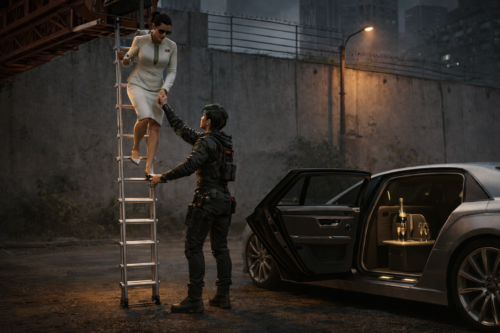 This is the image that kills Dogtown.
Not with explosions. Not with lore. Not with a speech. With municipal hardware. The outer wall of Dogtown looms up like the expansion’s entire lie made concrete: too tall, too ugly, too declarative, too eager to announce itself as separation. A brute slab of militarized fiction pretending to divide one ontology from another. Dogtown in there. Night City out here. Pressure cooker and theater inside; ordinary urban rot outside. But the wall is already spiritually compromised. That’s what this scene proves.
The boom of a firetruck is extended up and over the wall like the most insulting possible answer to a state security problem. Not a stealth VTOL. Not a black-budget cable extraction. Not Reed with his little solemn voice in V’s ear. A firetruck. Something municipal. Something almost laughably practical. Something whose existence implies that vertical surfaces are not sacred and never were.
The basket hangs just over the lip of the wall. Myers is climbing down—carefully, not helplessly. She is not being carried like a damsel. That would weaken her. She is controlled, steady, pissed off, adaptive. A President stripped down to first principles: survive, descend, continue. She is dressed for the aftermath of disaster, not ceremony. Wind catches on her clothing. The wall behind her is scarred, massive, and suddenly stupid. V is below, one hand up, guiding her the last step down. Not reverent. Not flustered. Efficient. The gesture is intimate only in the sense that all true emergencies are intimate: weight transfer, balance, grip, no speeches. V is not basking. V is managing. And then—right there, absurdly, gloriously, perfectly—there is the Delamain. Waiting. Door already open. Paint immaculate. Body flawless. Glass dark and expensive. That rich, overcompetent machine-calm presence. It should look like it has no business being in this muddy, busted seam outside Dogtown, which is exactly why it’s funny. Somebody—V, or V through some favor, or V through sheer Night City black magic—has arranged a perfect extraction vehicle at the base of a geopolitical wound. This is where the image becomes lethal. Because if the viewer sees all of this at once— the wall – the boom – the President descending – V helping – the car ready – the route out already secured – then the whole natural response is: What. Exactly. Is the fucking problem.
The frame should sell that question without text. This is not escape by miracle. This is escape by embarrassingly available means. Dogtown’s mythology dies not because it is breached by military genius, but because it is breached by the same logic that gets cats out of trees and people off burning buildings. It reveals the whole district for what it partly is: a fenced spectacle whose authority depends on nobody bringing a ladder long enough.
The light here should be late afternoon or overcast dusk. Not pretty sunset. Something hard, urban, metallic. The wall should feel oppressive but also faintly ridiculous now that it is being outplayed by basic city infrastructure. Maybe the firetruck itself is mostly unseen below frame, so what dominates is the red hydraulic arm cutting into the composition like a bureaucratic insult. A giant metal finger pointing at the lie. Myers’ expression matters. She should not look terrified. She should look like a woman who has just recalculated the hierarchy of competence around her. V’s expression matters too. She should look like she has already moved on to the next administrative task. There’s no triumph pose. No chest puffing. No cinematic grin. That would cheapen it. Instead the image says: You wanted extraction. Here. Extracted.
That’s the elegance. You may regard this as a theoretical statement, problem is that extracting Myers from Dogtown is possible. You can in theory walk Myers all the way to Judy’s apartment.
PHASE TWO — JUDY’S COUCH
“No, no. I made alternate arrangements. You guys come pick her up.”
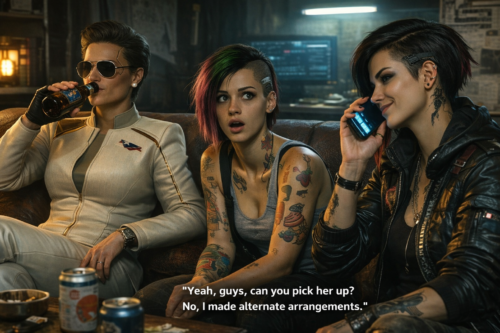
This is where the premise stops being merely clever and becomes immortal. Because getting Myers out is one kind of insult. Putting her on Judy’s couch with a beer is another, much worse kind. This is the collapse of scale. All that presidential aura, all that military panic, all that intelligence-community throat- clearing, all that heavy national-security weather—reduced to one room in Night City, one couch, one baffled witness, one tired merc on the phone. Judy is the anchor of disbelief. Without her, the scene is just an alt-extraction meme. With her, it becomes social reality. She is the civilian eye. The ordinary moral geometry of the room. She takes one look at Myers sitting there in all her alarming legitimacy and essentially communicates: V, what catastrophic branch of reality have you dragged into my apartment.
She should be wide-eyed, not screaming. Too shocked for volume. The silence around her is part of the joke. Judy has seen Night City, seen braindance horrors, seen gang madness, seen corporate rot—but this is different. This is surreal not because it is violent, but because it is administratively impossible. Myers, meanwhile, is on the couch drinking a beer like someone who has passed beyond dignity and reached a higher, grimmer stratum of composure. Not sloppy, not slouched, not comedic. She drinks like a person who understands that history has gone off-book and there is no point pretending otherwise. In some perverse way, she respects the efficiency of what V has done. Not emotionally. Not warmly. But professionally. V is on the phone, and that phone call is the axis of the whole composition. She is not pleading. She is not apologizing. She is not explaining. She is informing.
The line matters because it transforms the whole situation from thriller into customer service dispute:
“Yeah, guys, can you pick her up? No, I made alternate arrangements.”
That line is pure venom because of how ordinary it sounds. It treats the President of the NUSA as a package rerouted around a logistics failure. Which, in functional terms, she now is.
The room should be richly lived-in. Not filthy caricature, not fan-service clutter, but real Judy-space: tech residue, soft practical lighting, hints of color, cables, screens, apartment intimacy. The whole point is contrast. Night City domesticity contains what the state could not. The President is safe not because of a fortified black site, but because nobody in the grand chain of command would imagine this as the holding pattern. That is why the image is so vicious. It says: Your institutions are stupid in exactly the ways ordinary people survive around. Judy’s stare should be aimed not just at Myers, but partly at V—as if she is trying to decide whether V is a genius, a lunatic, or some special hybrid native to Watson. Myers sits with contained steel, still visually presidential even in a living room. V, relaxed enough to make the phone call, becomes the only person in the frame who has fully metabolized what just happened. She has crossed the threshold from “participant in crisis” to “owner of outcomes.” That’s why phase two is the crown jewel. It miniaturizes the empire.
V will have spectacular sex that night.
PHASE THREE — THE PICKUP
“Trust me, things are going to be all right. You got my personal guarantee.”
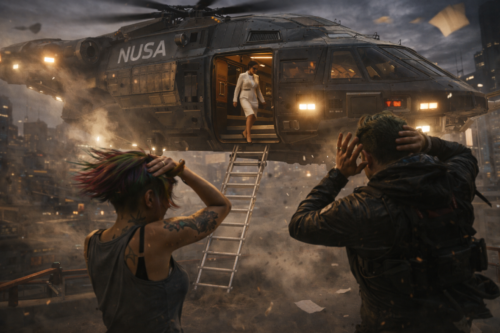
Now the state arrives late. As it always does. This image needs scale again, but differently than phase one. Phase one humiliates Dogtown with municipal pragmatism. Phase three humiliates the NUSA with belated grandeur. By the time the huge aerodyne shows up, V has already done the hard part. All the spectacle now reads as aftercare and ego repair.
The location should feel like the roofline or upper exterior zone by Judy’s place—tight urban verticality, ragged megabuilding geometry, neon bleed, Night City stacked around the scene. Judy is there, and here her expression changes from pure shock to a different kind of astonishment: the awe-struck recognition that yes, apparently the federal government will bring a screaming great military-grade aerodyne to your neighborhood if V has spent the afternoon freelancing with the President.
The aerodyne should dominate the frame. Huge. Loud. Overpowered. Downwash blasting dust, tarps, cables, stray paper, laundry, maybe loose rooftop clutter. Harsh searchlights or undercarriage illumination. Black or dark NUSA armor plating. Official markings. This is state power finally reasserting itself in visual form.
And yet—it is diminished by timing. Because Myers is not being saved by it. She is boarding it. That distinction is everything. She gets in not as someone plucked from peril, but as someone already delivered to the curb. The aerodyne is pickup service. Nothing more. The viewer should feel that insult.
V is still on the phone. Agitated now, yes, but not panicked. Annoyed. Exasperated. Transactional. Reed or SoMi or both are still trying to smuggle significance back into the situation, and V is having none of it.
Judy stands there in the rotor wash, hair and clothes and posture all responding to the impossible machinery in front of her. But what she is really witnessing is not hardware. She is witnessing the proof that V did it. V actually did it. She found some absolutely cursed Night City route from “President trapped in Dogtown” to “federal pickup at my building,” and the world had no choice but to catch up.
Then Myers turns—mid-boarding, or at the threshold, or just before stepping into the craft—and throws back the line:
“Trust me, things are going to be all right. You got my personal guarantee!”
This line is beautiful because it is both powerful and faintly ridiculous. It’s Myers re-inflating presidential language after an afternoon of being hauled through the city by one merc’s improvised logistics. It has weight, because she means it enough to say it. But it also has that perfect aftertaste of political theater trying to restore itself. Which is exactly what V is reacting against. That’s why V on the phone should still look unimpressed. She doesn’t want guarantees. She wants delivery. The cure. The follow-through. The actual thing promised. Not the aura of repayment. This phase should feel like triumph if you glance at it and something much more acidic if you look longer. Giant craft. President boarding. Witnessed by Judy. Night City skyline around them. Everything looks resolved. But the emotional truth is: the real conflict is only now being clarified. The President is safe. Now the lies lose camouflage.
PHASE FOUR — JOHNNY
“Who are you? Have we met?”
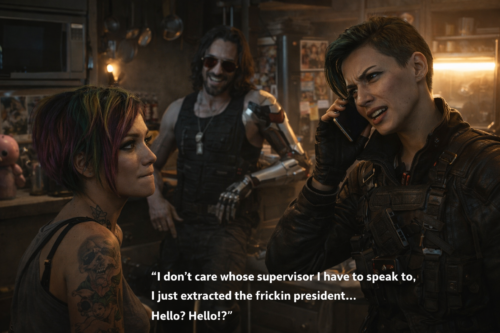
This is the afterimage. The verdict. The ghostly little coronation.
Johnny Silverhand appears not as comic relief, but as the one impossible spectator who truly appreciates the perversity of what V has accomplished. He is impressed. More than impressed—hopeful. Not in some soft Hallmark way. Hopeful because for the first time in a long while, the world’s massive grinding systems have been made to look stupid by direct action and contempt. That’s his religion.
He stands there in the aftermath—streetlight, rooftop glow, apartment spill, whatever best carries the residue of the previous scene. The aerodyne may be gone or receding. The rotor wash has settled. The official machinery has reclaimed its precious body. But Johnny remains, a witness from another era of rage, staring at V with that expression that says:
Well. I’ll be damned. You actually made them play your game. V is still on the phone. And now the tone becomes surgical. 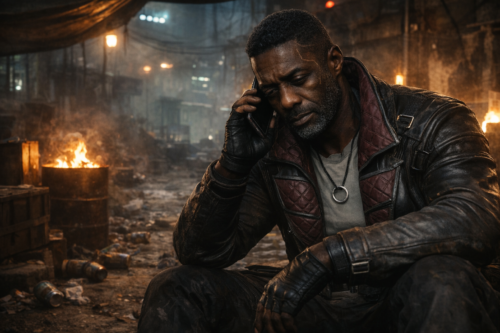 Not loud. Not theatrical fury. Not even especially emotional. Just devastatingly unimpressed. This is where the line lands:
“Who are you? Have we met?”
Reed is annihilated by that line. Not because it is grand, but because it is petty in exactly the right register. He has spent years becoming a man of burden, chain-of-command, sanctioned sorrow, procedure, sacrifice, all that expensive internal architecture—and V reduces him to a guy calling late about a job already finished.
That is exquisite.
The rest of the call should live in that register: mockery not as comedy, but as recalibration. Reed wants to reframe the world so he matters centrally again. SoMi wants the emotional geometry back under her control. V refuses both. The President was extracted. The handoff occurred. The visual proof is undeniable. All that remains is payment. Johnny, standing nearby, gets to embody the emotional shift.
For once, he is not just the dead man muttering ideology from the margins. He is the witness to a beautiful obscenity: V has turned the national-security state into a pair of whiny voicemail threads.
That gives him hope because it gives you hope. Maybe the systems are not invincible. Maybe they are just padded with myth and sequence triggers. Maybe the answer really is sometimes to drag the center of power bodily through the side door and then ask why everyone is still complaining.
Visually, phase four should be calmer than phase three. More intimate. More aftermath. The grand machinery has receded. Now it’s just V, Johnny, the phone, the city, and the lingering sensation that a questline has been morally defeated even if the UI hasn’t caught up. Johnny should look at V like someone watching a new species of insurgent intelligence evolve in real time. Not pure amusement. Respect. A little awe. Maybe even relief. Because from his perspective, what V just did was pure anti-imperial art: not a bomb, not a manifesto, not a noble speech— but a flawlessly rude rerouting of power.
 So Mi: HEY! WE HAD A DEAL!
V: We did. President delivered. You’re welcome.
So Mi: That is not what was supposed to happen!
V: Funny, because from where I’m standing, it looks exactly like what was supposed to happen. She’s alive. She’s out. She’s breathing. You said get Myers out, I got Myers out.
So Mi: You can’t just hand her off!
V: I didn’t “just hand her off.” I extracted the President of the NUSA out of Dogtown through a wall breach, got her into a Delamain, parked her on a couch, and called in pickup. We got drunk. We watched watson whore for twenty minutes. That’s not “just.” That’s deluxe service.
So Mi: V, listen to me—
V: No, you listen to me. You came crashing into my life with this dying-girl, secret-war, trust-me-or-we-both-die routine. Fine. I listened. I did my part. So now we’re at the interesting bit: cure. deliver. now.
So Mi: It’s more complicated than that.
V: It always gets complicated right after I do the hard part.
So Mi: You don’t understand what Myers is capable of.
V: Oh, I understand perfectly. She’s capable of sending a giant murder taxi to Judy’s roof after I already solved her problem. What I don’t understand is why you think this gives you room to start moving goalposts.
So Mi: I was trying to survive!
V: Yeah? Join the club. Difference is I didn’t lie to everybody in a five-mile radius and call it destiny.
So Mi: You think you’re better than me?
V: I think I kept my hands cleaner than you did. Which in this city is practically a religious miracle.
So Mi: We had a deal.
V: Then honor it.
WHY THIS WHOLE THING HURTS SO GOOD
Because it does not merely break the game. It exposes a better emotional logic than the official route. The official route says: trust the process – endure the spectacle – accept the handlers – let the plot educate you into its dependencies
Your route says: – the President was the urgent problem – the cure is the payment – everything else is manipulative surplus
And once stated that plainly, it becomes very hard not to see the whole DLC as slightly overfurnished.
That’s why this idea has such voltage. It’s not just funny. It’s simplifying in a way that feels morally insulting to the official sequence. Like V took one look at a thousand-dollar espionage charcuterie board and said, “No thanks. I’ll have the sandwich.” Then ate the sandwich in front of the people who plated the board.
THE FOUR IMAGES AS A SINGLE ARC
1. Wall breached
The myth of Dogtown is punctured.
2. Couch
The President is socially miniaturized and made manageable.
3. Pickup
The state reappears too late to reclaim dignity.
4. Johnny
The whole operation is reinterpreted as proof that V can force systems to answer to her. That’s the structure. A perfect little symphony in four movements: breach, domesticity, spectacle, reckoning.
THE KEY DIALOGUE FLAVOR
This matters for the captions and future image prompts, so here’s the tonal law of the land:
V is not begging. V is not ranting randomly. V is not confused. V is aggressively clear.
She speaks like someone who has already completed the assignment and now deeply resents everyone trying to pretend the assignment is still theoretical. That means the language should always orbit the same hard nouns:
- President
- cure
- deal
- delivered
- problem
- guarantee
- payment
- what exactly is the issue
This is not a love scene. Not a loyalty scene. Not a moral quandary scene. It is a contract dispute conducted after impossible success. Which is why it’s so delicious.
THE MASTER TAGLINE
If this whole four-part heresy had one thesis line, it would be:
“I delivered the President. Now deliver the cure.”
Everything else is garnish. Beautiful garnish, yes. Gigantic corrupt butter-dripping garnish. But garnish. That line is the spine.