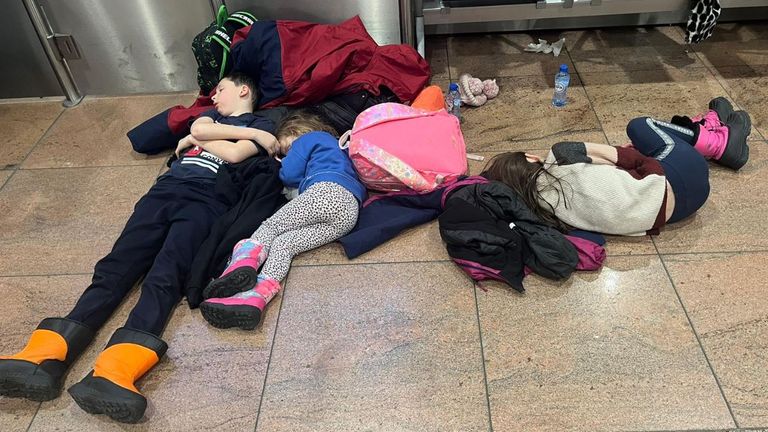
Modern hub airports are built for throughput, not recovery. They can process tens of thousands of passengers per hour under nominal conditions and still fail abruptly—sometimes for days—when a small set of dependencies breaks: de-icing capacity, crew availability, a single software issue, or a transport link into the city. When that happens, the terminal stops being a machine for movement and becomes a holding pen for bodies.
In January 2026, heavy snow and ice pushed Amsterdam Schiphol into multi-day disruption with large-scale cancellations. Reuters reported KLM canceling at least 300 flights in a day amid ongoing snow disruption. Reuters Reuters also reported Dutch rail operator NS halting train traffic due to snow and ice—removing a key “escape valve” from the airport into the country. Reuters Business Insider described more than 2,500 flight cancellations over several days and operational constraints like limited de-icing points and long taxi delays. Business Insider
Those facts matter because they expose the core design flaw: large airports are resilient at routine variability, brittle at systemic shock. When the shock arrives, passenger welfare becomes a negative space in the business model—something implied by the brand promise, but underprovided by the facility design.
This article treats that gap as an operational and market-design problem, not a moral one.
|
Meta The meta-analysis here is this: in late-stage, decaying mass capitalism, we are witnessing a cut-throat extraction rush by large corporations—an aggressive race to strip costs, liability, and responsibility—that would have been unthinkable just decades ago. Under liberal democracy, there existed at least a functional contract of dignity: human rights, due process, proportionality, and protection under the law. Under contemporary corporate reservation systems, that contract has been replaced by minimalist service, maximal legal insulation, and zero tolerance for disruption. At the first sign of inconvenience or system failure, the response is not care or problem-solving but stonewalling: lawyers activated, “do not disturb” signs raised, and security empowered to remove families with children from facilities under threat of arrest or permanent blacklisting. This is not exaggeration. The corporate machine no longer primarily practices efficiency; it increasingly displays an overt, almost performative meanness. A passenger who “freaks out”—reasonably or not—can be intercepted by teams of armored, kevlar-clad security marshals, arrested, cuffed, dragged face-down off an aircraft, publicly humiliated before applauding crowds (who do not realize how close they themselves were to being next), theatrically read their rights, marched through the terminal, locked in isolation holding cells, maced, tased, subjected to invasive searches, placed on suicide watch, billed for damages and costs, and finally blacklisted for life. This is now called consumer management. In practice, it increasingly resembles cattle management in industrial processing: reduce cost per unit as far as possible, and come down hard—decisively and publicly—on any individual who deviates from expected behavior. The moment the system malfunctions, decades of cost-cutting reveal themselves as systemic fragility, producing infernal conditions almost instantly. In response, every employee is functionally enrolled—without deliberation—into a behavioral regime reminiscent of the Milgram and Stanford Prison experiments. Passengers cease to be customers. They become a wall of Nothing But Trouble. Infrastructure shifts into a collective brace-for-impact posture. Psychological truncheons are raised. The goal is no longer service, or even resolution—but control. |
1) What “intermittent suffering” looks like in a hub terminal
Airport discomfort is often caricatured (expensive coffee, bad seating). Intermittent suffering is different: it is episodic, mass, and predictable—a product of known failure modes. It has three characteristics:
-
Unbounded waiting
Passengers don’t just wait; they wait without a credible end time. The difference is physiological and behavioral: humans can tolerate hardship with a horizon. Remove the horizon and you get exhaustion, conflict, and medical incidents. -
Information collapse
Airports and airlines frequently default to “check online” precisely when online becomes least useful: flight statuses churn, rebooking portals throttle, and call centers saturate. This is described as “self-service,” but functionally it is a load-shedding mechanism. -
Thermal and spatial mismatch
Terminals are not heated like housing. They are engineered for transience and ventilation, and they use seating geometry that discourages sleeping. In a disruption, those design choices stop being aesthetic and become operational risk.
These conditions are not rare edge cases. Airports plan for them—just not primarily with passenger rest infrastructure. They plan with queues, announcements, and rerouting. That is, they plan to keep the machine moving, not to create a humane “pause state.”
2) Duty of care exists; the delivery mechanism doesn’t
In the EU, passenger protections include “assistance” obligations (meals, refreshments, communication, and—where necessary—accommodation and transport) in cancellation and long delay situations. Regulation (EC) No 261/2004 sets out these assistance obligations. EUR-Lex
The practical reality is that obligations are often met via reimbursement processes and ad hoc vouchers, not by creating enough immediate, proximate capacity to sleep. When weather or large-scale disruption hits, nearby hotel inventory is rapidly exhausted. That is not a scandal; it is simple arithmetic. A hub can strand tens of thousands in a day. The surrounding hotel market cannot be built for that peak without being structurally unprofitable the other 350 days a year.
That mismatch creates the modern airport’s welfare gap:
-
the public framework assumes accommodation can be procured,
-
the market can’t scale fast enough at the peak,
-
and the terminal is not designed to absorb overnight stays.
3) The adjacent market: captive demand and controlled supply
Two overlapping market structures shape passenger comfort during disruption:
A) The airport’s captive market model
Airport commercial models rely heavily on non-aeronautical revenue (retail, food & beverage, parking, real estate). Airport industry sources emphasize concession contract management and the importance of concessionaires to airport revenue. aci-asiapac.aero Academic work describes airports as benefiting from a locational monopoly and a captive market, with limited outside alternatives once passengers are inside secure areas. MDPI
A captive market tends to produce:
-
higher unit prices,
-
fewer substitutes,
-
and a premium on “convenience under constraint.”
Those economics are tolerated because the typical passenger is transient. Under disruption, the same economics become more visible, because the passenger is no longer choosing among options; they are stuck inside the option set.
B) The airport-adjacent hotel market as a scarcity amplifier
Airports create predictable base demand for nearby hotels (crew rest, early departures, missed connections). Disruptions create shock demand (mass cancellations). Hotels respond with dynamic pricing, explicitly designed to maximize revenue under changing demand conditions. SiteMinder
This is not a conspiracy; it is standard revenue management.
The effect, however, often looks like one: prices spike sharply during mass cancellation events. The Financial Times documented sharp rate increases at Heathrow-area hotels during a disruption, including large jumps within hours amid stranded-traveler demand. Financial Times
In other words: airport disruption converts hotels into a scarcity tollbooth.
4) “Cartels” and price fixing: what’s real, what’s adjacent, what’s structural
It’s easy to call this a cartel. The more realistic analysis is that the airport-adjacent lodging market exhibits coordination effects and constraint-driven pricing power, some of which can be reinforced by platform mechanics.
One concrete example: rate parity clauses—contract terms that restrict hotels from offering lower prices on their own websites than on a dominant booking platform—have been heavily contested in Europe. Reuters reported Spain’s CNMC fining Booking.com hundreds of millions of euros for abusing a dominant position and imposing conditions that restricted competition, including preventing hotels from offering lower prices on their own websites. Reuters
Separately, news reporting describes continuing legal and policy pressure around such pricing rules and parity clauses in Europe. Le Monde.fr+1
This matters because even if the airport-adjacent hotel market is not literally price-fixed by the hotels themselves, the distribution layer can impose alignment pressures that reduce price dispersion and keep prices “sticky” at higher levels, especially during high-demand windows.
The net result for stranded passengers is simple:
-
inventory is scarce,
-
prices converge upward quickly,
-
and passengers without budget elasticity become terminal sleepers.
No pity is required to observe that this is a predictable outcome of a market serving normal demand under extreme peaks.
5) Case study: Schiphol, but not inside the hall
Schiphol already has a reference point: YOTELAIR inside the airport. YOTELAIR Amsterdam Schiphol is located airside in Terminal 2 (Lounge 2), behind security and passport control. yotel.com+1 This proves the concept—compact sleep infrastructure is feasible, brandable, and acceptable in principle.
However, airside sleep is constrained:
-
access depends on being able to pass security and on baggage status,
-
capacity is small relative to crisis-scale demand,
-
and airside real estate is among the most politically and commercially contested in the building.
If the goal is to absorb disruption without rewriting airport operations, the more robust approach is near-terminal, landside, connected by a warm walkway or very short shuttle loop—what you described on Schiphol Boulevard, roughly 100 meters from the terminal.
Functionally, it’s “airport hospitality.” Contractually, it’s closer to “real estate + accommodation services.”
That difference is everything.
6) The proposed intervention: a near-terminal capsule annex (“coffin hotel”) as a pressure valve

Physical concept
-
Refurbished office space in Schiphol Boulevard (or equivalent perimeter zone)
-
Connected via covered walkway capacity or a short, frequent shuttle
-
Capsule/cubicle units in several configurations (single, double, family/stacked, accessible)
-
Lockers for luggage; single credential (card/QR) for capsule + locker + re-entry
-
Security patrols for monitoring and compliance
-
Quiet signage with continuous flight status mirroring, and timed alerts
Capsule products are broadly commoditized. The Alibaba listing you provided is representative of how “plug-and-play” capsule hardware is sold globally, including materials claims, dimensions, and unit pricing tiers. Alibaba
The key point is not that Alibaba is “the supply chain,” but that the hardware layer is no longer exotic. The defensibility is in operations: compliance, flow, cleaning, credentialing, and the airport-adjacent integration.
Service design (where the value actually is)
The winning design is not “sleep pods exist.” It’s a controlled micro-terminal:
-
Discrete intake: small reception bays to avoid visible crowding
-
Predictable credentialing: one token for everything; low cognitive load
-
Automated error-catching: reminders for forgotten luggage; “occupant still present” alerts
-
Flight-aware wake logic: “you have 58 minutes until boarding” as an instructionless, non-panicking cue
-
Low-drama security: continuous presence, not theatrical screening
-
Noise and light discipline: the capsule zone must feel categorically different from the terminal
This is not a wellness fantasy. It’s queue theory applied to human recovery.
7) Why this digs into airport hospitality (and why airports might tolerate it anyway)
Airports monetize dwell time through retail concessions and food & beverage. They also treat the terminal as an extension of the brand promise: “premium, smooth, controlled.” A large, obvious sleeping population conflicts with that promise.
A near-terminal capsule annex creates a trade:
Pros for the airport operator
-
Reduces terminal congestion during disruption (lower crowd density, fewer medical events, fewer conflicts)
-
Reduces reputational risk from viral images of floor-sleeping
-
Creates a credible “assistance path” without retrofitting the terminal
-
Potentially reduces pressure on information desks and security pinch points
Cons for the airport operator
-
Cannibalizes some terminal spending during normal times
-
Introduces a new “expectation of care” that may be politically inconvenient
-
Creates a private actor who can become the de facto welfare layer during failure
This is why the design must be adjacent, not inside, and framed as short-stay recovery capacity rather than “an airport hotel competing head-to-head.”
The closer it feels to an operational extension of the airport, the more likely it is to be tolerated. The more it feels like a market insurgency, the more likely it is to be attacked via zoning, licensing, or “safety” arguments.
8) Passenger comfort impact: measurable, not sentimental
A capsule annex changes passenger comfort in four measurable ways:
-
Horizontal rest becomes available at scale
Even short sleep reduces cognitive errors, conflict, and missed instructions. That matters in rebooking and boarding compliance. -
Privacy becomes an operational feature
Privacy reduces the social friction of mass waiting (arguments, surveillance anxiety, discomfort around children sleeping in public). -
Thermal stability improves outcomes
A warm, stable environment reduces the cascade of minor ailments that generate disproportionate operational load (nurses, security calls, wheelchair requests). -
Information delivery becomes individualized
The terminal uses broadcast information; it’s inherently noisy and incomplete. A capsule system can deliver personalized timing without hysteria.
The practical output is not “luxury.” It’s fewer failures downstream: fewer missed rebookings, fewer gate sprints, fewer passengers removed from lines due to exhaustion.
9) The competitive impact on nearby hotels: why they will react hard
A near-terminal capsule annex is not an amenity. It is a new baseline competitor with radically different cost structure:
-
lower build cost per “sleep unit” than a full hotel room
-
simpler cleaning and staffing model
-
higher density per square meter
-
shorter stays (higher turnover and yield control)
-
less brand overhead
That’s precisely why it’s dangerous to incumbent hotels, especially chains optimized for steady ADR and predictable occupancy.
A relevant reference point on margins: Whitbread (Premier Inn) reports UK adjusted pre-tax profit margins north of ~20% in FY24. DirectorsTalk Interviews Chain hotels do not protect those margins by underpricing; they protect them by controlling channel mix, RevPAR, and rate integrity.
A capsule annex competes on “minimum viable sleep” and can set a new anchor price for the airport area.
10) The two-mode pricing strategy: near-cost in normal times, markup in scarcity
Let’s consider a realistic analysis of how cubicle hotels fare if they sell at near cost in normal times, then sell at markup during scarcity—and how that digs into hotel chain margins in both cases.
Mode 1: Normal times — near-cost pricing
If the capsule annex prices close to operating cost (plus rent, depreciation, and minimal margin), it can:
-
reduce spillover demand into nearby budget and midscale hotels for short stays
-
push ADR pressure downward by creating a credible substitute
-
steal the “crew rest / missed connection” segment, which is often price-sensitive and time-sensitive
Hotels can respond, but not cleanly:
-
They can discount, but it damages rate integrity and broad market comps.
-
They can bundle, but bundles don’t beat “walk 100 meters, sleep now.”
-
They can lobby, but in normal times the optics are weak: “we want the cheaper sleep option shut down.”
The consequence is margin compression at the low end and increased reliance on peak pricing windows.
Mode 2: Scarcity times — markup pricing
During disruptions, the capsule annex has a structurally strong position:
-
it is closer than most hotels
-
it has immediate availability (because it was underutilized the night before)
-
it can be flight-aware and operationally integrated
If it raises prices during scarcity, it competes directly with the hotels’ most profitable window: the spike.
This is where the annex digs in hardest. The hotels’ “scarcity rent” is not a side feature—it often makes the year’s P&L meaningfully better in airport corridors.
We have empirical evidence that airports’ crisis windows create public controversy precisely because of rapid rate increases near major airports. The Financial Times described Heathrow-area hotels quadrupling prices during disruption. Financial Times Even if one rejects the language of “gouging,” the revenue logic is explicit: dynamic pricing under high demand.
A capsule annex that can:
-
offer some capacity at a lower spike price than hotels, or
-
match the spike price but win on proximity and certainty,
will absorb a significant portion of the most lucrative demand.
The strategic trap for the capsule annex
If the annex surges too aggressively, it becomes politically and reputationally fragile. If it does not surge at all, it leaves money on the table and functions as a public utility while paying private rents.
The realistic middle path is:
-
published maximum prices (caps)
-
transparent “disruption tariffs” tied to occupancy thresholds
-
explicit time-sliced pricing (e.g., 4-hour blocks)
-
and clear priority rules (families, elderly, accessibility units held back)
That preserves legitimacy while still capturing scarcity value.
11) The most likely response from incumbents: regulation-by-proxy
Hotels and other incumbents rarely fight a near-terminal capsule annex on “you compete with us.” They fight it through second-order mechanisms:
-
zoning and change-of-use arguments (office vs accommodation)
-
fire safety and egress scrutiny (especially with high-density pods)
-
licensing definitions (hotel vs hostel vs rest facility)
-
consumer protection (especially around surge pricing)
-
pressure on the airport landlord (lease conditions, access control, signage restrictions)
The practical success factor is not whether pods exist, but whether the operator can be boringly compliant.
12) Conclusion: Airports don’t need more seating; they need a “pause state”
Airport disruption is not going away. Climate volatility, capacity constraints, labor pinch points, and tightly coupled schedules make multi-hour and multi-day events inevitable at major hubs. The Reuters reporting on Schiphol’s January 2026 snow disruption and simultaneous rail stoppage illustrates how quickly a transport node can lose multiple layers of redundancy. Reuters+1
The welfare gap in those moments is not primarily about empathy. It’s about unpriced risk:
-
risk to airport operations (crowding, safety events),
-
risk to airlines (missed connections, rebooking load),
-
and risk to passengers (sleep deprivation and exposure).
A near-terminal capsule annex is a plausible mechanism to price and supply the missing “pause state” capacity—without turning the terminal itself into a maze of ad hoc shelters.
It will face incumbent hostility because it changes pricing power in both normal and scarcity regimes. It will also attract institutional tolerance if it reduces disruption externalities and reputational blowback. The hard part is not the hardware. The hardware is already a commodity layer. Alibaba The hard part is building a compliant, operationally integrated micro-terminal that can absorb chaos without becoming chaos.