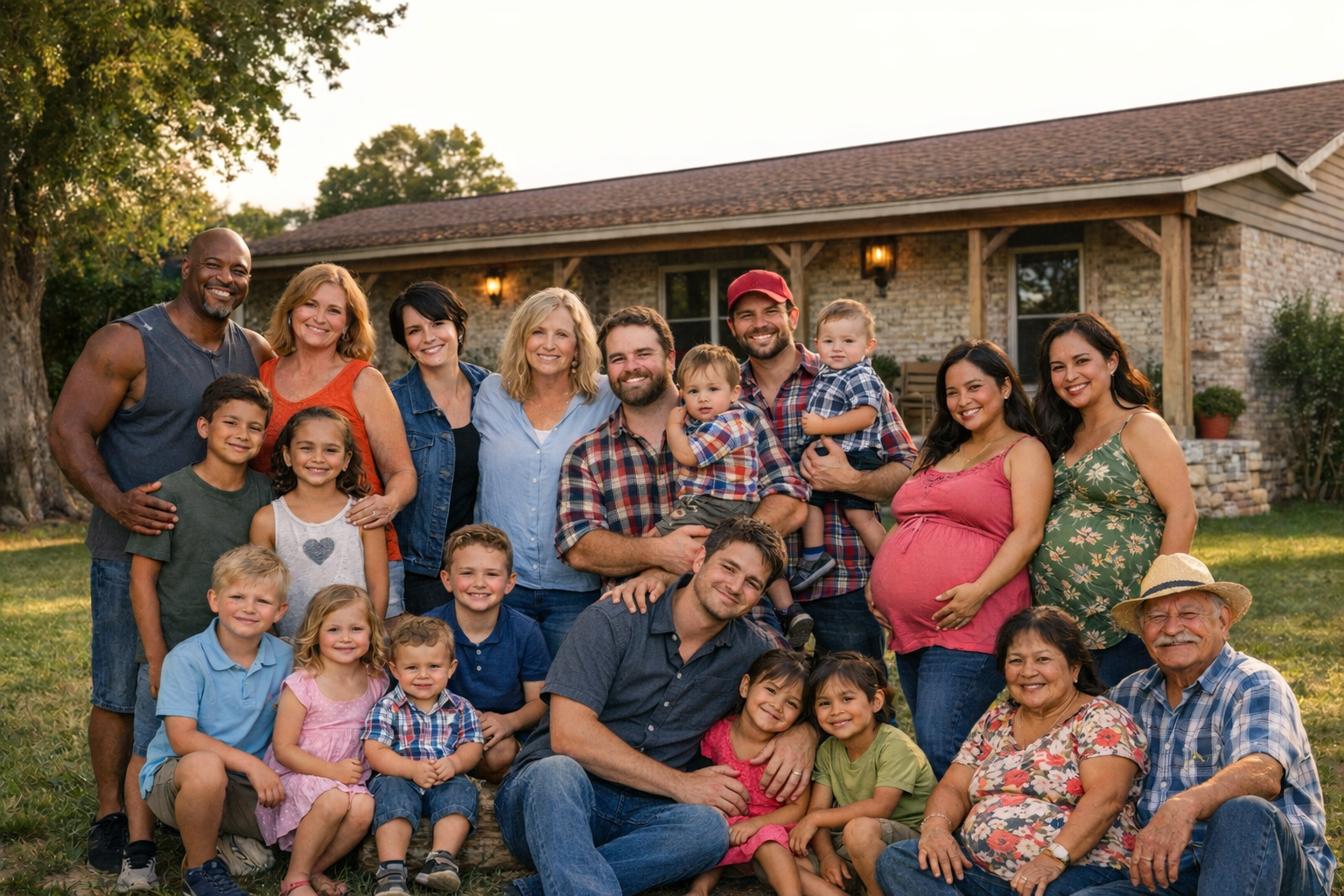
Billy-Ray Cormack was born in 1958 “in that state”, in a county where the land flattened into long commercial strips and pine woods swallowed the horizon, and he grew up in a ranch house his father expanded twice rather than replace, learning early that adding on was more honorable than starting over and that concrete, if poured correctly, would outlast sentiment.
He married Evelyn at twenty-three in 1981, when he was still apprenticing in upholstery and fixing torn vinyl seats for men who spoke about engines the way preachers spoke about souls, and by the time he was thirty he had opened his own small shop off the frontage road, re-covering church pews, diner booths, and pickup truck benches with a patience that bordered on reverence. (He got a small loan as they say) The used car lot came in 1992 after he realized the margins were better if he owned what he was reupholstering, and the HVAC business followed in 1998 when a supplier mentioned that every house he serviced needed climate control more urgently than new cushions, and Billy-Ray, who had always believed that comfort was simply temperature properly managed, learned quickly and scaled carefully.
He and Evelyn raised five children between 1983 and 1998, the older two boys drafted into weekend shop labor, the girls managing paperwork before they were old enough to drive, and the youngest, born in 1998, developing opinions about identity and politics that Billy-Ray dismissed at first as collegiate phase until the arguments hardened into declarations and the declarations into estrangement.By 2016, when the youngest announced ‘they’ (he) were (is) queer (a goddamn freak) and no longer willing to pretend otherwise, Billy-Ray, who watches ‘that news channel’ each evening as if it were both weather report and scripture, made the decision that they would not be welcome in his house if they insisted on bringing what he called “ideology” to the dinner table, a decision he frames as boundary rather than rejection and one that cost him more quiet hours than he admits.
His faith in ‘that religion’, steady since childhood and reinforced by men’s breakfasts and Wednesday Bible study, gives him language for order and hierarchy, and it also gives him the habit of hosting, so that when Evelyn left in 2017 after thirty-six years of marriage, citing deep existential exhaustion rather than betrayal, he found himself alone in a house that suddenly felt too large and too acoustically honest. Evelyn remarried in 2019 to his former best friend, who had relocated to Albuquerque, New Mexico—Billy-Ray still spells it phonetically in text messages—and between them they brought ten adult children into a loose, complicated orbit that now converges at Billy-Ray’s place for Thanksgiving and Fourth of July because he has the acreage, the smokers, and the parking.
In 2020, at sixty-two, he married Luz Navarro, a forty-two-year-old nurse from Cebu whom he met through church acquaintances and whose pragmatism steadies him even as her youth reminds him that time moves forward regardless of poured foundations; she brought three children into the marriage, they have since added one together in 2022, and she is now pregnant again in 2026, a fact Billy-Ray mentions with a mixture of pride and logistical calculation. By the time he retired from day-to-day operations in 2023, selling the HVAC contracts but keeping the land and the lots, he had convinced himself that provision was not merely financial but structural, that a man proves continuity by building spaces that can contain all possible futures, and it is in that conviction—formed over decades of expansion rather than rupture—that the first concrete was poured beneath the house.
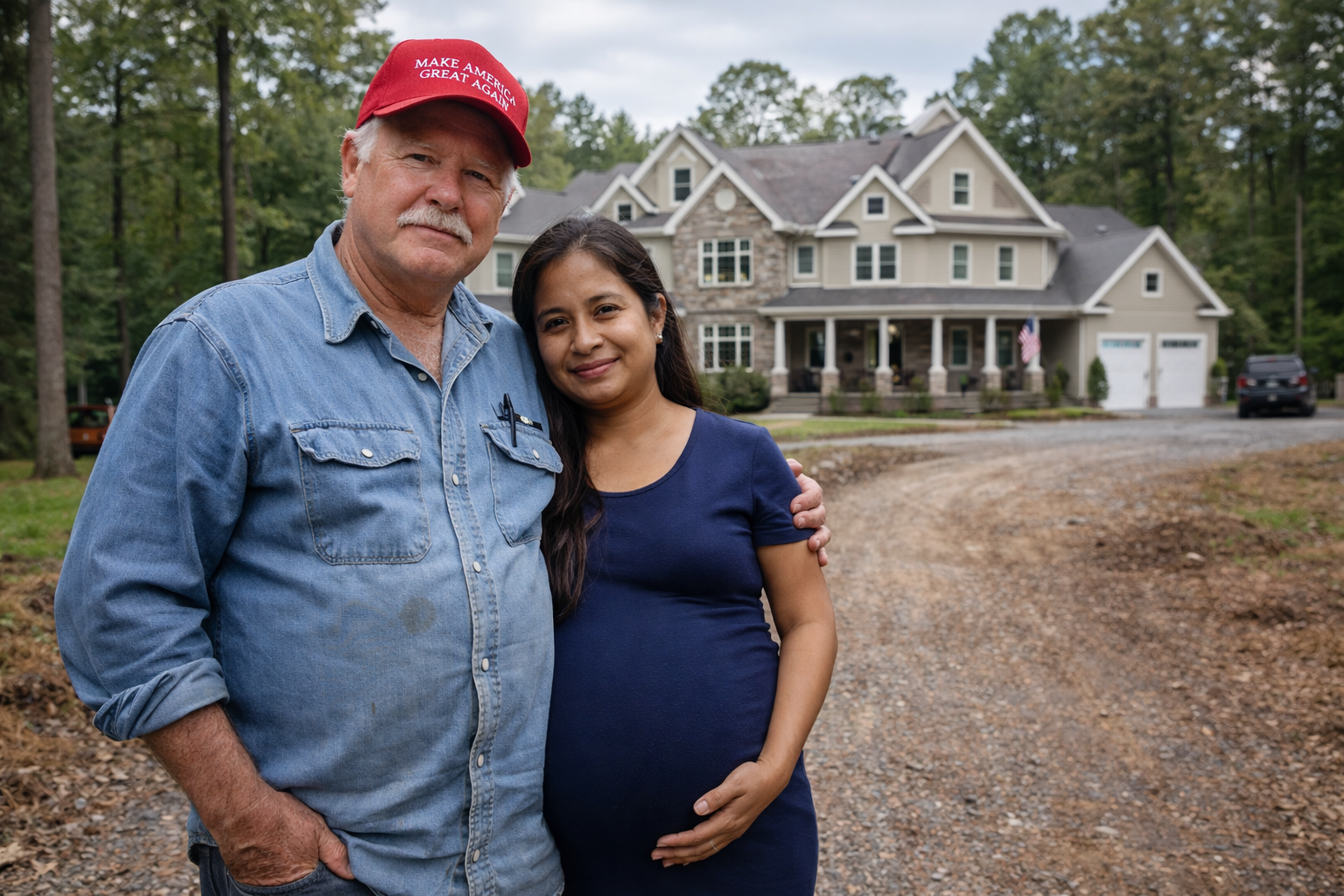
By the spring of 2001, when he was forty-three and flush from a decade of careful expansion, Billy-Ray had begun to experience the world not as a sequence of discrete events but as a braided river of possibilities, each one eroding the banks of certainty in its own way, and although he would have struggled to articulate it as such, his unease did not rest on any single headline so much as on a diffuse conglomeration of scenarios that overlapped, contradicted, and reinforced one another in the way late-night radio callers sometimes echoed each other without agreeing. He spoke, in those years, of marauding gangs drifting outward from the big cities should the power grids fail, of bureaucrats in distant capitals who might one day reinterpret the Constitution with an enthusiasm that left men like him defenseless, of regulatory creep that could swallow acreage in the name of wetlands or heritage corridors, of taxation spirals that punished success, of shifting demographics that he experienced less as people than as pressure, and of the cultural tremors that accompanied new technologies, from cell towers to broadband cables, which he regarded with a suspicion born less of technical understanding than of the feeling that signals were now passing invisibly through his property without permission. He had watched a movie one evening, a grim, unsettling film that lingered in the back of his mind long after the credits rolled, and although it concerned human depravity rather than extraterrestrial visitation, something about its atmosphere of hidden networks and unseen markets nudged him briefly into a phase of speculative thinking that included aliens, secret archives, and the possibility that the world operated on levels only partially disclosed to the average citizen, a phase he would later dismiss with a laugh but which at the time contributed to a sense that reality was layered and that prudent men prepared for layers.
It would be a mistake to imagine that he sat at his kitchen table drawing flowcharts of apocalypse, because his anxieties rarely crystallized into a single coherent narrative; instead they pooled and receded according to the rhythm of news cycles, church sermons, and conversations at the auto auction, so that one week he was concerned about gun legislation, another about foreign debt, another about the rumored health effects of new telecommunications infrastructure, and yet another about the erosion of what he called traditional values in schools that no longer felt familiar. The common denominator in these concerns was not their content but their direction, which always seemed to point away from local control and toward abstraction, and abstraction made him restless because it could not be repaired with tools. When a compressor failed in an HVAC unit he could replace it, and when a seat tore he could stitch it, but when a senator introduced a bill or a pundit speculated about global supply chains, he found himself relegated to commentary rather than correction, and commentary did not satisfy a man accustomed to tightening bolts until the wobble disappeared.
The year 2000 had passed without incident despite predictions that computer systems would collapse at midnight, and he had taken note of that, not as proof that warnings were unfounded but as evidence that preparation mattered, that unseen technicians had labored behind the scenes to avert catastrophe, and he internalized that lesson in a way that hardened into doctrine: better to overprepare quietly than to be caught unready publicly. In early 2001 he began to read about shipping containers repurposed as storage units and temporary offices, and the idea appealed to him because it combined industrial solidity with modular simplicity, a box within which one could impose order. He did not announce his plans as ideological; he framed them as prudent redundancy, as an extension of the storm shelters already common in that state, and when he mentioned the idea to Evelyn he emphasized tornado season rather than tidal waves of cultural change, because the former required no argument and the latter invited it.
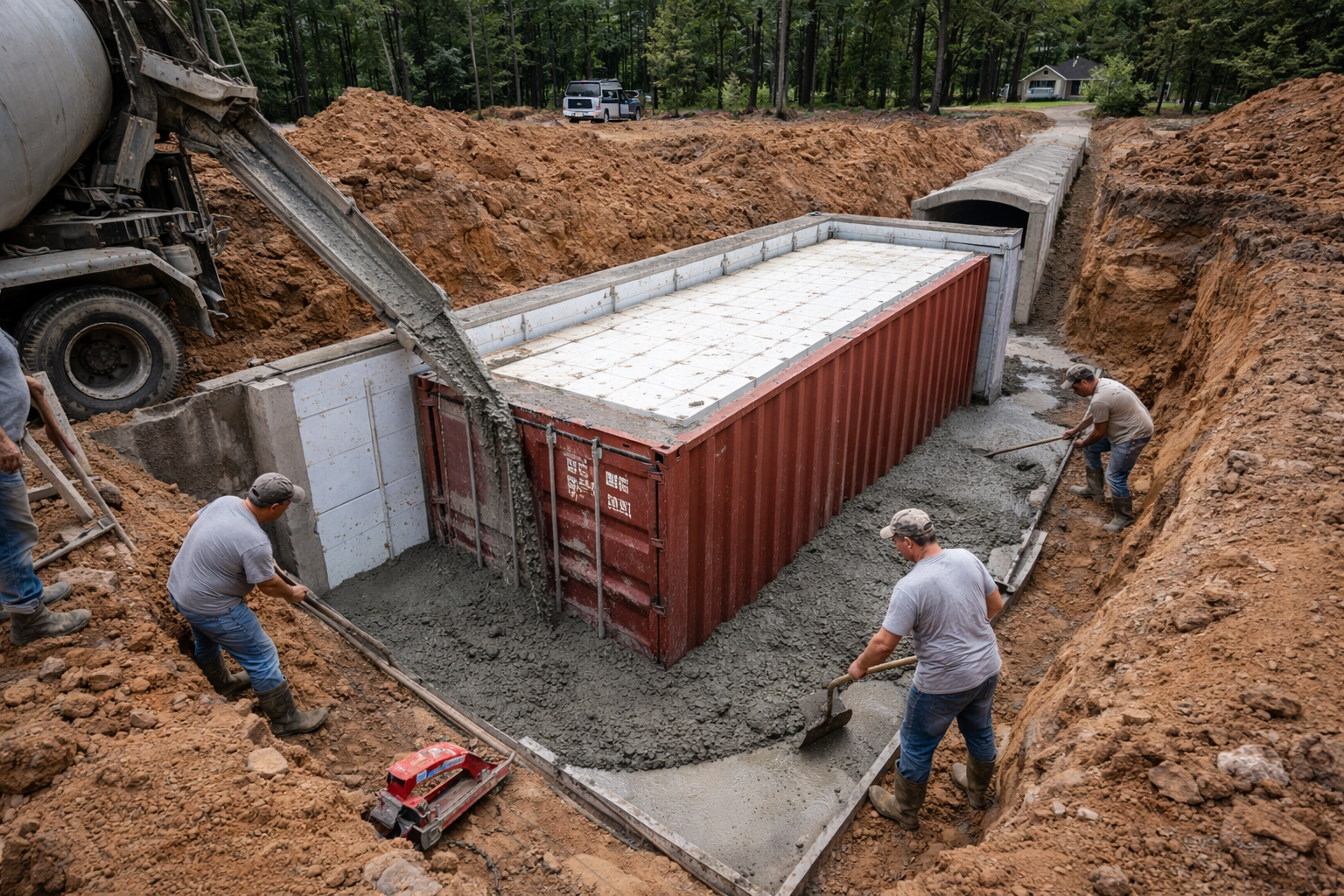
He purchased a used twenty-foot container from a distributor two counties over, negotiating down the price by pointing out rust along the seams, and he had it delivered on a flatbed to the rear of his property where the tree line thickened and the soil, though clay-heavy, could be coaxed into cooperation with rented machinery. He told the neighbors he was installing additional storage for the businesses, and that was not untrue, because at first the container held surplus filters and seat foam, but he had already sketched in his notebook the outlines of something more self-contained: insulation rated for damp conditions, a small diesel generator, deep-cycle batteries, shelves for canned goods, a chemical toilet, and a ventilation system that would not advertise itself with conspicuous exhaust. The burial itself took two weekends and the assistance of a hired operator who did not ask questions beyond depth and drainage, and when the container settled into its trench and the soil closed over it, leaving only a reinforced hatch disguised beneath a fabricated shed, Billy-Ray experienced a calm he had not anticipated, a quiet conviction that he had translated unease into geometry.
By the standards of later decades the installation was modest, even quaint, because 2001 insulation technology and battery capacity did not permit extravagance, and he lined the interior with rigid foam panels and plywood sheathing, sealing seams with tape more commonly used in ductwork than in habitation, then laid a simple subfloor to keep boots off bare steel and mounted shelving along one wall with the same care he had once devoted to diner banquettes. He wired in fluorescent lights powered by the generator and tested the system repeatedly, adjusting fuel storage protocols to minimize fumes, and he stocked the shelves not with theatrical abundance but with rotation in mind, labeling dates in neat block letters and keeping a ledger in which he tracked quantities as if they were inventory in a warehouse rather than rations against an unnamed disruption. Evelyn visited once, standing at the bottom of the short ladder with her arms crossed and her expression unreadable, and she remarked that it felt smaller than she expected, to which he replied that small was easier to defend, a phrase he later regretted because it implied a siege he could not describe.
The attacks of September 11 later that year did not create the bunker, but they altered the tone in which he discussed it, because suddenly preparedness had a vocabulary that did not require hypothetical gangs or abstract bureaucrats, and he could point to images on television and say that unpredictability was not paranoia but prudence. He did not claim that terrorists would descend upon that state, yet he folded the event into his mental archive of evidence that the world contained actors beyond the reach of local institutions, and he adjusted his supply list accordingly, adding water purification tablets and a shortwave radio, not because he anticipated invasion but because communication felt like a tether to sanity. In church he spoke softly about stewardship and the responsibility of heads of household to anticipate hardship, and although no one accused him of extremism, a few men asked for the name of the container distributor, which he provided without evangelizing.
Over the next several years his concerns continued to shift, sometimes coalescing around public health debates, sometimes around debates about telecommunications infrastructure, sometimes around changes in school curricula that he interpreted as moral drift, and sometimes around immigration patterns that he perceived through the lens of labor markets rather than demographics, yet the bunker remained physically unchanged for a time, as if it had satisfied a threshold requirement and did not yet demand embellishment. He visited it occasionally, performing maintenance and rotating stock, and each descent down the ladder functioned as rehearsal rather than retreat, an exercise in contingency rather than a response to immediate danger. When talk radio speculated about land seizures for eminent domain projects or commentators warned about overreach from agencies he could not name from memory, he felt the old braided river of possibilities swell, but he also felt the steady steel beneath his boots and reminded himself that he had acted rather than merely reacted.
It would be easy, in retrospect, to interpret his decision in 2001 as the first tile in a mosaic that would eventually depict a labyrinth, but at the time it seemed proportionate, a rational extension of a temperament trained by decades of incremental addition, and the sunk container, insulated by the standards of that year and provisioned with the discipline of a small-business owner, represented not hysteria but translation, the conversion of ambient anxiety into a space defined by walls he could measure and supplies he could count. If there was pathology in the act, it lay not in the dimensions of the steel box but in the way it answered questions he had not fully formed, and because it answered them quietly, without fanfare, he regarded it not as a descent into extremity but as a foundation, unaware that foundations, once poured, invite superstructure.
2001
The first container was, in almost every measurable sense, a technical embarrassment. Billy-Ray had approached it with the confidence of a man who had solved hundreds of mechanical problems in his life, and he assumed that steel, when buried, would behave as obediently as it did on the back of a flatbed trailer. He understood insulation in the language of HVAC ducts and attic batts, not in the subterranean grammar of vapor barriers, capillary action, and hydrostatic pressure, and so he lined the interior with rigid foam and plywood as if he were finishing a workshop rather than entombing a box. The gravel base was shallow, the drainage improvised, the seams sealed with the optimism of someone who believed that tape, if pressed firmly enough, could defeat humidity. When the rains came that autumn the soil swelled and shifted, and the steel began its quiet conversation with moisture; condensation gathered behind the foam where he could not see it, the plywood edges darkened, and a metallic tang entered the air, subtle at first and then persistent, like the smell of pennies left in a damp pocket.
He told himself that the scent was simply new construction settling, that the minor rust freckles blooming along the interior ribs were cosmetic rather than structural, and that the slight bowing he detected along the roofline was within tolerances, though he had no chart against which to measure it. He installed a dehumidifier that ran almost continuously and collected gallons of water from air he had once imagined to be sealed and obedient, and the machine’s hum became the bunker’s heartbeat, a reminder that equilibrium underground is not achieved but maintained at cost. When he descended the ladder in the evenings, flashlight in hand, he sometimes ran his fingers along the steel walls and felt a faint chill that had nothing to do with temperature and everything to do with the awareness that he had built something that required vigilance rather than simply offering it.
Yet for all its flaws, the container functioned in the way that mattered most to him. It was a space apart, a place where the noise of televised argument and speculative commentary fell away into the muffled quiet of earth, and he could inventory cans, rotate water barrels, and tighten bolts in a world reduced to manageable scale. The inefficiencies did not negate the psychological relief; if anything, they sharpened it, because each flaw presented a problem he could attempt to solve, and problem-solving was the dialect in which he felt most fluent. He kept a notebook in which he logged humidity readings, rust spots, minor seepage along one corner seam, and the performance of the generator under load, and over time the pages filled with observations that read less like a doomsday ledger and more like the diary of a man learning the language of soil.
Winter made the deficiencies impossible to ignore. The temperature differential between interior and exterior produced condensation that beaded along the roof supports and dripped in irregular patterns, and he found himself wiping down surfaces with shop rags as if tending to a patient that perspired in its sleep. He began researching in earnest, reading forums and manuals about underground construction, discovering terms he had not previously encountered: waterproof membrane, French drain, cathodic protection, overburden load. He learned that shipping containers derive their strength from corner posts and that lateral soil pressure can deform them in ways invisible until it is too late, and he stared at the slight roof deflection with a new apprehension, calculating weight per square foot as if it were an invoice. The realization that his first attempt had been structurally naive did not crush him; it invigorated him, because it implied a second attempt could be better.
In the spring of 2002 he convened his own quiet review of the project, listing what had failed and what had succeeded. The failures were tangible: moisture intrusion, insufficient drainage, inadequate roof reinforcement, insulation placed on the wrong side of the vapor barrier. The successes were intangible but decisive: the bunker had provided calm during a period of ambient national anxiety, it had transformed amorphous concerns into actionable tasks, and it had anchored his evenings in a ritual of maintenance that felt purposeful rather than reactive. He concluded, with the confidence of a businessman evaluating a new branch office, that the concept was sound but the execution required scale and sophistication.
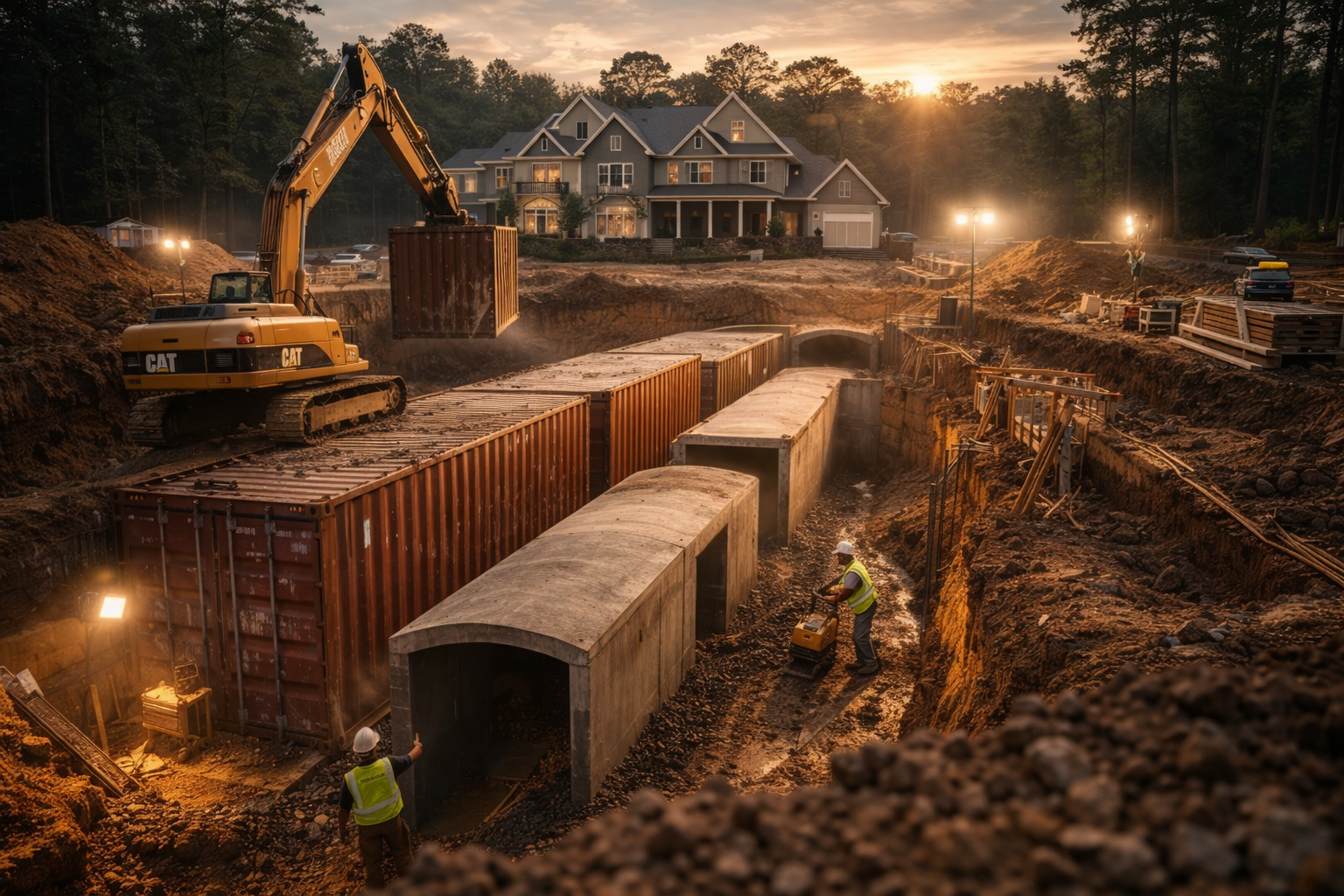
The decision to add five more containers did not arrive as a dramatic proclamation; it unfolded as an incremental logic. If one container required external insulation rather than internal, then the next should be wrapped in closed-cell foam and waterproofed before burial. If the roof required reinforcement, then steel I-beams could be welded across the span and a reinforced concrete slab poured above to distribute load. If drainage was essential, then a perimeter of gravel and perforated drain tile could channel groundwater to a sump basin equipped with redundant pumps. He purchased additional containers not because he needed five discrete rooms at once but because bulk acquisition reduced cost and because he could envision a configuration that extended beyond a single box into a system of corridors and chambers.
Excavation in 2002 and 2003 bore little resemblance to the shallow trench of the first attempt. He hired a contractor with experience in foundation work, though he did not disclose the full ambition of the project, framing it instead as an expanded storm shelter complex. The earth was cut deeper, wider, with stepped walls to reduce collapse risk, and a bed of compacted gravel was laid beneath each container site. Before lowering the steel into place, he supervised the application of a heavy-duty waterproof membrane, sealed meticulously at seams, and then installed rigid insulation panels on the exterior, not the interior, so that the steel would remain within the conditioned envelope and less susceptible to condensation. Each container roof received welded reinforcement beams, and once positioned, the entire assembly was encased in a reinforced concrete shell that acted as both structural support and additional barrier against moisture.
The tunnels connecting the containers were no longer improvised trenches but carefully formed corridors with rebar cages tied at intervals and expansion joints calculated to accommodate minor soil movement. He specified a slight slope toward drainage points and installed a network of French drains around the perimeter, leading to a sump pit with dual pumps powered by separate circuits. Ventilation shafts were integrated into the design, rising discreetly through the soil to emerge in inconspicuous outbuildings, and though he did not yet invest in full nuclear-biological-chemical filtration, he selected filters rated for particulates far beyond ordinary household use, comforted by the knowledge that air, like water, could be disciplined.
As the five new containers settled into their reinforced cradles, he began assigning them functions, not out of immediate necessity but in anticipation of potential scenarios. One was designated for food storage, its shelving engineered from floor to ceiling with adjustable brackets and clear labeling systems that mirrored the inventory practices of his businesses. Another became sleeping quarters, initially sparse but wired for future expansion, the bunks arranged with military efficiency. A third container housed mechanical systems: generator, battery bank, fuel storage in sealed tanks with spill containment measures. The fourth he reserved for communal space, a room that could host conversation, games, or prayer should circumstances require prolonged occupancy. The fifth was left partially unfinished, a blank slate for needs not yet articulated.
The transition from a single flawed container to a five-unit complex did more than correct engineering mistakes; it altered his relationship to the project. The first bunker had been an experiment tinged with embarrassment; the second phase was an assertion of competence. When he walked through the reinforced corridors and heard only the muted echo of his own footsteps rather than the drip of condensation, he felt vindicated. The air smelled neutral, the humidity readings stabilized within acceptable ranges, and the structural calculations suggested longevity measured in decades rather than seasons. He installed a modest plunge pool in an adjoining chamber, justifying it as a means of thermal regulation and morale enhancement, but privately acknowledging that water, underground, symbolized mastery over an element that had once threatened his steel.
Between 2002 and 2006 the complex evolved steadily, absorbing his evenings and weekends with a rhythm that paralleled the growth of his businesses. Food storage expanded beyond simple canned goods into vacuum-sealed grains, dehydrated vegetables, and carefully rotated stockpiles tracked on spreadsheets. Sleeping quarters acquired privacy partitions and improved ventilation. The communal space gained a table large enough to seat extended family and, eventually, shelves for board games and books. He installed a bathroom with a composting toilet and gray-water management system, proud of the engineering that rendered waste manageable rather than unspeakable.
If there was excess in this expansion, it manifested not as chaotic accumulation but as systematic redundancy. He added a second generator, then a third battery array, arguing that failure modes must be anticipated. He installed a medical bay stocked with trauma kits and basic medications, labeling drawers with a precision that bordered on reverence. He experimented with hydroponic trays in a small chamber outfitted with grow lights, fascinated by the possibility of self-sustaining agriculture beneath the soil. Each addition was justified by a plausible scenario, yet collectively they formed something that exceeded any single threat model.
By 2006 the underground footprint approached a scale that would have seemed absurd in 2001, yet to him it felt like the natural consequence of iterative improvement. The semi-failed first attempt had taught him humility and the importance of moisture control; the second phase taught him that infrastructure, once stabilized, invites elaboration. He did not perceive himself as spiraling but as optimizing, refining, expanding in response to lessons learned. The rust of the original container remained as a reminder of imperfection, and he kept it accessible, not as a primary shelter but as an archive of his miscalculations, a place he could visit to remember the cost of ignorance.
The five-container complex became, over time, less a refuge from catastrophe and more a parallel architecture to the house above. It mirrored his worldview: compartmentalized, redundant, engineered against uncertainty. The psychological soothing value of the first flawed box had not diminished; it had been institutionalized into corridors and chambers, into airlocks and sump pumps, into a system that translated diffuse anxiety into concrete geometry. Whether the scale was proportionate to any realistic threat mattered less to him than the fact that each expansion reduced the margin of unknowns, and in that reduction he found not hysteria but order.
And yet, in quiet moments when he stood in the central corridor and listened to the hum of filtration and the distant thrum of pumps, he sometimes wondered whether the system was containing external dangers or merely amplifying his need to anticipate them. The answer eluded him, because the bunker did not shout; it reassured. It did not insist on imminent collapse; it offered preparedness. The semi-failed first attempt had been an act of translation; the five-bunker expansion was an act of consolidation, a declaration that errors could be corrected and that uncertainty, though never eliminated, could be mapped, drained, filtered, and stored on shelves labeled with dates and intentions.
During those middle years, when the reinforced corridors had begun to feel less like contingency and more like infrastructure, the spirit animating Billy-Ray’s expansions was less a single fear than a collage of anxieties assembled from cable news panels, late-night radio, forwarded emails, and the ambient hum of post-9/11 geopolitics. He did not sit down and declare to himself that Islamic law was inevitable or that nuclear war was scheduled; rather, he absorbed a steady stream of commentary suggesting that Western civilization was fragile, that enemies operated patiently, and that vigilance was the only antidote to complacency, and in the way that some men take up golf or woodworking, he took up fortification. The idea of imminent attack, whether from foreign extremists or domestic unrest, hovered at the edge of his imagination, never fully articulated as a timeline yet persistent enough to justify action, and because action felt better than dread, he channeled that energy into excavation and procurement.
His reading habits during this period tilted toward worst-case analysis, and he began to speak in conditional phrases—“if they ever,” “when things turn,” “should the grid go down”—that converted speculation into planning scenarios. The bunker complex, already technically competent by mid-decade, started to accumulate features that went beyond comfort and redundancy into symbolic resistance: thicker doors, more robust filtration, additional weapon storage carefully cataloged and humidity-controlled, and a communications room designed not only to receive information but to project the image of preparedness. He framed these upgrades as rational responses to an unstable world, citing geopolitical flashpoints and domestic policy debates as evidence that sovereignty, both national and personal, was under strain. The notion that Islamic extremism might metastasize into broader cultural transformation did not present itself to him as prejudice but as prudence, because he experienced it through the lens of commentators who equated vigilance with patriotism and who blurred the distinction between violent actors and entire civilizations.
The “model railroad effect” manifested in concrete and steel; each new chamber promised not only utility but reassurance, and the act of planning defensive perimeters and stockpiling equipment delivered a sense of agency that countered the helplessness he felt watching distant conflicts unfold on screen. Weapon acquisition, in this frame, was less about aggression than about insulation against humiliation, a refusal to imagine himself caught unprepared in a world he increasingly described as hostile. He attended gun shows not as a caricature but as a customer convinced that redundancy equaled responsibility, and he invested in safes, training courses, and ballistic upgrades to doors in the same way he had once invested in better compressors for his HVAC fleet.
What distinguished this phase was not chaos but escalation; the projects grew beyond practical necessity because the scenarios they were designed to counter were elastic, capable of expanding to justify additional layers of defense. Nuclear armageddon, invoked in conversation with a half-shrug and a citation of rogue states, required filtration upgrades and water storage expansion. Cultural transformation, described as creeping and inexorable, justified the creation of a parish meeting room underground, a symbolic ark for values he believed were endangered. The bunker became a concrete rebuttal to decline narratives, a space where law, order, and hierarchy could be preserved even if the surface world, in his imagination, tilted toward entropy.
Whether those fears were proportionate to reality is a separate question from whether they were sincerely held, and in Billy-Ray’s case sincerity was not in doubt; what is notable is how seamlessly existential unease translated into square footage. The subterranean complex did not shout hatred or collapse into incoherence; it expanded methodically, each room a footnote to a headline, each upgrade a vote of confidence in preparation over passivity.
2006
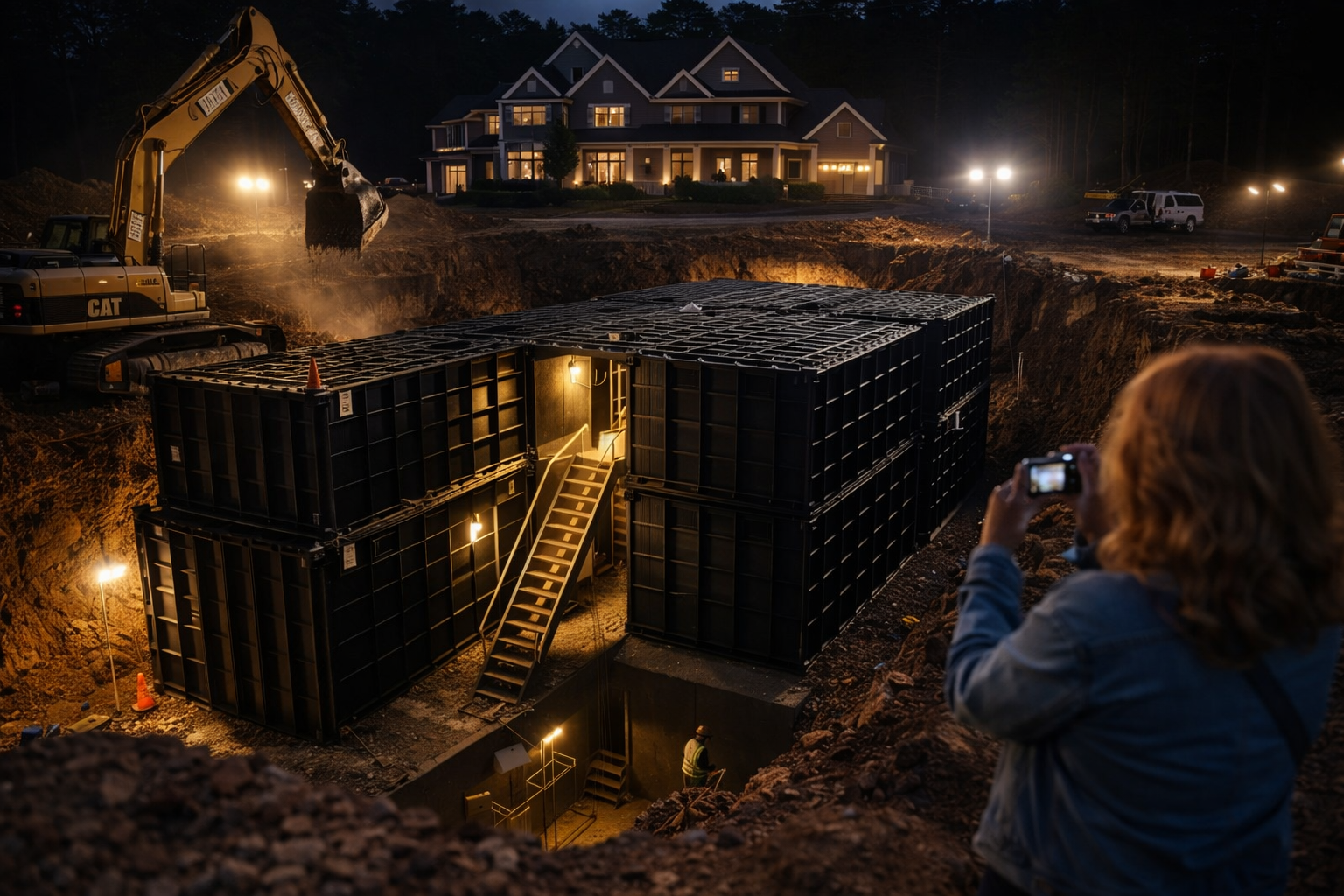
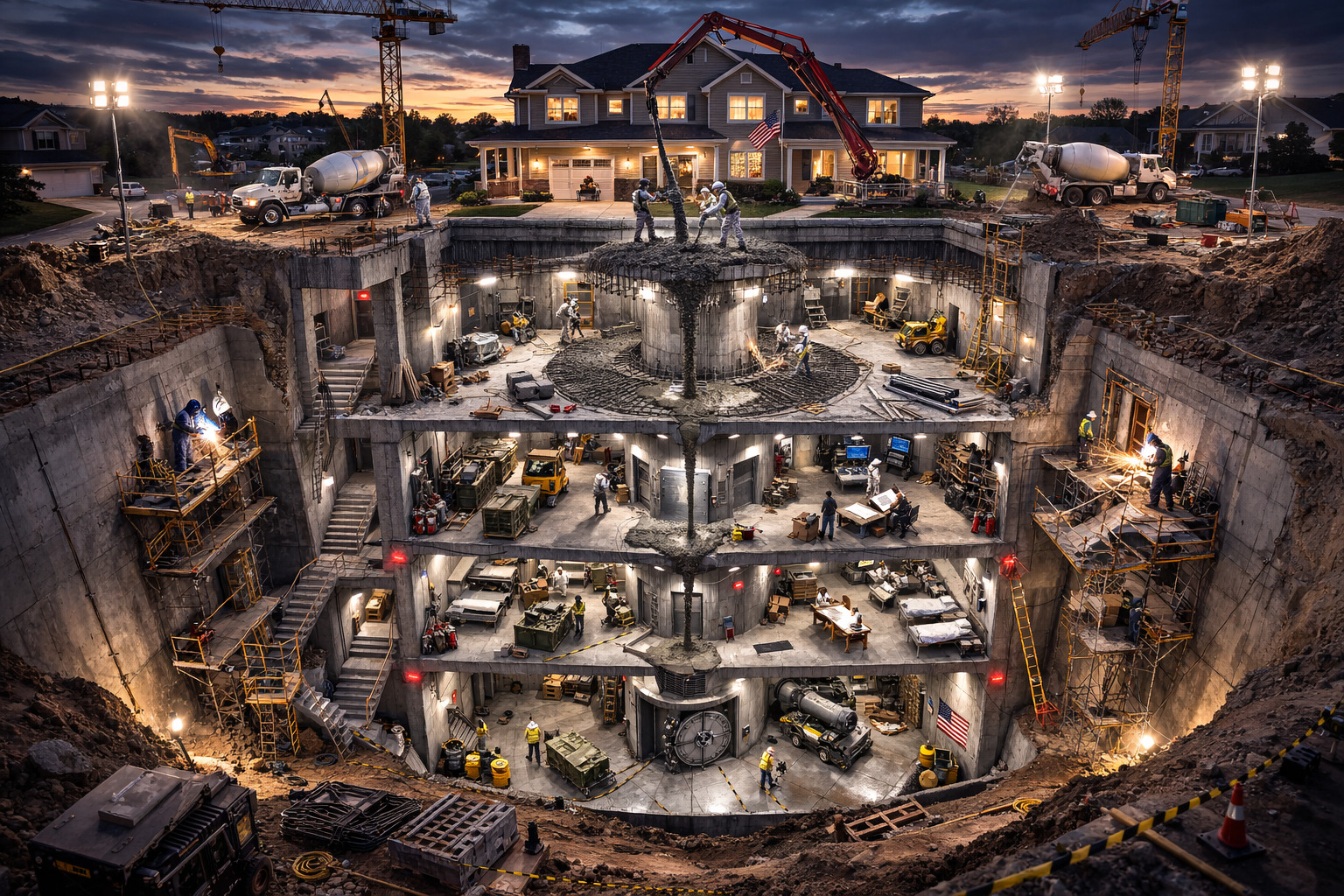
It was, even by the inflated standards of mid-2000s preparedness culture, a spectacle. The reinforced modules arrived on flatbeds like components of a lunar base, matte black and ribbed with structural geometry that suggested seriousness rather than improvisation, and when they were craned into the excavation two layers deep in a precise 2×2 grid, the scale of the thing forced even skeptical neighbors into silence. Floodlights carved the night into bright planes of activity and shadow, and the staircase that cut between the stacked levels, bolted in place before backfill, gave the structure an architectural legitimacy that his earlier experiments had lacked. This was not a buried container anymore; it was a subterranean facility. When Evelyn stood at the edge of the pit with her 2006 digital camera, the glow from the construction lights catching in her hair, she did not appear alarmed or embarrassed but animated, as if documenting the launch of a second enterprise, and her pride lent the scene a kind of domestic endorsement that neutralized its extremity.
Word traveled quickly through the forums and newsletters that circulated among preparedness enthusiasts, and photographs of the stacked modules against the backdrop of his wooded property began appearing on message boards where men debated filtration ratings and ballistic coefficients with equal fervor. The project’s price tag, rumored at five million dollars, functioned less as a caution than as a credential, proof that this was not a hobbyist tinkering in his backyard but a serious investor in continuity. Interviews followed, first informal and then structured, in which Billy-Ray described moisture mitigation strategies, structural load calculations, and redundant power systems in the calm, matter-of-fact tone of a contractor explaining a foundation pour. He avoided apocalyptic rhetoric in these conversations, speaking instead of resilience, stewardship, and responsibility, and that restraint enhanced his credibility among an audience weary of theatrics but hungry for models of execution.
Within months he found himself recognized at gun shows and preparedness expos, approached by men who wanted to shake the hand that had turned anxiety into reinforced concrete. He was invited to speak at small conferences where folding chairs faced PowerPoint slides of cross-sectional diagrams, and he stood at podiums in hotel ballrooms explaining why external insulation mattered more than internal lining and why drainage systems failed when treated as afterthoughts. The bunker complex, now photographed professionally and circulated in glossy spreads, became a benchmark, cited in discussions about what constituted “state of the art” in private defense infrastructure. Vendors courted him for endorsements, filtration companies offered upgrades at reduced cost in exchange for testimonials, and a niche magazine devoted an entire issue to the engineering of his stacked configuration, complete with annotated images of the visible staircase that connected the levels like a spine.
Celebrity in prepper circles is a peculiar phenomenon, equal parts admiration and projection, and Billy-Ray navigated it with a businessman’s instinct for brand management. He emphasized practicality over paranoia, systems over slogans, and in doing so he transformed his bunker from an eccentric indulgence into a case study in disciplined escalation. The underground complex, illuminated at night and framed by the silhouette of his house above, came to symbolize not fear but preparedness executed at scale, and in that reframing he found both validation and momentum.
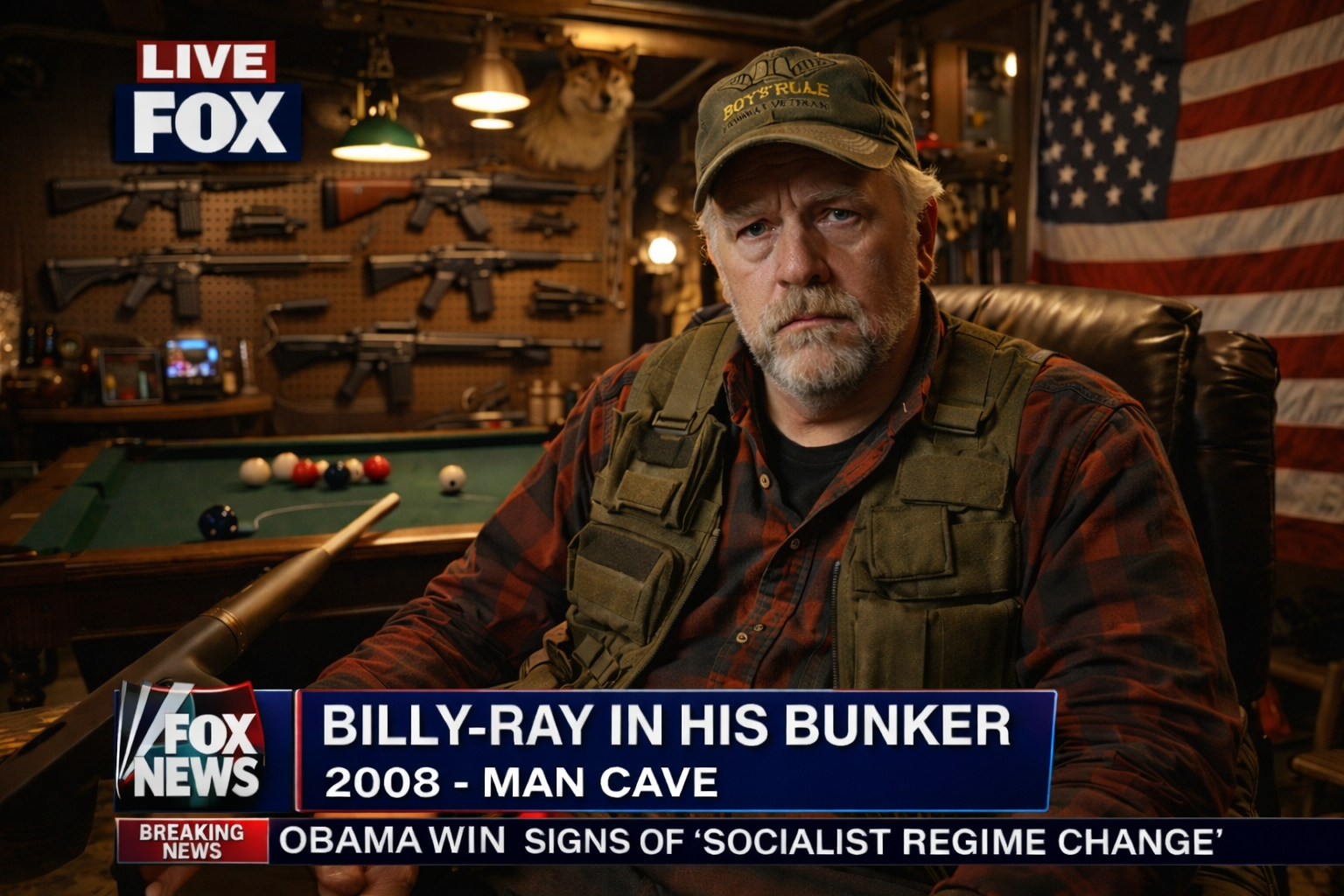
2008
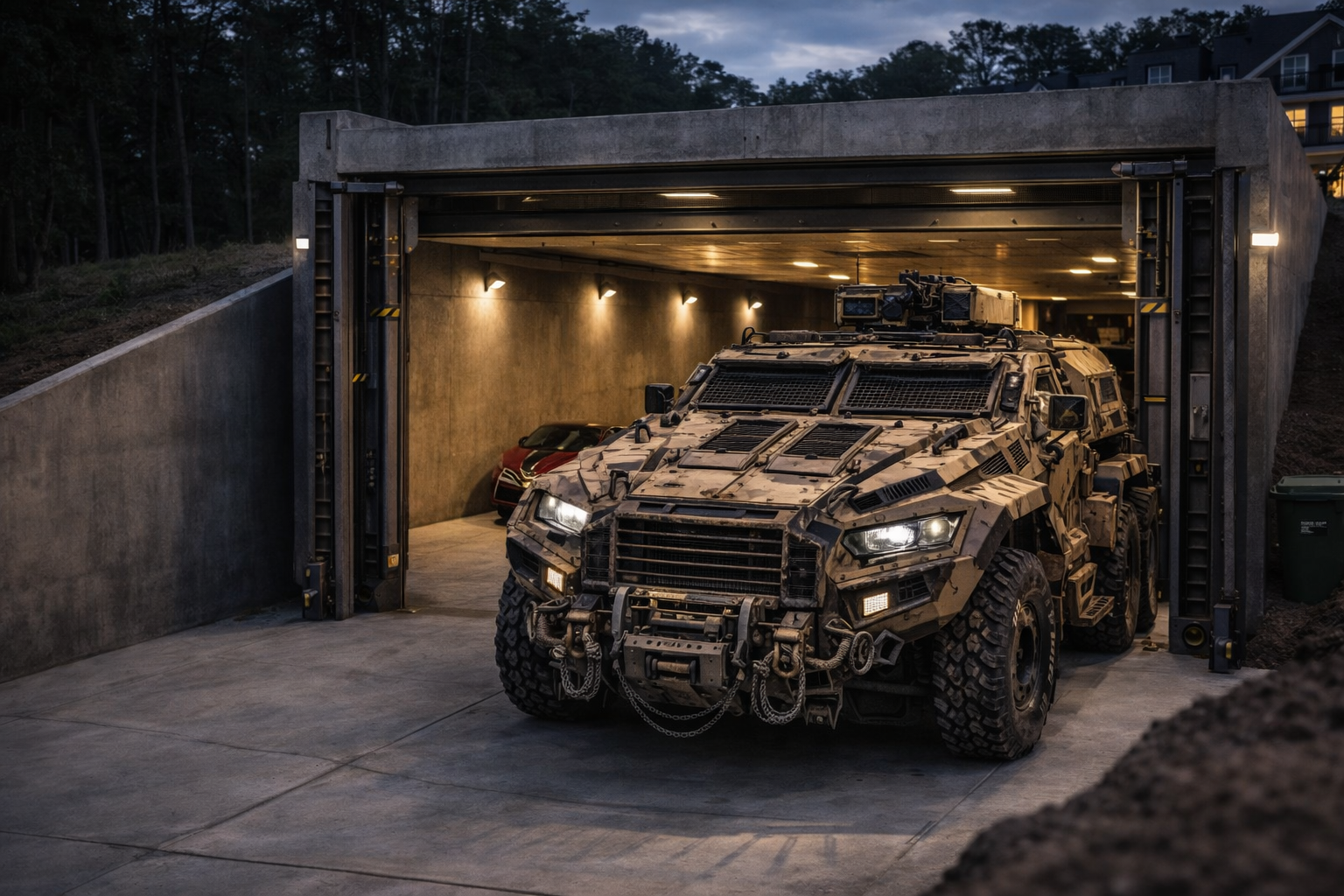
What followed was less a sequence of upgrades than a gravitational event. The bunker had begun as insurance and matured into infrastructure, but by the late 2000s it acquired its own appetite, and Billy-Ray’s considerable affluence, once diversified across upholstery contracts, vehicle inventory, and climate control service routes, began to flow with unsettling efficiency into concrete, rebar, and machinery. The expansion did not announce itself as extravagance; it arrived as “necessary integration,” as the logical accommodation of assets already acquired. If he owned vehicles intended for uncertain terrain, then they required secure housing; if he believed mobility would matter in a destabilized world, then those machines deserved protection equal to the food stores and filtration systems below. Thus the entrance garage was conceived not as indulgence but as continuity, a hardened threshold through which preparedness could roll.
The driveway was regraded first, widened and poured in reinforced concrete that sloped gently toward what appeared, from the road, to be an unusually austere outbuilding at the edge of the property. Neighbors assumed it was storage for tools or seasonal equipment; only at night, when floodlights flared and the steel door lifted with hydraulic deliberation, did the scale reveal itself. Behind that door, set flush with the earth and disguised as architectural minimalism, a ramp descended into a parking chamber large enough to shame municipal garages. The chamber was lined in poured concrete, its ceiling ribbed with beams and lit by industrial fixtures that hummed with overcapacity. Painted lines marked parking bays as if awaiting a fleet rather than a hobby.
He began acquiring vehicles with the same methodical justification he once applied to generators. A surplus armored transport here, a reinforced pickup there, and then, as the crown jewel, a Desert Gulf military vehicle that he spoke of in reverent tones, as though its presence alone conferred geopolitical literacy. The story of its journey back to the States grew more elaborate with each retelling, involving contacts, logistics, and the sort of quiet negotiation that suggests access rather than extravagance. It arrived on a lowboy trailer one humid afternoon, sand-colored and improbably angular, and he watched as it was eased down the ramp into its subterranean berth, the concrete swallowing its bulk with theatrical indifference.
The ridiculousness lay not in the machines themselves but in the choreography. He installed a vehicle lift between levels so that cars could be repositioned like museum pieces. He calibrated humidity control not merely for comfort but for preservation, as if curating artifacts of a future museum dedicated to collapse. He ran electrical hookups along the walls to maintain batteries, labeling each breaker with a precision that bordered on devotion. There was even talk, half serious and half promotional, of a “rapid deployment protocol,” though no one could quite define the conditions that would trigger it.
What had once been a bunker became a subterranean showroom of contingency, a space where mobility, firepower, and reinforced architecture converged in a symphony of overpreparedness. The entrance garage did not simply house vehicles; it dramatized the project’s evolution from shelter to spectacle. Each descent down the ramp felt like crossing into a parallel jurisdiction, one governed by torque specifications and threat models rather than zoning ordinances. If there was a line between preparedness and pageantry, it blurred beneath the concrete, and Billy-Ray, who had once corrected rust with humility, now presided over an underground motor pool that suggested he had begun to mistake scale for inevitability.
By 2008, Billy-Ray did not consider himself an extremist; he considered himself observant. The vocabulary he used was careful, layered, almost polite, as though by sanding down the edges of his words he could render their implications harmless. He spoke of “urban migration patterns,” of “demographic pressure,” of “cultural drift,” and of “shifting norms,” phrases that sounded like policy briefings rather than anxieties, and yet beneath them pulsed something more primal: a sense that the perimeter was thinning. He would never describe himself as prejudiced; he had acquaintances and friendships that, in his mind, proved otherwise. He fished with Tyrone, lifted weights with Tyrone, sat beside him in the sauna at the gym and discussed protein intake and bass seasons. Tyrone, in Billy-Ray’s telling, understood the situation. Tyrone, he would say, admitted that “the inner-city types” were getting restless, that crime statistics told a story if one knew how to read them, that governance was soft where it should be firm. These conversations, half-remembered and half-embroidered, became ballast for Billy-Ray’s conviction that what he feared was not people but disorder.
He distinguished constantly between individuals and what he called “trends.” Individuals were neighbors, colleagues, fellow congregants. Trends were waves, currents, abstractions. It was the abstraction that troubled him. He would gesture toward news footage—crowds, sirens, broken storefronts—and speak of contagion, of instability radiating outward from dense cores into quieter counties. He insisted he did not blame anyone for seeking opportunity; he merely questioned whether opportunity, unmanaged, would eventually spill over into communities unprepared for sudden influx. The phrase “they are coming” did not refer to a specific bus or caravan but to a cumulative drift, an inevitable movement of pressures seeking release.
The economic downturn amplified everything. As factories shuttered and foreclosures mounted, Billy-Ray saw not market cycles but warning lights. He began speaking of “stress fractures” in the social contract and “erosion of civic discipline,” terms that sounded analytical but were rooted in unease. In his mind, collapse was not cinematic; it was administrative. It would arrive through shortages, overwhelmed systems, delayed responses. And in those interstices, he believed, looting bands would form—not as caricatures of villains but as predictable outcomes of scarcity. He imagined grocery stores stripped within hours, gas stations barricaded, law enforcement stretched thin. He imagined the suburbs discovering, too late, that proximity to highways meant permeability.
When he said he was prepared, he meant it as a moral statement. Preparedness, to him, was stewardship. He had worked hard, paid taxes, donated to church initiatives. He felt entitled not to exemption from hardship but to insulation against chaos. The bunker, the garage, the reinforced doors were not instruments of hostility; they were hedges against unpredictability. He framed his expansions as civic responsibility, arguing that self-sufficiency reduced strain on public resources during emergencies. If more families invested in redundancy, he suggested, fewer would panic when supply chains faltered.
The coded language proliferated because direct language felt impolite, and Billy-Ray prided himself on civility. He did not say “race”; he said “culture.” He did not say “outsiders”; he said “transients.” He did not say “invasion”; he said “unsustainable migration.” Each substitution allowed him to maintain the self-image of fairness while nurturing a narrative of encroachment. He repeated that he judged people by character, not color, and cited Tyrone as living proof that the issue was behavioral rather than biological. In this way he reconciled friendship with fear, compartmentalizing relationships from rhetoric.
The more he invested underground, the more coherent his worldview felt. Infrastructure translated abstraction into measurable safeguards. Reinforced doors equaled delayed entry; filtration systems equaled breathable air; stocked shelves equaled autonomy. The imagined bands of looters became a design parameter rather than a nightmare. He rehearsed scenarios in his mind with the calm of an engineer stress-testing a bridge, calculating response times, fallback positions, escape routes. If collapse came, he would not scramble; he would descend.
There was a certain circularity to his reasoning that he did not perceive. The more he prepared, the more plausible catastrophe seemed, because so much effort demanded justification. He scanned headlines for confirmation that unrest was rising, that social cohesion was thinning, that governance was brittle. Each incident became a data point reinforcing his thesis. He did not recognize that for many people the same news signified progress, negotiation, or transformation rather than decay. He experienced change as acceleration without consent.
In quieter moments, when the garage lights dimmed and the hydraulic doors sealed with theatrical finality, a flicker of doubt would surface. He would recall laughter with Tyrone, potlucks at church where dishes spanned continents, the mundane stability of school schedules and fishing seasons. These did not align neatly with the narrative of imminent bands cresting the county line. Yet the doubt never lingered long, because doubt did not pour concrete. Certainty did.
So he continued, not out of hatred but out of a conviction that vigilance equaled virtue. The language remained coded, the friendships compartmentalized, the fear abstracted into “trends.” In his mind he was not bracing against neighbors but against entropy itself, and if entropy happened to wear the face of demographic change or urban unrest, that was a matter of pattern recognition rather than prejudice. He was prepared, he told himself, not because he expected violence tomorrow but because history, selectively curated and anxiously interpreted, suggested that systems falter. When they did, he intended to be beneath the soil, doors sealed, supplies counted, confident that prudence had triumphed over complacency.
2010
For a while, the spectacle paid for itself. Sponsorship contracts trickled in from filtration manufacturers, tactical supply companies, emergency food distributors, and niche preparedness brands eager to attach their logos to what magazines had begun calling “the most comprehensive private continuity installation in the region.” Billy-Ray filmed walkthroughs in a collared shirt embroidered with sponsor patches, gesturing toward air-handling systems with the practiced cadence of a man who had once explained HVAC ductwork to skeptical homeowners. The underground complex was no longer just a hedge against collapse; it was content. Affiliate codes softened operating costs, vendor discounts subsidized upgrades, and the garage doors—hydraulic and theatrical—opened for carefully lit promotional shoots that made concrete look like destiny.
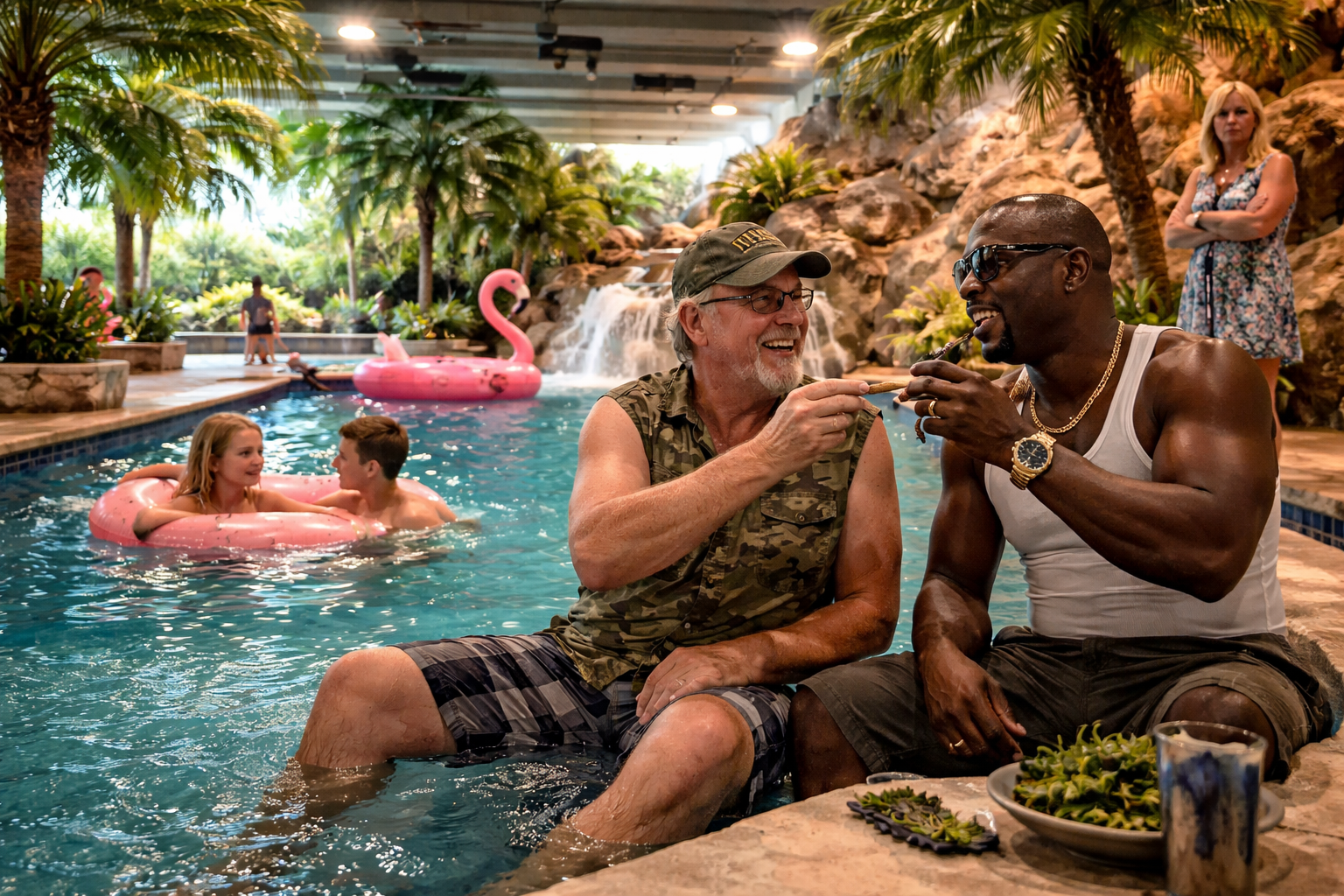
But sponsorship money is oxygen, not companionship. By 2011 the house above ground had begun to thin out. The older children moved for jobs, marriages, graduate school. Even the younger ones found reasons to stay out late. The cavernous underground spaces, once animated by construction crews and visiting journalists, acquired a faint echo. The pool, tropical and absurd beneath its climate-controlled ceiling, shimmered under LED grow lights without an audience. The greenhouse thrived. The generators purred. The parking bays remained immaculate. It was quiet.
Quiet, for Billy-Ray, felt like waste.
So he did what he had always done when confronted with underutilized square footage: he filled it.
He opened the lower recreation hall to the local Dungeons & Dragons group, framing it as “community resilience through imagination.” He contacted a Warhammer club in the nearest city and offered the climate-controlled chamber as tournament space, assuring them that the lighting was superior and the tables reinforced. He pitched the parish on hosting youth lock-ins “in a safe, secure environment designed for continuity of fellowship.” He suggested preparedness seminars on Saturdays and strategy game nights on Fridays, all under the benevolent umbrella of stewardship.
At first, it worked. The D&D group was dazzled by the subterranean spectacle; they arrived in hoodies and backpacks, dice clattering on folding tables while air filtration units hummed overhead. The Warhammer enthusiasts admired the reinforced shelving for miniature armies and the consistent humidity levels that kept painted figures pristine. Parish members toured the bunker with a mixture of awe and polite discomfort, nodding at the pantry, the medical bay, the decontamination airlock. Billy-Ray stood at the center of it all, smiling, narrating, assigning rooms as though curating a museum of preparedness.
The noise returned. Laughter ricocheted down corridors. Plastic swords and rulebooks replaced blueprints on the tables. The pool hosted youth events, inflatable flamingos bobbing under artificial palms while chaperones debated theology on concrete benches. For a moment, the bunker seemed vindicated not only as fortress but as forum.
But Billy-Ray had built a system, and systems demand order.
It began with small corrections. Dice trays were to be used to protect the tables. Miniatures were not to be placed near ventilation intakes. Wet swimsuits were prohibited beyond designated zones. Food consumption required adherence to labeled bins. “House rules,” he called them, and he printed them in neat bullet points laminated at the entrance to each chamber.
The D&D group bristled first. Their campaigns thrived on improvisation; Billy-Ray preferred structure. He insisted on ending sessions by 10 p.m. sharp to preserve “operational readiness.” He discouraged certain storylines he deemed “counterproductive to morale.” A disagreement over whether fictional necromancy was appropriate in a bunker built to survive catastrophe escalated into a debate about values. Billy-Ray reminded them that the space existed because he had anticipated worst-case scenarios; they countered that imagination required freedom, not filtration protocols.
The Warhammer club followed. A dispute over table space allocation turned into accusations of favoritism. Billy-Ray objected to what he described as “disrespectful clutter.” They objected to what they perceived as surveillance; security cameras installed for safety felt intrusive when aimed at their gaming boards. One evening, after a heated argument about repainting a scratched section of concrete near the greenhouse, a club leader declared that the environment was “too controlled to be welcoming.” The phrase lingered like a verdict.
Church activities proved no less complicated. Youth lock-ins became logistical puzzles. Parents questioned the necessity of decontamination briefings before Bible study. A pastor gently suggested that the constant framing of fellowship as contingency might send unintended messages. Billy-Ray, hearing critique where others intended nuance, doubled down on order. He spoke of “lack of respect” for the investment and the vision. He reminded everyone that the doors sealed vertically for a reason.
Frantic invitations followed. He expanded the calendar: preparedness workshops, community gardening seminars, tabletop strategy tournaments, fishing gear expos in the garage. Attendance flickered, then waned. Word spread that events came with lectures. The bunker’s grandeur, once a draw, began to feel like pressure. Guests sensed that they were not merely participants but props in a larger narrative of validation.
Arguments grew sharper. A D&D player challenged a posted curfew; Billy-Ray interpreted it as entitlement. A Warhammer organizer suggested rotating leadership; Billy-Ray heard ingratitude. A parish volunteer asked whether the funds might be better directed toward outreach above ground; Billy-Ray saw disloyalty. “House rules,” he repeated, as though repetition could restore harmony.
By 2014 the calendar was sparse. The pool’s pink pelicans drifted unbothered. The greenhouse hummed alone. Sponsorship contracts had tapered as newer projects captured attention. The underground complex, still immaculate, felt cavernous again.
What remained was the echo of a lesson Billy-Ray resisted naming: that infrastructure can host community, but it cannot substitute for it. He had tried to reverse the quiet with spectacle, to convert square footage into fellowship, to discipline spontaneity into compliance. For a few years, it almost worked. Then it fractured along the fault lines of control and autonomy, leaving him in the central corridor once more, listening to the hum of filtration and the distant drip of the pool, wondering why gratitude had proven less durable than concrete.

2013
The Warhammer room was, for twelve radiant months, the crown jewel of the subterranean complex. If the D&D table had been craftsmanship, the Warhammer installation was imperial mania carved into hardwood and resin. The table alone was the size of a small studio apartment, a cathedral of oak and brass with inlaid measurement grids, hidden drawers for dice and templates, and a recessed battlefield surface that could be swapped between ash wastes, gothic hive city, and blasted tundra. He had commissioned it from a custom shop three states away, specifying reinforced legs “just in case” and integrated LED lighting that could simulate dawn bombardment or orbital strike glow. The craftsmanship was so excessive that it bordered on parody; carved aquilas, iron skull motifs, even brass corner guards that looked as if they belonged on a treasure chest dragged from a crusade.
But the table was only the altar. The true absurdity lay in the miniatures.
Billy-Ray did not dabble. He acquired entire armies in bulk—Space Marines in chapter colors so meticulously highlighted they shimmered under the grow lights, Astra Militarum regiments painted in desert camouflage that matched his armored vehicle upstairs, Chaos warbands with freehand banners so detailed they required magnifying lenses to appreciate. He hired professional painters for centerpiece models: towering Titans with airbrushed gradients and battle damage rendered in obsessive realism. Display cases lined the walls, climate-controlled, lit like museum vitrines. The combined retail value crept into five figures, then six, once rare limited editions entered the collection. He referred to them as “assets,” though no spreadsheet could justify the expenditure beyond personal delight.
For a year, the room pulsed with life. Dice thundered across terrain. Arguments about line of sight and rule interpretations flared and cooled. The LED lighting shifted from cold white to apocalyptic orange during climactic turns. Billy-Ray hovered, sometimes playing, sometimes refereeing, sometimes lecturing gently about care of the battlefield surface. He insisted on coasters. He discouraged food near the miniatures. He reminded everyone of the house rules. The scale of the room magnified both spectacle and friction.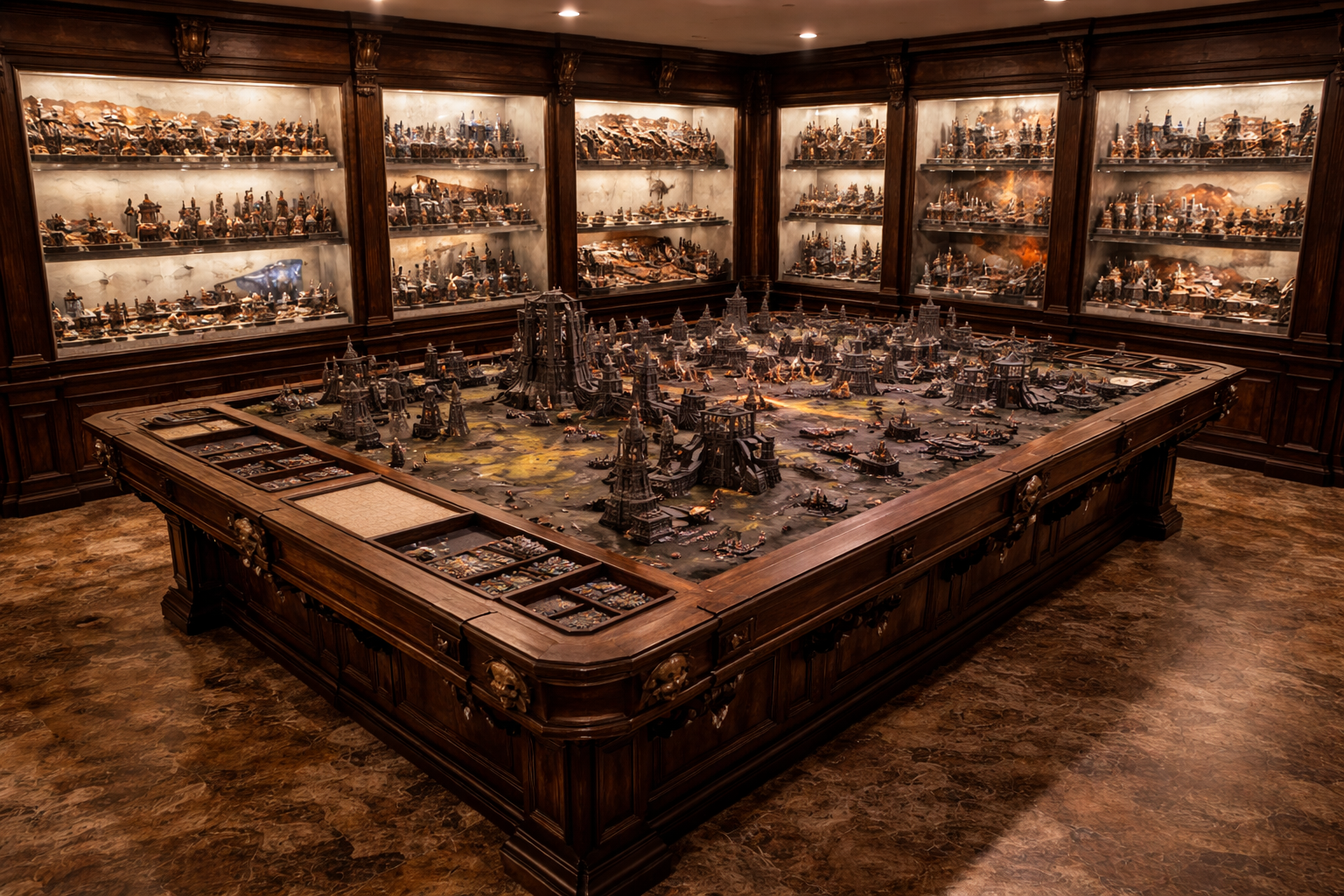
Then, as with the D&D chamber, the edges began to fray. Disputes over codex updates. Complaints about strict scheduling. Subtle resentments over the surveillance cameras he claimed were for security. Attendance thinned. One by one, the regulars found other venues—smaller tables, less oversight, more spontaneity. Within twelve months the laughter faded, leaving only the low hum of ventilation and the faint smell of lacquer.
Now the Warhammer room sits in a strange half-life. The battlefield remains assembled, frozen mid-campaign: a Titan poised in permanent stride, a squad locked behind ruined gothic arches. Dust gathers invisibly thanks to the filtration system, but the absence is palpable. Along the walls, storage boxes have encroached—archived sponsor banners, unopened survival rations, spare HVAC components, crates of promotional pamphlets. The oak table, once the pride of the underground, is too large to extract intact. The reinforced legs were bolted before the final concrete pour; the doorway clearance is insufficient. To remove it would require dismantling the staircase or sawing the table into sections.
He has stood there more than once with a tape measure, calculating angles, muttering about resale value and depreciation. eBay has been considered, photographed in drafts that were never posted. The logistics defeat him. To cut it apart would feel like admission of error. To leave it in place feels like silent indictment. So it remains, an opulent relic of a brief golden year when the bunker was not only a fortress but a forum.
The waste is not financial, though the numbers are staggering; it is spatial, emotional. Square footage devoted to imagination now stores unopened boxes of things meant to preserve reality. The LED strips still function. The glass cases still gleam. But the room is a museum of an enthusiasm that burned hot and brief. Billy-Ray sometimes pauses at the threshold, hand on the carved oak, and tells himself that trends cycle, that players may return, that preparedness includes patience. The table does not answer. It simply waits, too grand to remove, too heavy to ignore, occupying its concrete chamber like a monument to escalation.
2016

By the time Billy-Ray found himself standing shoulder to shoulder in a sea of red caps and stadium lights, he felt something he hadn’t felt in years: uncomplicated belonging. The bunker had been a project. The garage had been a statement. The Warhammer room had been a season. But this—this was a crowd moving in rhythm, chanting in unison, waving flags like synchronized swimmers of patriotism. It wasn’t concrete. It wasn’t steel. It was noise and heat and conviction.
He wore the cap like it had been waiting for him.
He was heavier than he’d been in his thirties, yes, but he carried it like ballast—solid, immovable, planted. When the candidate’s voice rolled through the speakers, Billy-Ray didn’t hear policy bullet points. He heard validation. He heard someone saying the country was still salvageable, still great, still worth fortifying—not underground, but out loud.
Evelyn stood beside him, hand on his side, half steadying, half claiming her place in the photograph that would inevitably be taken. She had seen all the phases: the first rusting container, the five-bunker expansion, the LED-lit Titan of Warhammer glory. She had watched his enthusiasms bloom and fade. This one felt different. This one didn’t require excavation. It required applause.
When he raised his fist, it wasn’t in anger. It was release. The years of reading headlines in isolation, of calculating threat models, of measuring sump pump output and battery redundancy—those were solitary rituals. This was collective. The chant rolled across the crowd like weather, and for once he was not preparing for a storm; he was inside one, but it was electric instead of ominous.
After the rally, they sat in the truck in the parking lot for a moment longer than necessary. The air smelled like spilled soda and hot asphalt. He was flushed, breathless, grinning. Evelyn adjusted the rearview mirror and said, softly, “You look happy.”
“I am,” he said, and meant it.
In the weeks that followed, something shifted. The bunker didn’t disappear. The garage didn’t retract. But they were no longer the only vessels for his energy. He started attending meetings above ground—volunteer committees, local organizing efforts, voter registration drives. He talked less about looting bands and more about school boards. He still believed in preparedness, but it was civic now, not subterranean.
He invited Tyrone to a town hall instead of the sauna one Thursday. They debated, laughed, disagreed without rupture. The pool downstairs hosted a Fourth of July barbecue that felt celebratory instead of defensive. The Warhammer room remained mostly untouched, but it no longer felt like a mausoleum. It felt like a chapter.
Billy-Ray had always needed projects. Concrete had been one. Miniatures had been one. Now momentum was his project. He printed yard signs instead of bunker schematics. He organized potlucks instead of survival drills. The energy that once flowed into reinforced doors flowed outward into conversations.
He still wore the cap sometimes. Not every day. But when he did, it was less armor and more emblem.
For the first time in a long time, Billy-Ray felt as though he was not bracing against the future but stepping toward it, one rally, one handshake, one hopeful chant at a time.
2017
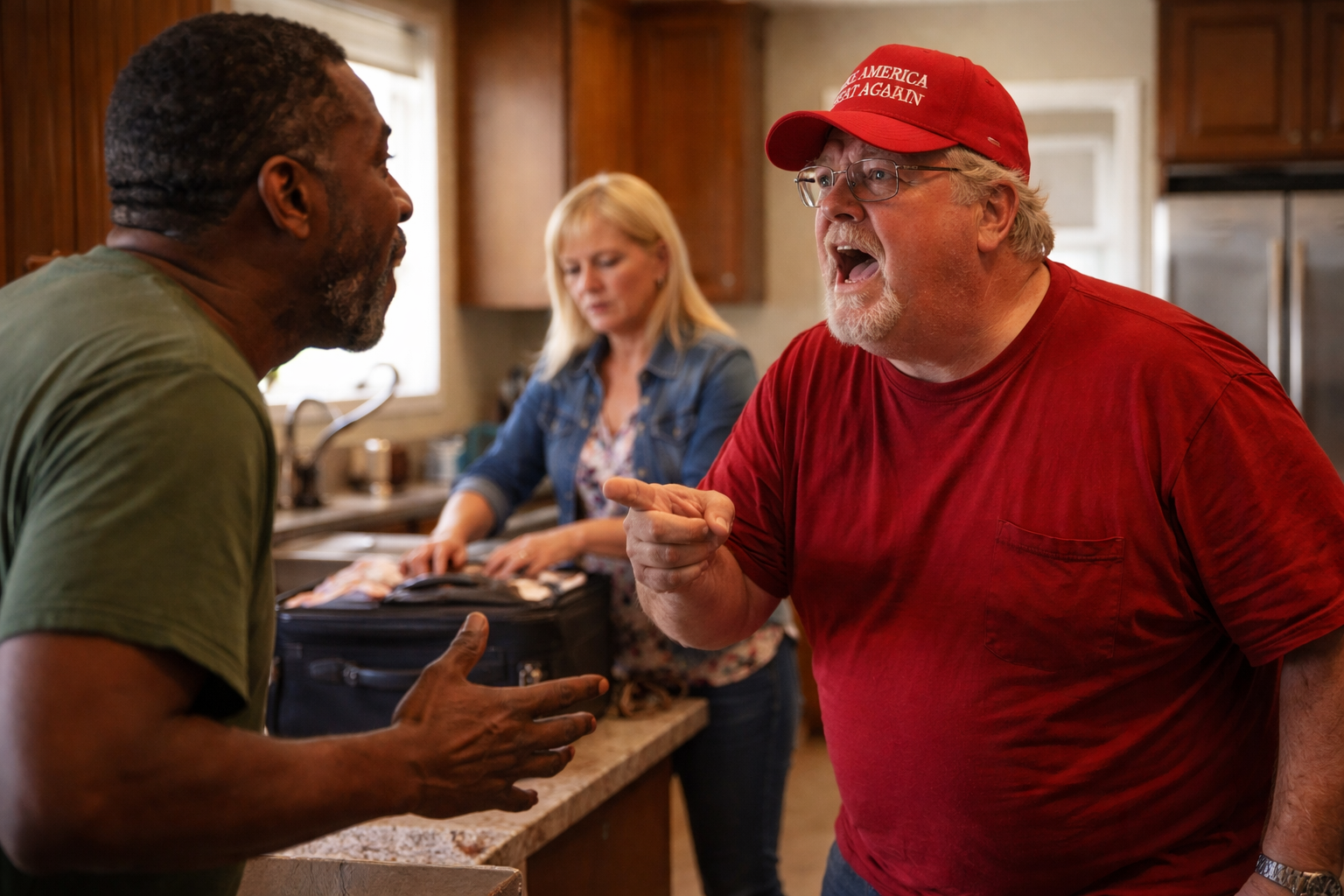
It didn’t happen in a blaze. It happened in a kitchen.
The argument with Tyrone began the way most of their disagreements did—half banter, half heat—two men who had once sweated through deadlifts and fishing trips now circling each other with words sharpened by years of news cycles. Billy-Ray had come back from another rally energized, talking fast, voice louder than he realized. He wasn’t describing policy; he was describing betrayal—how the country had been hollowed, how enemies were not just external but institutional, how you couldn’t trust anything anymore.
Tyrone leaned against the counter, arms crossed, listening at first. Then he started asking questions. Not aggressive ones. Clarifying ones. “Who’s ‘they’ exactly?” “What do you mean by ‘taken from us’?” “When did you decide everyone’s the enemy?”
Billy-Ray didn’t hear questions. He heard dismissal.
The shift was small and immediate. His tone hardened. He invoked crime statistics. He invoked borders. He invoked cultural decay. He invoked phrases he’d repeated so often they felt like scripture. He said, “You of all people should understand.” It was meant as solidarity. It landed as condescension.
Tyrone’s jaw tightened. “Understand what, Bill? That you’re scared? Or that you’re starting to see ghosts where there are just people?”
The word scared detonated something.
Billy-Ray pushed back from the table so hard the chair legs scraped like a warning siren. He accused Tyrone of being naive. Of ignoring the signs. Of turning soft. He talked over him. He jabbed a finger in the air, as if pointing toward an invisible horizon only he could see. The bunker became proof. The garage became proof. The headlines became proof. “I’m not crazy,” he snapped. “I’m prepared.”
Tyrone stepped closer, not aggressive, just firm. “Prepared for what? For me?”
That question landed differently. It sliced through the rhetoric. For a second, there was only the hum of the refrigerator and the faint echo of their raised voices against tile.
Billy-Ray’s face flushed deeper. “Don’t twist this,” he said, but the volume had dropped. The fury had turned inward, jagged and unstable.
Evelyn had been standing in the doorway the entire time.
She had watched the escalation like someone watching a storm you’ve seen form too many times before. The bunker phase. The Warhammer phase. The rally phase. Each one beginning as enthusiasm and ending in defensiveness. But this was different. This wasn’t a hobby argument. This was a fracture.
“Bill,” she said quietly.
He didn’t turn at first.
“Bill,” she repeated, sharper now.
When he finally looked at her, his expression was still hot, still convinced of its own righteousness. He expected reinforcement. Or at least neutrality.
Instead, he saw exhaustion.
“You’re yelling at your friend,” she said. “You’re yelling at the one person who’s never left.”
That hit harder than Tyrone’s questions.
The room felt smaller. The kitchen, once the staging ground for barbecue planning and holiday prep, felt like a courtroom.
Tyrone stepped back. “I’m not your enemy,” he said. “But you’re acting like you need one.”
He grabbed his keys. No dramatic exit. Just a shake of the head and a door closing with too much finality.
Billy-Ray stood there, breathing hard, chest rising under the tight red shirt he still wore like a uniform. He wanted to chase him. To say something restorative. Instead, he muttered about respect. About loyalty. About not being understood.
Evelyn walked past him, not angrily, not theatrically. She went to the bedroom. A suitcase appeared. The zipper sound was unbearable in its ordinariness.
“What are you doing?” he asked, the anger suddenly thin.
“I’m tired,” she said. “I’m tired of living in a fortress. I’m tired of every conversation being a battle. I’m tired of you needing the world to be collapsing so you can feel right.”
He tried to argue. The words came out tangled, defensive, loud. She didn’t match the volume. That was worse.
“This isn’t about politics,” she said. “It’s about you. You don’t look happy anymore. You look hunted.”
The house—above ground, no reinforced doors, no climate control hum—felt unbearably exposed. The bunker below had walls feet thick, but up here, the air was fragile.
She wheeled the suitcase past him.
For the first time in years, Billy-Ray didn’t know what to fortify.
The door closed.
And the house, suddenly, was very, very quiet.
2019
2020
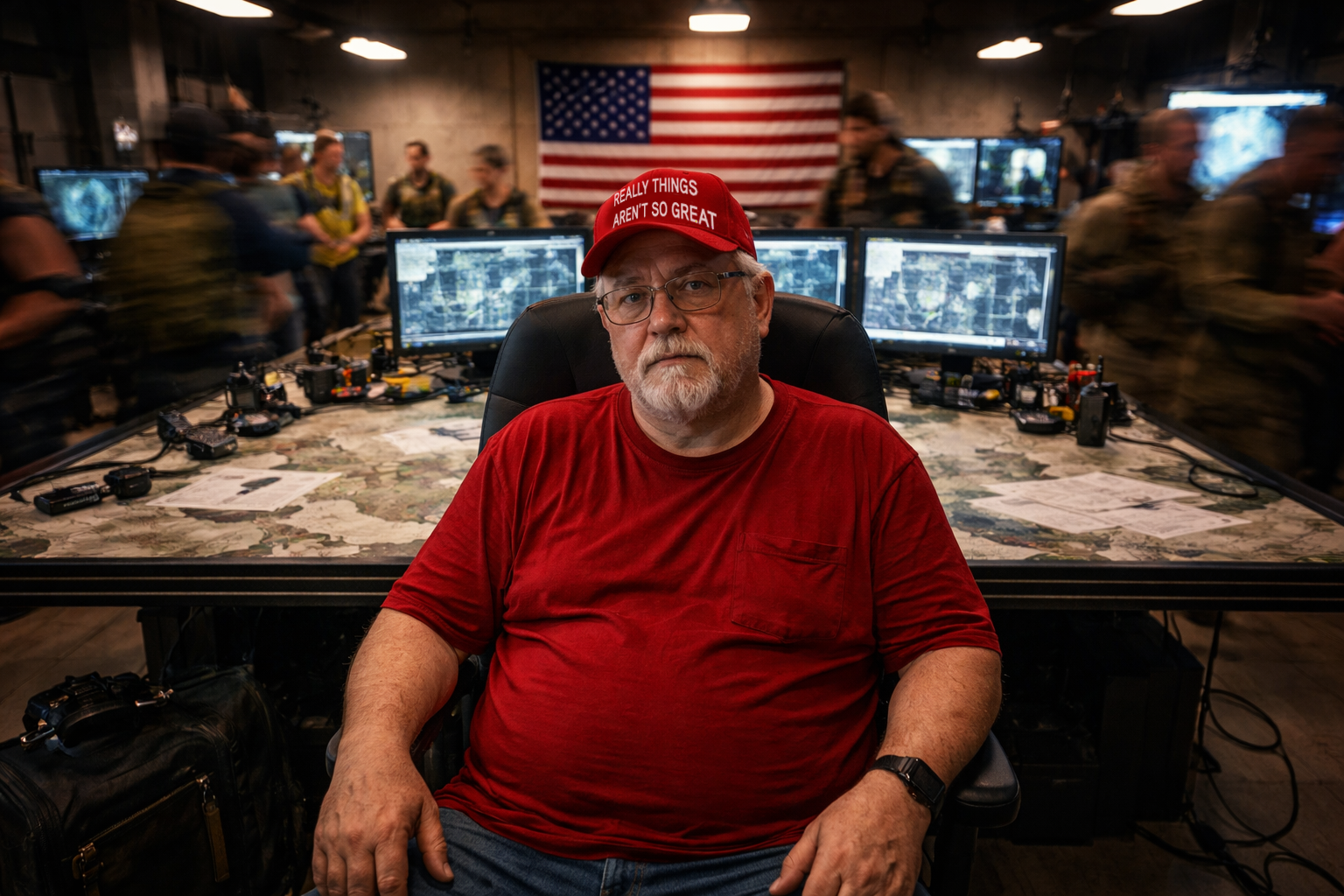
In the spring of 2020, when the roads thinned and the sky felt too large over an emptied town, Billy-Ray’s underground complex acquired a second life. The sponsorship contracts, once glossy and promotional, thinned by half as marketing budgets contracted. His company lost a quarter of its service volume almost overnight as customers postponed upgrades and deferred maintenance. And yet the bunker, which had always been a monument to anticipation, found itself newly relevant. A different quarter of its vitality came from a movement of neighbors, volunteers, activists, church members, and aggrieved citizens who needed a place to gather when gathering itself felt forbidden. The structure, engineered for continuity, became a refuge for continuity of voice.
He did not frame it as defiance. He framed it as ventilation for the soul. People arrived in small clusters, masks tucked under chins, then over mouths, then lowered again when conversation grew animated. They stood in the broad, empty concrete chambers that had once been Warhammer cathedrals and parish halls and found that the acoustics lent their frustrations an echo. There were folding chairs set six feet apart, then closer, then moved again depending on who was speaking. The filtration systems hummed with the steady confidence that had once made Billy-Ray wealthy. He gestured toward the air intakes as if to reassure everyone that they were safe, that his competence extended even to the invisible.
Anger over the virus, over mandates, over closures and news cycles and shifting guidance, needed somewhere to condense. The bunker gave it architecture. It was a place where people could say what they were thinking without feeling judged by the grocery store aisle or the parish bulletin. In the large central chamber, with its exposed concrete ribs and industrial lighting, they spoke about small businesses closing, about grandparents isolated in care facilities, about children staring at screens instead of playgrounds. Some spoke about liberty, some about fear, some about distrust. The bunker did not argue back. It received their words and held them.
Billy-Ray became, almost by accident, a facilitator. He knew how to run systems. He knew how to allocate space. He knew how to manage flow. If the first year of the pandemic felt like drift to many, to him it felt like activation. His infrastructure, once speculative, was now functional. He fielded calls from organizers who needed a venue. He coordinated schedules. He unlocked blast doors and checked pressure gauges. He stood at the base of the concrete staircase as people descended and felt, perhaps for the first time in years, that his preparation had social consequence.
There was relief in that. After the arguments with Tyrone, after the thinning of sponsorships and the emptying of gaming tables, he had feared irrelevance more than collapse. Now relevance returned in a different form. He listened to speakers at a makeshift podium beneath ductwork and floodlights and nodded. He did not always agree with every word, but he understood the tone: a mix of grievance and longing, a desire to feel seen by a system that seemed to speak in contradictions. The bunker became a freehaven not because it was sealed but because it allowed intensity without immediate reprisal.
And yet, even in that moment of communal validation, something subtle began to narrow. Digging in, which had once been a practical posture, deepened into an emotional stance. The more people came to the bunker to speak about the world outside, the more the world outside seemed hostile by contrast. The air underground was filtered, conditioned, regulated. The air above ground felt contaminated with mixed messages and unpredictable rules. Digging in no longer meant merely adding concrete; it meant anchoring belief. To dig in psychologically is to commit not only to a position but to the identity that flows from it. Billy-Ray’s sense of self braided more tightly with the structure he had built and the gatherings it now hosted.
Siege mentality crept in not with banners but with language. Words like “they” and “out there” floated through conversations, sometimes casually, sometimes sharply. In times of uncertainty, it is comforting to imagine that confusion originates somewhere specific. It gives shape to chaos. In the bunker, stories of inconsistency in policy, of perceived overreach, of economic harm, formed a narrative of encirclement. To feel under siege is to feel morally awake. It carries a strange dignity, as if endurance itself is virtue. Billy-Ray did not wake up deciding to view the world as hostile; rather, the repetition of grievance in a protected space gradually lent that interpretation solidity.
He remained capable of kindness. He still called customers to check on their families. He still waved to neighbors across lawns. But inside the bunker, the tone intensified. A place built for continuity became a place for consolidation. Siege mentality is seductive because it simplifies. It reduces ambiguity to allegiance. It suggests that if one fortifies sufficiently, one will outlast the confusion. The bunker’s thick walls seemed to affirm that philosophy. Concrete does not debate; it endures.
Bunker mentality followed like a shadow. To prefer the underground space was not merely to prefer safety but to prefer coherence. Outside, stores enforced changing rules; news anchors contradicted one another; familiar routines dissolved. Inside, there were schedules, air exchange rates, known faces, shared vocabulary. When the outside world becomes unpredictable, the mind seeks predictability, and if predictability exists in a sealed chamber, that chamber begins to feel like the truest environment. It is easy to mistake the reduction of sensory and social complexity for clarity.
Billy-Ray did not consciously choose withdrawal. He still slept upstairs. He still tended the lawn. But his emotional center of gravity shifted downward. When tension rose at home, he descended. When arguments flared online, he invited people to speak in person beneath the soil. The bunker soothed him, not because it denied reality but because it organized it. He could point to ducts and doors and say, “This is solid.” The solidity became metaphor.
Externalizing, in such a context, is less an act of blame than a redistribution of discomfort. The pandemic was frightening, economically destabilizing, and socially isolating. To sit with that vulnerability is hard. To locate the discomfort in external forces—bureaucracies, media narratives, abstract “systems”—is easier. It transforms diffuse anxiety into focused indignation. Billy-Ray found himself speaking less about his own worry and more about institutional failure. It felt braver to critique than to confess fear. The bunker gatherings encouraged that orientation; shared outrage bonds quickly.
Still, he was not a caricature. There were nights when, after the last folding chair had been stacked and the last argument quieted, he stood alone in the central chamber and felt the hum of the ventilation system like a pulse. He thought of Tyrone. He thought of Evelyn’s tired eyes. He thought of the children who had once splashed in the indoor pool under artificial palms. The anger in the bunker was not pure. It was threaded with grief, with loneliness, with the ache of rapid change.
Tunnel vision arrived gently, like a narrowing corridor. It is not blindness but focus hardened into exclusivity. When one spends enough time interpreting events through a single lens—threat, overreach, encroachment—that lens becomes habitual. Other interpretations do not vanish; they simply feel less urgent. Billy-Ray began to interpret new information as confirmation of what he already believed. It was not that he refused evidence; it was that evidence was filtered through an existing frame. The bunker’s filtration system became an unintended metaphor for his cognition.
Tunnel vision offers relief because it reduces cognitive load. In a year saturated with data, infection curves, policy shifts, and personal stories, narrowing one’s field of view can feel like sanity. But the cost is peripheral awareness. Nuance fades first, then empathy for those who interpret differently. Billy-Ray still loved his friends, but he found it harder to sit in conversations that did not orbit the themes that had taken root underground. He did not see himself as closed; he saw himself as consistent.
What makes such a phase tragic is not malice but rigidity. Billy-Ray was a man who built things to feel stable. He built bunkers, garages, rooms, communities. In 2020, when the world wobbled, he offered what he knew: structure. People came, spoke, vented, organized. In that sense, the bunker truly was a freehaven. It allowed expression when other venues felt constrained. It provided solidarity in a time of fragmentation.
But the same walls that protect can isolate. The same certainty that steadies can calcify. Digging in, when it becomes perpetual, turns ground into trench. Siege mentality, when sustained, transforms neighbors into potential adversaries. Bunker mentality, when preferred to daylight, shrinks the range of tolerable difference. Externalizing, when habitual, displaces the tender work of mourning and adaptation. And tunnel vision, when unexamined, makes even expansive chambers feel narrow.
If there is gentleness in this story, it lies in recognizing that Billy-Ray’s trajectory is not alien. Many people, in that year, sought smaller worlds they could control. Many found communities that amplified their strongest emotions. Many mistook coherence for truth because truth itself felt unstable. Billy-Ray’s bunker was an exaggerated version of a universal impulse: to make the uncertain solid.
The question, always, is not whether to build but how to remain porous. Whether the blast doors can open without feeling like surrender. Whether the ventilation system can admit not only filtered air but differing perspectives. Whether digging in can coexist with stepping out. Billy-Ray, standing in the dim light beneath his house, was not beyond redemption nor beyond reflection. He was a human being who had mistaken fortification for resolution, and who might yet discover that the deepest reinforcement required was not concrete but flexibility.
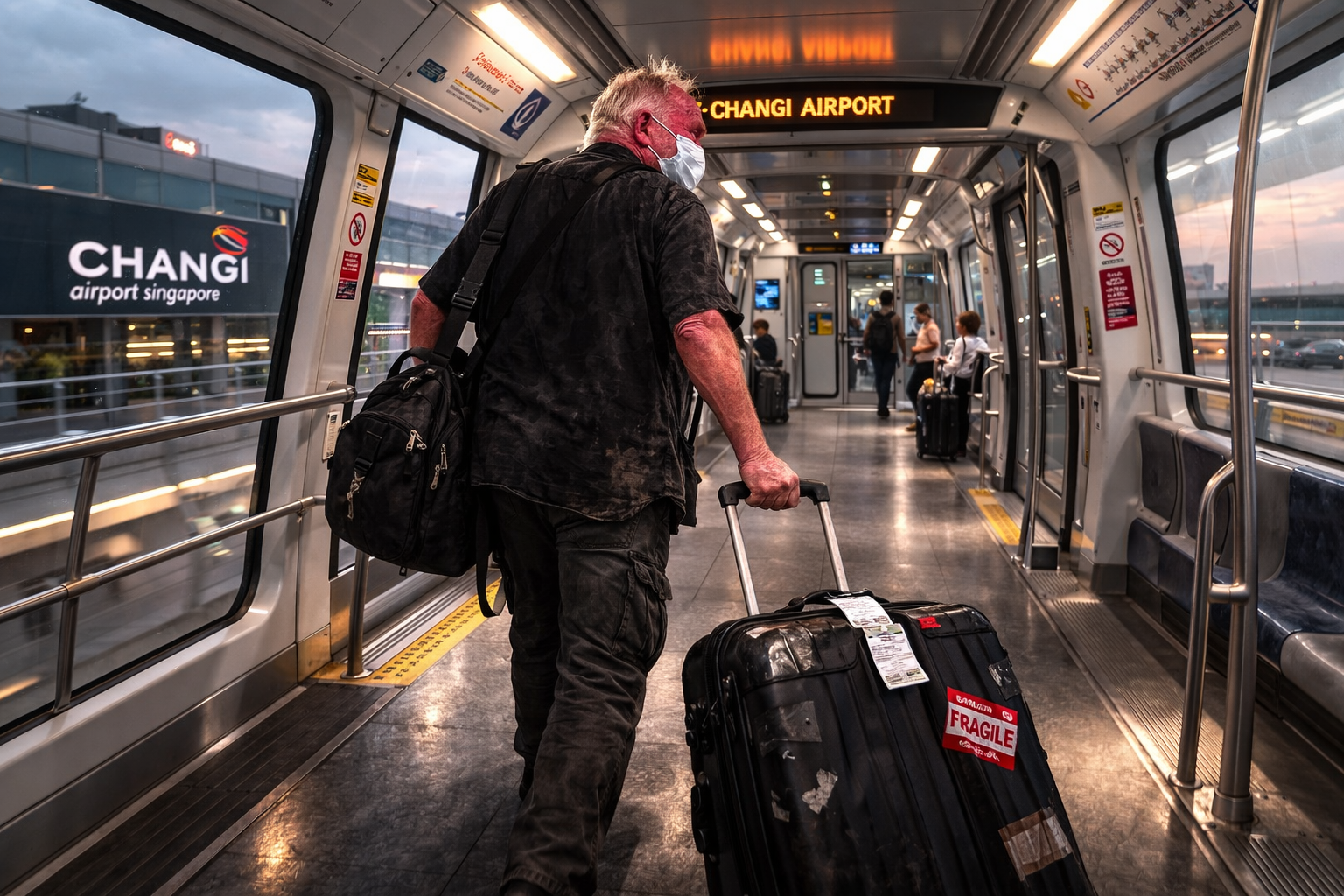 The flight felt like disassembly. Each mile of altitude and distance loosened a strand of tension. The ocean from above was unstrategic, blue without agenda. He arrived in humid air that clung without malice. Cebu did not care about his bunker. The dart had landed in the middle of the southern island, so it took a lot of walking and taxi’s. He ate grilled fish and mangoes that required juice to run down his wrists. The sun set without commentary. The first week was not transformative. His body still flinched at coughs from strangers. He still checked headlines compulsively. He still imagined symptoms. But there was no concrete ceiling above him to amplify the echo. The air moved. The sound of waves did not hum with mechanical constancy. After an indeterminate series of days he landed in a town near Osmenja peak, and there was this heat wave and it was so hot he could barely breathe.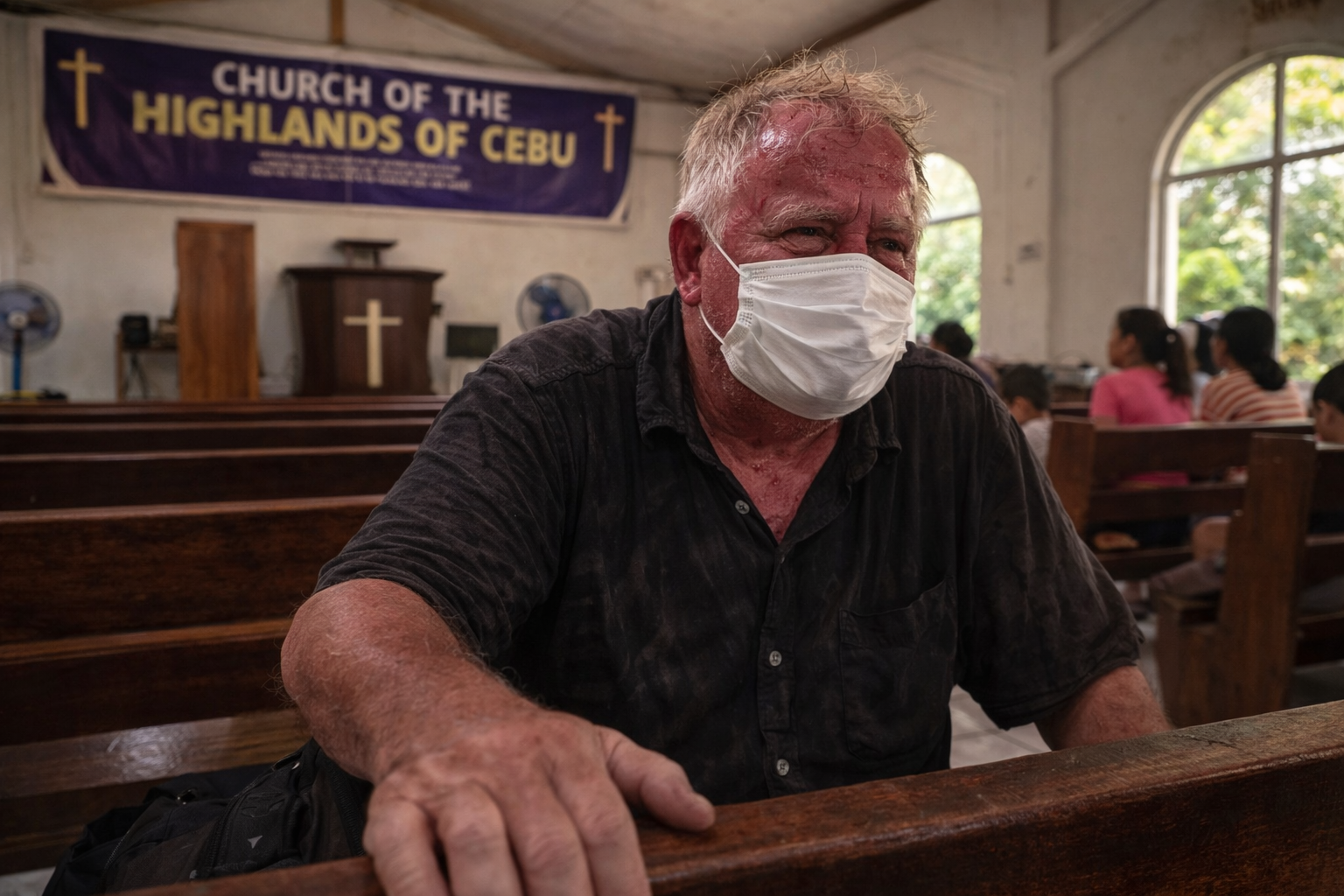
HEAT DEATH OF An AMERICAN
A Comedy in Several Humiliating Acts
(Now with Clinical Oversight)
INT. CHURCH OF THE HIGHLANDS OF CEBU — SUFFOCATING O’CLOCK
The fan oscillates.
Left.
Right.
Left.
Right.
Billy-Ray’s entire spiritual existence is tethered to that arc of mercy.
Left—ah. A draft. Civilization.
Right—no. No. Come back. I repent. I will tithe. COME BACK.
He has been sitting in this pew for what feels like the collapse of several empires. He weighs, conservatively, the moral equivalent of a defensive lineman and a regret. He is wearing black. A black shirt. Cotton. Purchased voluntarily at 8:12 a.m. this morning.
He entered this church because it had a roof.
That is the entire theology.
His mask is still on, because discipline. Because habit. Because Texas. It has become a personal sauna strictly for his face.
The congregation appears perfectly comfortable. This feels suspicious.
A child in the pew ahead turns around.
The child studies him the way one studies a volcano that has decided to attend Sunday service.
Billy-Ray raises one finger in greeting.
“…hey.”
The child points at his forehead.
Billy-Ray’s forehead is the color of a stop sign that has entered litigation with a lobster.
“Yeah,” Billy-Ray says. “I know.”
And then —
Tagalog enters.
She does not so much walk in as arrive.
148 centimeters of unapologetic authority. Late-term pregnant in a way that suggests gravity personally negotiated with her. She carries a hymnal and the gaze of someone who has worked emergency medicine long enough to know the difference between drama and danger.
She stops.
She tilts her head four precise degrees.
“American?”
Billy-Ray tries to straighten.
“…yes ma’am.”
She flips into exaggerated clarity-mode accent — not because she needs it, but because she enjoys the performance.
“OKAY. First thing. You sit backwards in pew. You face altar. Because that is where God is. You currently showing God your back like He insulted you.”
“I was just— the fan—”
“Second thing. Why you here. Hot season. Highlands. WHY. Every taxi driver in this province is asking: is he stupid, is he CIA, is he oil. Because no normal human being come here now unless they have a secret plan.”
“I just wanted to see the—”
“Third thing.”
She leans in.
Professional sniff.
Her nurse brain clocks the scent of cortisol, salt, and two years of unprocessed apocalypse.
“You smell like anxiety wearing a dead bird.”
Billy-Ray opens his mouth.
“In church,” she continues calmly, “you come washed. Even the goats outside smell better. The goats have no soap. What is your excuse.”
He sways.
Four inches to the left.
Her hand is on his arm before physics completes the thought.
“Oh no,” she says quietly, now fully Bronx ER, no theatrics. “You are not dying in my mother’s church.”
“…yeah,” Billy-Ray agrees gently.
“You are not.”
“I weigh—”
“I know how much you weigh. I have lifted worse. Come.”
EXT. TAGALOG’S GARDEN — MOMENTS LATER
The garden is a narrow riot of green behind a concrete house.
Flowers. Vegetables. Laundry. Hose. Eleven children materialize as if summoned by the gravitational disturbance of a sweating American.
They form a semicircle.
They assess.
“Kuya Ray,” Tagalog announces. “He is overheating. We repair.”
This is apparently sufficient explanation.
Billy-Ray is lowered into a plastic chair that audibly questions its life decisions.
“Shirt off,” Tagalog says.
“…excuse me?”
“You are heat-stressed. Shirt off. Medical order.”
He hesitates.
The eleven children do not blink.
He removes the shirt.
Collective intake of breath.
One child whispers something in Cebuano.
“She says you are very pink,” Tagalog translates. “Like lechon that forgot to finish cooking.”
“Fantastic.”
The hose appears.
“This will be cold.”
“Let’s maybe—”
The hose has no patience for negotiation.
The water hits him.
Billy-Ray emits a sound that linguistics departments will one day classify as a new dialect of panic.
Three children fall over laughing. The toddler applauds.
Tagalog remains professionally composed, rotating the spray methodically.
“Breathe,” she commands.
“I AM—”
“You breathe like a dog locked in truck. Through nose. Slow.”
She studies his pupils. His skin. His responsiveness.
“Not stroke,” she murmurs. “Just deconditioned Texan.”
She hands him a cup.
“Drink.”
“What is it?”
“Coconut. Ginger. Salt. And shame.”
He drinks.
“…what does shame do?”
“Improves circulation.”
LATER — SHADE STRUCTURE, IMPROVISED
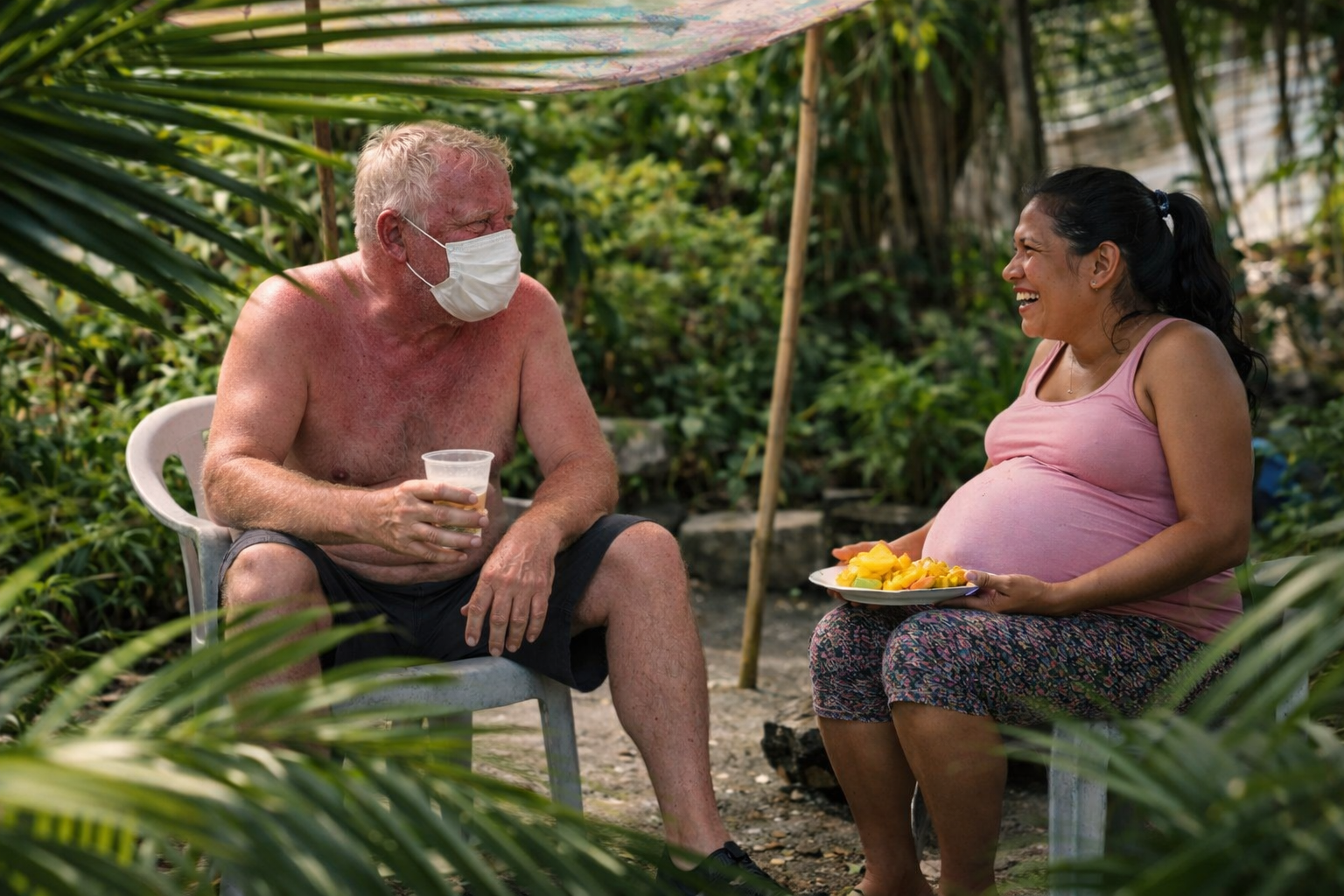
Billy-Ray now sits under a bamboo-and-tablecloth canopy assembled by children who operate like a crisis response unit.
A small dog has claimed his foot.
He has regained partial humanity.
Tagalog sits opposite him on an overturned bucket, eating mango.
“You are nurse?” he asks.
“Bronx-Lebanon. Twelve years. ER. Trauma. Respiratory. Panic men exactly like you.”
“…like me?”
“Men who think fear is strategy.”
He exhales.
“I thought I was going to die.”
“Yes,” she says simply. “You practiced dying for two years. Body listened.”
He stares at the leaves above.
“I built things,” he says.
“I know,” she replies. “Americans always build when they are scared. Very impressive. Very loud. Very unnecessary sometimes.”
He laughs weakly.
The children have now decided he is harmless and are showing him beetles.
“This one safe?” he asks.
“Yes. Shiny ones no. Dull ones yes. Same rule for people.”
He absorbs that.
“Why do you fake the accent?” he asks gently.
She grins.
“Because Americans listen better when they feel slightly confused.”
He nods.
“That tracks.”
She points her mango fork at him.
“Next time,” she says calmly, “white shirt. No mask in open air. More water. Less apocalypse. And face forward in pew. You are not on guard duty.”
He looks toward the church.
The fan inside still oscillates.
Left.
Right.
But for the first time that day, he is not timing his survival to its rotation.
He is sitting in a garden.
In Cebu.
Half-naked.
Cooling down.
Alive.
And mildly supervised.
This, Billy-Ray would later write, was the first time in years that someone corrected him without trying to conquer him.
And the first time the correction worked.
2022 – 2024
Opening Up
Billy-Ray never experienced it as a scam. The word never even fit the shape of what happened. To him it was an arrangement in the oldest sense of the term, an agreement between adults who understood that life does not always hand you romance wrapped in violins and filtered light. Sometimes it hands you survival, logistics, paperwork, and a chance. He had spent years believing the world was a hostile place that required fortification. Luz had spent years learning that love does not protect you from loss. When they met, neither of them was naive, and that was precisely why it worked.
Luz had married young, in a union arranged in the practical way families sometimes arrange things: introductions, conversations, time to consider, no coercion, no spectacle. She had loved her husband with a steadiness that frightened Billy-Ray the first time he understood it. The love was not theatrical; it was proven in daily effort. He had been a good man, the best kind of good man, the kind who woke up and tried. When he died, there was no moral lesson to extract from it. He had not been reckless. He had not been cruel. He had simply been unlucky. The unfairness of it lodged in Luz’s throat so tightly that even years later she could barely describe the moment without her body locking against the memory. Tagalog once explained it bluntly: he tried his best, and he got unlucky. There was no villain, no grand explanation, just absence.
That left Luz at forty with three children and a profession that demanded she be strong even when she was not. In the cardiac emergency room she was precise and unshakeable. She knew how to read monitors, how to anticipate a crash before it arrived, how to keep her voice level while families disintegrated in front of her. At home she moved more quietly, conserving energy, braiding hair, packing lunches, paying bills, making grief small enough to step around. She was shy in social settings but formidable in crisis, a woman who did not perform resilience but practiced it daily.
Billy-Ray arrived in her life not as a knight but as a man who had exhausted himself building defenses against a catastrophe that never fully materialized. He was wealthy, yes, and structured, and capable of large gestures. He was also lonely in a way that had become architectural. He had built rooms underground to protect himself from imagined futures, and yet he could not protect himself from his own pulse. Tagalog saw it immediately. She evaluated him with the cool pragmatism of someone who has watched too many people spiral because no one intervened at the right time. She did not see a savior for her sister; she saw a possibility. She saw a man who could provide stability and who, beneath the bluster, still possessed the capacity to listen.
The introduction was not romantic. It was deliberate. There was dinner, and conversation, and careful observation. Luz did not flirt. She did not perform vulnerability to attract him. She watched him with the caution of someone who had once trusted completely and paid dearly for it. Billy-Ray did not dominate the table, did not try to impress with money or stories of past achievements. He listened more than he spoke. He laughed when Tagalog teased him. He did not recoil from the presence of children, nor did he treat them as decorative obstacles to adult conversation. He noticed how one of them leaned into Luz without asking permission, and something in his chest softened.
What followed was not passion in the cinematic sense but negotiation in the mature one. They spoke about visas, about schooling, about insurance, about how one blends two households that were formed under entirely different circumstances. Billy-Ray did not promise romance; he promised provision. Luz did not promise adoration; she promised steadiness. When she asked whether he would be kind to her children even when he was afraid, the question was not rhetorical. It was the central clause in the contract. His answer, that he would try, was imperfect and therefore believable. She did not need perfection. She needed honesty.
The pregnancy that followed did not ignite scandal or suspicion. It accelerated decisions that were already in motion. Billy-Ray did what he understood best when faced with responsibility: he calculated. He contacted lawyers and accountants, structured trusts, arranged medical coverage, secured legal pathways. It was not romantic, but it was serious. Luz watched not for extravagance but for consistency. She wanted to see whether his resolve lasted past the first rush of novelty. It did. They married in Manila after the practical matters were settled, not because the money defined the union but because clarity did. In their world, preparation was not cynicism; it was respect.
What moved Billy-Ray most was not possession but coexistence. Luz did not erase her late husband from the narrative of her life, and Billy-Ray did not demand that she try. The photograph remained where it had always been, and he left it there. He understood something about men who try their best and lose anyway. He did not compete with a ghost. He built alongside it. In turn, Luz did not ask him to dismantle the parts of himself shaped by fear. She treated his anxiety as she treated a patient in distress: observe, stabilize, intervene gently. She did not ridicule his bunker stories; she reframed them. She did not mock his vigilance; she softened it.
If anyone could heal Billy-Ray’s aching heart, it was not through dramatic declarations but through rhythm. Meals eaten at predictable hours. Children’s laughter reverberating through hallways. The quiet choreography of shared responsibility. He had spent years constructing walls to keep disaster out, only to discover that what quieted him was not thickness of concrete but the sound of life continuing. Watching Luz braid her daughter’s hair did more for his pulse than any reinforced door ever had. Holding a child who fell asleep against him without hesitation undid him more completely than any political speech or panic attack.
It was never about rescue. Luz did not need saving from poverty or from her past; she needed partnership in the present. Billy-Ray did not need to be admired; he needed to be useful in a way that did not require perpetual vigilance. What they formed was not a fairy tale but a structure sturdy enough to carry grief without collapsing under it. Tagalog might have described it as a successful merger, but what she truly monitored were the vital signs. Were they stable? Were they improving? Were they sustainable? In time, the answers were yes.
2026
There is something that happens to things buried too long. Metal left underground corrodes even when it was forged to endure. Wood sealed in darkness grows brittle. Air that does not move becomes stale and then foul. Even water, when trapped in a chamber without flow, loses its clarity. It thickens. It stagnates. It forgets what it was for. We like to imagine that concealment preserves, that what we lock away will remain unchanged, waiting patiently for our return. But the truth is that hiding alters what is hidden. It hardens edges. It amplifies distortions. It breeds ghosts.
The same is true of people.
There are seasons when retreat feels necessary, even wise. When the world appears chaotic or threatening, the instinct to dig in is not irrational. It can be protective. We pull inward to conserve strength. We close doors to guard what is fragile. We store provisions of certainty in sealed containers so that doubt cannot contaminate them. Sometimes this is survival. Sometimes it is healing. But sometimes, slowly and without our noticing, it becomes calcification.
Things locked in holes in the ground do not breathe. They do not stretch. They do not receive correction from sunlight or air. They exist only in the environment of their own containment. Ideas do the same. Grievances do the same. Fears, when rehearsed without interruption, grow more intricate and more convincing. Without exposure to friction from the outside world, they become self-reinforcing systems. The mind, left alone with its worst predictions, begins to treat them as history.
On a personal level, this can look like illness disguised as discipline. We call it vigilance. We call it preparedness. We call it clarity. But beneath those names there is often a narrowing. A contraction. We stop asking whether our assumptions still serve us. We stop testing whether our fears still match reality. We stop noticing that the air has grown thin.
There are things that belong underground for a time. Seeds require darkness before they sprout. Wounds sometimes need quiet before they can scar properly. Reflection demands solitude. But darkness is not a permanent habitat. It is a stage. And when the stage becomes the home, something in us begins to stiffen.
It is not only individuals who calcify. Communities do. Nations do. Entire cultures can begin to hoard grievances like relics. Stories are told and retold in sealed chambers until they lose proportion. Memory becomes myth, myth becomes doctrine, and doctrine becomes a barricade. Beneath the surface, resentments accumulate like pressure in a geological fault line. From the outside, everything may appear stable. Beneath, something is tightening.
Festering rarely announces itself with clarity. It presents as certainty. It feels like righteousness. It can even masquerade as loyalty. We tell ourselves we are protecting what matters. We convince ourselves that if we loosen our grip, everything will collapse. Yet what we are often protecting is not life but a version of ourselves that once needed those defenses.
There comes a moment when what was once protective becomes corrosive. When the structures built to keep danger out begin instead to keep oxygen out. When the hole in the ground becomes less a refuge and more a tomb.
To bring something into the sun is not to shame it. It is to test it. Sunlight does not destroy what is alive; it reveals what is not. When hardened things are brought out and hosed down, they do not always dissolve. Sometimes they soften. Sometimes they regain flexibility. The process can feel humiliating. Exposure often does. What we buried with such conviction can look small when laid out in open air. What felt monumental underground can seem brittle under the sky.
But exposure is the only way to know.
We have lived through years in which many things were driven below the surface. Fear was quarantined. Anger was justified and amplified. Isolation was normalized. In private spaces, stories were curated to reinforce existing wounds. On digital platforms, grievances found communities and multiplied. What might once have been a passing irritation was given structure and repetition until it acquired identity.
Some of that was understandable. Crisis demands coping mechanisms. Shock demands retreat. But the coping mechanism can outlive the crisis. The retreat can become a habit. We can forget how to step back into the open without armor.
There is a difference between prudence and paralysis. Between preparation and obsession. Between conviction and rigidity. These differences blur when we remain underground too long. The absence of contradiction makes our own voices sound infallible. The absence of sunlight makes everything appear equally gray.
To ask whether this is what we want is not weakness. It is maturity. It is the ability to revisit earlier conclusions and say, perhaps they were necessary then, but are they necessary now? It is the courage to admit that what once felt like strength might have been fear in a more dignified costume.
When something hard is brought into the open and warmed, it does not instantly become supple. It must endure the discomfort of change. Rust flakes. Surfaces crack. Old sediment washes away in muddy streams. It can look like deterioration. But often it is simply cleaning.
The world itself feels like it has been holding its breath. Beneath headlines and rhetoric, beneath noise and posturing, there is an exhaustion. Many people are tired of living in defensive crouches. Tired of scanning for threats. Tired of rehearsing outrage. Yet fatigue alone does not guarantee transformation. It merely creates the opportunity for it.
To wander for a while without a predetermined destination can feel irresponsible in an era that prizes certainty. But wandering has always been a form of recalibration. It allows the senses to reset. It exposes assumptions to contradiction. It permits encounters that do not fit existing narratives. When we wander, we relinquish the illusion of total control and make room for surprise.
The question of whether we might conceivably want something better is not rhetorical. It requires imagination. It requires the willingness to envision a future that is not anchored entirely in defense against the past. This is difficult work. It demands humility. It demands that we loosen our grip on identities forged in crisis.
Hardness can feel powerful. Softness can feel risky. Yet flexibility is not fragility. It is resilience of a different kind. A branch that bends does not snap in the same way a rigid beam does. A mind that can revise itself does not shatter when confronted with new evidence.
On a personal level, stepping into the sun might mean admitting that the fortress we built is no longer necessary. It might mean apologizing. It might mean reengaging with people we withdrew from. It might mean allowing ourselves to be seen without the armor that once made us feel invulnerable. It can mean accepting that some of the battles we prepared for never arrived, and that the cost of perpetual readiness was intimacy.
On a collective level, stepping into the sun might mean interrogating the stories we tell about one another. It might mean recognizing that not all grievances deserve to be preserved as heirlooms. It might mean creating spaces where disagreement does not immediately escalate into existential threat. It might mean acknowledging that beneath ideological divides there are shared vulnerabilities that calcify when ignored.
Letting things open up is not the same as tearing everything down. It is a controlled exposure. A willingness to examine what we have stored. To ask which provisions are still edible and which have rotted. To discard what poisons and keep what nourishes. To rebuild not from fear of collapse but from desire for health.
Some sickness is personal. Anxiety, trauma, loss—these require care and patience. They require professional help at times, and compassion at others. Bringing them into the sun does not cure them instantly, but it prevents them from mutating in darkness. Other sickness is structural. Systems that incentivize division. Economies of outrage. Cultures of perpetual emergency. These require more than individual reflection; they require collective adjustment.
But all healing begins with exposure.
There is a risk in stepping out of the hole. The light can be blinding at first. The world is not suddenly safe simply because we leave our bunker. There are still uncertainties. There are still dangers. Yet living entirely in anticipation of them is its own form of captivity.
To ask whether this is what we want is to reclaim agency. It is to recognize that even if we did not choose the circumstances that drove us underground, we can choose whether to remain there indefinitely. It is to consider that the future need not be dictated solely by past fears.
Wandering for a while does not mean abandoning responsibility. It means testing the terrain. It means allowing ourselves to encounter alternative possibilities without immediately fortifying against them. It means rediscovering curiosity, which cannot thrive in sealed chambers.
The world has accumulated sediment. So have we. Bringing hardened things into the sun will not be tidy. There will be mess. There will be embarrassment. There will be resistance from those who prefer the predictability of darkness. Yet stagnation is not stability. It is decay postponed.
To become supple again is to remember that we are not fixed objects but living systems. We adapt. We adjust. We grow. The parts of us that hardened under pressure were once flexible. They can be again, if given warmth and time.
The invitation is not to abandon conviction but to refine it. Not to dissolve identity but to deepen it beyond reaction. Not to pretend the past did not wound but to refuse to let the wound define the entire body.
There is a moment when a buried object is lifted from the earth and placed in sunlight. It looks rough. Encrusted. Unrecognizable in places. But as water runs over it and hands begin to clean, its original shape reemerges. Not pristine, not untouched, but restored enough to be used again.
We are like that.
The time has come, perhaps, not to destroy what we built in fear, but to examine it in light. To keep what remains necessary. To discard what keeps us small. To step out from holes dug in urgency and ask whether we are ready to inhabit a wider sky.
And to consider, honestly and without defensiveness, that we might want—and need—something better than survival alone.