This is, first and foremost, a story about another Amsterdam.
Another 2026. Another Netherlands. Another Europe. Another world that once looked so much like ours that, if you were born before the middle of the twentieth century, you could almost mistake one history for the other. The same streets. The same war. The same reconstruction. The same nervous optimism. The same televisions glowing blue-white in dark living rooms. The same cigarettes, the same mopeds, the same church bells dissolving into traffic. Until somewhere around 1965 the resemblance begins to loosen, not dramatically at first, but with the quiet malevolence of a photograph developing in the wrong chemicals. Faces remain familiar. Names remain familiar. Institutions remain familiar. Yet things begin to happen that did not happen here, and things that should have ended refuse to end. The world does not break in one clean catastrophe. It bends.
The first great omen is the Moon.
The Americans reach it, but triumph turns to horror. Astronauts die there. Not in a training accident, not in some recoverable miscalculation over the Pacific, but on the Moon itself, watched by millions through signals arriving from a place no human being had ever touched before. For a brief time the entire planet experiences the same impossible knowledge: men have crossed the void and died where nobody can reach them. Their bodies remain above the world. The Moon is no longer poetry, romance, mathematics or navigation. It is a grave.
The Soviet Union answers because it must. Prestige has become strategy, strategy has become theology, and no empire can allow its rival alone to define the heavens. Soviet cosmonauts follow. Their mission fails too. Another machine strikes the lunar surface, another crew dies beyond rescue, and suddenly the race into space acquires a quality that neither Washington nor Moscow can publicly admit. Something is wrong with the future.
After that, history grows teeth.
Richard Nixon does not leave office. There is scandal, certainly. There are investigations, recordings, denunciations, constitutional crises, marches, resignations, disappearances, emergency statutes and the familiar rhetoric of preserving democracy by suspending inconvenient parts of it. But Nixon survives. He becomes something larger and uglier than a president, an architect of continuity, then a precedent. America does not become a dictatorship in the theatrical sense. There are still newspapers, elections, courts, wealthy dissenters, universities and comedians making dangerous jokes. What changes is subtler. Executive power learns that legitimacy can be stretched far past the point where everyone once assumed it would snap. It stretches again.
By the late 1960s, the United States had already begun sliding away from the political trajectory familiar to us, although very few people understood at the time that the divergence was becoming permanent. The Vietnam War did not begin winding down into withdrawal and retrospective shame. Instead it metastasized into a generational conflict. Administrations changed around it less than expected, military objectives were repeatedly redefined, and every attempt to reduce the American commitment produced some new crisis that was used to justify continuing it. The war became less a discrete campaign than a permanent organ of the state, with conscription, intelligence operations, procurement systems, allied governments, veterans’ institutions, antiwar movements and entire careers growing around it. By the 1980s there were American soldiers serving in Southeast Asia whose fathers had served there before them.
At the center of this increasingly strange American order was Richard Nixon. In the political crisis of the 1970s, Nixon did not leave office. Watergate and the surrounding constitutional scandals still happened in some recognizable form, but the institutions that, in another history, forced his resignation failed to produce the same result. Nixon resisted, survived, invoked emergency necessity, rallied enough of the security establishment and enough of the public around the proposition that removing him during wartime would be more dangerous than allowing him to remain, and gradually converted what had begun as an extraordinary constitutional exception into a doctrine of continuity. The crucial transformation was not a dramatic abolition of elections or Congress. America retained courts, newspapers, parties, governors, universities, protest movements and elections of various kinds. What changed was the presidency itself. The executive ceased to be treated as an office that necessarily turned over on schedule and increasingly became the permanent coordinating center of the state.
The process took years, which is why it endured. There was no single morning on which Americans woke to discover that the republic had vanished. Emergency measures became extensions; extensions became precedents; precedents accumulated into constitutional reinterpretations. Congress continued to fight with the White House, but increasingly over the limits of a presidency whose continuity was no longer seriously questioned. Courts issued decisions that narrowed or complicated executive authority without actually ending the arrangement. Opposition politicians promised restoration and then discovered that much of the security bureaucracy, military command structure and federal patronage system had reorganized itself around the assumption that Nixon would remain. After enough time, the abnormal became simply what government looked like.
Nixon himself changed with the office. The ambitious, paranoid politician of the early 1970s became an aging national fixture, increasingly remote but also increasingly difficult to imagine replacing. His supporters cultivated the idea that whatever his faults, he was the one man who had prevented the United States from coming apart during war, domestic unrest, economic instability and the growing collapse of confidence in institutions. His enemies regarded precisely the same history as evidence that America had allowed one man to hollow out the republic while claiming to save it. Both readings became culturally entrenched.
Vietnam was the greatest justification for continuity and the greatest indictment of it. The war dragged through the 1970s, through the 1980s and finally into the early 1990s. It changed shape many times. American troop levels rose and fell. Local governments collapsed and were rebuilt. Ceasefires were announced, violated, renegotiated and abandoned. The language of victory slowly disappeared, replaced first by containment, then stability, then honorable disengagement, then simply termination. By the end, almost nobody could clearly state what the original strategic objective had been. The war had become a historical organism feeding on its own institutions.
When the final peace was signed in 1992, Nixon himself presided over it.
The symbolism was almost obscene. The same political figure who had been associated with the escalation and prolongation of the war decades earlier was now presented as the statesman who had finally brought peace. He was an old man by then, visibly diminished, but the ceremony was designed around continuity rather than triumph. The official language spoke of sacrifice, endurance, reconciliation and the closing of a long chapter. The Vietnamese delegation faced an American president who had been part of the conflict for longer than many of them had been alive.
For Nixon’s admirers, the event became proof of historical vindication. He had stayed long enough to finish what weaker politicians would have abandoned. For his critics, it was the grotesque culmination of the system: a war prolonged for a generation partly because the political order built around it had become incapable of admitting failure.
The prolonged Nixon era also prevented the emergence of the political realignment associated in our history with Ronald Reagan. Reagan existed, certainly, but he never became Reagan in the mythic political sense. He remained an actor, governor, conservative celebrity and eventually a figure remembered mostly by specialists in late twentieth-century American politics. There was no Reagan Revolution defining the 1980s, no equivalent cultural synthesis of sunny nationalism, free-market triumphalism and evangelical confidence organized around his presidency. American conservatism developed differently under the long shadow of Nixon: more security-oriented, more bureaucratic, more pessimistic, less rhetorically optimistic and much more comfortable with permanent emergency institutions.
This also altered the economic character of the United States. The country did not experience precisely the same neoliberal restructuring familiar to us. Markets remained important, corporations remained powerful and inequality still grew, but the state retained a larger strategic role in energy, defense, infrastructure and industrial planning. The governing ideology was less “government is the problem” than “government is the fortress.” Nixon’s America became obsessed with resilience, domestic supply, strategic industries and the capacity to survive a hostile world.
That world was becoming more hostile.
The United States gradually retreated from the assumption that it could or should police the entire planet. The experience of Vietnam had not produced pacifism; it produced strategic exhaustion. Washington remained immensely powerful, but its doctrine shifted toward protecting North America, essential sea lanes, critical resource flows and selected allies rather than maintaining universal commitments. Overseas bases were reduced or consolidated. Certain alliances became transactional. Middle Eastern commitments were narrowed. The American political class became increasingly skeptical of sacrificing national stability for distant ideological projects.
Energy policy followed the same inward turn. Domestic extraction expanded, including a modest earlier push toward unconventional oil and gas development. Strategic reserves grew. Infrastructure hardened. The United States increasingly treated energy independence as a security imperative rather than merely an economic preference.
This withdrawal mattered enormously when the Soviet world later began to disintegrate.
The United States still participated in attempts to secure nuclear weapons and prevent total Eurasian collapse, but it no longer possessed either the political appetite or the ideological confidence to reconstruct Europe in its own image. American forces went east because loose nuclear arsenals threatened everyone, not because Washington intended to build a new liberal order from the wreckage. When Western, Scandinavian, Polish, Hungarian, Japanese and Chinese forces became trapped for years in the chaos of the former Soviet territories, Washington’s support was substantial but finite. The old expectation that America would simply keep pouring resources into Europe until order returned no longer held.
By then, Nixon’s central doctrine had become almost instinctive: America survives first.
This made the United States deeply resented abroad. Europeans accused Washington of retreating behind the Atlantic while the continent burned. American officials responded that Europe had spent decades expecting the United States to absorb every strategic cost generated elsewhere. The bitterness never entirely faded.
Domestically, however, the policy helped preserve the United States through the cascading disasters of the 1990s and early 2000s. America was damaged, poorer and more authoritarian than the country we know, but it remained territorially intact and retained enough industrial and agricultural depth to avoid the worst of the Eurasian famines. The government imposed rationing, strategic controls, censorship and emergency economic measures at various points, but the state itself did not collapse.
Nixon died in 1999.
By then he had occupied the American presidency for so long that an entire generation had never known another national leader. His death therefore created something closer to a succession crisis than an ordinary presidential transition. The institutions surrounding the presidency had to answer a question they had postponed for decades: was the continuity system Nixon, or had Nixon merely become the first occupant of something new?
The answer was uncomfortable.
The office survived him.
Later American leaders inherited a presidency far more powerful, permanent and security-centered than anything envisioned before the divergence. The exact balance shifted under subsequent presidents, but nobody simply restored the old constitutional culture because too many institutions had learned to function around the new one.
By 2026, Nixon has therefore become one of the great contested founders of modern America.
There are statues of him.
There are Nixon schools, Nixon highways, federal buildings carrying his name, coins and commemorative issues bearing his face, military facilities named after him and enormous archives devoted to his administration. Official histories often present him as the President Who Saved America, the leader who kept the country intact through Vietnam, constitutional crisis, Soviet collapse and the beginning of the global disasters that followed.
There are equally large communities that regard that phrase as obscene.
To them, Nixon did not save the republic. He taught Americans that the republic could be indefinitely suspended whenever the executive declared the alternative too dangerous. He transformed emergency into government and continuity into legitimacy. He made it possible for later presidents to inherit powers that would once have been considered unthinkable.
The argument remains unresolved because both sides can point to the same fact.
America survived.
The question is what survived with it.
Ronald Reagan, in this history, is barely a footnote.
Ask an educated American under forty who Reagan was and you may get an actor, a governor, a failed primary candidate, perhaps a television spokesman associated with some long-dead conservative coalition. There is no Reagan era because the political ecology that would have produced it never coheres. The great ideological repainting of the West does not occur in quite the same way. Other movements fill the space. Some are more paternalistic. Some are more militarized. Some are colder. Some are explicitly Christian. Others hide theology beneath economics and economics beneath national security. The late twentieth century becomes crowded with competing authoritarianisms, none powerful enough to impose final order and all powerful enough to poison what grows around them.
And Vietnam does not end.
This is one of the central obscenities of the timeline. The war mutates, contracts, expands, changes names, changes sponsors, changes uniforms, moves across borders, pauses under armistices nobody trusts and reignites under administrations that insist they inherited the problem from someone else. Generations enter adulthood with Southeast Asia as a permanent condition of international life. There are American teenagers in 1985 whose fathers fought there and whose older brothers are fighting there again. By the time the last major formations withdraw in 1992, the conflict has outlived movements, governments, currencies and marriages. Nobody can adequately explain what victory was supposed to mean. Millions have lived entire lives inside a war that began before they were born. Europe watches all this and learns the wrong lessons.
The postwar settlement does not disappear. It corrodes. The Atlantic order survives, but malformed. Britain remains disproportionately influential, increasingly aristocratic, increasingly brittle, increasingly convinced that historical continuity is a substitute for political imagination. Ireland festers rather than heals. On the continent Catholic reaction, nationalist revival, occult traditionalism and racial pseudoscience infiltrate institutions that still insist upon modern bureaucratic language. The east becomes a mosaic of restoration projects, purified zones, religious states, military corridors and hereditary experiments masquerading as emergency measures. Borders exist, but their significance varies wildly. A train can leave a bourgeois commercial enclave, cross forty kilometers of clerical territory, pass through an autonomous industrial canton and emerge inside a city whose police recognize none of the documents stamped along the way.
Chornobyl should have changed everything, but instead it became one more catastrophe that institutions learned to survive by controlling its meaning. The reactor failure in April 1986 was grave enough to force a complete reconsideration of Soviet nuclear safety, yet Moscow buried engineering failures beneath secrecy, softened casualty figures, classified what should have been public knowledge and presented the disaster as an extraordinary local aberration rather than evidence of a system that had become dangerously incapable of correcting itself. In Western Europe, meanwhile, there was an almost indecent willingness to accept that interpretation, not because governments trusted the Soviet Union, but because taking Chornobyl seriously would have required them to inspect their own reactors, emergency plans, liability structures and assumptions about the acceptable risks of nuclear power. Communist parties and sympathetic intellectuals dismissed much of the criticism as Atlantic propaganda, some went so far as to suggest CIA sabotage, and governments that had built large parts of their energy policy around nuclear generation discovered that disbelief was administratively convenient. Chornobyl was therefore not absorbed as a warning so much as metabolized as controversy, and the Soviet apparatus learned the worst lesson available to it: the system had not needed to become safer, because the system had survived by managing the story.
Thirteen months later, on 27 May 1987, Unit 4 of the Krasny Ostrov Atomic Energy Combine, some three hundred kilometres east-northeast of Moscow, entered the sequence of failures that would destroy the old European order. Krasny Ostrov was not a marginal plant hidden somewhere beyond the reach of political attention, but one of the immense RBMK installations upon which Moscow, the upper Volga industrial region, military facilities and several closed cities depended, and for years its output had been protected by precisely the kind of administrative culture Chornobyl should have discredited. Maintenance had been deferred, anomalous readings normalized, irregular procedures absorbed into routine, technical objections diluted as they travelled upward through management, and production targets treated not as economic goals but as tests of loyalty. When Unit 4 began to behave erratically, the men watching the instruments were therefore not confronting an entirely new danger. They were confronting a danger the system had already trained itself not to recognize.
What followed was close to the worst physically plausible outcome of a reactor disaster. The power excursion accelerated beyond the ability of the operators to arrest it, coolant flashed into steam, pressure surged through systems never designed to survive such a transition, fuel channels ruptured and the internal structure of the reactor began to come apart under heat and mechanical violence. The resulting steam explosion did not merely damage the building but tore open the reactor, displaced shielding, shattered containment structures and hurled burning graphite, fuel fragments and irradiated structural material into the open air, while secondary failures damaged adjacent cooling systems and turned the site into a prolonged source of heat, fire and radioactive release. Emergency crews arrived into an environment so intense that some of their instruments could not meaningfully describe it, and the plume rose into weather systems that carried contamination not across empty territory but across some of the most densely populated and economically essential regions of the Soviet Union.
The explosion at Krasny Ostrov did not destroy the Soviet Union by itself. That would almost have been mercifully simple. What it did was strike a command economy already exhausted by Afghanistan, administrative sclerosis, chronic shortages, corruption, military overextension and the cumulative effects of having lied to itself for too long. When one of the largest nuclear installations in western Russia tore itself open and spread contamination across the industrial heartland, the result was less like the failure of a power station than the release of something infernal into a system that had lost the ability to absorb shocks. Whole regions suddenly required evacuation, decontamination, medical support, replacement food supplies and emergency energy at precisely the moment when transport, agriculture and heavy industry were beginning to fail. Ministries issued orders to facilities that no longer possessed the staff to execute them, railway authorities received priorities from competing republics, military units appropriated civilian fuel, and every local government began hoarding whatever it could still control. The Soviet Union did not collapse cleanly into successor states. It began to come apart while tens of millions of people were still depending upon the machinery of the old state to remain alive.
Within six months, several of the former republics were already fighting one another over grain, fuel, rail access, military depots and the remaining uncontaminated agricultural regions. At first these clashes were described as border incidents, emergency requisitions or anti-bandit operations, because nobody wanted to admit that the union had dissolved into armed competition before the documents formalizing its dissolution had even been written. Chemical weapons appeared early because they were plentiful, terrifying and politically easier to rationalize than nuclear weapons. Biological agents followed in outbreaks whose origins remain disputed to this day, although few serious historians now believe all of them were accidental. The first nuclear detonations between successor forces came later, after command structures had fragmented far enough that weapons once held as instruments of deterrence became bargaining chips, revenge instruments and, in a few grotesque cases, tactical solutions to logistical problems. By then the distinction between civil war, interstate war and criminal warfare had become largely academic.
The atmosphere itself became part of the conflict. Several detonations, industrial fires, reactor failures and enormous urban conflagrations combined with the already staggering volume of particulate pollution to produce a sequence of staggered global winters. They did not arrive as one clean planetary blackout, but as a series of bad years layered over one another, each recovery interrupted by another eruption of warfare somewhere in the former Soviet sphere or by another contaminated industrial region going up in smoke. Summers became brief, weak and unreliable across much of northern Europe. Harvests failed unevenly. Fisheries collapsed in some areas and surged strangely in others. Governments discovered that modern food systems possessed very little resilience once fertilizer production, fuel transport, shipping insurance and predictable weather all began failing at once.
Millions moved west.
At first they moved legally, through evacuation programs and family reunification schemes, but soon the scale simply overwhelmed administrative categories. Refugee camps appeared across Poland, Germany, Denmark, the Low Countries and Scandinavia, some intended for a few thousand people and eventually holding ten times that number. Hunger became visible again in Europe, not as an abstraction from distant television reports but as something one could encounter at railway stations, church halls and motorway service areas. People arrived thin, sick, irradiated, traumatized, carrying documents from states that no longer existed and money that could no longer purchase anything. They waited in camps while governments argued over quotas and food stocks deteriorated in warehouses because nobody could agree who had authority to distribute them.
Then governments began to fall.
Some toppled under elections, some under emergency decrees, some under military intervention, and some simply ceased to function outside their capitals. New governments appeared with alarming speed, often claiming continuity with institutions that had already vanished. Constitutional monarchists, national restorationists, emergency socialist committees, military directorates, Catholic reconstruction governments, nationalist republics and corporate caretaker administrations all emerged within a few years of one another, sometimes controlling no more than a railway junction and the surrounding districts. The great ideological geography of the new Europe began here, not in manifestos but in logistics, because whichever movement could keep food arriving and heating systems functioning acquired legitimacy long before it acquired a coherent political philosophy.
The western powers, terrified by the number of nuclear weapons scattered across the collapsing Soviet military system, moved eastward with extraordinary urgency. Their objective was simple enough to state and almost impossible to execute: locate, seize, disable or secure as many nuclear weapons and associated materials as possible before they could be sold, stolen, fired or forgotten. By any reasonable standard the operation was extraordinarily successful. Thousands of warheads and delivery systems were secured, dismantled or rendered unusable. Entire arsenals disappeared from the strategic equation. What is less often discussed is what those operations did to the people who carried them out.
Hungarian, Polish, Finnish, Japanese, Chinese, American, British, Norwegian, Swedish and other multinational formations deployed into a landscape whose political authority could change every few hundred kilometres and whose climate was becoming progressively more hostile. Many had been told they would be deployed for months. Some remained for years. A few Scandinavian units sent deep into Siberia effectively lost contact with functioning national command systems after the countries that had dispatched them changed government, fragmented or withdrew support. There are veterans who say, without exaggeration, that they entered Russia in one political world and returned to another.
Some did not see a genuine spring for more than a decade.
They survived frozen bases, intermittent resupply, mutinies, contamination zones, armed bands, abandoned cities and populations starving in settlements that still displayed portraits of leaders whose governments no longer existed. They bartered ammunition for food, fuel for medicine, radios for livestock and, eventually, whatever they could seize for whatever kept their own men alive. The clean distinction between peacekeeper, occupier, scavenger and warlord blurred under conditions no doctrine had anticipated. Soldiers who had trained to secure missile silos found themselves stripping abandoned factories for copper, looting state warehouses, negotiating with village councils and occasionally robbing the same civilians they had nominally been sent to protect.
Later, these men became legends.
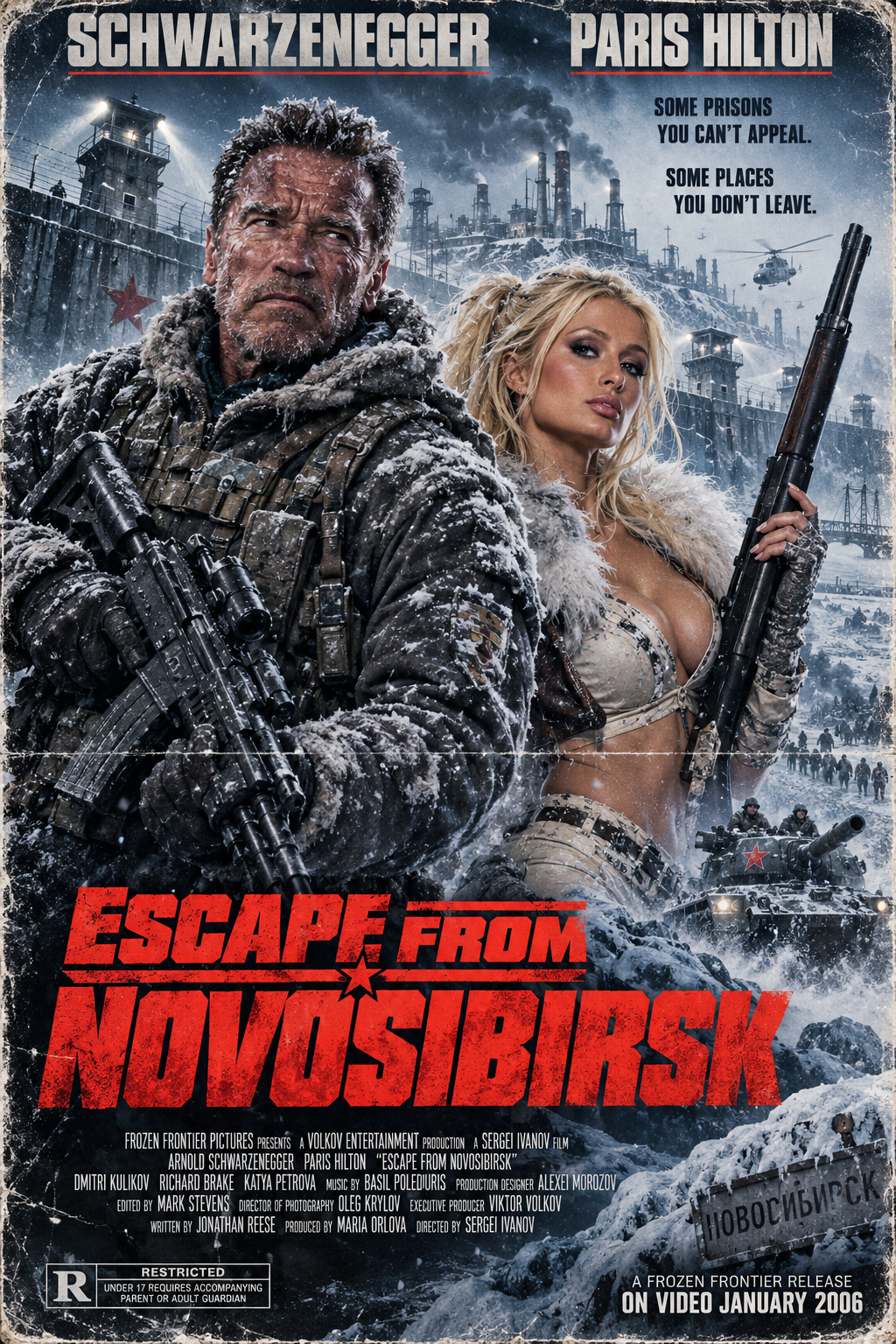 The popular culture of the late 2000s was full of them: stranded expeditionary forces, lost weapons teams, half-frozen mercenaries returning from the east with crates of icons, gold, imperial jewelry, paintings, precious stones and pieces of entire national treasuries. The historical reality was considerably uglier than the films, but the films preferred absurdity. Arnold Schwarzenegger played former Austrian special operations officers who shot their way out of Novosibirsk with stolen diamonds. Sylvester Stallone portrayed American retrieval commanders abandoned by Washington and forced to cross Siberia in armored trains. Ben Flaycock became famous for a trilogy about a disgraced Canadian officer who returned from the Urals with enough looted gold to purchase a Caribbean island. These movies were hyperviolent, ridiculous and wildly popular, partly because their audiences already knew enough veterans to understand that some of the most unbelievable scenes were based on things that had actually happened.
For Amsterdam, all of this arrived not as geopolitics but as people.
Danes came south. Germans came west. Czechs, Poles, Lithuanians, Latvians, Estonians, Ukrainians and others arrived in successive waves, carrying different languages, different wars and different degrees of anger about who had abandoned whom. Russians came too, though fewer of them than outsiders often assume. The Russians who reached the Netherlands early were disproportionately those who had possessed money, political connections, transport, foreign currency or weapons when the fallout began moving toward Moscow. Some bribed their way through checkpoints. Some purchased seats on private aircraft. Some attached themselves to military convoys. Some shot their way out. They were the lucky ones.
Lucky did not mean comfortable.
They still arrived in a Netherlands already overwhelmed by refugees and food shortages, and many ended up in brutally overcrowded districts in the Bijlmer, Almere, Naarden, Bussum and the expanding belt of Greater Amsterdam. Apartments designed for four people held twelve. Sports halls became dormitories and then remained dormitories for years. Warehouses were converted into housing with barely adequate sanitation. Entire neighbourhoods developed from emergency settlements that nobody had ever intended to become permanent.
By the early 2000s the Netherlands experienced its own hunger winters, though nobody starved in the numbers seen farther east. People remember them instead as years of bad diets, weak summers, rationing, government substitutes and endless arguments over what counted as enough. Fresh produce became sporadic. Meat became expensive. Imported goods vanished for months at a time. School meals were designed around calories rather than pleasure. Vitamin deficiencies became common enough that public health campaigns returned to language that sounded embarrassingly nineteenth century.
Television was heavily censored, though everyone knew it. The censorship was not always crude; often it took the form of omission, delayed reporting, carefully chosen footage and endless appeals to social stability. But people understood perfectly well that elsewhere things were worse. There were famines across large parts of Eurasia, outbreaks in refugee camps, urban collapses, failed harvests and whole regions from which almost no reliable information emerged. Everybody knew someone who had lost family. Everybody knew someone who had arrived from somewhere worse.
That is the Netherlands of 2026.
Not ruined, not prosperous, not free in the old effortless sense, and certainly not innocent. It is a country that survived because it became practical, suspicious, crowded and very good at making do. Amsterdam is enormous now, swollen far beyond its historical scale, packed with people from half of Europe and held together by infrastructure maintained long past its intended life. It is poor in ways our Amsterdam would find shocking and rich in ways our Amsterdam has forgotten how to measure.
Things matter there.
A warm room matters. A functioning tram matters. A full table matters. A friend who shows up matters. Music matters because people remember years when the lights went out. Food matters because people remember when it tasted of substitutes. Love matters because history has made it perfectly clear that entire countries can vanish while two people are still arguing in a kitchen.
And under all of that, beneath the crowded streets, the refugee blocks, the repaired bridges, the tired bureaucracies and the old canal houses full of too many lives, the supernatural world has adapted too. It has fed on the same catastrophes, migrated along the same routes, inherited the same grudges and discovered that the twenty-first century is not an age in which monsters disappeared.
It is an age in which they had competition.
The Supernatural

Let me introduce myself. I am Felix. I had a another name once but fuck that. I was made a vampire by Mister name – someone who still around, but not a vampire himself. The guy is Mister Important so let me not say that name here. He was a big shot in London around the time I was made. Fucker was wearing out his welcome in Paris quickly and he needed drugs and didnt have a supplier. At the time I was semi-ligit and involved with the daughter of an esteemed churchman, bit of a stiff character. The guy had gotten rich in pharmaceuticals. His daughter was as hot as they come and back in the day I wasn’t the most worldly or bright. I had come from the countries, couldn’t read or write, and I was mostly a thug. I scored myself a pretty lass and she really fancied me and I had a sort of vague idea of going ligit. My recollections are diffuse, but I fancied, a last score won’t hurt, some fat delusional Parisian cunt.
What I sold him was cut badly. It was poison. Someone died. Mister Important got sick and got very angry, and turned out he could get even in ways I didn’t even dream existed. He sent literal nightmares at me. He drove me to him. Very bad things happened, and when he was done I was the most broken, insane, fucked up vampire you can imagine, with the worst photophobic disorder imaginable. I mean candle light would fuck me up. Worse, I’ drift in and out of episodic bad like, going Bad on alcohol, going Bad on Opium, going Bad on Hasheesh and on and on and on. So a few weeks in I fancied ending it and I couldn’t. Mind you I was highly motivated, but demons came and prevented me, and I can’t say it any different. They still come to this day – anytime death comes, demons come and prevent me from dying. What’s new is new drugs. Every year new drugs come. Fucking OPCE. Nitazenes, Fuck Me. NEP an hour or two of that you wanna jump under a fucking lawnmower facefirst. Then mixes. Like what the fuck – vodka and PMA. 2CB mixed with Cathinone. And that awful speed Hell’s Angels snort. Mexican Meth juiced with Ether. Fuck Hunter S. Thompson sideways with a watermelon.
Mister Paris and his shitty smoking jacket sure got his revenge.
So in case you didn’t guess, Vampires are real, and I am close to celebrating my centennial. I was made in London, moved to Texas – that’s where I acquired the accent – and let me emphasize one thing clearly. In 1973 I was in New Rochelle. I had a garage there. So before anyone gives me any shit about my trenchcoat and me frequently going around with a Katana, this character Blade was invented around the time I was hanging around that exact fucking area of New Rochelle, so imagine those fucking odds eh?
Europe is hard country. I couldn’t come back to London, or even the UK. When I tried in the early 80s, the whole scene I was part of, briefly, in the 30s was nothing left of. Plus I wasn’t the same. In the 1930s I was an Albino scrawny creature, hideous like this blue eyed cat eyes nos. Fucking hideous, white hair, creepshow eyes. I saw great in the dark, but even street lanterns fucking blinded me. So I was the weirdo with sunglasses at night. There was absolutely no way I would be doing a world war in that environment. Coming back fourth years later, I didn’t recognize the streets. The step from London 1929 to oh what was it, Fucking Beaumont and Fucking Galveston and Fucking Abilene was smaller than the Jump from Fucking Montmorency 1982 to Southampton.
What’s so terrifying is, I took every precaution and still these cunts knew where I was, day one. Nobody on the boat knew. I was in a welded compartment with my own energy supply. It was on no blueprints. The Captain didn’t know. He couldn’t have known. Ballast was rearranged. I had twice as much blood. I had cameras on an isolated cable system. I was in a fucking faraday cage. I waited hours – silence. 3AM, I go invisible of the fucking boat, bam, five guys waiting, “please if you’d be so kind to come with us”, like fucking HOW. So I ended up in what they call the investment tier of a guy called Raffen. A cock, with is short for Peacock. A Torey. Toreador, which a dumb-spoof name they been giving the Daeva for half a century now, ever since that stupid Minos painting in the Louvre. Raffen was also into the magic shit, which was probably no koinkidinky, and he said I stank of sorcery, so his first act was he has some purifying spells to remove that. Then the fucker bonded me.
I mean Raffen wasn’t a bad guy or anything. Just very gay. After a century I didn’t much have a problem either way, he just wasted a shitload of time on the Gay. Also the occult and the goth surrounding it was at least a third cosplay extravaganza for the guy. Crystals and goblets and Dream Merchant and Camden Market even as far back as the 60s. He wrote letters with red ink on a Fucking underwood to that factory cunt of the cans. Soup cunt wrote back on black parchment with silver paint with some ermeline brush or whatever. Raffen made me run errants and a lot. It was fucking hard work. Made me work on cars. made me work on guns. Made me do logistics. Made me do electronics. Made me do machinery. It went on and on, seven days a week. I was a slave.
Then a couple of years in he set me free. Gave me a suitcase with half a mil, and a recommendation letter to this cunt Prince in the Lowlands, and made me forget his private shit. He even somehow removed the blood bond, and send me packing. “fuck off to the Netherlands” he said in more polite terms.
I didn’t. I went the way of Antwerp. Antwerp is easier. I knew people in Antwerp. Not exactly Vampires – more like freaks. There’s more freaks in the world than Vampires. They aren’t nearly as powerful but freaks can walk in the sun and once you have a basis for trust you can do good business. Antwerp, ostensibly is unclaimed. Unclaimed by and large means Sabbat. Most of Europe is a patchwork of claimed territories. The trick apparently is the Elders have precognition, so when you show up they can see your future interaction and trace you statistically back. So unless you can statistically be all but certain you will project zero causal chain of events they’ll spot you and intercept you. That’s what the Raffster did. He was notified but this muscle bunny albino Russian chick above him, and then this guy with the tattoos above that, all Daeva. I dunno, we are talking generations down to six by this stage I suppose, and people that saw the sun when the Americas wasn’t yet discovered. One doth not fucketh with any of that.
It’s exactly like playing checkers and you have one piece of checkers whatever and the other side is playing chess with a full board. And every time you make a move someone hits you on the head with a plank. It’s highly uneven. I never saw much Sabbat in Antwerp. I don’t like the mentality of the folks there, I never dealt with the locals. Belgians are sly, hypocrites, slimy, underhanded people. As a rule. I believe the incidence of child abuse there is like five fold European norm and since I quite often operate close to porn and drugs and the sleazier part of society I often get to look and sniff under the tail. Let’s just say I procure sizeable amounts of lime. It gets tedious, oh fuck another, ‘looks at the map on the wall’ jezus I have buried them everywhere, where do I bury this one, FUCK.
Anyways. I never met Werewolves. I have heard ’em howl. Precisely that fucking metallic sound from American werewolf in London. Normally I’d say the era of werewolves is over by they do crap with spirits and can disappear and appear pretty randomly. Fog. Darkness. I have fuck all clue. The dead are everywhere. Intermittenly I can see em, problem is the memories don’t stay. So I have this habit, anytime I consciously see them, I write it the fuck down immediately. If I can. I also have a dictaphone kind of chip device. Or I record my memories. It’s very odd. I read back things I wrote down and then there’s only a hazy recollection. “you were in a graveyard and you spoke to Henry, Alicia and the twins. They were spirits. They were spectral kinda with vague skeletal and organ shit inside. They smelled musky. This is what we discussed. ” Recordings don’t work. There are Sorcerers and Shaman and Warlocks and Magi, Magicians, Wizards, Witches, and Necromancers. And all manner of variants. Theurges and Thaumaturges and Cabalists and I have fuck all idea. Raffen was a Sorcerer. Tremere are ancestrally by blood talented as Thaumaturges, but some are also Sorcerers.
You gotta be careful with the old ones, and the ones that come off world. I do not known where they come from, but there are other places besides Earth. You go there, normally people die, and mostly vampires also die. You gotta take measures. You gotta translate you body. Nature operates differently there. Metaphysics.
And then there’s stuff we don’t talk about. Shit from thousands of years ago, like biblical stuff. There was one in the Hague, David something. There was a hybridization in that motherfucker, Catraziel or whatever, which is essentially a hereditary family arrangement – One of the family joins with the Demon, as a pact. It’s a franchise thing. Guy took over when the place was falling apart, late 90s and became de facto Prince of Vampires. This happens and when that happens the old Vampires sweep all the young out. It’s a very stable arrangement, quite common apparently. Florence. Dresden. Rennes. Barcelona and a whole bunch of cities east coast of spain – a bunch or one powerful Demon, a court of Vampires. The reverse also happens – Marrakesh; extremely Invictus with a court of very strict Demons. Belgrade is stuff of Legend and more complex – but again, Vampires and Demons, and it gets particularly epic and theatrical there.
Europe is hard country because everyone who survived it learned to call whatever arrangement kept the lights on a civilization. You have to understand that before anything else. There is no one Europe anymore, not really, and there has not been for years. There are borders, sure, and flags, and ministries, and men in uniforms who get very upset if you suggest otherwise, but half the time the border is less important than who controls the power station, whose trains are still running, whose priests have enough influence to keep a hospital supplied, whose militia has diesel, whose old families still own warehouses, whose vampires have been sitting in the same quarter since Napoleon, and whether the local radio station says the road ahead is open or full of people shooting at one another over potatoes. People still say France and Germany and Poland because maps need labels, but in practical terms you travel through arrangements.
The internet exists. Don’t get excited. It is shit.
I mean technically, yes, there are networks, there are message boards, there are encrypted relay systems, corporate intranets, government networks, university servers, porn, endless porn, because apparently civilization can lose three harvests and half its electrical grid but somehow tits remain mission critical. But the grand shining global brain people used to talk about never quite happened. Too much infrastructure got blown up, sanctioned, nationalized, partitioned, rationed, compromised or simply maintained by some poor bastard with a soldering iron and a manual printed in 1996. A lot of Europe still runs on patched copper, microwave links, satellite windows, regional fibre trunks and whatever somebody managed to keep alive through two governments and a coup. You can send data across the continent, but you do not assume immediacy. You do not assume privacy. You certainly do not assume permanence. People still print things because paper doesn’t suddenly decide the certificate authority in Prague is illegitimate.
This has consequences.
People remember phone numbers.
People know where things are.
People write letters.
Information has weight because moving it takes effort, and because half the useful information is local anyway. There are databases, sure, but nobody sensible trusts just one. If I want to know who controls a warehouse in Zaandam, I can probably find three government records saying three different things, one vampire who insists it belonged to his ghoul’s grandfather, a union clerk who knows who actually has the keys, and a Serbian woman running a kiosk who will tell me exactly who comes by every Thursday at four in the morning. Guess which source I trust.
This also means rumors have power again, which is frankly terrible for us. Mortals used to think technology would kill superstition. Instead unreliable technology made everybody superstitious in a more sophisticated way. People know governments lie. People know databases are wrong. People know recordings can disappear. People know things happen in districts and nobody reports them. So if six people swear they saw something walking through fog near a rail yard, nobody automatically says impossible. They say, well, was it military, chemical, occult, irradiated, some rich cunt’s experiment, or just six drunk idiots? That is an improvement in epistemology and a fucking nightmare for the Masquerade.
The west is still richer, comparatively, but “richer” now means you can usually get antibiotics and the trains arrive on the day printed on the ticket. The British sphere is obsessed with hierarchy and contracts and pretending decline is tradition. They still have money, old money especially, and a whole ecosystem of titled parasites who survived because their families owned land, ports, insurance companies, archive companies, security companies, food companies, and anything else that becomes extremely valuable once systems start collapsing. The Americans support them when it suits them, but America is far away and weird and much less omnipotent than people imagine. Americans still show up everywhere, though. Americans always show up. Soldiers, contractors, missionaries, businessmen, intelligence types, rich idiots, poor idiots, fucking Texans. I say that affectionately.
East of the old German line it gets complicated very quickly. Poland is Catholic in a manner that would make medieval Catholics nervous. Purity, fertility, radiation, bloodlines, family, soil, all this shit braided together until nobody remembers which part started as public health and which part came from some bishop with a breeding obsession. They have institutions that look modern enough, biometric records and genetics labs and respectable schools, and then you talk to people for fifteen minutes and realize the entire thing has been wrapped around an idea of contamination so deep it has become theology. They are not stupid. That is what makes it worse. Stupid people are easy. Intelligent people with coherent systems of horror are a professional hazard.
South and east you get the Orthodox restoration crowd, Slavic and Hungarian imperial projects, Serbian influence people will loudly deny, Greeks who think everybody else is doing Orthodoxy incorrectly, old aristocratic military families, reconstructed monasteries, armies carrying icons next to radiation dosimeters. Their dream is Russia. Not the Russia that existed, obviously, because that Russia is dead and everyone knows it, but Russia as an idea, purified, reconsecrated, recolonized over centuries. They speak about recovering irradiated territory the way medieval people spoke about reclaiming Jerusalem. A thousand-year project. They mean it.
The funny thing is the supernatural maps overlay all this but never match cleanly.
The Sabbat leans Catholic because of course they do, except half their internal philosophies would get them burned alive by the Catholics they politically support. They are full of Paths and internal covenants and ideological systems that range from grimly honorable to batshit heresy. You get some Sabbat knight who sincerely believes in discipline, oath, sacrifice and divine order, standing three rooms away from another Sabbat who thinks Lilith was the first truth of creation and Christ was a metaphysical fraud. Somehow they both agree the Camarilla is degenerate. Fine. Politics.
The Camarilla in western Europe is less coherent than we pretend. The Carthians are progressives until they need to negotiate with a banker. The Invictus are aristocrats until the aristocracy stops paying. The Lancea Sanctum says Scripture is absolutely true and then you get them drunk enough and suddenly Jesus was six-foot-eight with six fingers, or female, or an angelic projection, or never existed as a single human being at all. The Circle of the Crone pretends not to be political while somehow always being found near feminists, separatists, witch cults, rural insurgencies and women who have very strong opinions about saints nobody else has heard of.
Then there are demons, which everybody likes to pretend are somebody else’s department.
That works until one runs a city.
The Hague had that David fellow, and I cannot remember his fucking surname because that whole period is foggy in my head, but the important part was Catraziel or Catraziel-ish, hereditary arrangement, family pact, demon joins the line, somebody inherits the franchise, and when government authority started going soft in the late nineties he just stepped into the hole. Vampires adjusted because vampires are practical when confronted with something that can turn their haven inside out metaphysically. The old ones purge the young, reorganize the feeding structure, everyone swears this is temporary, and twenty years later it is tradition.
Florence has arrangements. Dresden has arrangements. Rennes has arrangements. Barcelona is basically an argument between demon courts, vampire courts and people who insist neither exists. Marrakesh is reversed, old Invictus structures with demons operating inside a brutally strict hierarchy. Belgrade is another category entirely. People speak about Belgrade with the tone sailors use for storms they survived once and do not intend to test twice. Everything there is theatrical because apparently Serbians believe metaphysics should have costumes, banners, relics, ancestral blood feuds and somebody reciting something in Church Slavonic while the building catches fire.
Amsterdam is quieter.
Quieter does not mean safer.
It means Amsterdam has learned discretion.
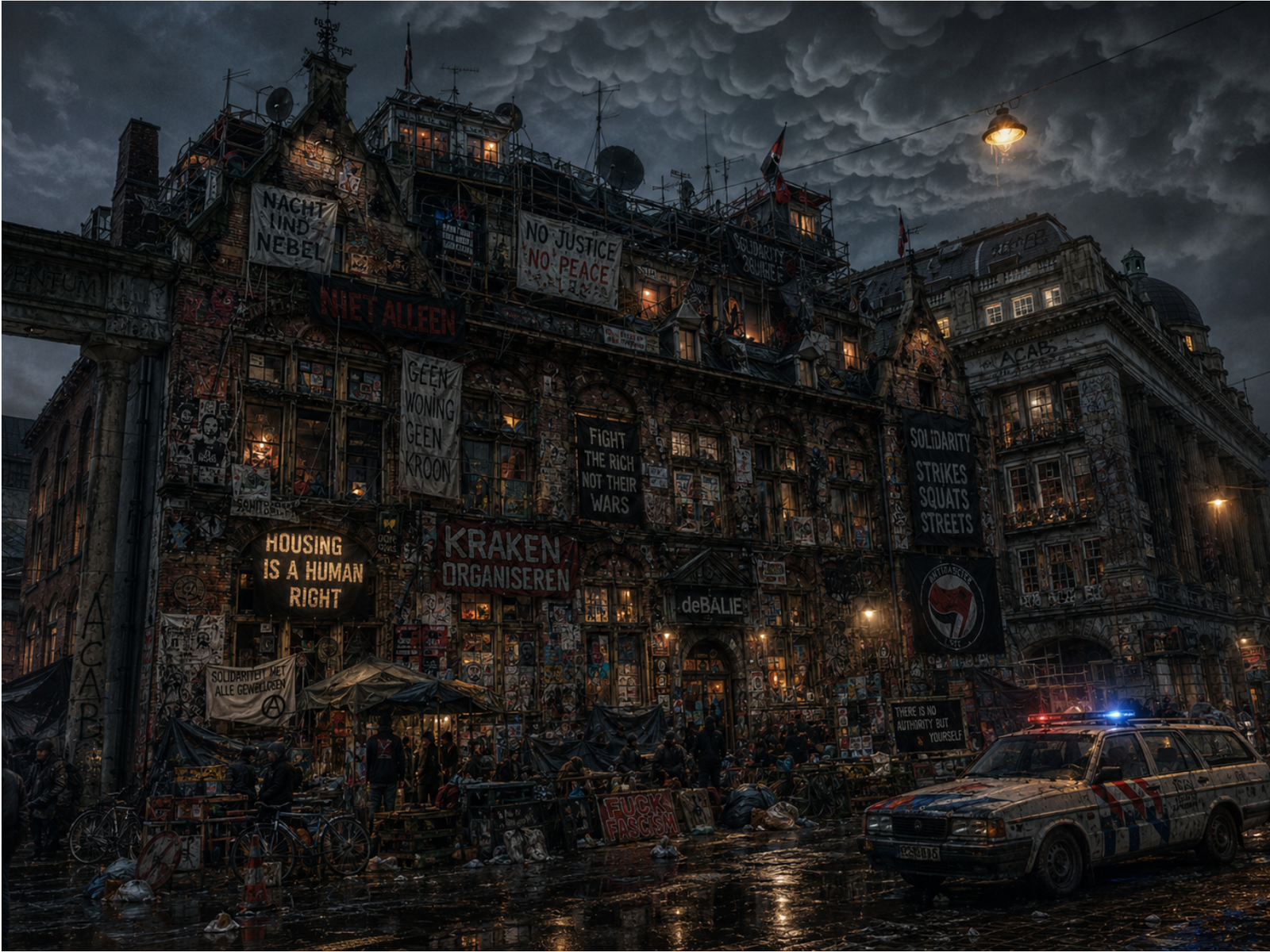
ook at De Balie. In another world it might have been an intellectual venue, a respectable debate house, people drinking wine and arguing about democracy. Here it looks like somebody barricaded politics inside a building and forgot to let it out. The façade is layered in posters, banners, scaffolding, graffiti, old slogans, new slogans written over old slogans, and half the people inside are discussing housing while the other half are discussing whether some eastern government still technically exists. It is ugly, alive, exhausting and absolutely Amsterdam. If you want to know what the city thinks, you do not read the official statements. You go there and listen to three people shout over each other in Dutch, Polish and English while someone upstairs is broadcasting through a server that crashes every forty minutes.
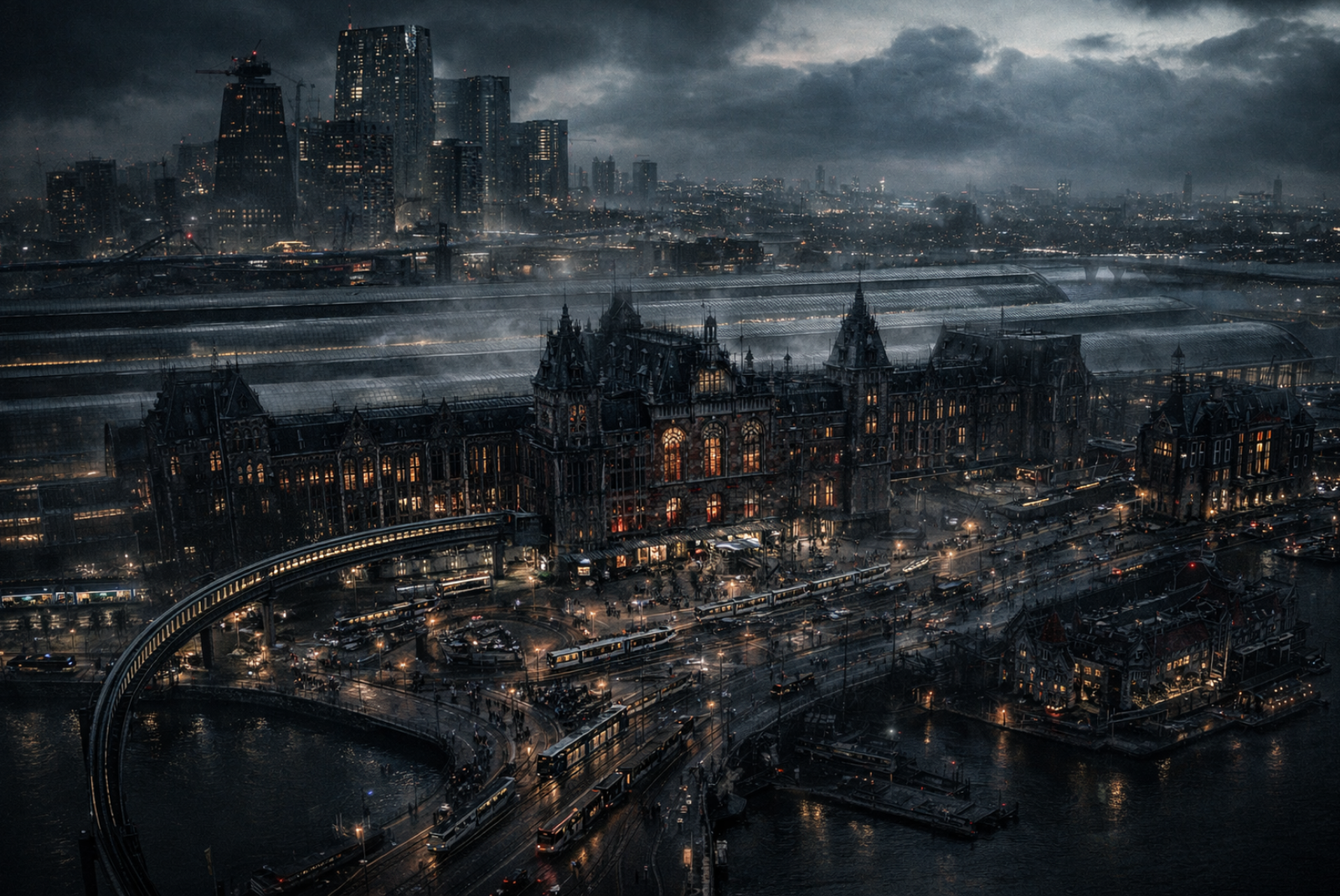 Centraal Station is the opposite. Centraal is empire by logistics. You stand above it and you understand why Amsterdam survived. Rail, tram, water, ferry, metro, freight, people, all braided together around this giant dark cathedral of movement, patched and expanded until the original nineteenth-century building has become the ceremonial face of something much larger. Behind it are transit halls, refugee processing annexes, distribution platforms, freight sheds, emergency power structures, security corridors, old tunnels nobody admits still exist, and enough hidden infrastructure to feed a small country. At night it glows in the rain and looks magnificent, which is irritating because the toilets still smell like death.
The Continental is where people with money go to pretend the twentieth century did not happen.
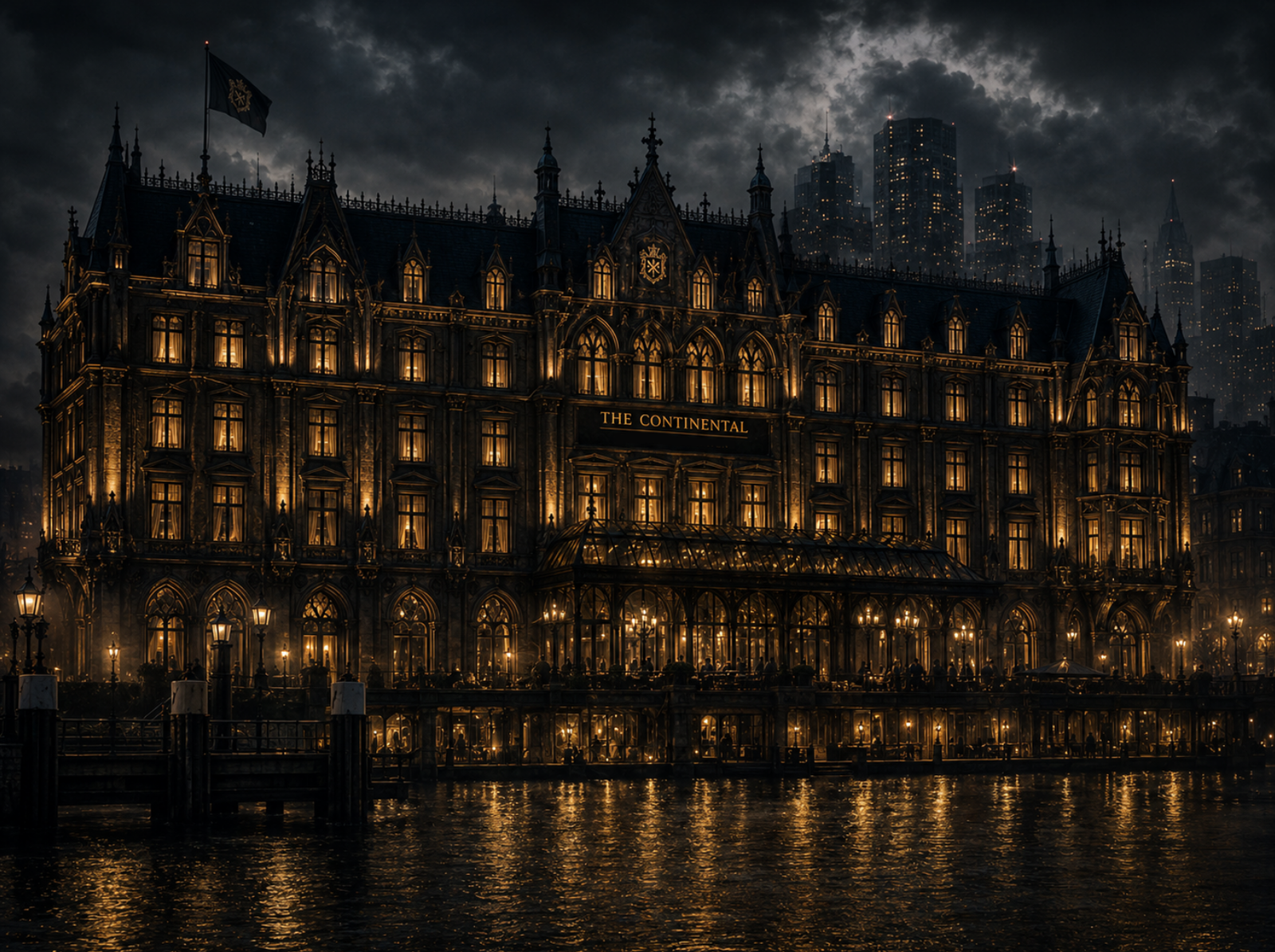 That enormous black hotel on the water, all Gothic roofs and warm windows and absurdly expensive glass, is not subtle. It is neutral in the way only very expensive places can be neutral. Everybody there knows somebody. Diplomats, old families, corporate intermediaries, vampire retainers, smugglers who have graduated into logistics executives, minor royalty from jurisdictions nobody recognizes, people who absolutely are not intelligence officers, and occasionally somebody whose paperwork says they are thirty-two years old despite the fact that three photographs from 1911 show the same face.
You can have dinner there and never see anything supernatural at all. But start paying close attention when people start paying in gold coins.
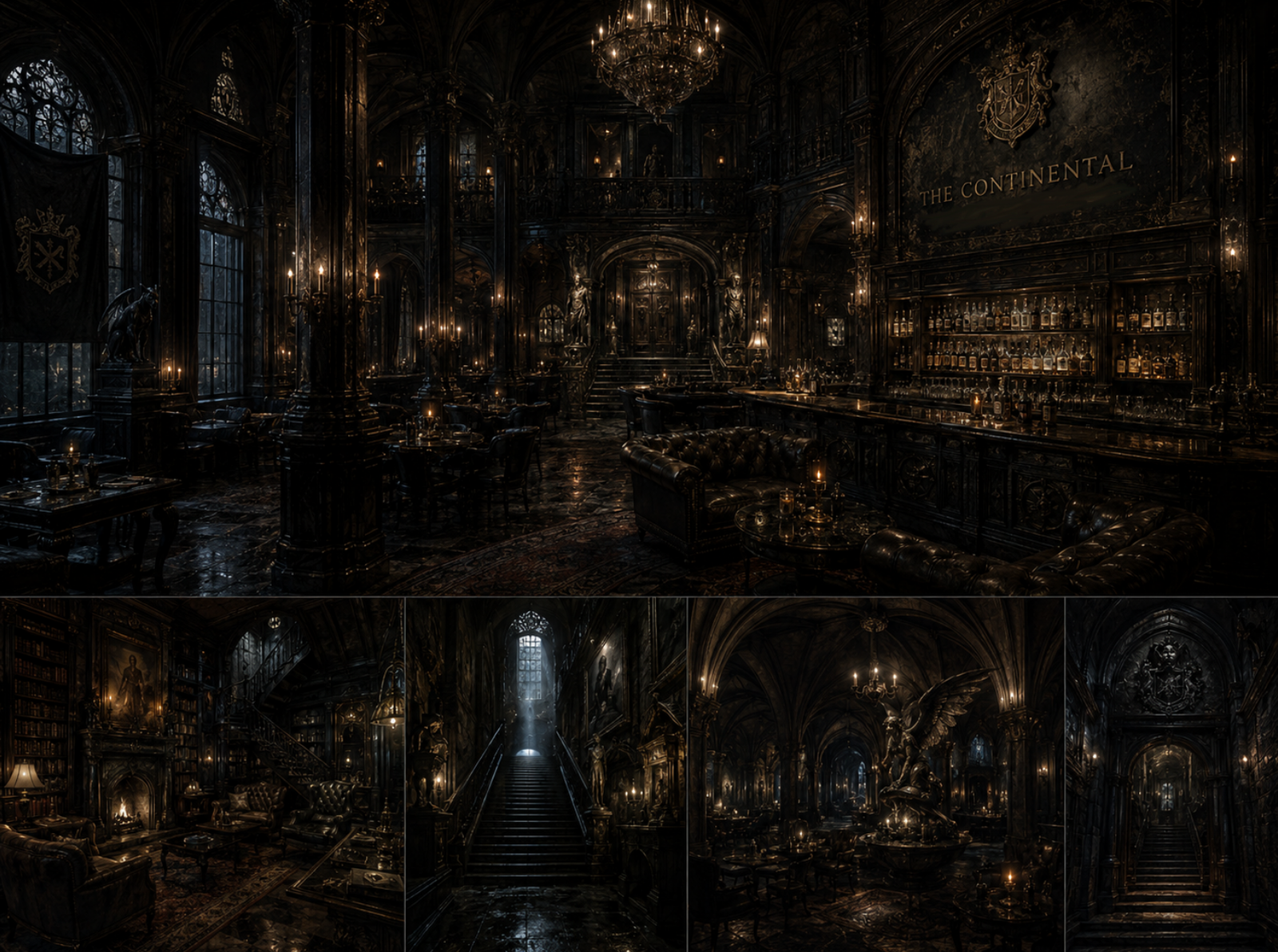 That is how you know you should be nervous.
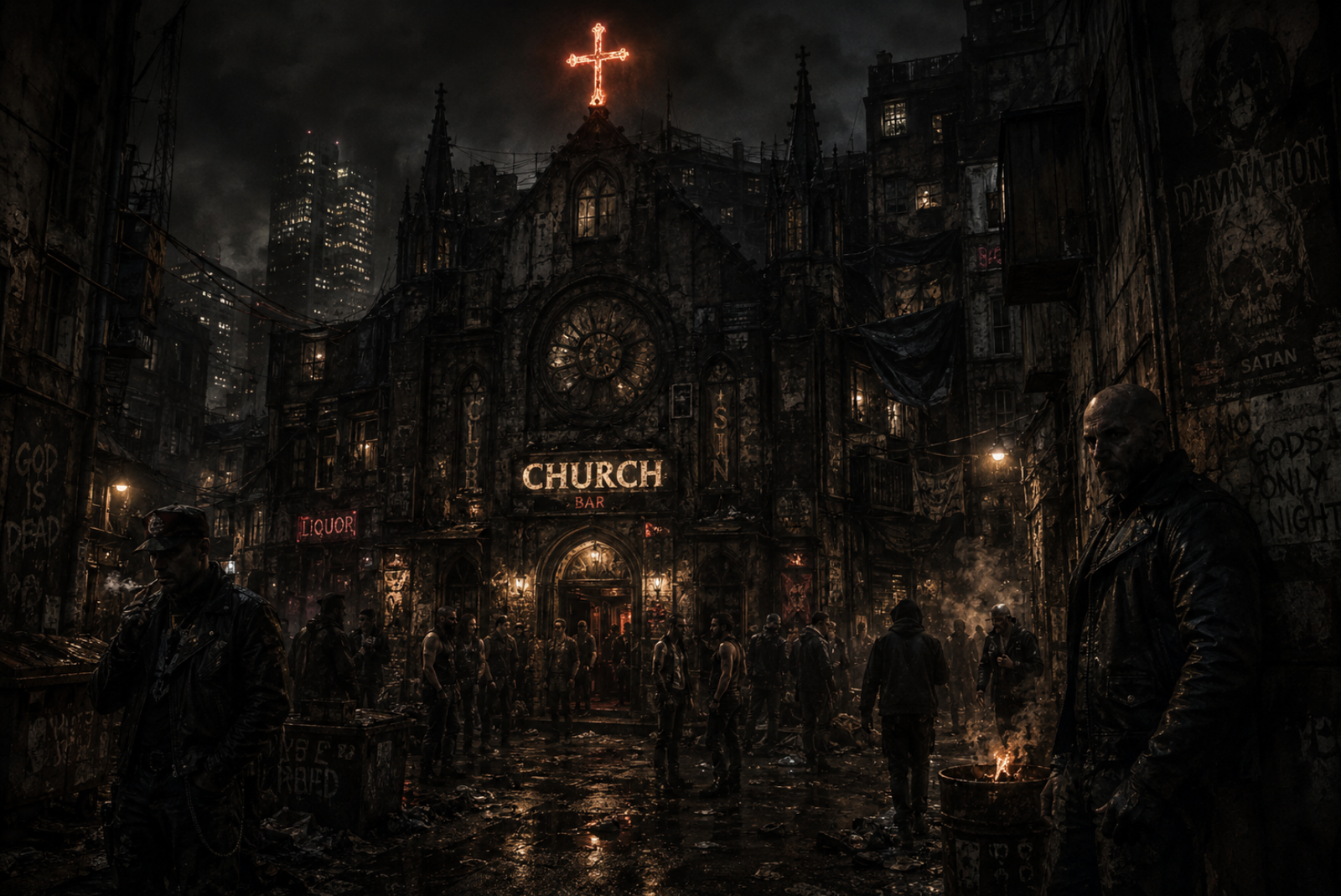
Club Church is another matter. Church does not pretend. It occupies the remains of an actual church complex because apparently irony became structural at some point. Half religious ruin, half leather club, half sanctuary for people who do not fit anywhere else, which I understand is three halves but go there after midnight and tell me arithmetic still matters. There is a cross in neon. There are people dancing under saints whose faces have been painted over. There are vampires who can behave themselves, humans who know more than they admit, and things I cannot classify because I have learned not to classify everything that smiles at me in a dark room. I like Church. That should worry you. There was a time when I was staunchly heterosexual, and then I realized a cute ass is a cute ass.
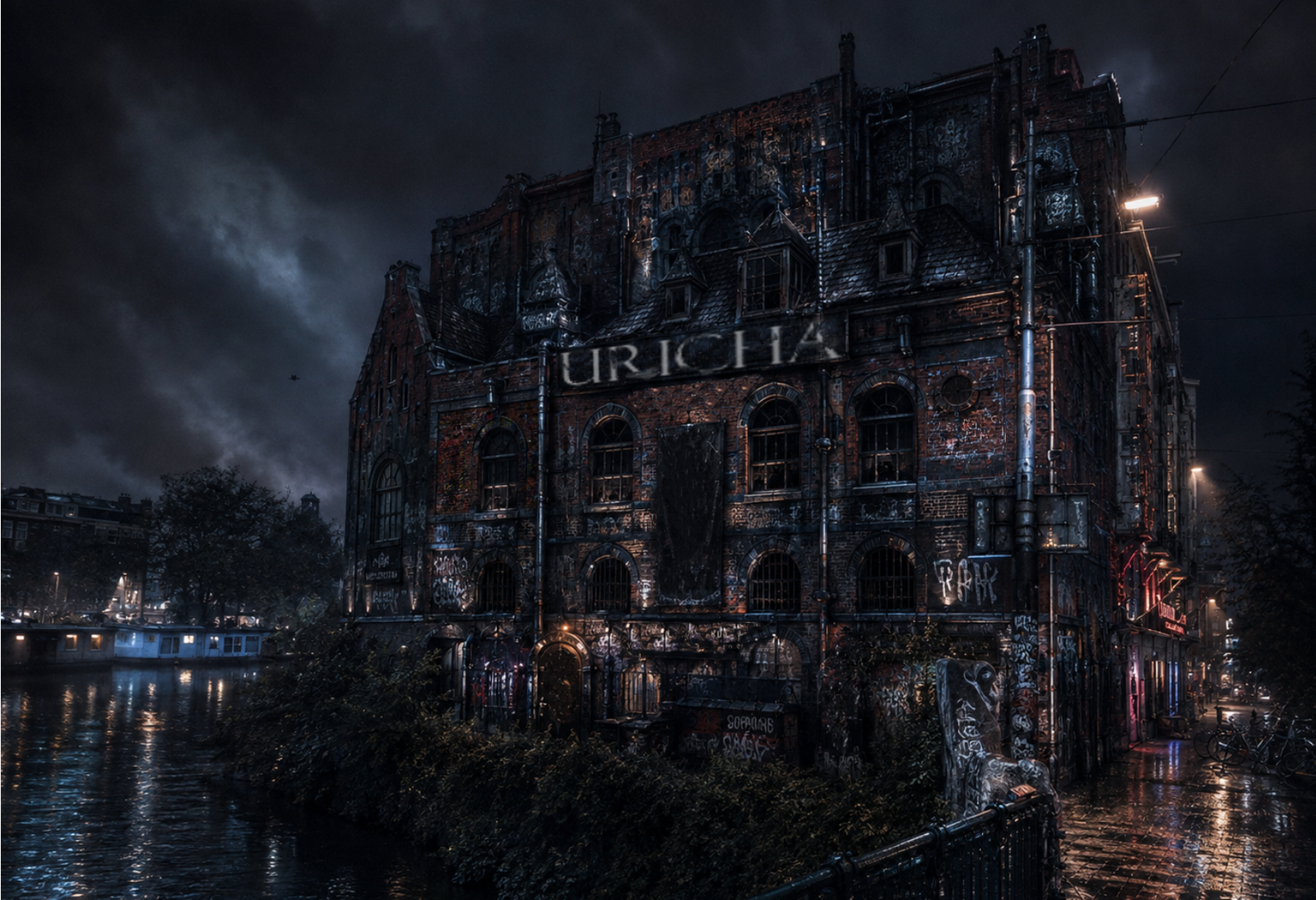
Uricha is a place my girl runs. Modest club.
That is Amsterdam now. The city did not become futuristic. It became layered. Old brick under new cable. Old churches under clubs. Refugee blocks around seventeenth-century canals. Analog radios beside encrypted terminals. Aristocrats using fax machines because they trust paper. Witches with pagers. Vampires with VHS collections. Police driving vehicles held together by municipal optimism. Sorcerers who can open doors into places where physics behaves differently but still complain when the tram is late.
People imagine darkness as absence. It is not. Darkness is accumulation. Too many histories. Too many survivors. Too many systems stacked on top of one another, none fully replacing the last. Europe is full of things that should have died and did not, governments, religions, bloodlines, grudges, technologies, gods, vampires, me.
Especially me. I am very difficult to get rid of.
I was still in the Hague, Fucking Prince Nobody Piece of Shit Darren in the 1990s. The asshole used me, put me briefly in charge of keeping order, which was a jerk move. We had that Canadian imbecile Dwayne, pretty famous in his own right who managed this discrete Techno Industrial place – COMPLACENCY, center of the Hague. It was de facto just the meeting place for the Leeches, was closed half the week for Vamp business, even the local police was patrolling outside asking questions. Bunch of famous folks, Ed, some fat sleazy brit who lived in the past, real old type, centuries old. The guy was a real big one, a famous Tremere type, but totally non grata, Guy from history but a fucking liar about literally everything.
You had this local tremere….. Constantijn…. FUCK... Ah you know what I don’t even want to think about that shit era. I am fucking done with that era. The Hague was a shit period. It was a small pond with losers, wannabe’s and a mix of sociopath and amateur hour nobody’s. Most of them weren’t gona last a decade. Ghouls who literally put their heads on train tracks. Failed embraces, favorites of some older vampire but not actually material. Thing with Europe is – nearly everything is claimed by the old ones, and young vampires, contrary to how things are in the U.S. are almost nowhere tolerated. It’s a matter of weeks, at most a month (and as you noticed sometimes hours) you are caught and either you go into the puppy mill, or you get ‘contracted’ or you RUN. The Hague was a very rare and momentary set of circumstances where a bunch of the elders were incapacitated or loathed taking action. They were frozen in place watching one another and let the kids run amok for a few years. That was about 1994 to 2000 and then the fun was over. Puppy mill, in case you didn’t get the reference, means – a younger vampire gets puts in a chair and sucked dry every night and fed copious amounts of animal blood. It’s not a fun way to go, but eventually you rot from the inside out and put the mindless horros that’s left in an Oubliette, or just burn it.
Yeah I was with someone in the Hague. It was a thing for a bunch of years. We were a thing. It was my first boy. I… I think it was kinda an arranged thing. He was one of Raffens discarded fucktoys, Raffen had gotten tired with all the constant drama, the band bullshit, the screaming, the throwing crap, the crying. I mean to be with someone like that, the sex is off the wall good, but it’s not meant to last. I was deep-programmed by some cunt, probably not Raffen, likely that Daeva creepshow Ivana or someone up the food chain with a combo package of Presence and Dominate, maybe a bit of ritual magic. I still can’t wrap my head around it. Normally I would have put my hind tire in the face of that one. Totally not my type. I mean, what kind of Vampire embraces a fucking borderliner? Thing is the creature was an incarnated soul in some kind of chain and by making it a vampire some folks had purposefully obstructed a rebirth and some kind of cyclic stuff. They kept him served on a silver platter – fucking mansion in Wassenaar, extremely well-funded. Creature was not ugly either, and pretty high in demand in those kind of Goth circles. It was an interesting experience fucking a boy. I mean, it wasn’t really a guy, he was like petite, almost like a girl. Pretty little as and real good in bed. I was not exactly missing any options if you know what I mean. But the creature was not an adult – emotionally it was an infant, a child, stuck at something like 13, 14 ears of age in major intellectual faculties. Narcistic as a motherfucker. Hey I don’t consider myself the end all in terms of sanity and moral and ethical accountability, get me right, but Lagartija? Fuck, if I ever met an emotionally crippled, stunted being, utterly haunted, this was it.

And the explanation was those goddamn voices. Lagartija was some kind of conduit. There was an inside in there somewhere, and there were things. There was this shrill mutilated creature always screaming. A girl. But real torn up. Like physically shredded and barely put together, like a doll, or an accident victim, or an artistically reanimated corpse. And there was a monk. Bunch of kids. These were all dead folks, and they were all really really lost. Dangerously so. Evil spirits. And they frequently spoke to him. I know, I was just put there as some kind of programmed wind up doll. Raffen put me there, like some Bodyguard Golem. I was still under contract and I had no idea.
It all doesn’t matter. Lagartija is in Torpor. I left him and he fell apart. I mean it wasn’t me, it was a lot of different things, but I had already broken off contact in the Hague stopped coming over. I rode my bike. I drove my car. Every night. Hours and hours from Haven to Haven. I felt the calls in my soul get weaker and weaker and then after two years they finally stopped and I knew Lagartija was gone, faded, in some deep place underground, in some mauseoleum, probably High Gate.
I should stop talking about that period. I get angry. I get Hard.
I had business in… Italy for over a decade and that’s all I’ll say about it. I became more connected. Florence. Napels. Catania.
I became a lot more respectable and knowledgeable. One might even say that in certain circles inhabit a role of consequence and importance. This is not normal for one of my blood. Yeah they keep reminding me, I am Caitiff. Normally Caitiff have trouble siring children but I did, one. She’s an odd one. I didn’t expect it to work. I find that as the years pass I have stronger feelings for her and every time I like fucking her more and more and she clearly likes how I fuck her. She is managing my club here, but she stays out of politics. She is deep, very deep, wise, spiritual. Intellectual. Curious. Very female. Not jealous. Confident, enterprising. Survivor. A cat, like me.
I now work for… I am not exactly sure. She is a weird one. Not entirely human. I see her once or twice a year. But she is part of a network. I believe in the values, not the person.
So anyways I was asked to speak to you about Brandon. So here it is. Brandon. Again.
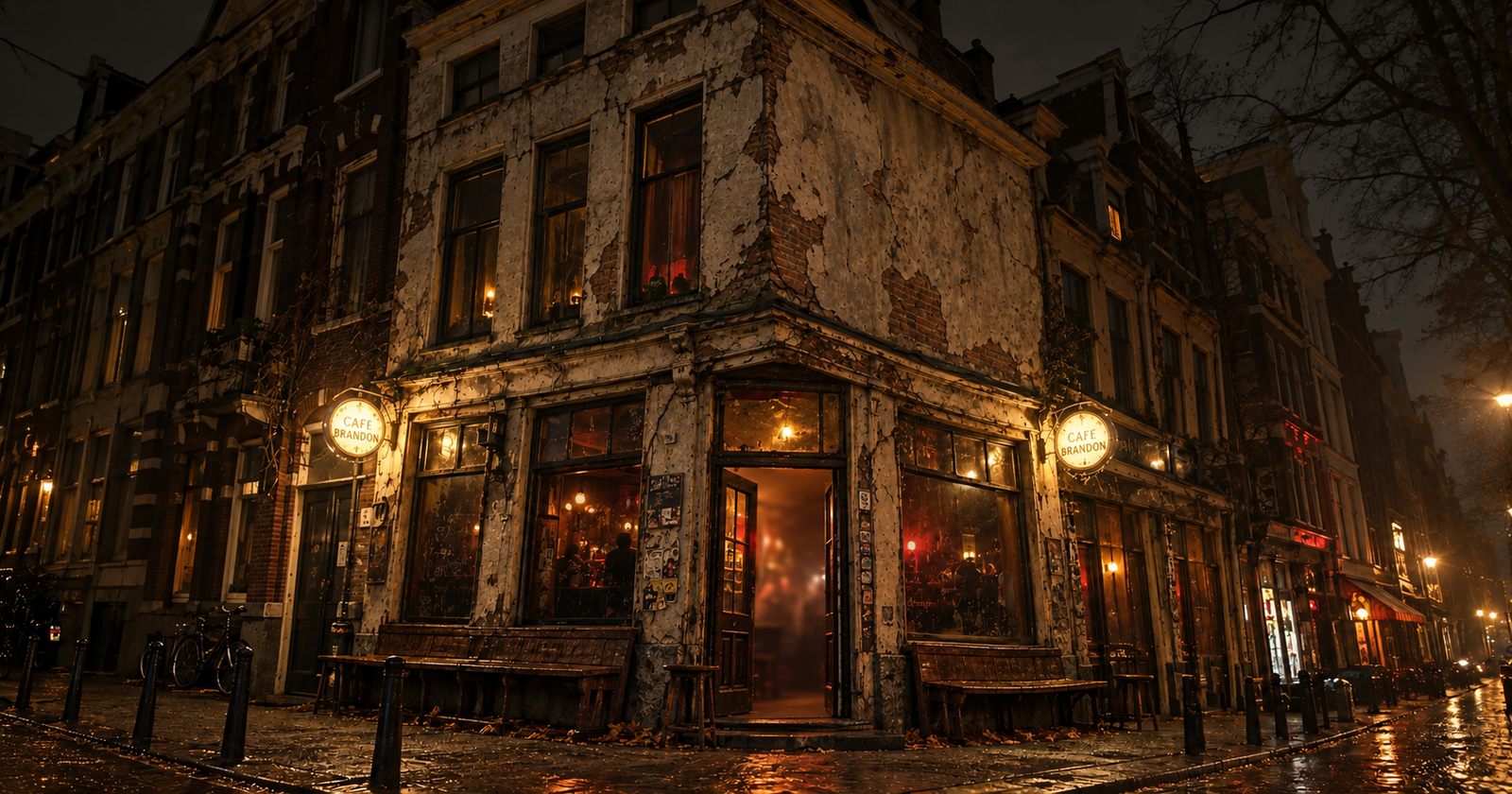
Keizersgracht, Leliegracht. You can just walk there and walk in. That’s the first thing. No ritual, no invitation, no hand signal, no cunt in a velvet coat asking who sent you. You open the door and there it is, modest as anything, almost disappointingly so if you have been told stories. Brown wood, old walls, beer, people who have been sitting in roughly the same places for longer than some governments have existed. Sit your ass down, order something, and respect the place. Do not perform. Do not arrive trying to be interesting. Brandon has seen interesting people before and most of them were less interesting than they thought.
It works on you if you let it.
Not theatrically. Nothing glows. The glasses do not levitate. There are no spectral children running through walls and no choir of the damned under the floorboards. The place has history, and history is heavier than tricks. You sit there long enough and you start to feel the pressure of accumulated lives, conversations, funerals, reunions, lovers, arguments, people who came in after work and people who came in because they had nowhere else to go. Thousands and thousands of ordinary people, which is more powerful than most occultists understand. They always want bloodlines, seals, gods, names in dead languages. Sometimes all you need is fifty years of people caring very much about the same room.
Brandon is not flashy magic.
Brandon is sediment.
That makes it dangerous in a different way.
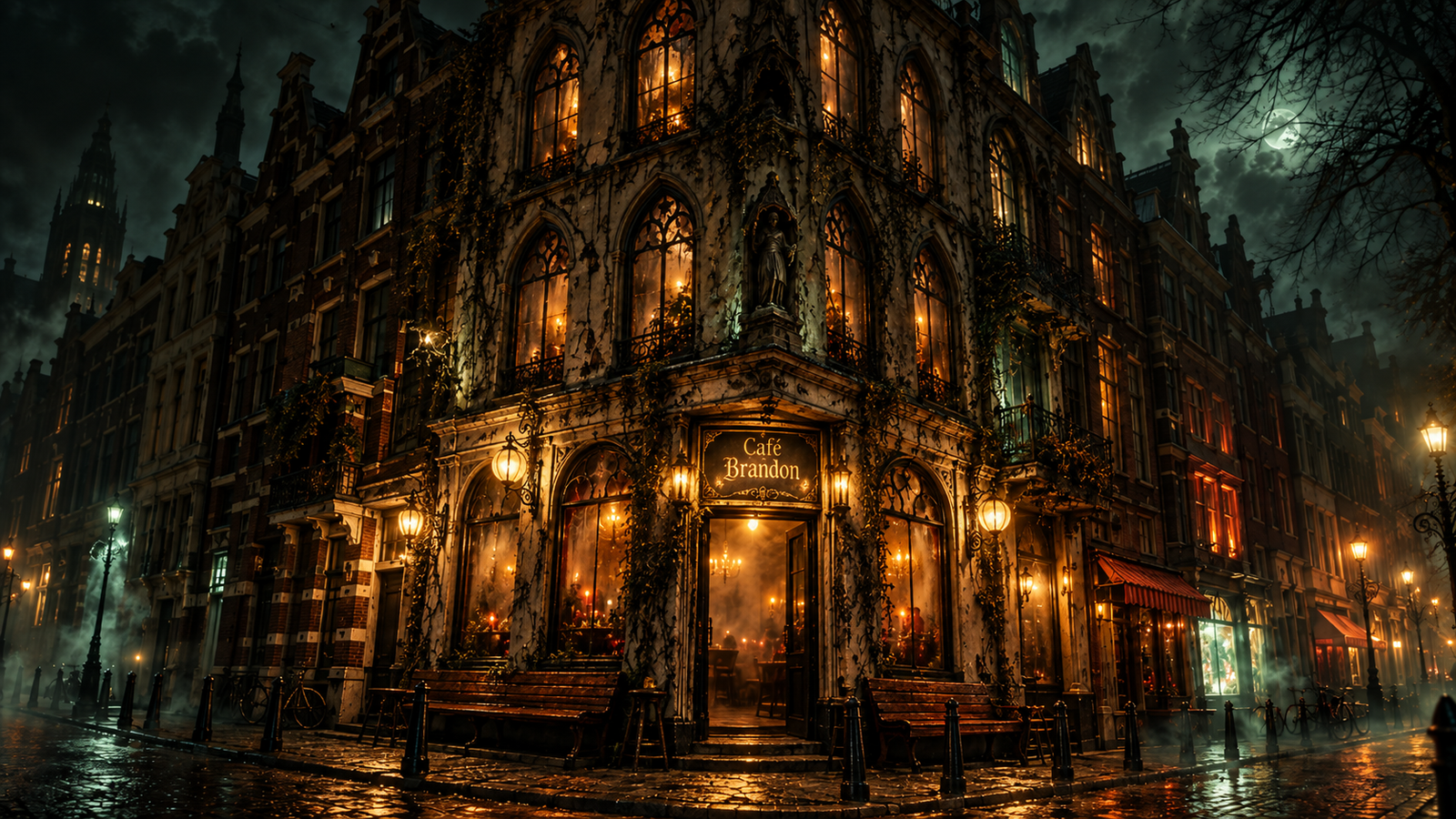
There are nights when it is just a café. There are nights when it is Neutral Ground. There are nights when even I do not know what it is and I have learned not to ask. The schedule is not posted, and anyone who tells you they have the schedule is lying or about to become embarrassed. I have heard three separate explanations involving lunar cycles, municipal anniversaries, deaths, birthdays, old disputes, and something about the weather over the IJ. Maybe all of them are true. Maybe none of them are.
The proprietors are mortal. But they know their shit… That is the official answer and the correct one.
Do not be clever about this.
Do not stand there squinting at them with Auspex or muttering about resonance or trying to detect possession. You will only make yourself look like a prick. Whatever is happening there is not improved by your attention.
There are names associated with the place.
Cor.
Jan.
You hear them sometimes from people who know enough to lower their voice when they say them. Nobody sees them. Nobody respectable claims to. There are stories, of course. There are always stories. Someone heard a voice after closing. Someone saw a glass move. Someone was told something no living person should have known. Fine. People tell stories. Brandon does not need ghosts to be strange.
What matters is the behavior of the room.
On certain nights, aggression simply stops working properly.
That is the best way I can put it.
You can hate someone. You can despise them with perfect clarity. You can remember what they did to you, what they did to your people, what they represent, everything. The hatred remains intact. But the chain that turns hatred into violence is gone. Not blocked. Gone.
It is deeply unpleasant.
People imagine peace as soft. Brandon peace is not soft.
You can stand next to someone you would kill anywhere else and feel every reason why, while being entirely unable to form the intention to do it. You can discuss the past. You can insult one another. You can explain, in detail, why the other person is an obscenity. You can remember torture, betrayal, slaughter, humiliation, all of it. But the room will not let you cross the line into action.
This produces extraordinary manners.
I once watched an Invictus shitbag and a Black Hand monster stand next to one another at the bar for twenty minutes discussing each other’s smell. It was one of the most civilized conversations I have ever seen.
“You are revolting.”
“As are you.”
“Drink?”
“Certainly.”
That is Brandon.
Not reconciliation.
Containment.
The actual café is small, but if you are sensitive enough there is another room.
Is it really like this? If you have the right eyes it is exactly like this.
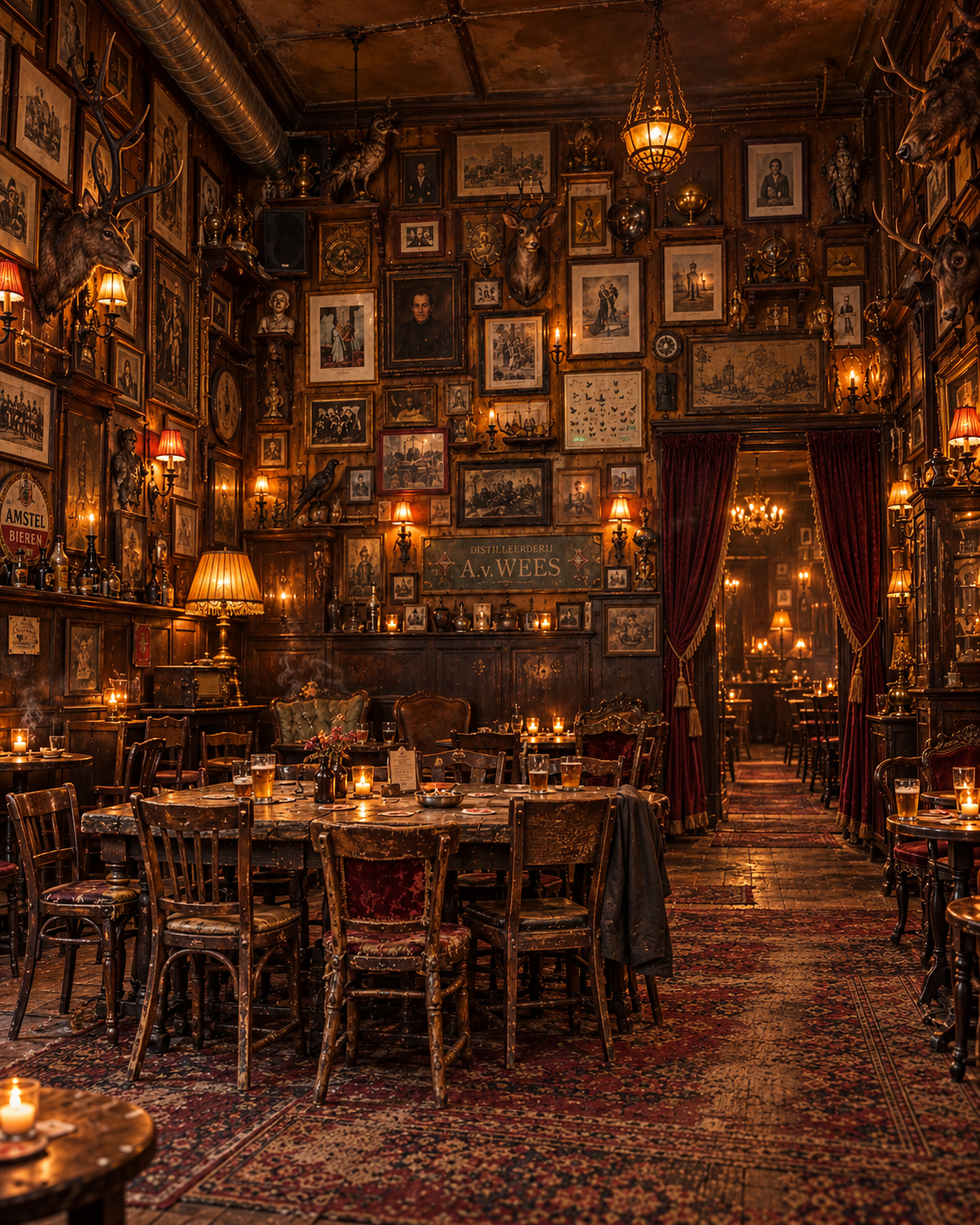
Do not ask me where.
It is not behind a hidden panel or under some staircase you missed. It is there when you can perceive it. One moment the wall is a wall, then one night you realize there is a door and you get the unpleasant sensation that the door has always been there and you are the one who has been absent.
The second room is larger than the building allows.
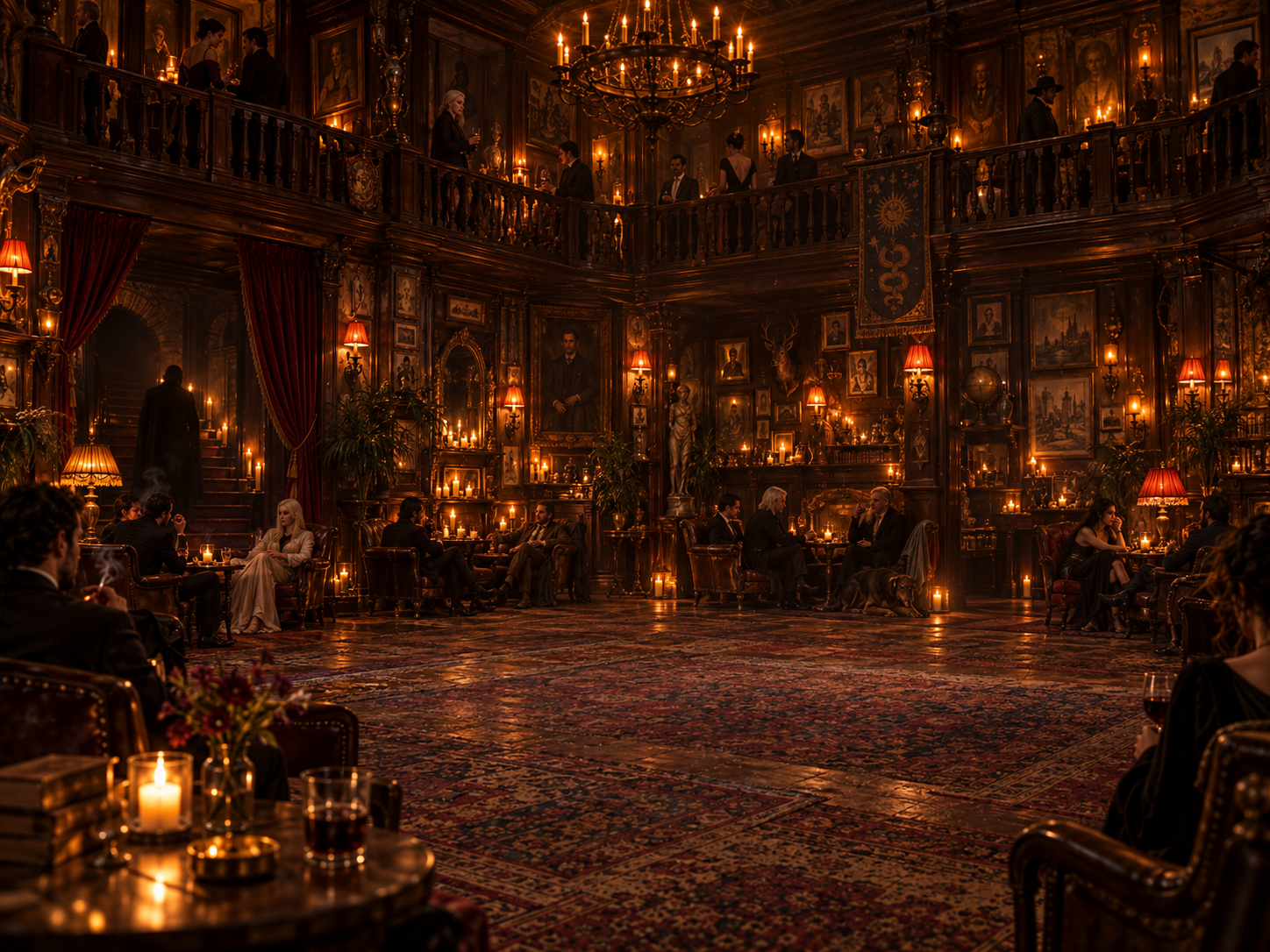
This bothers architects more than vampires. Another bar, no windows, old wood, a balustrade, low lamps. Nothing spectacular. It still feels like Brandon, which is the weird part. Same atmosphere, same sense that you should stop acting like an asshole and sit down. Maybe a fair bit more luxurious.
Then there is a staircase. Most people who see the second room do not see the staircase. People who see the staircase tend to stop talking about Brandon afterward. I have been down some of it. Not all. No fucking thank you. There are places where you need to translate yourself before you go, and I am not speaking metaphorically. Nature is not consistent everywhere. Matter, memory, identity, causality, all those things people assume are universal because they have only ever lived in one universe, they can behave differently. You go somewhere wrong without preparation and your body stops being a meaningful object. Brandon is gentler than that.
Mostly.
But it touches layers.
The dead know the place.
Sorcerers know the place.
Vampires know the place.
Some demons know the place.
Humans know the place best, which is probably why everybody else behaves.
That is the part people miss.
Brandon is not important because supernatural creatures use it. Supernatural creatures use it because Brandon was already important. That distinction matters. The dead do not make a place sacred by haunting it. People make a place sacred by living in it hard enough that the dead have something to remain attached to. There are old vampires who hate Brandon because it humbles them. A creature can have six hundred years, own half a district, command a dozen retainers, know the names of kings who no longer exist, and still walk into Brandon and discover that the room does not give a shit. No throne. No precedence.
No bloodline. No divine right. Sit down. Behave. Have a drink.
That is difficult for certain people. It is especially difficult for those who think immortality makes them important. It does not. Longevity merely gives you more opportunities to become tedious.
Brandon knows that. I suspect that is why I like it. I have been very tedious in my time.
There are rules, but nobody gives you a card. You figure them out. Do not hunt there. Do not feed there unless explicitly invited and for fuck’s sake do not make a production of it.
And for the love of everything, do not go looking for Cor and Jan. Respect means accepting that some things are not improved by being dragged into visibility.
If something is there, let it be there. If someone is listening, let them listen. If you receive hospitality, behave like a guest. That is all. People have asked me what Brandon looks like on the other side. Different. Bigger.
Not grand exactly, though some people say grand. More complete, maybe. As if every decade added something and nothing was ever removed. The windows are higher. The façade is wrong in elegant little ways. There are more rooms than memory can account for. Everything looks older and better maintained and more decayed at the same time, which makes no fucking sense until you see it. Some people say Parisian. I say Amsterdam after dreaming about Paris. There is an extra floor, sometimes. Do not ask.
The walls sag. The plaster is cracked. Old stone shows through. The sign is still the sign. That is important. Because no matter how deep you go, it remains Brandon. That may be the entire trick. Not becoming something else. Becoming more itself. You can do worse. Most of Europe did.