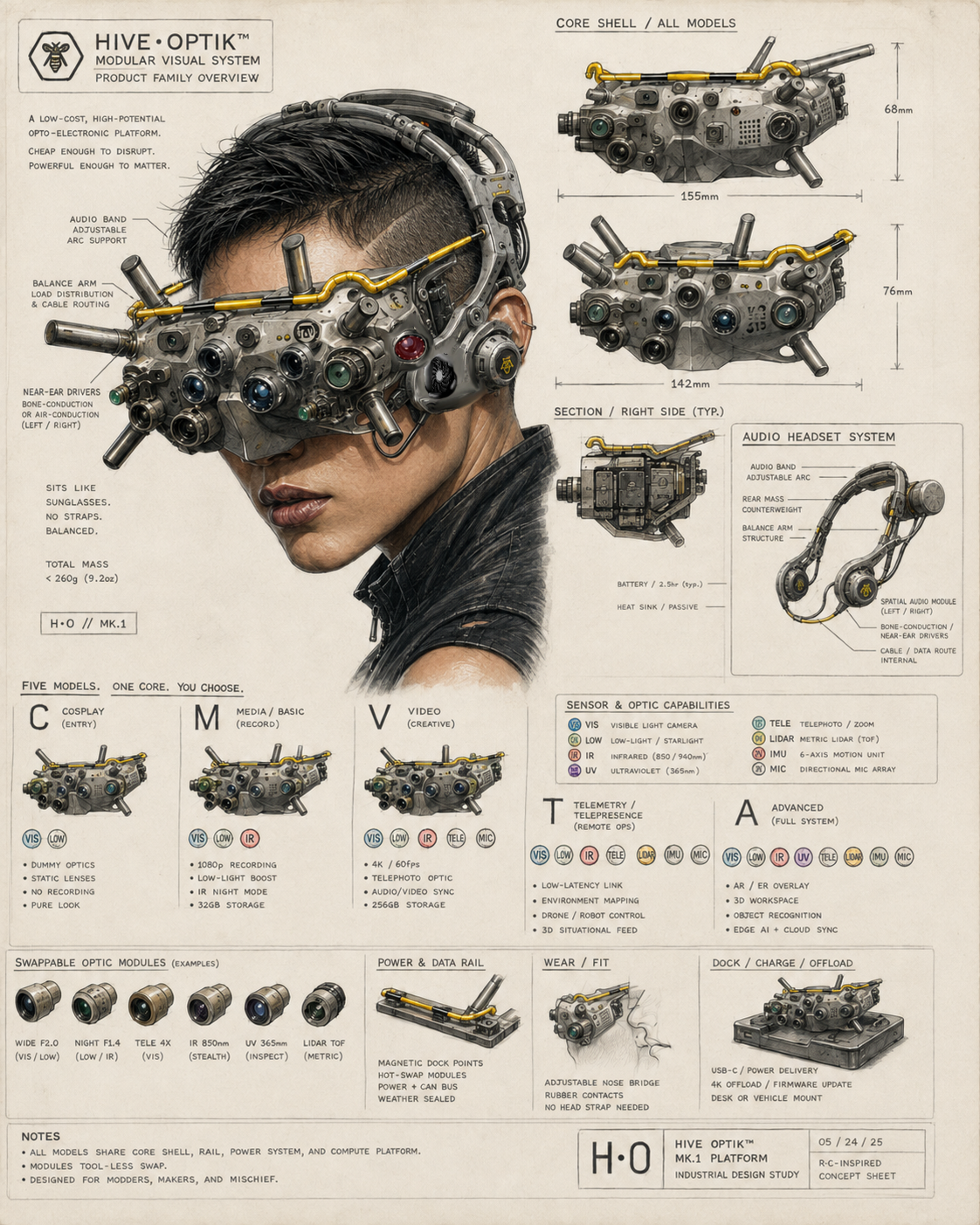
HIVE·OPTIK
The Glasshole Cambrian Explosion
The first HIVE·OPTIK was not a surveillance platform.
It was a joke.
That distinction would later become legally important.
The original C-model was a piece of aggressively over-designed cosplay eyewear sold by a Shenzhen vendor whose storefront also carried tactical umbrellas, titanium chopsticks, fake cybernetic knuckles, illuminated face masks, folding drones, and at least one device that claimed to “sterilize hostile frequencies.” The HIVE looked like eight cameras had been nailed to a pair of sunglasses by an engineer who had recently been divorced by ergonomics.
It sold out.
The joke was obvious. Google Glass had spent a decade being remembered as the canonical emblem of wearable technological social autism. The HIVE revived that cultural wound deliberately. You wore one to a convention, a warehouse party, a techwear shoot, a hacker meetup, or an expensive café where everyone had already seen too many people talking into AirPods.
Someone would ask if it was recording them.
You would say, “Recording? No. It’s sunglasses.”
And then the lenses would blink.
The C was dumb plastic, aluminum-colored polymer, mirrored inserts, passive prisms, dummy barrels, fake vents, an absurd yellow data rail, and enough visual menace to cause strangers to become self-conscious about their posture. It had no cameras. No microphones. No radios. No storage. The “wide aperture module” was tinted acrylic. The “spectral sensor” was a red bead.
It did, however, look expensive.
That was enough.
Within eighteen months, manufacturers discovered the dangerous truth about props: once a prop contains convincing representations of useful hardware, somebody will eventually replace the representations with useful hardware.
C: COSPLAY
The C remained the seed crystal.
Its entire purpose was appearance, and this gave it an advantage every later model struggled to retain. It was light. It did not need cooling. It did not need firmware. It could be dropped down stairs, repainted, stickered, drilled into, modified, glued to horns, sewn into a hood, or mounted on a mannequin.
The optics were partly functional in a deliberately stupid way. Tiny passive periscopes allowed a wearer to peer through several offset apertures, producing fractured little slices of peripheral space. Nobody would mistake the result for normal vision. That was part of the charm.
It was anti-AR.
Reality remained exactly where it was, but now you had to negotiate with it through a small industrial cathedral built across your nose.
Cosplayers started replacing the dummy components. Makers fitted LEDs. Photographers installed pinhole cameras. Drone hobbyists stuffed receivers into the temple housings. Musicians ran audio cables through the balance rail. Somebody in Osaka replaced the fake ear modules with a home-built binaural microphone array and accidentally produced an excellent field-recording rig.
Then came the M.
M: MEDIA
The M was the first version normal people could plausibly use every day while maintaining a straight face.
It paired with a phone. It had six-channel spatial audio, voice calling, streamed music, private video, notifications, simple head tracking, and transparent microdisplays close enough to the eyes to produce floating interface elements without pretending to be full augmented reality.
The manufacturer advertised it as a “personal audiovisual environment.”
Everyone else called it FacePods.
The rear audio arc mattered enormously. Instead of hanging conventional headphones from the sides of the skull, the HIVE carried part of its mass over and behind the crown. Batteries, amplifiers, and driver hardware could therefore sit behind the head, balancing the ridiculous optical façade at the front. The wearer looked like a diagram had escaped from an aerospace contractor.
The M also introduced one feature which manufacturers initially regarded as trivial and users regarded as magic: selective presence.
A microphone array could isolate a conversation partner from surrounding noise. The displays could darken peripheral clutter. Ambient audio could be attenuated. The outside world could be made less demanding without being completely removed.
This immediately made the HIVE popular on trains.
Porn was, predictably, an early killer application.
An entire etiquette emerged around whether somebody wearing an M was present, telepresent, working, asleep, watching a movie, reading subtitles, having a call, or consuming something nobody wanted to know about.
The sentence “Sorry, I wasn’t looking at you” became socially ambiguous in several new ways.
V: VIDEO
The V introduced cameras.
Civil society noticed.
The first V was not particularly frightening. Smartphone-quality wide-angle cameras, basic stabilization, eye-line recording, livestreaming, simple zoom, automatic horizon correction, and a few outward-facing status lights that supposedly indicated when capture was active.
The trouble was not that the V could record.
Everything could record.
The trouble was that the HIVE pointed where the wearer looked.
Handheld cameras announce intention. Phones must be raised. Conventional body cameras are visibly cameras. The V converted ordinary attention into cinematography.
A person could walk through a protest, exhibition, nightclub, auction, campaign office, courthouse lobby, police station, or private party while producing an exceptionally coherent visual record simply by behaving normally.
Journalists loved them. So did streamers, cyclists, mechanics, tourists, documentary makers, activists, creeps, security guards, police officers, insurance investigators, burglars casing buildings, and people documenting encounters because they no longer trusted anyone’s description of what had happened.
The political argument began almost immediately.
Then the T arrived and made the V controversy look quaint.
T: TELEMETRY / TELEPRESENCE
The T did not merely record space.
It measured it.
Metric LiDAR continuously built a local three-dimensional model. Wide-field cameras textured that model. An inertial unit tracked the wearer through it. Low-light sensors extended useful vision after dark. Infrared channels produced translated spectral overlays. Ultraviolet sensing revealed materials and markings otherwise difficult to distinguish. Telephoto optics pulled distant details forward.
The world became a dataset.
Walk into a room wearing a T and the room could become geometry: walls, openings, tables, windows, ceiling height, door width, furniture positions, major objects, human movement paths, approximate distances.
The terrifying element was not any single sensor. It was synchronization.
A video frame knew where it had been captured. A sound knew roughly where it originated. A face existed at a particular coordinate inside a room mesh. An object could be tagged and encountered again. A doorway could be recognized from a previous visit. The wearer’s own path could be reconstructed.
Telepresence emerged almost accidentally. Once the system possessed a live model of local space, a remote user could occupy a simplified version of that model. Technicians could guide workers. Friends could share environments. Designers could inspect rooms. Drone operators could fly through an integrated spatial map while keeping their hands free.
Gaming developers immediately weaponized architecture.
Your apartment became a dungeon.
Your office became a stealth map.
Your neighborhood became a persistent multiplayer level.
The HIVE ceased to be something you looked through.
It became something that interpreted where you were.
A: ADVANCED
The A was where respectable reviewers stopped laughing.
It contained substantial local compute, an AI assistant, a spatial operating environment, office applications, indexing, retrieval, gaming, media production, environmental analysis, object recognition, scene memory, and enough storage to preserve a person’s life in unnervingly searchable fragments.
The desktop no longer lived on a rectangular screen.
It lived in space.
Documents could occupy the wall to your left. Communications floated near the ceiling. A simulation might occupy the table. HoloWiki annotations could attach information to physical objects. A machine in front of you might acquire floating maintenance history. A building could display public records. A product could carry reviews, repair instructions, provenance, warnings, price histories, or arguments.
More importantly, the A remembered.
Not perfectly, and not innocently.
“Where did I last see the blue case?”
“Which café had those chairs?”
“Show me the room before the renovation.”
“Find the person I spoke to after the lecture.”
“Which shelf was that book on?”
“What changed in this workshop since Tuesday?”
The AI could search spatial experience rather than files.
A generation raised with search engines suddenly possessed search over memory-adjacent reality.
Private servers became popular precisely because nobody wanted this archive living inside an advertising company.
That did not stop advertising companies from trying.
THE SPY-SHOP ECOSYSTEM
Once millions of HIVE-compatible face rigs existed, an accessory market appeared. Most accessories were harmless. Some were useful. A small number were the kind of products that arrived in matte-black boxes with terrible translations and made lawyers begin speaking very slowly.
The following were all sold, banned, renamed, exported, re-imported, copied, litigated, or denied to exist at various times:
- Whisperglass directional audio module. A narrow listening accessory capable of isolating distant speech more effectively than the standard microphone array. Journalists called it transformative. Privacy advocates called it a lawsuit with a battery.
- Thermal Wake. A sensor that highlighted recent heat differences on surfaces: seats, handles, machinery, engines, recently occupied spaces. Private investigators adored it for approximately six months before several jurisdictions regulated it.
- CrowdThread. Software that assigned temporary anonymous identifiers to people moving through a scene and reconstructed where those tracks had crossed previously recorded spaces. Officially it did not identify anyone. Unofficially, everyone understood the next step.
- PaperGhost. A specialist imaging module designed to enhance faint markings, overwritten notes, erased whiteboards, damaged labels, altered packaging, and other low-contrast surfaces. Archivists wanted it. Fraud investigators wanted it more.
- Signal Weather. A passive RF visualization layer which showed the wearer that nearby wireless activity existed and roughly how dense it was. The harmless version looked beautiful. The less harmless aftermarket versions produced diplomatic complaints.
- Long Eye. An absurdly compact telephoto module that transformed the HIVE silhouette from “eccentric eyewear” into “please stop looking at my apartment.” Birdwatchers were blamed for its existence.
- Black Orchard. A low-light enhancement package tuned for extremely dark environments. It became popular among cave explorers, urban explorers, wildlife researchers, security personnel, and people whose explanations became noticeably less convincing after midnight.
- Spectral Paintbox. A user interface that translated infrared and ultraviolet information into selectable false-color palettes. Artists produced magnificent work with it. Building inspectors discovered unexpected uses. So did counterfeit investigators.
- Roomprint. A one-touch spatial capture mode that froze a local LiDAR reconstruction for later inspection. Estate agents loved it. Architects loved it. Burglary investigators hated how much burglars loved it.
- EchoTag. A forensic audio notebook that let users mark moments in a recording and later retrieve associated spatial context. Civil-rights observers treated it as a defensive documentation tool. Police unions treated it as evidence that civilians had become extremely annoying.
- FaceLedger. The most controversial accessory ever released for the platform. It indexed recurring faces against date, time and location while leaving identity fields blank unless a user linked them manually or through an authorized database. That distinction satisfied almost nobody.
- Dead Reckoner. An offline navigation and scene-memory package designed to continue operating when positioning networks or cloud services disappeared. Disaster-response teams praised it. Intelligence services immediately became interested for completely different reasons.
- Afterimage. A scene-comparison module that remembers what changed between visits: furniture moved, cabinets opened, cables rerouted, signs replaced, unfamiliar objects introduced, doors left differently, stains appearing, panels no longer sitting flush. Maintenance crews use it for faults, conservators for artifacts, insurers for damage, investigators for continuity, activists for documenting altered barriers or police deployments, and landlords and employers for exactly the reasons privacy lawyers predicted. Its real power is embarrassingly simple: humans are terrible change detectors; machines are not. A room can lie to memory. Afterimage keeps receipts.
- Parallax. By combining several offset cameras and sensor apertures, Parallax reconstructs approximate depth, movement, and position even when something was never squarely centered in the wearer’s view. For AR it makes overlays cling properly to reality; for photographers it produces dimensional footage; for investigators it means a hand behind a doorway, a bag passing through a crowd, or a vehicle half-hidden behind pedestrians may still acquire a place, trajectory, and timestamp. Courts eventually encounter the unpleasant category of the “machine-inferred witness”: no single camera saw the event clearly, yet the combined geometry asserts that something occupied a particular place at a particular time.
- HushMap. Originally sold to improve spatial audio, HushMap learns a room through its acoustics: reflections, resonances, dead zones, open doors, closed windows, moving bodies, machinery and structural changes. Better headphones were the excuse; environmental inference was the consequence. Move a cabinet, open a corridor door, draw a curtain, start a hidden machine, and the acoustic fingerprint changes. Musicians adore it, building engineers find it useful, security companies find it hilarious, and civil-rights observers use it to document crowd-control sound and public-address systems. Consumer electronics quietly acquiring structural information about every room because somebody wanted better bass is exactly the sort of future nobody formally voted for.
- ColdRead. Absolutely, definitely, legally not a mind reader. ColdRead fuses visible imagery, thermal gradients, voice changes, posture, gaze direction, motion, and historical interaction patterns into deliberately cautious labels such as AGITATION TREND: RISING, ATTENTION SHIFT: LEFT, or VOCAL STABILITY: DEGRADED. Negotiators buy it, police demand it, dating companies touch it once and recoil, and scientists spend years explaining that physiology is contextual and ambiguous while marketing departments put enormous “READ THE ROOM” slogans above microscopic disclaimers. The frightening part is not that ColdRead truly knows what someone feels; it is that somebody wearing one may become convinced that it does.
- GhostTag. GhostTag assigns persistent anonymous tokens to recurring people, vehicles, bags, bicycles, drones and other moving entities without necessarily identifying them: P-0317, CAR-882, BAG-14. See the same anonymous track again and the HIVE quietly notes the recurrence: this person appeared near the station yesterday, this vehicle has crossed three previous recordings, this bag was previously associated with another track. Police call it privacy-preserving because it need not contain names; civil-rights groups point out that a stable anonymous identifier is already most of the way toward a dossier. Private investigators love it because coincidence becomes searchable. Intelligence agencies dislike the possibility that ordinary consumers may accidentally notice repetition they were not supposed to notice.
- Palimpsest. A surface-history tool combining oblique lighting, visible imagery, IR, UV, texture mapping and previous scene records to reveal that something has changed: a label removed, a wall repainted, a panel replaced, a sticker peeled off, handwriting erased, a package resealed, a symbol painted over. Conservators use it on paintings, archaeologists on inscriptions, mechanics on repairs, inspectors on buildings and journalists on inconveniently altered public spaces. It does not magically recover hidden information; it simply aggregates enough weak physical evidence that alteration becomes difficult to ignore. After several governments restrict it around sensitive facilities, the manufacturer rebrands the civilian version as the Heritage Edition, which convinces approximately nobody.
- Witness Chain. A provenance package for users who assume somebody will later claim their recording is fake. Witness Chain seals captured material together with timestamps, device state, spatial context and selected environmental measurements, then replicates the record to trusted destinations so later tampering is easier to detect. It does not prove that interpretation is correct; it strengthens the chain showing that particular data existed in a particular form at a particular time. Journalists, defense lawyers, human-rights observers and police departments all adopt incompatible versions. The deeper disruption comes when ordinary people can produce records with provenance once associated with specialized institutions. Official credibility no longer belongs exclusively to uniforms, letterheads and whoever owns the press conference.
- Memento. The feature that finally reveals what HIVE really became: retrieval over lived experience. Cameras, LiDAR meshes, audio, spectral layers, anonymous encounter tracks, object histories, maps, messages and annotations feed a private archive, and Memento lets the wearer ask ordinary questions: Where was I when I first saw this? Who stood nearest me? Have I seen this symbol before? What did this room look like last winter? When did that object move? Have this anonymous person and vehicle ever appeared together? Intelligence agencies stop treating HIVE primarily as eyewear because a user wearing one for years may accumulate something more unsettling than perfect memory: searchable memory. Human societies have always depended partly on forgetting. Memento makes forgetting increasingly optional. Its rejected advertising slogan survives anyway: THE PAST IS NOW A SEARCH FIELD.
None of these technologies needed to be perfect to alter behavior. People behave differently when they suspect perfect memory may exist. That became the HIVE’s true social effect.
THE MODELS THAT CAME AFTER
The product family did not stop at A.
The first unexpected branch was the R, nominally Recreation.
The R was designed for games, but developers discovered that players enjoyed seeing the real world transformed more than they enjoyed being removed from it. City streets became game boards. Historical reconstructions occupied ruins. Ghostly racing lines appeared on roads. Buildings displayed fictional interiors. Theme parks stopped constructing some scenery physically because sufficiently good overlays were cheaper.
Then came P, Professional.
P-series devices were boring, expensive, certified, rugged, and extraordinarily successful. Surveyors, engineers, emergency workers, industrial inspectors, conservators, surgeons, logistics staff and technicians adopted them because a machine capable of remembering exactly where something was had obvious value.
The J, Journalism model, was politically radioactive. Its defining feature was provenance. Media captured by a J could carry cryptographic evidence describing when and where it had been recorded and what transformations had subsequently been applied. In an era saturated with synthetic media, the ugly glasses became a kind of witnessing instrument.
Then somebody released the N.
Nobody agreed what N stood for.
Nomad. Night. Null. Network.
The N was optimized for operating without cloud dependency. Local models, local storage, local maps, local identity management, peer-to-peer synchronization. Governments disliked it for precisely the reasons privacy people loved it. It made the wearer difficult to disconnect without physically taking the device away.
The S was stranger.
S stood for Social.
It attempted to make people more socially competent by annotating conversation.
Names. Context. Previous meetings. Pronunciation reminders. Shared interests. Promises you had made. Topics somebody disliked. Whether you had already told this story.
It was marketed toward forgetful executives and socially anxious professionals.
Within a year, dating culture had declared war on it.
The E, Evidence model, never officially existed as a consumer device.
Everyone nevertheless knew what it was.
Tamper-resistant capture. Redundant local storage. continuous environmental logging. Independent timestamp sources. Secure remote replication. A record designed around the assumption that somebody might later attempt to seize, erase, alter, dispute, or discredit what had been witnessed.
Police hated civilian E-clones.
Activists hated police E-clones.
Lawyers loved both.
THE REALLY BAD IDEA
The most unsettling development arrived when sensor fusion became good enough that the device no longer needed users to consciously request analysis.
It simply noticed things.
A door had been opened since your last visit.
A vehicle had changed position.
Someone had removed an object from a shelf.
A person you had encountered three times before was standing across the street.
A building’s ventilation sound had changed.
A face showed unusual stress.
A room contained a new wireless emitter.
A license plate differed from yesterday.
A package had been resealed.
The HIVE had become an attention prosthesis.
This was the point where citizens, civil-rights organizations, investigators, police, intelligence agencies and politicians all became frightened for different reasons.
The state feared ubiquitous private observation.
Citizens feared ubiquitous state observation.
Corporations feared employees documenting workplaces.
Employees feared employers documenting employees.
Police feared crowds possessing synchronized evidence.
Crowds feared police possessing synchronized identification.
Politicians feared archival memory.
Private investigators feared everyone becoming a private investigator.
Spooks feared cheap consumer equipment reproducing capabilities that had once required specialized procurement.
And everyone feared the possibility that some stranger’s ridiculous AliExpress sunglasses had quietly noticed something they themselves had missed.
The great joke of the HIVE was that it remained a toy throughout all of this.
The C-model still existed.
Kids still wore them with cyberpunk jackets. DJs wore fluorescent versions. Fashion houses released polished titanium editions whose lenses did absolutely nothing. There were pink ones, transparent ones, gothic ones, brass ones, furry ones, biodegradable ones, anime collaborations, military parody editions, and an officially licensed children’s model with eight enormous plastic eyes.
You could still walk into a club wearing something that looked capable of mapping the entire building and truthfully say:
“It’s cosplay.”
The person staring at you would have no reliable way to know.
That ambiguity became the defining cultural property of the platform.
Not surveillance.
Not augmented reality.
Not media.
Not gaming.
Ambiguity.
The HIVE existed at the exact point where clothing became machinery and machinery became deniable as clothing.
The most advanced model could map a room, reconstruct an encounter, search a lifetime of spatial records, translate invisible spectra, operate drones, annotate the physical world, host a floating office, run games, identify objects, preserve evidence and quietly ask an AI what the hell you were looking at.
The cheapest model contained six pieces of tinted plastic and a fake screw.
They looked almost the same.
That was the product.
That was the joke.
And, eventually, that was the problem.