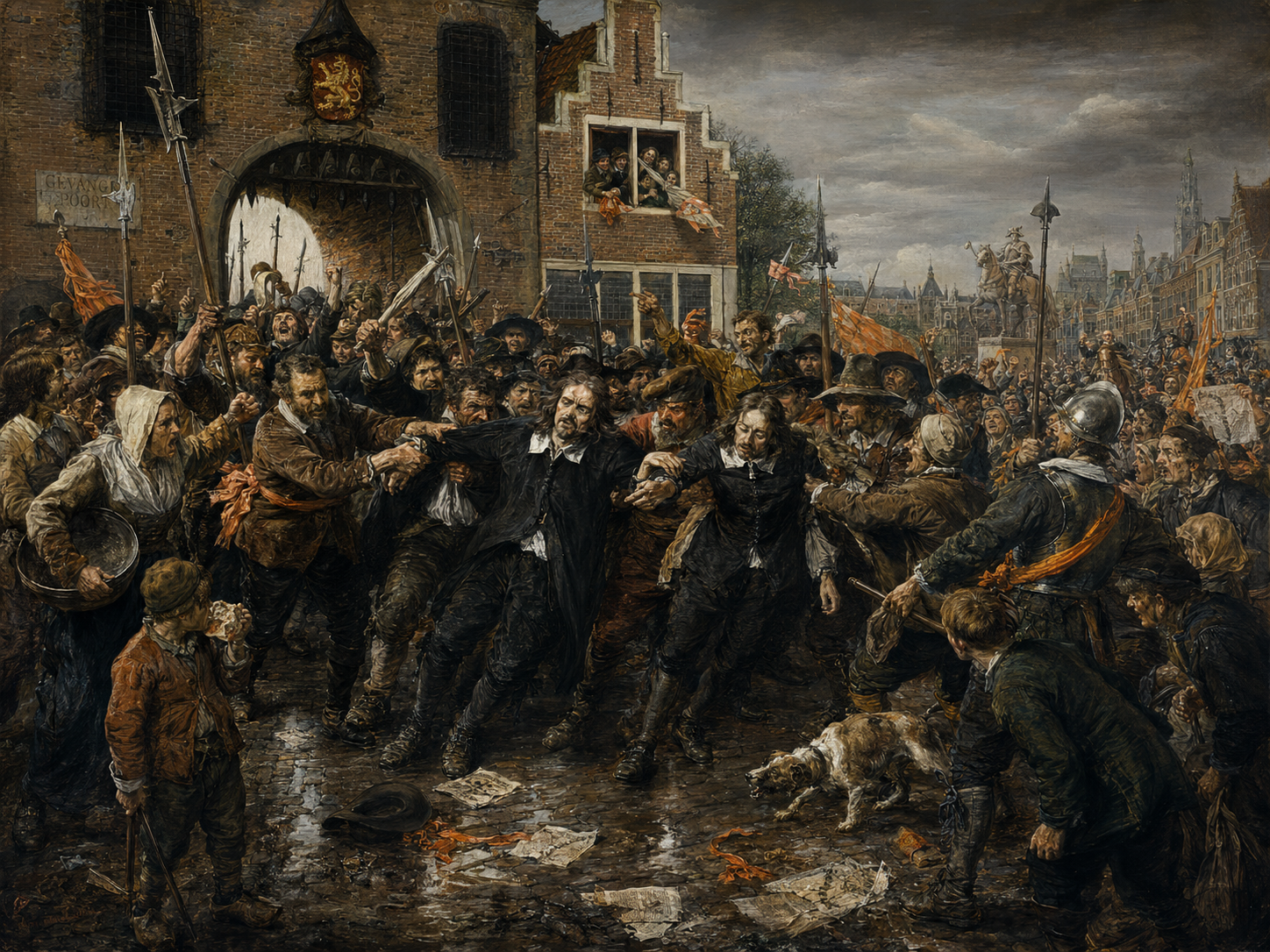
The De Witt brothers offer a fierce Dutch warning, but not the cheap folkloric version. Johan and Cornelis de Witt were not dictators toppled by a purified people. They were leading republican officeholders in a decentralized republic, destroyed in August 1672 by a convergence of military panic, pamphlet warfare, Orangist factionalism, rumor, and militia-backed street violence. The Rijksmuseum’s painting, the broadsides, the Gevangenpoort, the medals, and even the preserved tongue and finger all testify to the same thing: a state can become a butcher’s stall when fear decides that political rivals are traitors fit for public degradation.
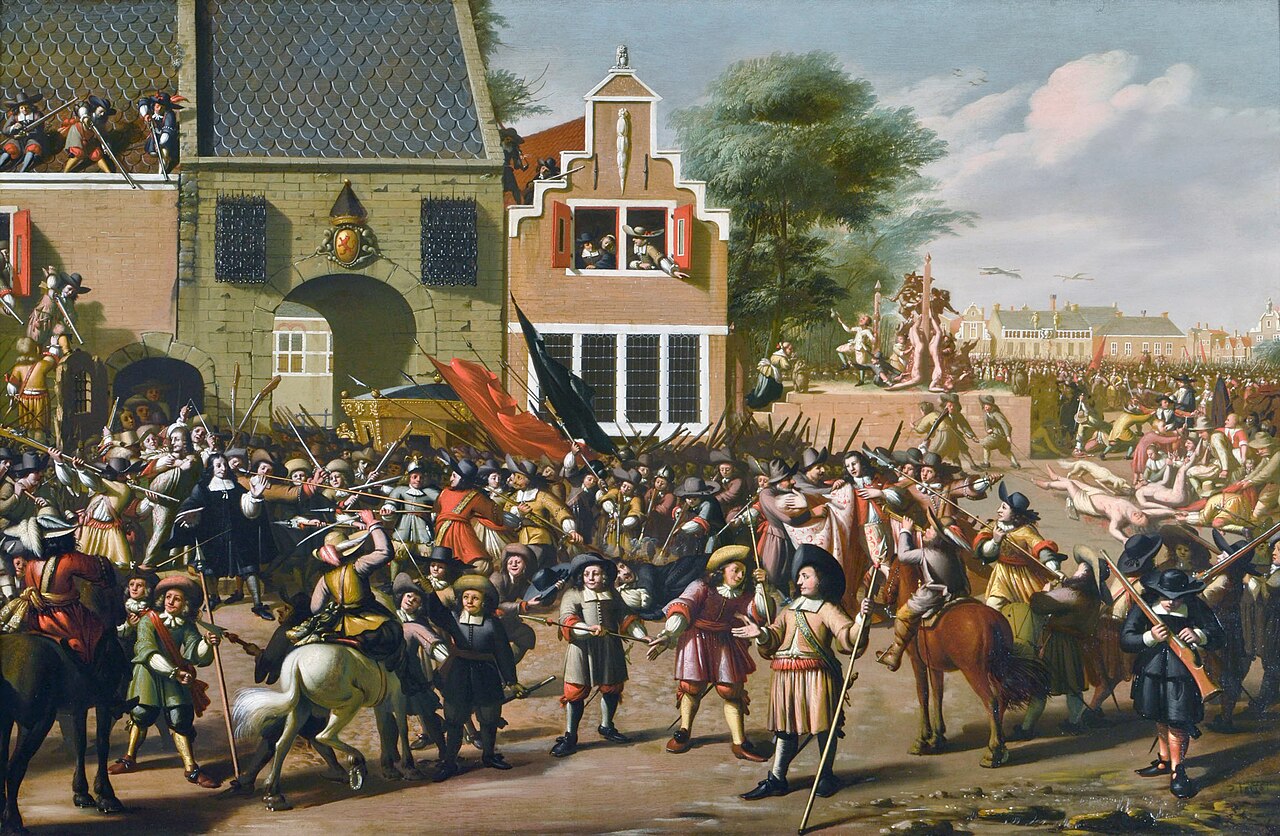
 Here’s the two fellas a bit later. That really happened. Interesting detail – as a kid I went to the dentist at de Groene Zoden, and I worked for a short while at an office at Number 6 in work related to de Betuwelijn. Yes I actually worked, however briefly. I also clearly remember having molly sex with my ex during Vampire Larp on that square at night. She cut me with a small razor and drank my blood (just minor cuts, nothing scary) and I sodomized her under that statue of Johan de Witt deep at night late 1990s, same spot where rabid crowds hung his eviscerated corpose upside down a few centuries earier. Our endeavours seem strangely respectful in retrospect
The object lesson corrected
The first correction matters because it changes the lesson. The Dutch Republic was not a monarchy with a single sovereign at its apex. It was a federation of seven provinces whose assemblies represented towns and landed nobility, with weak central taxation, strong provincial authority, and politics perpetually tugged between Holland’s regent class and the House of Orange. Johan de Witt, as Grand Pensionary of Holland, was immensely powerful, but he governed inside a system built on distributed authority rather than on dictatorship in the modern sense. That decentralized system functioned precisely because power was divided and because no single center could easily swallow the rest.
That is why the De Witt murders should not be romanticized as a popular antidote to tyranny. The immediate political beneficiary of the crisis was William III of Orange, who emerged in 1672 at the head of government and would dominate Dutch politics thereafter. The mob did not abolish arbitrary power; it cleared the stage for a stronger, more centralized Orange ascendancy. Read this way, the episode is not a triumph of liberty but a demonstration of how anti-elite fury can be harvested by ambitious power.
The furnace of the Rampjaar
The year 1672 was the Rampjaar, the Disaster Year, and the mood was as unstable as dry timber in a lightning storm. France invaded from the east, England attacked at sea, and the bishoprics of Münster and Cologne pressed in as well. By late June the crisis was catastrophic; scholarship on state communication in 1672 notes that within four weeks of the invasion the provinces of Utrecht, Gelderland, and Overijssel were already lost, while Leiden historians summarize the republic’s condition as desperation at the level of government, people, and country alike. The famous Dutch triad captured the feeling: the people were redeloos, the government radeloos, and the country reddeloos—irrational, distraught, and beyond rescue.
French cannon battered the frontier, but pamphlets battered legitimacy even more effectively. From June onward, writers charged the De Witts and their allies with corruption, cowardice, bribery, military negligence, and even treason; one scholarly survey cited in Oxford’s chapter on 1672 identifies at least 1,600 pamphlet editions flooding the public sphere that summer. Leiden University’s reportage on the De Witt correspondence adds that supporters of the prince waged a smear campaign depicting Johan as responsible for everything that had gone wrong. In other words, the body politic was marinated in accusation before blood was ever spilled.
The campaign tightened with brutal precision. Johan de Witt was wounded in an assassination attempt on 21 June. Cornelis was arrested on 24 July, accused of plotting against William III, and—according to museum and university summaries—tortured without confessing. Johan resigned as Grand Pensionary on 4 August. On 20 August Cornelis was sentenced to exile or lifelong banishment, depending on the account’s phrasing, and Johan went to the Gevangenpoort to fetch him. Meanwhile, William’s allies were not neutral spectators. Oxford’s study of the year notes that William’s circle helped intensify the pamphlet offensive, that William publicly refused to protect De Witt against slander, and that an incendiary letter from Charles II blaming the “Loevestein” faction was printed on 15 August—five days before the brothers were killed.
The afternoon at the Gevangenpoort
The day itself, stripped of melodrama and told as soberly as the evidence allows, is dreadful enough. Johan arrived at the Gevangenpoort in The Hague to collect his brother after sentence. A rumor spread that Cornelis would be allowed to escape. That rumor did what a spark does in a powder room. According to the Hague Historical Museum, the arrival of Johan and the whisper of an escape drew an angry crowd; according to the National Archives and the museum’s history of the murder, schutters and furious citizens gathered around the prison, rejected the sentence as too mild, and eventually dragged the brothers outside.
What followed was not merely a riot but a civic unhousing of restraint. Oxford’s study stresses that in many Dutch towns the unrest of 1672 was not the work of a criminal underclass alone; it involved broad middling groups of respected citizens, and it specifically identifies the lynching of the De Witts in The Hague as one of the most shocking spectacles of murder and mutilation in that crisis. This matters. The square was not filled only with outcasts. It was filled with neighbors, militia men, tradesmen, and the respectable face of panic. That is what makes the scene feel so Brueghelian and so terrible: not chaos without society, but society itself learning how quickly it can impersonate a gallows.
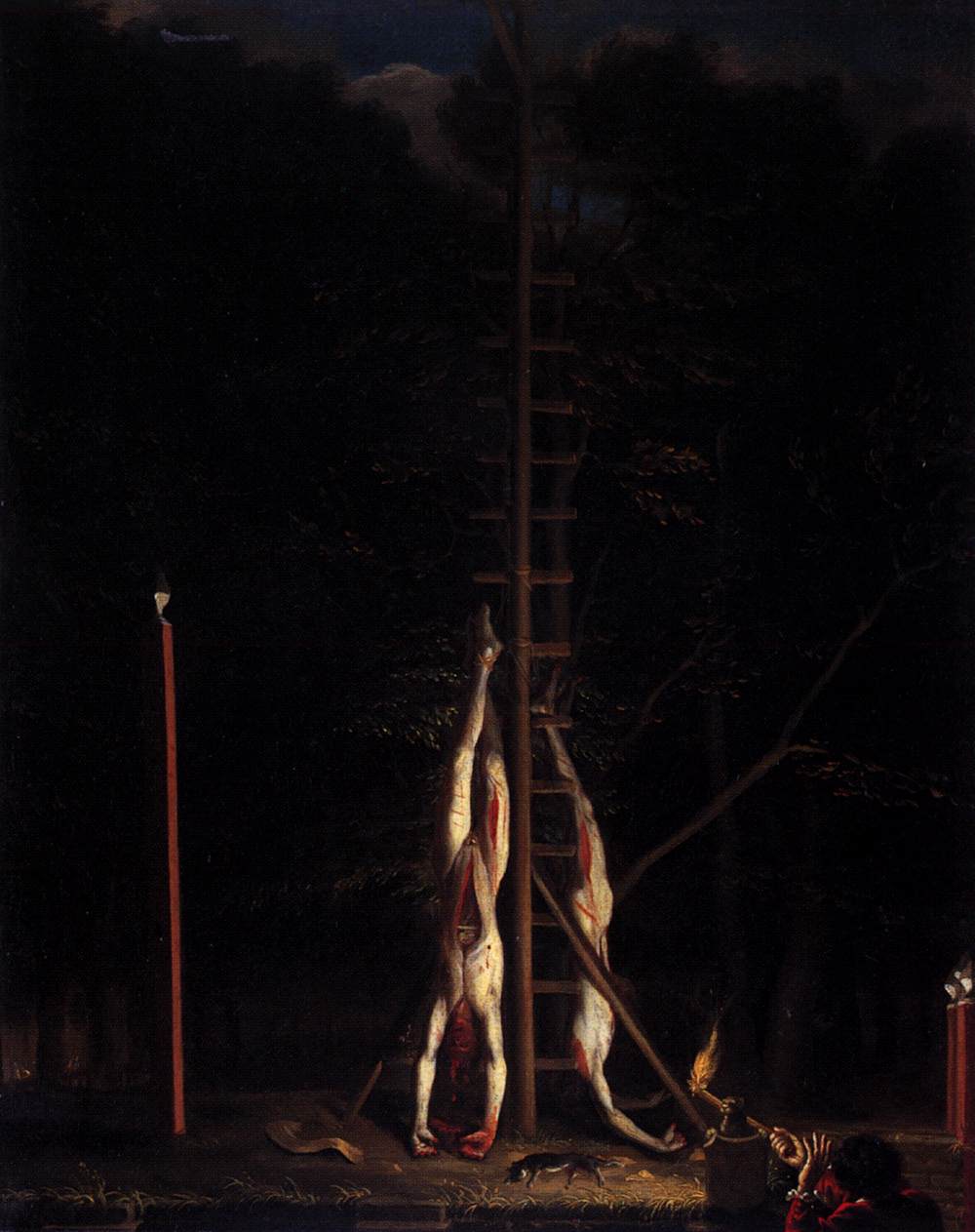
The brothers were killed and their bodies carried to the Groene Zoodje, the scaffold near the prison. There they were hung upside down on the wip, an inversion that art historians describe as a ritual act with strong symbolic force. The Rijksmuseum’s object text and related scholarship agree that Jan de Baen’s canvas shows their mutilated bodies on public display there, and the inscription recorded on the painting claims the scene was captured “from life” while the bodies were still hanging late that evening, around eleven o’clock. Whether taken as literal reportage or as a painterly boast of immediacy, the inscription captures the appetite of the hour: politics had become a market for instant atrocity.
The degradation did not end with display. The Gevangenpoort’s own account says limbs and scraps of clothing were auctioned off to bystanders for small sums, that pieces were later displayed in pubs, and that some remains were dried or preserved. The Hague Historical Museum likewise records the sale of fingers, ears, and toes to onlookers. Scholarly writing on the painting and the pamphlet aftermath adds a necessary note of caution: mutilation and trophy-taking are securely attested, while the oft-repeated story that flesh was eaten belongs partly to sensational contemporary and later reporting and is best described as alleged, not as the single uncontested fact of the case. That distinction matters, because history is already grisly enough without leaning on every lurid echo.
The visual afterlife
The visual archive did not simply record the event; it processed it, sharpened it, and turned it into political memory. Before the brothers themselves were destroyed, a furious crowd in Dordrecht had already attacked Jan de Baen’s triumphant image of Cornelis de Witt at Chatham—a rehearsal in painted form for the destruction of the men. After the killings, prints, medals, and memorial devices multiplied. Art historian Frans Grijzenhout goes so far as to describe the hanging bodies as an “inverse political double portrait”: the state portrait turned inside out, office converted into carrion, glory reversed into warning.
The historical record is better than invented pastiche. It begins with composed portraits of Johan and Cornelis in black silk and official poise, passes through broadsheets that place dignified likenesses above the scene of butchery below, and ends in relic containers, medals, and memory sheets. The mood is not modern horror but municipal dusk: brick, torchlight, white collars, militia sashes, a scaffold half absorbed into the architecture of ordinary civic life. The cruelty is all the more powerful because it borrows the staging of respectable urban order. That synthesis is borne out by the surviving portraits, prints, and the Gevangenpoort’s relic narratives.
The afterlife of the remains is among the strangest parts of the story. Supporters of the brothers preserved Johan’s tongue and a finger associated with Cornelis as secular relics. The Gevangenpoort and the Hague Historical Museum both recount that these fragments were kept with explanatory notes, at one stage housed in a precious silver box engraved with the murder scene, and eventually displayed in museum collections. The Hague museum adds that forensic study in 2011 could not produce a DNA profile but did indicate that the finger had been forcibly removed from a male body dating to 1672 and belonging to a man in the right age range. Even after all the myth, there remains matter. Even after all the rhetoric, there remains bone and tissue in a box.
Then came the curtain. Grijzenhout notes that on 27 September 1672, on the explicit wish and recommendation of the Prince of Orange, the States of Holland declared that everything concerning the recent unrest and rebellions “must be and must remain forgotten and forgiven.” That general amnesty is as important as the murder itself. Violence had done its work. Official forgetfulness moved in afterward like a stagehand pulling drapery over a bloodied set.
Why strongmen often stumbled in the Netherlands
If one asks why the Netherlands, compared with many European neighbors, has often been difficult terrain for durable one-man domestic rule, the answer is more constitutional than temperamental. The Dutch Republic grew out of the Union of Utrecht, a pact that became the foundation of the republic and left primary force in the provinces. Britannica and Oxford both emphasize the same structural point: the United Provinces were decentralized; the States General lacked straightforward direct-tax powers; major decisions operated under unanimity; and the political seesaw between Holland and the House of Orange prevented either side from effortlessly swallowing the whole system. The republic was not democratic in the modern sense, but it was stubbornly plural in its centers of power.
That old structure did not create liberty by itself, and it certainly did not prevent authoritarian episodes. Britannica describes King William I in the early nineteenth century as a kind of “enlightened despot” who resisted parliamentary expansion and liberal principles. So the Dutch story is relative, not innocent. But the long-term trajectory bent away from personal rule. In 1848 William II signed a constitutional revision that sharply curtailed royal power; the Canon of the Netherlands, Government.nl, and Radboud University all describe this as the foundation of Dutch parliamentary democracy, with ministerial responsibility shifting accountability from monarch to ministers and parliament.
Modern Dutch politics compounds that anti-monopolistic habit. The House of Representatives describes the Netherlands today as a parliamentary democracy, while Britannica notes that proportional representation allows parties to gain seats with very small vote shares, producing a fragmented parliament and normalizing coalition government. That does not eliminate demagogy or political crisis, but it does make it institutionally harder for a single figure to rule alone for long. The country’s strongest anti-tyrant tradition is therefore not a folk memory of lynching. It is a machinery of divided sovereignty, cabinet responsibility, parliamentary scrutiny, and coalition bargaining.
The usable lesson
So what is the real lesson if the subject is “how to deal with tyrants”? It is not to mythologize the mob. The De Witt case shows how quickly a republic can teach itself to confuse emergency with permission, libel with truth, enemy with neighbor, and public justice with sacrificial theater. The brothers were first made into symbols, then into prey, then into relics, and finally into something the authorities preferred to “forget and forgive.” The men who profited politically were not the dead republicans but those who survived the storm and inherited the apparatus of state.
The durable Dutch answer to concentrated power lies elsewhere. My inference from the historical pattern is that the more effective anti-tyrant repertoire is slower, colder, and less theatrical: disperse authority; keep ministers answerable; force public argument through representative institutions; tolerate multiple parties and centers of power; refuse to let rumor become governance; and never let constitutional conflict become a carnival of bodily revenge. The De Witt brothers are unforgettable not because they teach how noble it is to tear down a supposed despot, but because they show how a frightened polity can mutilate its own laws before it mutilates its victims.