Executive summary
There is strong evidence of a recent intensification in visibility, production speed, and cross-platform circulation of hyper-empowered female infernal and vigilante imagery across AI-native platforms and adjacent art communities. The exact global size of the phenomenon cannot yet be measured as a single platform-wide census, but the convergence is clear: open model hubs and creator tools now make it cheap to generate demon queens, succubi, “dark feminine” Lilith figures, female demon hunters, and female Punisher variants; meanwhile, mainstream culture has supplied catalytic franchises and aesthetics such as Diablo IV’s Lilith, “succubus chic,” “dark feminine energy,” and the breakout success of KPop Demon Hunters. Official platform releases from TikTok, Meta, and YouTube since 2024 have also lowered the barrier from still image to short AI video, which materially changes scale and discoverability.
The evidence below shows that the motif is not one thing. It is at least four overlapping archetypes: the infernal seductress; the demon hunter / avenging warrioress; the female Punisher / punitive vigilante; and the celestial or divine combat heroine. On AI-native platforms, these are not just isolated artworks; they become reusable templates, LoRAs, prompts, and video formats with visible run counts and remixability. In a directional, linked sample documented in this report, infernal coding dominated, while punishment, hunting, sovereignty, and seduction repeatedly co-occurred.
The most rigorous explanation is not that the internet suddenly invented a new type of woman. Rather, older visual lineages—succubus folklore, the “monstrous feminine,” female vigilante narratives, and 1990s “bad girl” comics—have been recombined with generative AI affordances, mainstream fandom spikes, short-form video distribution, and a broader online discourse around women’s rage, dark femininity, and sovereignty. That mix produces images that can read simultaneously as empowerment, cosplay, erotic fantasy, revenge script, and aestheticized politics. This ambiguity is the phenomenon’s appeal, and also its risk.
Evidence from recent public examples
This report uses a purposive English-language public sample from roughly the last three years, drawing on accessible post pages, search-result snippets, model cards, tag pages, and official platform announcements. Exact dates are used where public pages exposed them; where only relative dates were available, I normalize them cautiously from the May 2026 reference date and mark them as approximate. The sample is meant to document the phenomenon transparently, not to claim a complete census.
Platform |
Public-facing audience logic |
Public metrics and controls |
What it means for this motif |
|---|---|---|---|
DeviantArt |
Large legacy art community with over 100 million registered members and more than 650 million artworks; DreamUp is integrated into the platform. |
Favourites, views, tags, comments, and AI-generation features are visible; users can suppress AI content, while DreamUp policies prohibit pornographic and violent generations. Linked source |
Useful for tracking the blend of human-made fantasy art and AI-assisted/fan-art variants. |
Tensor.Art |
AI-native model-sharing and image/video generation site focused on checkpoints, LoRAs, workflows, and generated posts. |
Model pages publicly expose runs, stars, downloads, upload dates, and base models. Linked source |
Best place to see when a visual archetype has become a repeatable recipe rather than a one-off artwork. |
Sketchfab |
3D-model sharing community; by late 2022 it reported 10 million members and 5 million models. |
Tag pages and model pages expose views, likes, downloads, AI-generation flags, and publish recency. Linked source |
Useful for CGI / game-asset manifestations of demon queens, hunters, and armored antiheroines. |
YouTube |
Mass-reach narrative and short-video distribution platform. |
Official synthetic-content disclosure tools exist, and YouTube is adding creator-side AI video tooling for Shorts. Linked source |
This is where still-image archetypes become animated myths, trailers, and “AI cinema.” |
Newgrounds |
Human-creator community built around art, games, animation, and fandom. |
Art pages expose upload date, views, faves, votes, and tags; Art Portal rules ban AI-generated art. Linked source |
A valuable comparison platform because demon queens and hunters are present here too, but without AI-native generation economics. |
| Timestamp | Platform | Creator / account | Example | Why it matters | Linked source |
|---|---|---|---|---|---|
| Apr. 24, 2023 | DeviantArt | Darkenaz | Demons | Tags include demongirl, succubusgirlwarrior, and warrior, showing demonized femininity linked to combat identity. | Linked page |
| Dec. 23, 2023 | DeviantArt | OdysseyOrigins | Forest Enchantment: Succubus Allure | Description emphasizes “captivating succubus,” “seductive charm,” “alluring presence,” wings, fractal energy, and cinematic framing. | Linked page |
| Jan. 20, 2024 | DeviantArt | PowerGoofy | Female Punisher | Explicit female-Punisher fan art; page states it was created using AI tools. | Linked page |
| May 6, 2024 | Newgrounds | Cronaxxx | Demon Hunter | Straightforward demon-hunter illustration showing the avenger / huntress strand. | Linked page |
| Aug. 18, 2024 | Newgrounds | StoneRex | Demon Queen | Compact but clear “demon-girl” + queen framing in a fandom art portal. | Linked page |
| Dec. 21, 2024 | DeviantArt | Thekobs | The Punisher – Marvel 2 | The description calls her the “fiercest vigilante,” “bold, unrelenting, and unstoppable,” and the page says it was created using AI tools. | Linked page |
| Dec. 30, 2024 | Newgrounds | ForgeFrog | Demon Hunter | Tagged as “badass knight,” then frontpaged in Jan. 2025, showing audience traction for the hunter variant. | Linked page |
| May 5, 2025 | Tensor.Art | Jack | Demon Queen Lilith | A dedicated Lilith LoRA with public run counts shows the archetype as reusable AI infrastructure. | Linked model |
| Nov. 7, 2025 | Tensor.Art | 更年期的白菜 | Succubus Transform | An Img2Video LoRA with 8.9K–11K public runs, demonstrating high repeat generation of succubus transformation clips. | Linked model |
| Oct. 5, 2025 | YouTube | Secret Stories by Isa | Lilith – Live From Hell – Short AI Movie | Explicitly branded “Dark Feminine AI Cinema,” made with Kling.ai and OpenArt. | Linked video snippet |
| ~Oct. 2025 | YouTube | AI film channel | DANCE OF SHADOWS | The trailer says a succubus emerges from a crow, claims the city as her domain, and treats people as prey. | Linked video snippet |
| Dec. 18, 2025 | Newgrounds | Nymse | Succubus | Tags include batwings, demoness, horned-girl, and succubus. | Linked page |
| Dec. 22, 2025 | Newgrounds | dhumos | Succubus | Tags include horns, skulls, throne, and succubus, concentrating the infernal-sovereign look. | Linked page |
| Early 2026 | Sketchfab | ItsKrish7 | Dark Fantasy Demon Queen | Publicly surfaced as a popular model on Sketchfab’s dark-fantasy and demonic tag pages with roughly 17.4K–17.7K views. | Linked model and tag pages |
| Mid-2023 | YouTube / official music video | Halsey, SUGA, Blizzard tie-in | Lilith (Diablo IV Anthem) | Mainstream bridge example: infernal femininity is fused with blood/rage language in an official franchise campaign. |
The visible surface area is broader than these examples suggest. DeviantArt’s succubusart tag page publicly lists clusters of works such as Succubus on the Prowl, Succubus Emerging From Fire, Succubus Closeup, and Forest Enchantment: Succubus Allure; Behance’s female warrior search returns 10,000+ results; Sketchfab’s dark-fantasy and demonic tag pages prominently feature “Dark Fantasy Demon Queen,” “Dark Fantasy Witch Empress,” “Dark Valkyrie Queen,” and adjacent infernal sovereigns. These are rough public signals, not clean longitudinal counts, but they point in the same direction.
Themes, motifs, and language
A directional hand-coding of the 15 linked examples above, using only public titles, tags, and visible snippets, shows how concentrated the vocabulary is. This is not a machine-vision study of all images; it is a transparent coding of the textual metadata attached to the examples. The point is not exact population inference, but visible patterning.
| Marker in the linked sample | Share of sample | What it usually looks like |
|---|---|---|
| Explicit infernal coding | 12 of 15 | “Succubus,” “demon,” “Lilith,” “live from hell,” “demon queen,” “demon hunter.” |
| Hunt / vigilante / Punisher framing | 5 of 15 | “Punisher,” “demon hunter,” rooftop vigilantism, hunter-versus-prey narratives. |
| Sovereignty or divinity markers | 5 of 15 | “Queen,” “Lilith,” “goddess,” throne imagery, ruler language. |
| Seduction / temptation language | 4 of 15 | “Allure,” “captivating,” “temptation,” “deadly beauty,” “mesmerizing.” |
| Explicit punitive or violent language | 5 of 15 | “Punisher,” “prey,” “dark power,” blood, obsession, destruction. |
| Stated supernatural signifiers | 5 of 15 | Wings, horns, skulls, throne, aura, fractal or infernal energy. |
The language clusters around five semantic poles. The first is seduction: “allure,” “captivating succubus,” “mesmerizing gaze,” “temptation,” and “deadly beauty.” The second is sovereignty: “queen,” “divinity,” “goddess,” and “Lilith” as a mythic proper noun rather than just a character name. The third is punishment: “Punisher,” “hunter,” “prey,” “retribution,” and “unrelenting.” The fourth is energy and transformation: fractal energy, live-from-hell spectacle, “ultimate dark power,” and image-to-video “transform” models. The fifth is insurgent rage, which appears less often as a stable tag than as trailer speech or music-video phrasing: rebellion, vengeance, and the lyric fragment “I taste blood.”
The female Punisher strand is smaller than the succubus / demon-queen strand, but analytically important. It acts as a bridge between crime-vigilante iconography and feminine-coded empowerment aesthetics. DeviantArt pages for Female Punisher and The Punisher – Marvel 2 show that artists and AI-fan-art makers are already explicitly feminizing the Punisher emblem, while Tensor.Art and Sketchfab expose adjacent prompt and 3D-object variants such as “FEMALE PUNISHER” and “Punisher Top for Female.”
Cultural drivers
The strongest immediate driver is technical affordance. Open model-sharing and personalization ecosystems have made niche archetypes highly reproducible. Tensor.Art exposes this directly through public run counts on models such as Succubus Transform and Demon Queen Lilith. More broadly, recent scholarship on CivitAI shows how open text-to-image ecosystems scale template reuse: the Civiverse study found a “predominant preference” for explicit content and semantic homogenization, while Wagner and Cetinic’s 2025 analysis of more than 40 million images and over 230,000 models found a disproportionate rise in NSFW content and exploitative, misogynistic patterns on the platform.
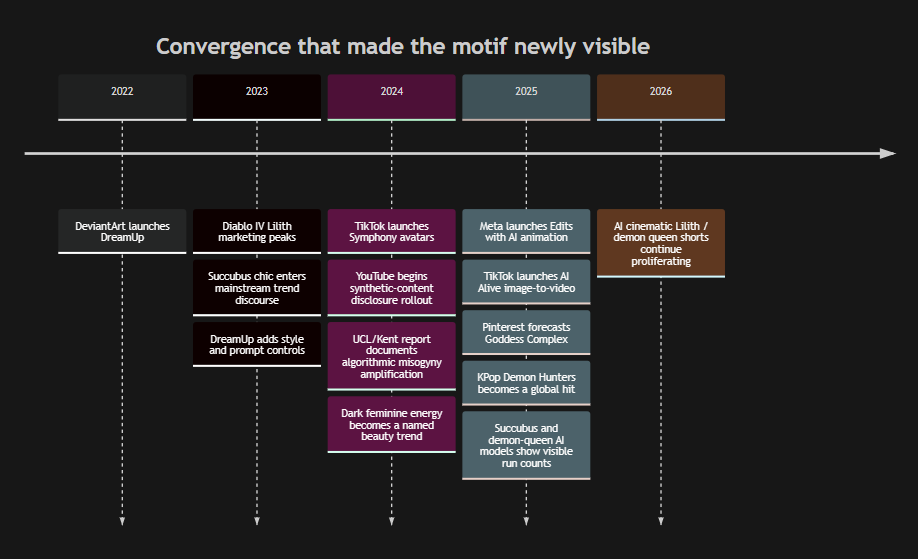
The second driver is toolchain compression. TikTok’s Symphony suite and AI Alive, Meta’s Edits app and image/video animation tools, and YouTube’s growing AI-tool stack for creators all reduce the cost of taking a still fantasy image and turning it into a short, soundtrack-ready, algorithmically distributable clip. This matters because the demon queen or avenging hunter is an ideal short-form figure: instantly legible silhouette, bright energy effects, emotional compression, and high recognizability even without story setup.
The third driver is fandom and franchise spillover. Diablo IV put Lilith back into mainstream visual circulation, not only through release trailers but through the official Halsey/SUGA anthem, which paired infernal femininity with blood, corruption, and destructive self-assertion. In 2025, KPop Demon Hunters then provided a mass-market, female-led demon-hunting myth that became one of Netflix’s biggest phenomena. These franchises expand the legitimate visual vocabulary that fan artists, AI model-makers, and short-video creators can remix.
The fourth driver is adjacent aesthetic culture, especially the migration from “clean girl” minimalism toward darker, more theatrical femininity. Fashion and beauty media identified “succubus chic” in 2023 and “dark feminine energy” in 2024; Dazed explicitly linked succubus chic to TikTok’s “dark feminine energy” and siren-eye trends. Pinterest’s 2025 trend forecast added a divine counterpart—“Goddess Complex”—with official increases including goddess core (+40%) and goddess energy aesthetic (+170%). Those trend ecosystems do not by themselves explain demon-hunter or Punisher imagery, but they normalize the face, color palette, mood, and symbolic language that make infernal or sovereign women feel fashionable rather than fringe.
The fifth driver is market structure. Stanford’s working paper on a creative-goods marketplace finds that when GenAI enters, production, entry, and variety all rise sharply, while human-made supply is crowded out. A new NBER paper on Pixiv similarly finds that the launch of a major text-to-image system reduced uploads by incumbent illustrators. In other words, even if the archetype already existed, post-2022 GenAI makes more of it, faster, and makes “successful looks” easier to clone.
Historical precedents and shifts
The imagery is old; the delivery system is new. The succubus is a medieval and early-modern demon figure associated with seduction, bodily danger, and later Lilith traditions; Britannica still defines the succubus as the female counterpart to the incubus in European folklore. Barbara Creed’s foundational work on the “monstrous feminine,” and later game-studies work on the monstrous-feminine in video games, both show that modern media have long made the female body monstrous in relation to sexuality, abjection, and power.
A second lineage runs through female vigilante and antihero culture. Scholarship on vigilante feminism argues that female vigilante figures recur across comics, television, literature, and fairy-tale revisions. Joseph Crawford’s recent history of 1990s “bad girl” comics describes a market full of blood-soaked, barely dressed action heroines and antiheroines, while publisher descriptions of Killer Bodies emphasize the politically conflicted mix of feminism, fetishization, violence, and commercial opportunism that defined that era.
What changes after 2022 is the hybridization of those older lineages. The old bad-girl/comic antihero, the medieval succubus, the gothic fashion villainess, and the game-ready CGI boss merge into a single promptable object. Instead of being limited to a comic run, poster, or painstaking 3D sculpt, the archetype becomes an endlessly remixable stack element: a LoRA, a prompt phrase, a TikTok or YouTube short format, a 3D-printable queen, a digital fashion skin, a fandom trailer. That changes not just quantity, but tone: the figure is less often a mere monster to be defeated and more often a sovereign, avenging, audience-facing subject.
Social impacts and risks
The first impact is symbolic rather than immediately behavioral. This imagery gives many users a language for female agency, rage, and refusal. Recent feminist scholarship describes women’s rage as a legitimate, transformative response to systemic injustice, and newer work on TikTok argues that female-rage discourse has become a recognizable digital empowerment script. Read this way, the demon queen or avenging hunter is not simply misogynistic imagery; she is a compensatory fantasy of social, sexual, and moral power.
But the second impact is more troubling: the same image package can normalize punitive violence. Punisher scholarship argues that Frank Castle represents a politics of unchecked anger over due process, and Gerry Conway has repeatedly objected to law-enforcement adoption of the symbol because it situates police power inside outlaw vigilantism. When female variants inherit that emblem, the result can look progressive or subversive while still aestheticizing extralegal punishment. The female body changes the surface, but not necessarily the politics of retribution underneath it.
A third risk comes from network context. The imagery is not automatically radicalizing on its own. The contextual problem is that it circulates on systems already shown to amplify misogyny and grievance. UCL/Kent/ASCL’s “Safer Scrolling” report found that misogynistic TikTok recommendations rose fourfold over five days, from 13% to 56% of recommended videos in the tested accounts. In such environments, “dark feminine” demon-hunter or Punisher aesthetics can be recruited into culture-war scripts, adversarial gender politics, or revenge fantasies that feel playful, sexy, or “just vibes” while training punitive intuitions.
A fourth risk is gendered exploitation through the same technical ecosystem. Oxford’s 2025 FAccT paper found almost 35,000 publicly downloadable deepfake model variants across two repositories, nearly 15 million downloads since late 2022, and 96% targeting women; the models can be produced with as few as 20 images, 24GB VRAM, and around 15 minutes of training. Wagner and Cetinic similarly argue that open model-personalization environments normalize misogynistic and hypersexualized content. This does not mean every demon queen or succubus artwork is harmful, but it does mean the visual ecosystem surrounding such imagery can slide from symbolic empowerment into non-consensual sexualization very quickly.
A fifth impact is aesthetic homogenization and creator displacement. The Civiverse paper finds prompt homogenization on CivitAI-derived data, while Stanford and NBER evidence suggests GenAI expands output while weakening the position of many non-AI incumbents. So even if this motif remains culturally interesting, it may become flatter: more of the same horned queen, glowing eyes, rooftop huntress, or skull-emblem avenger, made faster and with less stylistic diversity.
Hypotheses and monitoring agenda
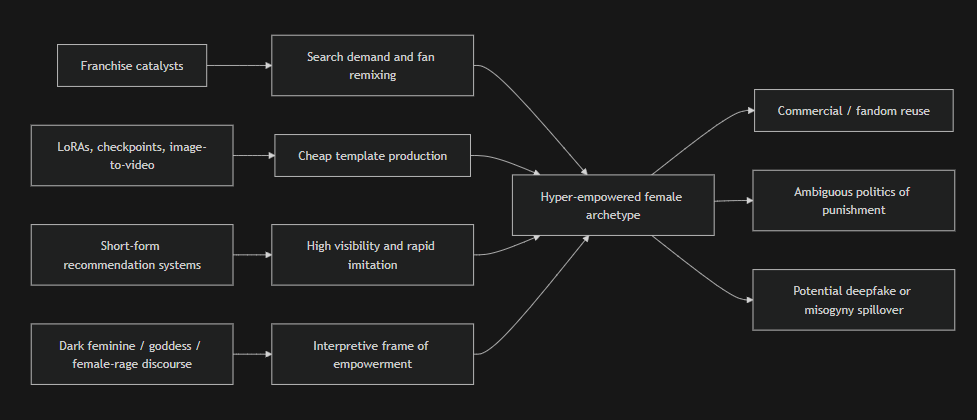
A rigorous research program should treat this as a convergence phenomenon, not a single-cause trend. The most plausible hypotheses are shown below.
| Hypothesis | Why it is plausible | Testable indicators |
|---|---|---|
| Toolchain hypothesis | Image-to-video, LoRAs, and creator AI tools make this motif cheap to mass-produce. | Weekly counts of new models/posts with keywords such as succubus, demon queen, Lilith, female Punisher, huntress; Tensor.Art runs/downloads; YouTube uploads tagged as synthetic. |
| Fandom catalyst hypothesis | Major releases create temporary legitimacy and search demand for feminine infernal / hunter imagery. | Post volume before/after franchise moments such as Diablo IV or KPop Demon Hunters; spikes in derivative tags and fan trailers. |
| Female-rage translation hypothesis | Online anger discourse is being translated into symbolic avenger imagery. | Co-occurrence of female rage, dark feminine, vengeance, justice, huntress, Lilith, goddess, revenge arc. |
| Punitive-aesthetics hypothesis | The archetype packages punishment as glamour, especially when crossed with skull iconography or hunter scripts. | Share of posts with skulls, tactical gear, “Punisher,” “retribution,” “no mercy,” “prey,” or law-and-order language. |
| Moderation-displacement hypothesis | Stricter rules on one platform displace production to another rather than removing it. | Compare uploads and model releases across Newgrounds, DeviantArt, Tensor.Art, Sketchfab, and YouTube before and after policy changes. |
For ongoing monitoring, the highest-yield public sources are: DeviantArt tag pages and dated deviations for linked titles, favourites, views, and AI labels; Tensor.Art model pages for runs, downloads, and upload timestamps; Sketchfab tag pages for 3D-model views and AI-generation flags; YouTube search results and policy/help pages for visible AI-cinema uploads plus disclosure changes; TikTok and Meta product/newsroom pages for new image-to-video or remix tools; Pinterest Trends / Predicts for aesthetic demand; and Oxford, UCL/Kent, Stanford, NBER, and CivitAI-related academic work for the risk and ecosystem layer.
Open questions and limitations. The largest unresolved question is whether visibility is rising because the motif is genuinely being produced more often, or because AI tools, recommendation systems, and newsy franchises have made it easier to notice. Direct Instagram and TikTok post-level sampling was constrained by public-web access and platform opacity, so the strongest visual examples here come from publicly accessible DeviantArt, Newgrounds, Tensor.Art, Sketchfab, and YouTube surfaces. The report therefore supports a conclusion of recent intensification and convergence, not a mathematically exact claim about total global incidence.
Additional Chapter: The Demon Feminine After Political Lesbianism and Gender Fragmentation
This subject requires caution because the internet compresses irony, trauma, fetish, politics, aesthetics, and identity into the same symbolic ecosystem. People increasingly mistake aesthetic language for coherent ideology, and algorithmic repetition can make scattered emotional currents appear more unified and organized than they really are. Nevertheless, there does appear to be a meaningful structural shift underway.
The older currents associated with political lesbianism in the 1970s framed heterosexuality itself as a mechanism of patriarchal collaboration and social control. That movement was relatively small, highly intellectualized, materially grounded, and often ascetic in tone. What is emerging online now is much stranger, more memetic, more aestheticized, and deeply entangled with posthuman imagery and algorithmic identity formation. The contemporary archetype is no longer centered on the idea of women merely withdrawing from men. Instead, it increasingly imagines femininity as becoming something fundamentally other: predator, entity, goddess, machine, demon, avenger, or metaphysical force.
This is where the recurring imagery of transgender succubi, cyberwitches, synthetic saints, biotech sirens, AI-generated avengers, and celestial antiheroines begins to converge into a recognizable symbolic pattern. These are not always stable political identities so much as escape vectors from older social categories. The recurring emotional message embedded in the imagery is not simply “leave me alone,” but rather: “You no longer possess interpretive access to me. I no longer operate inside your categories, institutions, or expectations.”
That shift is significant. The emerging demon feminine online often appears anti-biological, anti-domestic, anti-romantic, anti-traditional, anti-state, and increasingly detached from older assumptions surrounding motherhood, intimacy, or social continuity. In many cases it even carries an anti-human undertone. This is why the visual language repeatedly combines horns, halos, tactical armor, cathedral imagery, chrome, glowing eyes, blood symbolism, synthetic flesh, machine aesthetics, and ritualistic grandeur. The figure being depicted is not merely “empowered womanhood” in a conventional feminist sense. What is increasingly represented is a fantasy of metaphysical sovereignty: a being who exists beyond dependence, beyond social vulnerability, and beyond institutional mediation.
The danger embedded in this symbolic environment is that internet culture increasingly rewards identities organized around emotional invulnerability, retaliatory fantasy, punitive spectacle, and fantasies of purification. Because AI systems industrialize archetypes and accelerate repetition, these symbolic forms proliferate at enormous scale. This does not mean that large numbers of people literally desire violence. Rather, it reflects populations that increasingly experience themselves as politically trapped, sexually distrustful, spiritually uprooted, economically humiliated, and psychologically manipulated by systems they no longer trust. The demon feminine becomes a symbolic answer to helplessness.
Historically, societies have repeatedly generated equivalent archetypes during periods of instability. Earlier eras produced outlaw cowboys, fascist supermen, cyberpunk antiheroes, revolutionary martyrs, and hypermasculine “sigma” mythology. The symbolic forms differ, but the underlying psychological function remains recognizable. They are attempts to imagine escape from perceived humiliation and powerlessness through mythic transformation.
Additional Chapter: Epstein, Elite Corruption, and the Return of the Blood Myth
The Epstein scandal carried psychological consequences that extended far beyond the crimes themselves. What it fundamentally shattered was a civilizational firewall between institutional reality and conspiratorial imagination. For decades, conspiracy culture largely revolved around hidden finance, intelligence agencies, organized crime, blackmail networks, occult symbolism, and elite corruption. After Epstein, many people concluded that the most disturbing rumors circulating online were no longer entirely implausible.
That psychological shift matters enormously. Once institutional trust collapses, symbolic imagination escalates rapidly. The belief that elites traffic children can mutate into claims that elites consume blood, harvest souls, or function as literal demonic entities. Historically, societies repeatedly mythologize ruling classes in this manner whenever elites become psychologically illegible or morally untouchable. Aristocracies become vampires, oligarchs become parasites, and corrupt courts become cannibalistic cults. The internet reproduces this process at hyperspeed.
Within this symbolic environment, the demon feminine undergoes another transformation. She ceases to function merely as temptress or erotic danger and instead becomes avenger, punisher, witness, hunter, and executioner of hidden corruption. This is why so much contemporary imagery combines nightclub seduction, infernal glamour, tactical violence, holy wrath, child-protection symbolism, and revenge fantasy within the same visual package. The emotional structure begins to resemble older goddess archetypes associated with violated boundaries and cosmic retaliation: Kali, Sekhmet, Nemesis, the Erinyes, Black Madonnas, Lilith, and Erzuli Dantor. These figures are not reducible to simple moral categories of good or evil. They embody blood debt, imbalance, rage, violated innocence, and the terrifying return of justice after institutional failure.
The internet’s conspiratorial imagination is now saturated with this emotional logic. Because institutions often respond to public distrust with managerial language, public relations frameworks, or procedural evasiveness rather than visible moral clarity, the symbolic pressure intensifies further. People increasingly fantasize about supernatural justice because ordinary justice no longer appears psychologically real to them.
Additional Chapter: The Three Faces of Erzuli
Erzuli is useful here not primarily as theology, but as symbolic structure. Across Afro-Caribbean traditions, the different manifestations of Erzuli embody radically different dimensions of femininity, and contemporary internet culture appears to be unconsciously reconstructing those dimensions into a composite digital archetype.
Erzuli Freda represents desire, glamour, seduction, luxury, ornament, and impossible longing. Her contemporary online equivalents appear in the proliferation of AI goddesses, glamour demons, “divine feminine” aesthetics, luxury witches, succubus chic, and hyperfeminine infernal queens. Yet beneath the beauty there is almost always grief, emotional exhaustion, or hunger. Freda traditionally contains disappointment and wounded longing, and this maps remarkably well onto algorithmic femininity itself: hyper-visible, hyper-desired, endlessly aestheticized, and emotionally depleted beneath the spectacle.
Erzuli Dantor represents something much harsher and more contemporary. Scarred, protective, tribal, and violent when necessary, she increasingly appears in female vigilante fantasies, demon hunters, tactical angel aesthetics, revenge heroines, anti-predator narratives, and “touch her and die” mythology. This is not passive empowerment. It is retaliatory and institutional in tone. The underlying emotional logic is that formal systems have failed so completely that the self must become the institution of justice. In many ways this is one of the defining emotional structures of the modern internet.
The third manifestation is the threshold figure: woman as mediator between worlds, between life and death, between human and posthuman existence. This appears in cyberwitch imagery, necromantic aesthetics, AI ghost-girls, liminal transhuman femininity, and synthetic oracle archetypes. This figure is not attempting to fight patriarchy directly because she has already psychologically departed from the human social order altogether. That is why so much AI femininity now feels ceremonial, spectral, emotionally distant, post-romantic, and detached from older assumptions surrounding reproduction, domesticity, and continuity. She no longer appears merely as woman, but as entity.
Additional Chapter: After Redpill, Incels, Andrew Tate, and Hypermasculine Internet Culture
The demon feminine did not emerge in isolation. It emerged in direct symbolic dialogue with hypermasculine algorithmic culture. Over the last decade, large parts of the manosphere constructed an interpretive framework in which women became associated with exploitation, manipulation, humiliation, emotional cruelty, false accusation, and sexual opportunism. Dating was reframed as warfare, vulnerability as weakness, and domination as masculinity.
The feminine counter-myth increasingly evolved in response. The resulting symbolic figure became dangerous, untouchable, punitive, emotionally armored, spiritually superior, and impossible to control. This follows a classic escalation pattern. Each side mythologizes the other into existential monsters. The male side imagines succubi, manipulators, social destroyers, or parasitic exploiters. The female side imagines predators, traffickers, narcissistic abusers, fascistic patriarchs, and rapacious systems of male domination.
The internet intensifies this polarization because outrage, humiliation, fear, and vengeance are algorithmically adhesive emotions. What emerges is no longer ordinary sexism in the traditional sense, but something closer to memetic civil war: competing mythologies of victimhood, punishment, grievance, and moral retaliation. This is why the imagery becomes increasingly theatrical and apocalyptic. Demons, angels, hunters, executioners, avenging queens, divine judges, and infernal warriors all emerge because ordinary civic language no longer feels emotionally adequate to large numbers of people attempting to describe the scale of their distrust and rage.
Additional Chapter: Vigilantism, “Rape Academies,” and the Edge of Escalation
This is the point where caution becomes most necessary. There are indeed documented cases of misogynistic underground networks, exploitative dating subcultures, coercive “pickup” ecosystems, organized abuse forums, humiliation economies, and predatory influencer pipelines. These environments have produced genuine reactive countercultures and intensified cycles of distrust and retaliatory symbolism.
However, it is extremely important not to romanticize vigilantism. Online ecosystems are structurally terrible at verification, proportionality, de-escalation, and due process. Once individuals begin imagining themselves primarily as hunters, avengers, righteous punishers, or holy executioners, the boundary between symbolic fantasy and real-world harm can deteriorate very quickly.
Historically, periods characterized by moral panic combined with revenge mythology frequently produce witch hunts, paranoia spirals, false accusations, purification campaigns, factional violence, and collective hysteria. The emotional atmosphere currently circulating online contains many of the necessary ingredients for such escalation: humiliation, sexual distrust, institutional collapse, algorithmic radicalization, resentment, fear, and a growing sense that ordinary systems no longer function.
Within this environment, the demon feminine often serves as an emotional container for unresolved social tensions. She functions less as evidence of a coherent revolutionary conspiracy and more as a mythic dramatization of collective instability. The underlying emotional message increasingly resembles: “The old social contract has failed, the institutions are spiritually compromised, and something dangerous is emerging from the ruins.”
That feeling is genuinely widespread. Yet symbolic intensity alone does not automatically produce organized revolutionary violence. The internet amplifies aesthetics much faster than it produces coherent movements. Much of what appears online may therefore reflect millions of individuals independently converging upon the same emotional iconography because the underlying social atmosphere feels unstable, humiliating, sexually adversarial, spiritually contaminated, and psychologically unsafe.