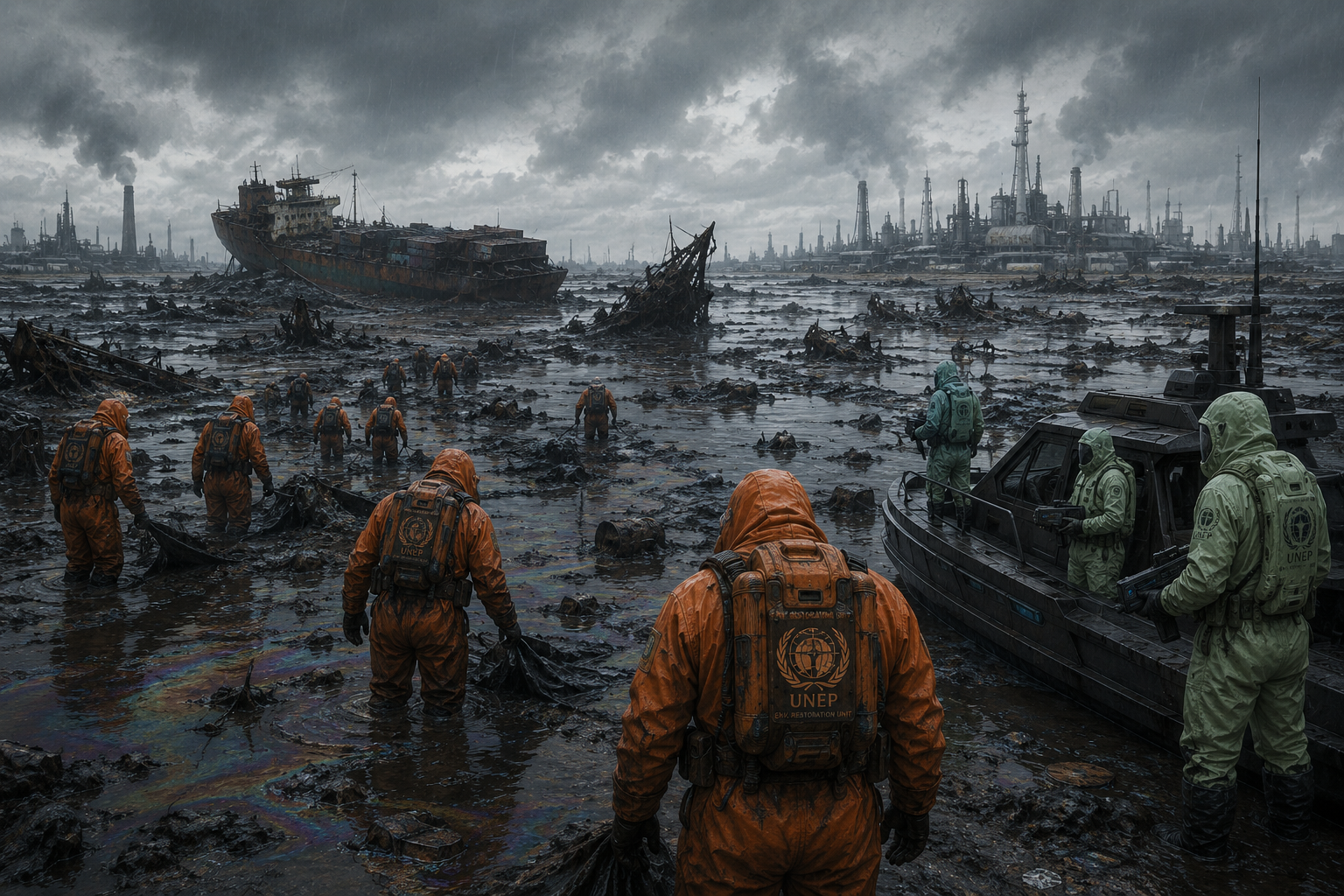
There’s a certain kind of modern conversation that feels less like civic discourse and more like a hostage video recorded by a species under mild sedation. Someone brings up climate collapse, ecological overshoot, antibiotic resistance, ocean acidification, PFAS accumulation, microplastics in placentas, mass migration, coastal flooding, state fragmentation, agricultural depletion, declining fertility, AI destabilization, demographic inversion, or the charming possibility of wet-bulb temperatures turning entire regions into biological crockpots, and within roughly forty seconds everyone develops the thousand-yard stare of an office worker trapped in a mandatory cybersecurity seminar.
William Gibson called the grand convergence of all these mutually amplifying catastrophes The Jackpot, which is probably the best term anyone has come up with because it captures the central obscenity of the thing: not one apocalypse, but all of them arriving together in a hideous gift basket.
Other terms are available, such as “The Brown Fan”or “Hell’s Toupee”.
Because that’s the really uncanny part. The world-ending event is not arriving with flaming meteors and choirs of screaming angels. It is arriving through insurance repricing, drainage failure, crop instability, sewage overflows, migration tribunals, dead fisheries, particulate inhalation, infrastructure fatigue, and quarterly earnings reports. And the problem — the truly crushing problem — is scale.
Every single major issue now on the board would historically have constituted a civilization-defining crisis all by itself. If this were 1970 and scientists discovered that:
- global temperatures were rising rapidly,
- oceans were acidifying,
- fisheries were collapsing,
- entire coastal industrial corridors would eventually flood,
- forever chemicals were in human blood,
- antibiotic resistance threatened modern medicine,
- and major agricultural regions faced hydrological instability,
…humanity would have treated any one of those revelations as the defining emergency of the century. Instead we got all of them simultaneously because apparently the universe subscribes to the “value combo meal” model of suffering. And critically, each crisis interacts with every other crisis.
When sea level rise enters mainstream political discussion it is often framed as a problem of real estate. Waterfront property values shift. Insurance becomes expensive. Some roads flood more often. Wealthy people relocate from one coastline to another and begin arguing over zoning permits for elevated condominiums. The dominant mental image is inconvenience. Adaptation. Redevelopment.
This framing is dangerously incomplete.
The real problem with sea level rise is not merely that the sea rises. The problem is what the sea floods.
Industrial civilization concentrated a very large percentage of its infrastructure directly along coasts, estuaries, river mouths and deltas. This was logical. Ports drive trade. Rivers provide cooling water and waste transport. Coastal access reduces shipping costs. Heavy industry clustered around harbors because harbors were the circulatory system of industrial modernity.
Unfortunately, this means humanity has spent roughly two centuries building an immense chemical inventory directly in the path of rising seas.
When people imagine flooded coastlines, they often picture water moving over relatively clean urban environments. In reality, many coastal zones are layered with: petrochemical facilities, refineries, fertilizer plants, pesticide storage, ports, shipbreaking yards, battery dumps, landfills, coal ash storage, heavy industry, wastewater infrastructure, fuel depots, informal dumping grounds, mining waste, sewage systems, chemical warehouses, abandoned industrial sites, military contamination, and decades of unregulated or poorly documented toxic burial.
And maybe the odd Nuclear Reactor.
In many developing regions, the situation is substantially worse because environmental regulation was historically weak, corruption pervasive, and rapid industrialization prioritized over long-term containment. Entire coastlines accumulated untracked contamination.
Sea level rise transforms this from a static contamination problem into a dynamic dispersal mechanism.
Floodwater is not passive. It erodes, dissolves, suspends, transports and redistributes material over very large areas. Storm surges penetrate groundwater systems. Saline intrusion alters soil chemistry. Flood pulses move contaminants into wetlands, estuaries, fisheries and agricultural zones. Sediments are mobilized and redeposited repeatedly.
The result is not simply local pollution.
It is continental-scale contamination transfer.
The inventory involved is staggering: benzene, toluene, xylene, heavy metals, lead, mercury, cadmium, arsenic, chromium, hexavalent chromium, asbestos, PCBs, dioxins, PFAS, phthalates, solvents, formaldehyde, ethylene oxide, chlorine compounds, cyanides, ammonia, sulphuric acid, nitrates, pesticide residues, pharmaceutical waste, sewage, antibiotic-resistant bacteria, agricultural runoff, microplastics, lithium battery decomposition products, hydrocarbons, radioactive residues, and countless poorly catalogued industrial compounds.
Many of these materials are persistent. Some bioaccumulate. Some remain chemically active for decades. Some concentrate upward through marine food chains. Some bind to sediments and travel slowly through estuarine systems before re-entering circulation during future storms.
Once contamination enters groundwater or marine food webs, remediation becomes extraordinarily difficult and often economically impossible. This is one of the least appreciated aspects of large-scale environmental contamination: removal is usually unrealistic after broad dispersal.
Localized spills can sometimes be contained. A flooded delta cannot.
Once toxic material spreads into: coastal sediments, aquifers, wetlands, fisheries, estuarine mud, river systems, or agricultural soils, containment largely ends.
At that point the strategy becomes risk management rather than cleanup.
The contamination pathways are numerous.
Floodwaters can directly inundate chemical facilities and storage tanks. Landfills can erode or leach into adjacent water systems. Sewage infrastructure can fail during storm surges, releasing pathogens and nutrient loads simultaneously with industrial contaminants. Salinity changes can mobilize previously stable heavy metals within soils and sediments. Flooded battery storage facilities may release fluorinated compounds, acids and metal residues. Petrochemical infrastructure can rupture during storms, fires or subsidence.
Compounding effects are likely.
For example:
- nutrient runoff drives algal blooms,
- algal collapse drives hypoxia,
- hypoxia stresses marine systems,
- stressed marine systems become more vulnerable to toxic exposure,
- warming oceans reduce oxygen retention,
- acidification alters chemical interactions,
- contaminated sediments accumulate in benthic ecosystems,
- fisheries absorb pollutants,
- human food systems inherit the burden.
- chemical leeching may hasten release of deep sea methan clathrates
This is not speculative science fiction. Variants of these mechanisms are already observable worldwide.
The Gulf of Mexico dead zone is driven primarily by agricultural runoff and nutrient loading. PFAS contamination is now globally distributed. Heavy metals accumulate in fisheries. Microplastics are detectable in human blood, placentas and marine ecosystems. Coastal flooding already releases industrial contamination during major storm events.
Sea level rise scales these processes upward.
Particularly vulnerable regions include: Bangladesh, the Pearl River Delta, Jakarta, Manila, Lagos, the Nile Delta, parts of coastal India, São Paulo/Santos regions, the Mekong Delta, and numerous rapidly urbanized coastal zones across Africa and Southeast Asia.
These areas combine: very high population density, industrial concentration, flood vulnerability, limited adaptive capacity, aging infrastructure, and in many cases incomplete environmental oversight.
The humanitarian implications are severe.
Contaminated floodplains compromise agriculture. Fisheries become unsafe or collapse economically due to consumer distrust. Groundwater contamination increases chronic disease burdens. Sewage failures increase infectious disease risk. Informal settlements experience disproportionate exposure because poorer populations often occupy the most flood-prone and least protected terrain.
Migration pressures increase accordingly.
This is an important distinction: climate migration is not driven solely by rising water levels.
It is driven by declining habitability.
A region does not need to disappear beneath the ocean to become socially or economically nonviable. Repeated contamination events, chronic groundwater salinization, toxic sediment deposition and collapsing fisheries can produce long-term displacement long before permanent inundation occurs.
Insurance systems are already retreating from certain coastal regions. Governments are beginning to discuss “managed retreat” in carefully bureaucratic language. But most public discourse still underestimates the scale of toxic infrastructure exposure embedded within coastal industrial civilization. You can retreat managed all you want, but if you then proceed to ignore buried landfills, and the resulting contamination makes desalination impossible for all your desert Kingdoms, then basically that means – no more desert Kingdoms. Curtains.
Another underappreciated issue is long-distance transport.
Marine systems are highly connected. Pollutants do not remain where they originate.
Ocean currents, atmospheric transport, migratory species and sediment circulation distribute contaminants over very large distances. Persistent pollutants originating in one region may eventually appear in fisheries, seabirds, sediments or marine mammals thousands of kilometers away.
This is already well documented with mercury, PFAS, PCBs and microplastics.
A major contamination pulse from repeatedly flooded industrial coastlines would not remain geographically isolated.
Material released in one region may eventually circulate globally through: ocean currents, seafood trade, migratory ecosystems, atmospheric deposition, and sediment transport.
It is entirely plausible that contamination released during severe flooding events in heavily industrialized or poorly regulated coastal regions could later appear in measurable concentrations in distant marine ecosystems, including northern Atlantic fisheries or Arctic food webs.
This is one reason the problem cannot realistically be compartmentalized as a local governance issue. The ocean is not divided into national environmental jurisdictions in any meaningful chemical sense. The most dangerous misconception surrounding sea level rise is that it is a clean hydraulic problem. You can not litigate Bangladesh as it floods and chemical runoff proceeds to devastate fisheries all over Australia.
Human civilization built much of its toxic infrastructure directly adjacent to dynamic water systems under the assumption that coastlines were relatively stable over industrial timescales. That assumption is increasingly false.
The issue is compounded further by financial and political inertia.
Proper remediation is extraordinarily expensive. Large-scale relocation of industrial infrastructure is politically difficult and economically disruptive. Cleanup liabilities are often poorly defined or deliberately obscured. Many contaminated sites already lack responsible corporate entities because ownership structures dissolved decades ago.
Governments therefore face a growing triage problem: which coastlines are protected, which facilities are hardened, which populations are relocated, and which regions are quietly abandoned to chronic degradation.
No country possesses unlimited adaptive capacity.
This becomes especially destabilizing when combined with broader climate stress:
- heat waves,
- crop instability,
- water scarcity,
- infrastructure fatigue,
- migration pressure,
- geopolitical fragmentation,
- and declining ecological resilience.
The cumulative effect is what William Gibson described as “The Jackpot”: not a singular apocalyptic event, but multiple systemic crises interacting simultaneously.
The contamination dimension of sea level rise receives relatively little public attention because it is less visually dramatic than storms or fires. Toxic sediment dispersal lacks cinematic immediacy. Chronic groundwater poisoning does not produce spectacular footage. Fisheries decline gradually. Endocrine disruption unfolds statistically. Cancer clusters emerge over decades.
But these processes may ultimately shape long-term human habitability more profoundly than many headline disasters.
The future coastal landscape in many regions may not resemble sudden annihilation.
It may instead resemble chronic environmental degradation:
- endless flood remediation,
- recurring contamination advisories,
- abandoned industrial districts,
- restricted fisheries,
- elevated cancer burdens,
- failing sewage systems,
- saline groundwater,
- chemically stressed agriculture,
- and populations trapped between economic necessity and declining environmental viability.
This is not merely a story about rising water. It is a story about what industrial civilization placed in the path of that water.