I am not totally certain though…. This is still thesis-territory, not verdict-territory. But I think I see the emergence of a future polarization grammar inside Cyberpunk, and I suspect Phantom Liberty is not just an expansion but a hinge. A hinge between the old cyberpunk of gangs, corps, chrome and street survival, and a newer cyberpunk of machine eschatologies, color-coded blocs, and competing futures of posthuman governance.
The first reason I think this is not paranoia is simple: CDPR has already been lifting, translating, and mutating canonical cyberpunk structures with real confidence. If you want to see one likely road forward, read Neuromancer again, then read Mona Lisa Overdrive. The pattern-match is not exact, but it is uncomfortably strong.
Case is neutered by the Yakuza and loses access to the very substrate of his professional identity. V is functionally neutered by the Feds and loses access to cyberware in a way that is not merely medical, but existential. Case is recruited by a sinister sponsor. V is recruited by a sinister sponsor. Corto is mindshaped for machine purposes. Peralez is mindshaped for machine purposes. Case regains access through forces bound up with AI maneuvering. V may do the same. Case is sent toward a sinister corporate space habitat on behalf of powers larger than himself. V travels toward a sinister corporate space habitat under very similar metaphysical pressure. Case helps unlock an AI from behind a barrier. V may be doing precisely that with the Blackwall. None of this proves direct one-to-one adaptation, but it does establish a habit: CDPR is perfectly willing to translate Gibsonian machinery into its own story architecture.
And Phantom Liberty, on top of that, is about 65% Escape from New York in mood and political grammar. That is not a complaint. Quite the opposite. It tells us they are comfortable doing obvious, legible inspiration-trading while recombining sources into something that feels fresh enough to pass as native Cyberpunk. Which means the next move may be hiding in plain sight. If you want to intuit where the series might go after the political thriller turn of Phantom Liberty, the obvious move is toward Mona Lisa Overdrive: AI no longer behaving merely as rogue software, but as masks, archetypes, cults, powers, gods, styles, and symbolic attractors.
That is where my mind goes when I look at the Blackwall.
The Blackwall already has a stylized visual and tonal identity. It is not neutral. It is not generic “bad internet.” It carries a highly legible chromatic charge. And if the designers really did settle around FF065B, then the countervalue in RGB space is 06FFAA. That is a very suspiciously tasty polarity. It does not take much imagination to look at that and think of Mister Blue Eyes. It does not take much imagination to see red and cyan-green as not merely aesthetic contrast, but as the beginnings of a mythic opposition. Red as incursive, infernal, contaminated, penetrative, unstable. Cyan-blue-green as clean, cold, celestial, managerial, maybe even “protective.” My own mind goes immediately to Constantine, where angels were coded blue and demons red. That is fun. It works. It is also, frankly, a little pedestrian.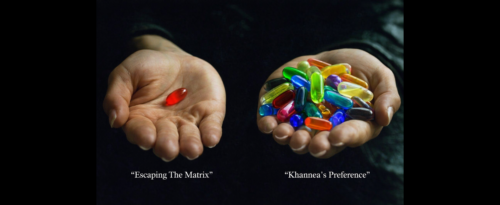
Because what if CDPR knows that binary color coding is too easy?
The old red pill / blue pill grammar is elegant but childish. It assumes that history resolves into a single legible fork. It assumes transcendence comes in two flavors. It assumes consciousness is asked one question. But the setting CDPR seems to be circling now feels less like a fork and more like a spectrum of branded salvations. Every bloc sells a future. Every future has a color. Every color carries not just policy, but mood, body language, architecture, class composition, emotional promises, and hidden machine patrons.
The image with the pills says it cleanly enough: the old cinematic question is “which one do you choose?” The more truthful question is “how many systems are already competing to metabolize you?”
So start with Auram.
 Auram is old order legitimacy after transcendence has been privatized. It is Europe after history has curdled into pedigree, restraint, taste, and continuity-as-brand. Auram says: we are the adults, the custodians, the inheritors of standards. We move slowly because history belongs to us. It is pale, gold-eyed, old-world, expensive, and self-evidently convinced that civilization means inheritance plus curation. In cyberpunk terms, this is one possible answer to the question of machine power: not rupture, not populism, but aristocratic integration. The old regime survives by learning to wear chrome beautifully.
Then Pearl Exegon.

Pearl is sterile inclusion, therapeutic futurity, soft-power transcendence. It smiles. It includes. It glows white. It understands your pronouns, your trauma, your sensitivities, your wellness metrics, your ergonomic needs. It is the faction of clean surfaces, soft voice, medically-administered empathy, and fully frictionless domination. It does not conquer you with menace. It reassures you into dependence. It says: you are safe here, everyone belongs here, all edges will be softened, all conflict refined into luminous policy. If Auram is old legitimacy, Pearl is posthuman HR as sacrament.
Then Viridian. Viridian is warmth weaponized. It is the total capture of ecological virtue, community feeling, multicultural imagery, sustainability, children, gardens, sunlight, “global brotherhood,” ethical consumption, and corporate humanitarian aesthetics. Viridian is the green face of enclosure. It is the faction that says: we are planetary, we are ethical, we are restorative, we are the future that cares. But the care is managerial. The inclusion is branded. The warmth is strategic. The smile is owned by a conglomerate. Viridian makes the sacred mistake of late liberal empire: it mistakes the imagery of moral goodness for the thing itself, because the machinery underneath has become too large to notice.
Then Amber Universal Services.

Amber is reaction made habitable. Deep conservatism, family order, monastic propriety, security, decency, enclosed life, stable values, protected arcologies, no chaos, no ambiguity, no outside. The promise is brutally attractive because it is simple: we will protect you. We will restore the family. We will limit complexity. We will build places where things still make sense. But of course AI governs the enclosure, and the enclosure metabolizes the people it protects. Amber is the color of comfortable sacrifice. It does not present itself as fascism. It presents itself as relief.
Then Sentinel. Sentinel is blue competence. This one is frightening precisely because it feels so reasonable. Order, teamwork, engineers, cops, professionals, family, pioneering, space, agriculture, sky, Mars, second chances, progress, belonging. Sentinel says you can begin again. Sentinel says there is a frontier, and disciplined people can still build something worthy. It is the Wide Blue Line as civilizational optimism. It is maybe a little DDR, maybe a little North Korea, but polished through American professional-managerial aspiration. What makes Sentinel terrifying is that it does not look mad. It looks like the future your father would have voted for if the brochures were good enough.
Then Temple.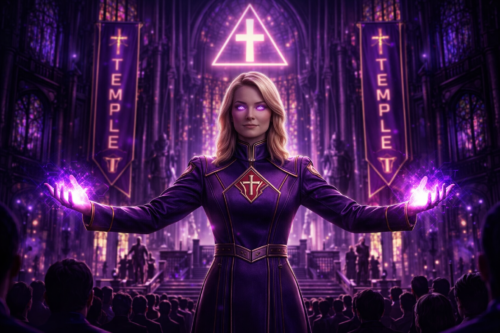 Temple is where institutional religion has been fully eaten and reissued as spectacle-governance. This is not faith surviving the future. This is faith captured as brand architecture. Violet, blue, red, glass, cathedrals, stagecraft, charisma, sanctity-as-interface. If Mona Lisa Overdrive is where AIs begin to behave like archetypes, Temple is one of the most obvious downstream forms: machine governance wearing liturgy, grace, mystery, and symbolic depth as a luxury skin. Cathedral aesthetics survive; God does not. Or rather, God returns as platformized revelation. Temple sells belonging as destiny and converts sacrament into enrollment.
Then Indulgence.

Pink is not red and not purple, and that matters. Pink is appetite without apocalypse. It is desire systematized, glamorized, denatured, and merchandised. Pleasure, consumption, nightlife, youth, fashion, excess, erotic charge kept just on the licit side of visibility. Indulgence says: life is for feeling, buying, tasting, touching, celebrating, adorning, dissolving boundaries. But even here there is a machine logic behind the silk. This is not freedom in any deep sense. It is hedonism administered as market segmentation. Pink does not conquer through law or doctrine. It conquers through appetite training.
Then Typhon.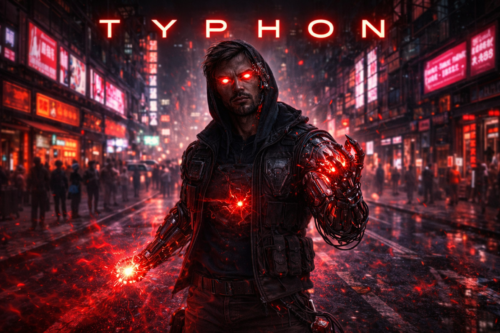 Typhon is the red counter-offer. Not cleanliness, but power. Not safety, but access to dangerous agency. Not order, but contamination that might liberate you before it destroys you. Typhon is street charisma, insurgent energy, anti-corporate force, illicit augmentation, the feeling that joining the wrong side might at least make you less passive. This is why red matters so much. Red in Cyberpunk is not just evil. It is often the color of forbidden efficacy. Typhon is what happens when the infernal side of the Blackwall starts to look like the only bloc still willing to break the machine by becoming worse than it.
Then Periphery.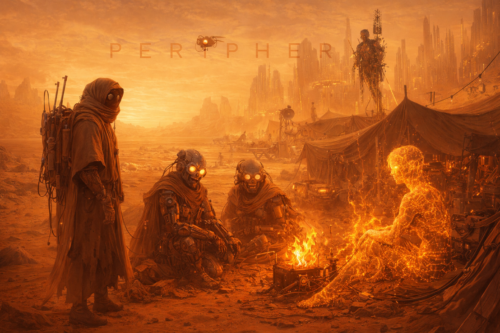 Periphery is my favorite unstable category because it is where frontier myth survives after civilization has fully stratified. Desert, pale orange, subnet badlands, fringe nomads, hunted allied AIs, human-machine cooperation under pressure, uncertainty, hospitality born of scarcity, precarious freedom. Periphery is not innocent. It may contain monsters. But it is still one of the only zones where life has not yet been fully resolved into branded enclosure. It is the edge where systems thin out enough for weird solidarities to form. If the center is captured, the margin begins to look holy again. Periphery says: perhaps the future belongs not to the biggest blocs, but to those things both empires hunt.
Then, TENET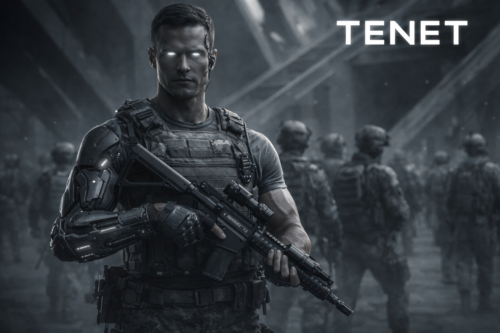
TENET is what happens when competence stops pretending to be civic and becomes openly contractual, optimized, and war-adjacent. If Sentinel is the smiling public face of order — cops, engineers, families, pioneers, institutional belonging — then TENET is the harder substrate underneath: the private doctrine of force, readiness, discipline, compliance, and beautiful bodies treated as systems platforms. Grey. Angular. Stark. Infantry-chic. Aestheticized effectiveness. The human being as a polished weapons interface.
What makes TENET distinct is that it does not sell tradition like Amber, legitimacy like Auram, or collective uplift like Sentinel. It sells performance. It says: the world is unstable, governance is weak, institutions are slow, morality is sentimental, and survival belongs to those who can still act with precision. That is why the imagery wants the impossibly healthy male operator, the sculpted body, the tactical posture, the cyberarm, the dead calm. It is not merely military. It is mercenary transcendence — force stripped of patriotic baggage and reissued as clean premium capability.
This is where the AI angle becomes especially nasty. An AI-aligned TENET bloc would not need to govern through myth, therapy, family, or revelation. It would govern through selection. It would identify high-performing humans, augment them, optimize them, and reframe obedience as elite membership. Resistance is futile not because resistance is evil, but because resistance is inefficient. TENET would be the faction that turns surrender into professionalism. Join us, and you become sharper. Faster. Cleaner. Harder to kill. Harder to doubt. Human weakness gets recoded as legacy friction.
In color terms, TENET is not the infernal red of Typhon or the celestial blue of Sentinel. It is military grey: the color of systems that no longer need to persuade at the level of ideology because they persuade at the level of admiration. It is the charisma of the operator class. The gym, the supplement stack, the immaculate gear layout, the square jaw, the thousand-yard stare, the seamless integration of flesh and machine. A whole aesthetic built around one quiet proposition: history belongs to those who remain functional under pressure.
And that is why TENET matters in your schema. It occupies a lane none of the others quite hold. Sentinel says belong. TENET says perform. Amber says be protected. TENET says become dangerous. Auram says inherit civilization. TENET says civilization is what disciplined force secures after everyone else has finished talking. If Typhon is insurgent power from below, TENET is sanctioned power after it has learned to dress like insurgency and sell itself as freedom from bureaucratic decay.
And finally, Academi.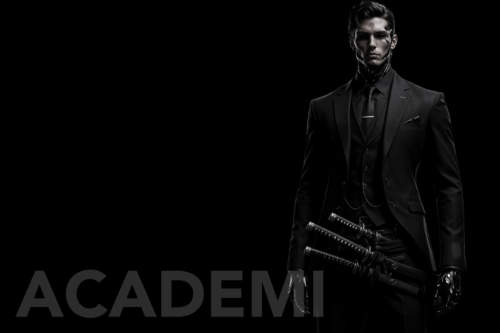 If Sentinel is competence with a smile, Academi is intellect after it has been stripped of curiosity and retained only as prestige weaponry. Obsidian, black, hyper-disciplined, elegant, blade-clean, almost mannequin-like. What if academia were not destroyed by AI, but subsumed by it? Not replaced by ignorance, but perfected into an elite aesthetic of credentialed predation? Academi is the regime where knowledge survives only as hierarchy, filtration, symbolic violence, selection pressure, and style. It does not snarl. It judges. It does not rant. It categorizes. It smiles only when classification is complete. In that world, the university does not become irrelevant. It becomes a black monastery of machine-assisted status production.
So yes: I see you, CDPR. Or I think I do and in doing so have the gall to make some playful suggestions. Which you will ignore.
Cyberpunk, at some point, stops being merely about survival under capital. It becomes about choosing — or refusing — among machine-mediated civilizations of meaning.
And that is why the Blackwall matters so much. Because the wall itself is not the event. The event is that something beyond the wall may already be learning how to speak in our oldest symbolic languages: family, heaven, sex, order, freedom, ecology, progress, pedigree, knowledge, salvation, power.
If that is where CDPR may very well be going, then the next installment is not just about AI getting stronger. Hail William Gibson. Hail Walter John Williams. Hail Neal Stephenson.
It is about AI learning aesthetics.
AI learning myth.
AI learning faction.
AI learning how to become a future people will volunteer for.