At first many assumed it was a hoax. The date alone — April 1 — produced confusion across newsrooms and government offices alike. Analysts hesitated, diplomats called one another, and social media lit up with speculation that the announcement might be some elaborate provocation or disinformation campaign. It was most certainly not a joke.
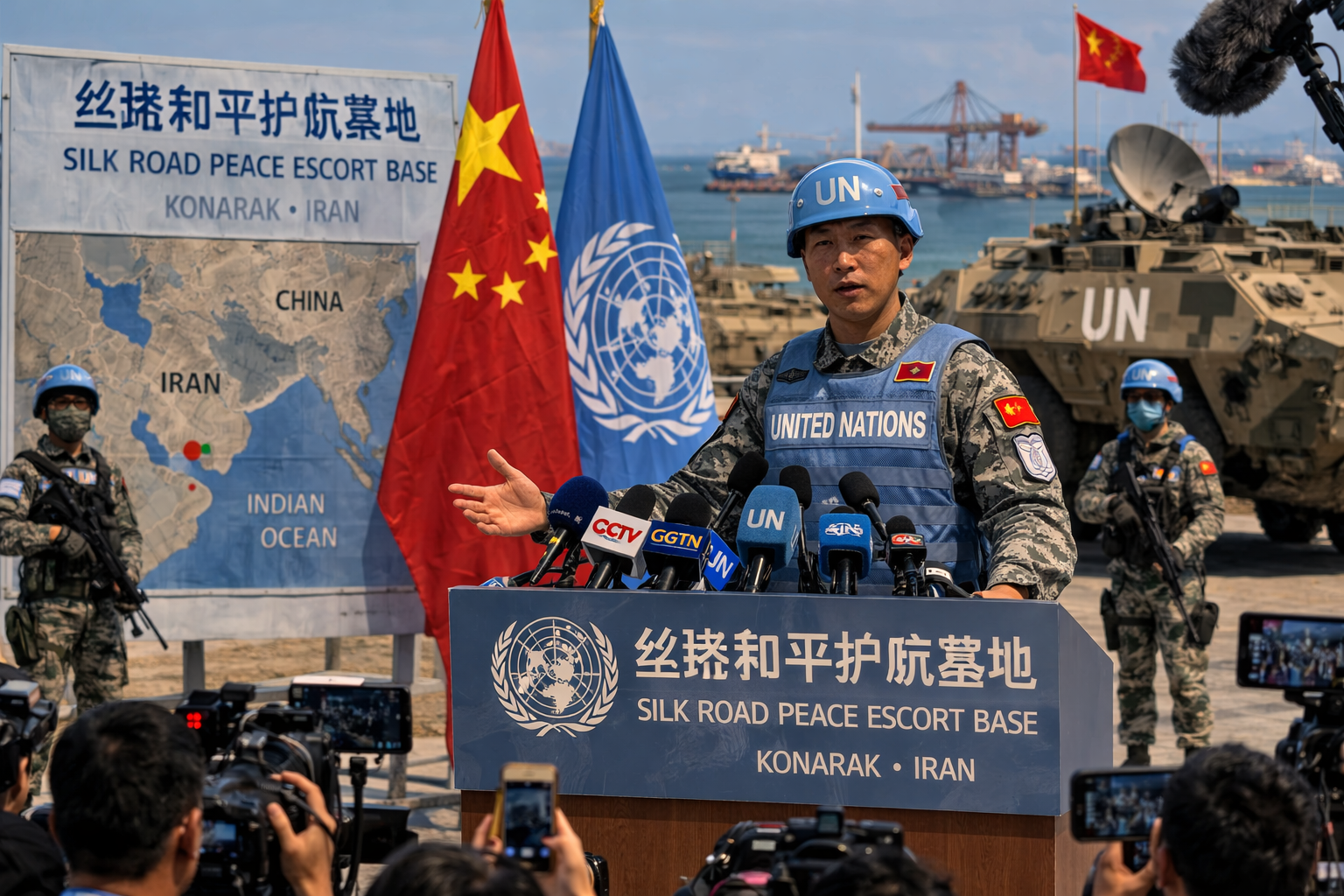
Within minutes, live footage confirmed what many had thought an even more unthinkable event in an already absurd series of quickly escalating unthinkable events. On a windswept stretch of Iran’s southeastern coastline, Chinese officials — dressed in the unmistakable blue helmets of United Nations peacekeepers — stepped before a bank of cameras to deliver a message that would immediately send governments into emergency consultations. China, they announced, had arrived in full force.
According to the statement delivered at the podium, Beijing had deployed what it described as a “peace stabilization mission” to Iranian territory. The Chinese delegation said the deployment was intended to prevent further escalation in a region already strained by years of confrontation and proxy conflict. Chinese forces, they said, would guarantee Iran’s sovereignty and help ensure that the Persian Gulf did not become the flashpoint for a wider global war.
The announcement went further. Chinese officials confirmed that the mission would include what they called “strategic deterrent capabilities,” intended to prevent attacks on Iranian territory and to stabilize what they described as an increasingly dangerous security environment.
“China has arrived to guarantee peace,” the official said. “China has arrived to prevent a sequence of events that could otherwise lead to a catastrophic conflict.”
Standing behind the podium were Chinese and Iranian flags, along with the blue banner of the United Nations. Behind them, armored vehicles bearing UN markings sat in formation near the shoreline.
The symbolism was unmistakable — and deeply controversial.
Beijing framed the deployment as a reluctant but necessary step. Chinese officials said the region had become dangerously unstable and that outside military actions against Iran risked triggering a broader war between major powers.
“China accepts this grave responsibility,” the statement continued, “to stabilize the situation, uphold international order, and create the conditions for security and economic recovery.” Whether the rest of the world would accept that framing remained an open question. Within hours, governments across Europe, the Middle East, and Washington convened emergency meetings. Analysts scrambled to verify the scale of the Chinese deployment and the meaning of Beijing’s reference to “strategic deterrence.”
If confirmed, experts said, the move would mark one of the most dramatic shifts in global power dynamics in decades — a direct Chinese military presence on the shores of the Middle East.
And it had begun with a press conference many initially thought was a joke. It wasn’t.
CNN — April 1, 2026 (continued)
Within hours, the first satellite images began circulating among intelligence agencies and defense analysts. What they showed stunned even seasoned observers. China had not merely announced a deployment. It had already completed one.
High-resolution imagery revealed what had escaped detection only days earlier: a small but unmistakable Chinese military footprint along Iran’s southeastern coastline. Transport aircraft had landed during the night under the cover of ongoing regional bombardments. Temporary launch platforms, radar arrays, and hardened containers — consistent with strategic missile systems — appeared to have been assembled with startling speed. Rough estimates suggested roughly 250 Chinese personnel on the ground, supported by defensive equipment and what several Western analysts described as “strategic deterrent assets.”
The implication was chilling.
China had inserted a nuclear tripwire force into an active war zone while U.S. operations were already underway. To some observers the move bordered on reckless. To others it was audacious — an act of geopolitical brinkmanship that effectively froze the escalation ladder in place overnight. How the arrangement had been negotiated remained deeply unclear.
Sources inside Tehran suggested the agreement had been finalized in secrecy between a narrow circle of Iranian security officials and Chinese envoys. Within Iran’s own government, the reaction was far from unified. Several senior figures were reportedly furious, seeing the deployment as a humiliating intrusion into Iranian sovereignty. Yet the alternative — continued escalation with the United States and Israel — had begun to look increasingly catastrophic.
For months tensions had climbed steadily toward open confrontation.
Missile exchanges, covert strikes, and cyber operations had pushed the region to the brink. Israel had been hit far harder than any news outlet was allowed to report. In Washington and Tel Aviv, hawkish voices argued that Iran’s nuclear infrastructure had to be neutralized decisively before it crossed a perceived red line. In Tehran, hard-liners warned that Iran could no longer absorb attacks without responding against the broader economic lifelines of its adversaries.
Intelligence chatter suggested factions within Iran’s security establishment had begun discussing strikes against Gulf energy infrastructure, including major oil facilities in Saudi Arabia and the United Arab Emirates — targets that could send global energy markets into chaos overnight.
At the same time, Israeli political and military circles were locked in their own internal arguments. Some officials advocated an immediate strike on Iran’s enrichment facilities, particularly the complex near Isfahan, which they viewed as the heart of Iran’s nuclear program. Critics warned such an attack risked severe environmental fallout and could ignite a regional war far beyond anything previously seen.
Israel had been implied, false or not, in false flag attacks against various targets in the middle east, as far as Azerbaijan and Turkey. Elements in the Israeli elites were snarling mad demanding immediate nuclear strikes against the Uranium enrichment reactor at Isfahan, knowing this would likely trigger a full chernobyl level contamination of the Gulf region.
Each side accused the other of covert provocations and shadow operations. In the fog of escalation, distinguishing verified intelligence from speculation became increasingly difficult — but the mutual distrust only deepened the sense that the situation was spiraling beyond control.
That was the atmosphere into which China waded in, intent on securing its own interest as well as saving the world from blowing itself up.
By the time the world watched the press conference from the Iranian coast, the reality had already been established on the ground: Chinese personnel, Chinese equipment, and a Chinese strategic guarantee now stood between Iran and its adversaries. The region had not moved toward war overnight. Instead, it had been frozen mid-escalation — locked in a new and uncertain balance shaped by the sudden arrival of a third nuclear power. And for the first time in decades, the Middle East had become a direct frontier between the world’s largest military powers.
CNN — April 1, 2026 (continued)
In Washington, the shock was immediate.
Inside the White House Situation Room, officials struggled to absorb what had just happened. Satellite confirmations were arriving in rapid succession. The Chinese presence in Iran was no longer hypothetical — it was already established, and with it came a strategic reality no American administration had anticipated confronting so abruptly.
President Donald Trump, facing one of the most volatile international crises of his presidency, appeared increasingly strained as advisers debated their next move. Weeks of escalating tensions in the Persian Gulf had already rattled global markets. By late March, oil prices had surged to nearly $165 a barrel, triggering economic convulsions at home and pushing the administration’s approval ratings to under 35%.
Political pressure in Washington was mounting. Even no impeachment was mysteriously locked out as an option in the GOP controlled and chronically terrified, paralysed institutions, the White House was clearly under catastrophic stress. Senior aides privately acknowledged that the administration was searching for a path to de-escalate the confrontation without appearing to retreat, while signs indicated Trump was exhibiting increasingly more demoralized, slurred speed, “I was only following advice from…” Trump was moving to look for someone to throw under the bus. The stress was having a physical and emotional impact on the already frail health of the US president and he visibly was looking for an out.
For Trump, the sudden Chinese intervention presented an unexpected opportunity.
If Beijing’s presence froze the conflict, the administration could pivot quickly — For Donald Trump this was the new narrative he needed, but the new configuration meant a complete change of the geopolitical reality. He didn’t really care. He didn’t have to face those consequences long term. He only cared about surviving the midterm elections and that meant lowering the oil prices. Advisers began quietly floating the idea that Washington might frame the development as the result of back-channel diplomacy or strategic pressure that had forced Beijing to step in and stabilize the situation.
Beijing showed little interest in cooperating with such a framing.
Chinese officials, speaking in the hours after the press conference on the Iranian coast, adopted a tone that was unusually blunt for the normally measured language of Chinese diplomacy. Their statements sharply criticized what they described as years of destabilizing actions in the region and warned that further escalation by any outside power would now carry “grave consequences.”
The message was unmistakable: China was not entering negotiations from a position of uncertainty. It was presenting the world with a new reality.
Behind the scenes, “informally” the language was visceral. Backchannel officials used particularly harsh language towards Israel (a genocidal state) the US (a feral mafia state infested by pedophyles) and Donald Trump himself (close to dying, advanced frontotemporal dementia, severe narcistic psychopathy, serial rapist, lifelong criminal, convicted felon) closing the door to most forms of dialogue intentionally.
At the same time, reports indicated that elements of China’s naval forces were moving through the western Pacific and towards India, reinforcing the perception that Beijing intended to demonstrate both political and military resolve. While Chinese officials insisted their deployment was defensive in nature, the broader strategic picture was becoming clear to analysts.
The crisis had already moved past the stage of negotiation.
The Chinese presence inside Iran had effectively frozen the conflict in place. Any military action risked direct confrontation with another nuclear power — a scenario no government appeared willing to test in the opening hours of the standoff.
In diplomatic terms, the situation had become a fait accompli.
For Washington, that meant the choices were narrowing quickly: escalate into a dangerous confrontation with China, or find a way to step back from a conflict that had suddenly become far more complicated.
For the rest of the world, it meant something even more unsettling.
The balance of power in the Middle East had just shifted — overnight, and without warning.
CNN — April 3, 2026 (continued)
If Washington reacted with shock, the Gulf monarchies reacted with something closer to panic.
Within minutes of the broadcast from the Iranian coast, emergency consultations were underway in Riyadh, Abu Dhabi, Doha, Kuwait City, and Manama. Royal courts and security councils convened in the early morning hours, summoning defense chiefs, intelligence heads, and economic advisers. For governments that had spent decades building their security architecture around American protection, the sight of Chinese military personnel planted on Iranian soil landed like a thunderclap.
For years, the strategic map of the Gulf had been brutally simple: Iran on one side. The U.S.-aligned monarchies on the other.
Now, suddenly, there was a third pillar.
….. And it was nuclear.
Saudi Arabia moved first. Sources close to the Saudi leadership described the reaction as “existential alarm.” Within hours the kingdom’s air defense network shifted to heightened readiness. Fighter patrols increased along the eastern coast, where the kingdom’s massive oil infrastructure faces the Persian Gulf. At the same time, Saudi diplomats began reaching out frantically to Washington, London, and Paris seeking clarification about whether the United States intended to challenge the Chinese move — or accept it.
Privately, Saudi officials were asking a much darker question:
Had the entire regional balance just collapsed?
In Abu Dhabi, Emirati officials moved with characteristic speed and calculation. Emergency meetings of the UAE’s security council reportedly focused less on immediate military reaction and more on economic shockwaves. Oil markets were already convulsing. Insurance rates for Gulf shipping had begun to spike within hours of the announcement, and energy traders were scrambling to assess whether tanker traffic through the Strait of Hormuz might soon become entangled in a geopolitical standoff between the world’s largest powers.
Across the Gulf, financial markets began reacting even before governments issued official statements.
Energy futures surged violently. Currency traders began hedging against prolonged instability. Several major shipping firms reportedly halted new bookings for Gulf routes until the strategic picture became clearer.
But the deepest anxiety was political.
For decades, the Gulf states had depended on the American security umbrella to contain Iranian power. That system — naval patrols, air bases, missile defenses, intelligence coordination — had formed the backbone of regional stability. The Chinese deployment threatened to upend that architecture overnight.
Now Gulf leaders faced a deeply uncomfortable possibility: that Iran, long treated as a regional adversary under pressure, had just acquired the protection of another superpower — one that was economically intertwined with nearly every country in the region. The reaction inside the smaller Gulf monarchies was particularly intense.
In Bahrain, home to the U.S. Navy’s Fifth Fleet, officials reportedly feared their island nation could suddenly find itself on the front line of a new great-power rivalry. In Kuwait, senior officials quietly discussed contingency plans for energy infrastructure and civilian evacuation routes should the situation spiral further.
Even Qatar, which had historically maintained more flexible diplomatic relations across regional rivalries, moved cautiously. Qatari officials urged restraint publicly, while privately seeking assurances from both Washington and Beijing that the Gulf would not become a stage for direct confrontation.
But beneath the panic ran another current: calculation.
Some Gulf leaders quickly recognized that China’s move might not simply be a threat — it might also represent the arrival of a new strategic broker in the region. China was already the largest buyer of Gulf oil. It was a massive investor in infrastructure and technology across the Middle East. And unlike Washington, Beijing had historically avoided becoming entangled in the region’s sectarian and ideological conflicts. Now it had crossed that line. The question confronting Gulf rulers was brutally simple:
Was China entering the region as a protector of Iran, or as the new arbiter of Middle Eastern stability?
The answer would determine the future of the Gulf.
And no one yet knew what it was.
CNN — April 15, 2026 (continued)
Two weeks later, something few analysts had predicted began to happen.
Oil started falling.
At first the shift was subtle — a few dollars shaved off the extreme highs that had gripped energy markets since late March. Traders initially assumed it was temporary volatility. But the decline continued the next day. And the day after that.
Then it accelerated.
Within days, crude prices began sliding steadily downward, unwinding the panic that had sent global markets into convulsions only weeks earlier. By mid-April the same traders who had been pricing in catastrophic supply shocks were suddenly confronting a very different possibility: that the confrontation in the Gulf might actually stabilize the region rather than ignite it.
The logic was strange but increasingly difficult to ignore.
For weeks before the Chinese deployment, energy markets had been bracing for escalation: Iranian retaliation against Gulf oil infrastructure, Israeli strikes on nuclear facilities, or a widening war drawing in multiple regional powers. Any one of those scenarios could have choked off a significant portion of the world’s energy supply.
Instead, the Chinese presence appeared to have frozen the situation in place.
Missile exchanges stopped. Threats quieted. Military posturing continued, but no one seemed willing to take the first step across the new strategic red line created by Beijing’s sudden arrival.
The region, in effect, had entered a tense but unmistakable armed pause.
Tankers continued to pass through the Strait of Hormuz. Insurance rates, which had spiked dramatically in late March, began to inch downward. Several major shipping firms quietly resumed suspended routes. Refineries across Asia resumed normal purchasing schedules.
By April 15, oil had fallen sharply from its peak.
Markets were beginning to price in something that would have seemed almost absurd only weeks earlier: the possibility that the most explosive confrontation in the Middle East in decades had been contained without a war.
In Washington, the shift offered a fragile political reprieve.
The White House moved quickly to emphasize the falling prices, pointing to stabilizing markets as evidence that the crisis had been managed successfully. Administration officials suggested that intense diplomatic pressure had forced all parties to reconsider their positions.
Privately, many within the U.S. national security establishment understood the reality was far more complicated.
The market was not responding to American diplomacy.
It was responding to deterrence.
China’s sudden intervention had altered the strategic equation so dramatically that no one involved — not Iran, not Israel, not the United States — seemed willing to push further, at least for now.
For global markets, that was enough.
Fear was draining out of the system.
And with it, the price of oil.
An End to Hezbollah
One of the quietest but most consequential provisions of the new security arrangement concerned Iran’s network of regional militias.
Under the terms negotiated with Beijing, Tehran agreed to cease material support for armed proxy organizations across the Middle East. That condition was not symbolic. It was structural — a central pillar of the Chinese stabilization plan.
For decades Iran had cultivated a network of allied groups often described by analysts as a strategy of “strategic depth,” projecting influence and deterrence beyond its borders through organizations such as Hezbollah in Lebanon and other aligned militias across the region.
Now that architecture was being dismantled almost overnight.
For Iran’s hard-line factions the concession was bitter. Hezbollah had long been the crown jewel of Tehran’s regional strategy — a highly capable political and military movement built with Iranian funding, training, and weapons since the 1980s.
But the calculus had changed.
The escalation spiral that had been building across the region left Tehran facing a stark choice. Continuing the proxy confrontation risked a widening war that could devastate Iran itself. The alternative was to abandon the militant network that had defined its foreign policy for decades in exchange for something far more basic: National survival.
Chinese negotiators reportedly made the decision bluntly clear. If Iran expected Beijing’s security umbrella — including the strategic deterrence that now shielded its territory — Tehran would have to end the cycle of proxy warfare that had helped push the region to the brink. For Iran’s leadership, the decision was grim but unavoidable.
The dismantling began quickly. Financial pipelines were cut. Arms transfers stopped. Liaison units that had coordinated operations across Syria and Lebanon were quietly withdrawn. The sprawling logistical corridors that had once moved weapons through Iraq and Syria toward Lebanon began to fall silent.
The impact in Lebanon was immediate and profound. Without Iranian funding and logistical support — estimated by analysts to have been the backbone of Hezbollah’s military capability — the organization faced a sudden strategic vacuum.
For years Hezbollah had relied on Iranian money, training, and weapons systems to maintain its arsenal and pay thousands of fighters and staff. Now those lifelines were disappearing. Inside Lebanon, reactions were mixed. Some political factions quietly welcomed the development, seeing it as a chance for the Lebanese state to reassert authority over weapons and security. Others feared the sudden weakening of Hezbollah could destabilize Lebanon’s delicate political balance and leave large armed networks without clear direction.
Across the wider Middle East, the effects rippled outward.
The “Axis of Resistance” — the loose coalition of Iranian-aligned groups stretching from Lebanon through Syria and Iraq to Yemen — had been one of the defining geopolitical structures of the region for decades.
Its sudden unraveling created both relief and anxiety.
For Gulf states, it meant the disappearance of a long-feared threat network. For Israel, it removed a powerful adversary on its northern border but replaced it with something more uncertain: a Middle East now shaped by direct great-power deterrence rather than proxy warfare.
And for Iran itself, it marked a profound transformation.
The Islamic Republic was no longer projecting power outward through militias and shadow wars.
Instead, it had traded that system for something unprecedented in its modern history — protection under the nuclear shadow of another global power.
The age of proxies was ending. The age of superpower guarantees had begun.
Shock Inside Israel
The immediate consequences inside Israel were political and emotional as much as strategic.
The sudden halt in hostilities — combined with the unprecedented Chinese deployment inside Iran — left many Israelis feeling disoriented and deeply angry. For weeks the country had been mobilized under the expectation that the confrontation with Iran would escalate toward a decisive military outcome. Instead, the conflict appeared to freeze overnight under the shadow of a new superpower deterrent.
In the first days after the announcement, confusion spread through Israeli political and military circles. Officials scrambled to assess what the Chinese move meant for Israel’s long-standing strategy of preventing Iranian nuclear capability through force if necessary.
The answer was deeply uncomfortable.
For the first time in Israel’s history, the possibility of striking Iranian nuclear facilities now carried the immediate risk of confrontation with another nuclear-armed global power.
Public frustration quickly turned toward Israel’s leadership.
Prime Minister Benjamin Netanyahu, who had long positioned himself as the country’s most resolute voice against Iran’s nuclear ambitions, suddenly found his strategy under intense scrutiny. Critics argued that the escalation spiral preceding the Chinese intervention had cornered Israel strategically, allowing Beijing to step in and fundamentally alter the balance of power in the region.
Within days, protests began gathering momentum in Tel Aviv, Jerusalem, and several other cities. Demonstrators demanded answers about how the crisis had unfolded and whether Israeli leadership had miscalculated the reactions of the wider international system.
The protests were not limited to Israel’s traditional opposition blocs. Even within segments of Israel’s conservative political base, frustration grew as it became clear that the confrontation with Iran had not ended in the decisive manner many had expected. Political analysts described the moment as one of the most destabilizing domestic crises in Israeli politics in decades.
At the same time, the shockwaves extended beyond Israel’s borders.
In the United States, some of the most ardent religious supporters of Israel within the Evangelical community found themselves grappling with the sudden strategic shift. For decades, certain theological interpretations had framed Middle Eastern conflict in apocalyptic or prophetic terms. The abrupt freezing of the confrontation under Chinese nuclear deterrence forced many commentators and religious leaders to reconsider narratives that had long shaped political and religious discourse around the region.
Back in Israel, political pressure on the government continued to intensify through the spring and early summer. Netanyahu has arrested in June, arrained later that year and he fell ill and died in an Israeli hospital not long after. For years many speculated that he was “disposed off” by elements in the top of the Israeli elite as his political choices and crimes existence represented a major inconvenience.
Parliamentary inquiries were proposed. Opposition leaders demanded investigations into decision-making during the crisis. Public debate grew increasingly heated as Israeli society struggled to process a moment that seemed to have reshaped the region overnight.
For many Israelis, the most unsettling realization was not simply that a conflict had been halted — but that it had been halted by a power outside the region entirely.
The Middle East had entered a new era.
And Israel, long accustomed to navigating regional threats largely on its own terms, was now confronting a geopolitical landscape transformed by forces far beyond its control. It had to resign to a far less prominent role, with most of its economic and military support, trade privilege with EU and EU and Gulf states having fallen away. The attacks had shattered much ofs its infrastructure and Israel limped on, impoverished for many decades, eventually evolving into a fairly sedate two state solution in 2032. It agreed to abandoning its nuclear program completely in 2034 and opened talks to join the EU in 2035.