I was literally speculating about this one and a half year ago, in ChatGPT. Brainstorming I called it. I contemplated the value for agriculture, reducing the winter season, improving efficiency for solar, maybe even for recreational purposes, and I visited the catastrophic effects on wildlife, human psychology, geopolitics. For me at the time “a full year ago” this was a mental exercise in absurdity. Well, how about those apples, now we have a bunch of cunts, pardon my French by the name of Reflect Orbital who are proposing an experiment with a small startup trial to see if this idea has merit.
What Reflect Orbital says it wants to do
Reflect Orbital proposes to redirect sunlight from orbit onto selected places on Earth after dark. The company’s public pitch is not vague about this: it says it will deliver “a spot of sunlight on-demand” using “a constellation of in-space mirrors,” with the stated goal of making solar power available after sunset and providing large-area lighting where and when a customer wants it. On its site, Reflect explicitly markets this across energy, disaster response, industrial work, agriculture, civil infrastructure and defense.
In plain English, the concept is simple: launch satellites carrying very large reflective structures, point those structures so they catch sunlight that would otherwise miss Earth, and redirect that light onto a chosen patch of ground. Reflect frames this as a new kind of infrastructure rather than a novelty: not a one-off stunt, but a future service layer for power and lighting.
How the current concept works
The current public concept has two layers: a near-term demonstration system and a long-term commercial constellation.
At the demo level, the company has asked the FCC for authority to launch one experimental satellite, Earendil-1, in low Earth orbit. In the FCC public notice, Reflect says Earendil-1 would test “space-based reflector technology by reflecting sunlight to targeted areas on the Earth’s surface,” from an orbit around 625 km altitude at near-polar inclination.
On its public-facing materials, Reflect describes the service as delivering a localized illuminated area with a 5 km diameter and up, with adjustable intensity ranging “from full moon to full noon.” Its energy product page further presents a planning tool for reflected irradiance in the range of roughly 100–500 W/m², and says the system is meant to make solar “dispatchable” after sunset.
For the company’s current consumer/demo “Experience” offering, the claimed capability is much more limited than the grand rhetoric. Reflect’s booking portal says the peak of the experience lasts 4 minutes, while the satellite takes 12 minutes to move horizon to horizon, and that the brightness for this first experience will be merely “brighter than a supermoon.”
So the current concept is not “turn night into day over a city for hours.” It is closer to this: a moving, time-limited patch of reflected light from a single orbital pass. The company’s own materials present longer-duration, brighter, and more operationally useful service as something that would require a much larger future constellation.
What the current concept can do
Based on Reflect’s own published claims, the present concept can plausibly be described as capable of four things.
First, it can deliver a brief demonstration of reflected light to a selected area during a satellite pass. Reflect openly sells such experiences now, with fixed-date and queue-based booking options.
Second, it can produce a large but localized footprint, not a citywide blanket. The company’s homepage says 5 km diameter and up.
Third, it can vary brightness. Public product language ranges from full-moon-like illumination for early experiences to a longer-term aspiration of anything from moonlight up to “full noon.” The company also states on its site that today’s concept can provide 0.1 lux for 5 minutes, comparable to full moonlight, and up to 5,000 lux for minutes, which it compares to daylight.
Fourth, in business terms, it can already function as a bookable service concept even before real operational scale exists. Reflect has a live booking system, deposits, delivery windows, queue logic, and a notion of private versus public events. That matters because it shows the company is not just pitching science-fair optics; it is already testing a market format.
What the current concept cannot do
What it cannot do, at least on the basis of the company’s present filings and public materials, is just as important.
It cannot currently provide continuous all-night coverage over one location. The first service described by Reflect is explicitly tied to a short satellite pass, with a peak experience of 4 minutes and no option to make it longer.
It also cannot currently provide high-intensity, utility-scale power support for hours at a time from a single spacecraft. Reflect’s own roadmap language makes clear that the broader value proposition depends on building a constellation beyond the first demonstration satellites. In its February 2026 dark-skies statement, the company says it plans to launch two demonstration satellites in 2026 and aims by 2030 to help utility-scale solar farms extend productivity.
And it cannot honestly be described, today, as a deployed operating energy service. Right now it is still a startup with funding, filings, prototypes, and a commercial story — not an operational orbital utility. Its first satellite launch is still described as upcoming, not accomplished.
Launch cost: what is known and what is not
Here the honest answer is: the launch cost for Reflect Orbital’s first mission has not been publicly disclosed in the sources I could verify.
What is public is that Reflect has raised $6.5 million in seed funding and then an additional $20 million Series A, and says the Series A will support “the company’s first space missions.”
So the company has at least $26.5 million in disclosed venture funding and is clearly budgeting its first missions within that broader capital stack.
As a benchmark rather than a Reflect-specific number, SpaceX’s official pricing page says its smallsat rideshare program exists today, and SpaceX’s current capabilities/pricing document lists a Falcon 9 LEO mission at $74 million for the full launch vehicle.
That does not mean Reflect is paying $74 million. A startup launching one small demonstration spacecraft would more likely buy a rideshare slot, not an entire Falcon 9. But because Reflect has not publicly disclosed Earendil-1’s launch contract, spacecraft mass, or launch provider in the materials I found, any exact launch-cost figure would be guesswork. The only defensible sentence is that the launch cost is undisclosed, but that it is almost certainly being pursued through the now-standard commercial smallsat launch market rather than through a bespoke heavy-lift campaign.
What the current business plan appears to be
This is the part where the company is actually quite revealing.
Reflect’s current business plan looks like a two-track model.
The first track is public-facing demonstrations and premium experiences. The booking portal offers a Scheduled Beam requiring a $1,000 deposit with price on inquiry, and an Orbital Queue with a 10% deposit and variable pricing. The queue is explicitly ordered by highest price to lowest, and Reflect says the service will be delivered opportunistically whenever a satellite is “available & dispatchable.”
That is not a utility tariff. It is much closer to an auction or concierge booking model for scarce orbital spectacle. The company also distinguishes between public events and private ones, and says private experiences would not necessarily be publicly disclosed.
The second track is the real intended business: enterprise and government service sales. Reflect’s own materials point repeatedly to energy, industrial, defense, agriculture, emergency response and civil infrastructure. Its Series A announcement says that after the initial “World Tour” lighting experiences in 10 iconic locations, it plans to expand into remote operations, defense, civil infrastructure and energy generation. It has also announced an AFWERX SBIR Phase II award tied to nighttime energy and light for defense use cases.
So the current business model appears to be:
Use stunts and experiences to prove the concept, attract attention, and perhaps collect deposits.
Build credibility through demos and government-backed experimentation.
Pivot into higher-value B2B and government customers for energy, defense, infrastructure, and remote lighting.
What that implies about customers and pricing
At the moment, the pricing model is not transparent in the way ordinary utilities are transparent. There is no public posted per-kWh rate, no posted per-hectare rate, and no ordinary service catalog. Instead, there are deposits, custom pricing, and a flexible queue.
That suggests the current client model is not “mass market.” It is more likely aimed at three groups.
One is high-visibility promotional or luxury customers willing to pay for spectacle. The booking structure and “World Tour” language point in that direction.
Another is government and defense buyers, where “light on demand” can be framed as resilience, logistics, emergency response, or remote operations support. The AFWERX contract is the clearest evidence of that.
The third is future enterprise energy customers, especially operators of utility-scale solar farms, which Reflect explicitly identifies as its strategic target by 2030.
So the present business plan is best described not as a mature energy market offering, but as a scarcity-priced pre-utility service: part demonstration, part venture theater, part government-tech pilot, and part early attempt to invent a new category of orbital infrastructure customer.
The backlash: astronomers and dark-sky advocates push back
The proposal has already triggered strong opposition from astronomers, dark-sky advocates, and environmental groups who argue that turning orbit into a programmable lighting system risks permanently degrading the night sky.
Among the critics is the creator behind the Cool Worlds YouTube channel, astrophysicist David Kipping of Columbia University, who has publicly condemned the concept and urged viewers to mobilize against it. In a widely circulated video clip, he describes orbital sunlight reflection as a deeply troubling precedent: a private company effectively introducing planet-scale light pollution into the night environment.
Kipping and others argue that the night sky is not simply aesthetic. It is a shared natural resource with scientific, ecological, and cultural importance. Astronomers worry that large reflective structures in orbit could produce bright glints and diffuse skyglow that interfere with telescopes. Environmental researchers warn that nighttime illumination can disrupt wildlife behavior, particularly for nocturnal species and migratory animals. Critics also raise concerns about human health and circadian rhythms if artificial light were scaled beyond small demonstrations.
In response, activists have begun organizing a coordinated campaign aimed at regulators and the public.
A central hub collecting information and organizing opposition has been set up here:
3. Submit comments to the FCC Because the first demonstration satellite requires U.S. regulatory approval, critics are encouraging the public to file comments with the Federal Communications Commission.
A short video explaining the concerns and urging action can be viewed here: https://www.youtube.com/shorts/C2-R6nis-Vs Critics say the issue should not be treated as a niche astronomy complaint. Instead, they frame it as a governance problem about who controls the night sky—and whether a single nation’s licensing decisions can authorize technologies that affect the entire planet.
The geopolitical reality
And this is where the conversation stops being about optics and engineering and starts being about geopolitics. Because in theory, space law assumes a certain level of international cooperation and restraint. The Outer Space Treaty was written in the 1960s under the assumption that major powers would treat orbital activities as something approaching a shared domain. In practice, space has increasingly become an arena of national competition and unilateral action. Recent U.S. policy documents and industry reports openly frame commercial space as a strategic economic sector in which the United States intends to maintain dominance, emphasizing competitiveness and rapid innovation in the commercial space economy.
That priority—maintaining leadership and market advantage—often translates into reducing regulatory barriers for American space companies and accelerating the pace of deployment. From Washington’s perspective, that makes sense. The U.S. space sector is enormous, contributing hundreds of billions of dollars to the economy and supporting hundreds of thousands of jobs. But from the perspective of the rest of the world, it creates a very different picture.
Because when the United States licenses a commercial orbital system, that system does not stay above American territory. It goes everywhere. Low Earth orbit is global. Satellites pass over every country, every ocean, every observatory, every ecosystem. And under the current legal structure, one nation’s regulator can effectively authorize technologies that change the sky for the entire planet.
The “authorization problem”
Under Article VI of the Outer Space Treaty, governments must authorize and supervise the space activities of their private companies. In other words, if a U.S. startup launches a spacecraft, the responsibility for regulating that activity sits with the United States government. Not with the United Nations. Not with an international environmental body. Not with the countries that will actually experience the effects. Just the licensing state.
In the U.S. system, that authority is fragmented across several agencies—most prominently the FCC, which authorizes satellite systems that use radio spectrum. Once those approvals are granted, the spacecraft is free to operate. Other nations may object, protest, or file diplomatic complaints, but there is no global enforcement mechanism capable of halting a commercial satellite mission.
The unilateralism problem
That reality matters even more in a political climate where the United States has increasingly demonstrated a willingness to act unilaterally in strategic domains. In areas ranging from trade policy to military action to technology regulation, Washington has repeatedly shown that it is prepared to move first and deal with international objections later. Space is no exception.
U.S. policy frameworks have increasingly emphasized that commercial space development should move quickly and that regulatory systems should be modernized to avoid slowing down American innovation.
Which sounds admirable if you are a venture capitalist. It sounds rather different if you are an astronomer in Chile, an environmental researcher in Namibia, or a small island state whose skies suddenly contain a privately operated lighting system. From their perspective, the system works like this:
A U.S. company proposes a technology.
A U.S. regulator approves it.
The satellites launch.
The consequences become global.
Consultation with the rest of the world is, at best, informal. At worst, it is irrelevant.
The precedent problem
This is not hypothetical. We have already seen this dynamic play out with satellite megaconstellations. Thousands of Starlink satellites—licensed through U.S. regulators—now cross the skies of nearly every country on Earth. Observatories in Chile, South Africa, Australia, and Europe had no vote in that decision. They simply woke up one morning to discover that the night sky had changed. Orbital mirrors would operate under the same legal structure. If the United States authorizes them, they launch. And once they launch, they belong to the entire sky.
The uncomfortable question
Which leads critics to a blunt conclusion. The question is not whether Reflect Orbital should be allowed to test one experimental mirror satellite. The real question is this: Who actually gets to decide what happens to the night sky? Because under the current legal framework, the answer may be less international than people imagine. It may simply be whoever holds the launch license—and the political will to issue it.
A Sky of Purchased Light
Before the spectacle begins, one must understand the setting.
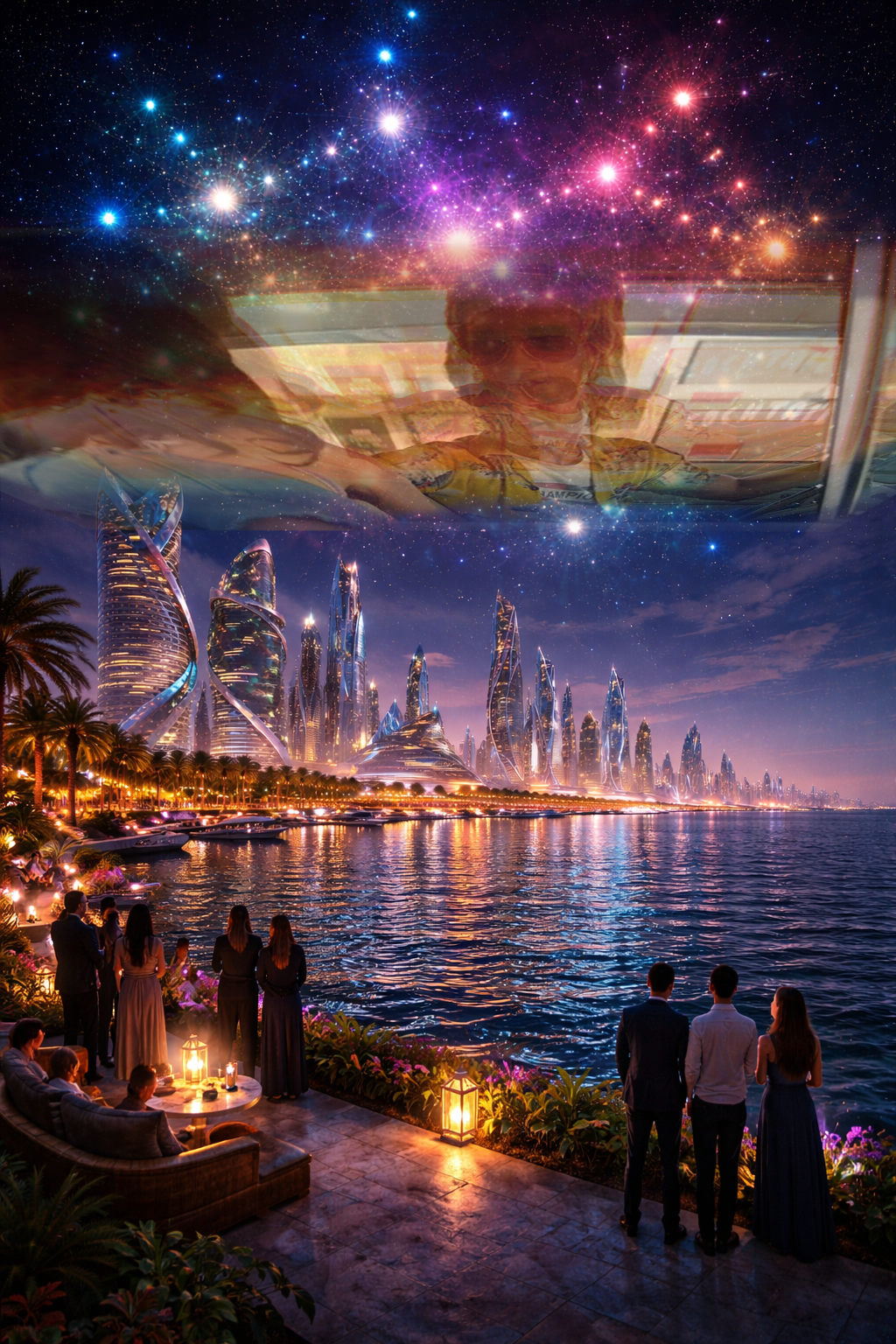
The city rises from the edge of the Gulf like an architectural hallucination—towers shaped like twisting glass helixes, terraces of suspended gardens glowing with bioluminescent foliage, bridges hanging between buildings like strands of light. The skyline has outgrown the old vocabulary of skyscrapers. Some structures spiral upward like crystalline shells, others flare outward into enormous cantilevered petals that shade entire districts below. Along the shoreline, artificial lagoons curve through the city in turquoise ribbons, reflecting a thousand shades of neon and gold. The air itself carries a faint electric haze, the product of desalination plants, data centers, and cooling systems quietly sustaining the metropolis behind the scenes.
At night the city does not darken; it transforms.
The waterfront promenades shimmer with polished stone and slow rivers of autonomous traffic. Floating gardens drift offshore like illuminated islands. Drone ferries pass silently over the water, their navigation lights blinking in careful choreography. Music travels easily across the warm air from rooftop terraces and distant marinas, blending with the soft mechanical hum of the city’s infrastructure.
But what truly commands attention lies above.
The sky over the Gulf is not empty. Suspended high overhead—far beyond the reach of ordinary aircraft yet low enough to be unmistakable—are dozens of intensely bright points of light. They are arranged in shifting geometric constellations, each one glowing with a saturated purity of color: deep cobalt blues, sharp emerald greens, vivid crimson flares. The lights are not fixed stars but articulated instruments, part of a vast orbital lattice whose individual elements slowly adjust their angles in perfect synchronization.
As they move, the colors overlap and resonate, forming an immense pointillistic tapestry across the sky. Red points drift into alignment with blue, producing brief flashes of violet. Green clusters bloom outward like luminous flowers before dissolving again into separate nodes of light. The effect is strangely organic, as if the heavens themselves were breathing in pulses of color.
The sea reflects the spectacle like a second sky. Gentle waves scatter the colored light into trembling ribbons that stretch toward the horizon, while the glass façades of the city’s towers catch the same hues and multiply them across their mirrored surfaces. For a moment it becomes difficult to tell where the skyline ends and the heavens begin.
Visitors along the waterfront inevitably fall silent when they notice it.
Above them hangs a luminous architecture of its own—an engineered firmament, composed not of stars but of machines, each one precisely positioned and tuned. The points of light drift, align, separate, and recombine in careful patterns, preparing the atmosphere itself for what will follow.
The sky is becoming a canvas.
And somewhere beyond the horizon, unseen control systems and orbital mechanics are slowly guiding those brilliant nodes of color into their final configuration, assembling a celestial display whose scale can only be appreciated once the night itself begins to glow.
The Escalation: From Startup Mirrors to Orbital Infrastructure
Let us assume, for the sake of argument, that the first phase works.
The trial satellite launches despite protests. It produces its brief arc of faint illumination—barely brighter than moonlight—but the spectacle is enough. Investors see the potential. Governments notice. Wealthy clients begin placing reservations years in advance. What began as a novelty service becomes something far more serious: a market for controllable light.
At first the architecture remains modest. Reflect Orbital and its imitators deploy constellations of low-orbit reflector satellites. The system works like a relay. One spacecraft swings over the horizon and throws a faint artificial twilight across a desert solar installation or a polar research station. Minutes later another satellite takes the baton, extending the glow. The windows are short, but the customers tolerate it. For an Arctic mining site in winter darkness, even twenty minutes of scheduled illumination has measurable value. For a luxury resort or theme park, the brief appearance of a manufactured sunset is a spectacle worth millions.
The model scales quickly.
Launch costs continue to fall as reusable rockets become routine and automated launch operations multiply. The rideshare economy expands into something closer to an orbital logistics industry. Hundreds of satellites begin to populate the relevant orbital shells. The night sky acquires new moving stars—machines quietly angling reflective surfaces toward paying clients.
And the business becomes wildly successful.
Not merely profitable. Explosive.
Orders arrive from everywhere darkness carries a price. Arctic regions facing months of winter night. Gulf states that want curated skies—gossamer dawns lingering over waterfront developments. Mega-resorts, theme parks, floating cities, billionaire islands. Solar farms eager to squeeze extra megawatt-hours from the evening market. Governments discovering that programmable illumination can double as prestige theater.
Contracts stretch decades into the future. Reservation schedules begin to resemble airline flight plans or satellite transponder leases. Reflective capacity becomes a tradable commodity.
And then the industry runs into its first existential wall.
Low Earth orbit becomes crowded.
Thousands of satellites share the same altitude bands. Collision avoidance becomes routine. Close calls accumulate. Engineers and regulators begin to speak in increasingly worried tones about the Kessler Syndrome—the cascading debris scenario where collisions produce fragments, fragments produce more collisions, and entire orbital shells become unusable.
For an industry dependent on reflective surfaces—thin, delicate structures that behave badly when struck by even tiny debris—the risk is catastrophic.
The operators realize something uncomfortable.
If they stay in the crowded lanes of low orbit, they may eventually destroy the environment they depend on.
So they do what every successful industry does when it runs out of room.
They move outward.
The Second Generation Platforms
By the mid-2030s the architecture begins to change.
Instead of deploying endless swarms of small reflector satellites, companies start launching fewer but much larger orbital lighting platforms into higher orbits. These are not satellites in the traditional sense. They are sprawling structures assembled from automated modules—long trusses extending hundreds of meters, sometimes kilometers, from a central hub. Along the trusses sit triangular reflector panels, thin metallic foils tensioned like sails, each one mounted on actuators that allow it to tilt and swivel with extraordinary precision.
Individually the panels are modest. Together they form a vast heliostat field in space.
The platforms operate more like power plants than spacecraft. Each one occupies a carefully chosen orbital track—higher than the chaotic traffic of low orbit, but still low enough to keep the reflected sunlight concentrated over usable footprints. From this vantage point the structure can dwell over a region for longer periods, slowly steering its facets to allocate light where contracts demand.
Customers do not book a satellite anymore.
They book reflective capacity.
An Arctic municipality purchases winter illumination windows. A Gulf state reserves permanent twilight over a waterfront development. A solar installation leases a nightly band of reflected light timed to coincide with peak electricity prices.
And sometimes the beams overlap.
Sometimes the system illuminates more than the customer asked for. A carefully aimed reflection meant for a resort lagoon spills over the adjacent coastline, brightening half a province in pale artificial dawn.
The operators shrug. The contracts were fulfilled.
A Thousand Points of Light
By the time the system matures, the sky has changed in ways nobody quite predicted.
From orbit the night side of Earth glitters differently now. Not only with city lights, but with slow moving arcs of reflected sunlight drifting across continents and oceans. Platforms hand off illumination the way satellites once handed off communications signals.
Observers begin to notice something else.
The sky contains more and more of these luminous nodes—platforms stationed along carefully spaced orbital tracks, each one a hub of reflective machinery quietly steering sunlight across the planet.
Seen from space, they resemble a lattice of bright anchors scattered across the darkness.
A journalist somewhere remembers an old political phrase and writes that humanity has finally achieved the vision of “a thousand points of light.”
The irony is almost perfect.
The phrase had originally been meant as a metaphor for volunteerism and civic goodwill—a poetic description of human generosity scattered across the nation.
Decades later it becomes something else entirely.
A literal constellation of engineered light sources, circling the Earth, selling pieces of the night sky to whoever can afford them.
Las Vegas
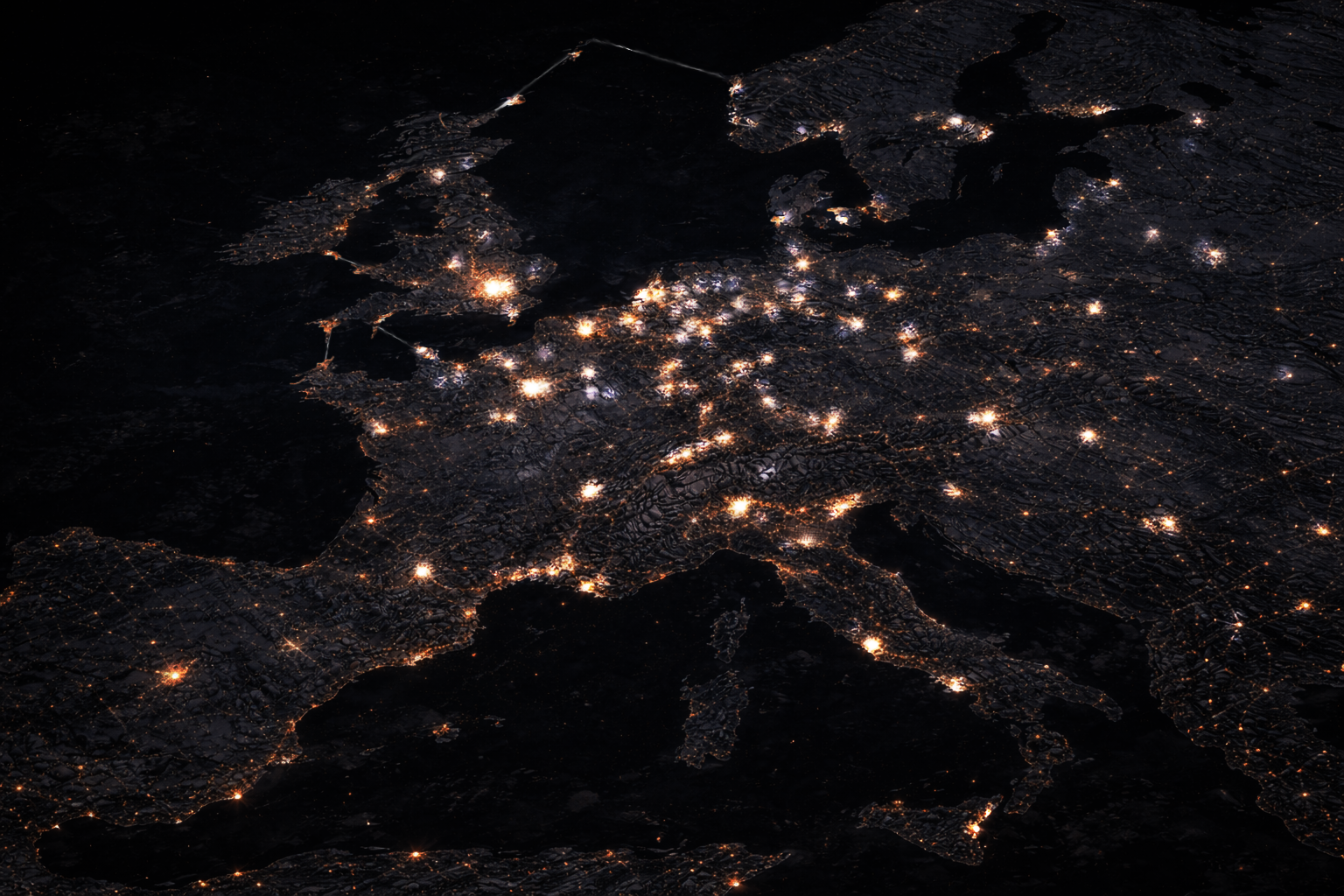
Europe in Deep Winter
An Exercise in Hypocrisy
Later in the 21st century, after decades of protests, UN injunctions, and diplomatic outrage over coastal protection megaprojects, the European Union finally constructed the North Sea Enclosure Dam (NEED) to hold back accelerating sea-level rise.
The unintended consequence was catastrophic. By sealing off the North Sea basin and disrupting ocean circulation, the project helped trigger the collapse of the North Atlantic Current, plunging Northern and Western Europe into a prolonged regional cooling event — effectively a localized ice age.
Yet necessity has a way of dissolving principles.
The same governments that had spent decades condemning orbital geoengineering suddenly found themselves placing urgent contracts for localized solar reflection systems. Artificial sunlight was ordered for winter heating, agricultural stabilization, and urban “cooling mitigation” around major population centers.
The skies over Europe filled with engineered dawns.
What had once been denounced as reckless planetary tinkering became, overnight, critical infrastructure.
The Orbital Sun
Reflect Orbital and the Strange Future of Artificial Light
When Reflect Orbital first proposed reflecting sunlight from space, the idea sounded like the sort of speculative thought experiment that appears in late-night engineering forums or science fiction novels. A constellation of satellites, each equipped with a reflective surface, would redirect sunlight toward specific points on Earth. In theory, cities could extend daylight, solar farms could harvest energy after sunset, and polar communities could experience illumination during long winter darkness.
For many observers the concept initially seemed absurd. Artificial sunlight from orbit? It sounded like an exaggerated extrapolation of the satellite megaconstellation era, a technological curiosity rather than a serious infrastructure proposal.
Yet history is full of ideas that were once dismissed as impossible or ridiculous before becoming normal parts of civilization. Electrified cities, aviation, nuclear power, and global telecommunications networks all passed through a phase where they appeared outlandish. Reflect Orbital’s proposal occupies that same ambiguous territory between fantasy and feasibility.
Once one begins to examine the idea more closely, the picture becomes more complicated. The technology carries extraordinary potential benefits, but also profound risks, ethical dilemmas, environmental consequences, and opportunities for exploitation. It also exposes a deeper truth about technological development: once a capability exists and can be monetized, it tends to spread, regardless of the philosophical objections that once surrounded it.
Reflect Orbital may be one of the clearest examples yet of this phenomenon.
The Promise of Artificial Sunlight
The basic promise behind orbital reflectors is simple. Sunlight is abundant in space. The Earth receives enormous quantities of solar energy every day, but its distribution is uneven. Nights interrupt energy generation. Winter reduces daylight hours. Polar regions endure months of darkness.
Orbital mirrors offer a theoretical way to redistribute sunlight where and when it is needed.
In the energy sector alone the implications are significant. Solar power is now one of the fastest growing energy sources in the world, yet it suffers from a fundamental limitation: it only produces electricity during daylight hours. Energy storage technologies such as batteries partially solve this problem, but they remain expensive and resource-intensive.
Reflecting sunlight onto solar farms after sunset could extend their productive hours. Even modest illumination—far weaker than full daylight—could produce additional electricity during evening demand peaks. If implemented efficiently, orbital illumination might increase solar capacity factors without requiring additional land or infrastructure on Earth.
In remote areas the advantages could be even greater. Arctic communities and industrial sites often operate under extreme darkness during winter months. Artificial sunlight could support agriculture, improve safety, and reduce dependence on diesel power generation.
There are also emergency uses. Disaster zones frequently lose electrical infrastructure and lighting during crises. Orbital reflectors could theoretically provide temporary illumination for search and rescue operations, humanitarian response, or military logistics.
In principle, the ability to deliver sunlight on demand could become a new form of planetary infrastructure.
A Market for the Night Sky
Yet the most immediate commercial uses may have little to do with energy or humanitarian needs. They may instead arise from spectacle.
Modern cities already compete aggressively for visual attention. Skylines, light shows, fireworks displays, and architectural illumination all serve as symbols of prestige and identity. Orbital sunlight offers a new frontier in that competition.
Imagine a coastal resort bathed in permanent twilight long after sunset. A major sporting event illuminated by artificial dawn. Theme parks staging nightly spectacles in which the sky itself becomes part of the performance.
Las Vegas, Dubai, and other cities built on spectacle would almost certainly embrace such possibilities. The night sky could become another medium for advertising, entertainment, and civic display.
The economic logic is straightforward. If a single orbital reflection can produce a visually dramatic event visible across an entire metropolitan region, the marketing value alone could justify the cost.
In that sense, Reflect Orbital is not merely selling light. It is selling attention.
The Environmental Objections
Astronomers and environmental scientists were among the first to raise concerns.
The modern night sky is already under pressure from satellite constellations. Thousands of spacecraft now cross the heavens each night, leaving streaks across astronomical images and altering the visibility of stars.
Orbital reflectors introduce a different problem. Instead of faint moving objects, they could create bright artificial illumination visible across large portions of the sky.
Astronomy depends on darkness. Observatories are built in remote locations precisely to escape the glow of human civilization. If orbital illumination becomes widespread, even those remote sanctuaries could be affected.
Wildlife is another concern. Many species rely on natural darkness for migration, reproduction, and feeding behavior. Artificial nighttime light already disrupts ecosystems around cities. Extending illumination across broader regions could intensify these effects.
Human health is also linked to natural circadian rhythms. Excessive nighttime light exposure has been associated with sleep disorders and other physiological impacts. If artificial illumination becomes common, the boundary between day and night could blur in ways society has never experienced.
In short, the night sky is not merely aesthetic. It is part of Earth’s environmental system.
The Political Hypocrisy
One of the most fascinating aspects of orbital illumination is how quickly moral positions can shift when circumstances change.
For decades, many governments and international organizations expressed strong opposition to large-scale geoengineering projects. Manipulating planetary systems, they argued, carried unacceptable risks.
Yet those same institutions have repeatedly demonstrated a willingness to embrace controversial technologies when they become necessary.
Consider the hypothetical European scenario illustrated earlier. After years of opposition to radical infrastructure projects, the European Union ultimately constructs the North Sea Enclosure Dam to defend against rising seas. The project alters regional ocean circulation, contributing to a collapse of the North Atlantic Current and triggering a severe regional cooling event.
Suddenly the political calculus changes.
Orbital sunlight, once condemned as reckless planetary experimentation, becomes a practical tool for heating cities and supporting agriculture during harsh winters.
Principles dissolve in the face of necessity.
This pattern is not unusual. Throughout history, technologies initially criticized on ethical or environmental grounds have often been adopted once their practical advantages become clear.
Reflect Orbital may simply be another example.
The Absurdity Factor
Even if orbital sunlight becomes technically feasible, the concept retains an element of surreal absurdity.
Human civilization has spent centuries developing increasingly sophisticated ways to illuminate the night: candles, gas lamps, electric lighting, LEDs, and massive urban lighting networks.
Reflecting sunlight from space seems like an almost comically extravagant extension of that trend.
It raises strange questions. At what point does technological capability cross into theatrical excess? Do we truly need orbital mirrors to illuminate cities already saturated with artificial light?
In many ways the concept resembles the construction of enormous fountains in desert cities or indoor ski resorts in tropical climates. These projects are not driven purely by necessity. They are expressions of wealth, ambition, and the desire to reshape environments according to human preference.
Orbital sunlight could become the ultimate version of that impulse.
Opportunities and Innovation
Yet dismissing the technology outright would be shortsighted.
Large engineering projects often produce unexpected technological spin-offs. Developing lightweight reflective structures, precision orbital control systems, and advanced energy management technologies could benefit many other fields.
Space manufacturing, satellite servicing, and large-scale orbital construction may all advance through such projects. Reflective arrays might eventually support solar power stations in space or planetary exploration infrastructure.
In addition, the global economy increasingly relies on complex space systems. Navigation, communications, weather forecasting, and Earth observation already depend on orbital networks. Orbital illumination could simply become another layer in that expanding ecosystem.
The real question is not whether the technology is extravagant. It is whether the benefits outweigh the costs.
Ethical Questions
The ethics of orbital illumination extend beyond environmental concerns.
One major issue is control of the sky.
If private companies or individual nations can deploy systems capable of altering illumination over large areas, who decides where those systems operate? Could a country object to artificial light being projected into its airspace? What happens if illumination interferes with cultural traditions or religious practices tied to the natural night?
Another concern is inequality. Technologies that manipulate environmental conditions often benefit wealthy regions first. Artificial sunlight may initially serve luxury resorts and major cities rather than vulnerable communities.
This raises uncomfortable questions about priorities. Should scarce technological resources be used to enhance entertainment districts while poorer regions struggle with basic infrastructure?
Such debates are likely to intensify as orbital technologies become more powerful.
Unintended Consequences
History repeatedly shows that large technological systems produce unexpected outcomes.
Satellite constellations designed for internet access are now raising concerns about orbital congestion and space debris. Similarly, widespread orbital reflectors could introduce new risks.
For example, highly reflective structures might affect satellite tracking or create hazards for spacecraft navigation. They could also contribute to complex lighting patterns in the atmosphere, altering climate models or remote sensing observations.
There is also the possibility of geopolitical tension. If one nation deploys large orbital illumination systems, neighboring countries may view them as potential strategic tools.
Technologies that can manipulate light could theoretically be adapted for surveillance, signaling, or psychological operations.
These risks may seem remote today, but technological capabilities often evolve in unpredictable directions.
Decadence and Power
Ultimately, the story of Reflect Orbital may not be purely about engineering or environmental science. It may also be about human psychology.
Civilizations have always used monumental projects to demonstrate power and prestige. Ancient pyramids, medieval cathedrals, and modern skyscrapers all served symbolic as well as practical functions.
Orbital sunlight could become the next expression of that tradition.
A city capable of commanding artificial dawn from space sends a clear message: we possess the technological and economic power to reshape even the sky itself.
That message carries both inspiration and arrogance.
To some observers, orbital mirrors will represent humanity’s ingenuity and ambition. To others they will symbolize the excesses of a civilization increasingly detached from natural limits.
Both interpretations may be correct.
The Inevitable Question
The most important question may not be whether orbital sunlight is a good idea.
It may be whether the idea can be stopped once it becomes economically viable.
If companies can profit from selling artificial illumination, investors will fund the technology. Governments seeking strategic advantage may support it. Cities competing for attention may demand it.
In such an environment, opposition may slow development but rarely halts it entirely.
The night sky, once one of the last universally shared natural spaces on Earth, could gradually become another domain shaped by human commerce and infrastructure.
Reflect Orbital may be the first step down that path.
Whether the journey leads to progress, absurdity, or something in between remains to be seen.
But the possibility itself forces us to confront an uncomfortable reality.
The future of the sky may no longer belong solely to nature.
The Other Side of the Mirror
When Orbital Sunlight Becomes Orbital Shade
There is another implication hiding quietly beneath all the spectacle.
Reflect Orbital and similar concepts are usually framed as technological extravagance. Artificial sunlight projected onto cities. Orbital mirrors lighting festivals, solar farms, or remote communities. A civilization so wealthy and technologically capable that it begins treating sunlight itself as something programmable.
At first glance the idea appears decadent, almost absurd. Humanity has spent centuries electrifying the night, and now we contemplate reflecting sunlight from space as if the sky itself were a controllable lighting rig.
But this framing misses a far more profound implication.
If humanity ever develops the industrial capacity to deploy reflective structures in orbit at large scale—structures capable of redirecting sunlight toward Earth with routine reliability—then the same infrastructure could be used in the opposite direction.
Not to add sunlight.
But to subtract a little of it.
And that possibility changes everything.
A Small Adjustment to the Planetary Thermostat
The Earth’s climate system is governed by an extraordinarily delicate energy balance.
The planet receives solar radiation from the Sun—about 1,361 watts per square meter at the top of the atmosphere. Because the Earth is a rotating sphere and reflects some of that energy back into space, the effective average absorbed energy is closer to about 240 watts per square meter.
For most of human history, this balance remained relatively stable.
Climate change is the result of a comparatively small disturbance in that equilibrium. Greenhouse gases trap a little more heat than before. The difference is surprisingly modest in absolute terms—only a few watts per square meter of additional radiative forcing.
That small imbalance, sustained over decades, is enough to gradually warm the entire planet.
Which leads to a remarkable realization.
If a few watts per square meter can warm the Earth, then removing a similar amount of incoming solar energy could offset a portion of that warming.
In other words, the difference between a warming climate and a stabilized one may amount to adjusting the planet’s solar input by a fraction of a percent.
A civilization capable of manipulating sunlight from orbit might one day possess the ability to do exactly that.
From Spectacle to Infrastructure
Viewed through this lens, orbital reflectors take on a completely different character.
In their earliest form they may appear as novelties—tools for illumination, entertainment, or niche energy applications. Cities extend twilight. Resorts stage spectacles. Solar farms harvest extra evening light.
But once the underlying technology matures, the logic of scale begins to change.
Reflective surfaces that redirect sunlight toward Earth could just as easily redirect it away.
Orbital structures designed to concentrate light on specific regions could be reoriented to scatter or deflect a small portion of incoming solar radiation back into space.
Instead of creating artificial dawns, the system could produce a subtle dimming of the Sun.
Not a dramatic reduction in sunlight. Nothing approaching the darkness of a solar eclipse.
Just a slight adjustment—small enough that people on the ground might barely notice, but large enough to influence the planet’s energy balance.
In this sense the same infrastructure that once symbolized technological excess could evolve into something closer to planetary climate control.
The Concept of Solar Shading
Scientists have long explored the concept of solar radiation management—methods of reflecting a fraction of sunlight away from Earth to counteract global warming.
Some proposals involve injecting reflective particles into the stratosphere to scatter sunlight. Others imagine vast structures placed in space between the Earth and the Sun, acting as partial sunshades.
These ideas remain controversial. They raise questions about environmental risk, governance, and long-term dependency on engineered climate systems.
Yet the basic physics is not speculative.
A reduction of even one or two percent in incoming solar radiation could significantly influence global temperature.
More modest adjustments—tenths of a percent—might offset a meaningful portion of greenhouse warming.
The difficulty lies not in theory but in scale. Implementing such a system requires enormous reflective surfaces and precise control over their orientation and stability.
But if orbital reflector technology becomes commonplace, that barrier may gradually erode.
What begins as commercial infrastructure could evolve into climate infrastructure.
Industrial Capacity as Destiny
History suggests that once humanity develops the ability to build something at scale, that capability eventually finds applications beyond its original purpose.
Railroads were initially built for transporting goods but reshaped entire economies. Satellite constellations designed for communication now underpin navigation, climate monitoring, and disaster response.
Orbital reflectors may follow a similar path.
The moment a civilization becomes capable of launching, assembling, and maintaining square kilometers of reflective material in space with routine reliability, the question naturally arises: what else could be done with that capability?
Reflecting sunlight onto Earth is one answer.
Reflecting a small portion of sunlight away from Earth is another.
At sufficient scale, the infrastructure that powers orbital illumination might also function as a planetary thermostat.
The Ethics of Turning Down the Sun
Such a possibility raises profound ethical questions.
Manipulating the Earth’s energy balance is not a trivial intervention. Climate is a complex system influenced by countless interacting processes—oceans, clouds, atmospheric circulation, vegetation, and ice.
Even small changes in solar radiation could produce uneven effects across different regions.
Some areas might benefit from reduced warming, while others could experience shifts in rainfall patterns or seasonal weather cycles.
Who decides how much sunlight to deflect? Who bears responsibility if unintended consequences occur?
Unlike local infrastructure projects, planetary-scale climate interventions affect every nation and ecosystem on Earth.
Control of the Sun—however slight that control might be—becomes a geopolitical issue.
The Risk of Technological Dependence
Another concern is technological dependency. If orbital shading were used to counteract global warming while greenhouse gas concentrations remain high, the climate system could become dependent on continued operation of the shading infrastructure. Should that system fail suddenly—due to economic collapse, conflict, or technical malfunction—the accumulated greenhouse forcing would remain. The result could be a rapid surge in warming, far faster than the gradual change experienced today. In effect, humanity would have placed part of the climate system on life support. Maintaining that support indefinitely would become a permanent responsibility.
The Strange Symmetry of Orbital Mirrors
Yet there is also a peculiar elegance in the symmetry of the idea. The same reflective structures that once symbolized technological excess—artificial suns lighting desert cities—could become tools for planetary stability. The mirrors that illuminated the night might also soften the day. Civilization would move from passively experiencing climate to actively managing it. This transition may feel unsettling, but in some ways it represents the logical continuation of a long historical trend. Human societies have spent centuries modifying their environments—building dams, irrigating deserts, altering landscapes, and shaping ecosystems to suit their needs. Orbital shading would simply extend that impulse to the sky itself.
The Sky as Infrastructure
At that point the sky ceases to be purely natural. Our Heavens may at some point end up becoming infrastructure. Sunlight, once an immutable force beyond human influence, becomes another parameter subject to adjustment, dial up and down like a Celestial Thermosptat. A tiny fraction redirected here. A little less there. Slight increases or decreases depending on season, region, or global climate conditions.
Such a system would not eliminate climate challenges. But it could provide a margin of control—an additional tool for managing the complex interactions between human activity and the planetary environment. The atmosphere would remain a natural system, but one lightly guided by technological intervention. We leave it up to the forces of Capitalism, competition, unilateralism and international politics, then we also leave it up to the forces of war. There’s always a bigger fish to trump the little guy.
The Uncomfortable Possibility
Whether such a future is desirable remains an open question. Many people recoil instinctively at the thought of altering the Sun’s influence on Earth. The idea feels hubristic, an overreach of human ambition. I personally don’t give a damn about those sentiments. Todays hubris is tomorrows tax deductions scheme.
Climate change itself already represents an unintended modification of the planet’s energy balance. Human industry has altered atmospheric chemistry, shifting the delicate equilibrium that once governed the Earth’s temperature. Faced with that reality, societies may eventually confront a difficult choice.
As a species we started wrecking the natural balance well in the 1800s. That train left the station the moment we allowed trains to leave stations, so to speak. If we have the means to do something about it, should we? If we have the means, but they have all sorts of unpredectable consequences, should we, or should we compensate any lsers for these consequences? Should the winners compensate losers? Or should losers declare war on the winners? How do we resolve losing and winning when we no longer even agree on how to conduct dialogue on reality these days? Orbital reflectors, originally conceived as tools of spectacle, commerce or litigation – may one day become part of that dialogue, for good or for ill.
The Real Meaning of Reflect Orbital
In the end, Reflect Orbital may be remembered not for its first commercial applications, but for what it revealed about humanity’s trajectory. The project hints at a future where technological systems extend beyond cities and continents into the fabric of the planetary environment itself. The ability to redirect sunlight—even slightly—represents a fundamentak shift in scale. It suggests that human civilization is approaching a point where the boundary between natural systems and engineered systems begins to blur. Artificial dawns over cities may be the most visible manifestation of that shift. But the deeper transformation lies elsewhere. Once humanity learns to manipulate sunlight, the most important question will not be how to brighten the night. It will be whether we are prepared to dim the day.